

Launching a collaborative venture is an exciting milestone, yet determining how to structure initial funding without sparking future equity disputes remains a notorious hurdle for business partners. Before drafting any formal contract, partners must first align on their shared operational vision and financial risk tolerance. Utilizing a structured Capital Contribution Agreement grants partners absolute clarity on funding timelines while safeguarding individual assets against unexpected liabilities.
As a crucial educational stipulation, however, these templates should be treated as strategic frameworks to customize, rather than rigid, one-size-fits-all legal mandates. Different business structures demand highly tailored clauses; for instance, a high-growth tech startup may prioritize intellectual property valuation as capital, whereas a real estate joint venture requires strict cash-call schedules for ongoing property maintenance. This article explores customizable agreement templates tailored to diverse business models, detailing the essential clauses required to secure your partnership's financial foundation.
Partnership Capital Contribution Agreement Template
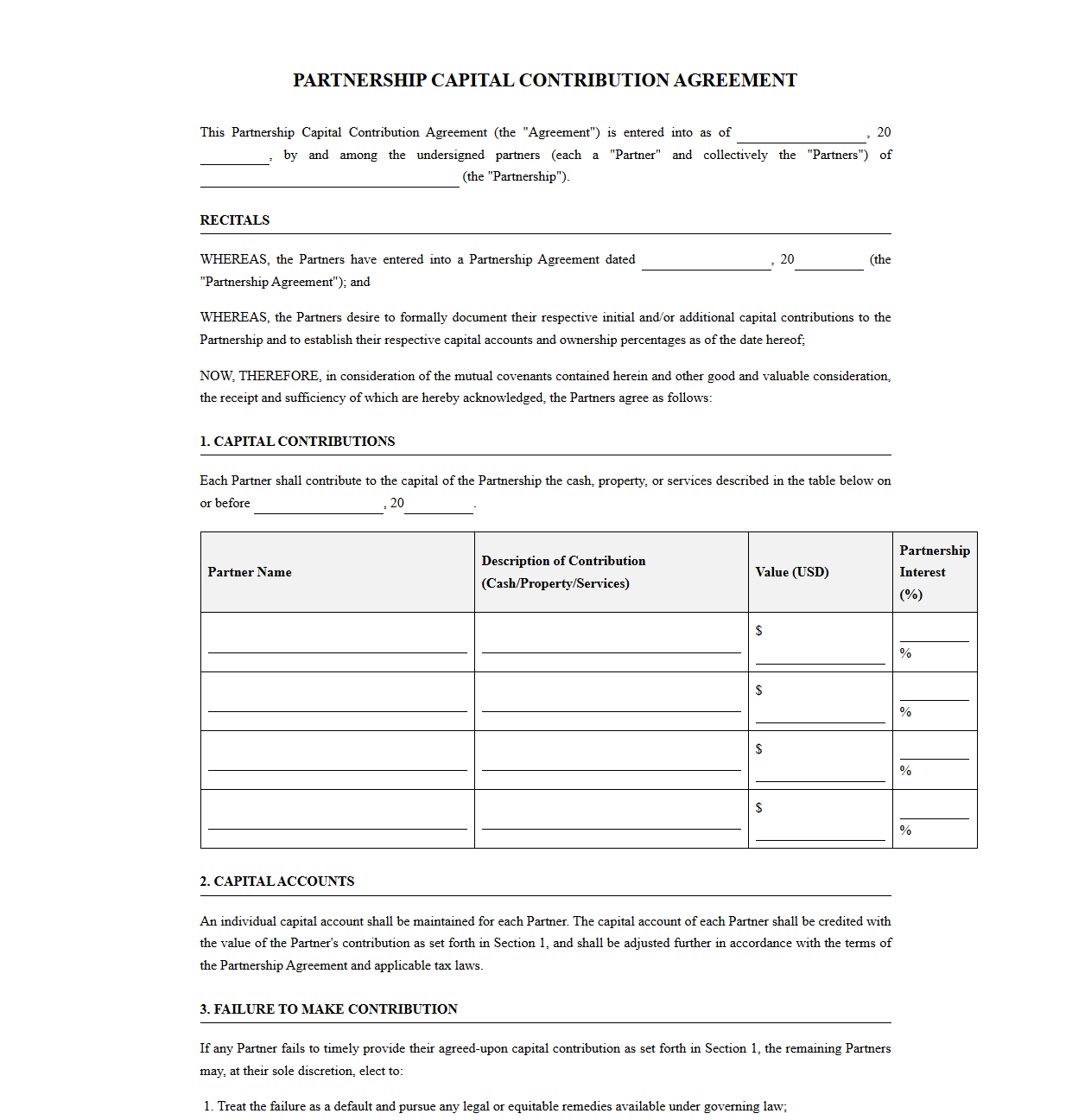 Download: .PDF
Capital Funding Agreement for Business Partners
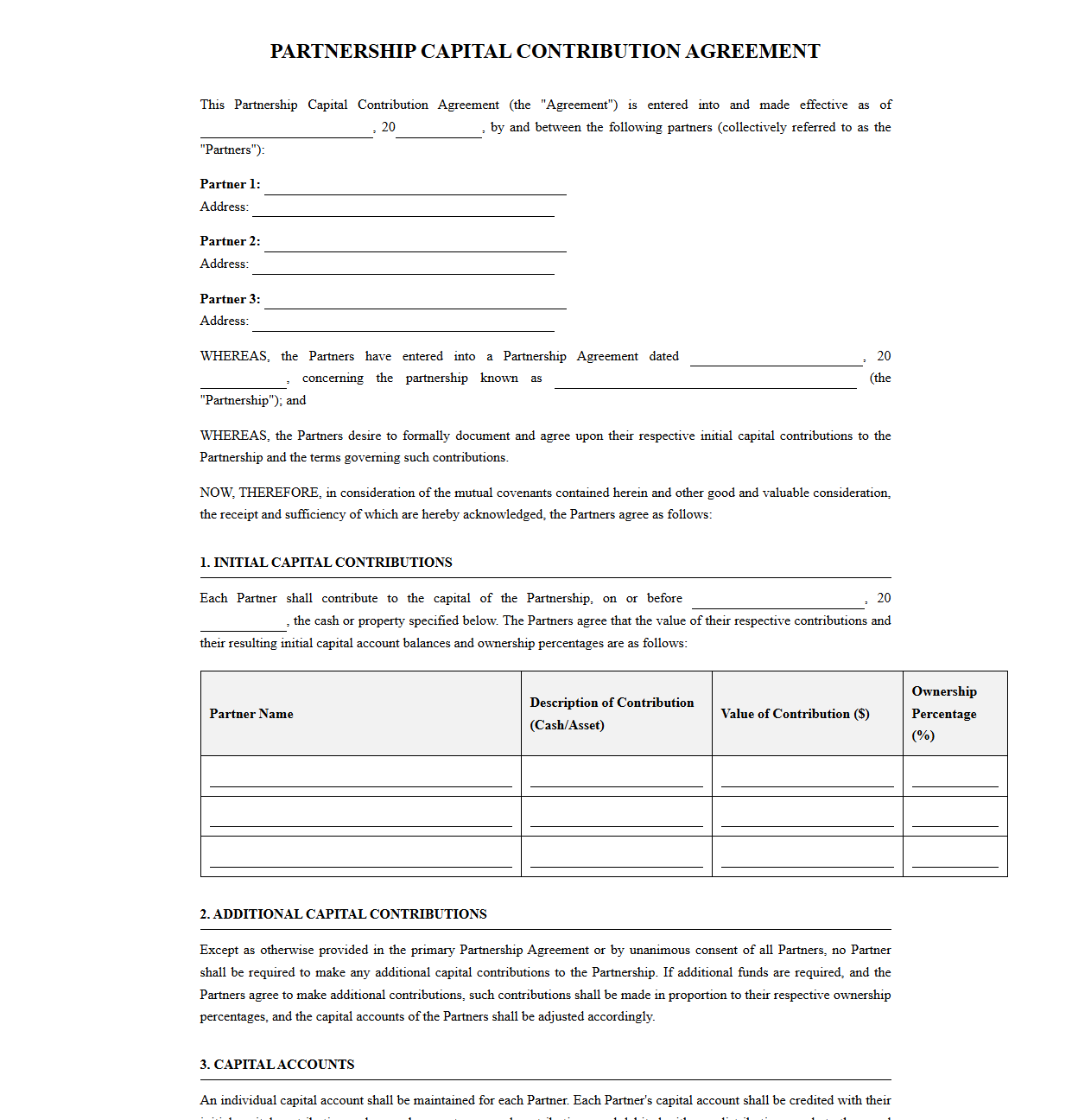 Download: .PDF
Partnership Capital Investment Contract Template
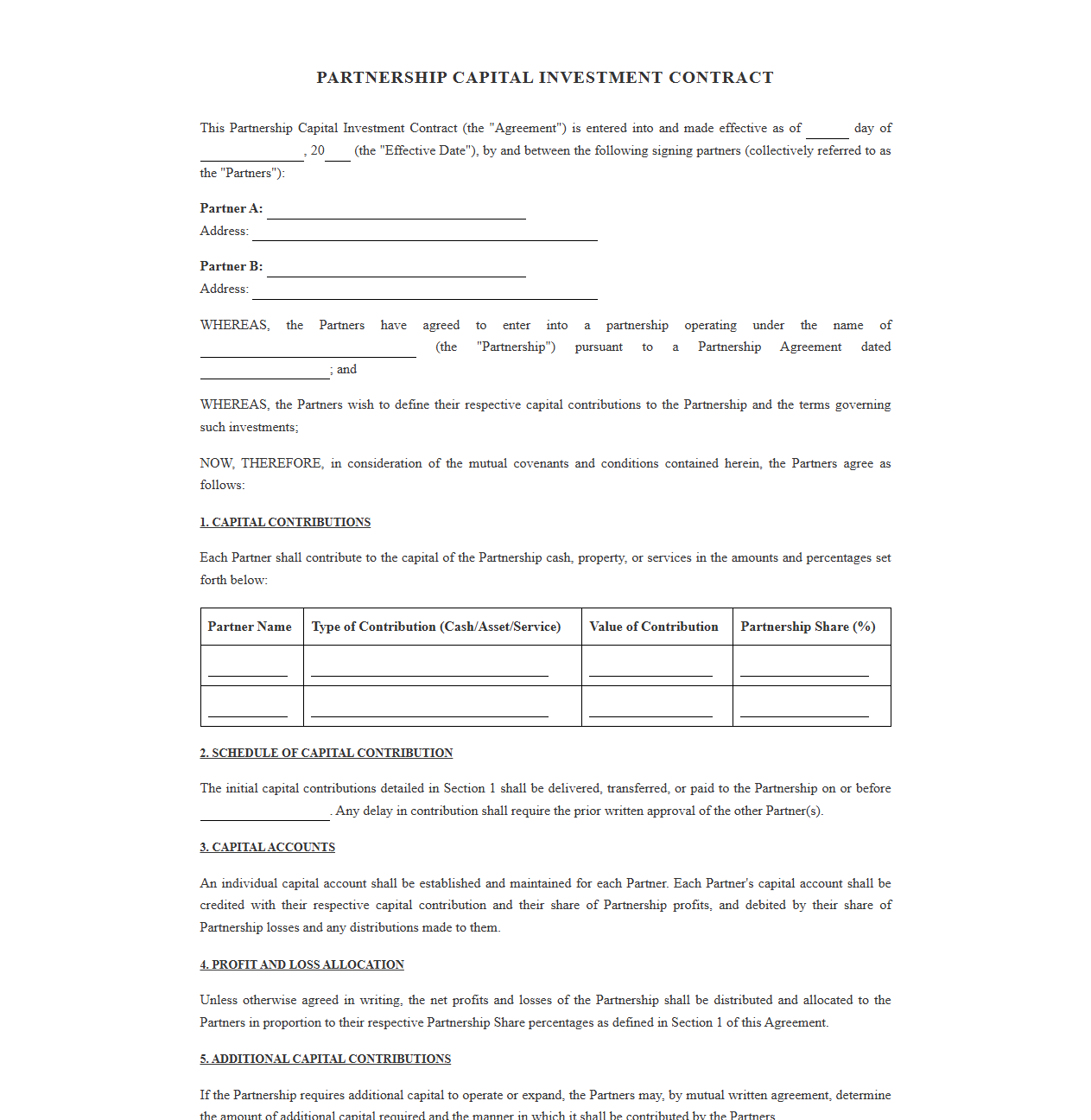 Download: .PDF
Capital Contribution Deed for Partnership Ventures
 Download: .PDF
Partner Capital Infusion Agreement Template
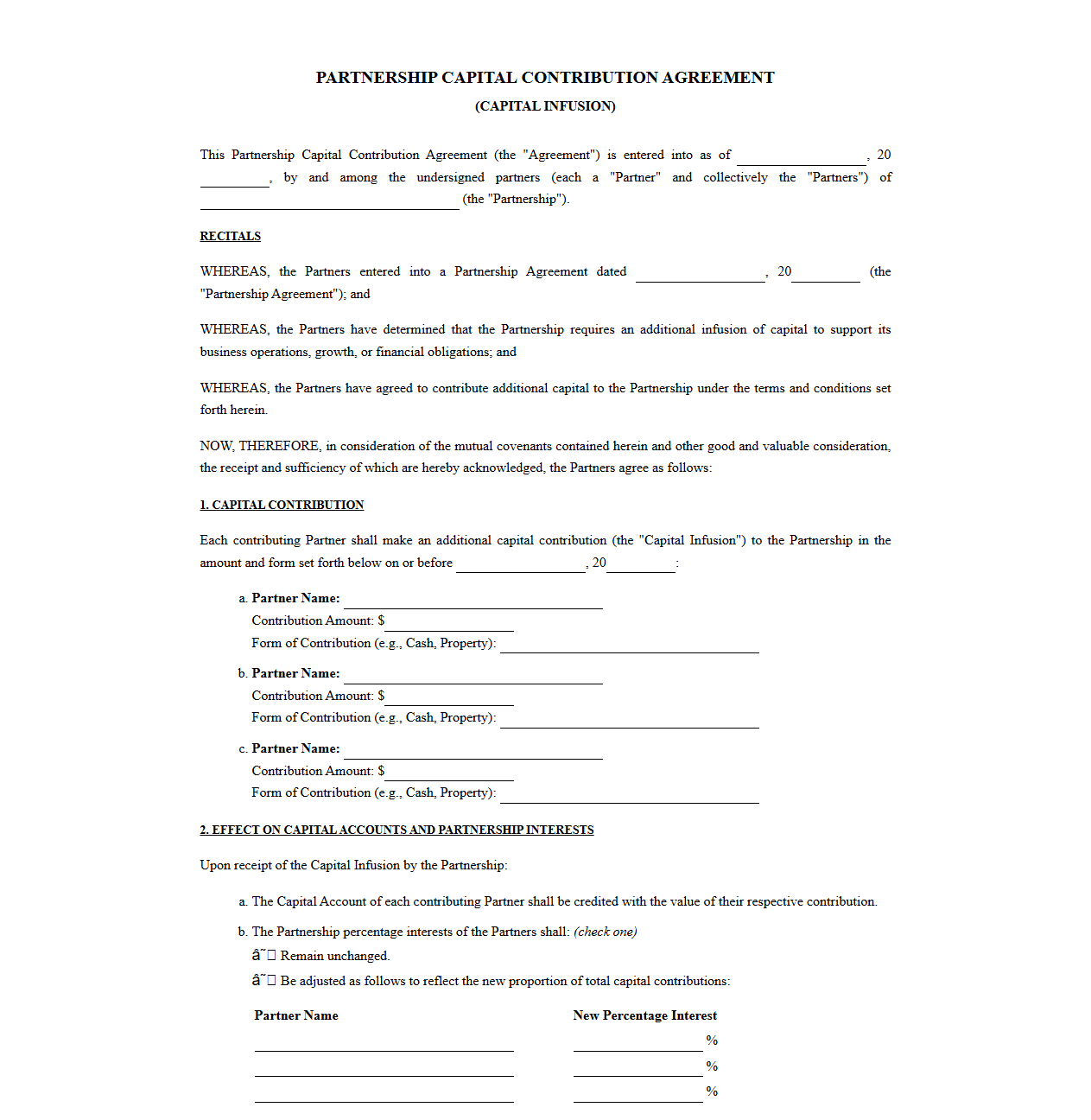 Download: .PDF
Equity Contribution Agreement for Business Partnerships
 Download: .PDF
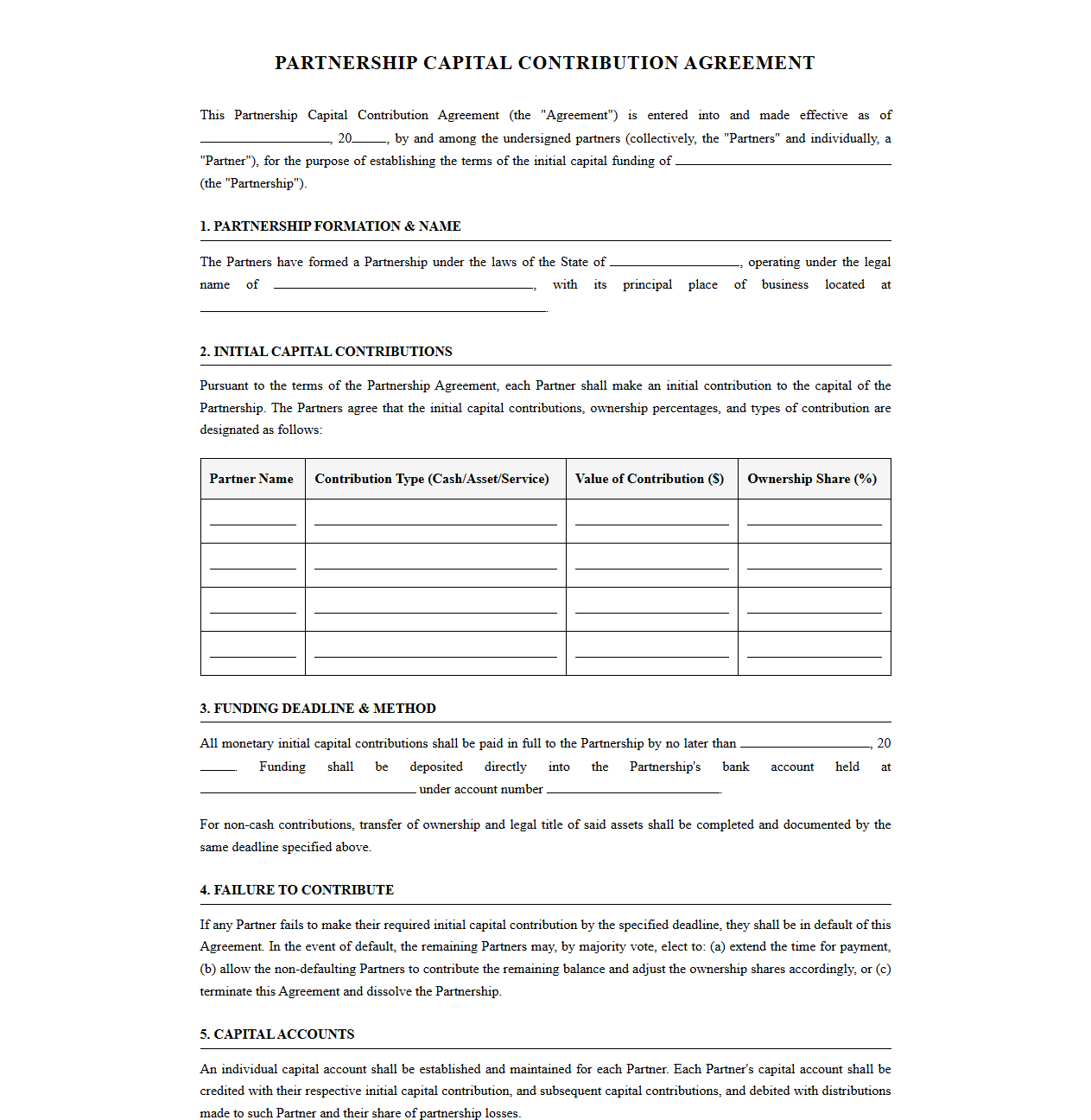
Partnership Initial Capital Funding Contract
 Download: .PDF
Business Partnership Capital Commitment Agreement
 Download: .PDF
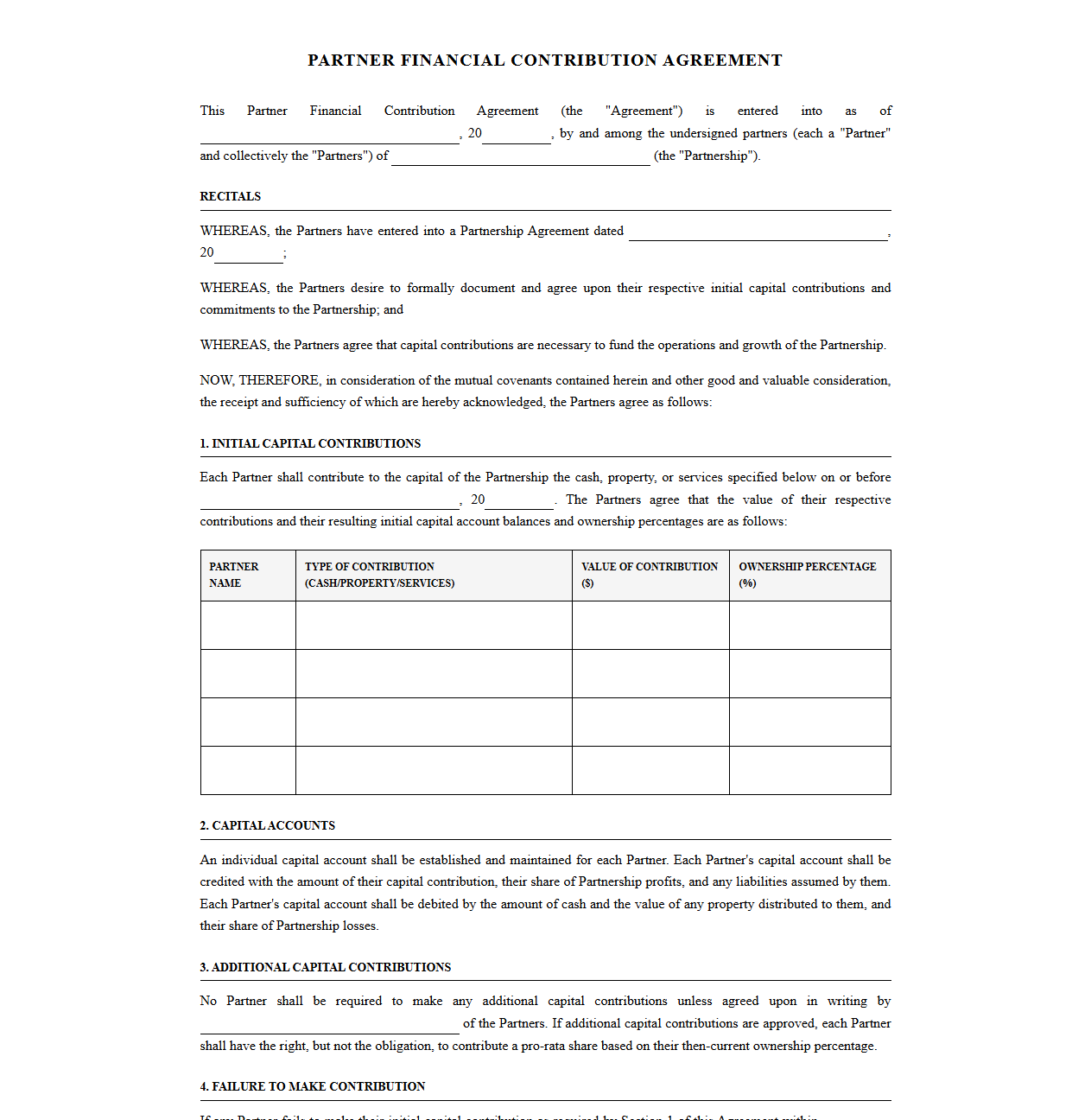
Partner Financial Contribution Agreement Template
 Download: .PDF
Demystifying Capital Contribution Agreements in Business Partnerships
Launching a successful business venture requires a solid financial foundation and clear alignment among all participating partners. A capital contribution agreement is the fundamental legal document that outlines how much capital each partner must commit to the business, the form that capital will take, and when it must be paid. Without this formal roadmap, partnerships risk running into funding shortages, operational paralysis, and intense internal disputes.
Securing sustainable partnership funding relies on establishing clear guidelines upfront. This document acts as a vital tool for investor confidence, showing that all founders are financially committed to the venture's success. Whether you are launching a localized retail shop or an ambitious joint venture, this contract serves as the foundation for diverse business models, defining the equity ownership split and financial obligations of every stakeholder from day one.
Core Components of a Standard Capital Contribution Template
Essential Clauses for Financial Alignment
To prevent misunderstandings and legal disputes, every capital contribution agreement should rely on a highly structured template. This template must explicitly define how and when financial resources enter the partnership's accounts.
- Initial Capital Amounts: The exact monetary value or cash equivalent that each partner is legally obligated to contribute to the business during the initial funding round.
- Contribution Schedules: Detailed timelines and deadlines specifying when the funds must be deposited into the partnership bank account.
- Non-Cash Asset Valuations: Clear mechanisms and third-party appraisal methods used to determine the fair market value of contributed real estate, equipment, intellectual property, or specialized labor.
- Consequences of Default: Punitive measures, diluted equity stakes, or legal remedies that apply if a partner fails to deliver their agreed-upon capital on time.
Structuring Agreements for General and Limited Partnerships
The legal framework of a capital contribution agreement must be tailored to the specific type of partnership structure being formed. General Partnerships (GPs) and Limited Partnerships (LPs) operate under entirely different risk profiles, liability thresholds, and funding obligations, which must be clearly reflected in the contract.
| Partnership Feature | General Partnership (GP) | Limited Partnership (LP) |
|---|---|---|
| Liability Profile | Partners share unlimited personal liability for the business's debts and obligations. | Limited partners are only liable up to the amount of their capital contribution. |
| Funding Obligations | Equal or proportional funding demands; partners may be called upon to cover unexpected operational shortfalls. | Contributions are strictly capped at the pre-agreed amount defined in the initial agreement. |
| Management Rights | All partners typically maintain active roles in daily business operations and decision-making. | Limited partners function as silent investors with no day-to-day management authority. |
Milestone-Based Funding Templates for Tech Startups
High-growth tech startups rarely operate on simple lump-sum cash injections. Instead, they require dynamic funding structures that incentivize long-term commitment and protect early-stage founders from premature equity dilution. In these environments, capital contribution templates must account for intellectual property transfers, sweat equity, and performance-based vesting schedules.
- Intellectual Property Transfer Phase: The initial contribution phase where developers and founders legally transfer software code, patents, and trademarks to the company in exchange for seed equity.
- Milestone-Locked Funding Rounds: Tranches of capital that are only released to the operating budget once the startup hits specific technical or user-acquisition targets.
- Vesting and Sweat Equity Realization: The chronological timeline over which a partner's equity fully matures, ensuring that co-founders do not walk away with large ownership stakes shortly after formation.
Capital Call Structures in Real Estate Joint Ventures
Real estate joint ventures are highly capital-intensive and frequently require sudden infusions of cash to cover unexpected construction costs, market fluctuations, or property acquisitions. To handle these fluid financial demands, joint venture agreements rely on sophisticated capital call provisions and emergency funding clauses to ensure uninterrupted operations.
"In the event of an Unfunded Capital Call, the non-defaulting partners shall have the right to advance the deficient funds as an Emergency Member Loan. This loan will accumulate interest at a rate of 15% per annum, or the maximum rate permitted by law, and will take priority over any standard equity distributions."
When a partner fails to meet an emergency capital call, the agreement must outline precise dilution mechanics. The complying partners who cover the shortfall are compensated with an increased ownership share, systematically reducing the defaulting partner's equity and decision-making power in the property asset.
Navigating Legal Compliance and Tax Considerations
Structuring a capital contribution agreement involves navigating complex regulatory frameworks and tax codes. Partners must ensure that the transfer of assets does not trigger unintended tax events or run afoul of securities laws, particularly when dealing with non-cash assets or bringing on passive investors.
Best Practices for Customizing and Executing Your Agreement Templates
While generic templates offer an excellent starting point, they must be tailored to the unique goals, risks, and operational structures of your specific business. Taking the time to refine your agreement prevents future litigation and builds a resilient foundation for long-term growth.
Final Execution Checklist
Before signing your capital contribution agreement, ensure the following steps are complete:
- Conduct a comprehensive legal review with an independent business attorney.
- Obtain certified, independent valuations for all non-cash asset contributions.
- Confirm that all contribution deadlines align with your operational bank account setup.
- Formally execute the document with notarized signatures from all participating partners.

Leave a comment