

Tax advisory firms constantly struggle to safeguard highly sensitive client assets in an era of unprecedented data vulnerability. As digital collaboration and remote consulting become the industry standard, relying solely on basic cybersecurity measures is no longer sufficient to prevent catastrophic intellectual property leaks.
Implementing a customized Non-Disclosure Agreement (NDA) grants firms the legal fortitude required to protect proprietary tax planning methodologies. However, while these template frameworks provide an invaluable baseline, they must be treated as foundational structures rather than one-size-fits-all solutions, requiring adaptation to meet specific regional compliance mandates.
By establishing clear legal boundaries around concrete examples-such as proprietary tax strategies, valuation models, and trade secrets-firms can mitigate risk effectively. Below, we outline the essential components of a robust financial NDA, discuss critical drafting pitfalls, and provide customizable templates designed to secure your practice's proprietary data.
Tax Advisory Services Non-Disclosure Agreement Template
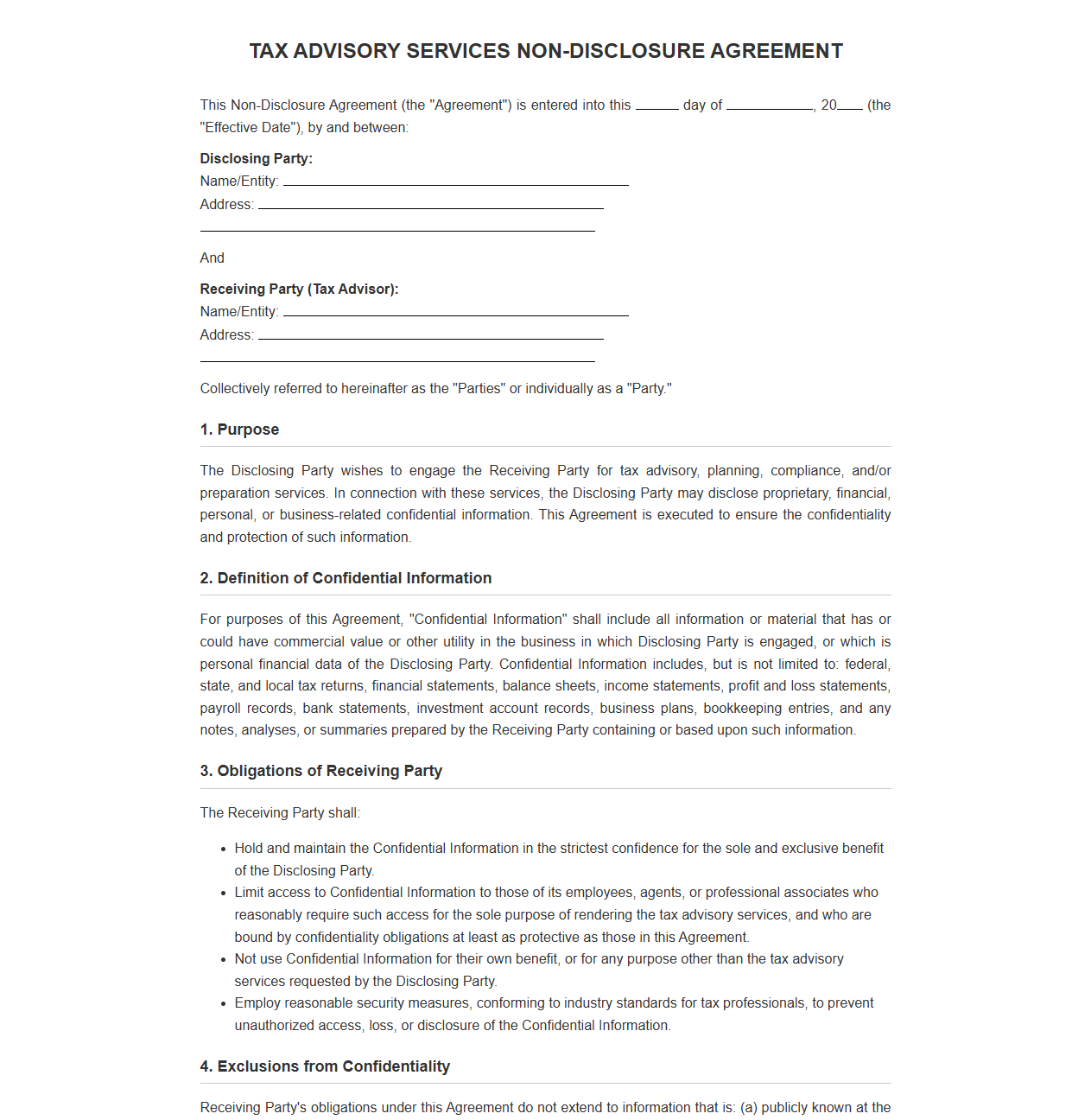 Download: .PDF
Confidentiality Agreement for Tax Advisory Services
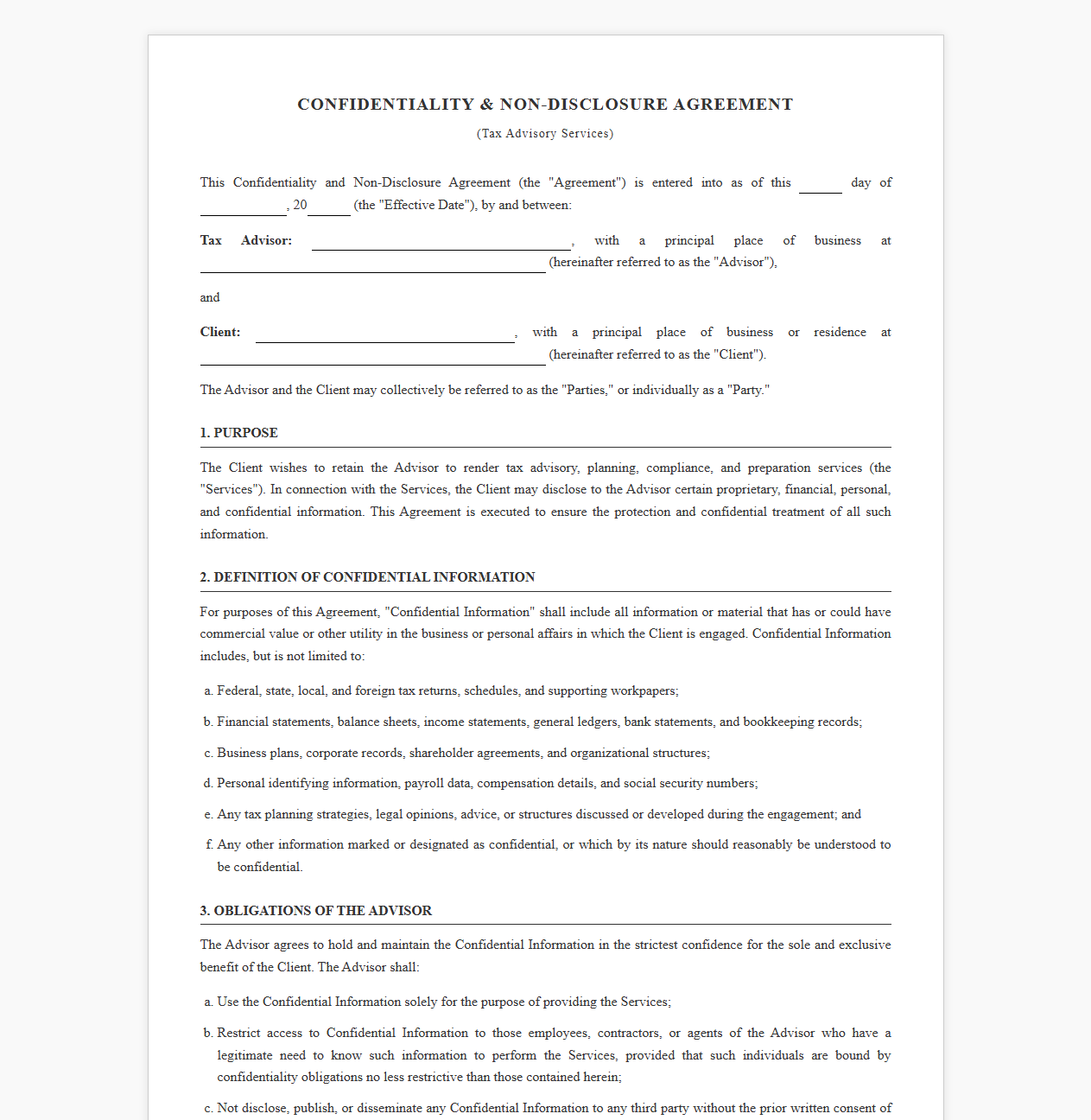 Download: .PDF
Non-Disclosure Agreement for Tax Consultation Services
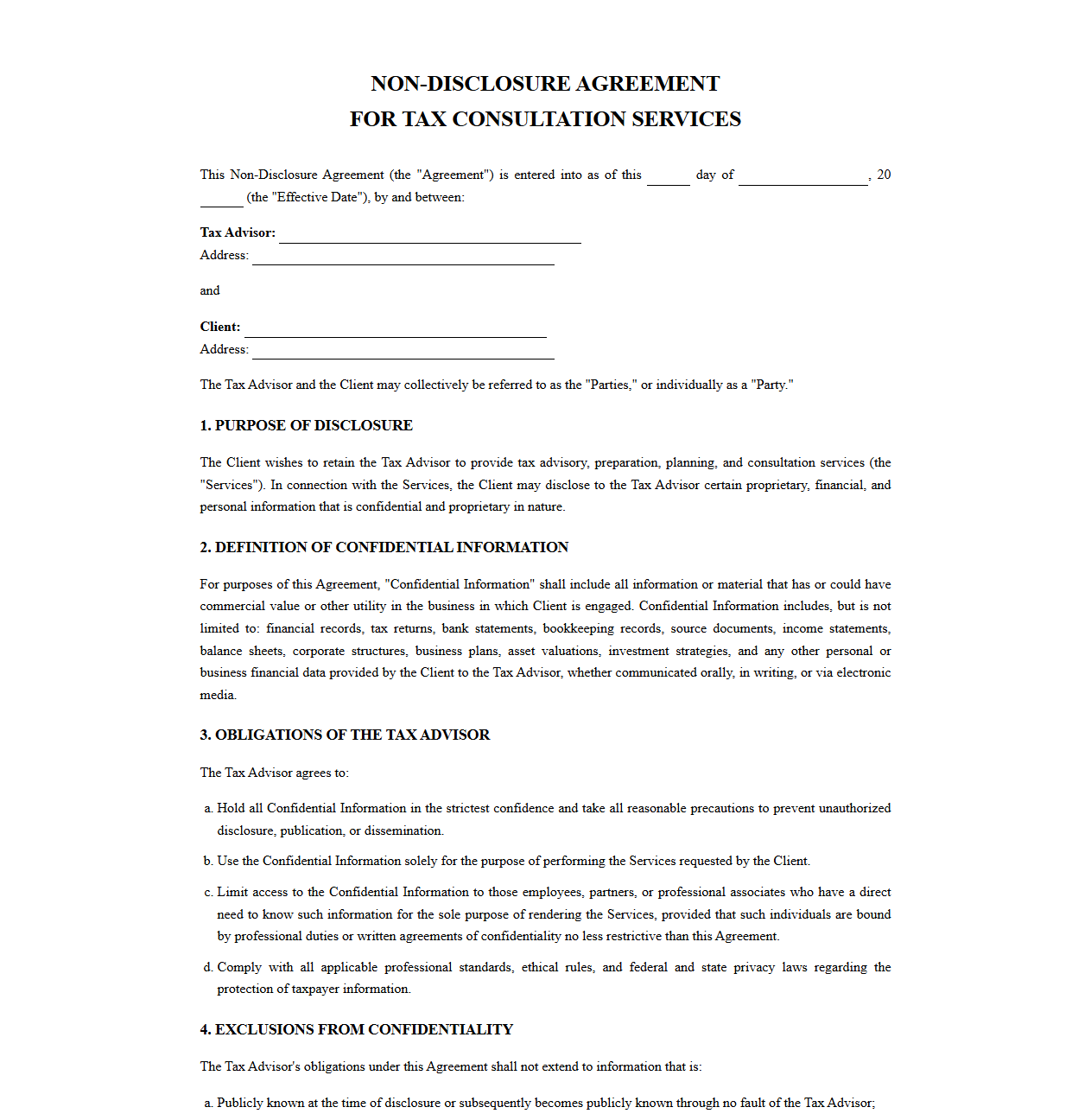 Download: .PDF
Tax Advisor NDA and Confidentiality Agreement Template
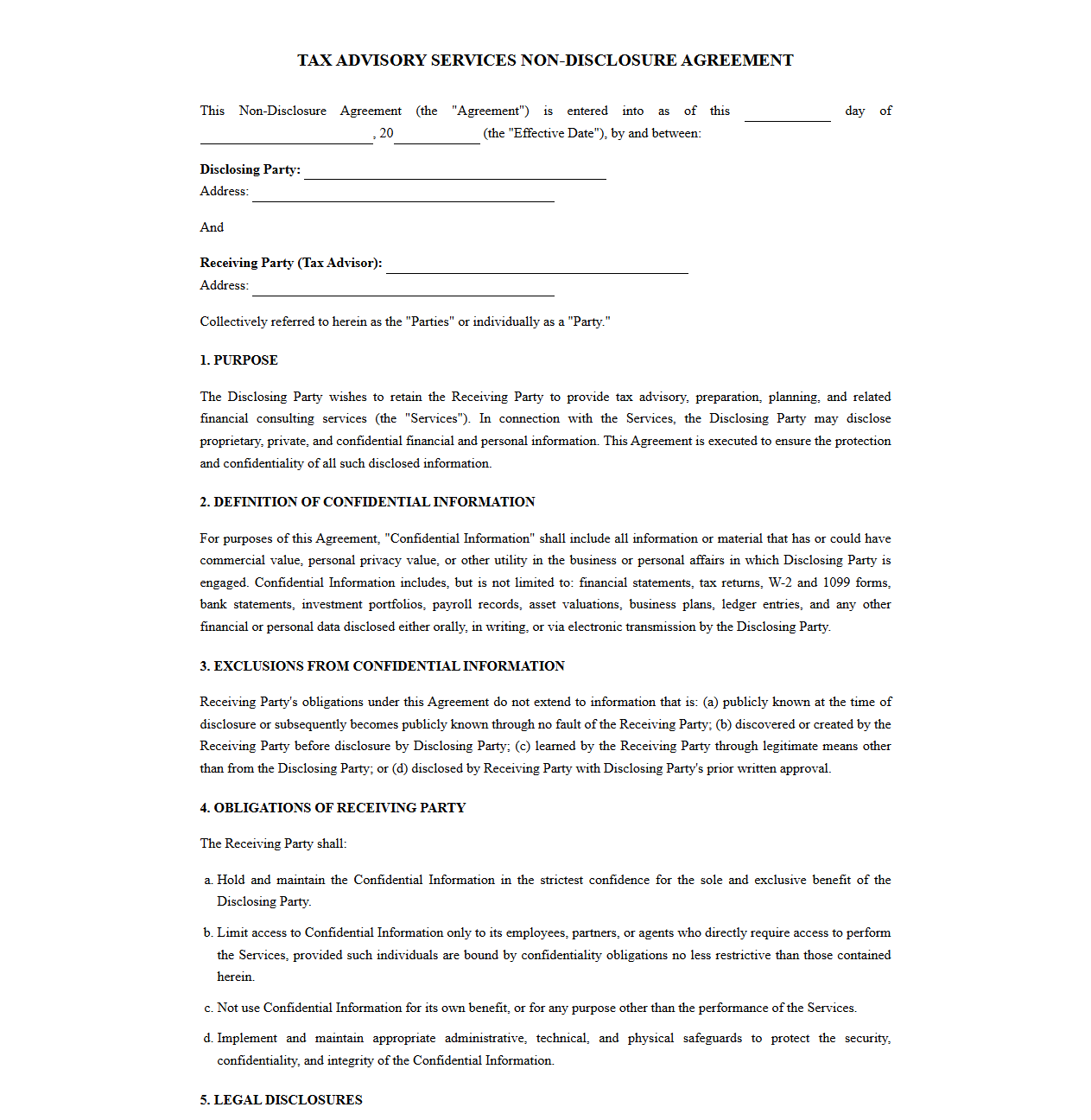 Download: .PDF
Mutual Non-Disclosure Agreement for Tax Advisory
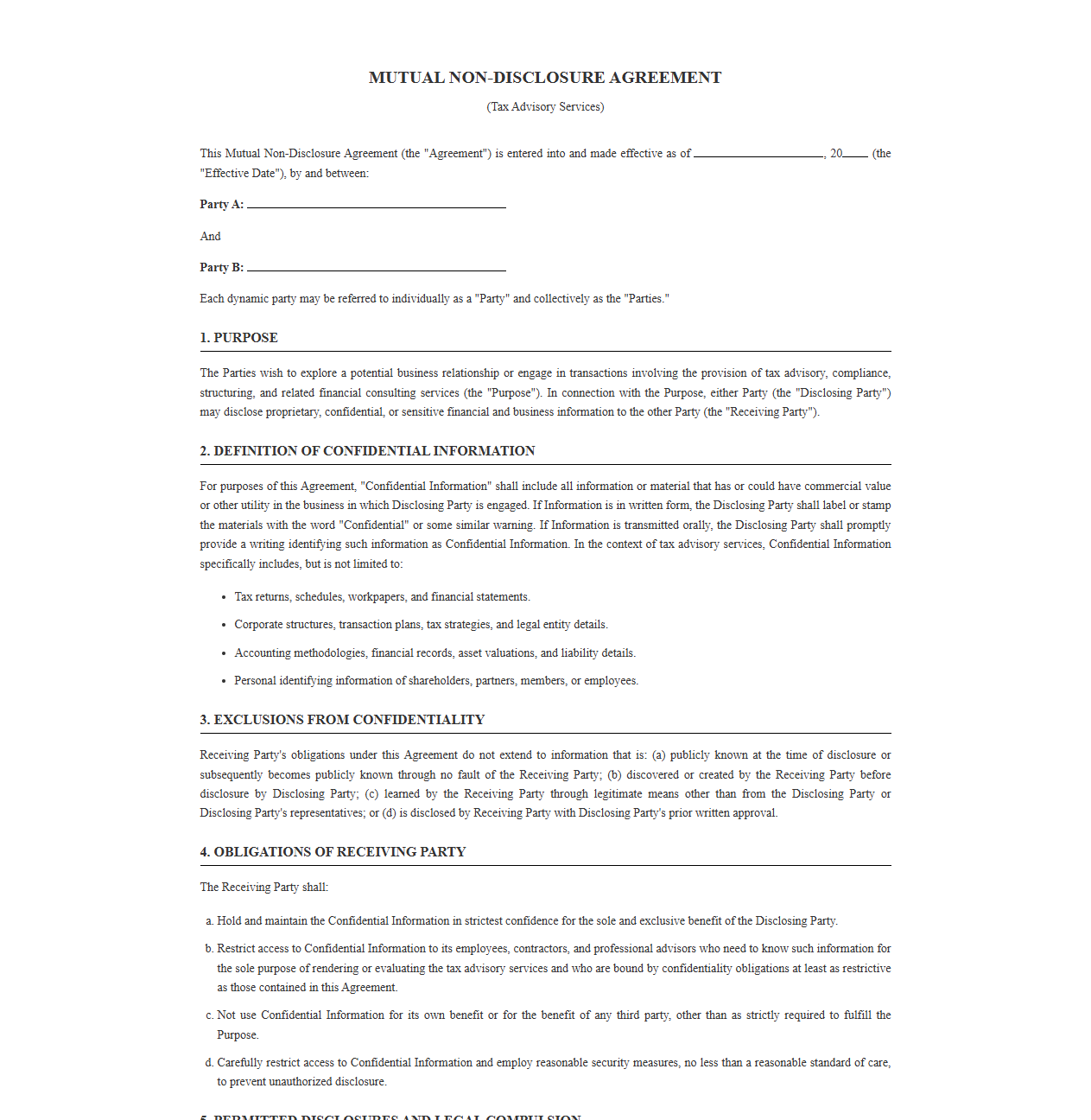 Download: .PDF
Tax Services Confidentiality and Non-Disclosure Agreement
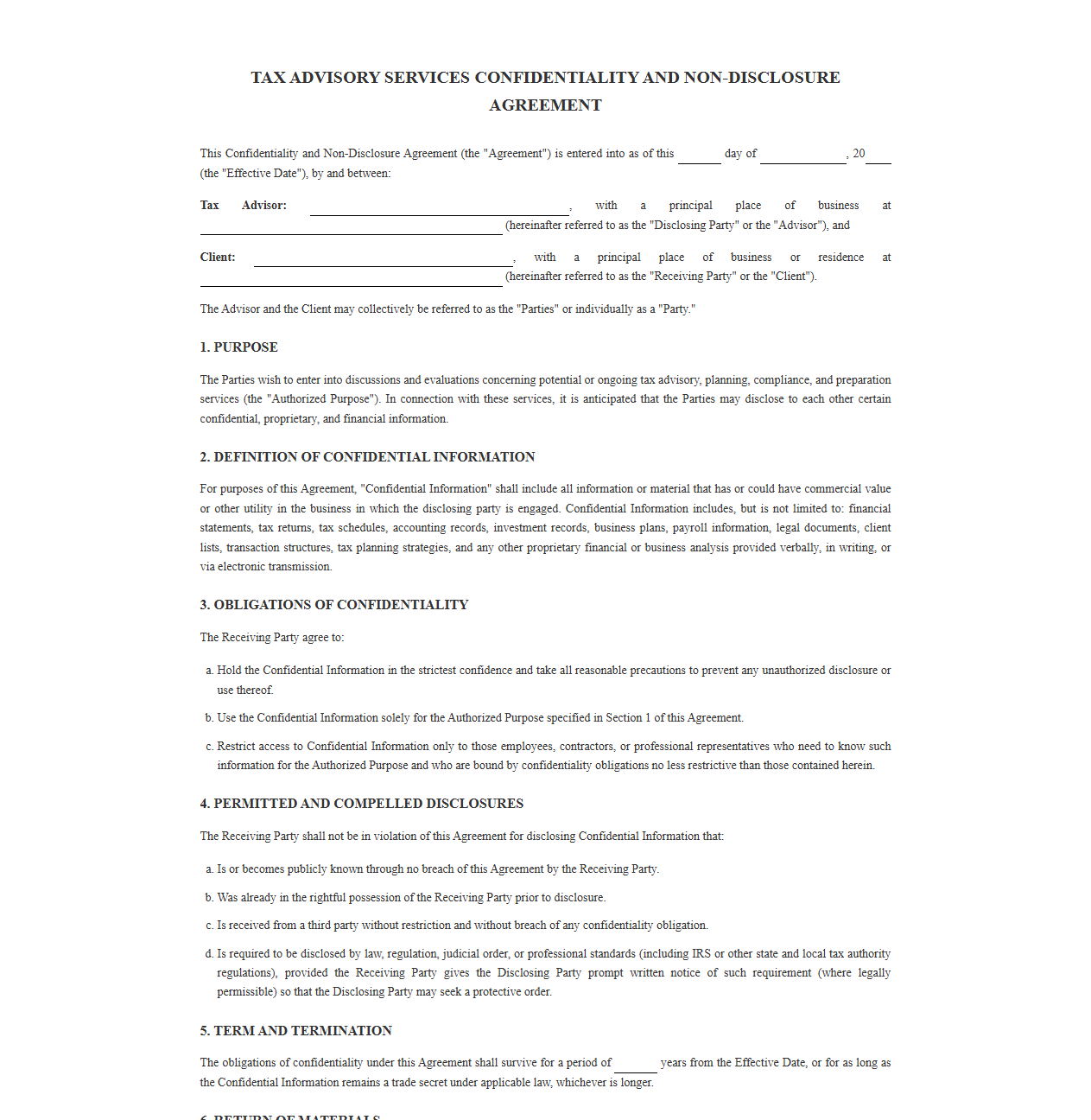 Download: .PDF
Non-Disclosure Agreement for Corporate Tax Advisory
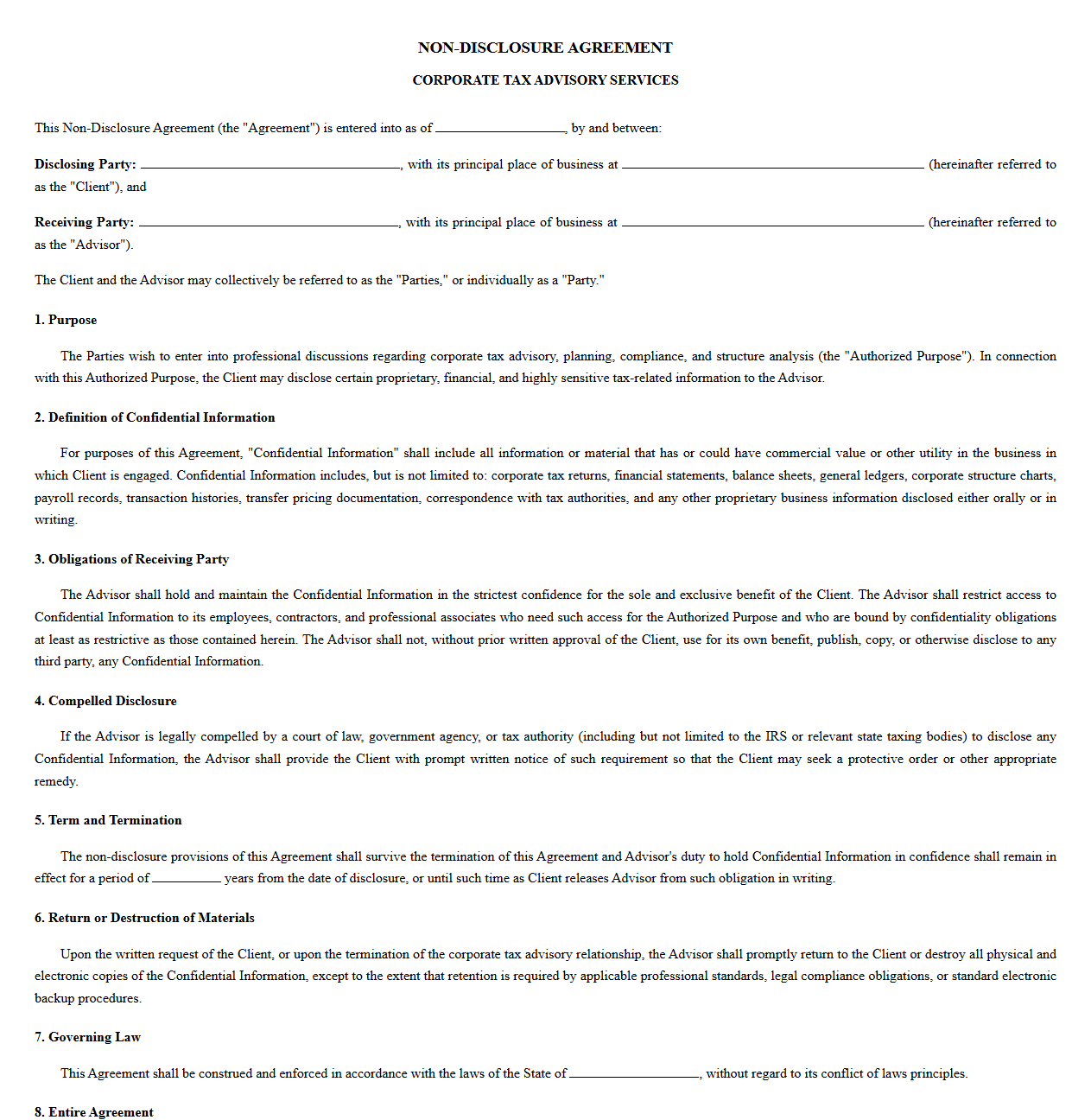 Download: .PDF
Tax Planning and Advisory Services NDA Template
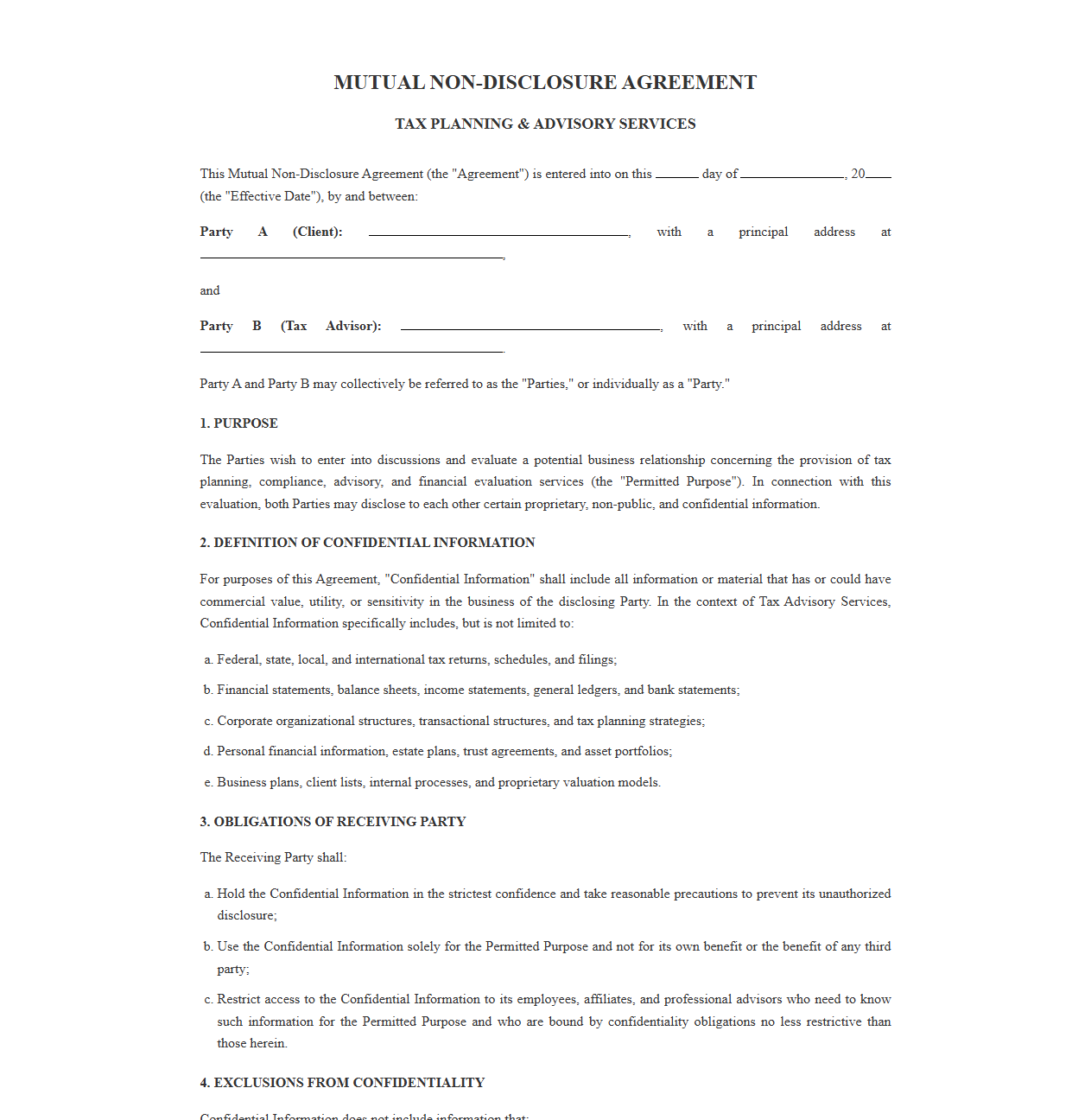 Download: .PDF
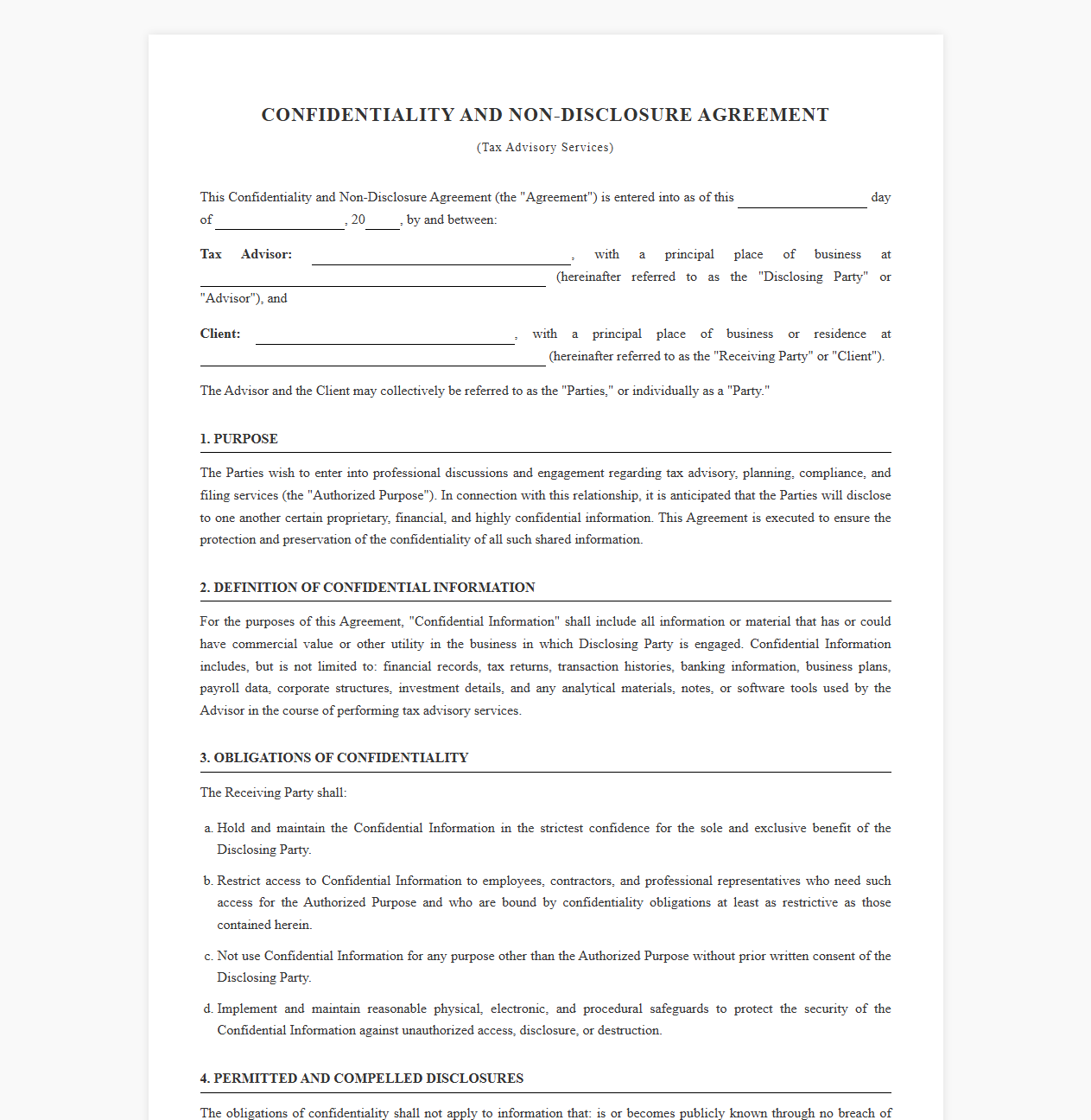
Confidential Tax Advisory Services Agreement Template
 Download: .PDF
The Critical Role of NDAs in Tax Advisory
Tax advisory firms handle some of the most sensitive information in the business world, ranging from corporate restructuring plans to high-net-worth individual portfolios. Protecting this proprietary financial data is not just a matter of professional pride; it is a foundational requirement for maintaining trust and compliance. A robust Non-Disclosure Agreement (NDA) serves as the indispensable first line of defense, shielding confidential client information from unauthorized exposure and potential financial espionage.
Without strict legal protections, proprietary tax structures and sensitive financial records risk being leaked to competitors or the public. Utilizing a specialized NDA ensures that both the firm and its clients operate within a secure environment, reinforcing fiduciary duty and protecting competitive advantages.
Key Elements of a Tax Advisory Non-Disclosure Agreement
A standard confidentiality agreement is insufficient for the complex landscape of tax planning. A tax-specific NDA must contain precise clauses that account for regulatory nuances and the specific nature of financial advisory services.
- Definition of Confidential Information: Explicitly states which documents, data, and oral communications are protected under the agreement.
- Permitted Disclosures: Outlines exceptions, such as disclosing information to internal IRS auditors, legal counsel, or under subpoena.
- Receiving Party Obligations: Establishes strict security protocols, such as encrypted storage, access logging, and limited employee access.
- Term and Termination: Defines the duration of the agreement and the survival of confidentiality duties after the business relationship ends.
What Constitutes Proprietary Financial Data?
To ensure maximum legal protection, a tax advisory NDA must clearly categorize the specific types of data covered. Broad, ambiguous definitions can fail in court, making precise categorization essential.
- Tax Records and Returns
- Federal, state, and international tax filings, historical returns, and audit correspondence.
- Proprietary Tax Strategies
- Unique corporate restructuring plans, legal loopholes utilized for tax optimization, and proprietary transfer pricing models.
- Financial Statements and General Ledgers
- Balance sheets, income statements, cash flow analyses, internal transaction logs, and client billing records.
Tailoring Templates to Tax Advisory Needs
While generic NDA templates are readily available online, they often fail to address the unique regulatory compliance requirements governing the tax industry. Generic templates lack provisions for IRS IRC Section 7216 compliance, which penalizes unauthorized disclosures of tax return information by preparers.
"Using a generic NDA in a tax advisory context is a high-risk gamble. Specialized templates must integrate IRS regulations and state-specific accounting standards to offer true legal protection."
Determining the Lifespan of Confidentiality Obligations
How long should a tax NDA remain in effect? Unlike standard business agreements that may expire after two or three years, tax records require extended protection. IRS audits can occur years after a return is filed, and corporate tax strategies may remain active for decades.
Firms typically enforce a confidentiality term of five to seven years for standard financial data. However, for highly sensitive proprietary strategies, a perpetual survival clause is often necessary to ensure the information is never legally exposed.
Enforcing the NDA and Addressing Breaches
In the unfortunate event of a data breach or unauthorized disclosure, the tax advisory firm must be prepared to take immediate legal action. Having a clear enforcement mechanism within the NDA enables swift resolution and minimizes reputational damage.
- Injunctive Relief: A court order to immediately halt further dissemination of the leaked financial data.
- Liquidated Damages: Pre-agreed financial penalties for breaches, bypassing the complex process of proving exact monetary loss in court.
- Compensatory Damages: Recovery of actual financial losses suffered by the firm or the client due to the breach.
Implementing Best Practices for Data Protection
Securing proprietary financial data requires a proactive approach that integrates legal agreements directly into daily operations. Establishing a culture of confidentiality ensures that NDAs are more than just paperwork.
- Integrate into Client Onboarding: Require signed NDAs before exchanging any financial documents or scheduling deep-dive advisory sessions.
- Limit Access Control: Restrict document access strictly to advisors and staff directly assigned to the client's file.
- Conduct Annual Audits: Regularly review NDA templates and compliance practices to align with shifting state and federal tax laws.

Leave a comment