

Navigating the complex regulatory landscape of partnership distributions often leaves tax professionals and business partners vulnerable to severe IRS scrutiny. While Internal Revenue Code Section 704(b) offers unmatched financial flexibility, bridging the gap between creative business deals and rigid regulatory compliance remains a persistent, high-stakes challenge.
Our legally vetted Special Allocation Agreement templates grant you the exact structural blueprint needed to confidently defend your tax positions. For example, when allocating 100% of depreciation write-offs to a high-tax-bracket partner who contributed the majority of the initial capital, these templates ensure your agreement satisfies the IRS's strict "substantial economic effect" test.
Stipulation: These templates serve as foundational frameworks and must be customized to reflect your partnership's specific economic realities and state-level jurisdictions.
In the guide below, we will explore the core mechanics of compliant allocations, break down safe harbor requirements, and walk through how to customize our templates for your specific partnership structure.
Special Allocation of Partnership Income Agreement
 Download: .PDF
Partnership Agreement Amendment for Special Income Allocations
 Download: .PDF
Special Partnership Income and Loss Allocation Agreement
 Download: .PDF
Partnership Income Special Allocation Addendum
 Download: .PDF
Agreement for Special Allocation of Partnership Profits
 Download: .PDF
Non-Pro Rata Partnership Income Allocation Agreement
 Download: .PDF
Partnership Distributive Share Special Allocation Agreement
 Download: .PDF
Special Tax Allocation Agreement for Partnership Partners
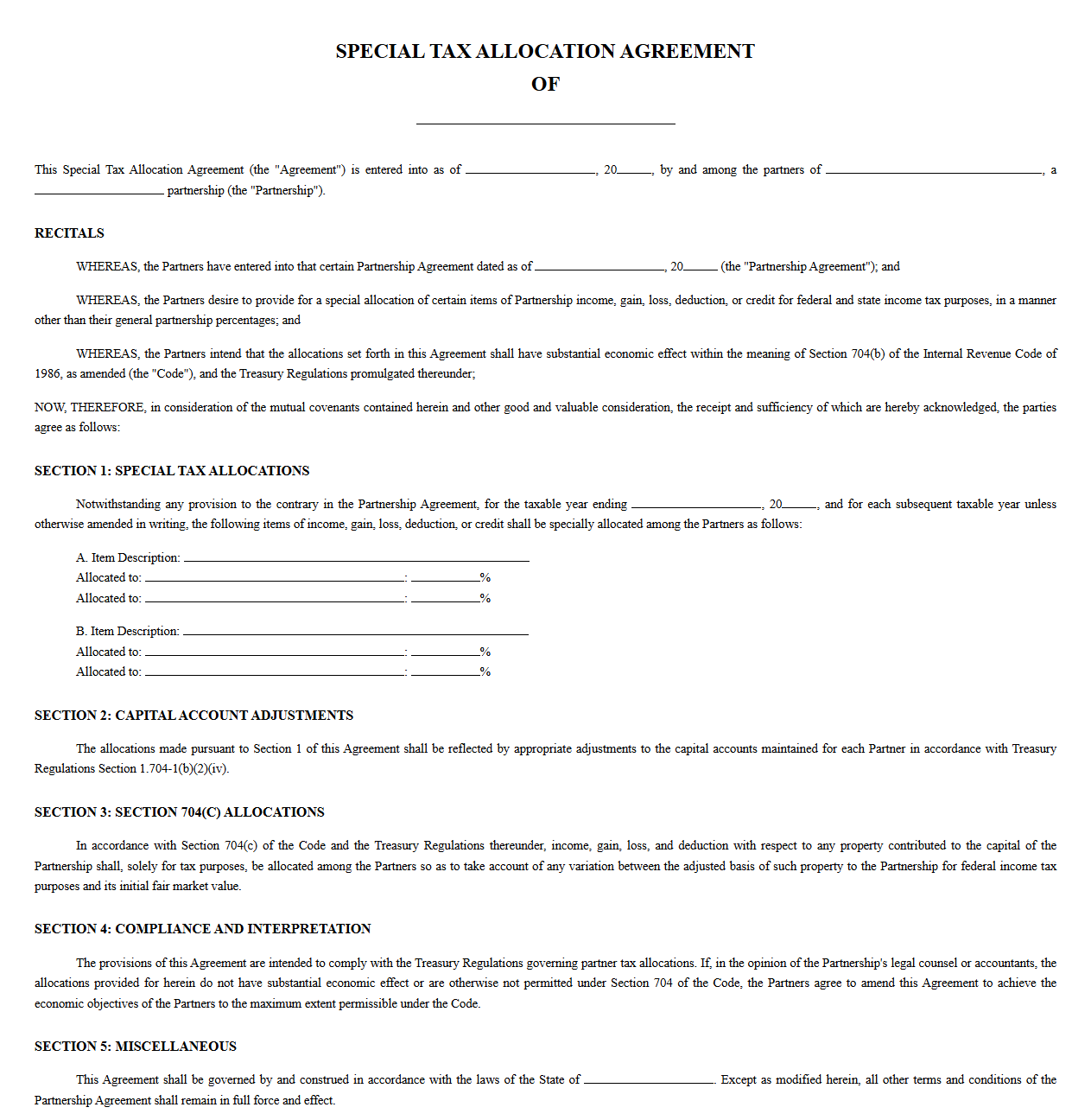 Download: .PDF
Introduction to Partnership Special Allocations
In the realm of joint business ventures, flexibility is a primary reason entrepreneurs select partnership structures. Standard partnerships often distribute profits and losses based on each partner's ownership percentage-a method known as pro-rata distribution. However, many ventures require a more tailored financial arrangement. This is where partnership special allocations become essential. Special allocations allow partners to distribute financial items-such as depreciation, tax credits, or specific streams of income-disproportionately to their actual capital contributions.
While this flexibility offers immense strategic value, it must be structured with precision to withstand regulatory scrutiny. Under IRC Section 704(b), the IRS closely monitors these arrangements to ensure they are not used solely as tax-avoidance schemes. IRC Section 704(b) dictates that any special allocation must have real, non-tax economic consequences. If an allocation fails to meet federal guidelines, the IRS reserves the right to reallocate the tax items in a manner that reflects the partners' actual economic interests in the partnership.
The Substantial Economic Effect Test
To be respected by the IRS, all special allocations must pass the rigorous two-part Substantial Economic Effect (SEE) test. This test ensures that the tax consequences of an allocation align directly with the underlying economic realities of the business operation.
The first part of the test is economic effect. This means that if a partner is allocated a dollar of income or loss for tax purposes, they must also receive the corresponding economic benefit or bear the corresponding economic burden. The IRS generally requires partnerships to meet three safe harbor criteria to prove economic effect:
- Maintenance of capital accounts in accordance with federal tax regulations.
- Liquidation distributions made strictly according to positive capital account balances.
- An unconditional deficit restoration obligation, or a qualified income offset provision.
The second part of the test is substantiality. An allocation is substantial if there is a reasonable possibility that the allocation will affect substantially the dollar amounts to be received by the partners, independent of tax consequences. If an allocation merely shifts tax liabilities among partners without shifting real economic risk or reward, the IRS will deem it insubstantial and invalidate the arrangement.
Core Components of a Special Allocation Agreement Template
To draft a legally binding and tax-compliant partnership agreement, specific foundational clauses must be clearly defined. A poorly structured template can lead to internal partner disputes and external regulatory audits.
- Partner Ownership Percentages: Clearly state the initial capital contributions and the baseline ownership interest of each partner.
- Definition of Distributive Shares: Explicitly define how book income, gains, losses, deductions, and credits are calculated and distributed among the partners.
- Modification Rules: Outline the exact procedures required to alter the allocation formulas, ensuring that any amendment requires the unanimous consent of all affected partners.
By establishing these core structural parameters within the agreement template, partners can ensure that their business arrangement remains predictable and legally enforceable.
Capital Account Maintenance Rules
Proper capital account maintenance is the cornerstone of passing the Substantial Economic Effect test. These accounts must accurately reflect the ongoing financial relationships between the partners and the partnership entity.
"Capital accounts must be increased by the amount of cash and the fair market value of property contributed, and decreased by the distribution of cash and the fair market value of property distributed."
Furthermore, agreements must include specific provisions for asset revaluations. When a new partner is admitted or an existing partner exits, the partnership must revalue its assets to fair market value to ensure that built-in gains or losses are allocated to the partners who actually earned them. Additionally, liquidation preferences must be explicitly tied to positive capital account balances. This ensures that when the business winds down, assets are distributed strictly according to the economic tracking established by the capital accounts, satisfying the IRS safe harbor rules.
Addressing Regulatory Allocations and Chargebacks
To safeguard the validity of your partnership agreement, you must incorporate mandatory IRS regulatory allocations. These provisions function as "savings clauses" that automatically adjust allocations in specific scenarios to maintain compliance with federal tax law.
Three primary regulatory provisions must be written into your agreement:
Qualified Income Offset (QIO): This provision protects partners who unexpectedly receive distributions that push their capital account into a deficit, automatically allocating them items of income to eliminate the deficit as quickly as possible.Minimum Gain Chargeback: This requires that if there is a decrease in partnership minimum gain (typically associated with nonrecourse debt), partners must be allocated income to cover their share of that decrease.Partner Nonrecourse Debt Allocations: This ensures that any deductions associated with partner nonrecourse debt are allocated strictly to the partner who bears the economic risk of loss for that specific debt.
Best Practices for IRS Compliance and Audit Defense
Drafting a compliant agreement is only the first step; maintaining compliance over the life of the business requires ongoing diligence. The IRS frequently audits partnerships with special allocations to verify that the substantial economic effect is being maintained in practice.
To mitigate audit risks, partnerships should implement an annual compliance checklist. It is vital to document the business purpose of every special allocation in the corporate minutes. Aligning closely with a certified tax advisor who understands partnership taxation can help you navigate shifting federal regulations and ensure that your book allocations match your tax filings year after year.
Finalizing and Executing Your Agreement Template
Executing your partnership agreement requires precise administrative steps to ensure its long-term validity. Every partner must review, understand, and provide their formal, written signature to the document, demonstrating complete partner consensus.
As tax codes change, agreements must adapt to remain compliant. Relying on outdated legal language can expose your business to severe tax penalties. Working with legal counsel to implement regular updates is the most secure way to protect your business interests and maintain the economic integrity of your joint venture.

Leave a comment