

Navigating the labyrinth of international tax compliance often leaves advisory firms highly vulnerable to scope creep, cross-border disputes, and severe professional liability. As jurisdictions tighten regulatory standards globally, advisors must first establish rigorous operational boundaries before rendering complex cross-border advice.
Utilizing standardized, robust agreement templates grants firms the dual advantage of ironclad liability protection and seamless operational scalability. However, these templates must be understood as adaptable structural frameworks rather than rigid, one-size-fits-all legal counsel.
For instance, precise contractual clauses are vital when defining scope for complex deliverables like Transfer Pricing documentation or Permanent Establishment risk assessments. Below, we outline the essential clauses required in international tax engagement letters and provide the core agreement templates designed to secure your firm's cross-border operations.
Cross-Border Tax Advisory Services Agreement Template
 Download: .PDF
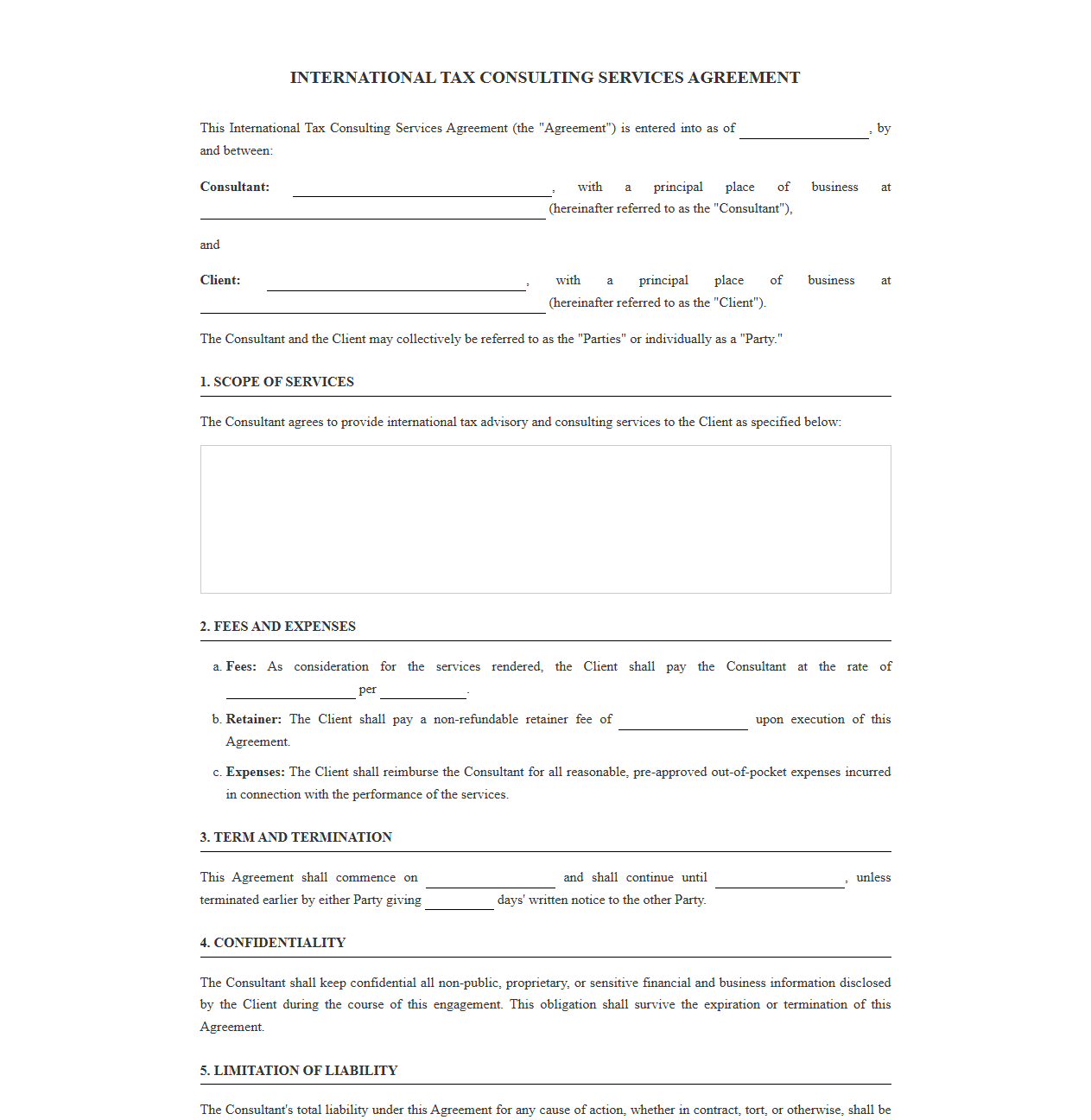
International Tax Consulting Services Agreement
 Download: .PDF
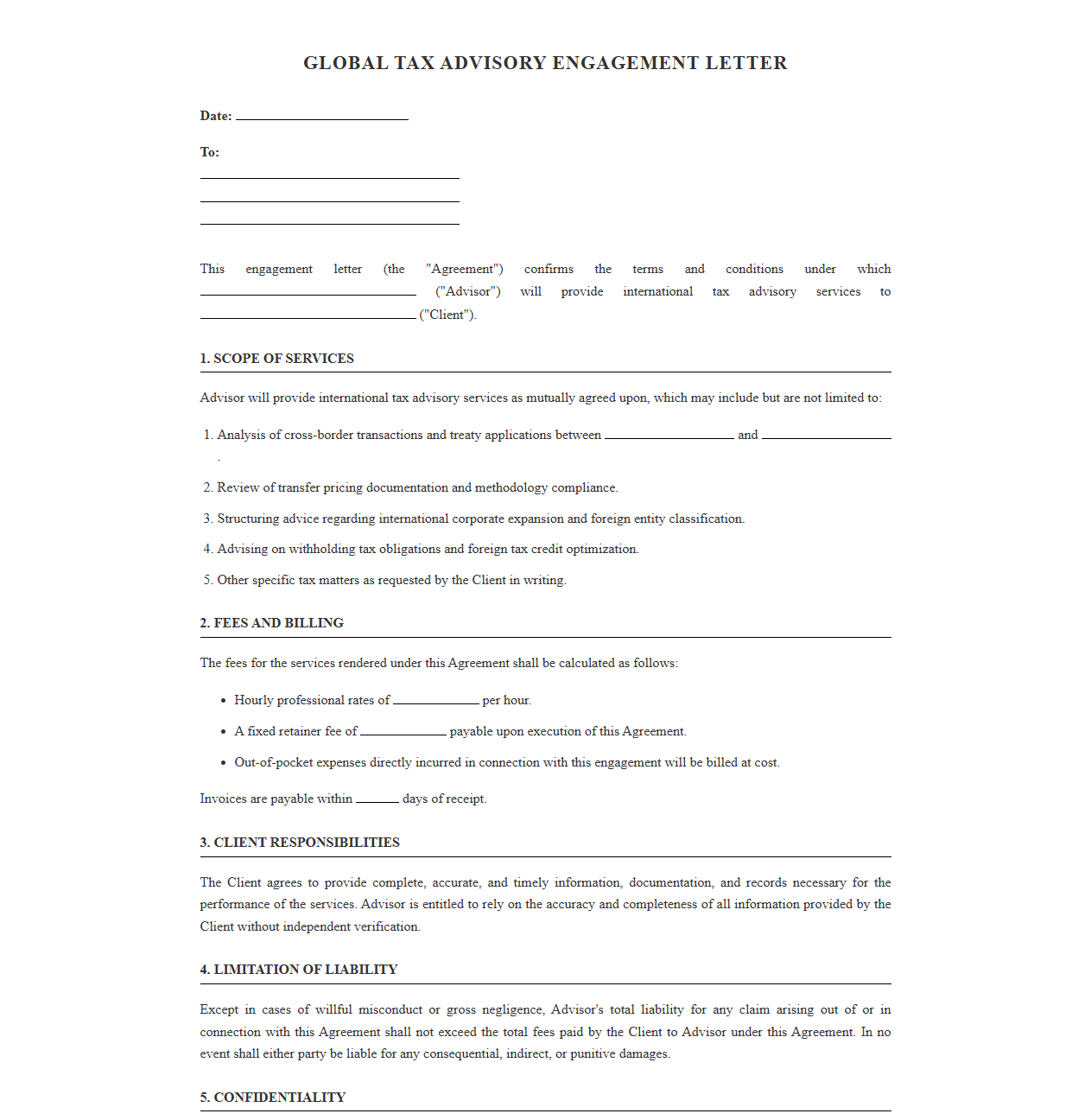
Global Tax Advisory Engagement Letter Template
 Download: .PDF
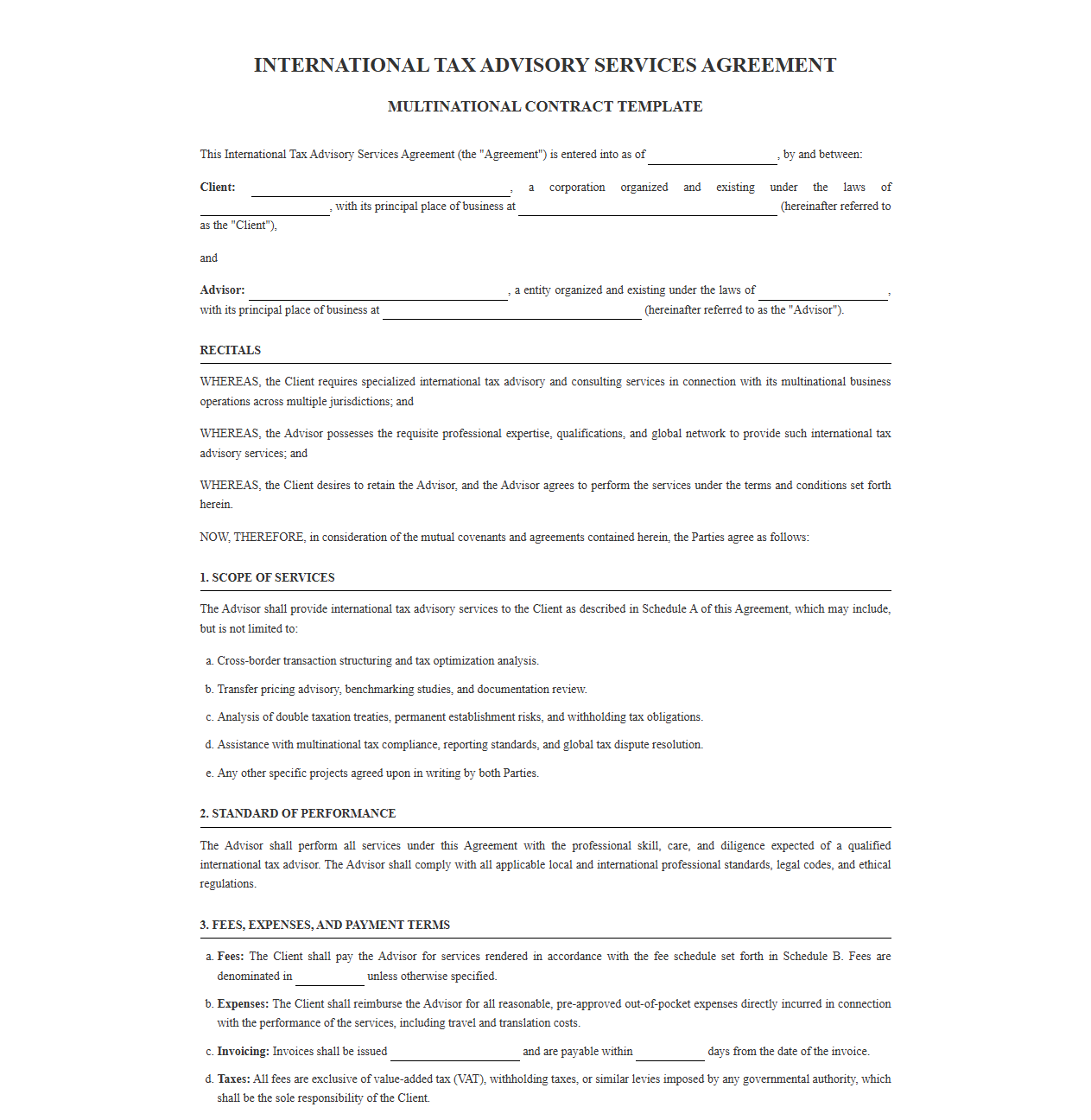
Multinational Tax Advisory Contract Template
 Download: .PDF
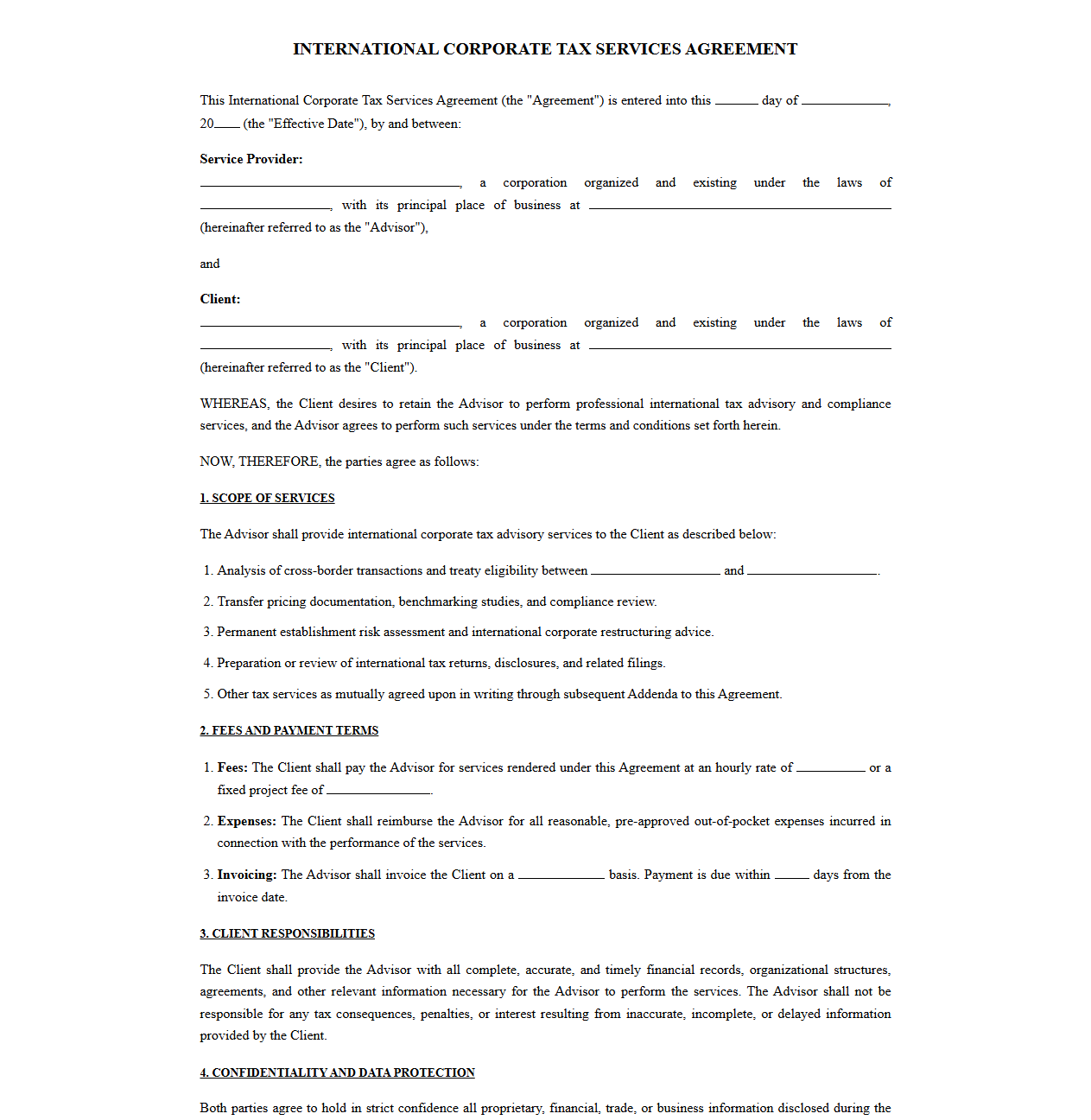
International Corporate Tax Services Agreement
 Download: .PDF
Foreign Tax Advisory Services Agreement Template
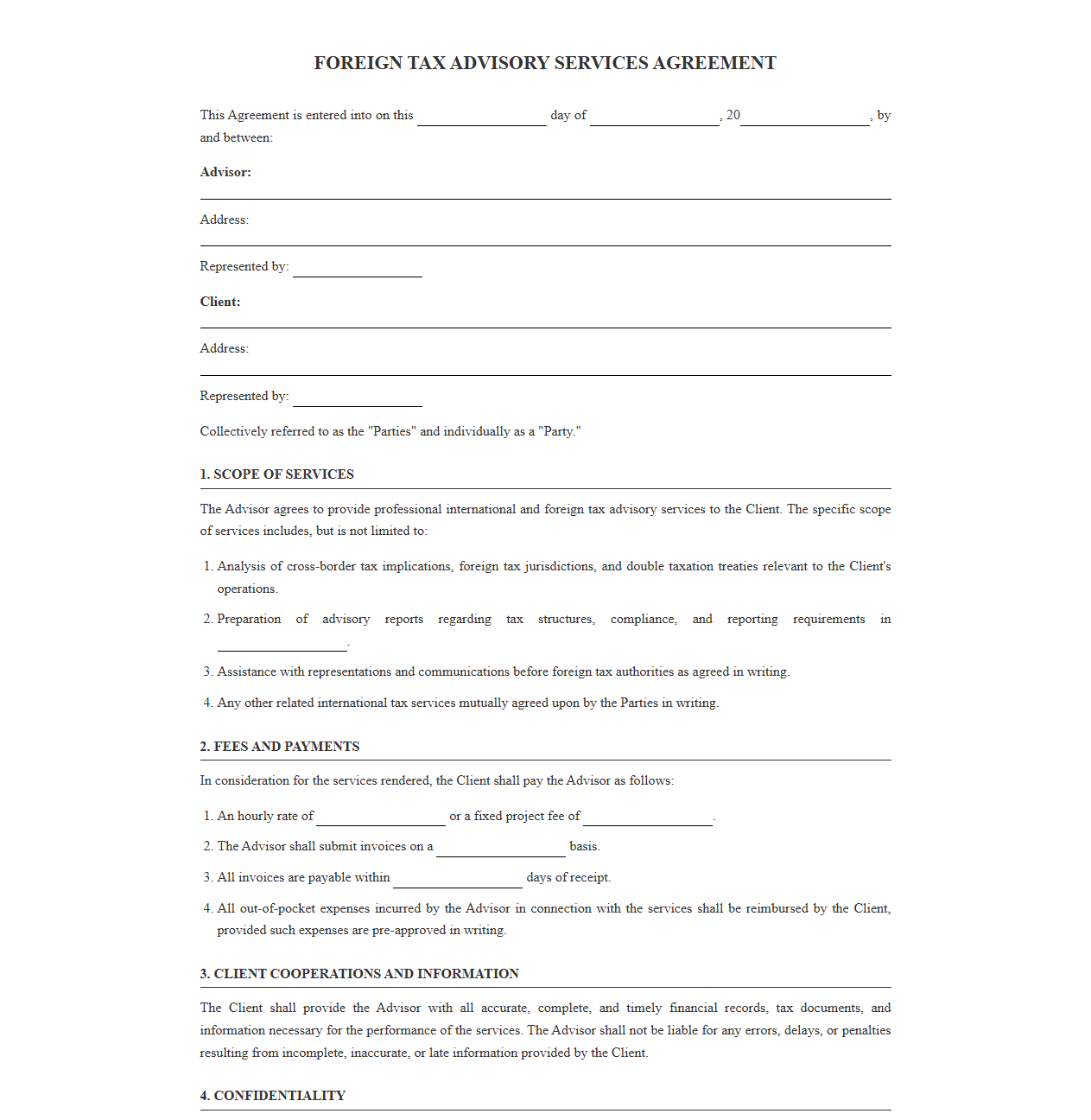 Download: .PDF
Global Tax Compliance and Advisory Agreement
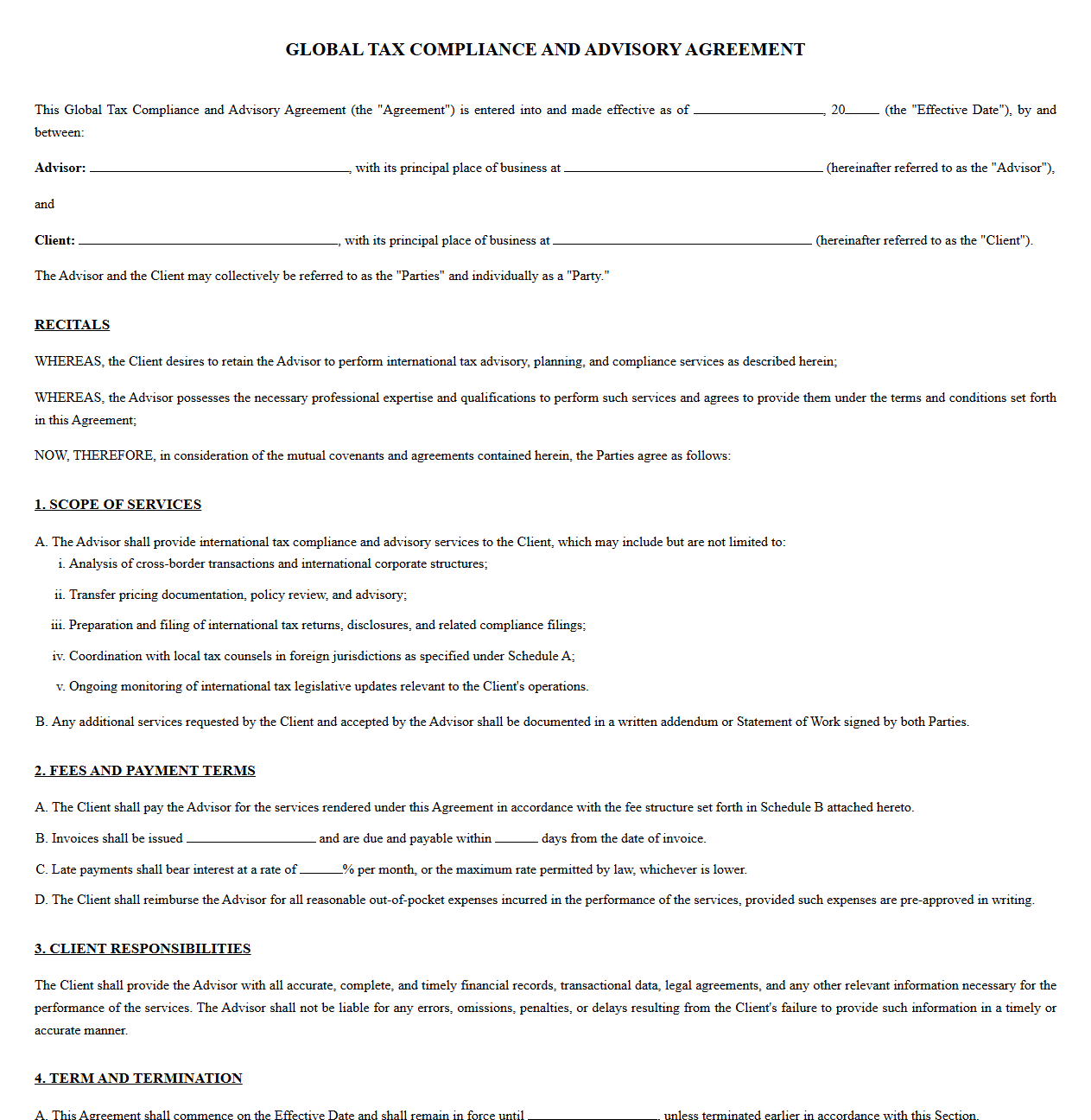 Download: .PDF
Cross-Border Tax Consulting Agreement
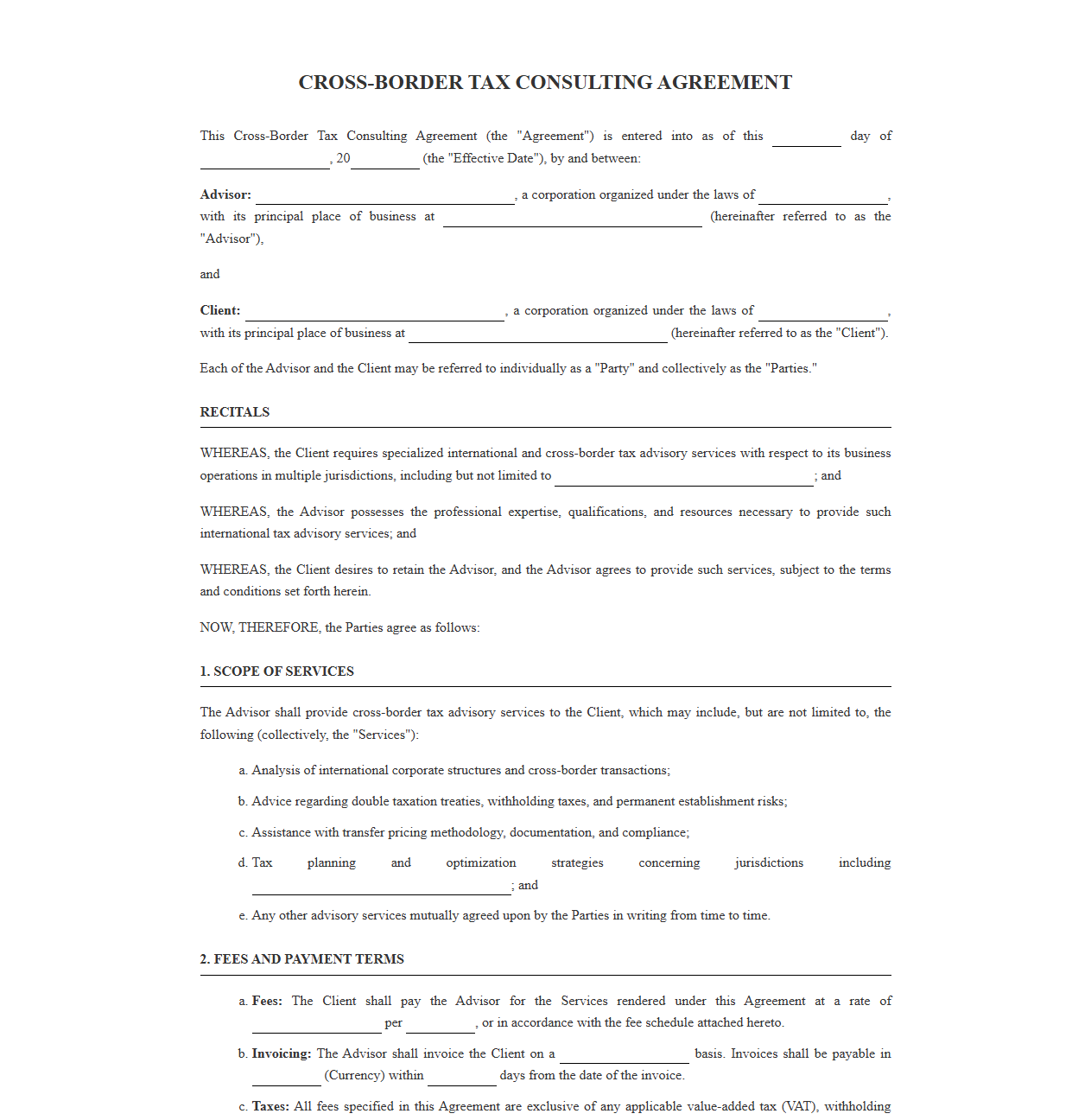 Download: .PDF
Section 1: Navigating the Complex Landscape of Cross-Border Tax Advisory
Operating in the arena of international taxation requires navigating an incredibly intricate web of conflicting jurisdictions, shifting multilateral instruments, and aggressive regulatory scrutiny. For multinational enterprises, the stakes of non-compliance are exceptionally high, ranging from severe financial penalties to reputational damage. Tax advisors must manage these risks while helping clients mitigate the dangers of double taxation. Establishing robust legal agreements prior to delivering advice is not merely a best practice; it is an absolute necessity to protect both the advisory firm and the client from unforeseen regulatory liabilities.
Section 2: Defining Scope with Comprehensive Service Level Agreements (SLAs)
Preventing Scope Creep in Multi-Jurisdictional Engagements
A well-drafted Service Level Agreement (SLA) serves as the primary defense against scope creep, which frequently occurs when tax advisory services span multiple geographic borders. Without explicit boundaries, an advisory firm may find itself inadvertently analyzing local municipal taxes or foreign payroll obligations that were never factored into the original pricing model.
To maintain clear operational boundaries, the Scope of Work within the SLA should explicitly outline:
- The specific sovereign jurisdictions covered by the tax advice.
- The exact tax types being analyzed, such as corporate income tax, value-added tax (VAT), or customs duties.
- Concrete deliverable timelines and milestone dates for draft opinions and final filings.
- Exclusions that clearly state which jurisdictions or tax matters will not be addressed.
Section 3: Protecting Clients Against Double Taxation Risks
Double taxation remains one of the most critical threats facing multinational businesses. Advisory agreements must clearly allocate responsibilities regarding tax treaty interpretation and the prevention of permanent establishment (PE) triggers. Advisors must ensure that the contract establishes who is responsible for verifying and obtaining vital tax documentation.
"The client shall bear sole responsibility for obtaining, verifying, and maintaining all necessary tax residency certificates (TRCs) and related documentation required to claim benefits under any applicable double taxation treaty."
By using precise contractual language, the advisor protects themselves from liabilities arising from a client's failure to produce the required administrative proof of residency, while ensuring that the advice rendered remains grounded in valid, verifiable treaty positions.
Section 4: Transfer Pricing and Arm's Length Compliance Templates
Standardizing Transfer Pricing Documentation Clauses
Transfer pricing structures are subject to intense audits by tax authorities worldwide. Advisory agreements covering transfer pricing must clearly define the operational responsibilities of both parties to ensure compliance with the Organisation for Economic Co-operation and Development (OECD) guidelines and local country transfer pricing regulations.
The agreement must explicitly state that the client is responsible for providing complete, accurate, and timely financial data. The advisor's role is strictly limited to analysis and documentation based on the information provided. The contract should feature clauses specifying that the advisor is not liable for penalties resulting from undisclosed intercompany transactions or inaccurate operational data provided by the multinational client.
Section 5: Safeguarding Data Privacy and Cross-Border Information Flow
International tax advisory inherently involves the transmission of sensitive corporate financial records and personally identifiable information (PII) across international borders. Tax consulting firms must integrate rigorous data privacy protocols directly into their engagement agreements to comply with global regulations such as the General Data Protection Regulation (GDPR).
To ensure regulatory compliance and secure communication, agreements should mandate:
- Strict adherence to Standard Contractual Clauses (SCCs) for all transfers of personal data outside the European Economic Area.
- The mandatory use of encrypted, secure client portals for exchanging tax records, financial statements, and sensitive employee data.
- Defined data retention and destruction timelines upon the conclusion of the advisory engagement.
Section 6: Mitigating Liability through Indemnification and Limitation of Liability Clauses
Structuring Realistic Liability Caps
Given the immense financial scale of global tax audits, an advisory firm must protect itself from catastrophic claims. Standard engagement contracts must feature carefully structured limitation of liability clauses that place a reasonable cap on potential financial damages.
"To the maximum extent permitted by applicable law, the advisor's total aggregate liability for any claims, losses, or damages arising out of this engagement shall be strictly limited to the fees actually paid by the client for the specific services giving rise to the claim."
These clauses must also include strong third-party reliance disclaimers, ensuring that the tax advice is intended solely for the contracting client and cannot be relied upon by external stakeholders, lenders, or prospective buyers without express written consent.
Section 7: Establishing Jurisdictional Boundaries: Governing Law and Dispute Resolution
When a dispute arises in a cross-border advisory relationship, resolving it can become highly complex if the contract lacks clear jurisdictional boundaries. The contract must contain unambiguous choice-of-law clauses and forum selection provisions to prevent costly jurisdictional battles. Selecting a neutral, mutually agreeable jurisdiction provides both parties with predictability and fairness. Rather than risking litigation in unfamiliar foreign courts, agreements should specify international arbitration as the preferred mechanism for binding dispute resolution, ensuring that complex tax conflicts are evaluated by qualified legal and financial experts under established international rules.

Leave a comment