

Tax practitioners often struggle with scope creep and client misunderstandings during R&D tax credit studies, risking uncompensated hours and soured professional relationships. This friction typically stems from the highly technical and heavily scrutinized nature of IRS Section 41 claims, which require meticulous substantiation and complex calculations.
Establishing a robust, specialized engagement agreement not only safeguards your firm from liability but also secures your hard-earned professional fees. However, a standard, one-size-fits-all retainer is insufficient. A proper R&D engagement contract must clearly stipulate the boundaries of your services. For instance, explicitly detailing whether your scope includes drafting IRS Form 6765 or representing the client during a subsequent IRS audit is a critical distinction that prevents costly disputes.
In this guide, we provide essential engagement agreement templates and break down the critical clauses you need to protect your practice and streamline your next R&D tax credit study.
R&D Tax Credit Study Services Agreement
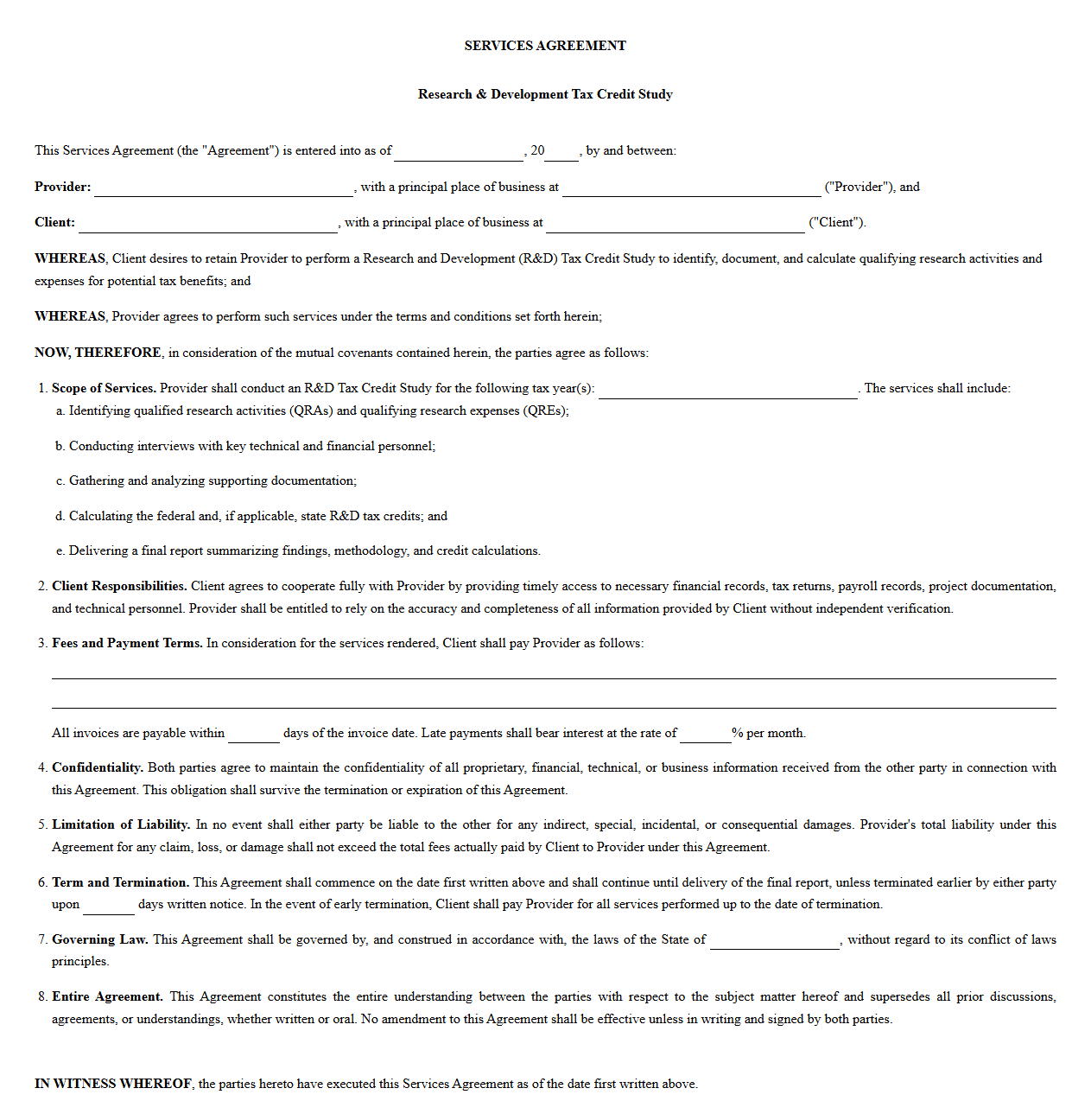 Download: .PDF
Research and Development Tax Credit Consulting Agreement
 Download: .PDF
Agreement for R&D Tax Credit Assessment Services
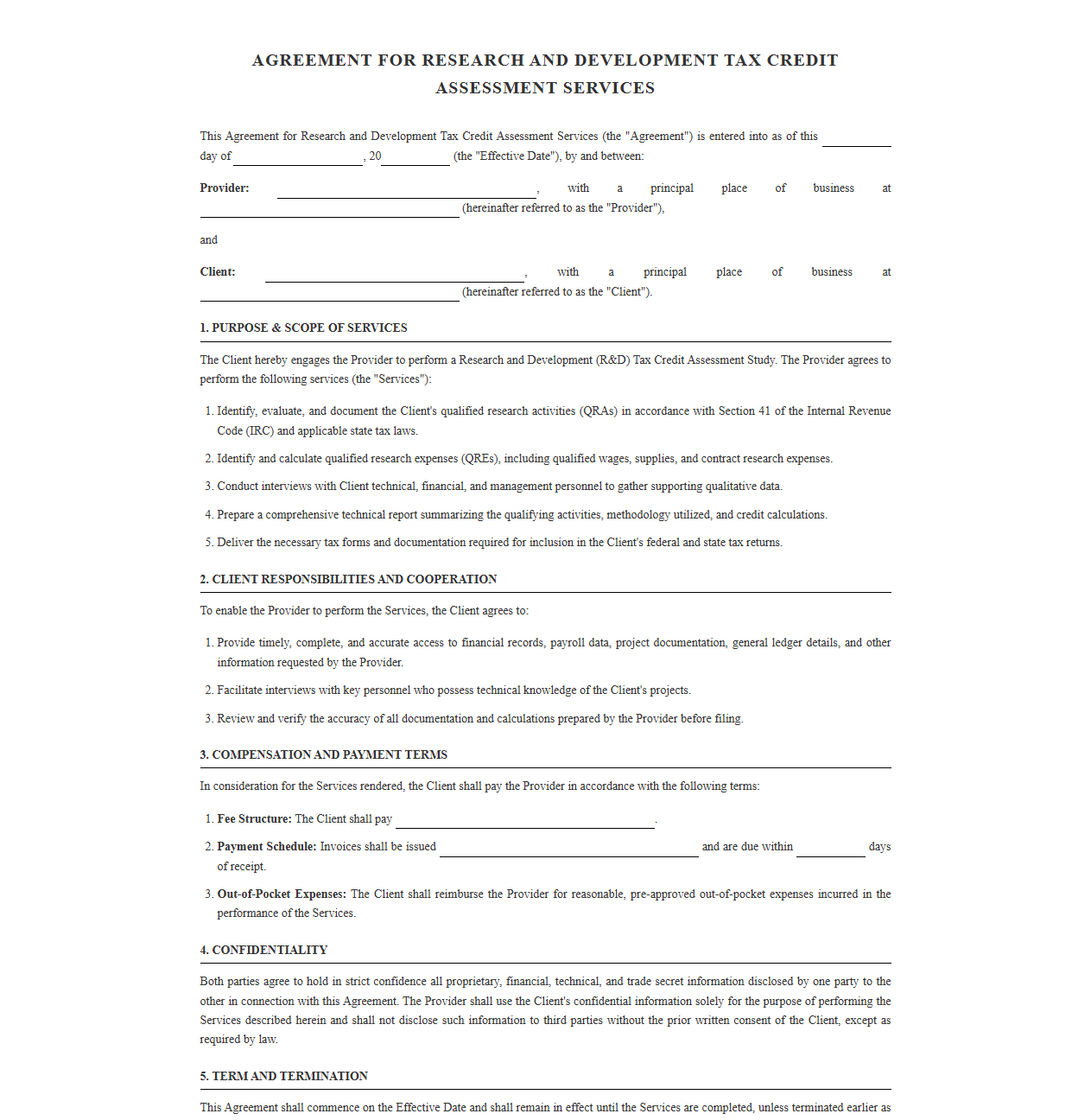 Download: .PDF
R&D Tax Credit Study Engagement Letter
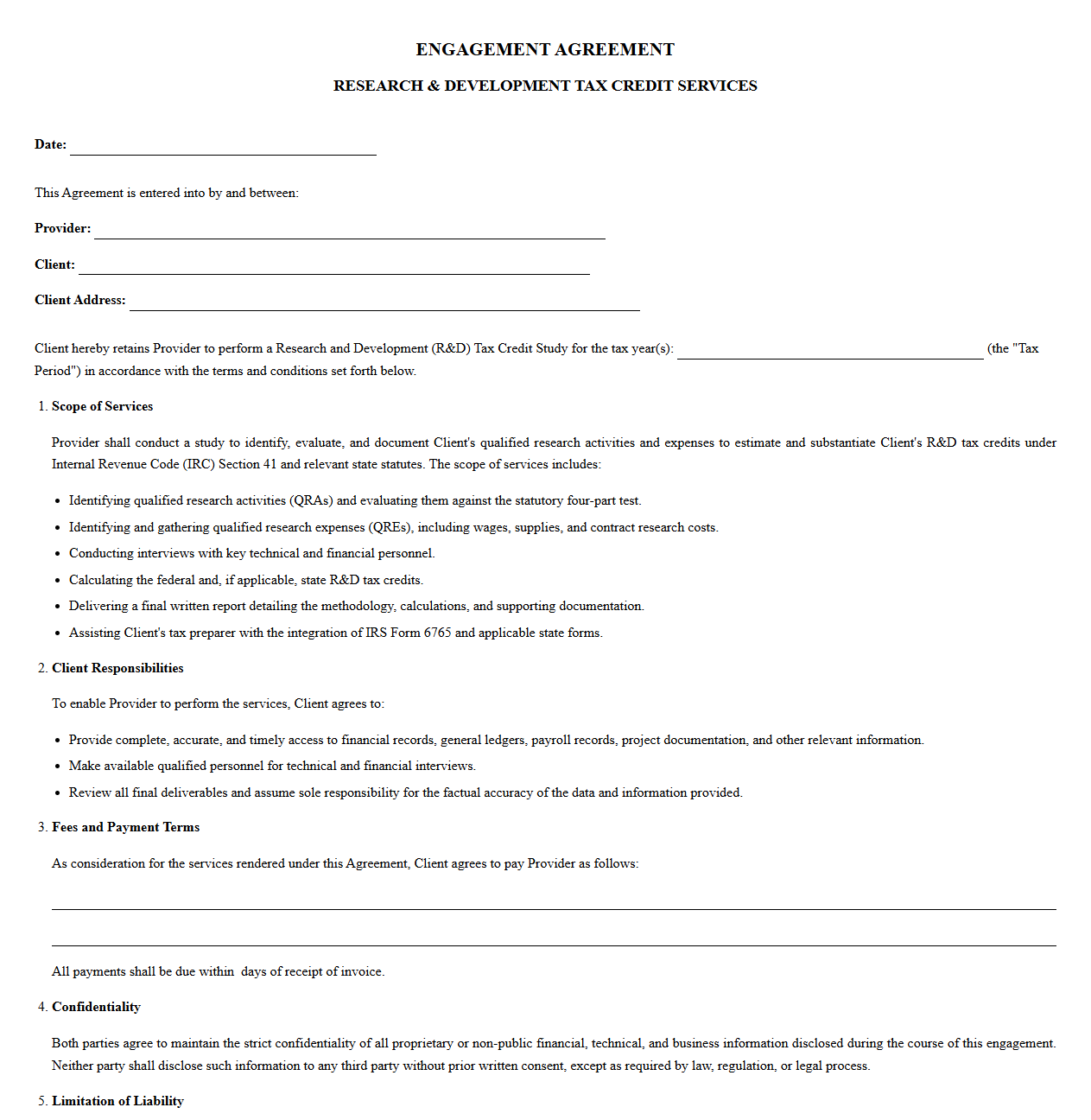 Download: .PDF
Professional Services Agreement for R&D Tax Credits
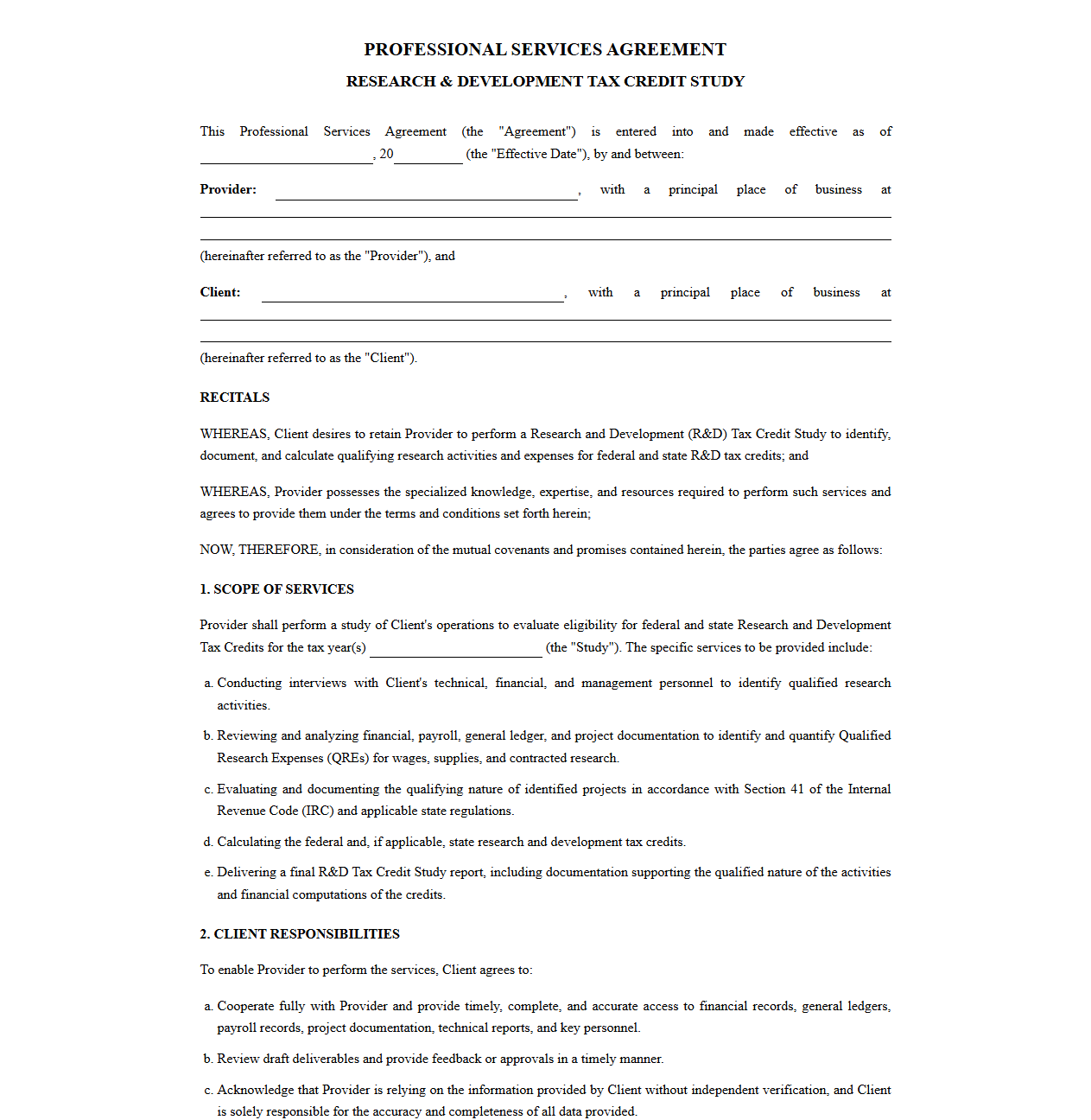 Download: .PDF
R&D Tax Credit Study Service Contract
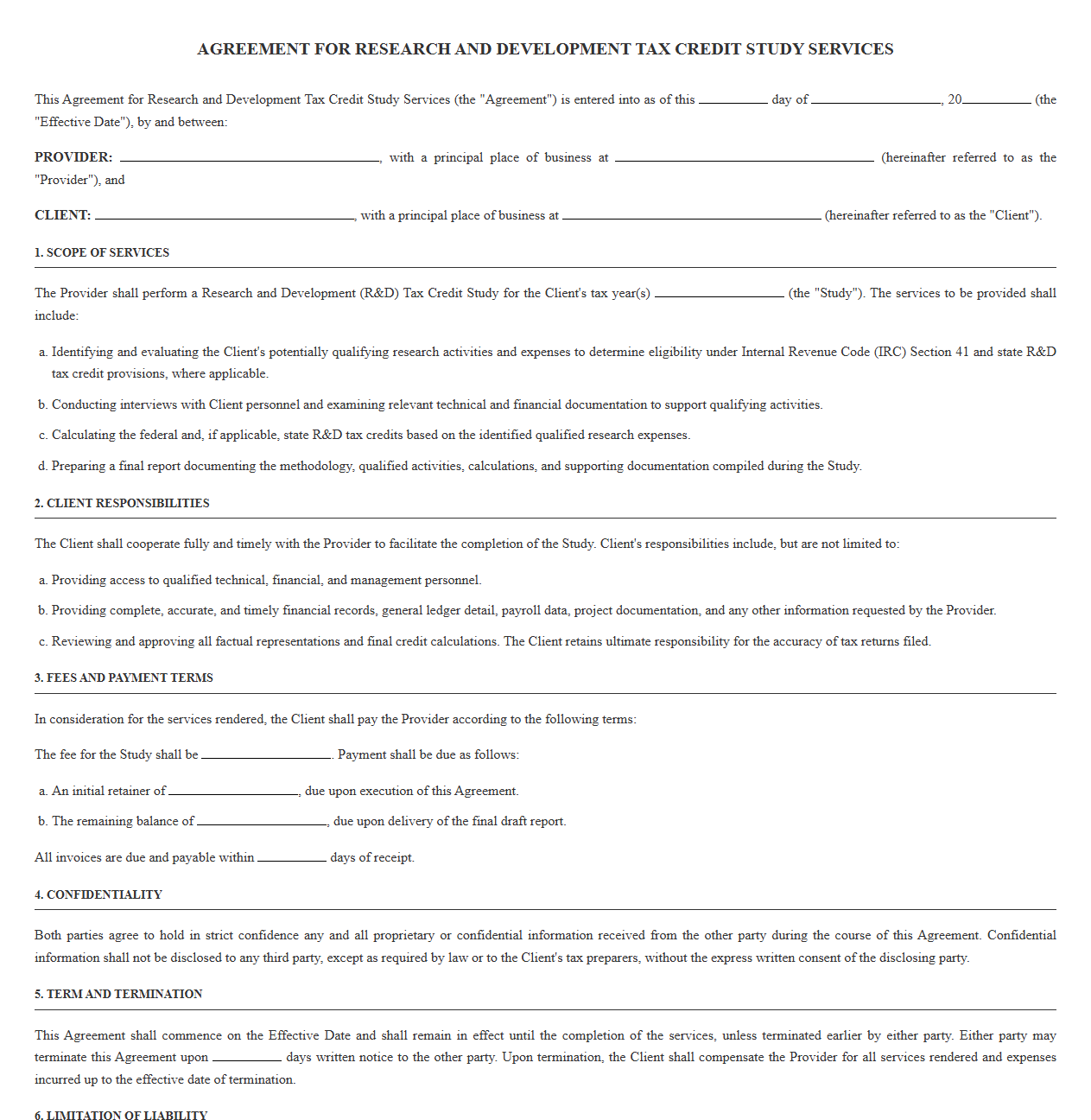 Download: .PDF
Research and Development Tax Credit Study Agreement
 Download: .PDF
Agreement for R&D Tax Incentive Study Services
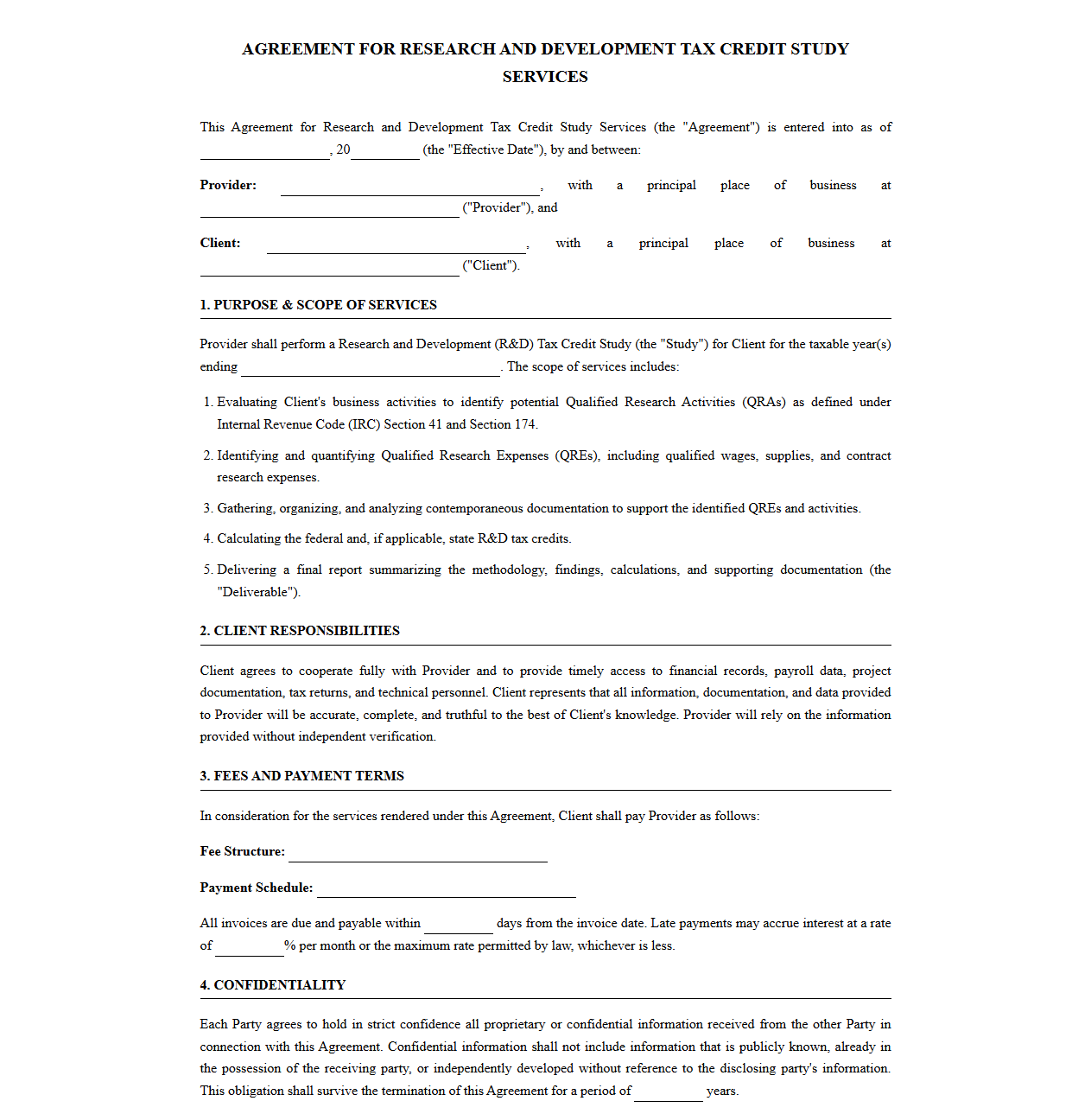 Download: .PDF
The Critical Role of Engagement Agreements in R&D Tax Credit Studies
An Research and Development (R&D) tax credit study is a highly technical and rigorous undertaking that requires deep collaboration between a CPA firm and a client. Because of the complexity of Internal Revenue Code (IRC) Section 41, a well-drafted engagement agreement is essential for safeguarding both parties. Establishing clear legal and operational parameters at the outset mitigates professional liability for the firm while ensuring the client understands the standard of care required to sustain the tax position. This foundational contract aligns expectations, protects billing practices, and establishes a secure framework for managing complex tax positions.
Defining the Scope of Services and Deliverables
To prevent scope creep and ensure legal clarity, the engagement agreement must explicitly detail what is-and what is not-included in the R&D tax credit study. A clearly defined scope helps manage resource allocation and sets transparent boundaries for the project lifecycle. The agreement should outline the specific phases of the study, including:
- Conducting detailed technical interviews with the client's engineering, software, or scientific personnel to identify qualified research activities (QRAs).
- Performing a quantitative analysis to calculate qualified research expenses (QREs), including wages, supplies, and contract research costs.
- Drafting the final technical substantiation report that meets the requirements of IRS Form 6765.
- Providing the necessary tax preparation deliverables, such as credit calculations and supporting workpapers, for inclusion in the federal and state tax returns.
Fee Structures and Payment Terms for R&D Studies
Determining how the R&D study will be billed is a critical component of the engagement letter. Firms generally utilize either a fixed-fee arrangement or a value-based billing structure, but each comes with distinct professional standards. Under Treasury Circular 230 and AICPA Code of Professional Conduct rules, CPAs must be highly cautious when structuring fees for tax preparation services.
"A practitioner may not charge a contingent fee for preparing an original tax return or claim for refund, except under very limited circumstances defined by regulatory authorities."
To ensure compliance, many firms utilize fixed-fee agreements with defined billing milestones tied to project progress, such as the completion of data collection, the delivery of draft calculations, and the final signing of the tax package. This approach ensures transparent pricing and aligns with ethical tax standards.
Establishing Client Responsibilities and Substantiation Duties
While the CPA firm performs the calculation and documentation, the burden of proof for the R&D credit lies with the taxpayer. The engagement agreement must clearly assign the responsibility for data accuracy and substantiation to the client. The client must commit to active participation to ensure the study is defensible.
Specifically, the client's responsibilities include:
- Providing timely access to subject matter experts (SMEs) who can explain the technical uncertainties and experimentation processes involved in the projects.
- Delivering complete and accurate financial records, including general ledger detail, payroll registers, and Form W-2 data.
- Certifying the accuracy of contemporaneous documentation, such as project plans, code repositories, design schematics, and testing logs, to prove qualified activities.
Safeguarding Intellectual Property and Confidentiality
An R&D tax credit study inherently requires the CPA firm to examine the client's most proprietary technological innovations, source code, and strategic business plans. Consequently, the engagement agreement must feature robust mutual confidentiality clauses to protect both parties. These provisions safeguard trade secrets, competitive technical advantages, and sensitive employee financial data from unauthorized disclosure. Furthermore, the agreement should state that while the CPA firm retains ownership of its proprietary methodologies, the client maintains sole ownership of their intellectual property and the final custom deliverables generated during the study.
Audit Defense and IRS Controversies Provisions
Given the IRS's increased scrutiny on R&D tax credit claims, the engagement agreement must explicitly address the possibility of a state or federal tax audit. The contract must clarify whether representation during an examination is included in the baseline fee or handled under a separate agreement. Standard clauses should specify:
- The initial R&D study fee covers the delivery of the substantiation report and calculations, but does not automatically include unlimited defense hours.
- Any future IRS or state agency audit representation will require a separate, subsequent engagement agreement with its own fee schedule.
- The firm's obligation is limited to providing the workpapers and documentation prepared during the course of the original study.
Best Practices for Executing and Reviewing the Agreement
Before executing the contract, both the CPA firm and the client must conduct a rigorous final review of the terms. Mitigating risk and setting clear expectations prevents costly legal disputes and operational delays down the road. Key execution steps include verifying that the agreement identifies the correct legal entities, contains clear dispute resolution mechanisms, and includes signatures from authorized corporate officers. Taking these precautions protects the professional relationship and establishes a secure foundation for the tax credit filing.

Leave a comment