

Navigating the labyrinth of IRC Section 704(b) allocations often leaves tax professionals and partners vulnerable to severe IRS compliance penalties and costly disputes over disproportionate distributions. As the IRS aggressively ramps up its enforcement focus on partnerships, establishing a bulletproof allocation framework is no longer optional-it is a critical defensive necessity.
Securing robust compliance agreement templates grants your firm immediate risk mitigation, ensuring all allocations carry "substantial economic effect" under federal tax law. Crucially, while utilizing templates for complex mechanisms like qualified income offsets and target capital account allocations provides a vital defensive shield, these tools must be customized to your specific operating agreement and are not a substitute for formal legal counsel.
In this guide, we will break down the essential compliance templates, dissect critical drafting clauses, and outline strategic steps to permanently insulate your partnership from tax allocation risks.
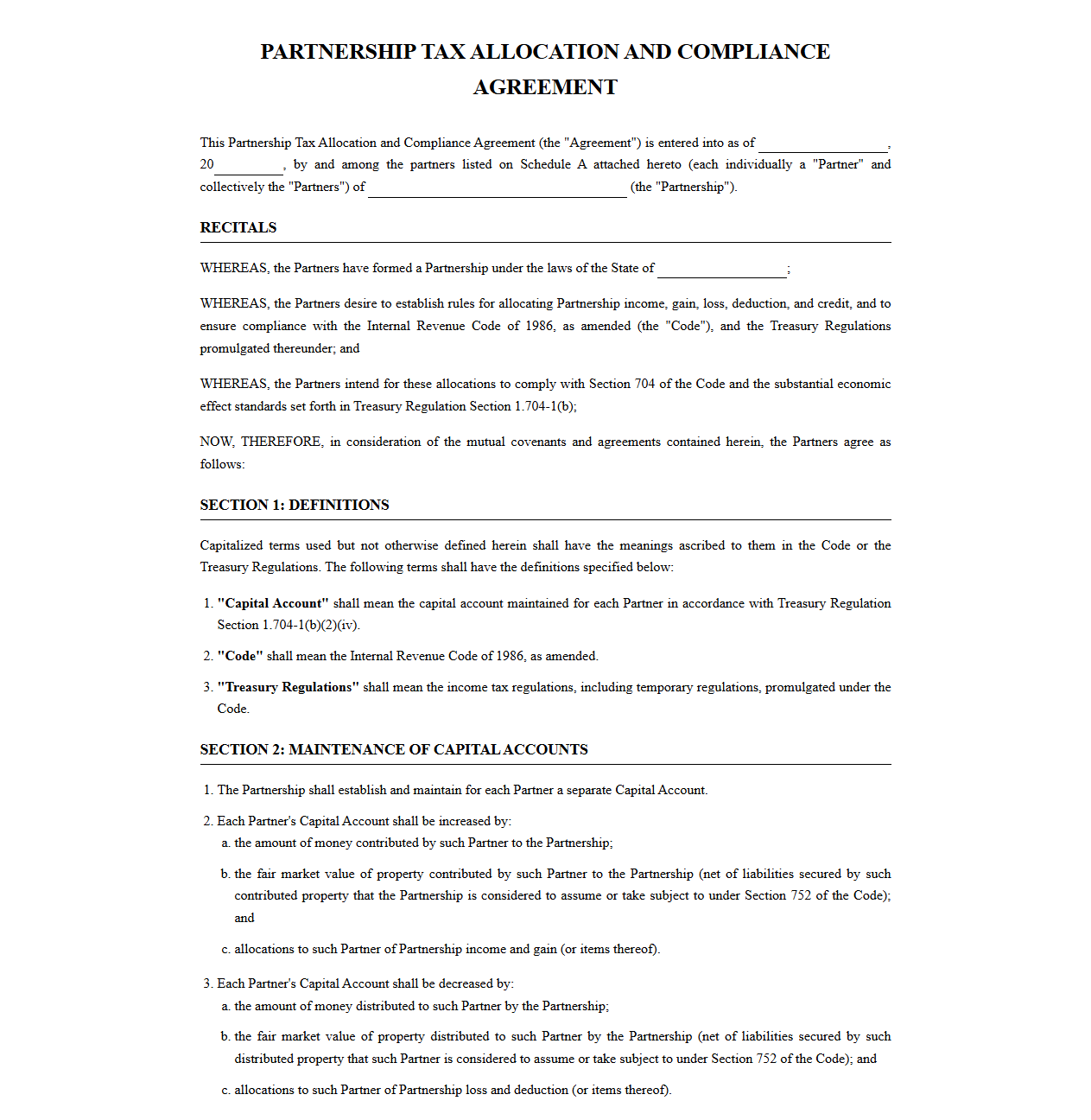
Partnership Tax Allocation and Compliance Agreement Template
 Download: .PDF
Agreement for Partnership Tax Allocation and Regulatory Compliance
 Download: .PDF
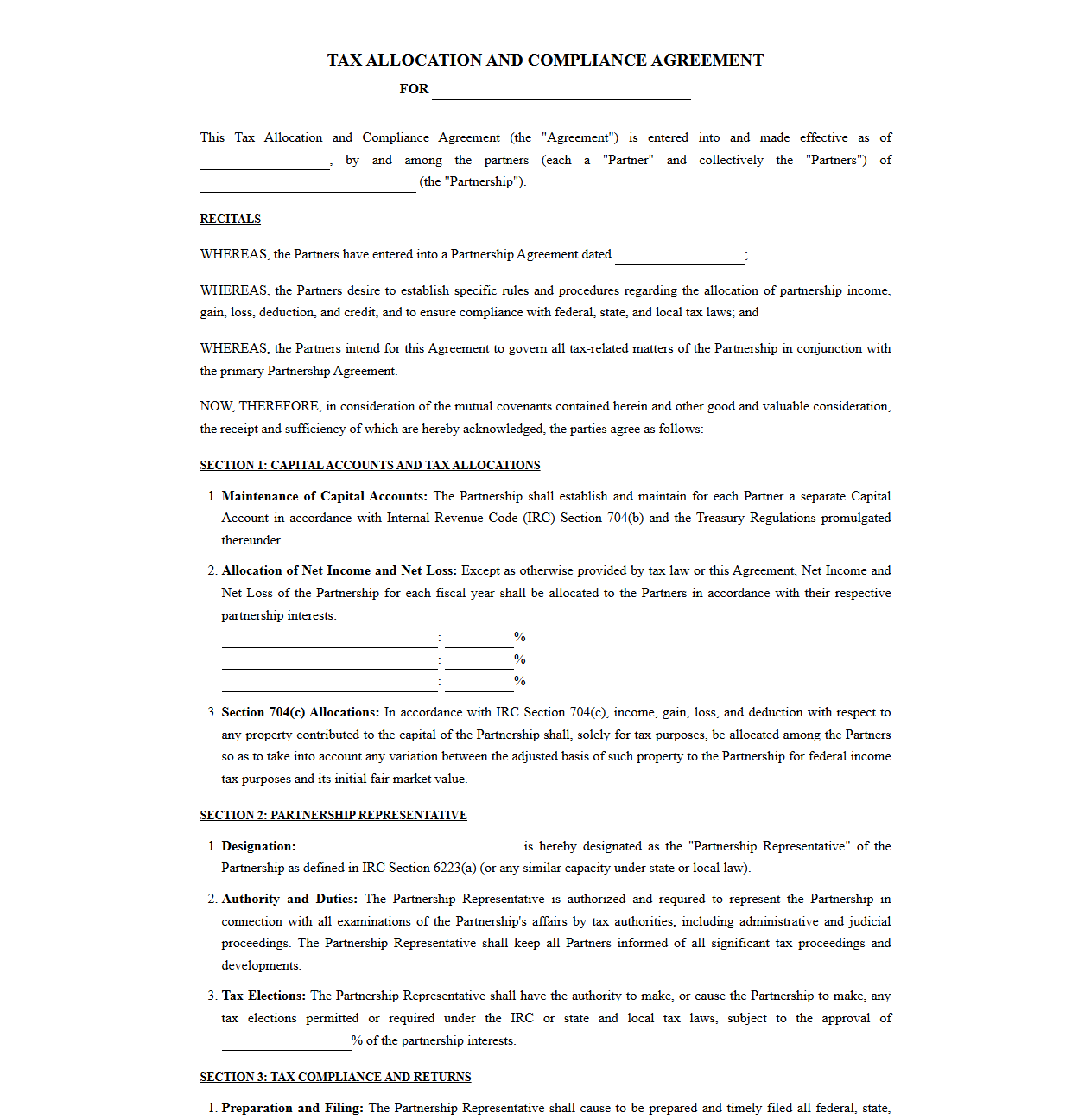
Tax Allocation and Compliance Agreement for Partnerships
 Download: .PDF
Partnership Agreement for Tax Allocation and Legal Compliance
 Download: .PDF
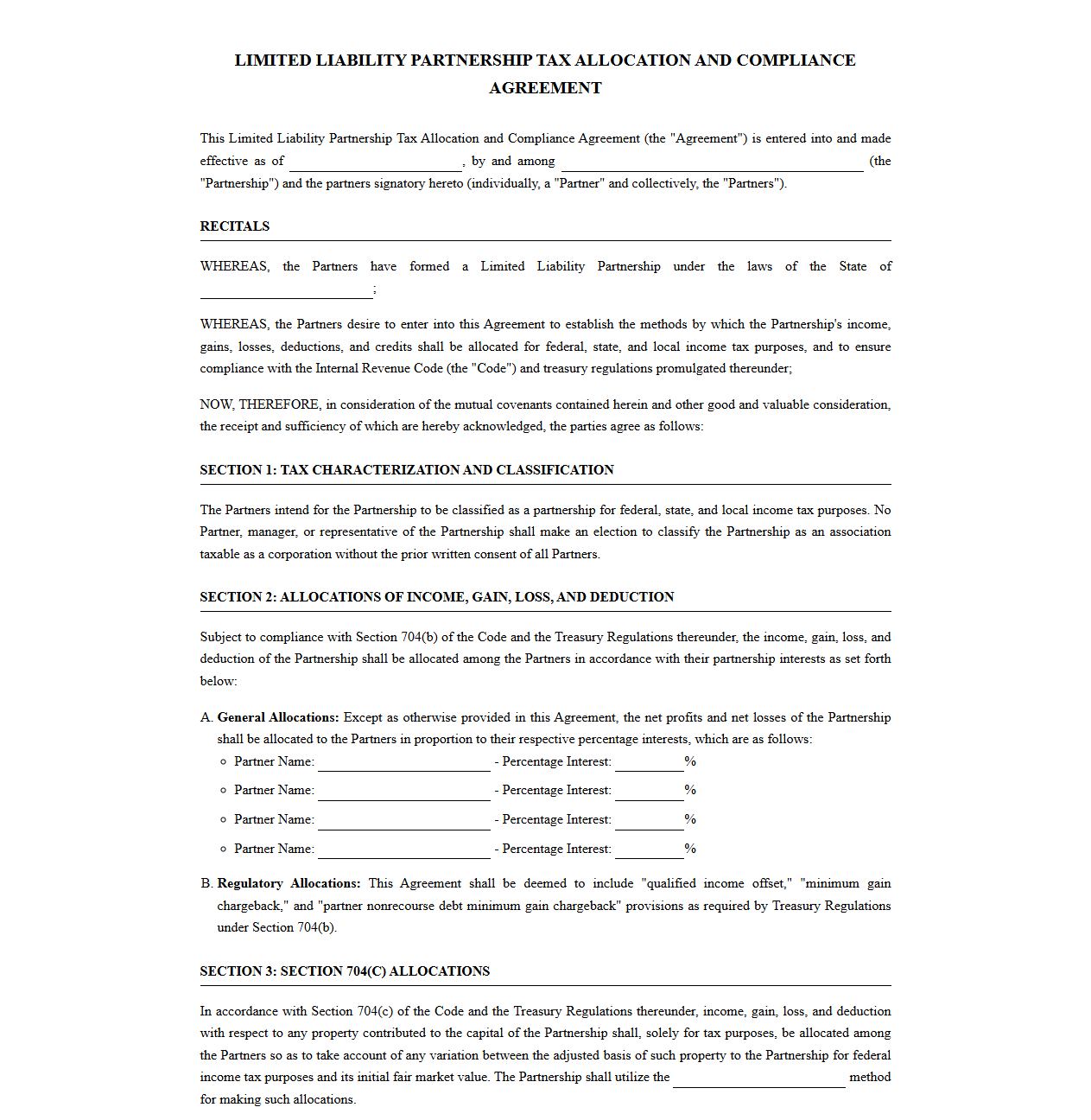
Limited Liability Partnership Tax Allocation and Compliance Agreement
 Download: .PDF
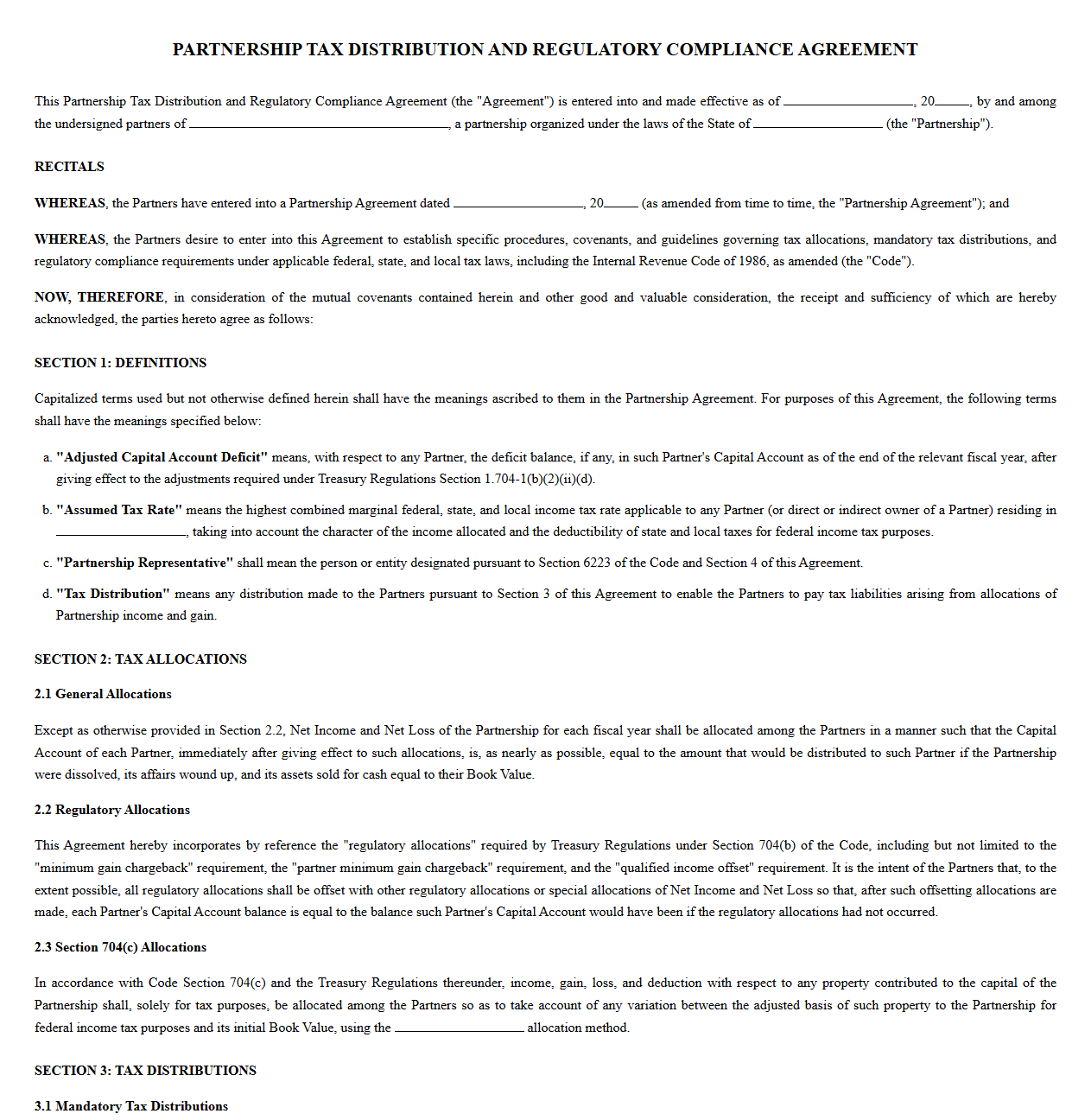
Partnership Tax Distribution and Regulatory Compliance Agreement
 Download: .PDF
Standard Partnership Tax Allocation and Compliance Contract
 Download: .PDF
General Partnership Tax Allocation and Compliance Agreement
 Download: .PDF
Section 1: Demystifying Partnership Tax Allocation Risks under IRC Section 704(b)
Partnership structures offer unparalleled flexibility in distributing profits, losses, and tax deductions among partners. However, this flexibility also makes them a prime target for federal regulatory scrutiny. The Internal Revenue Service (IRS) aggressively audits partnership returns to ensure that the allocations of tax items correspond to the actual economic arrangements of the partners. If an agreement allocates losses to one partner solely to reduce their tax liability while another partner reaps the actual financial gain, the IRS will step in to reallocate those items.
The primary weapon of federal tax authorities in this arena is IRC Section 704(b). Under this statute, a partnership's allocation of income, gain, loss, deduction, or credit will be disregarded if it lacks substantial economic effect. If the IRS determines that your allocation scheme fails this legal threshold, it possesses the authority to unilaterally recharacterize the transactions. This can lead to disastrous financial consequences, including retroactive tax liabilities, substantial underpayment penalties, and compounding interest charges for all partners involved.
Section 2: The Core Standard: Defining Substantial Economic Effect
To withstand an IRS audit, partnership allocations must pass a rigorous two-part test defined under Treasury Regulations. The allocations must possess both "economic effect" and that economic effect must be "substantial."
The Economic Effect Test
The economic effect test ensures that the partner who receives a tax allocation also bears the corresponding economic benefit or burden. In simple terms, if a partner is allocated a dollar of taxable income, they must eventually receive the economic benefit of that dollar. Conversely, if they are allocated a dollar of tax deduction, they must bear the actual economic risk of loss associated with that deduction.
"To have economic effect, an allocation must be consistent with the underlying economic arrangement of the partners. This means that in the event there is an economic benefit or economic burden corresponding to an allocation, the partner to whom the allocation is made must receive such economic benefit or bear such economic burden." - Treas. Reg. § 1.704-1(b)(2)(ii)
The Substantiality Test
Even if an allocation has economic effect, it will fail if that effect is not "substantial." This rules out allocations designed solely for tax avoidance. Under this rule, the economic effect of an allocation is not substantial if it merely shifts tax consequences among partners without significantly altering their pre-tax economic positions.
"The economic effect of an allocation (or allocations) is substantial if there is a reasonable possibility that the allocation (or allocations) will affect substantially the dollar amounts to be received by the partners from the partnership, independent of tax consequences." - Treas. Reg. § 1.704-1(b)(2)(iii)
Section 3: High-Risk Areas in Standard Partnership Agreements
Many business entities inadvertently expose themselves to audit risks by using outdated boilerplate partnership templates. The IRS closely examines specific operational mechanisms within these agreements to verify whether the economic effect rules are being strictly followed.
- Deficient Capital Account Maintenance: Failing to properly adjust capital accounts for constructive distributions, non-cash property contributions, or revaluations can invalidate the tax allocations of the entire partnership.
- Deficit Restoration Obligations (DRO): Standard agreements often require partners to restore negative capital account balances upon liquidation. If your agreement waives this requirement without implementing alternative protections, the IRS may invalidate loss allocations to partners with negative capital accounts.
- Improper Handling of Nonrecourse Deductions: Deductions funded by nonrecourse debt cannot have economic effect because the creditor bears the ultimate risk of loss. Partnerships must use highly specific allocations and minimum gain chargebacks to keep these deductions compliant.
Section 4: Essential Compliance Templates and Clauses to Adopt
To safeguard your partnership from reallocation risks, your operating agreement must contain precise legal language. Below are standard boilerplate clauses that help ensure your partnership aligns with safe harbor guidelines under IRC Section 704(b).
The first clause establishes strict adherence to Treasury Regulation capital account maintenance rules:
SECTION X.1: CAPITAL ACCOUNTS
The Partnership shall establish and maintain for each Partner a separate Capital Account in accordance with the rules of Treasury Regulation Section 1.704-1(b)(2)(iv). Each Capital Account shall be increased by (a) the amount of money contributed by such Partner, (b) the fair market value of property contributed by such Partner, and (c) allocations to such Partner of Partnership income and gain. Each Capital Account shall be decreased by (x) the amount of money distributed to such Partner, (y) the fair market value of property distributed to such Partner, and (z) allocations to such Partner of Partnership expenditures, losses, and deductions.
The second clause is a Qualified Income Offset (QIO), which is necessary to satisfy the "alternate test for economic effect" if partners do not have a deficit restoration obligation:
SECTION X.2: QUALIFIED INCOME OFFSET
In the event any Partner unexpectedly receives any adjustments, allocations, or distributions described in Treasury Regulation Sections 1.704-1(b)(2)(ii)(d)(4), (5), or (6), items of Partnership income and gain shall be specially allocated to such Partner in an amount and manner sufficient to eliminate the Deficit Capital Account balance of such Partner as quickly as possible, provided that an allocation pursuant to this Section shall be made only if and to the extent that such Partner would have a Deficit Capital Account balance after all other allocations provided for in this Article have been tentatively made.
The third clause is a Minimum Gain Chargeback, which is mandatory when partnerships utilize nonrecourse debt to fund property acquisitions or operations:
SECTION X.3: PARTNERSHIP MINIMUM GAIN CHARGEBACK
Except as otherwise provided in Treasury Regulation Section 1.704-2(f), if there is a net decrease in Partnership Minimum Gain during any Partnership taxable year, each Partner shall be specially allocated items of Partnership income and gain for such year (and, if necessary, subsequent years) in an amount equal to such Partner's share of the net decrease in Partnership Minimum Gain, determined in accordance with Treasury Regulation Section 1.704-2(g).
Section 5: Customizing the Templates to Your Partnership Structure
A one-size-fits-all approach does not work for partnership tax allocations. Different industries require distinct allocations and adjustments to match their specific economic realities.
| Industry / Business Model | Key Allocation Priority | Required Template Customization |
|---|---|---|
| Real Estate Joint Ventures | Depreciation & Nonrecourse Debt | Must integrate a robust Minimum Gain Chargeback and detailed partner nonrecourse debt allocation clauses to handle leveraged property. |
| Tech Startups (IP Contributions) | Pre-contribution Gain (Section 704(c)) | Requires customized Section 704(c) allocation methods (e.g., traditional, curative, or remedial) to address book-to-tax disparities for contributed intellectual property. |
| Hedge Funds & Private Equity | Carried Interest & Targeted Allocations | Requires target allocation clauses tied to liquidating distributions rather than traditional capital account tracking, necessitating precise "savings clauses" to align with 704(b). |
Section 6: Proactive Maintenance: Annual Reviews and Audit Prep
Drafting a compliant partnership agreement is only the first step. To withstand IRS scrutiny, your ongoing bookkeeping must reflect the exact terms laid out in your legal documents.
- Conduct Annual Capital Account Reconciliation: At the close of every fiscal year, reconcile your tax-basis capital accounts and your "Book" capital accounts maintained under Section 704(b) guidelines to identify and resolve any discrepancies.
- Verify Nonrecourse Debt Allocations: Check that any liabilities allocated to partners for tax basis purposes match the structural risk profiles of your outstanding commercial loans and qualified nonrecourse financing.
- Review Transactions for Disguised Sales: Ensure that any partner contributions followed by distributions are not recharacterized by the IRS as disguised sales under Section 707.
- Engage Specialized Partnership Tax Counsel: Retain a qualified CPA or tax attorney annually to review your allocations, track regulatory updates, and sign off on your Form 1065 Schedule K-1s before filing.
Section 7: Securing Your Partnership's Financial Future
Ensuring that your partnership tax allocations comply with IRC Section 704(b) is not merely a bookkeeping requirement; it is a fundamental pillar of risk management. A single non-compliant clause can expose your business and its partners to devastating audits, reallocations, and retroactive penalties. Taking proactive steps today to structure, audit, and maintain your partnership agreements will protect your investments and prevent future disputes.
Do not wait for an IRS audit letter to find the gaps in your corporate documentation. Consult with a specialized tax professional today to review your current partnership agreement and verify that your allocation formulas satisfy the substantial economic effect safe harbor.

Leave a comment