

Managing a sudden cash shortfall when a partner fails to meet a capital call is one of the most stressful challenges in joint venture management, threatening both project timelines and partner relations.
Before taking drastic legal action, managing partners must first evaluate their existing operating agreement to understand the precise default provisions already in place. Utilizing pre-structured capital call and funding agreement templates grants stakeholders immediate clarity and a standardized, repeatable roadmap to resolve funding gaps without paralyzing ongoing operations.
Please note that while these templates serve as highly effective operational frameworks, they should be reviewed by legal counsel to ensure compliance with your specific state laws and entity structures. For instance, our templates feature concrete mechanisms for equity dilution, default loan conversions, and non-defaulting partner advances to illustrate how these remedies function in practice.
Below, we will break down the essential components of these templates and outline how to execute them to protect your venture's financial health.
Partner Capital Call and Funding Agreement Template
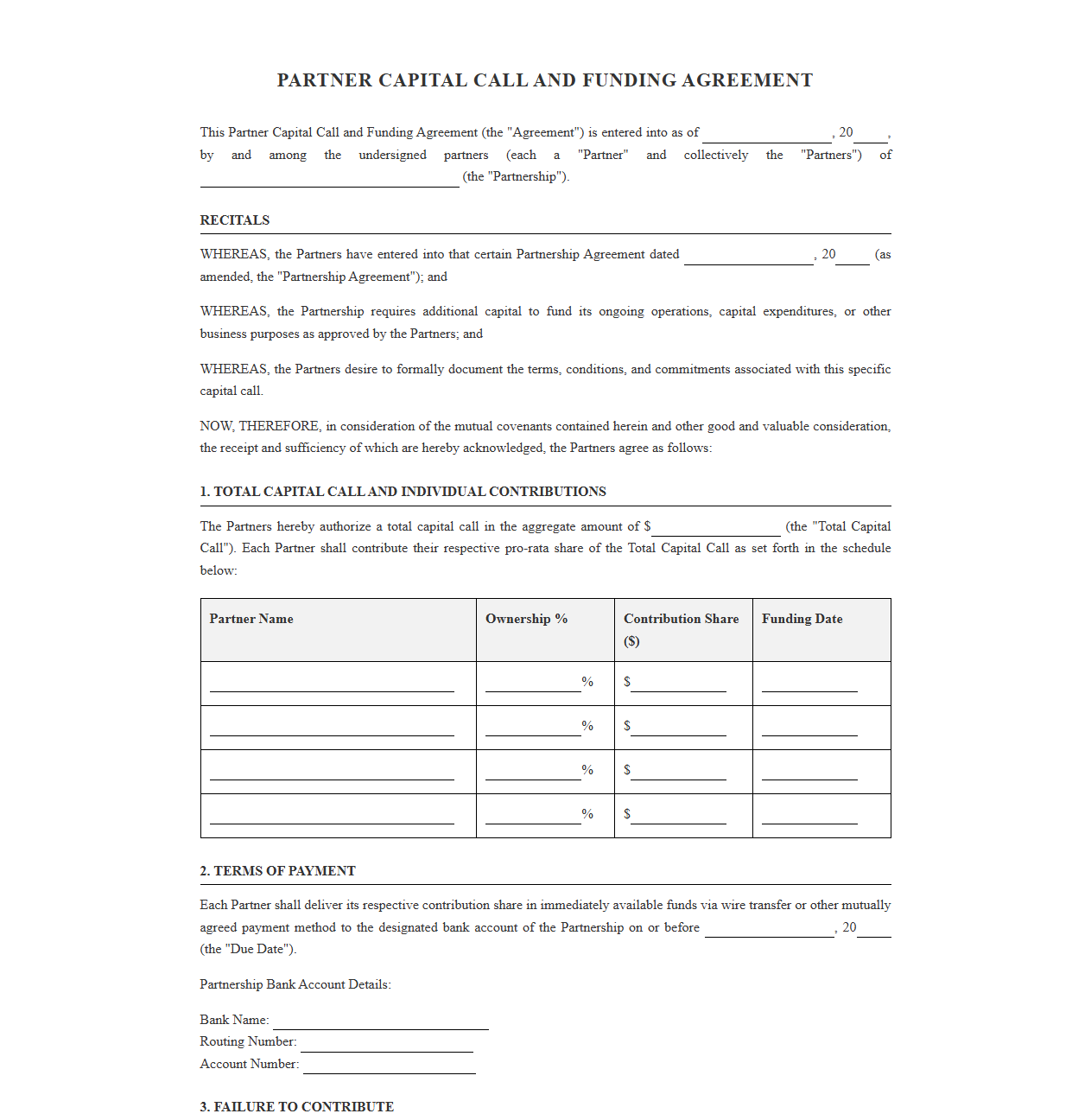 Download: .PDF
Partnership Capital Contribution and Funding Agreement
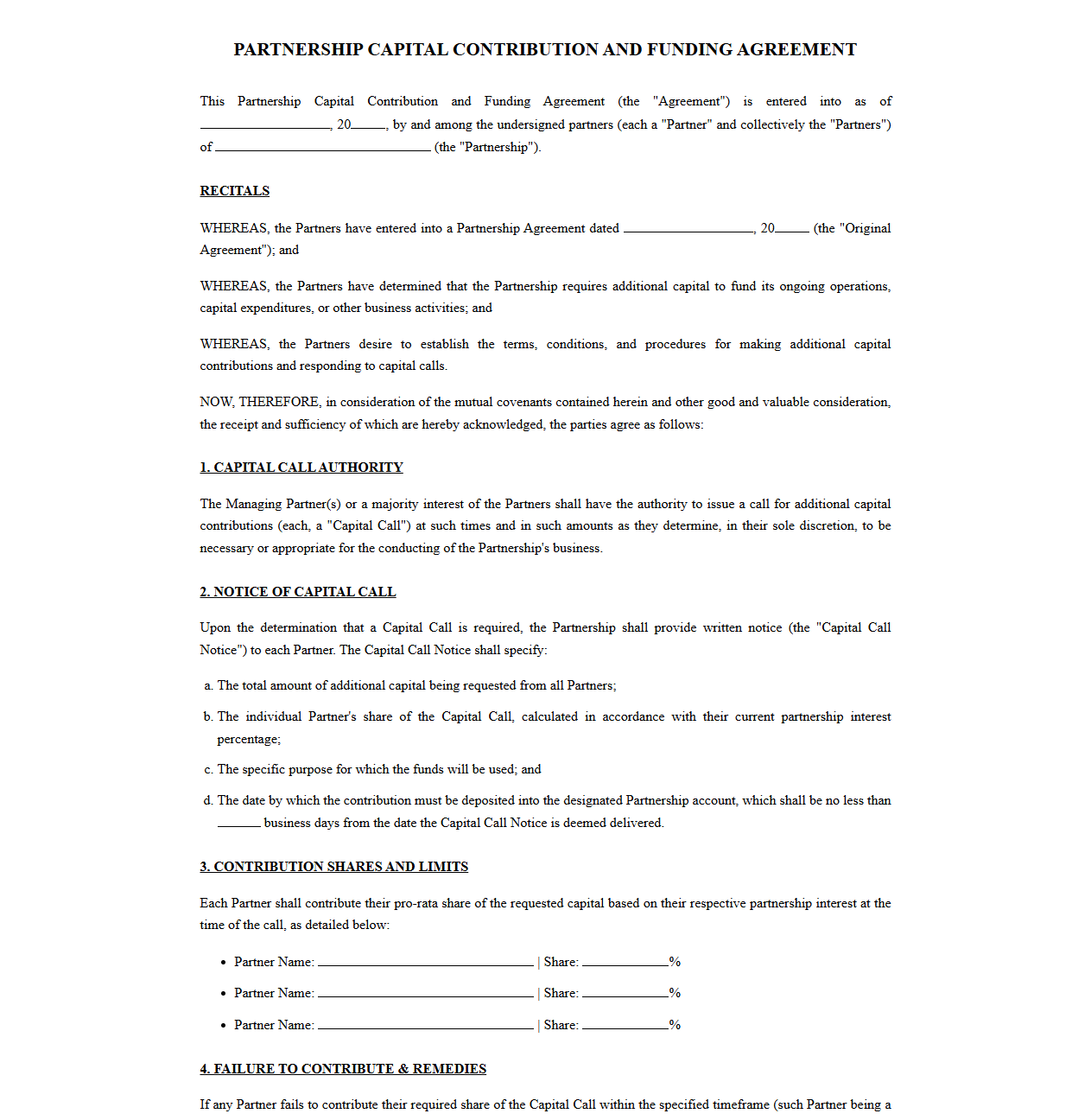 Download: .PDF
Capital Call Deed and Partner Funding Agreement
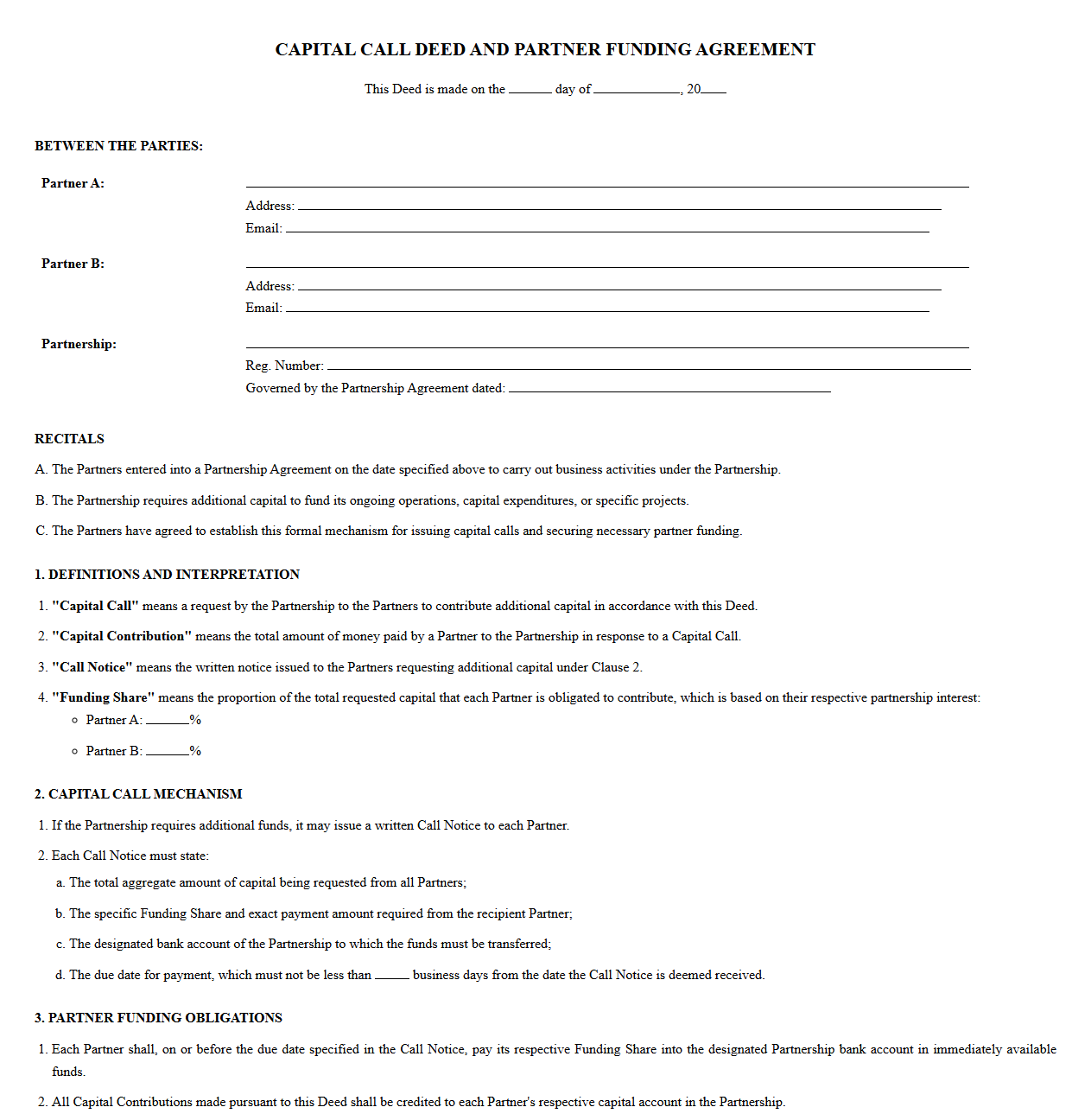 Download: .PDF
Partner Capital Commitment and Funding Agreement
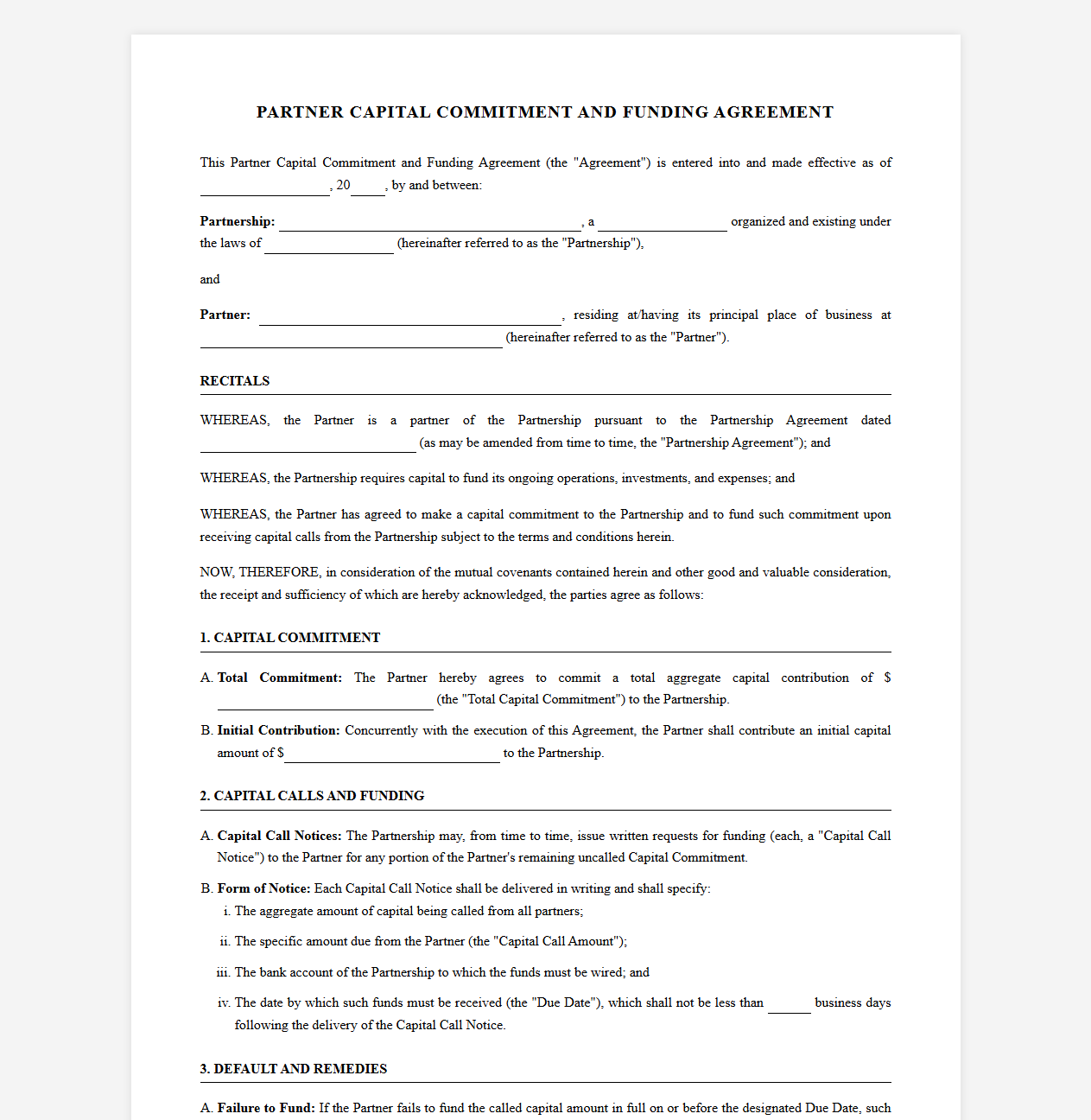 Download: .PDF
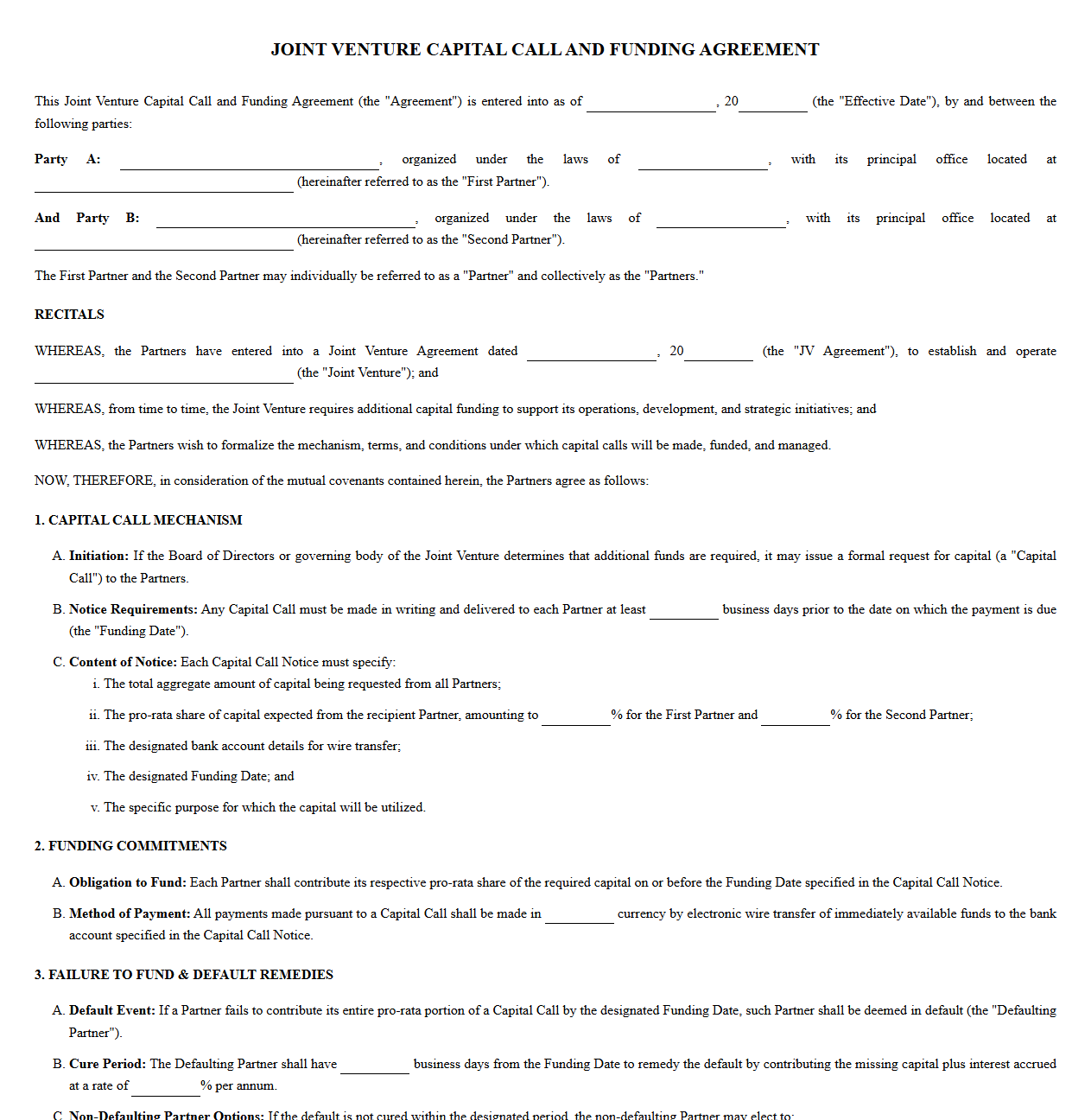
Joint Venture Capital Call and Funding Contract
 Download: .PDF
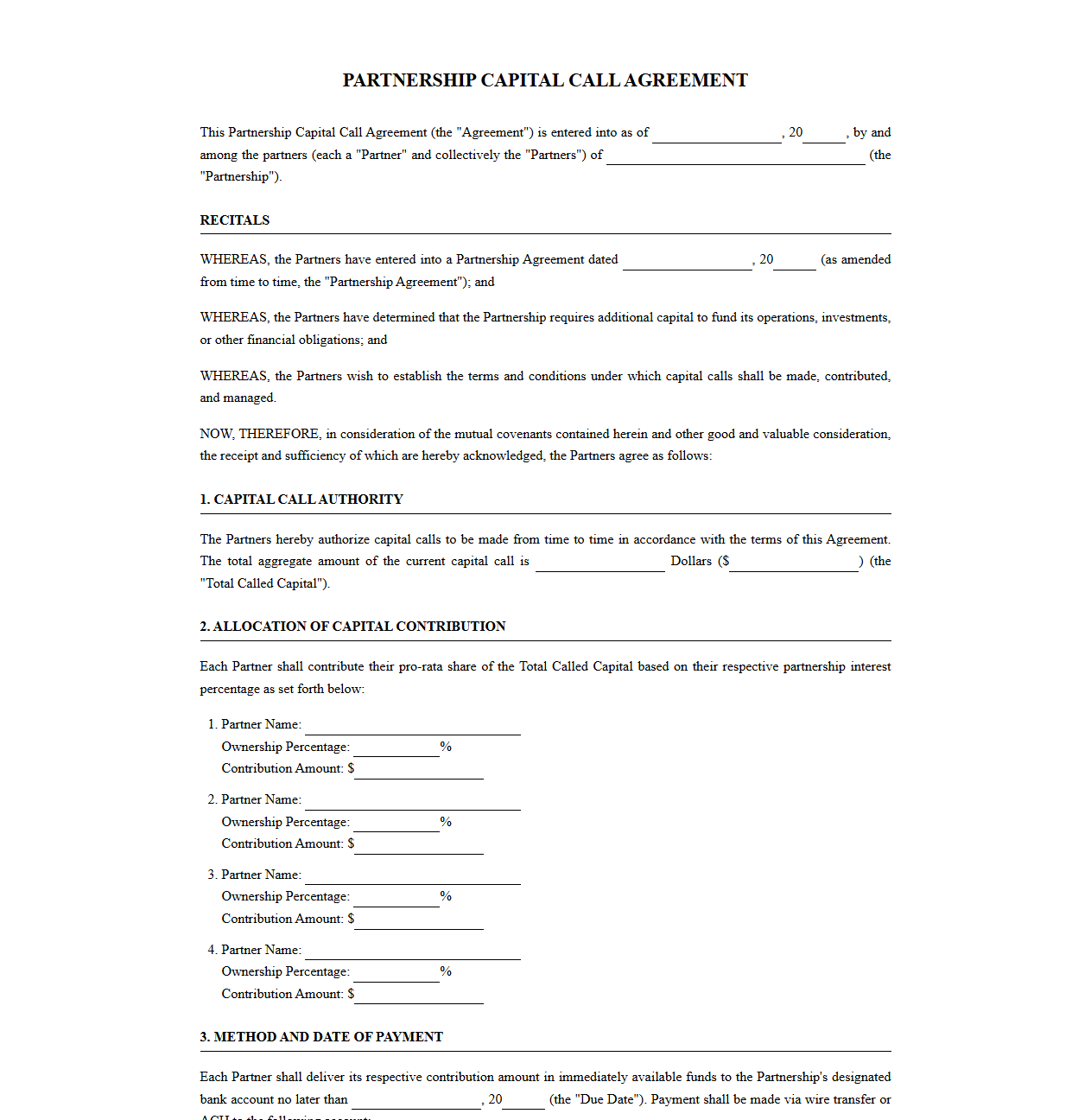
Partnership Capital Call Agreement
 Download: .PDF
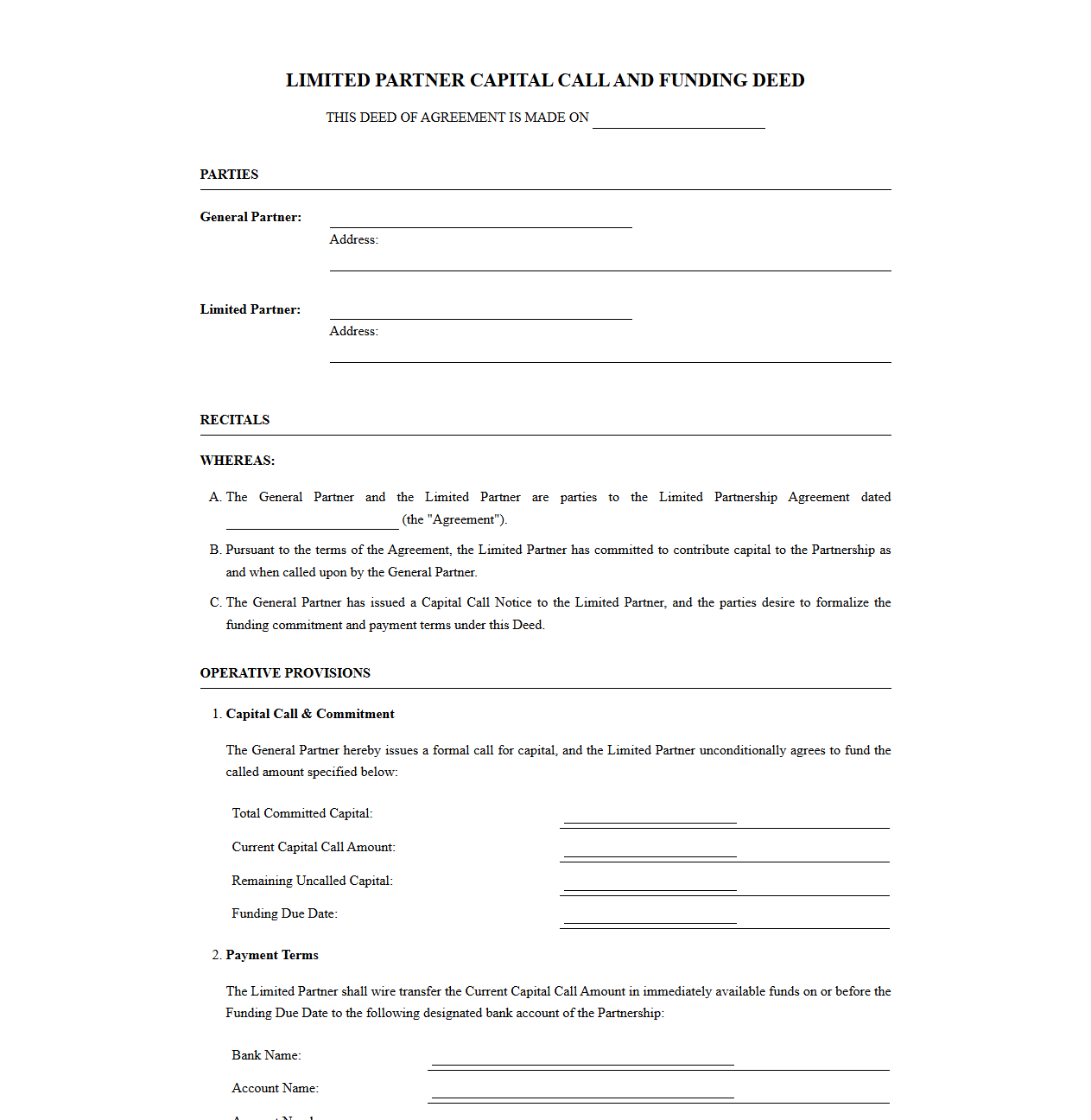
Limited Partner Capital Call and Funding Deed
 Download: .PDF
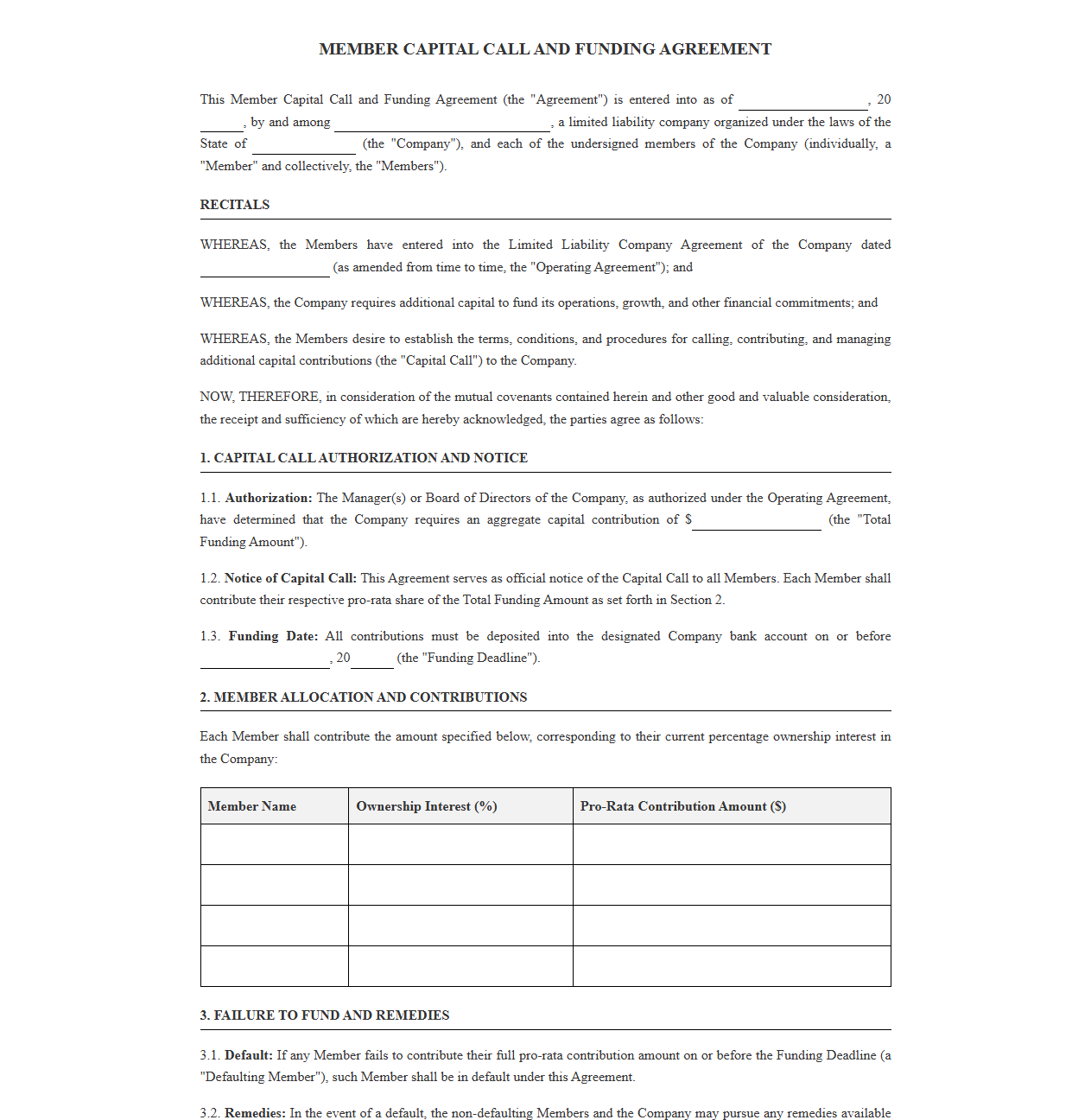
Member Capital Call and Funding Agreement Template
 Download: .PDF
Partner Funding and Capital Call Protocol Document
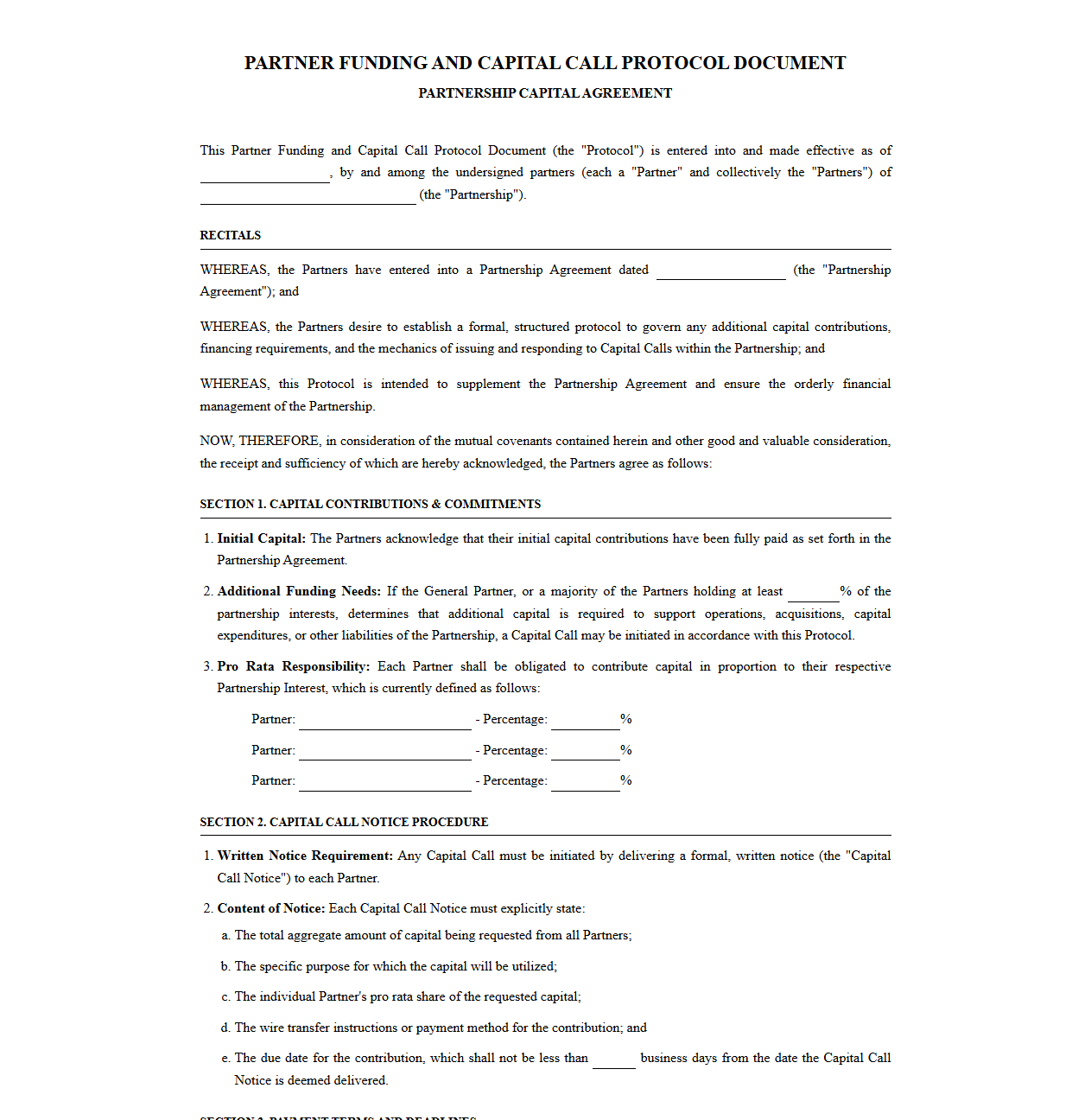 Download: .PDF
Understanding Capital Calls and Contribution Shortfalls
In a partnership structure, capital calls are an essential mechanism used to solicit additional funds from partners to meet sudden financial obligations or invest in growth opportunities. However, when a partner fails to meet their financial obligation, a contribution shortfall occurs.
This failure can trigger severe financial distress for the entire venture, resulting in missed strategic opportunities, project halts, and immediate operational disruption that can jeopardize the ongoing viability of the business.
The Role of a Partner Funding Agreement
A pre-negotiated Partner Funding Agreement serves as a vital safeguard for any collaborative business structure. Having these terms agreed upon in advance prevents costly litigation by establishing clear protocols before any dispute arises.
Establishing these parameters represents a highly proactive legal framework, offering a structured roadmap that guides partners through cash crunches without risking the destruction of the underlying business relationship.
Essential Clauses for Resolving Shortfalls
Critical Shortfall Provisions
To ensure absolute clarity during a funding emergency, several key clauses must be explicitly defined in the agreement.
- Default Definition: Clear parameters outlining what constitutes a formal failure to contribute.
- Contribution Deadlines: Strict timelines detailing when funds must be deposited following a notice.
- Grace Periods: A specific window of time post-deadline during which a defaulting partner can cure their shortfall without penalty.
Equity Dilution and Remedy Mechanisms
When a partner defaults, non-defaulting partners must have viable remedies to cover the capital gap. One common mechanism is a default loan, where the contributing partners cover the shortfall as a high-interest loan to the defaulting partner, repayable from future distributions.
Alternatively, the partnership may execute an equity dilution formula to reduce the defaulting partner's ownership stake. A standard dilution formula is represented as follows:
New Ownership % = (Prior Capital Contributed + (Default Penalty Factor * Shortfall Funded)) / Total Partnership Capital
Step-by-Step Capital Call Procedural Workflow
Adhering to a strict procedural sequence ensures that any enforcement actions taken against a defaulting partner are legally defensible.
- Identify a capital shortfall and issue a formal Capital Call Notice to all partners.
- Monitor contributions up to the designated Contribution Deadline.
- Identify any non-contributing partners and issue a Notice of Default.
- Initiate the mandatory Grace Period to allow the defaulting partner to cure the shortfall.
- If uncured, execute pre-agreed default remedies such as dilution or default loans.
Structuring Your Funding Agreement Template
Agreement Architecture
A robust Partner Funding Agreement should follow a clear, professional hierarchy, beginning with a formal preamble, followed by operational covenants, and concluding with signatures and detailed schedules.
"This Partner Funding Agreement (the 'Agreement') is entered into as of the Effective Date by and among the undersigned Partners, to establish terms governing emergency capital contributions and the remedies for default thereof."
Best Practices for Enforcement and Dispute Resolution
Enforcing a funding agreement requires a balance between protecting the partnership's financial health and preserving key business relationships. Partners should prioritize structured resolution pathways to resolve conflicts before escalating to public litigation.
Utilizing pre-agreed mediation and arbitration clauses ensures that disputes are handled privately and efficiently. Keeping communication open and leveraging these alternative dispute resolution mechanisms helps protect the enterprise from prolonged legal battles and maintains structural stability during periods of financial transition.

Leave a comment