

Navigating the labyrinth of State and Local Tax (SALT) consulting often leaves advisory firms exposed to unforeseen multi-jurisdictional liabilities and compliance disputes. As remote workforces and evolving economic nexus thresholds constantly shift the regulatory landscape, tax professionals must first establish a robust operational defense before advising clients across state lines.
Utilizing standardized, rigorously drafted agreement templates grants practitioners the risk-mitigation safeguard and operational clarity needed to protect their margins and client relationships. Although these frameworks-which incorporate specific liability limitation clauses and detailed nexus questionnaires-are educational tools and do not substitute for formal legal review, they serve as an essential frontline defense.
Below, we examine the critical contractual provisions, risk-mitigation strategies, and customizable templates necessary to secure your SALT practice against cross-border complexities.
State and Local Tax Consulting Services Agreement
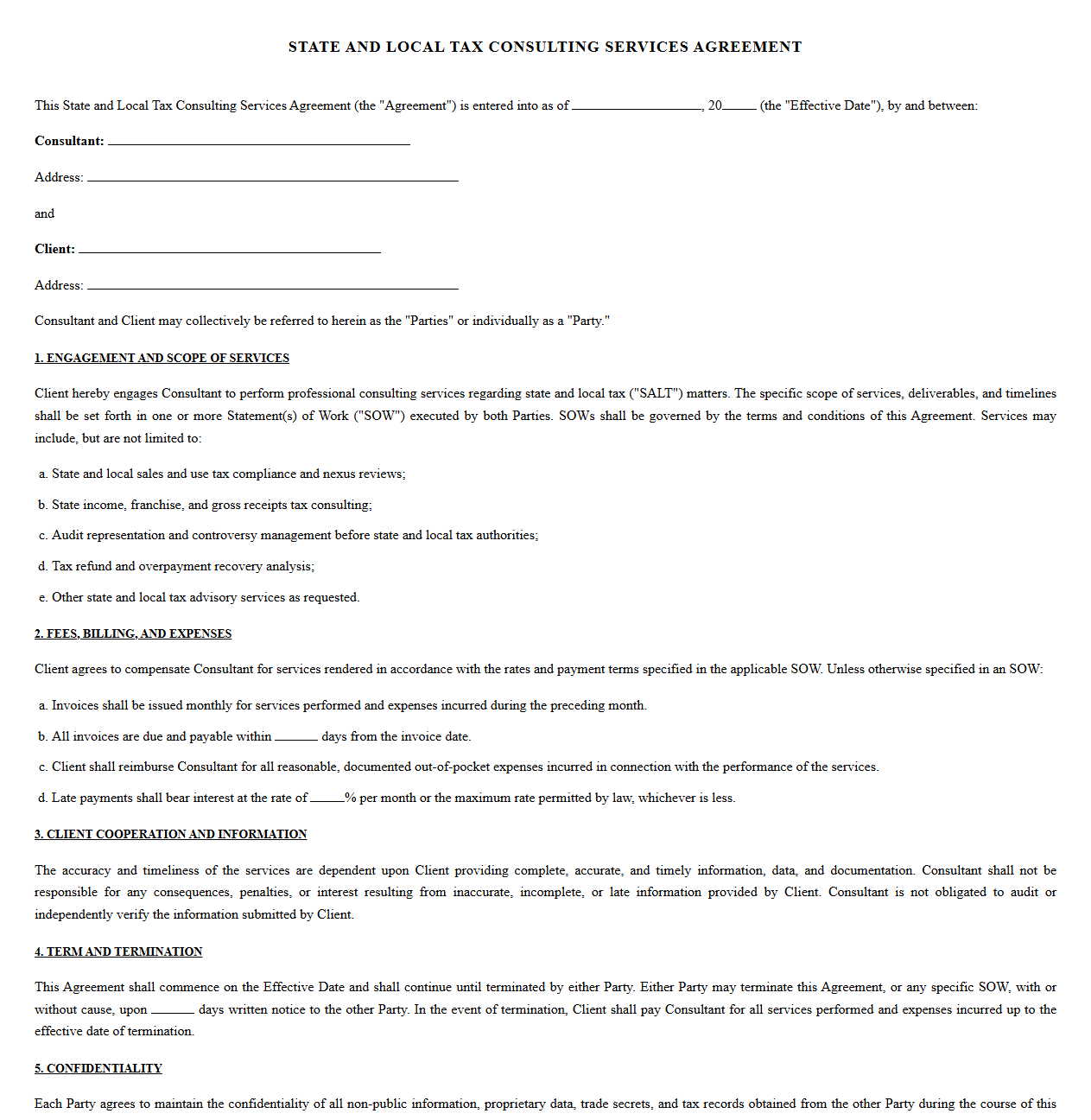 Download: .PDF
SALT Consulting Services Agreement Template
 Download: .PDF
State and Local Tax Advisory Services Contract
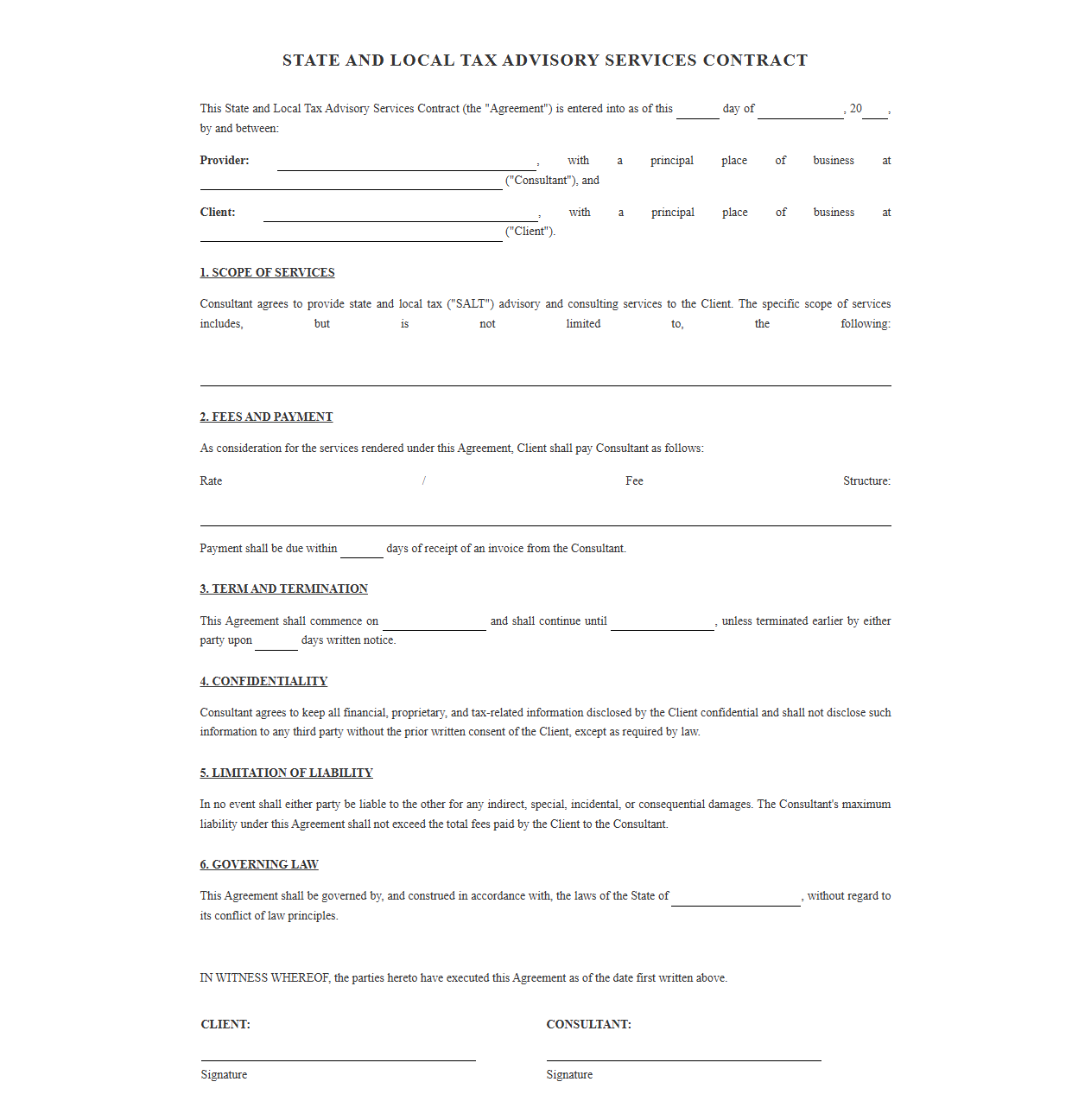 Download: .PDF
SALT Advisory Services Engagement Agreement
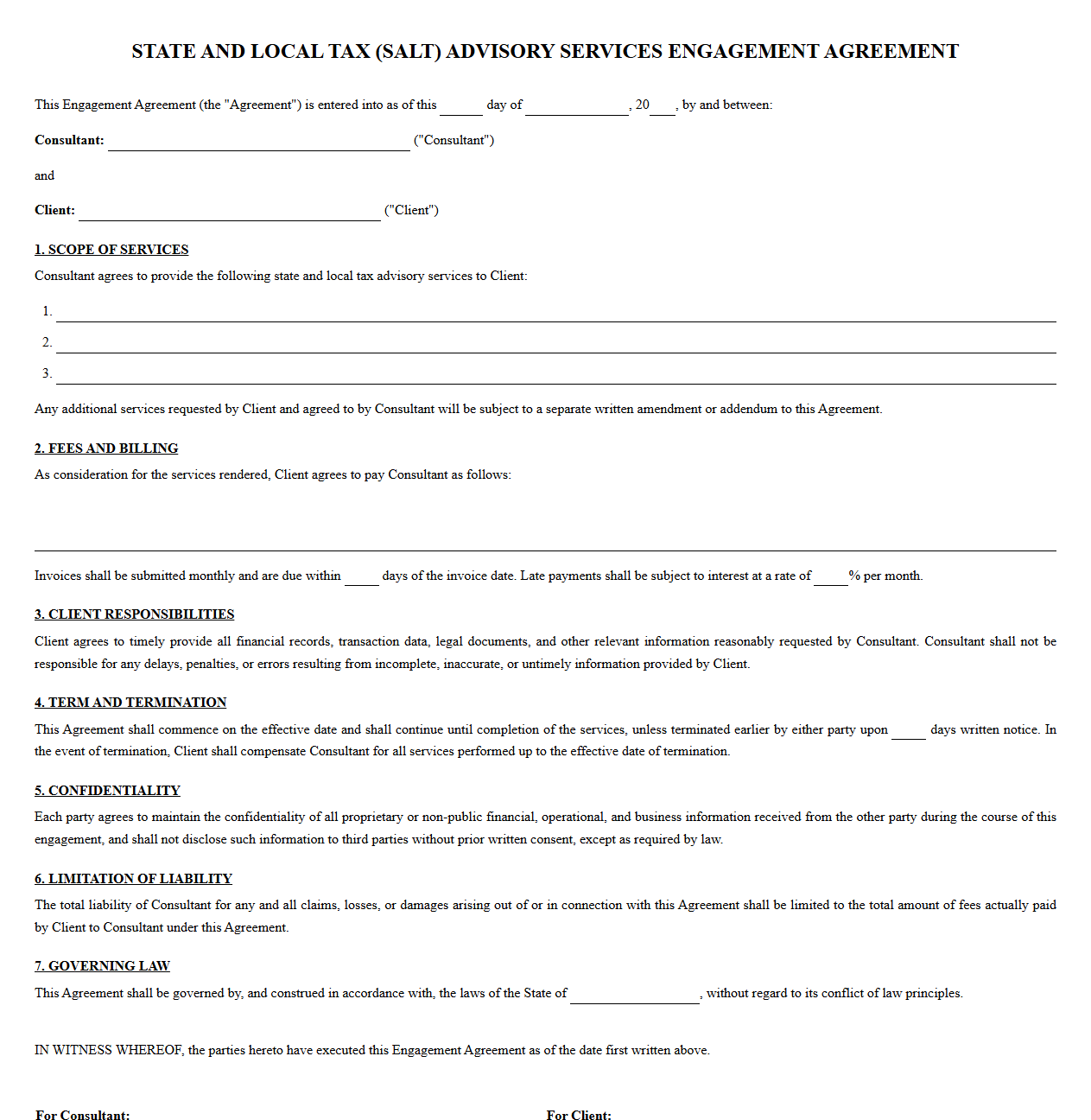 Download: .PDF
State and Local Tax Consulting Engagement Letter
 Download: .PDF
Master Services Agreement for State and Local Tax
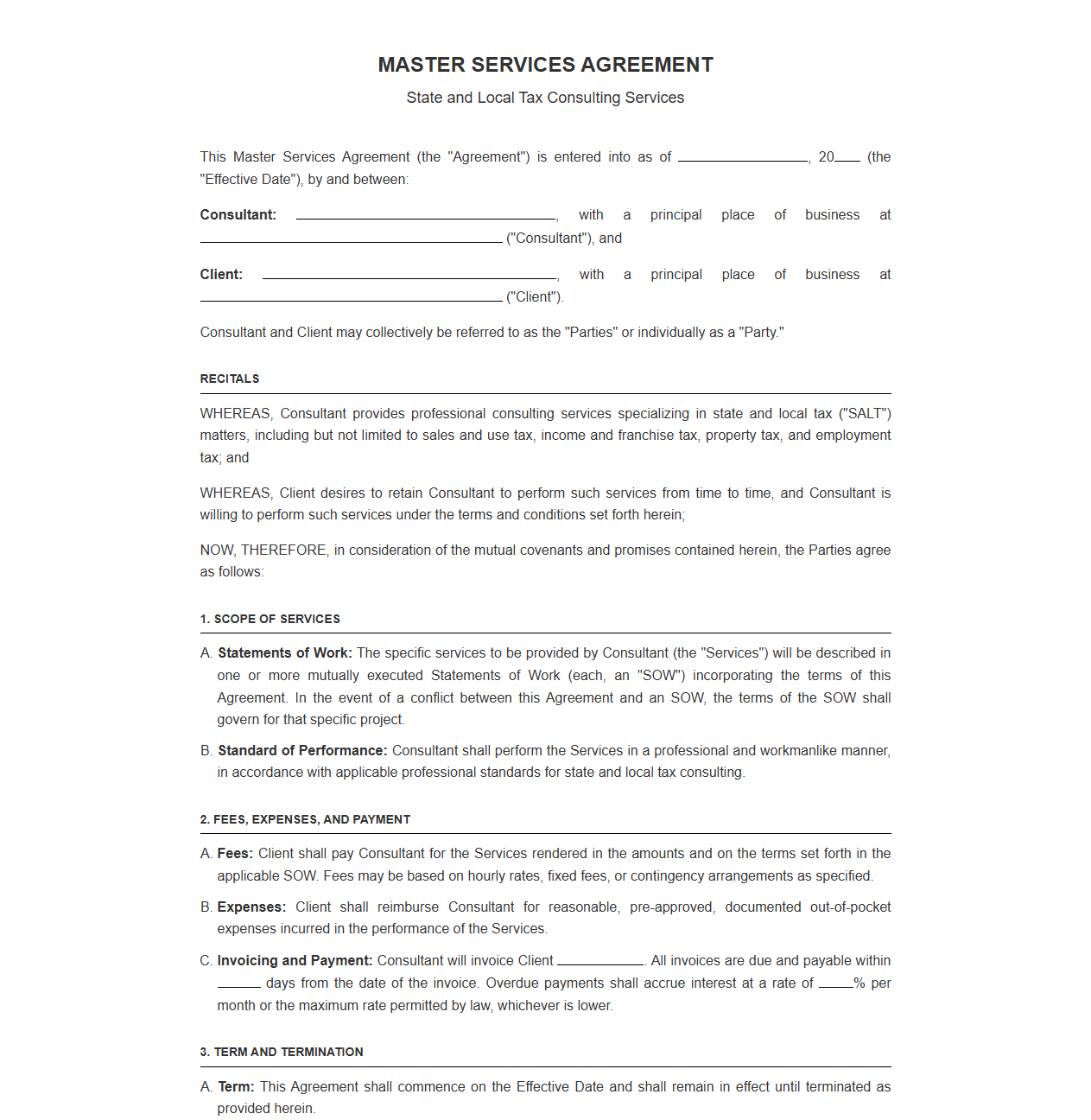 Download: .PDF
Professional Services Agreement for SALT Consulting
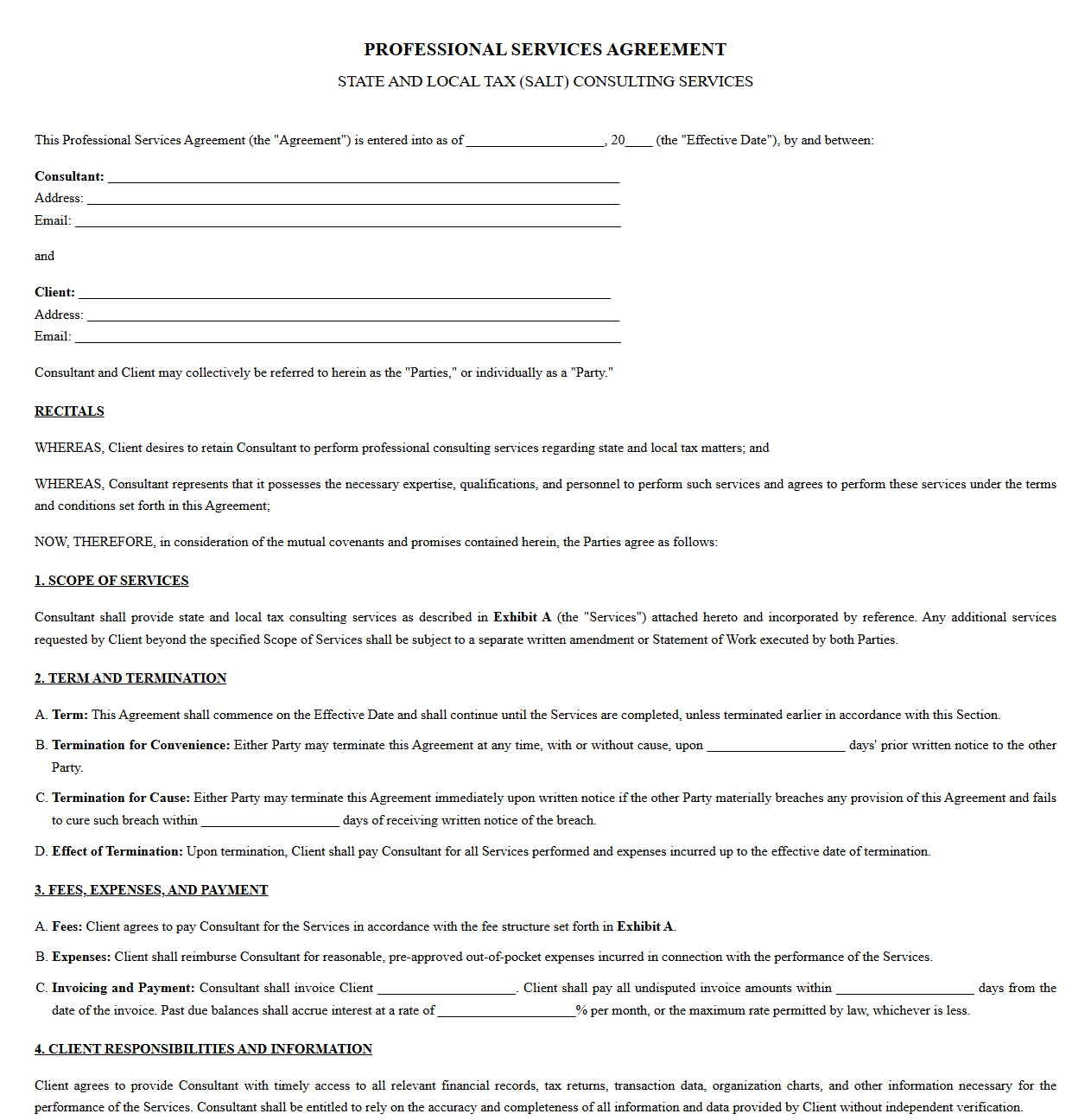 Download: .PDF
State and Local Tax Consulting Retainer Agreement
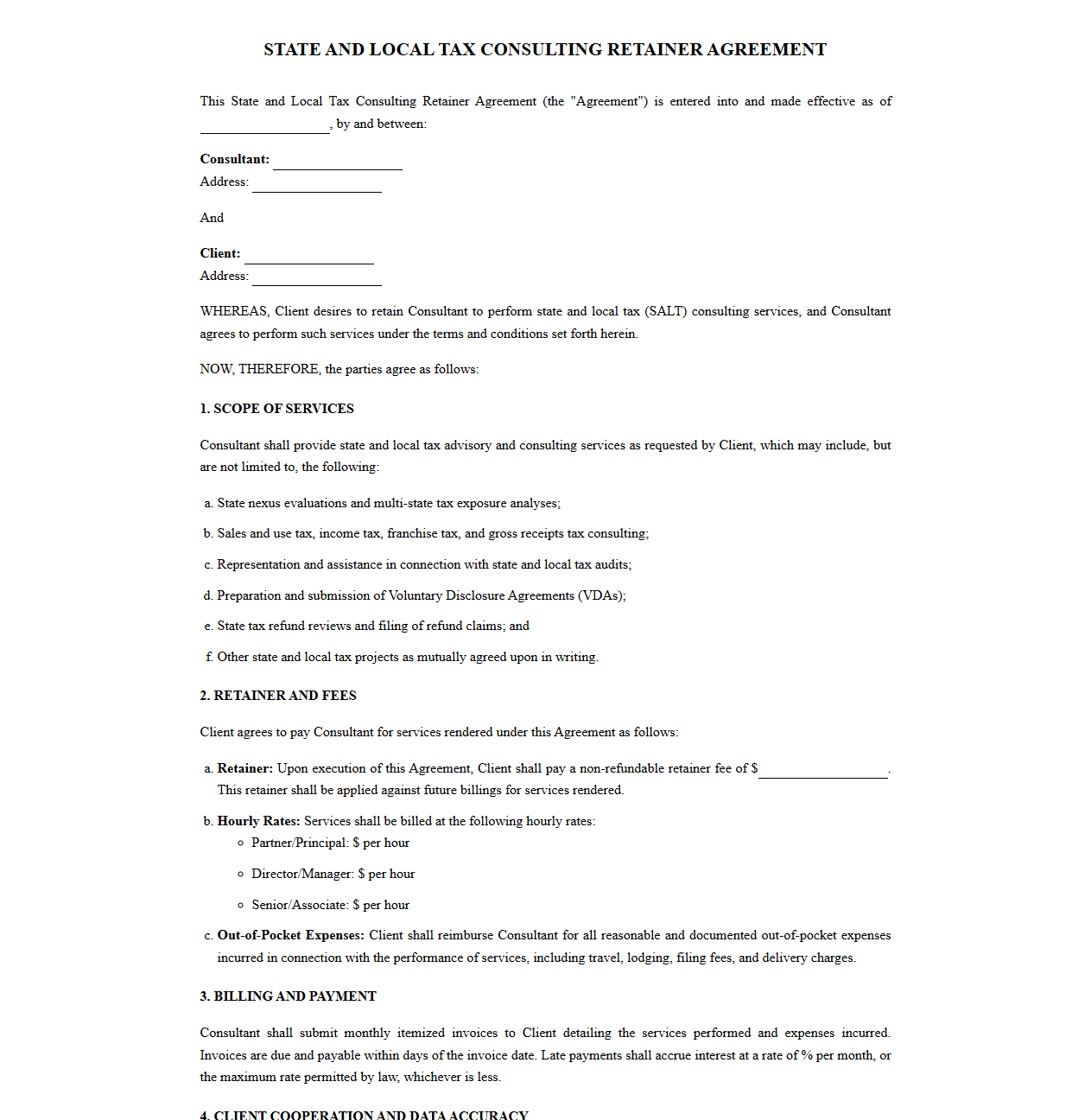 Download: .PDF
Navigating the Complexities of Multi-Jurisdictional SALT Compliance
Tax consultants operating in the modern regulatory environment face a labyrinth of overlapping state and local tax (SALT) regulations. With thousands of taxing jurisdictions across the country, each maintaining distinct rules for income, franchise, sales, and use taxes, the risk of non-compliance is exceptionally high. Navigating these waters requires not only deep technical expertise but also robust, legally binding agreement templates that define responsibilities and protect against liabilities. Crucial to this effort is managing the risk of establishing an unexpected taxable presence, or nexus, and correctly calculating the percentage of income attributable to each state through complex apportionment rules. Without precise, standardized agreements, consultants and their clients can easily find themselves exposed to double taxation and severe audit penalties.
The Foundation: Drafting Precise Scope of Work (SOW) and Engagement Letters
An engagement letter is the primary shield against disputes, specifically when dealing with multi-jurisdictional tax profiles. To prevent scope creep-where additional state filings are assumed by the client to be covered but are not-and to avoid the unauthorized practice of law (UPL), the Scope of Work (SOW) must outline strict jurisdictional boundaries.
A solid SOW must leave no ambiguity regarding which jurisdictions are actively being evaluated and which are excluded. A robust template should always incorporate the following critical elements:
- Jurisdictional Exhaustiveness: A clear, exhaustive list of specifically covered states and localities, explicitly stating that no other jurisdictions are included unless amended in writing.
- Exclusion of Legal Advice: A prominent disclaimer stating that the services provided are strictly accounting and tax advisory, not legal counsel, to mitigate UPL risks.
- Client Data Responsibility: A clause indicating that the accuracy of the tax analysis depends entirely on the completeness of the financial records provided by the client.
Structuring Intercompany Services Agreements for SALT Alignment
State tax auditors frequently scrutinize transactions between related corporate entities to identify artificial shifting of income. Intercompany services agreements must be meticulously structured to survive rigorous transfer pricing audits, demonstrating that all charges reflect economic reality and market rates.
To ensure alignment with both state-specific policies and federal arm's length principles, these agreements must clearly articulate the cost-sharing methodology and the exact nature of the services rendered. A robust intercompany pricing clause should be included in every corporate group template:
"All services provided under this Agreement shall be compensated at a rate equivalent to an arm's length price, calculated using a certified transfer pricing methodology. Under no circumstances shall charges deviate from the fair market value of equivalent third-party transactions, and cost-sharing allocations shall be adjusted annually to reflect actual operational utilization."
Allocating Risk: Indemnification and Limitation of Liability Clauses
Despite meticulous planning, unforeseen state tax assessments can occur due to sudden changes in administrative policy or retroactive state court rulings. It is vital to construct balanced defense, indemnification, and liability cap clauses to isolate your firm from catastrophic financial consequences.
Indemnification clauses must clearly define who is responsible for paying back-taxes, interest, and penalties if an audit determines a filing position was incorrect. At the same time, liability caps should limit the consultant's total financial exposure to a manageable threshold, such as fees collected under the specific engagement.
Safeguarding Confidentiality: Multi-Jurisdictional NDAs and Data Security
Tax consultations require the transmission of highly sensitive financial records, proprietary business strategies, and personally identifiable information (PII). When transferring this data across state lines, firms must comply with a fragmented landscape of state-level data privacy regulations.
A comprehensive Non-Disclosure Agreement (NDA) or a dedicated privacy addendum must account for strict mandates like the California Consumer Privacy Act (CCPA) and its various state-level equivalents. The contract must emphasize that data storage, processing, and disposal will satisfy the highest statutory requirements of all involved jurisdictions, ensuring regulatory compliance and protecting the firm from severe statutory fines in the event of a data breach.
Resolving Conflicts: Choice of Law and Forum Selection Clauses
When a tax advisory contract spans multiple states, a dispute over contract performance can quickly deteriorate into a battle over which state court has jurisdiction. Conflicting legal precedents regarding tax liability make the choice of governing law a strategic necessity rather than a boilerplate afterthought.
To establish predictable legal outcomes, agreements must feature mutually agreed-upon forum selection and choice of law clauses. By designating a single, business-friendly state with well-developed corporate and tax jurisprudence, parties can avoid costly jurisdictional disputes and ensure that any eventual litigation is conducted under a familiar and stable legal framework.
Future-Proofing: Regular Audit and Maintenance of Agreement Templates
The SALT landscape is dynamic, shaped by continuous state legislative sessions, administrative rule changes, and landmark judicial decisions. A template that was legally sound last year may expose your firm to significant risk today due to shifting definitions of taxable activity.
Tax practices must implement a disciplined schedule for reviewing and updating their contract libraries. This ongoing maintenance ensures that language remains aligned with the latest rulings on economic nexus and administrative apportionments, protecting the firm's bottom line and maintaining service excellence.

Leave a comment