

Managing subcontractor financial records often devolves into an administrative nightmare for prime contractors, characterized by missing receipts, inconsistent formatting, and the constant dread of audit non-compliance. In an era of escalating regulatory scrutiny, relying on ad-hoc reporting methods is no longer a viable operational strategy.
Implementing standardized record-keeping agreements grants your organization absolute financial visibility and effortless audit readiness. However, as a crucial stipulation, these templates must be treated as customizable frameworks rather than rigid legal advice, requiring adaptation to align with local jurisdictional tax codes. To ensure compliance, agreements must explicitly mandate concrete deliverables, such as itemized daily expense logs, verified payroll reports, and certified equipment invoices.
This article will explore the core pillars of standardized financial accountability, provide customizable agreement templates, and outline best practices for integrating these tools into your existing vendor management workflows.
Subcontractor Financial Record Keeping Agreement Template
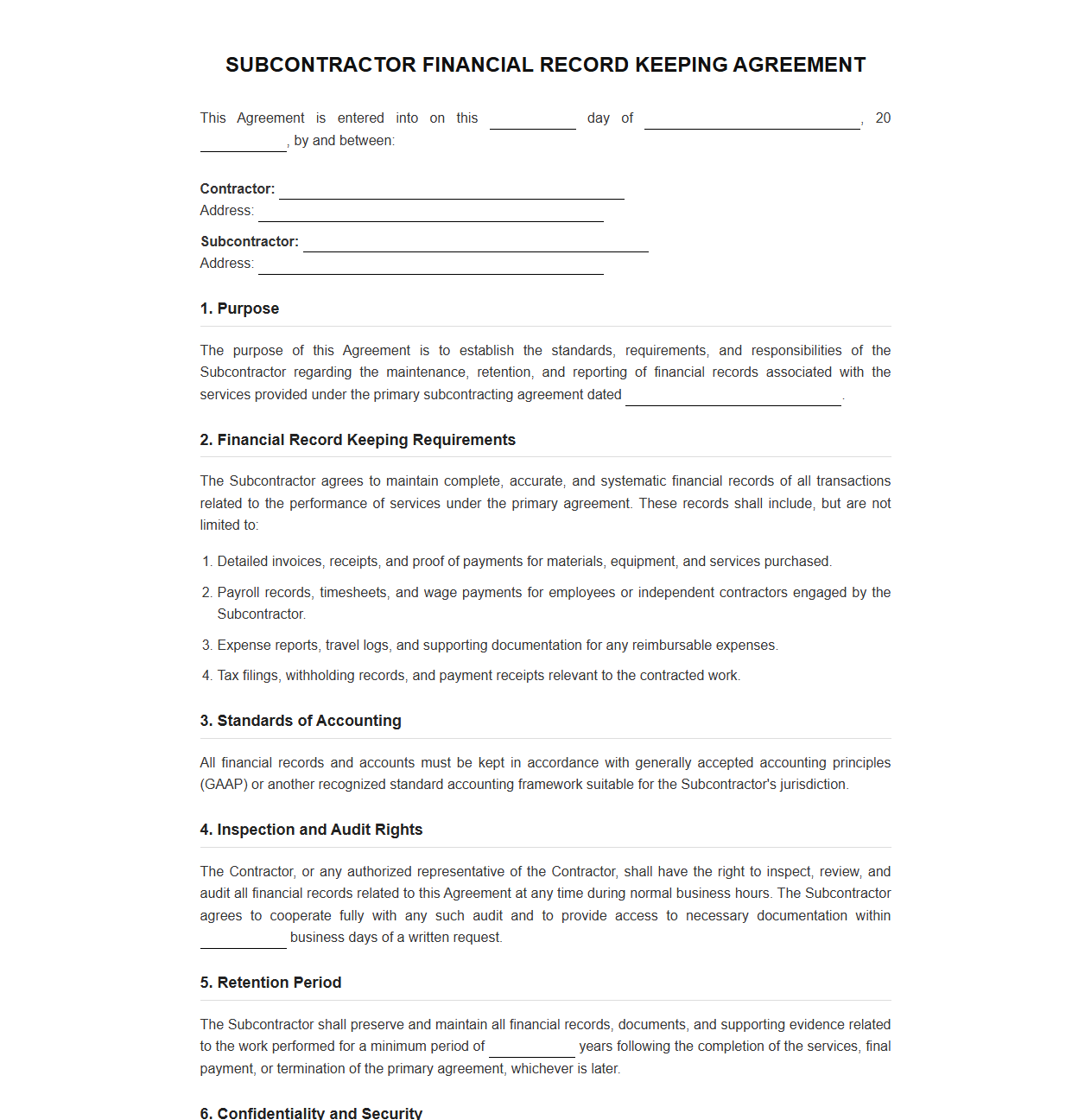 Download: .PDF
Financial Record Keeping Contract for Subcontractors
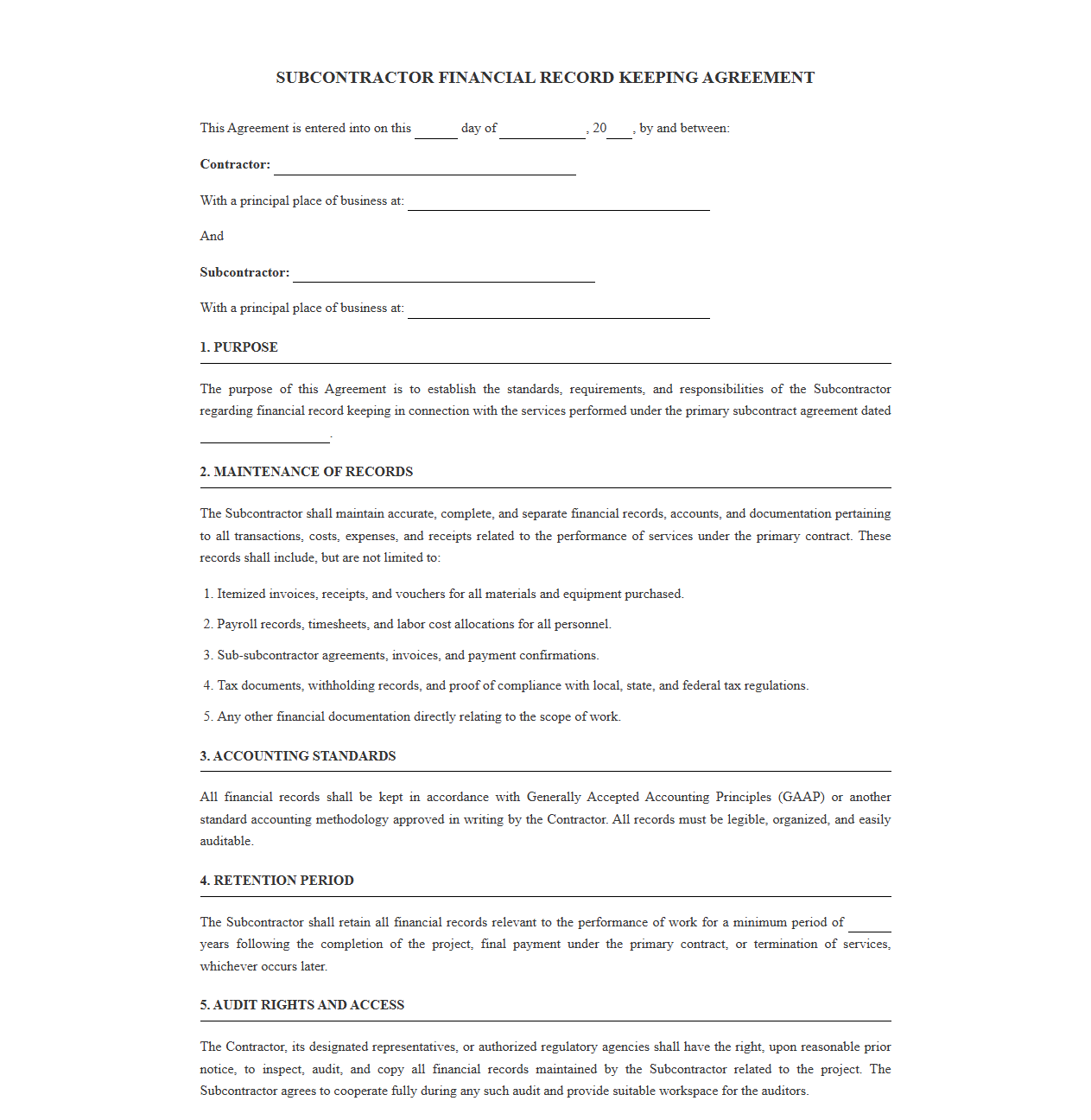 Download: .PDF
Subcontractor Financial Reporting and Bookkeeping Agreement
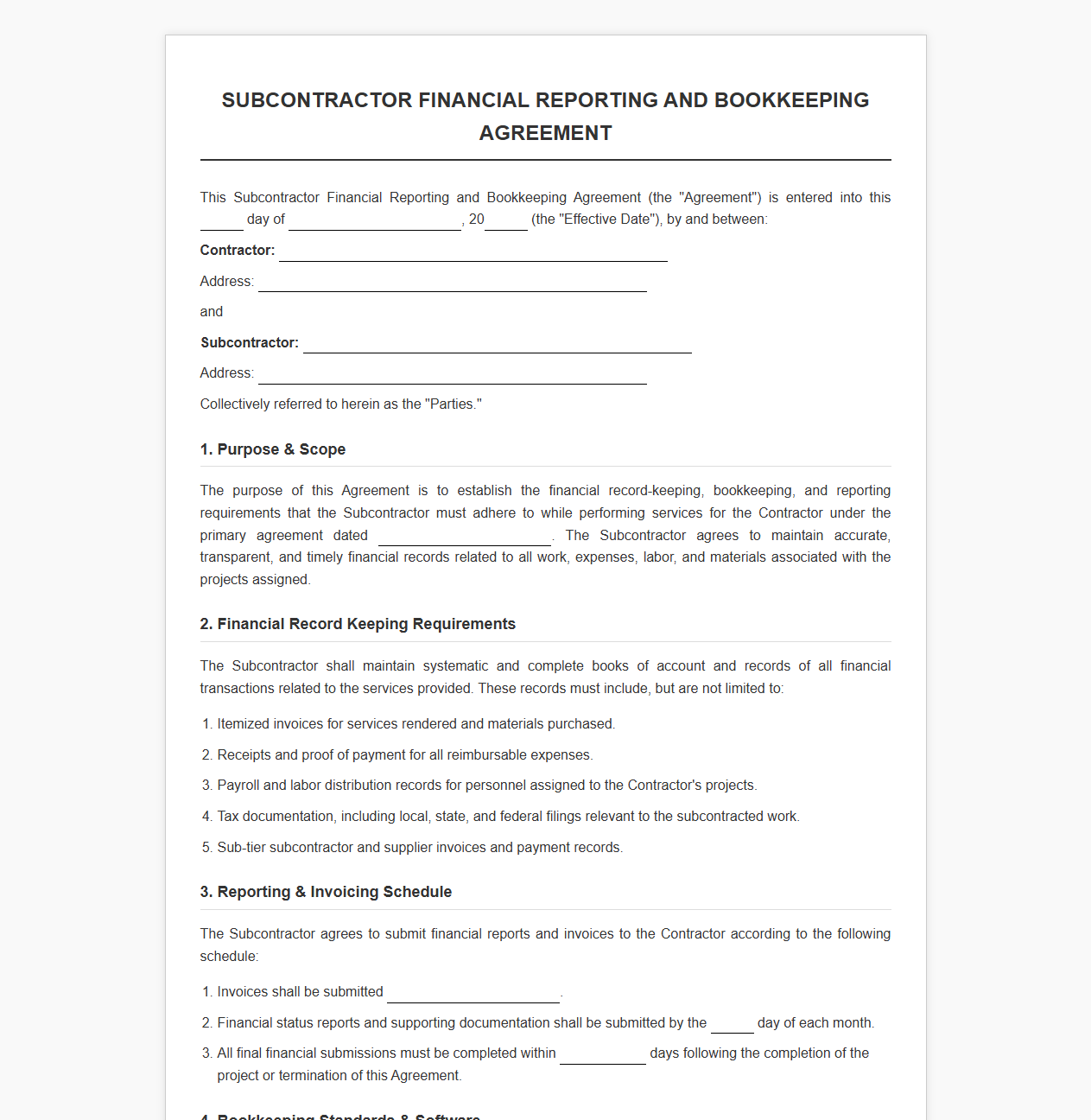 Download: .PDF
Subcontractor Financial Records Maintenance Agreement Template
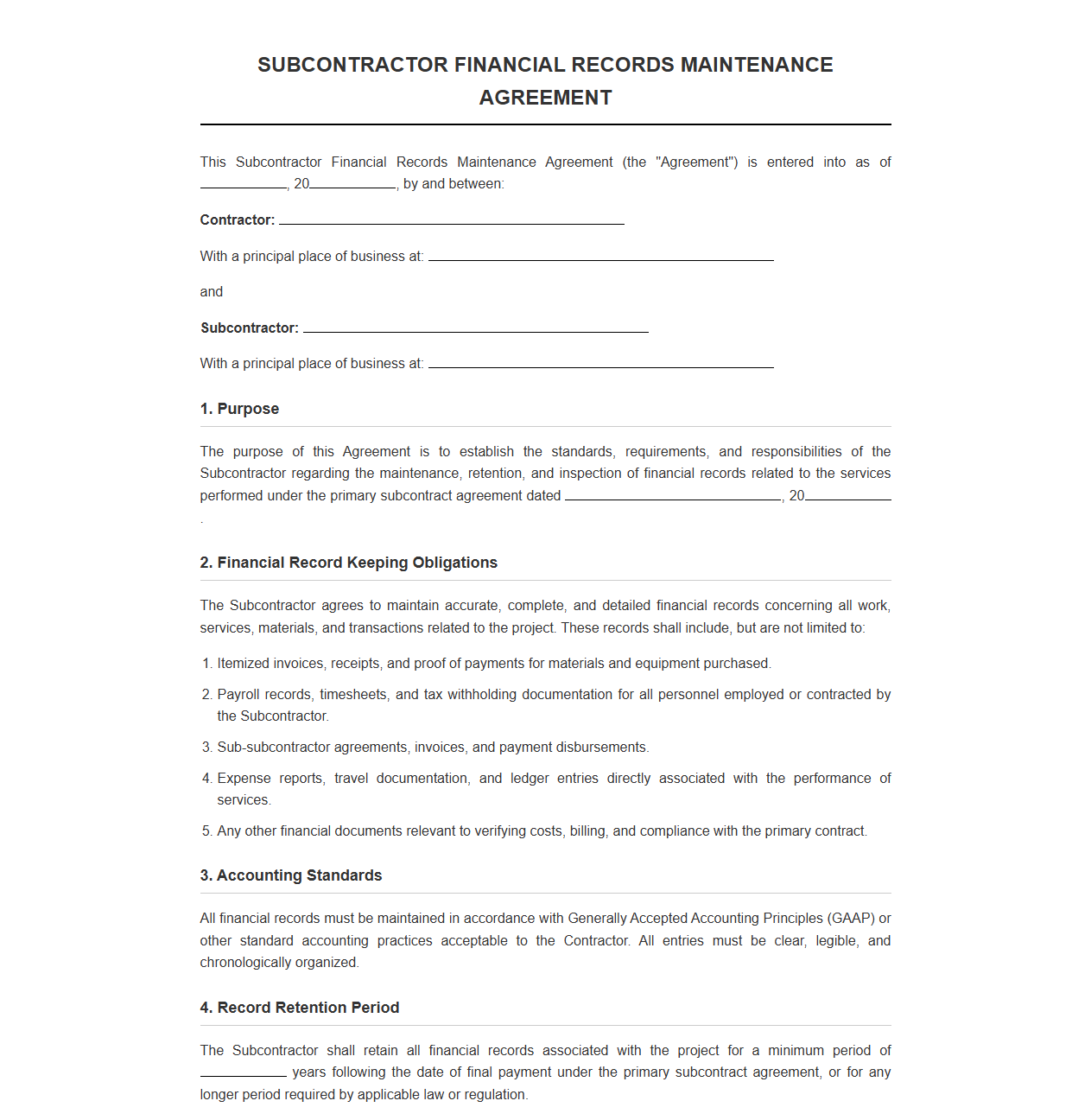 Download: .PDF
Financial Bookkeeping Agreement Template for Subcontractors
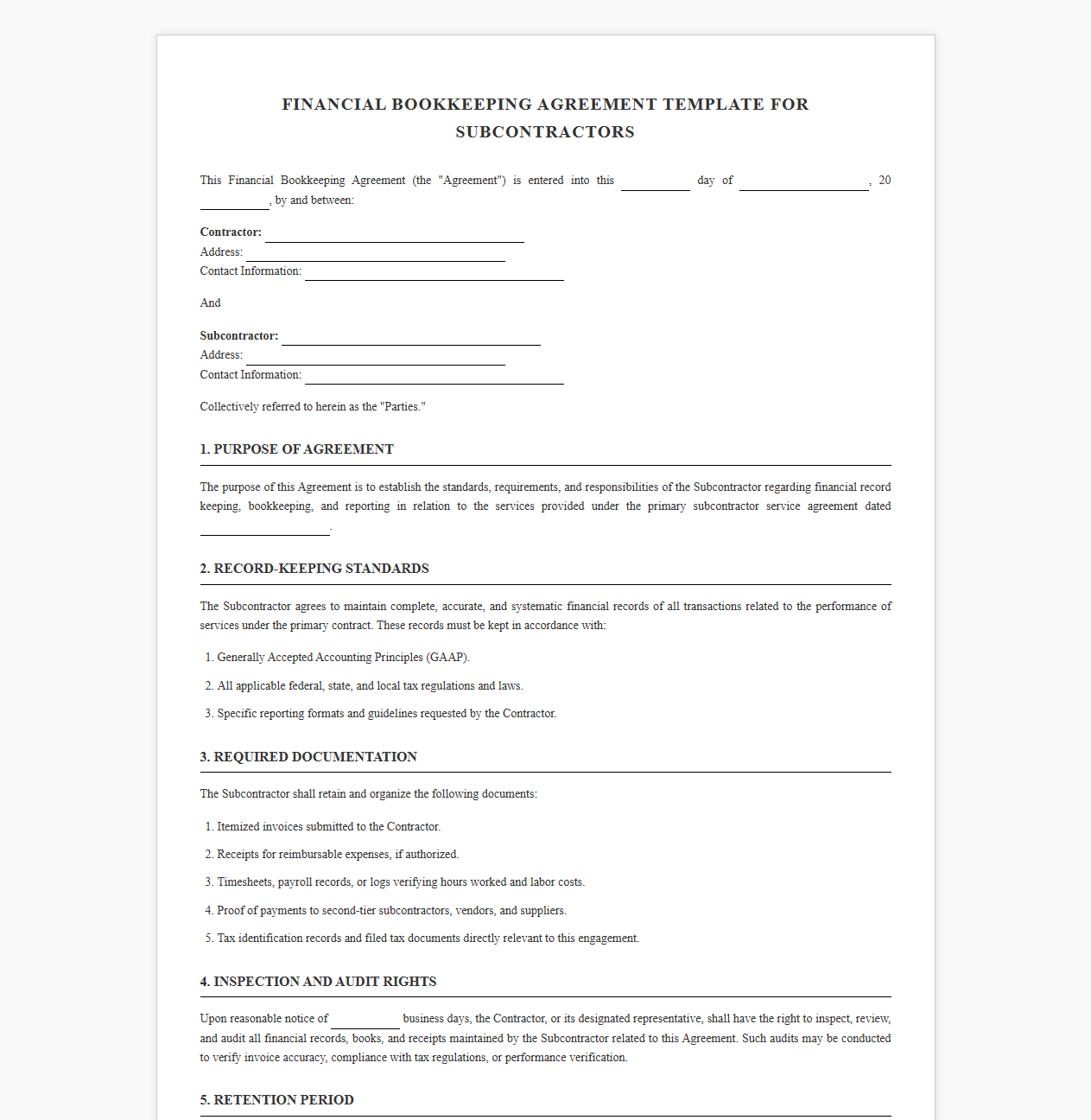 Download: .PDF
Subcontractor Financial Documentation and Accounting Agreement
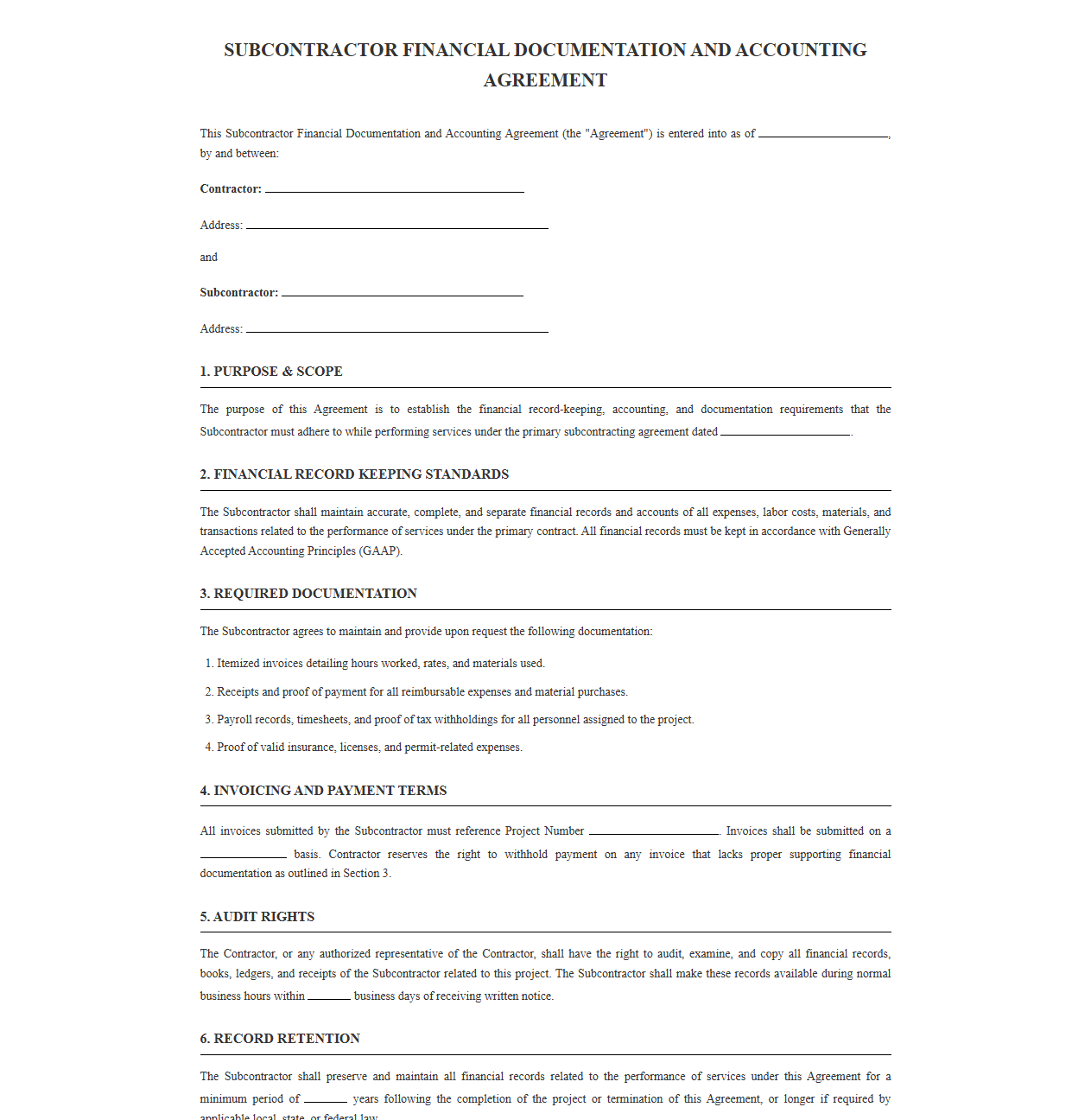 Download: .PDF
Subcontractor Financial Record Retention Policy Agreement
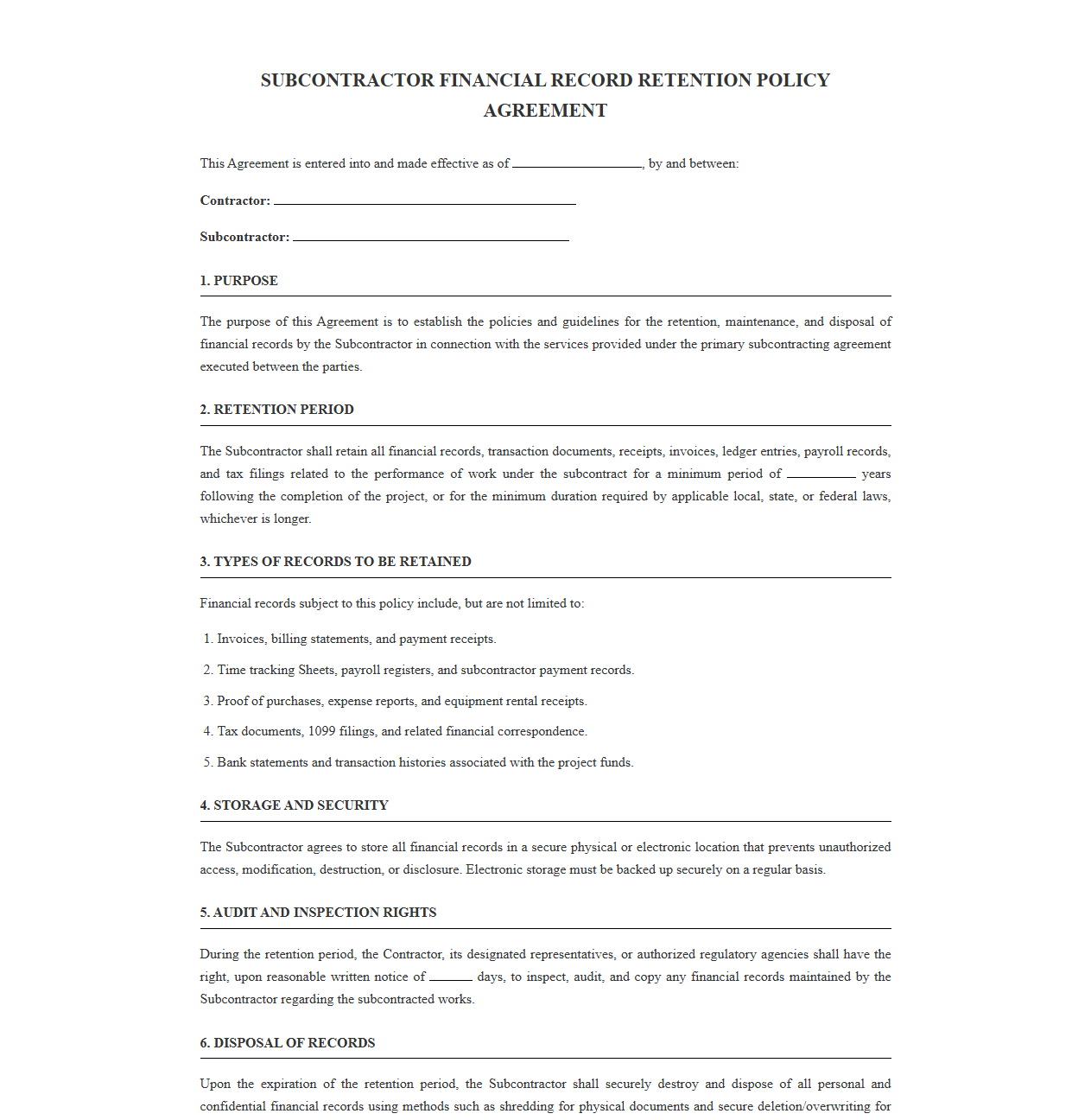 Download: .PDF
Financial Audit and Record Keeping Agreement for Subcontractors
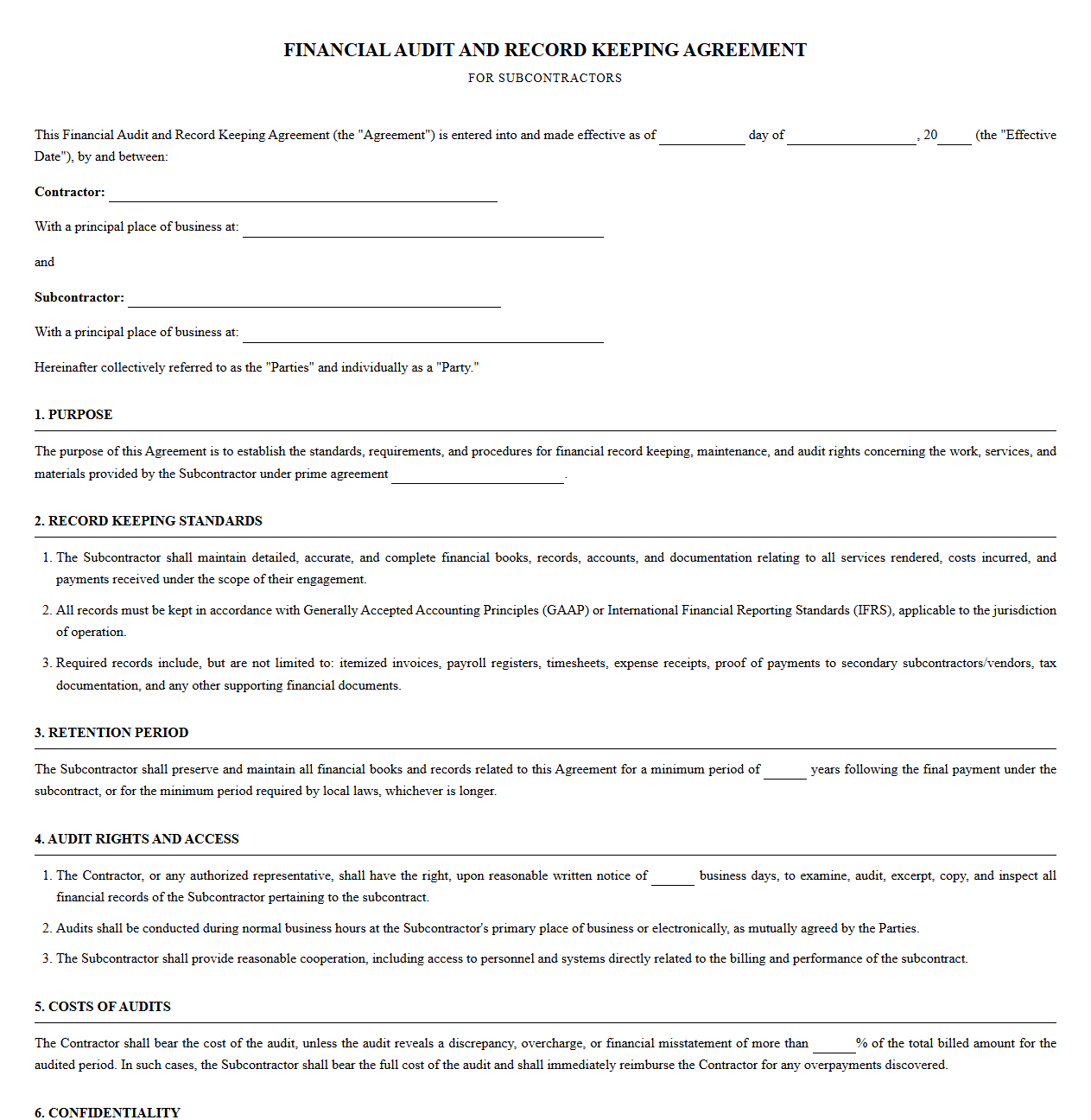 Download: .PDF
Introduction to Financial Accountability in Subcontracting
In the complex ecosystem of modern construction and project management, maintaining financial integrity is paramount. Standardized record-keeping agreements serve as the cornerstone of this integrity, establishing clear parameters of transparency between main contractors and subcontractors. By defining exactly how financial data is captured, shared, and verified, these agreements significantly reduce contractual disputes and prevent costly administrative delays.
Without a unified approach to financial documentation, both parties risk misalignment, unexpected overheads, and strained working relationships. Implementing a robust framework ensures that every dollar spent is traceable, reinforcing mutual accountability and fostering long-term collaborative success.
Defining the Scope of Required Financial Records
To ensure a comprehensive and accurate financial trail, subcontractors must systematically compile and preserve a designated suite of financial documents. Standardized agreements require the maintenance of the following records to guarantee compliance and absolute transparency:
- Detailed general ledgers tracking all project-specific expenditures and revenues.
- Itemized payroll records, including timesheets, hourly rate breakdowns, and proof of tax withholdings.
- Receipts and purchase orders for all raw materials, equipment rentals, and third-party vendor services.
- Subcontractor-tier agreements, documenting payments made to secondary suppliers or specialists.
Standardized Invoicing and Payment Documentation Protocols
Delays in payment processing often stem from fragmented or incomplete billing submissions. To streamline operations and maintain strict tax compliance, all subcontractors must adhere to a standardized invoicing protocol.
- Invoicing Format: Every invoice must clearly display the unique project code, purchase order number, tax identification numbers, and a detailed line-item breakdown of completed milestones.
- Supporting Evidence: Submissions must be accompanied by verified progress reports, signed-off timesheets, and corresponding receipts for reimbursable expenses.
- Submission Timeline: Invoices must be submitted by the 25th calendar day of each month to be eligible for the subsequent payment cycle.
Audit Rights, Access, and Record Retention Periods
Main contractors must maintain the operational right to verify the financial accuracy of ongoing projects. This legal oversight guarantees that project funds are utilized efficiently and strictly in accordance with contractual terms.
The main contractor, or their authorized third-party representative, reserves the right to examine, audit, and copy all financial records related to the project upon providing a written notice forty-eight hours in advance.
Furthermore, subcontractors are legally and contractually obligated to retain these financial records for a minimum duration. Typically, this retention period spans seven years following the date of final project completion, ensuring compliance with federal tax guidelines and potential retroactive audits.
Resolving Financial Discrepancies and Non-Compliance Consequences
When financial discrepancies or record-keeping failures occur, a structured dispute resolution protocol prevents escalation and minimizes project disruption. The table below outlines the graduated steps and contractual penalties associated with non-compliance.
| Severity Level | Nature of Infraction | Contractual Consequence / Action |
|---|---|---|
| Minor | Incomplete invoice documentation or minor ledger errors. | Temporary withholding of the disputed invoice portion until corrected. |
| Moderate | Failure to grant audit access within the specified timeframe. | Formal written warning and suspension of all progress payments. |
| Severe | Deliberate financial misrepresentation or fraud. | Immediate contract termination and potential legal prosecution. |
Leveraging Technology and Secure Data Management
Transitioning from paper-based files to digital accounting platforms is essential for modern project efficiency. Utilizing secure cloud storage solutions ensures that financial documents are not only easily accessible for audits but are also protected from physical damage. Subcontractors are encouraged to integrate their workflows with industry-recognized software systems to maintain automated trails.
To protect sensitive commercial information and personal identification data, all cloud-based platforms must comply with local privacy regulations. You can review the standardized security guidelines on our Data Protection Portal to ensure your systems meet the required encryption and multi-factor authentication benchmarks.
Implementing the Standardized Template in Your Operations
Successfully embedding a standardized record-keeping agreement into your business requires a systematic approach to onboarding and contract negotiations. Adopting these processes early ensures smooth integration and alignment from day one.
- Onboarding Briefings: Introduce the standardized record-keeping template during the initial pre-qualification phase so subcontractors understand the requirements before submitting bids.
- Contractual Integration: Formally append the record-keeping protocol as an enforceable schedule in all standard subcontracts.
- System Alignment: Host a brief technical alignment meeting post-award to verify that the subcontractor's digital platforms can output the necessary reports.

Leave a comment