
Managing subcontractor VAT compliance is a constant source of anxiety for financial directors, particularly when faced with the looming threat of joint liability and catastrophic tax audits.
As tax authorities globally digitize their auditing processes, relying on generic service contracts is no longer a viable defense strategy. By implementing structured compliance templates, organizations instantly secure their supply chains and shield their profit margins from unexpected penalties.
However, a critical stipulation remains: these resources must serve as robust foundational frameworks rather than a direct substitute for local legal counsel. For example, incorporating explicit clauses covering the Reverse Charge Mechanism and mandatory monthly VAT registration checks is essential to establish commercial due diligence.
Below, we dissect the primary risk zones in subcontractor management and introduce the essential agreement templates you need to insulate your enterprise from regulatory exposure.
Subcontractor VAT Compliance Agreement Template
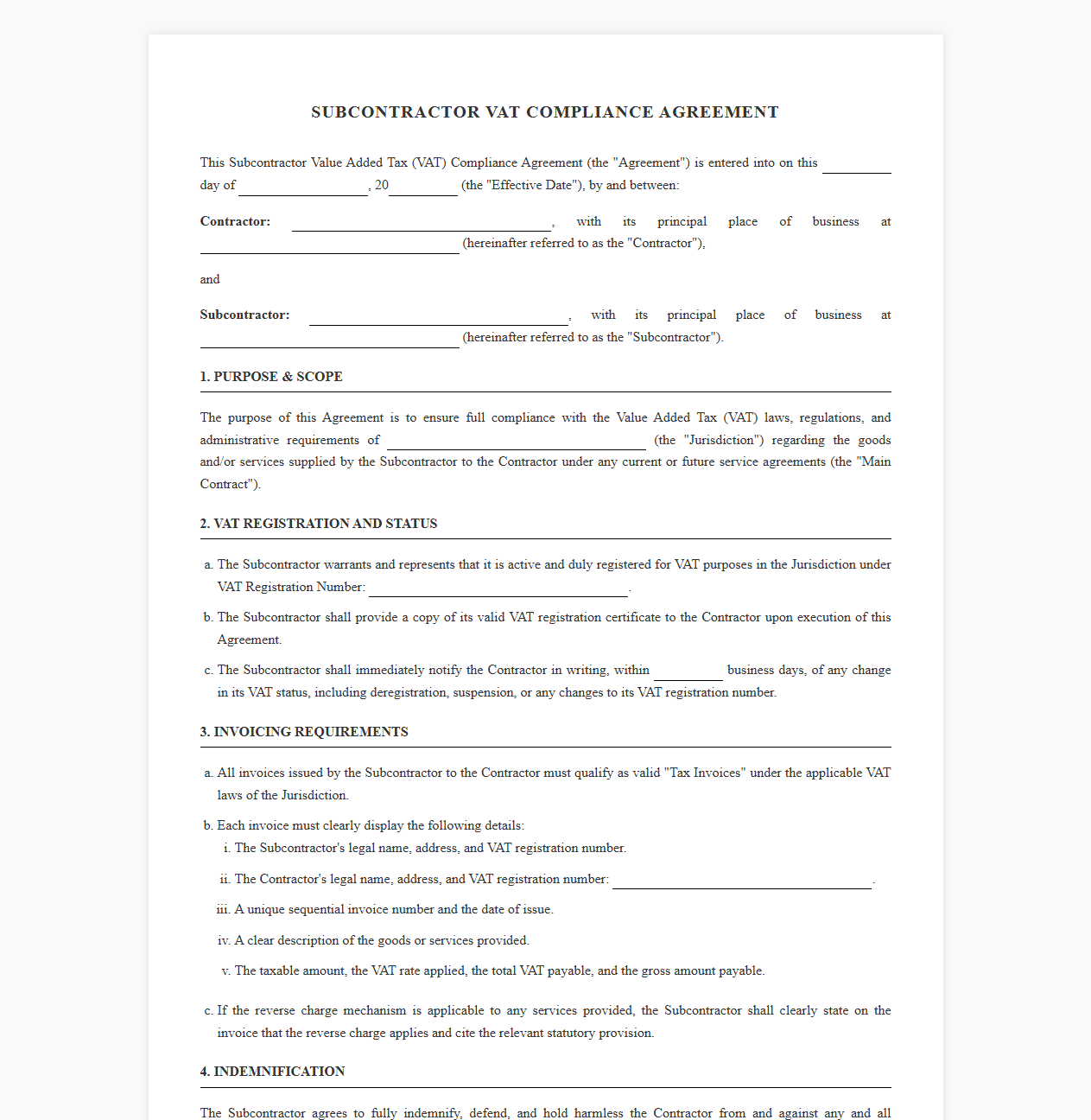 Download: .PDF
VAT Indemnity and Compliance Agreement for Subcontractors
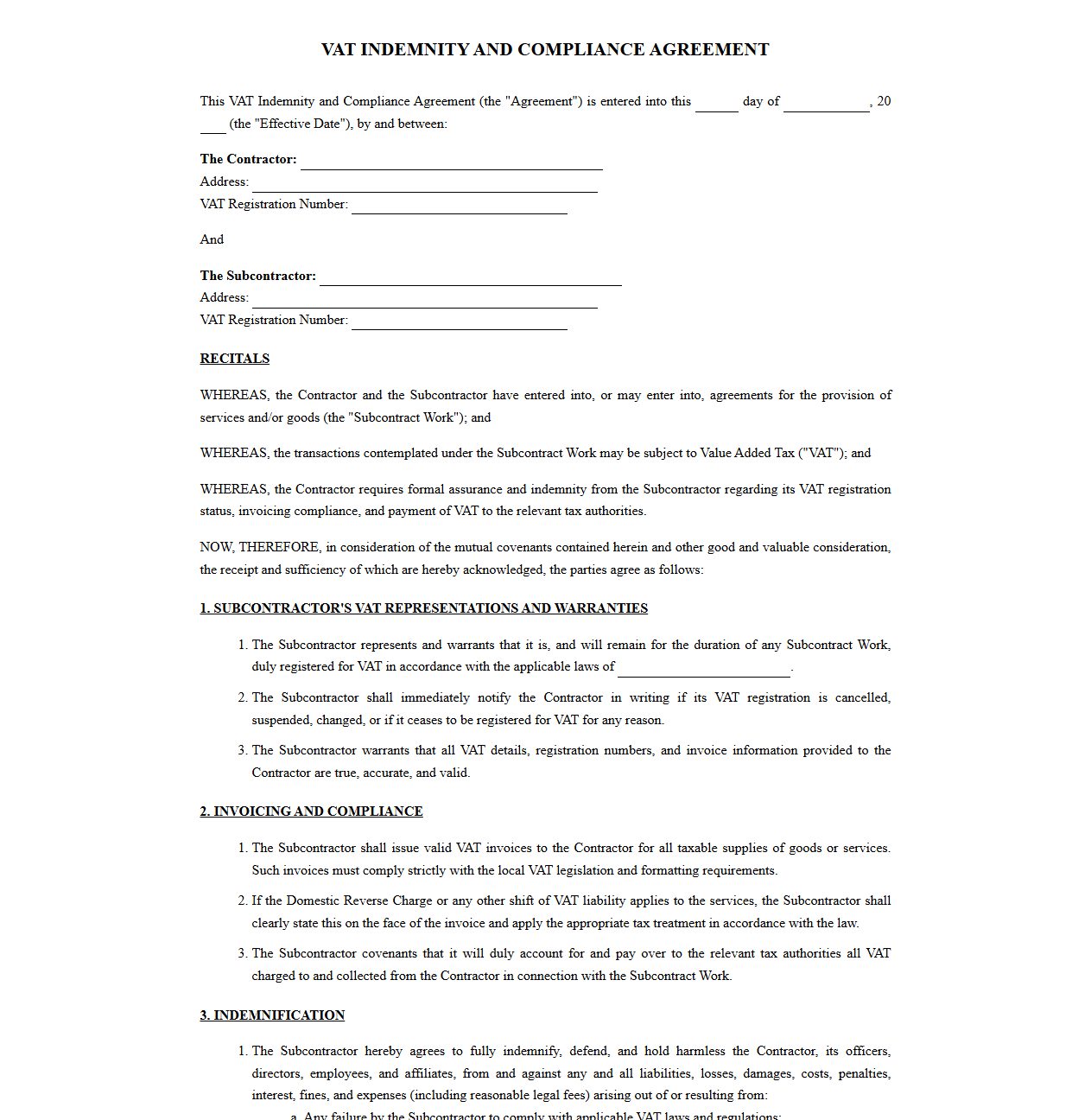 Download: .PDF
Subcontractor Value Added Tax Declaration and Agreement
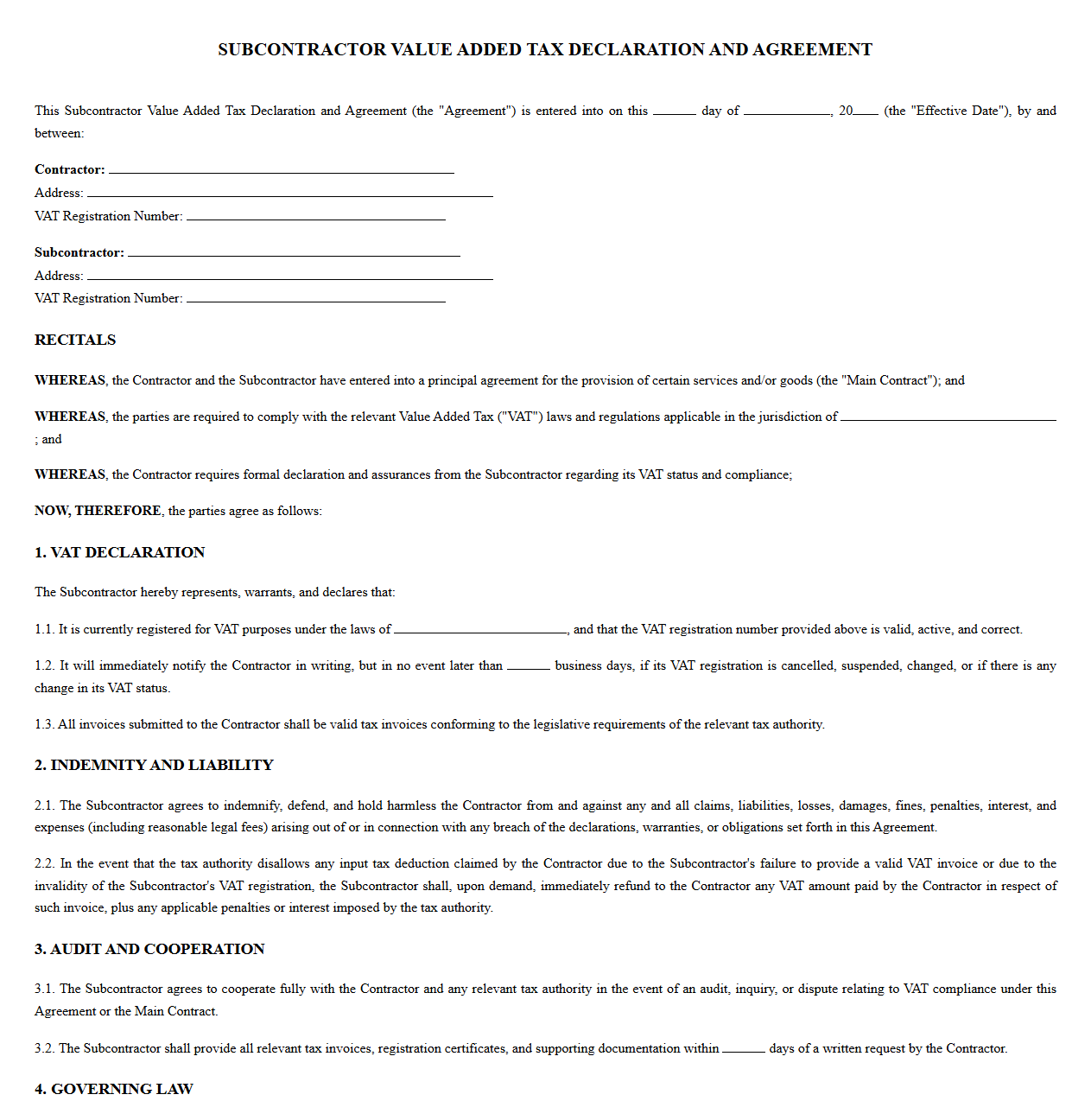 Download: .PDF
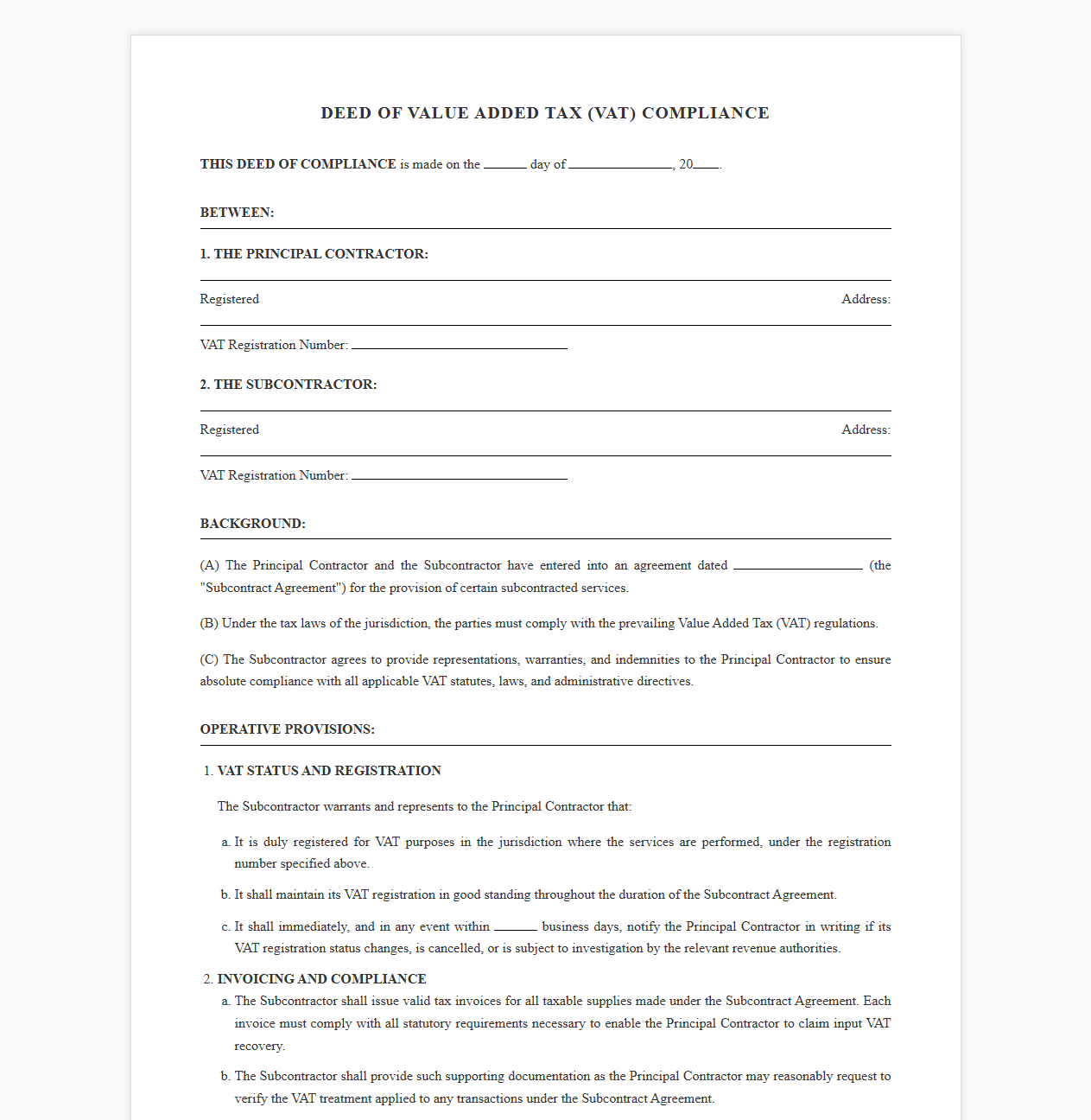
Value Added Tax Compliance Deed for Subcontracted Services
 Download: .PDF
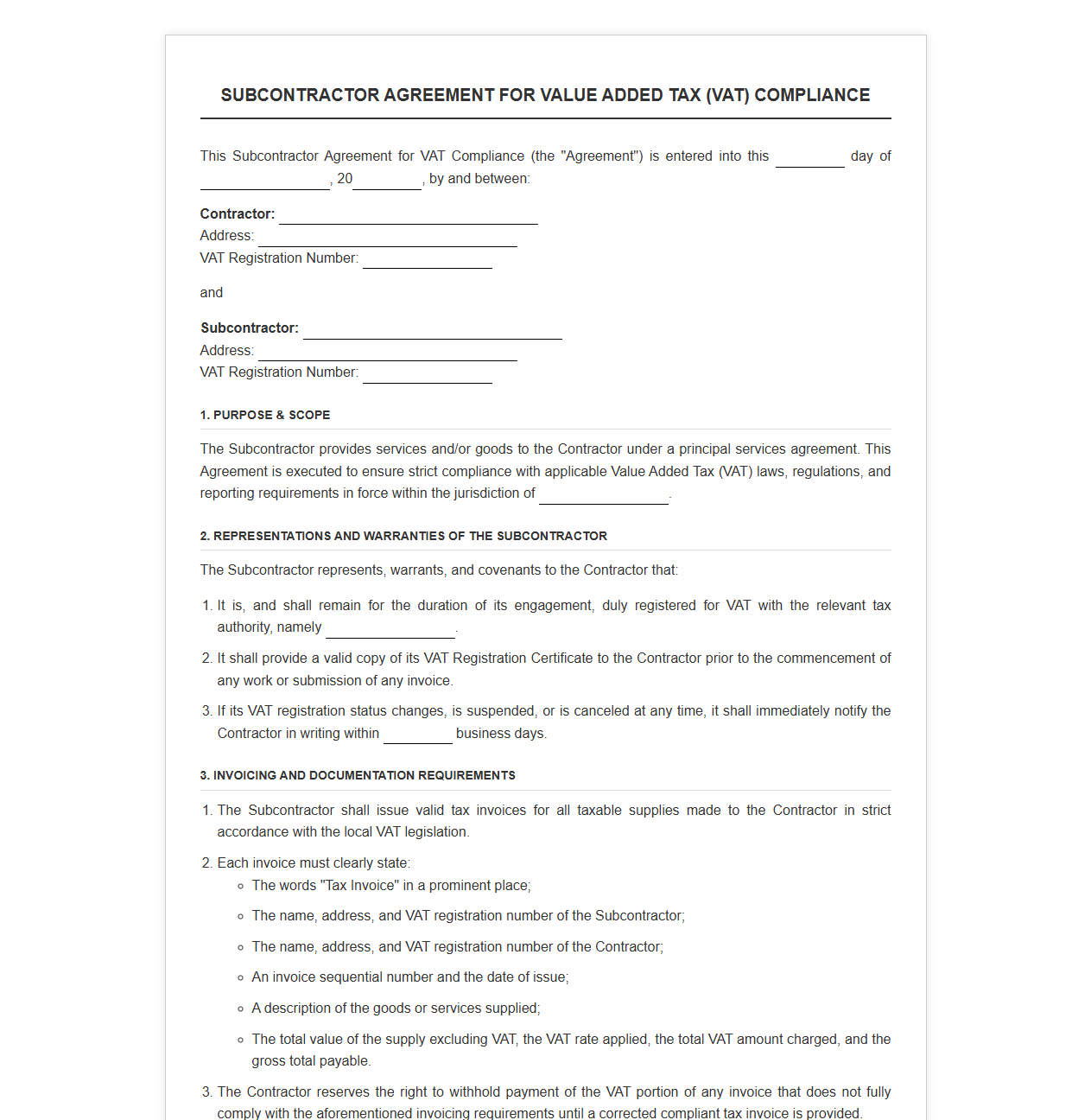
Subcontractor Agreement for VAT Registration and Reporting Compliance
 Download: .PDF
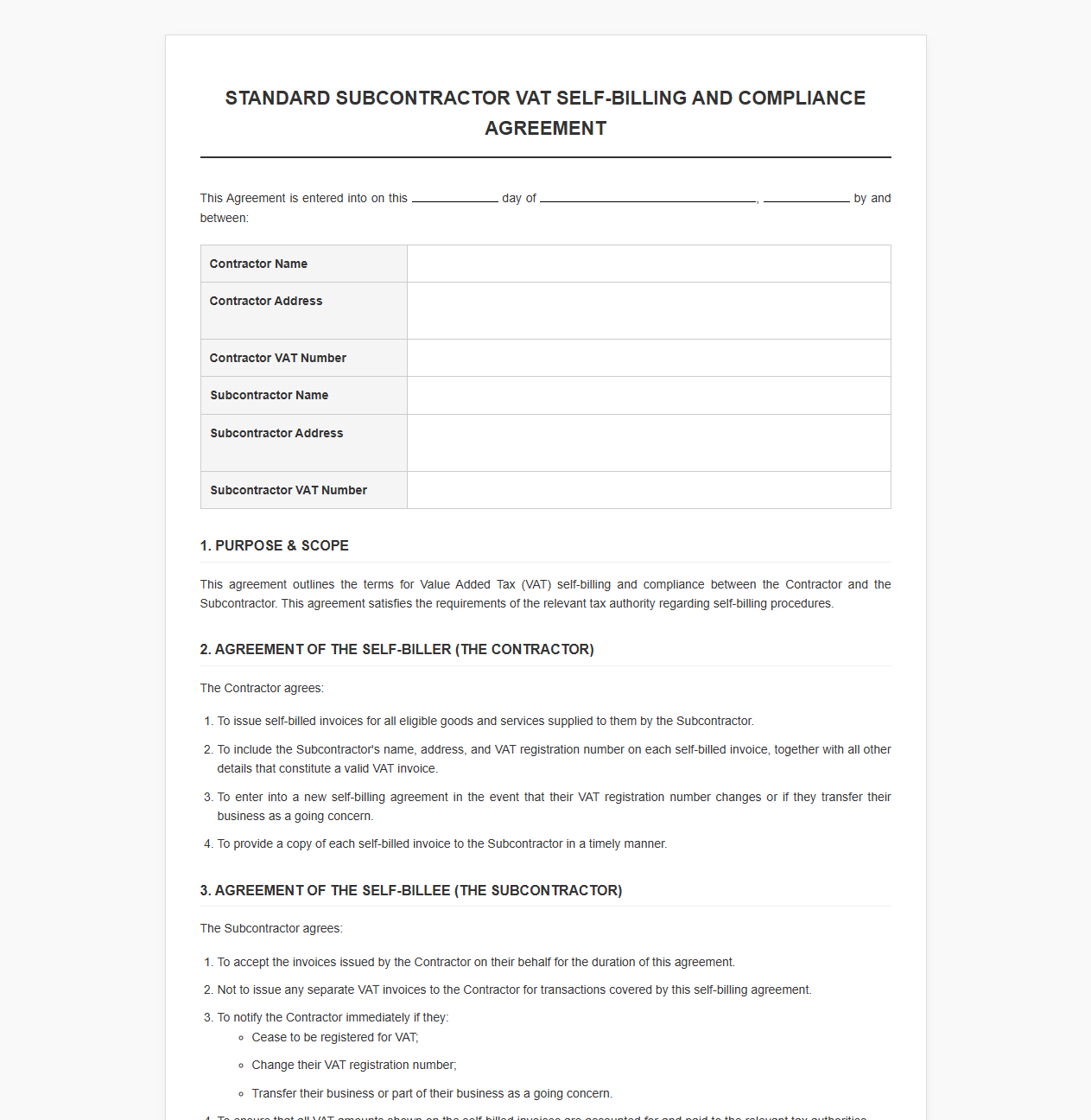
Standard Subcontractor VAT Self-Billing and Compliance Agreement
 Download: .PDF
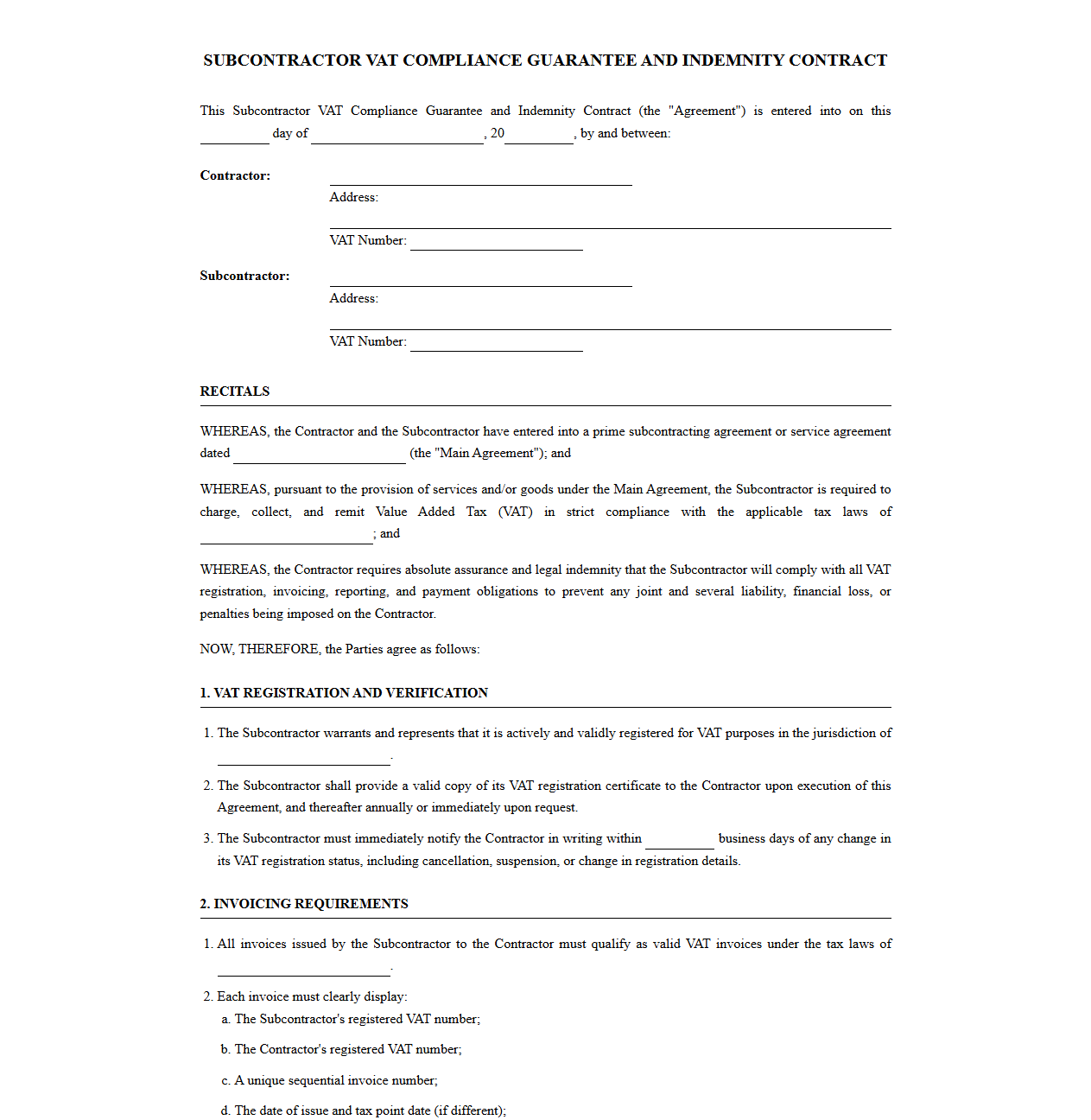
Subcontractor VAT Compliance Guarantee and Indemnity Contract
 Download: .PDF
Master Subcontractor Agreement for Value Added Tax Compliance
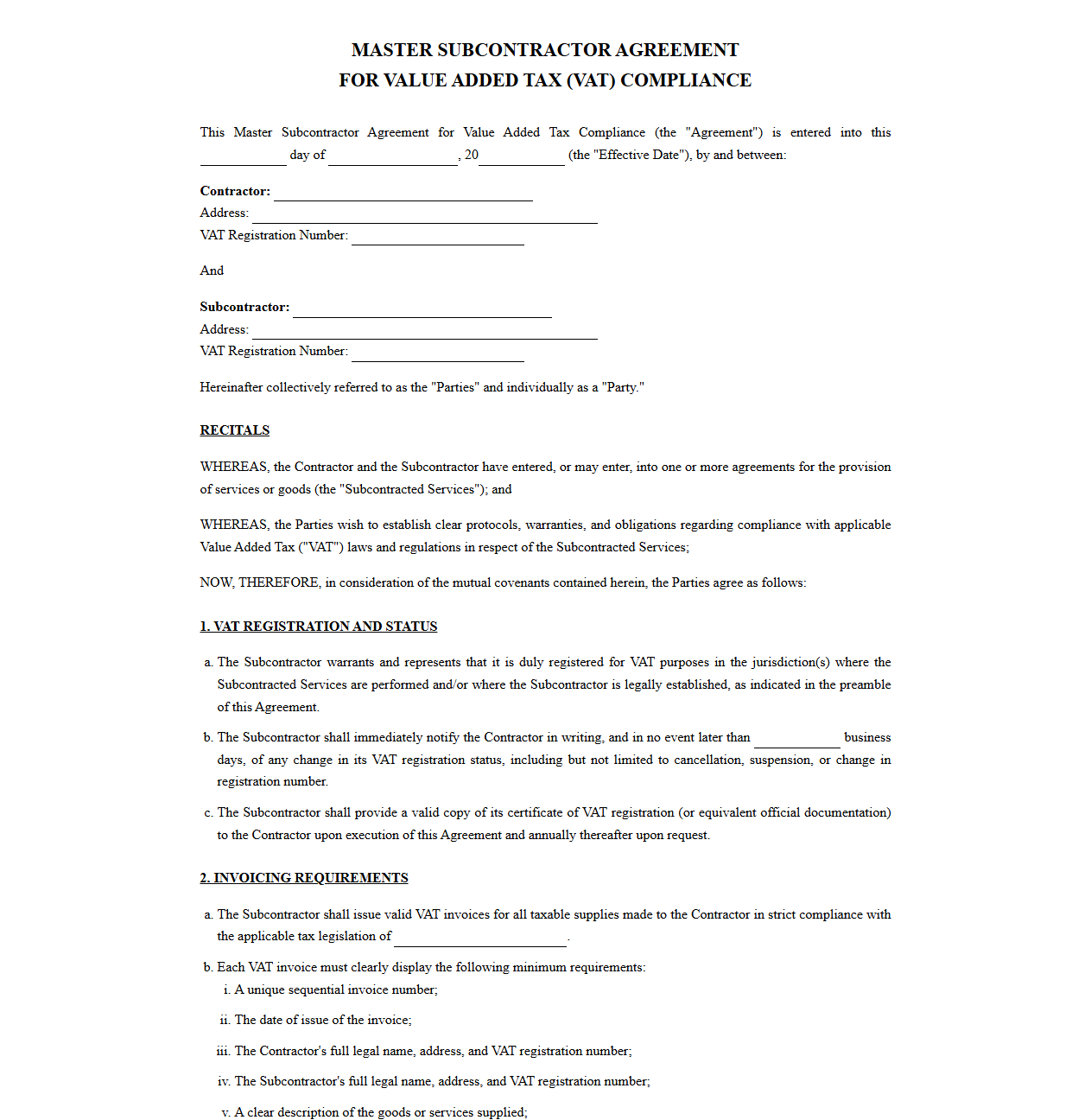 Download: .PDF
Understanding the VAT Risk in Subcontractor Management
In the construction and corporate procurement sectors, managing supply chains involves more than just overseeing physical deliverables. Subcontractor VAT non-compliance poses a severe financial and legal risk to main contractors. If a subcontractor fails to account for VAT correctly, registers fraudulently, or defaults on their tax obligations, tax authorities often look to the main contractor to recover lost revenue. This can lead to the immediate denial of input VAT recovery, leaving the main contractor with unexpected tax liabilities and severe cash flow disruptions.
Beyond direct financial losses, main contractors can face heavy penalties, interest charges, and reputational damage that disqualifies them from public tenders. To mitigate these systemic tax exposures, organizations must move away from informal handshakes. Implementing robust, legally binding subcontractor agreement templates is the first and most critical line of defense in securing the supply chain against tax default.
Defining Clear Subcontractor VAT Obligations
To establish a solid legal foundation, the subcontractor agreement must explicitly outline the subcontractor's tax status and responsibilities from the outset of the engagement. Ambiguity in these initial clauses can prevent the main contractor from enforcing compliance later on.
Mandatory VAT Registration and Maintenance
The agreement must state that the subcontractor is solely responsible for maintaining active, valid VAT registration in the jurisdictions where services are rendered.
Specific Compliance Responsibilities
- Active Registration: Providing immediate written notification of any changes to VAT registration status, including de-registration or transition to a different tax scheme.
- Accurate Reporting: Ensuring all transactions related to the contract are reported correctly to the relevant tax authorities.
- Jurisdictional Alignment: Complying with local VAT regulations, reverse-charge mechanisms, or sector-specific withholding tax rules.
Verification Protocols and Documentation Requirements
Main contractors cannot rely solely on a subcontractor's verbal or written assurances of compliance. Agreements must contain hard verification protocols that mandate the submission of physical or digital proof of tax standing before any work commences or payments are processed.
Contractors should require subcontractors to submit a valid VAT registration certificate alongside a recently issued Tax Clearance Certificate from the local tax authority. These documents must be updated periodically, especially for long-term projects spanning multiple tax years.
Standardizing Invoicing and Payment Terms
A major source of VAT friction is the submission of non-compliant invoices. If an invoice does not meet the strict statutory requirements of local tax laws, the main contractor cannot legally claim back the input VAT. Agreements must explicitly state that the release of payment is strictly conditional upon the receipt of a fully compliant tax invoice.
To avoid processing delays, the contract should outline the exact structure required for invoices, withholding payments automatically if any of the mandatory fields are missing or incorrect.
[Invoicing Template Requirements]
- Full legal name, address, and VAT registration number of the Subcontractor
- Full legal name and address of the Main Contractor: [Contractor Name / Address]
- Unique, sequential Invoice Reference Number
- Date of issue and Date of supply (if different)
- Description of the exact scope of services/materials provided
- Net Amount, Applicable VAT Rate (e.g., Standard, Reduced, Zero, or Reverse Charge), Total VAT Charged, and Gross Amount due
Drafting Robust Tax Indemnification Clauses
Despite thorough verification, compliance failures can still occur. To insulate your business from the financial fallout of a subcontractor's tax discrepancies, the agreement must feature a robust, legally binding tax indemnification clause. This clause shifts the financial burden of penalties, interest, and lost tax back to the defaulting party.
The indemnification should cover not only the disputed tax amount but also any legal and administrative costs incurred by the main contractor while disputing or resolving the issue with tax authorities.
"The Subcontractor hereby agrees to fully indemnify, defend, and hold harmless the Contractor against any and all liabilities, losses, damages, penalties, interest, fines, costs, and expenses (including reasonable legal fees) arising out of or in connection with the Subcontractor's failure to comply with its VAT obligations, the invalidity of the Subcontractor's VAT registration, or the rejection of any input VAT recovery claims by the Tax Authorities due to non-compliant invoicing by the Subcontractor."
Establishing Audit and Ongoing Monitoring Rights
A compliance framework is only as good as its enforcement. Agreements must grant the main contractor explicit rights to monitor and audit the subcontractor's tax-related documentation throughout the lifecycle of the project.
Audit Procedures and Right of Access
The contract must include clauses allowing the main contractor, or an appointed third-party auditor, access to the subcontractor's tax filing receipts, payment confirmations, and related accounting records. This ensures that the VAT charged on invoices has actually been declared and paid over to the state treasury.
These audit clauses act as a strong deterrent against fraudulent activity, ensuring the subcontractor maintains accurate records and treats tax compliance as a continuous operational priority.
Best Practices for Implementing VAT Compliance Templates
Developing robust agreement templates is an excellent first step, but they must be integrated systematically into your daily business operations to be effective.
Proactive management and regular updates are essential to keep pace with changing tax laws, digital reporting mandates (such as e-invoicing), and shifting local regulations.
Implementation Checklist
To ensure consistent application across all projects, implement the following steps within your procurement department:
- Integrate the VAT compliance and verification checklists directly into your onboarding software and ERP systems.
- Establish automatic calendar alerts to trigger annual requests for updated Tax Clearance Certificates from active subcontractors.
- Subject your master subcontractor templates to biannual reviews by specialized tax counsel to account for legislative amendments and case law updates.
- Train procurement and accounts payable teams to recognize invalid invoices and halt payments instantly when discrepancies arise.
Leave a comment