

For tax practitioners, navigating fluctuating seasonal cash flows and chasing unpaid invoices remains a persistent, draining struggle. Before addressing pricing structures, firms must first establish a consistent, legally sound framework for year-round client management. Transitioning to a standardized annual retainer model grants practitioners both predictable recurring revenue and administrative peace of mind. Crucially, these agreements serve as an educational tool, stipulating precise boundaries between standard filing services and specialized advisory work. By clearly defining these parameters, firms protect themselves against unpaid scope creep for complex tasks, such as responding to unexpected IRS audit notices or conducting off-season entity restructuring consultations. In this article, we will dissect the essential clauses of a modern tax retainer template, outline strategies for seamless client adoption, and provide customizable frameworks to safeguard your firm's profitability.
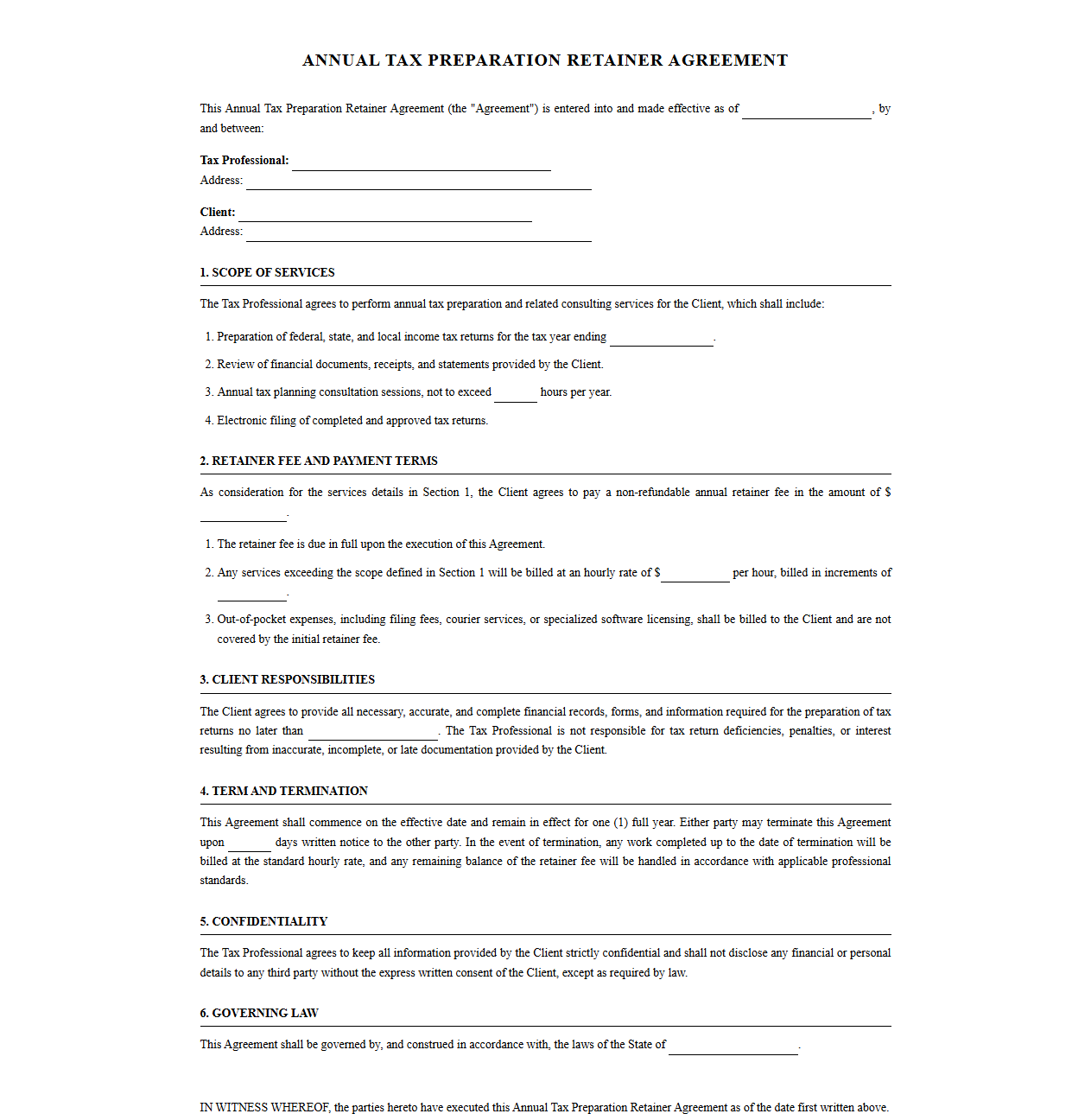
Annual Tax Preparation Retainer Agreement Template
 Download: .PDF
Yearly Tax Filing Retainer Contract Template
 Download: .PDF
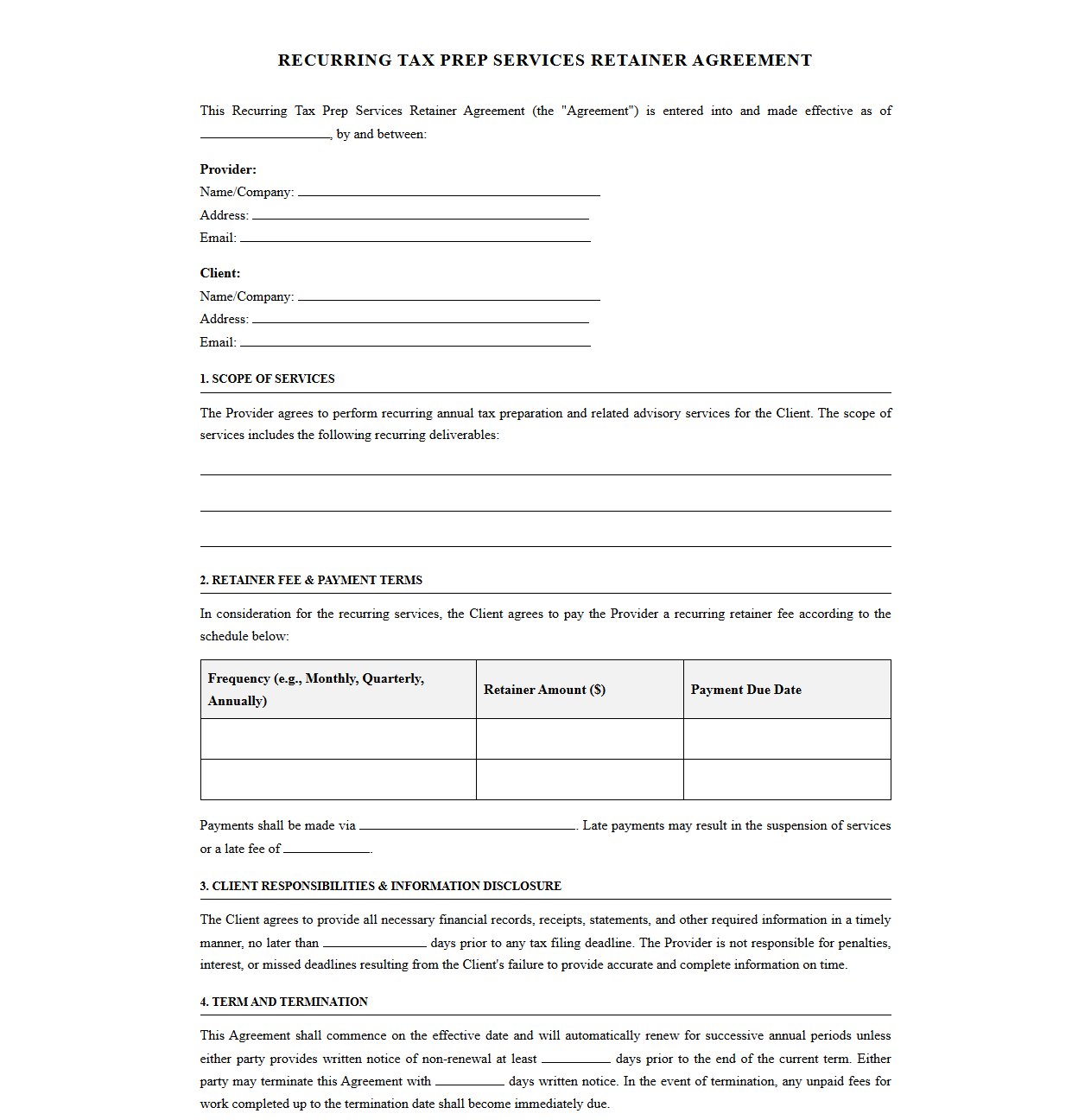
Recurring Tax Prep Services Retainer Agreement
 Download: .PDF
Annual Tax Service Retainer Agreement Form
 Download: .PDF
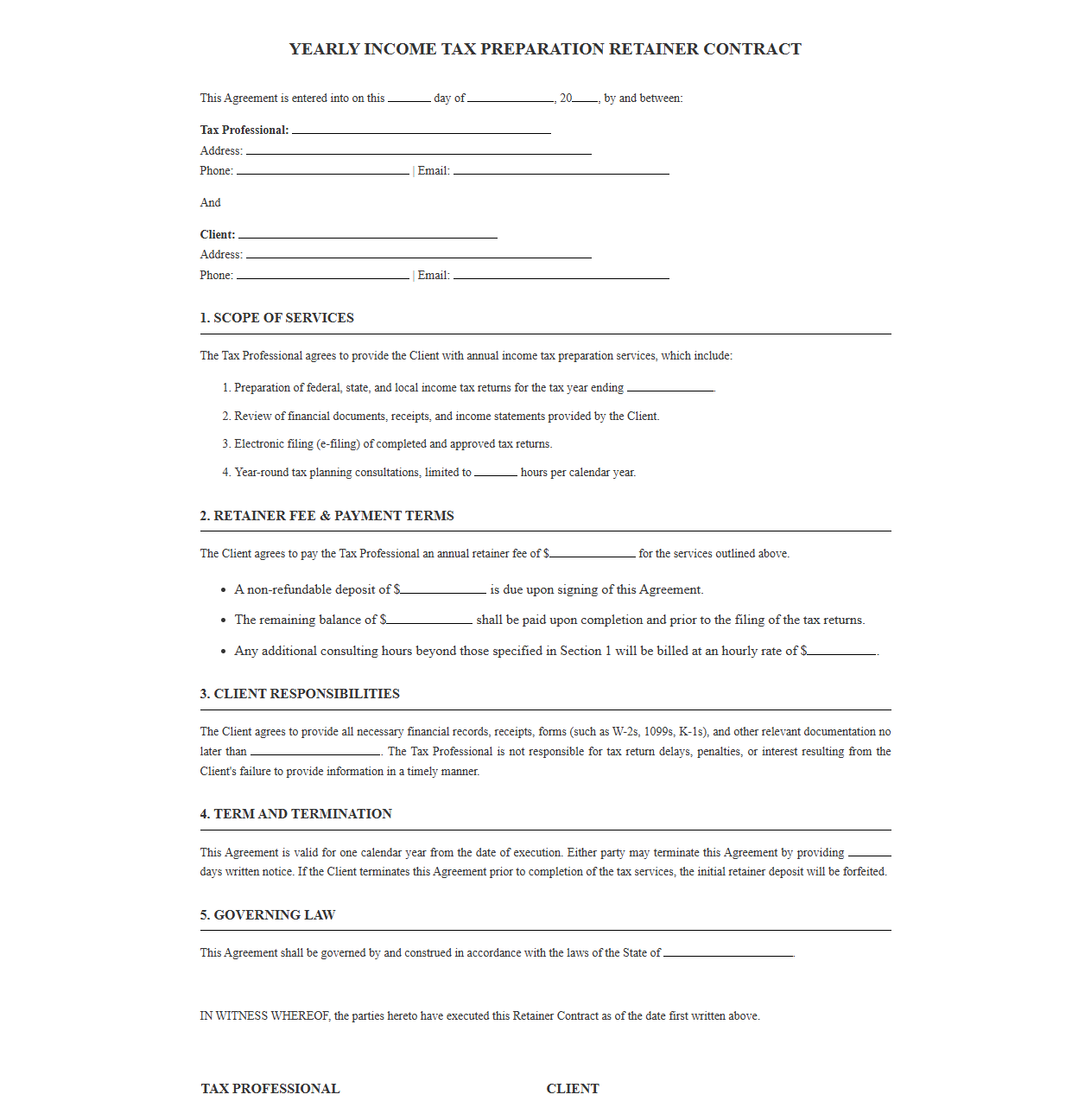
Yearly Income Tax Preparation Retainer Contract
 Download: .PDF
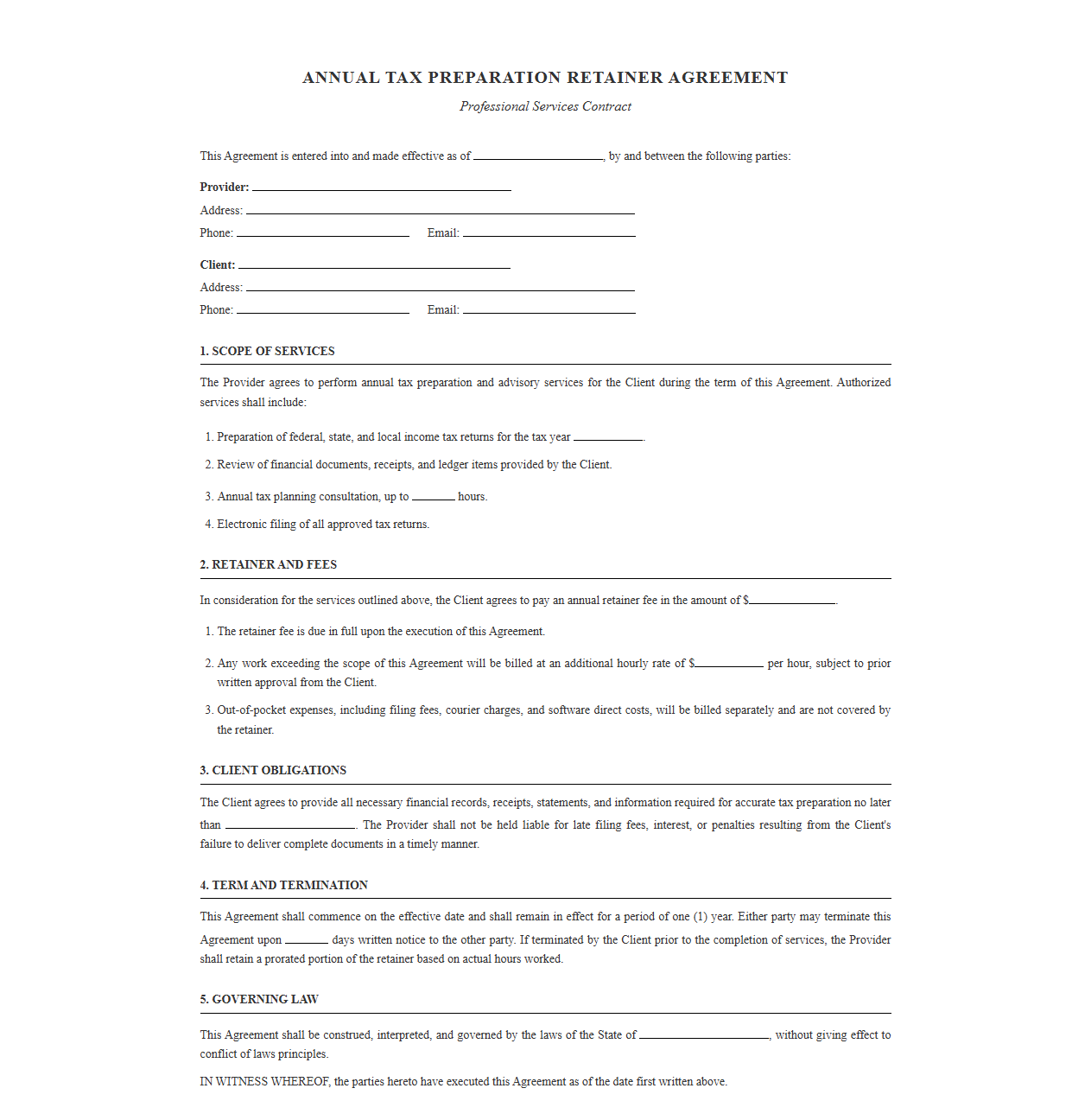
Professional Tax Prep Annual Retainer Agreement
 Download: .PDF
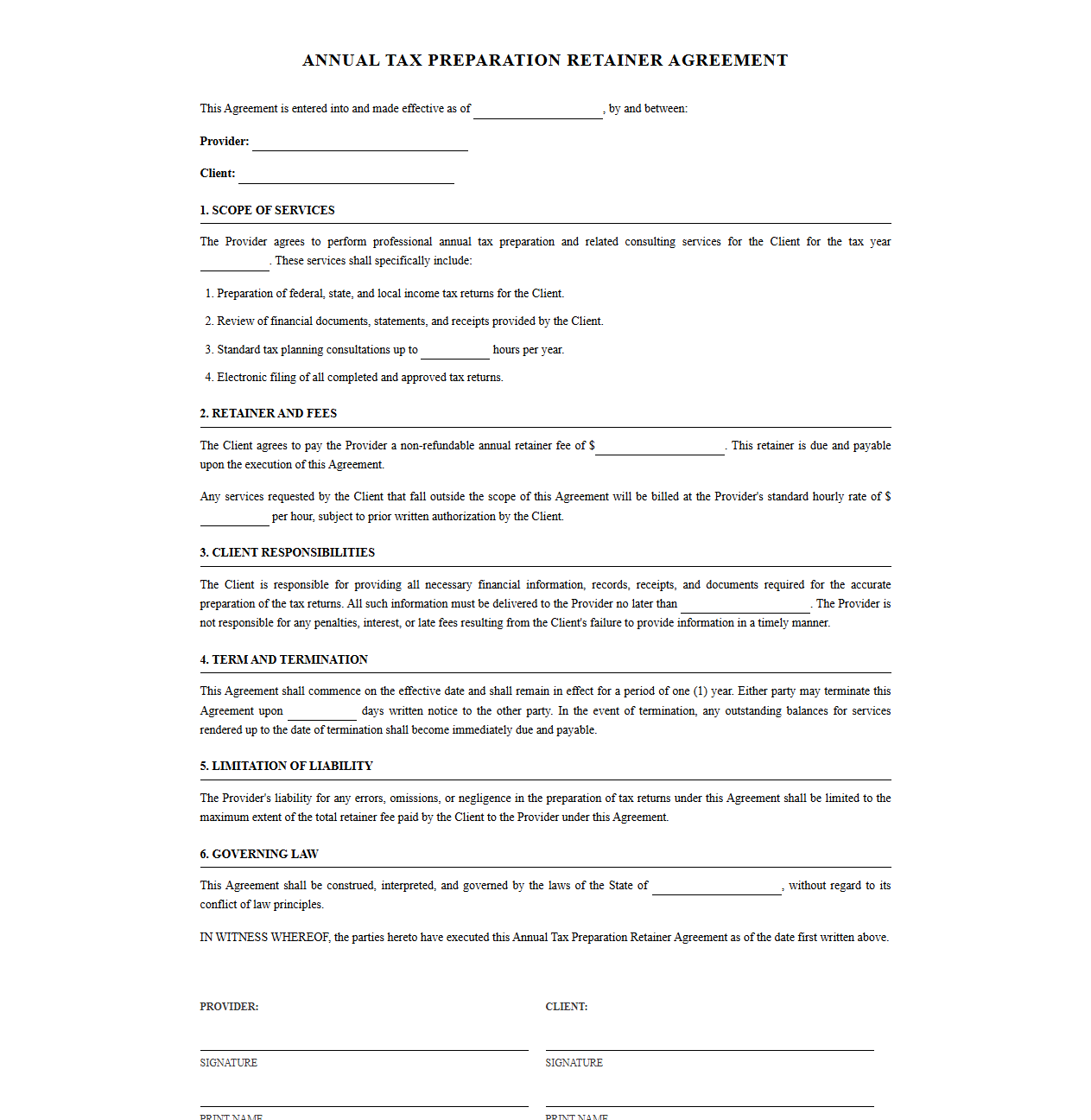
Standard Annual Tax Preparation Retainer Contract
 Download: .PDF
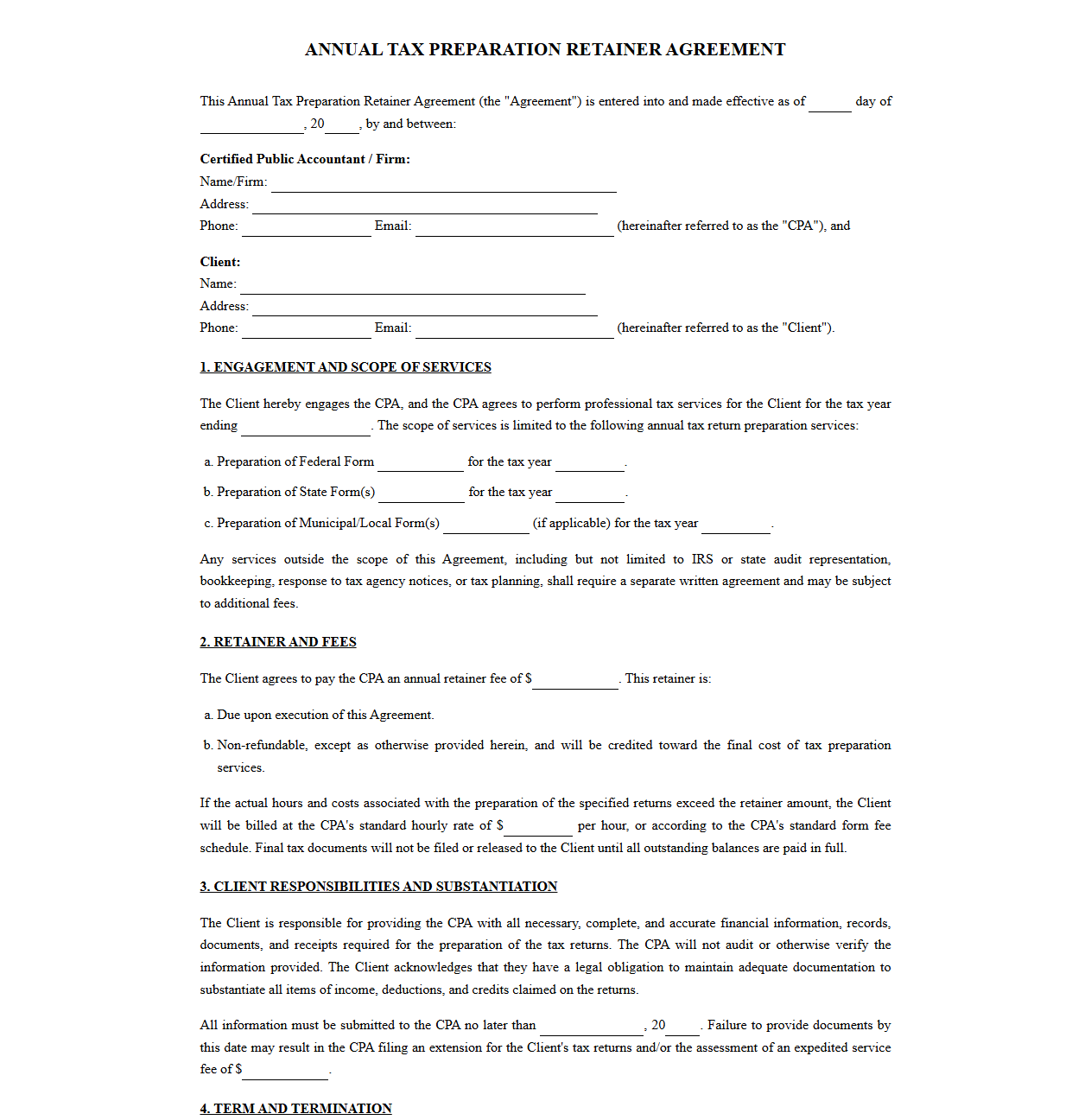
CPA Annual Tax Preparation Retainer Agreement
 Download: .PDF
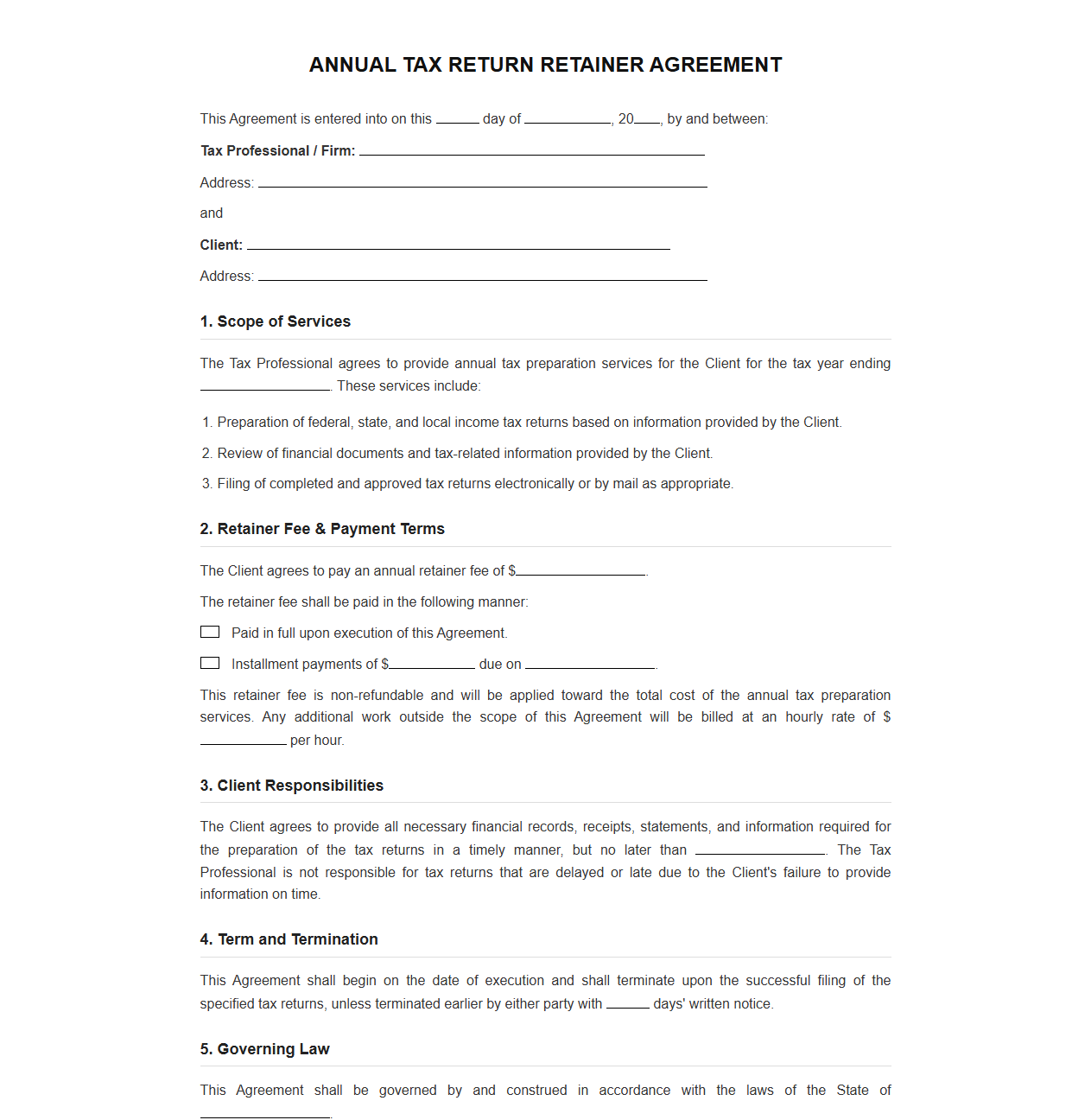
Annual Tax Return Retainer Agreement Template
 Download: .PDF
Introduction to Standardized Tax Retainers
In the rapidly evolving landscape of professional financial services, modern accounting firms face the dual challenge of managing complex regulatory updates while maintaining highly profitable client relationships. Implementing a standardized annual tax preparation retainer agreement is a critical mechanism for mitigating operational risk. Without a uniform contract, firms frequently fall victim to scope creep, where unbilled hours quickly erode profit margins.
By establishing a clear, standardized document, accounting practices can set precise client expectations from day one. This proactive approach ensures that clients understand exactly what services are included in their annual engagement and what requires additional billing. Standardizing these agreements protects your firm's revenue, reduces misunderstandings, and fosters professional, mutually respectful relationships with your client base.
Defining the Scope of Tax Services
A well-defined scope of services protects your firm from performing unpaid labor and clarifies the exact boundaries of your professional engagement. The retainer template must draw a sharp line between routine compliance tasks and specialized consulting services.
Included Compliance Services
The core of the annual retainer should explicitly cover standard compliance filing. This typically includes the preparation and electronic filing of annual federal and state income tax returns based on the financial information provided by the client. It also covers basic correspondence regarding the preparation of those specific returns.
Out-of-Scope Advisory Services
- In-depth strategic tax planning and quarterly forecasting.
- Audit representation and responding to unexpected IRS or state tax authority inquiries.
- Entity restructuring, transactional analysis, and M&A consulting.
- Bookkeeping cleanup and reconciling undocumented business expenses.
Establishing Fee Structures and Payment Terms
A transparent pricing model minimizes billing disputes and secures predictable cash flow for your firm. Retainer agreements should clearly outline the payment schedule, upfront deposit requirements, and the financial consequences of scope deviations.
Using a structured table within your agreement helps clients quickly digest the payment terms, ensuring there are no surprises when invoices are issued.
| Service Category | Billing Structure | Payment Terms |
|---|---|---|
| Annual Tax Compliance Retainer | Fixed Annual Fee / Monthly Retainer | 50% deposit upfront, balance due upon draft review |
| Out-of-Scope Advisory & Planning | Hourly Rate ($250 - $450/hr depending on staff level) | Billed monthly, payable within 15 days of invoice |
| Audit Support & Tax Authority Defense | Separate Engagement / Hourly Billing | Retainer replenishment required prior to defense work |
Outlining Client Responsibilities and Timelines
The success and accuracy of tax preparation rely heavily on client cooperation. To protect your firm from last-minute rushes and potential filing errors, the retainer must explicitly hold clients accountable for their own timelines.
To avoid late-filing penalties and ensure a smooth preparation process, clients must adhere to the following structured timeline:
- Document Submission: All bookkeeping files, 1099s, W-2s, and supporting tax documents must be uploaded to the secure client portal no later than 30 days prior to the official filing deadline.
- Response to Inquiries: The client must respond to any clarification questions or missing information requests within 5 business days of receipt.
- Final Sign-Off: The client is responsible for reviewing draft returns and returning signed Form 8879 (Authorization for Electronic Filing) at least 3 business days before the filing date.
Failure to meet these deadlines may result in additional rush fees, automatic filing of extensions, or the postponement of return completion until the next available filing window.
Addressing Liability and Confidentiality Safeguards
Accounting firms handle highly sensitive financial data, making robust legal protections non-negotiable in any professional retainer. Your agreement must shield your firm from excessive liability while reassuring clients of their data security.
Limitation of Liability
The agreement should contain a clause limiting the firm's liability to the total fees paid under the current annual contract. This clause protects the firm from consequential, indirect, or punitive damages arising from errors or omissions, provided the firm acted in good faith based on the data provided by the client. Clients must acknowledge that they are ultimately responsible for the accuracy of their financial records and tax filings.
Confidentiality and Data Security Protocols
Both parties must agree to a mutual confidentiality clause, ensuring that proprietary business information and personal financial data are never disclosed to third parties without prior written consent. The agreement should highlight that the firm utilizes bank-grade encryption, secure multi-factor client portals, and strict access controls to maintain compliance with federal data protection standards.
Managing Agreement Termination and Renewal
To establish long-term consistency, retainer agreements should be structured with automatic annual renewal terms. This ensures that the relationship continues seamlessly into the next tax year without requiring the renegotiation of basic contract parameters every season.
Either party may terminate the agreement by providing written notice of non-renewal. In the event of early termination, all outstanding balances for work performed up to the termination date must be settled immediately.
"This agreement will automatically renew for successive one-year terms on the anniversary of the effective date, unless either party provides written notice of termination at least sixty (60) days prior to the renewal date. Upon termination, any unbilled hours or completed milestones will be invoiced to the client and must be paid in full before final deliverables are released."
Best Practices for Template Customization and Deployment
A standardized retainer template is most effective when it can be easily customized for different client tiers. Firms can establish three distinct tiers-Basic Compliance, Mid-tier (Compliance + Quarterly Planning), and Premium (Comprehensive Advisory)-by simply adjusting the scope annex of the master template.
To deploy these agreements efficiently, firms should integrate them into modern digital signature and workflow platforms. This eliminates administrative friction and speeds up client onboarding.
- Integrate the template with systems like DocuSign, PandaDoc, or Ignition to automate the signature process.
- Utilize merge fields to automatically populate client names, specific entity details, and agreed-upon fee amounts.
- Set up automated email reminders for clients who have not signed their agreements as tax season approaches.
- Store the fully executed agreements within a secure, centralized document management system for easy reference.
To learn more about optimizing your firm's administrative workflows, explore our guide on modern accounting technology integration.

Leave a comment