

Tax advisory firms constantly struggle to mitigate professional liability and prevent scope creep when navigating highly fragmented state and local tax (SALT) jurisdictions. Before addressing these risks directly, one must recognize how rapid, post-Wayfair legislative shifts have transformed modern tax compliance into a high-stakes legal minefield. Securing robust engagement frameworks grants consultancies both operational peace of mind and protected profit margins.
However, these templates are not generic catch-alls; they must be treated as precise instruments tailored to specific deliverables-such as multistate nexus evaluations or Voluntary Disclosure Agreements (VDAs)-to remain legally enforceable. This article outlines the essential agreement templates every consultancy needs, detailing how to structure protective clauses that shield your practice while clearly defining advisory boundaries.
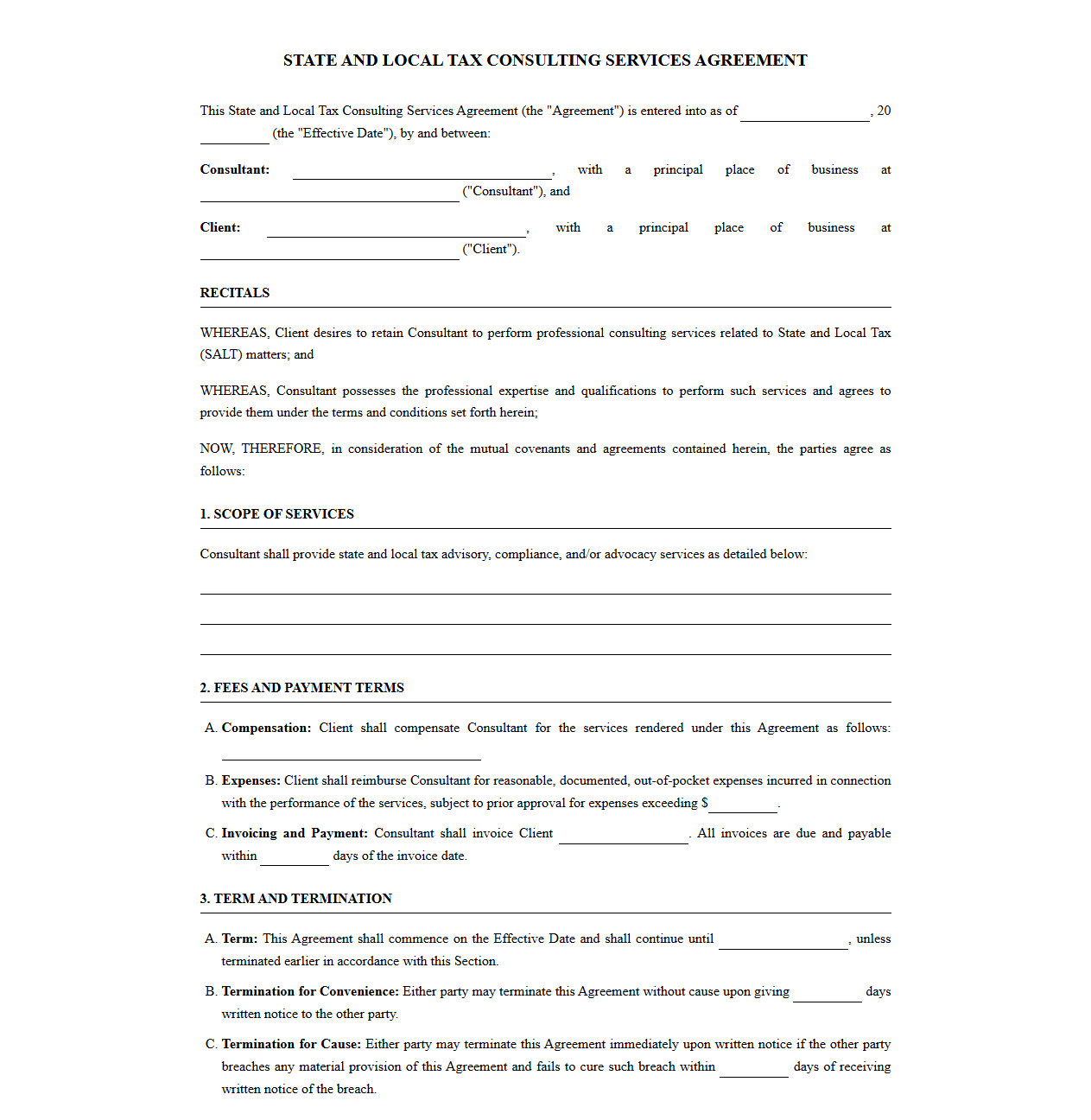
State and Local Tax Consulting Services Agreement
 Download: .PDF
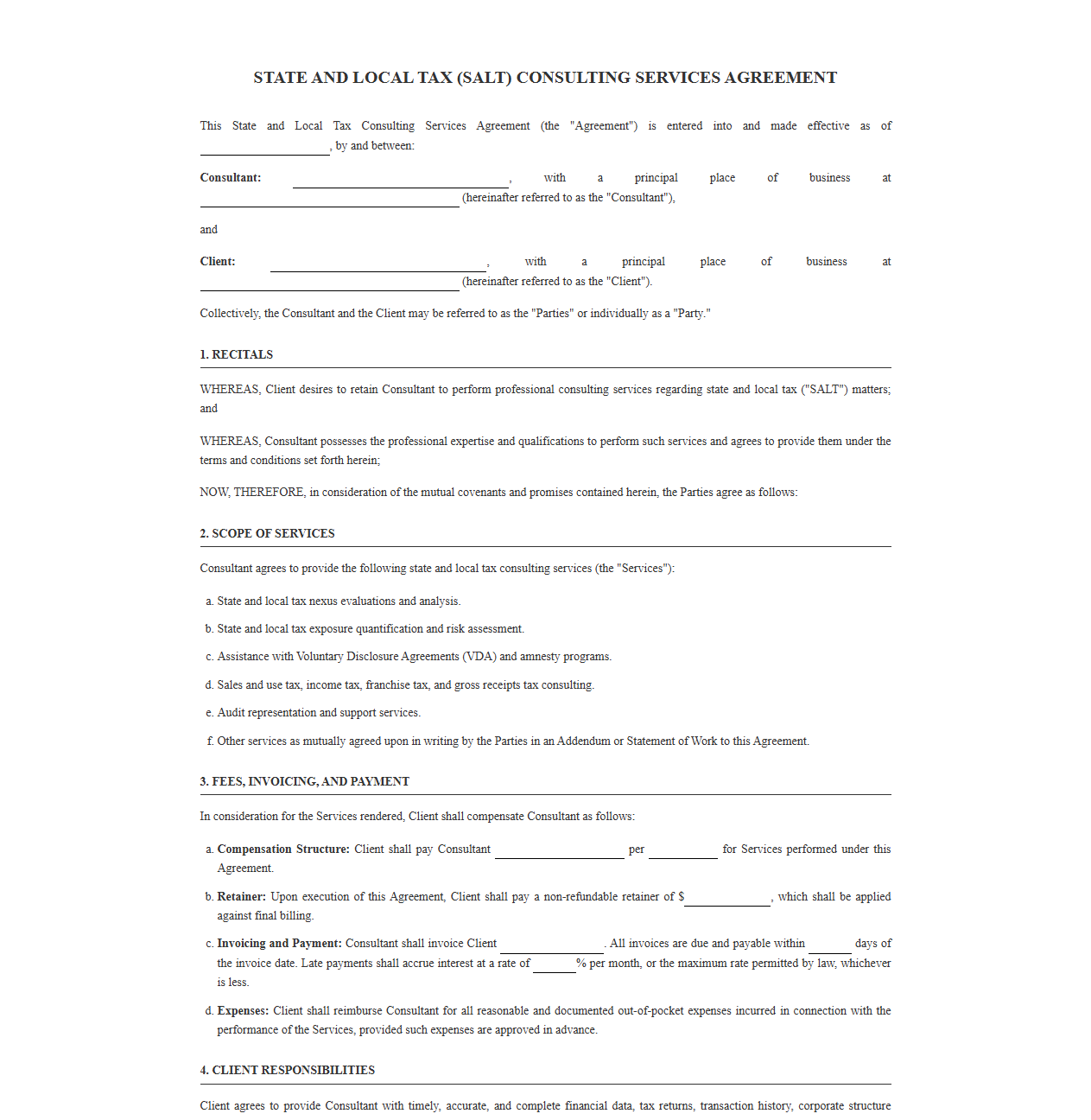
SALT Consulting Services Agreement Template
 Download: .PDF
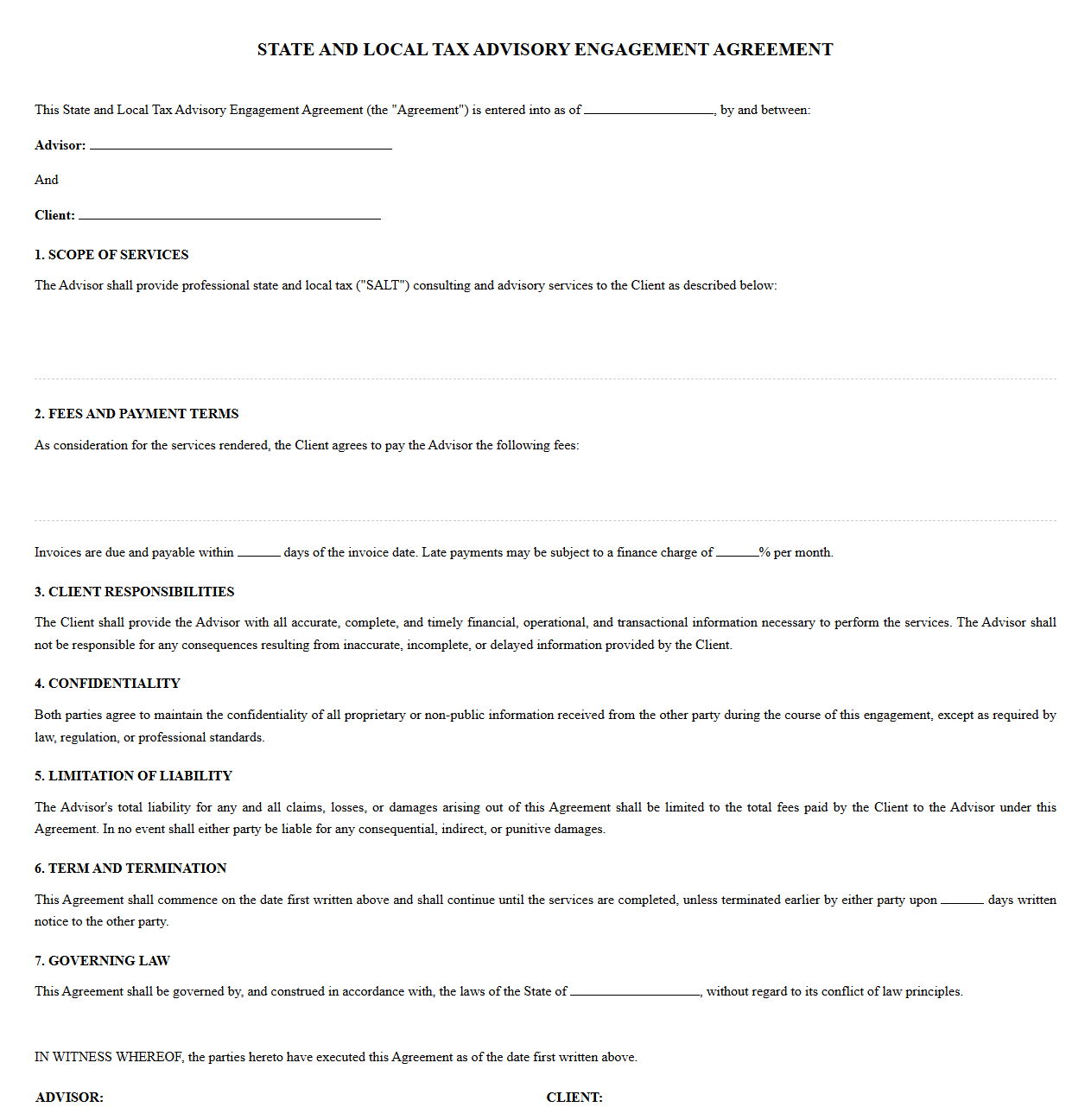
State and Local Tax Advisory Engagement Agreement
 Download: .PDF
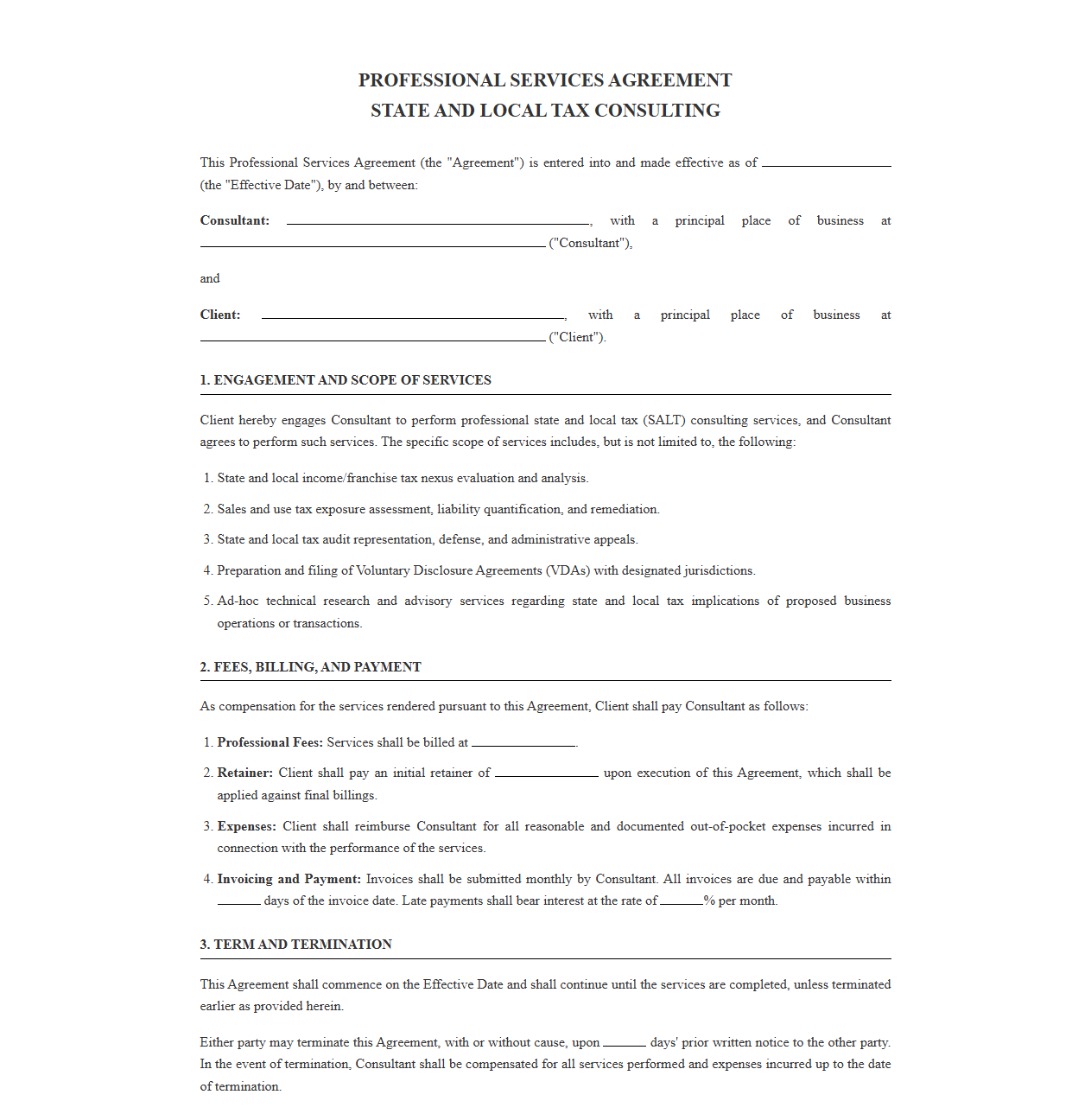
Professional Agreement for State and Local Tax Consulting
 Download: .PDF
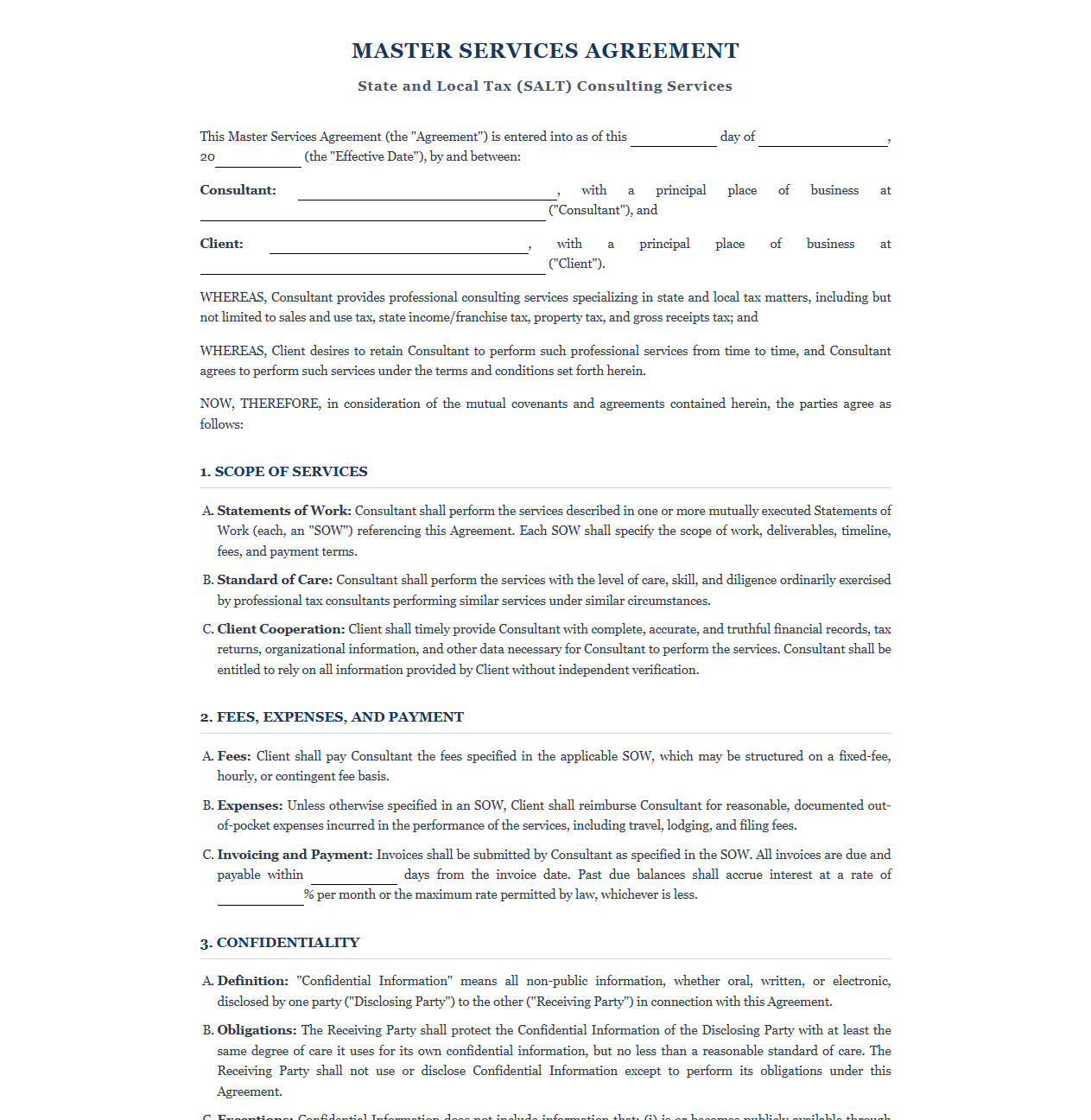
Master Services Agreement for State and Local Tax Consulting
 Download: .PDF
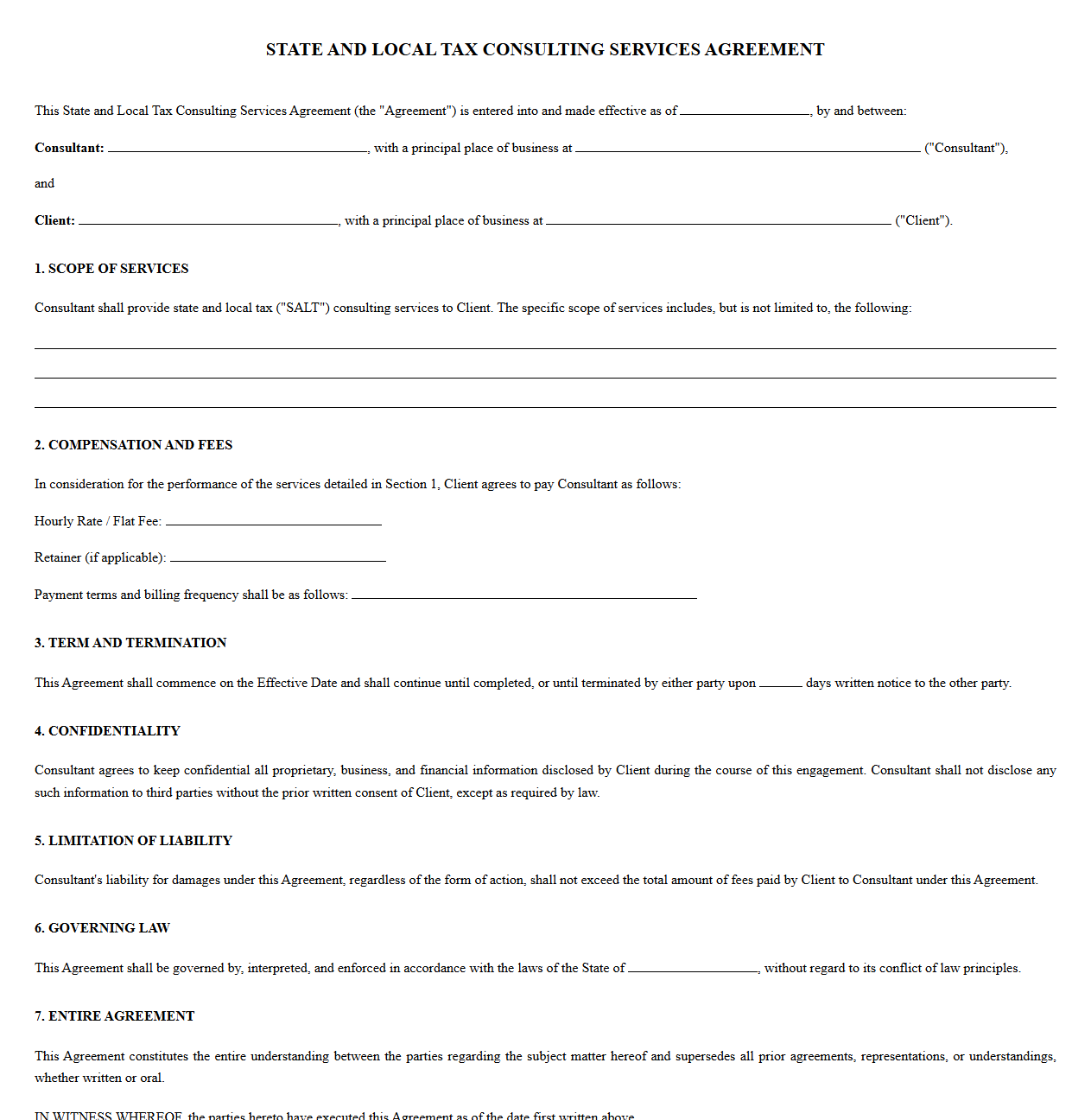
State and Local Tax Consulting Contract Template
 Download: .PDF
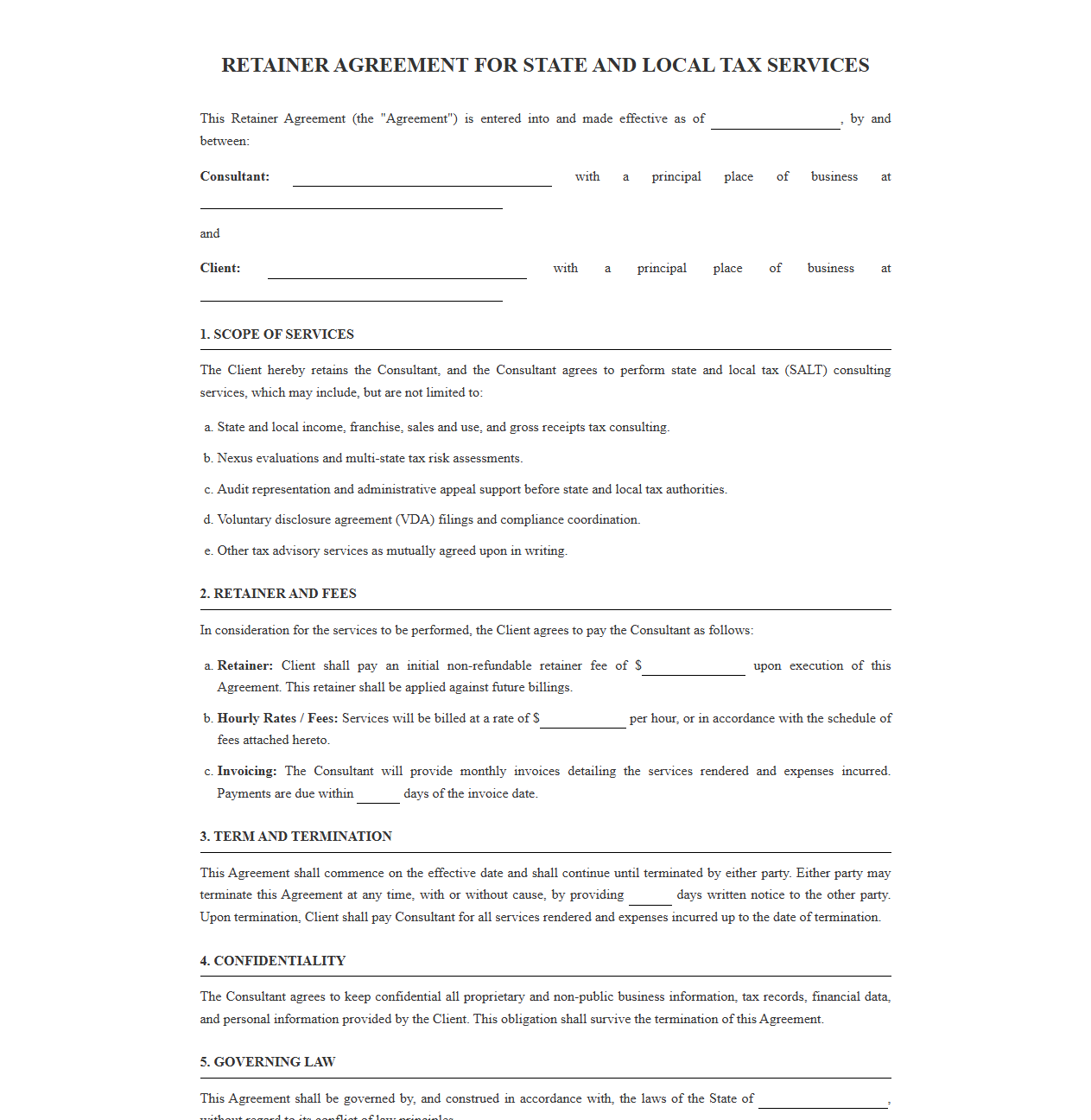
Retainer Agreement for State and Local Tax Services
 Download: .PDF
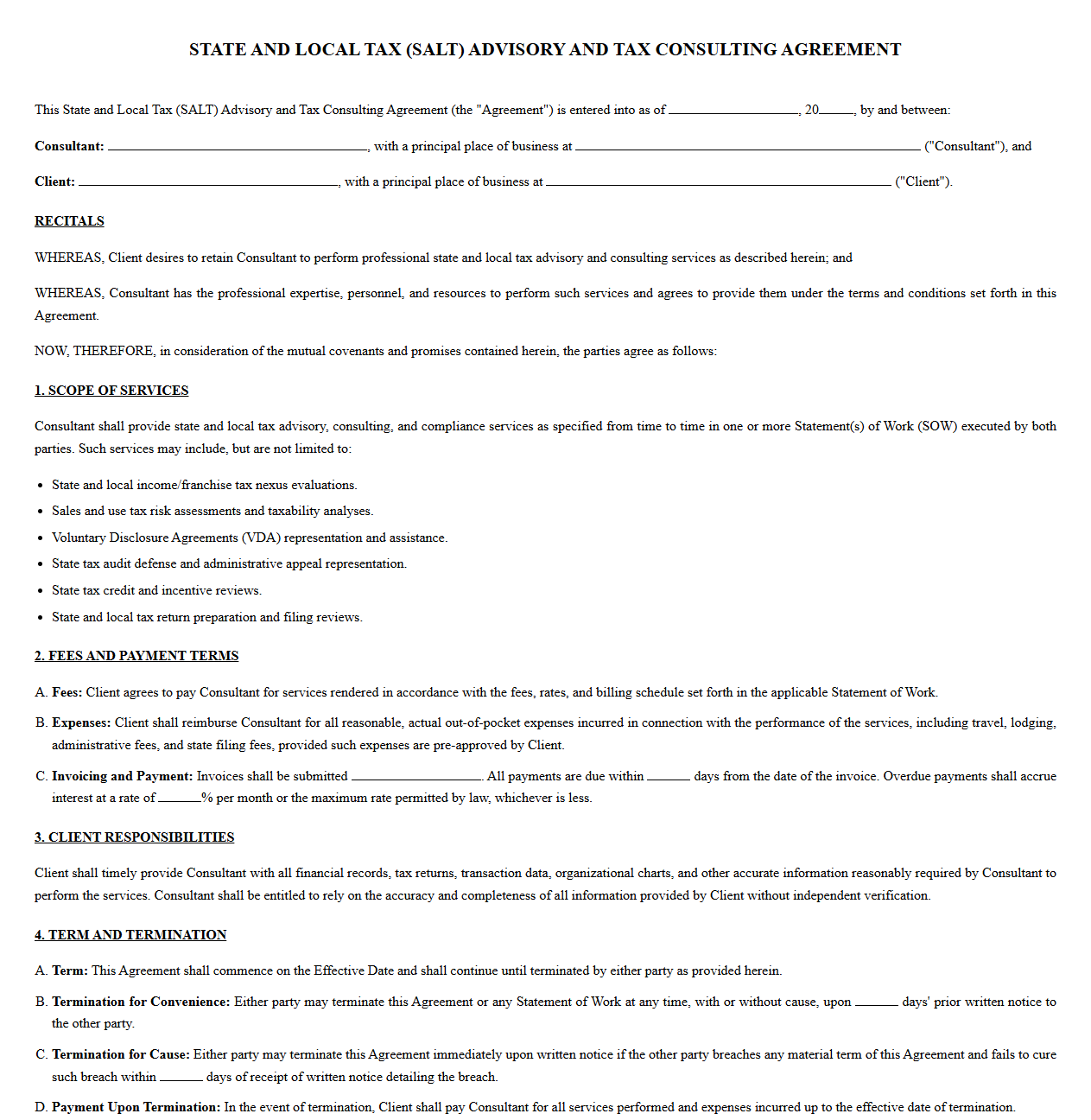
SALT Advisory and Tax Consulting Agreement
 Download: .PDF
State and Local Tax Services Engagement Letter Template
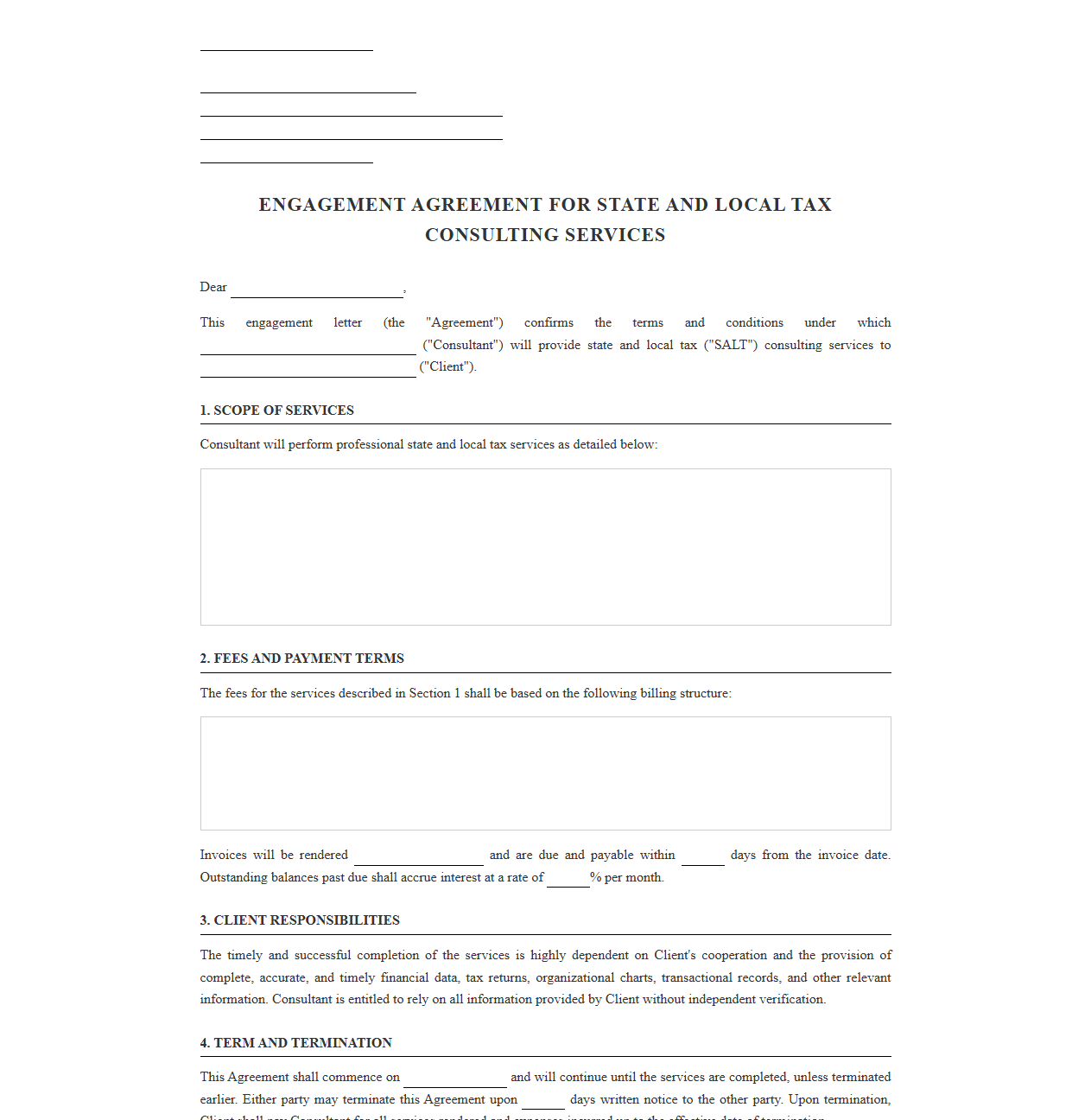 Download: .PDF
Navigating the Complexities of State and Local Tax Compliance
The landscape of state and local tax (SALT) regulations is shifting at an unprecedented pace. With thousands of jurisdictions across the country constantly adjusting their tax codes, rates, and nexus thresholds, businesses face an uphill battle to remain compliant. For tax advisory firms, this volatility presents both an opportunity and a significant risk. A robust, meticulously drafted consulting agreement is critical to mitigate compliance risks, aligning expectations and shielding both the advisory firm and the client from costly legal and financial disputes.
Defining the Scope of Work: The Foundation of SALT Agreements
To establish a transparent partnership, a SALT service agreement must explicitly define the boundaries of the engagement. Ambiguity in this section often leads to scope creep, where advisors perform uncompensated work, or clients assume services are being rendered when they are not.
To prevent misunderstandings, the agreement should clearly detail the following elements:
- Tax Jurisdictions: Specify exactly which states, counties, or municipalities are covered under the agreement, as well as those that are explicitly excluded.
- Tax Types: Clarify whether the services pertain to sales and use tax, corporate income tax, franchise tax, gross receipts tax, or property tax.
- Specific Services: Detail the actions to be taken, such as nexus evaluations, voluntary disclosure agreement (VDA) submissions, or audit representation.
Allocating Risk: Limitation of Liability and Indemnification Clauses
Given the high stakes of state tax audits, liability allocation is a cornerstone of any professional services contract. Drafting balanced liability clauses is essential to protect the consulting firm from disproportionate financial damages while maintaining professional accountability.
"The consultant's liability under this agreement shall be capped at the total fees paid by the client for the specific services rendering rise to the claim, ensuring a fair and balanced distribution of financial risk."
By incorporating reciprocal indemnification clauses, both parties agree to hold each other harmless from third-party claims resulting from negligence or willful misconduct, fostering a relationship built on mutual trust and clear legal boundaries.
Establishing Client Responsibilities for Information Accuracy
A tax consulting firm can only perform as well as the data it is provided. To safeguard the firm against the consequences of inaccurate tax filings, the consulting agreement must clearly outline the client's obligations regarding data provisioning.
This section should obligate the client to adhere to the following responsibilities:
- Provide complete, accurate, and unedited financial and transactional records in a timely manner.
- Promptly disclose any changes in business activities, physical presence, or sales channels that could impact nexus determinations.
- Acknowledge that the firm is not responsible for auditing the provided financial records for fraud or errors unless specifically contracted to do so.
Structuring Fees, Retainers, and Out-of-Pocket Expenses
Clear financial terms prevent billing disputes and support healthy cash flow. The agreement should outline a detailed billing framework that aligns with the complexity of the SALT project.
Advisors can structure billing using hourly rates, fixed fees for predictable projects like nexus studies, or contingent fees when assisting with tax recovery, provided such arrangements comply with state ethical guidelines. Retainers should be clearly defined, specifying whether they are refundable and how they will be applied against future invoices. Additionally, explicit terms regarding the reimbursement of out-of-pocket expenses, such as travel or specialized software access, must be included to avoid end-of-project friction.
Safeguarding Proprietary Data: Confidentiality and Security Standards
SALT engagements require clients to share highly sensitive corporate financial data, intellectual property, and proprietary business plans. Thus, implementing rigorous confidentiality and data security clauses is paramount.
To ensure total compliance with state and federal privacy laws, the agreement must enforce:
- Strict Non-Disclosure: Restricting the use of client information solely to the execution of the contracted tax services.
- Data Encryption: Utilizing secure, encrypted file-sharing portals for all financial document transfers.
- Breach Notification: Establishing clear protocols and timelines for notifying the client in the event of a suspected or confirmed data security incident.
Implementing and Updating Your SALT Service Agreements
State tax laws are not static, and your agreements should not be either. Tax firms must treat their service templates as living documents that require ongoing maintenance.
To ensure your agreements remain protective and legally sound over time, incorporate the following practices into your annual review cycle:
- Review agreements annually with specialized legal counsel to ensure compliance with updated state regulations.
- Customize template defaults for every new engagement to match the client's specific operational realities.
- Train staff on the boundaries of the scope of work to prevent informal expansion of services without an executed addendum.

Leave a comment