

Accounting professionals constantly operate under the looming threat of catastrophic malpractice claims and devastating financial liability. Before addressing how to draft protective contracts, one must first recognize how shifting regulatory standards and complex tax codes have drastically expanded an accountant's legal duty of care. Implementing standardized indemnity agreements grants firms the immediate, robust legal shields needed to protect both organizational capital and professional reputation.
However, as a crucial stipulation, practitioners must remember that generic templates serve as foundational frameworks rather than universal panaceas; they must be carefully tailored to state-specific jurisdictions to ensure enforceability. For instance, incorporating highly specific "hold harmless" provisions and mutual limitation of liability clauses is vital for effectively capping potential exposure. Below, we examine the essential accounting malpractice indemnity templates, detailing the key clauses and structural adjustments your firm needs to mitigate professional risk.
Agreement Template for Accountant Professional Liability Indemnity
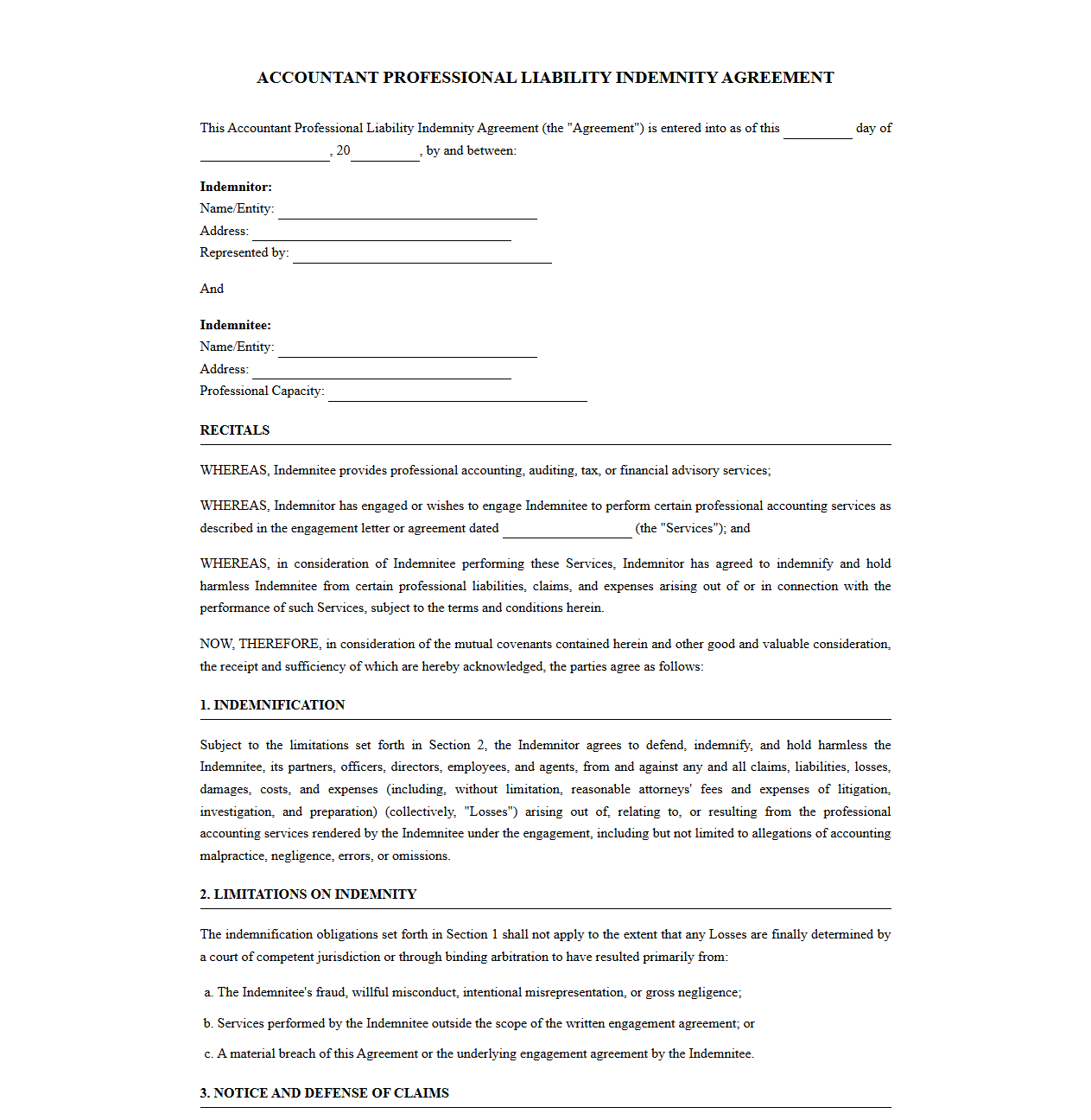 Download: .PDF
Certified Public Accountant Malpractice Indemnity Agreement
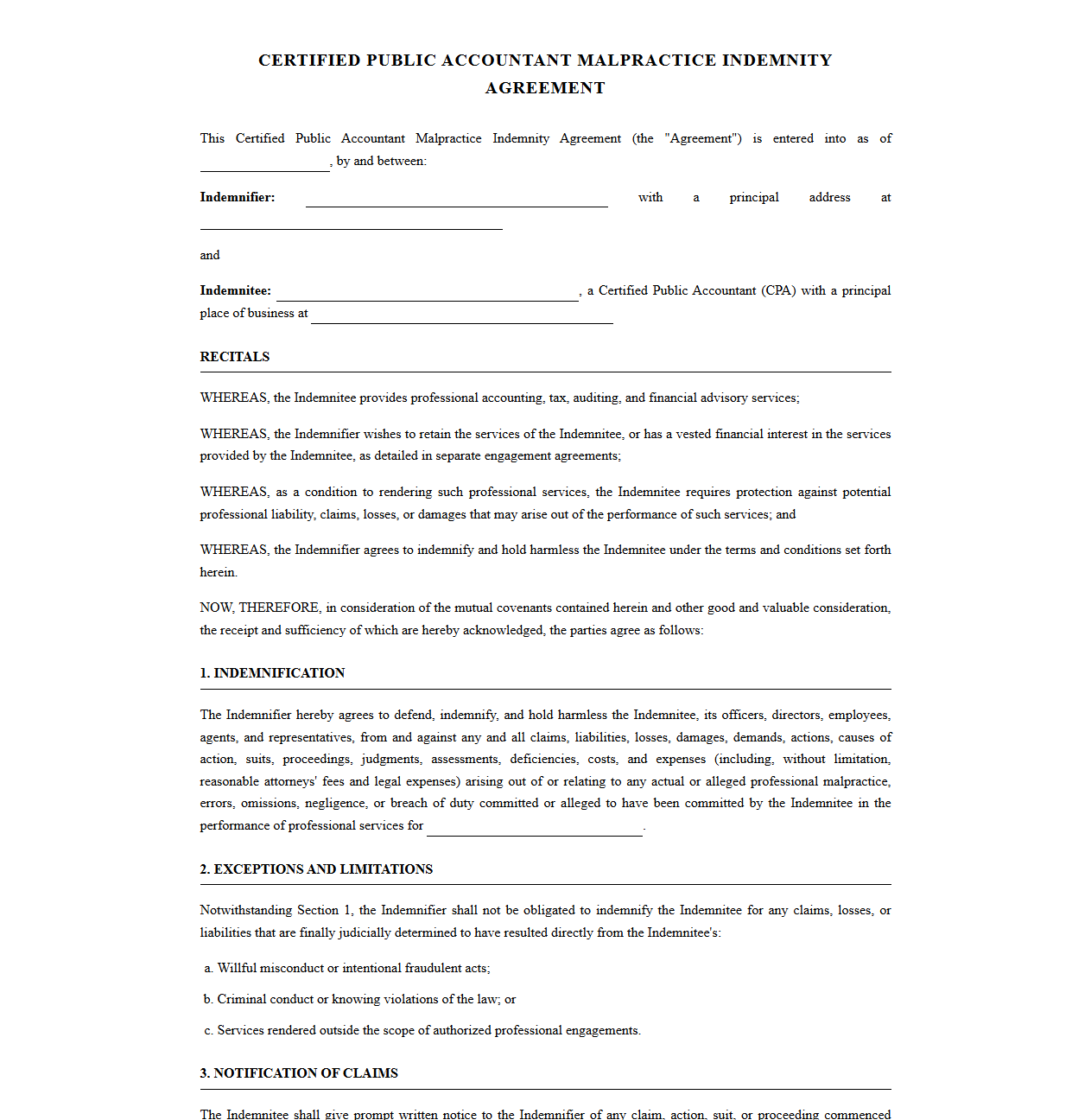 Download: .PDF
Accounting Services Liability Indemnification Agreement Template
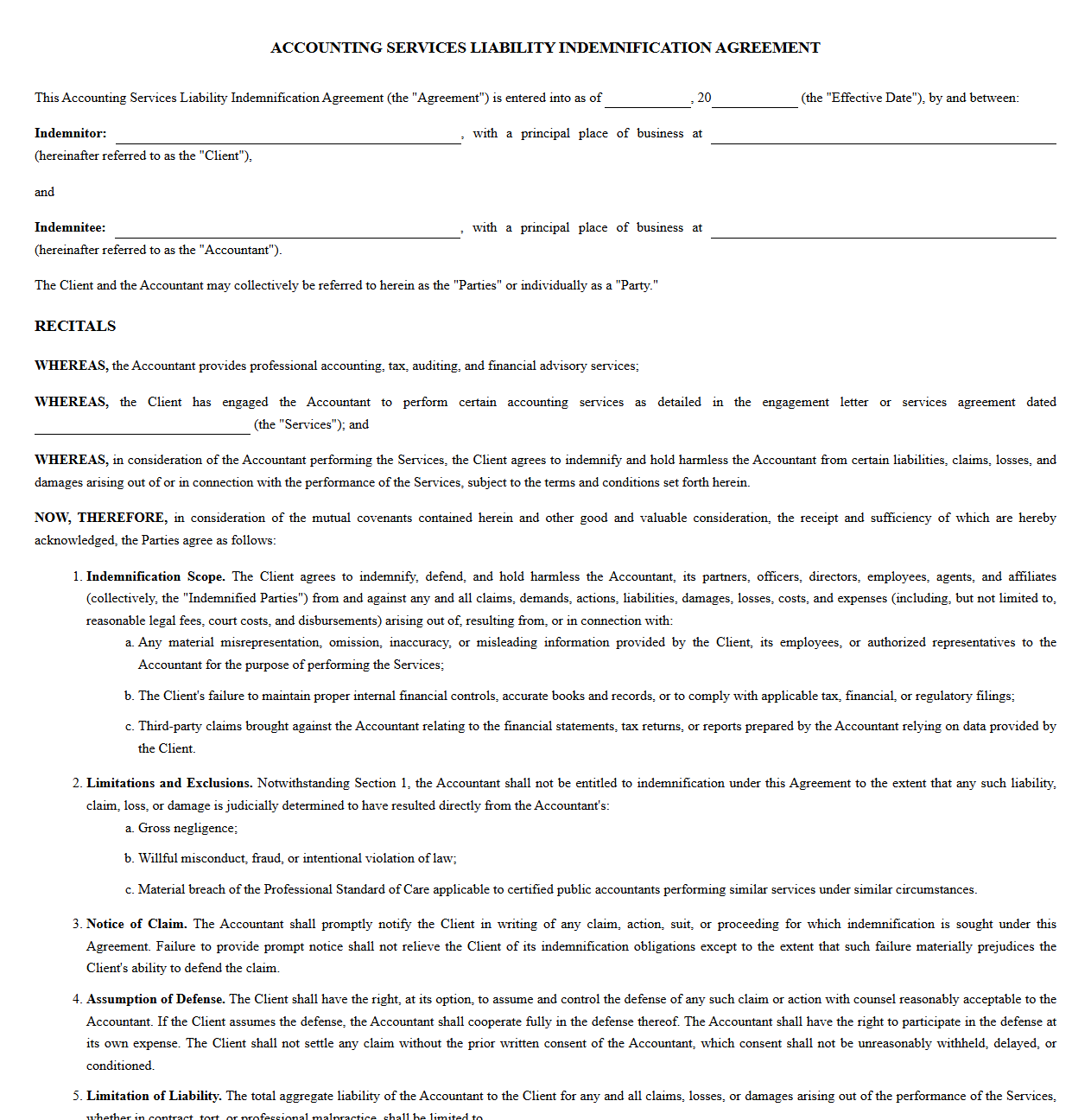 Download: .PDF
Accountant Hold Harmless and Malpractice Indemnity Agreement
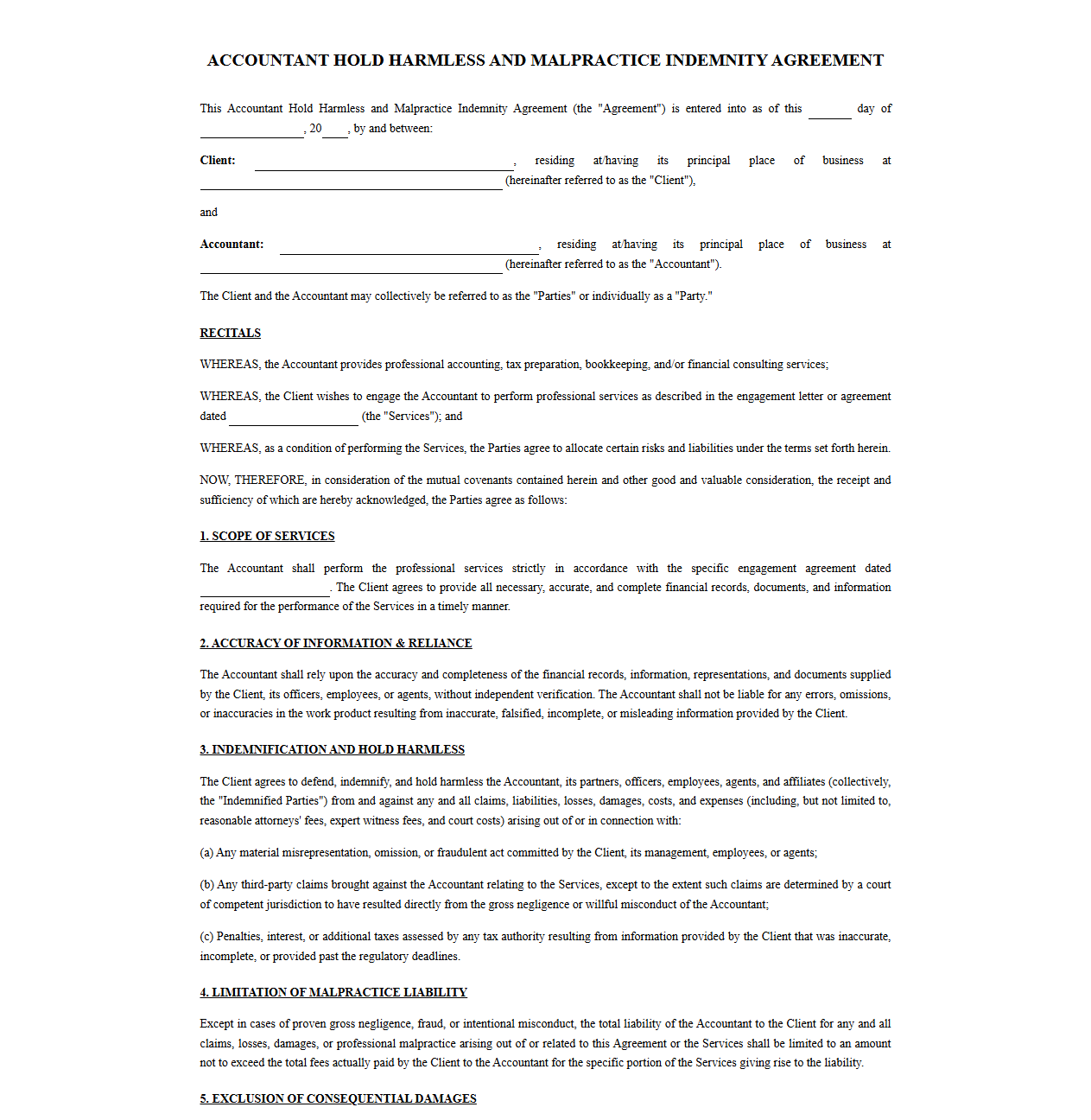 Download: .PDF
Financial Auditor Malpractice Indemnification Contract
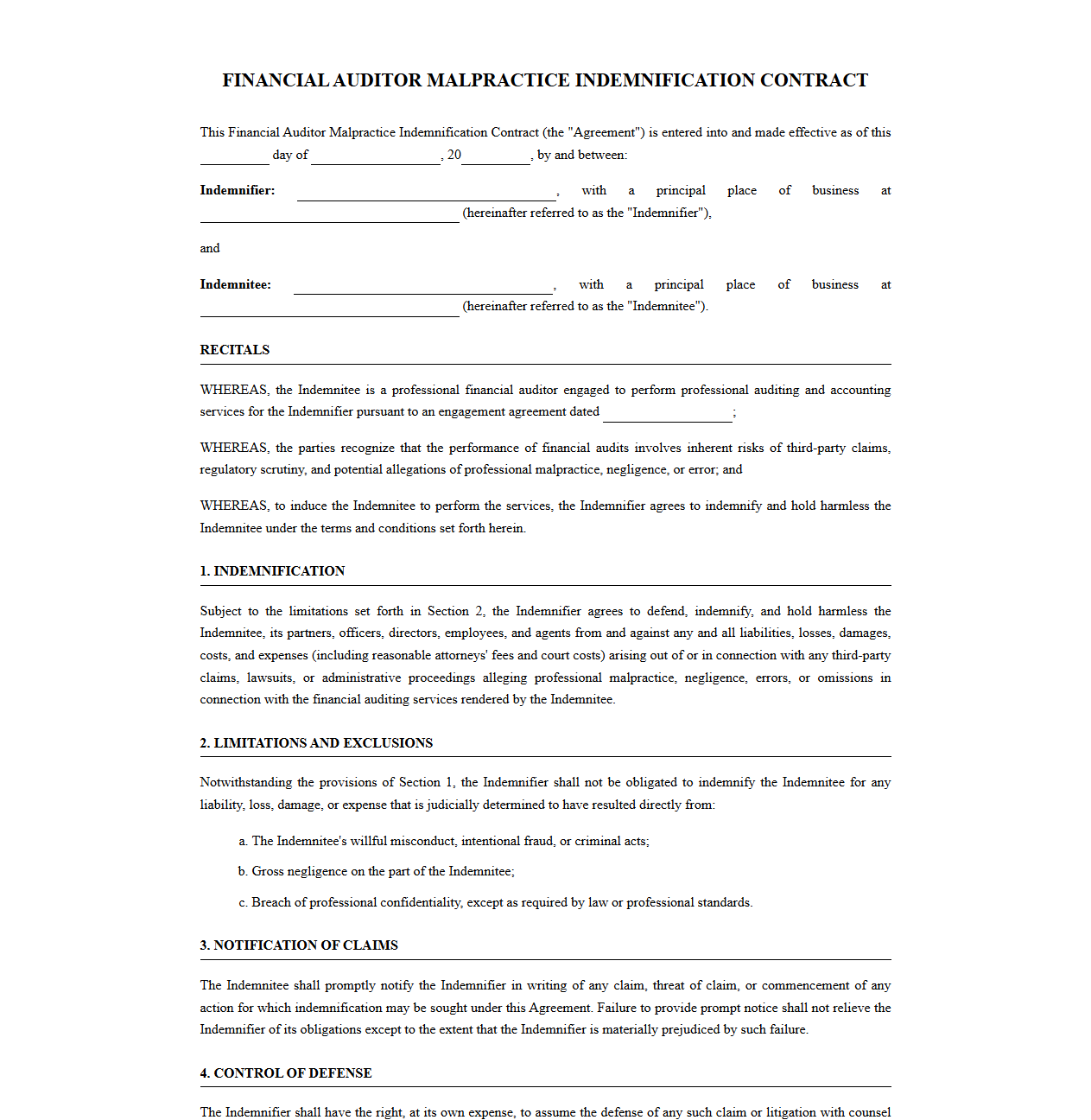 Download: .PDF
CPA Professional Indemnity and Malpractice Agreement
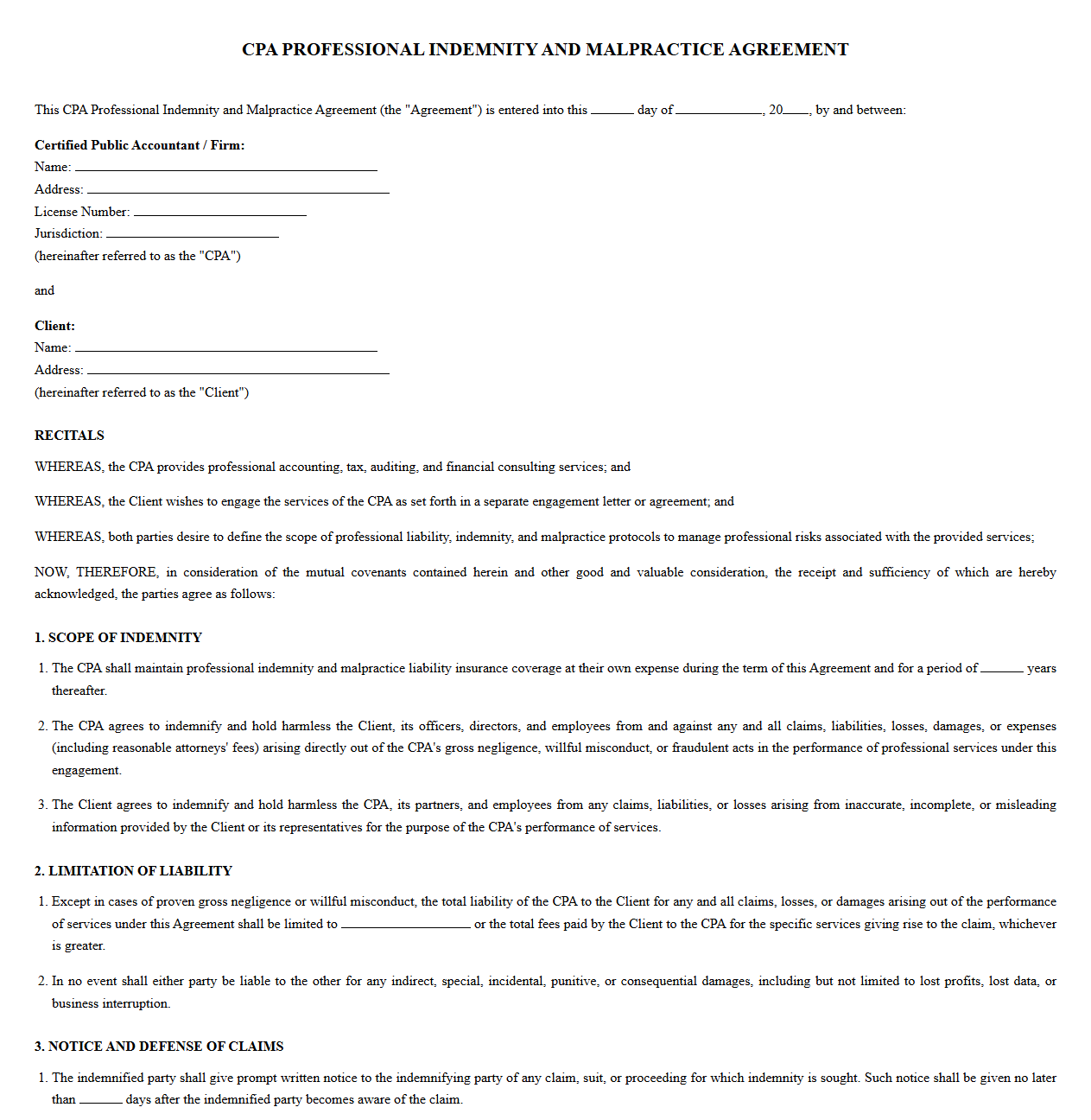 Download: .PDF
Tax Accountant Malpractice Liability Indemnity Agreement
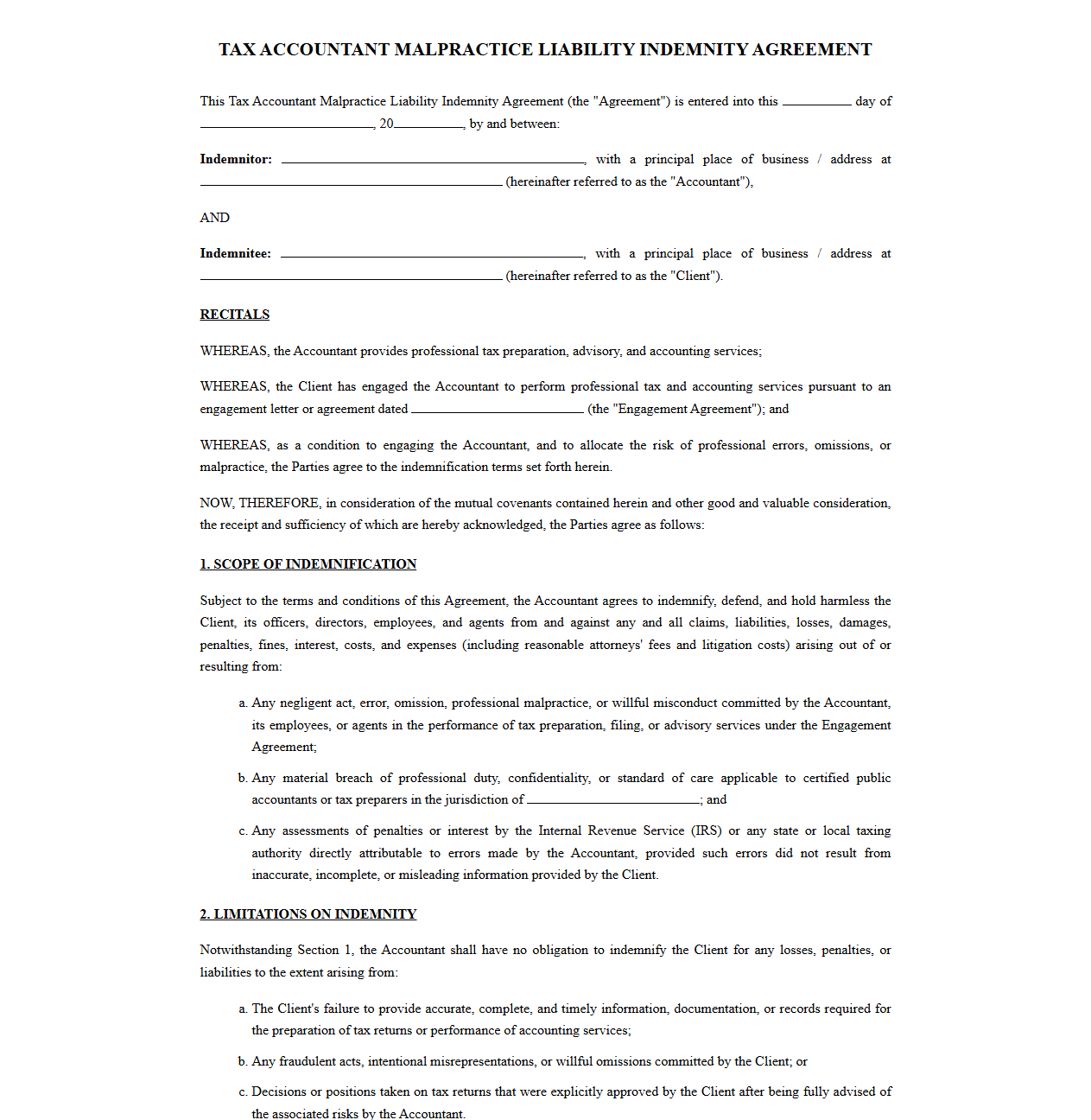 Download: .PDF
Bookkeeper and Accountant Malpractice Indemnity Agreement
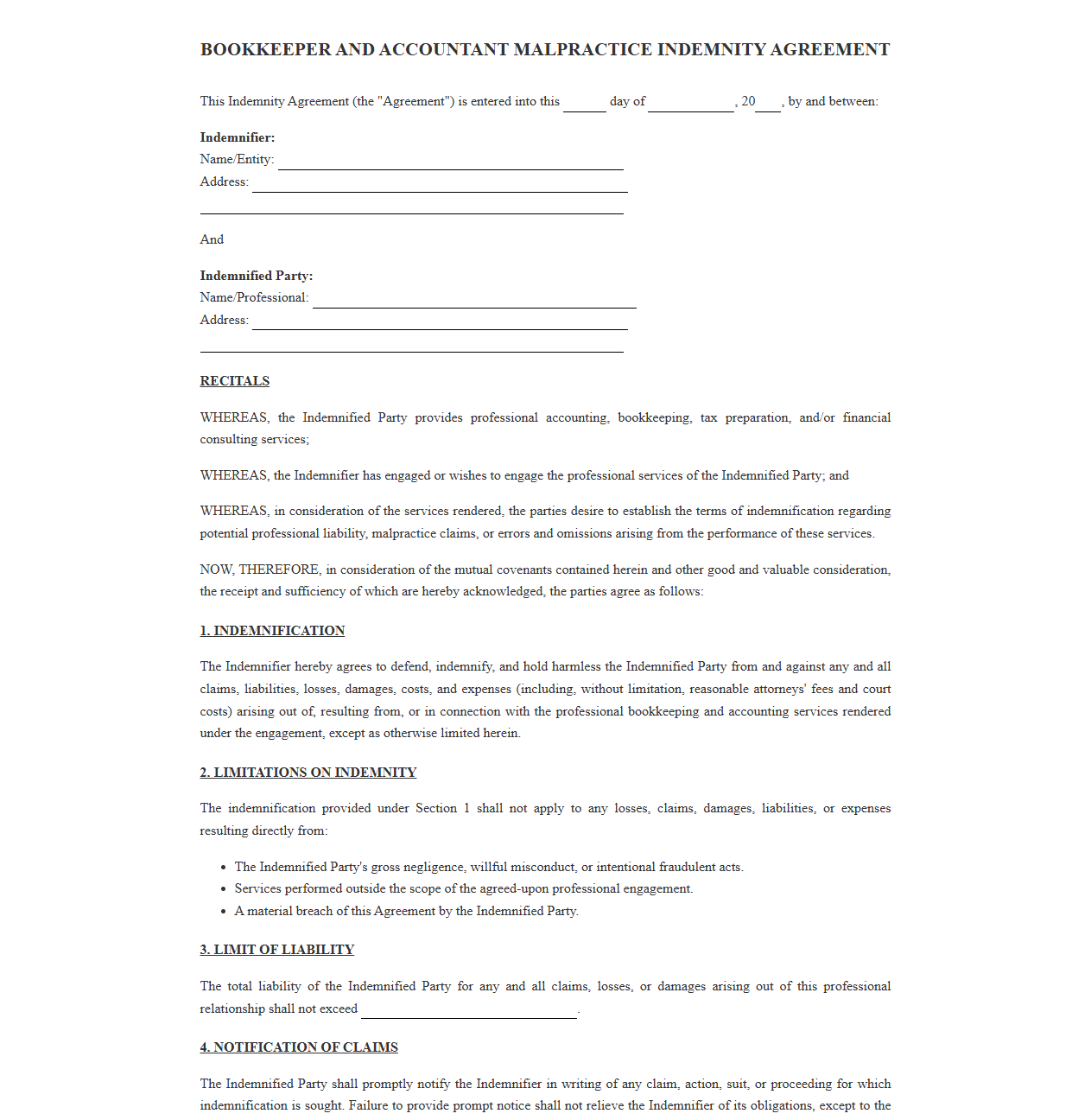 Download: .PDF
Understanding Accounting Professional Liability and Malpractice Risks
Accounting professional liability arises when a practitioner fails to perform their professional duties with the requisite level of skill and care, resulting in financial loss for the client. Malpractice risks frequently occur due to clerical errors, misinterpretation of complex tax laws, missed deadlines, or a lack of clear communication regarding the scope of work. To mitigate these significant financial exposures, CPA firms and independent accountants utilize indemnity agreements. Indemnity agreements serve as a vital legal shield, establishing a clear allocation of risk and safeguarding the financial practice against devastating litigation expenses.
Essential Clauses in an Accounting Malpractice Indemnity Agreement
A well-structured malpractice indemnity agreement contains specific, enforceable clauses designed to limit a firm's legal exposure. When drafting or reviewing these contracts, ensure the following essential components are clearly defined:
- Scope of Services: Explicitly details the exact professional services to be provided, preventing "scope creep" and liability for unauthorized tasks.
- Limitation of Liability: Caps the maximum monetary damages a client can recover, often limited to the total fees paid for the specific engagement.
- Hold Harmless Clause: Obligates the client to protect the accountant against losses, damages, and legal costs arising from third-party claims or inaccurate client data.
- Indemnification for Third-Party Claims: Establishes who bears the legal costs if an outside party (such as a lender or shareholder) sues over the work product.
Standard Mutual Indemnity Template for Accounting Firms
The following template is a standard mutual indemnification agreement tailored for accounting firms and corporate clients. It balances risk by requiring both parties to indemnify each other for losses arising from their respective breaches of contract or negligent acts.
MUTUAL INDEMNIFICATION AGREEMENT
This Agreement is entered into by and between [Accounting Firm Name] ("Accountant") and [Client Name] ("Client").
1. Mutual Indemnification.
Each party (as "Indemnifying Party") shall defend, indemnify, and hold harmless the other party, its affiliates, officers, directors, and employees (as "Indemnified Party") from and against any and all third-party claims, liabilities, losses, damages, and expenses (including reasonable attorneys' fees) arising out of or relating to the Indemnifying Party's gross negligence, willful misconduct, or material breach of this Agreement.
2. Limitation of Liability.
In no event shall either party's liability under this Agreement exceed the total fees paid by Client to Accountant during the [Number] months preceding the event giving rise to the claim.
IN WITNESS WHEREOF, the parties hereto have executed this Agreement as of [Date].
___________________________                ___________________________
[Accounting Firm Representative]          [Client Representative]
Client-to-Accountant Unilateral Hold Harmless Template
Accountants rely heavily on the accuracy of the financial documentation provided by their clients. This unilateral hold harmless template ensures the client bears sole responsibility for any legal or regulatory fallout resulting from fraudulent, inaccurate, or incomplete client-provided data.
CLIENT-TO-ACCOUNTANT HOLD HARMLESS COVENANT
The Client acknowledges that [Accounting Firm Name] ("Accountant") will prepare all financial statements, tax returns, and reports based solely on the information, records, and representations provided by the Client.
The Client hereby agrees to indemnify, defend, and hold harmless Accountant and its professional staff from any and all claims, liabilities, damages, costs, and expenses (including attorney fees and court costs) arising from or relating to any errors, omissions, or misrepresentations in the data provided by the Client, or any decisions made by Accountant in reliance thereon.
Addressing Third-Party Reliance and Liability Clauses
A common source of malpractice claims involves third parties-such as banks, investors, or creditors-who make financial decisions based on an accountant's reports. To prevent these outside parties from establishing privity of contract and filing lawsuits, engagement letters must contain robust non-reliance and third-party disclaimer clauses.
"No third-party reliance is intended or authorized by this engagement. The services, reports, and financial analyses provided under this Agreement are performed solely for the confidential use of the Client. No other party is entitled to rely on these work products, and [Accounting Firm Name] expressly disclaims any duty of care or liability to any third party who obtains access to these materials."
Best Practices for Executing and Enforcing Indemnity Agreements
Simply having an indemnity template is not enough; the manner in which it is integrated and executed dictates its legal enforceability. Accounting professionals should adhere to strict protocols to ensure their risk mitigation strategies remain legally sound:
- Incorporate Directly into Engagement Letters: Do not treat indemnity agreements as separate, optional forms. Embed them directly into your standard annual engagement letters.
- Obtain Authorized Signatures: Ensure the individual signing the agreement on behalf of a corporate client has the actual legal authority to bind the entity.
- Conduct Regular Legal Reviews: Laws regarding liability caps and indemnification validity vary significantly by jurisdiction and evolve over time. Have a local attorney review your templates annually.
- Verify State-Specific Compliance: Some states prohibit CPA firms from utilizing certain types of indemnification clauses in audit engagements. Verify that your clauses conform to state board of accountancy regulations.
Securing Your Practice Against Professional Liability
Operating a modern financial practice requires a balanced approach to both numbers and legal realities. Implementing robust, clear indemnity templates in daily workflows prevents misunderstandings and shields firms from catastrophic litigation. Proactive risk management is an ongoing process, requiring regular updates to contracts and constant vigilance to safeguard your professional livelihood.

Leave a comment