

Navigating the aftermath of a major corporate transaction often exposes organizations to the stressful reality of post-closing audit risks. Unanticipated liabilities can quickly erode transaction value, leaving executives scrambling to defend their financial positions. As regulatory scrutiny intensifies globally, simply hoping for compliance is no longer a viable risk-management strategy.
Structuring robust representation and indemnity (R&I) agreements grants transaction parties the precise legal and financial protection needed to safeguard their investments. However, we must stipulate that these frameworks are not generic, plug-and-play templates; they require meticulous customization. For example, incorporating specific tax representations or targeted environmental indemnity clauses serves as concrete proof of how tailored risk allocation prevents catastrophic exposure.
This article details the essential frameworks of R&I agreements, explores strategic negotiation tactics, and outlines practical methods to effectively mitigate audit liabilities.
Audit Representation and Indemnification Agreement
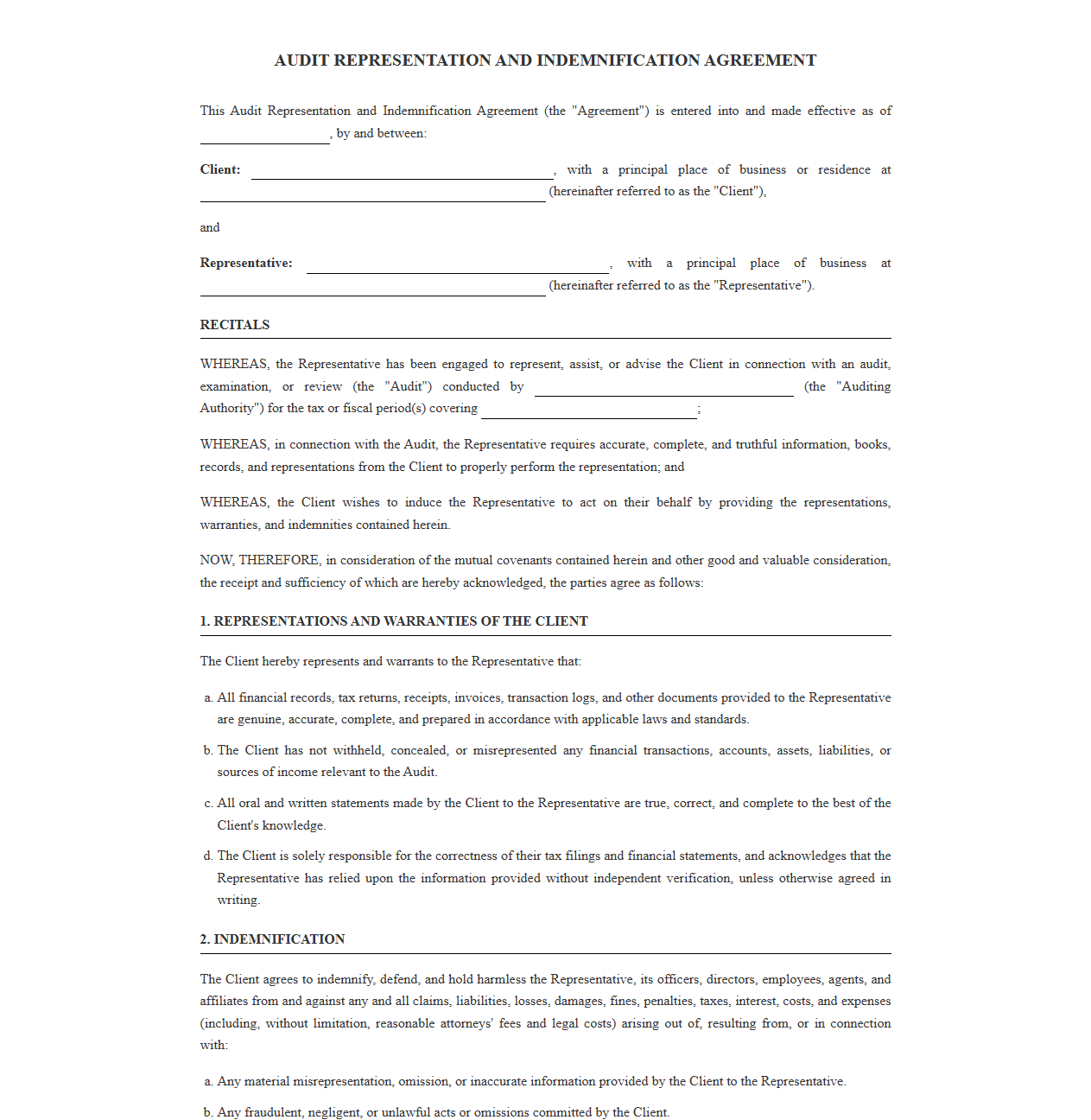 Download: .PDF
Tax Audit Defense and Indemnity Agreement Template
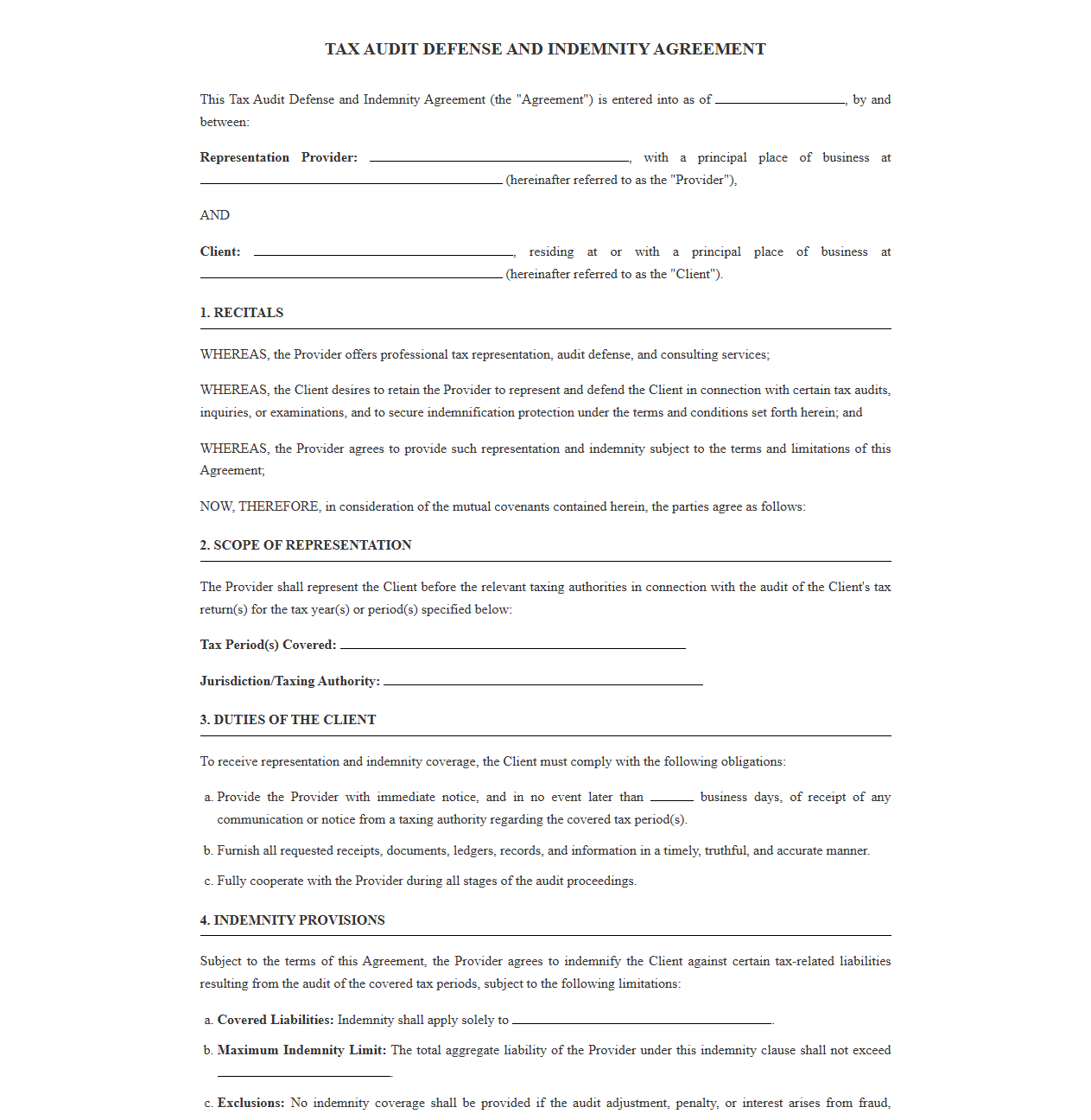 Download: .PDF
IRS Audit Representation and Hold Harmless Agreement
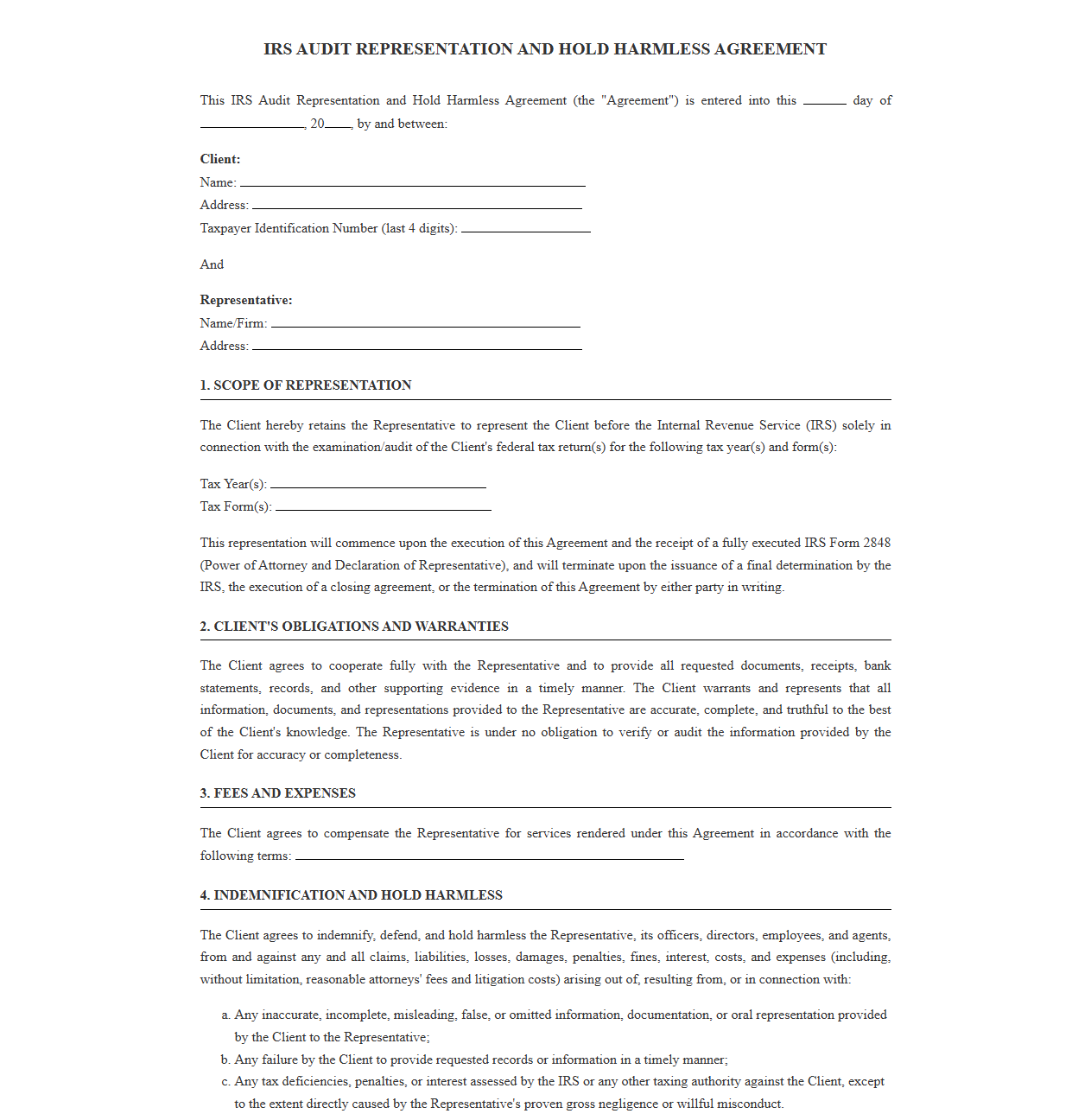 Download: .PDF
Corporate Audit Defense and Indemnity Contract
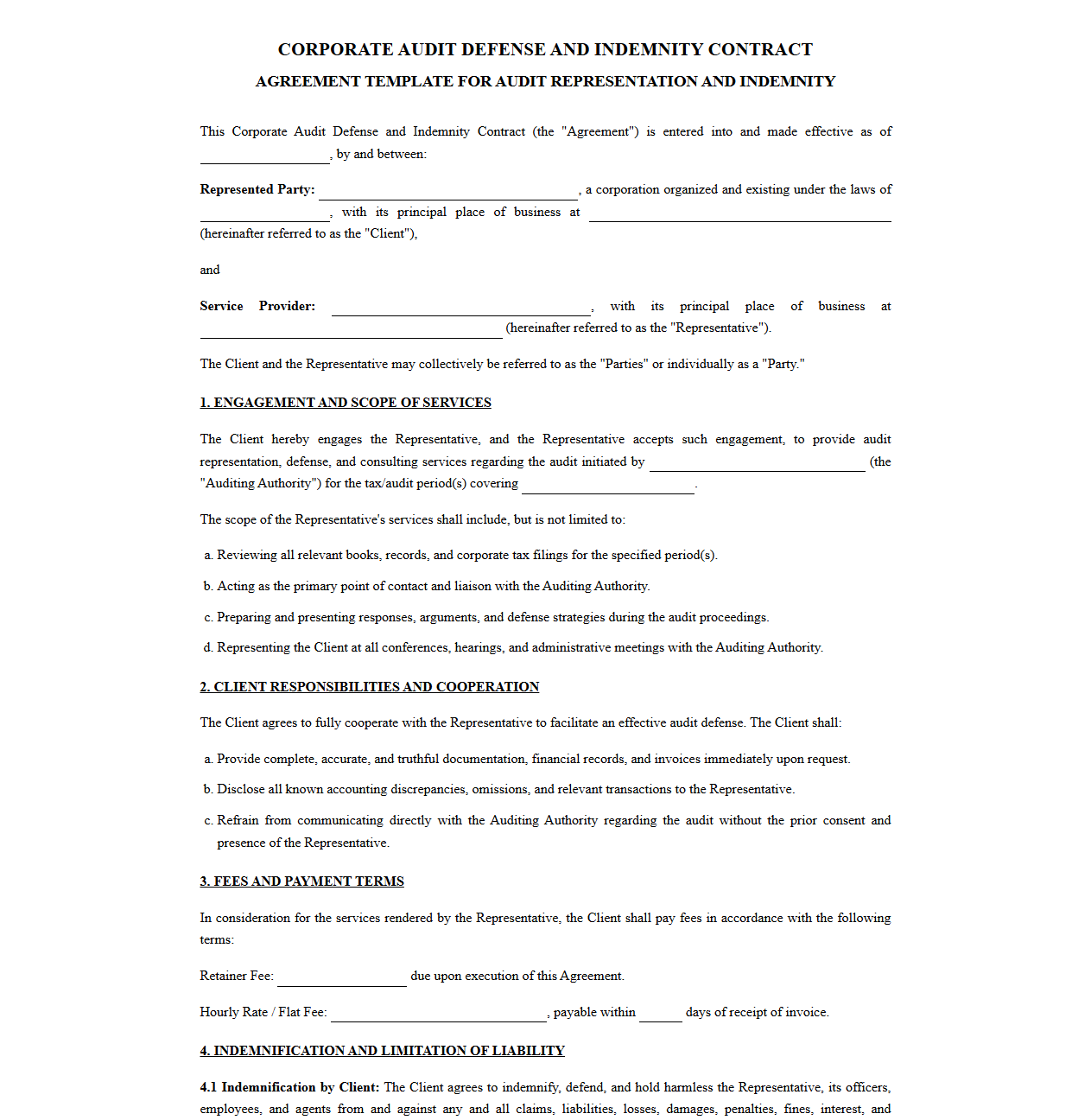 Download: .PDF
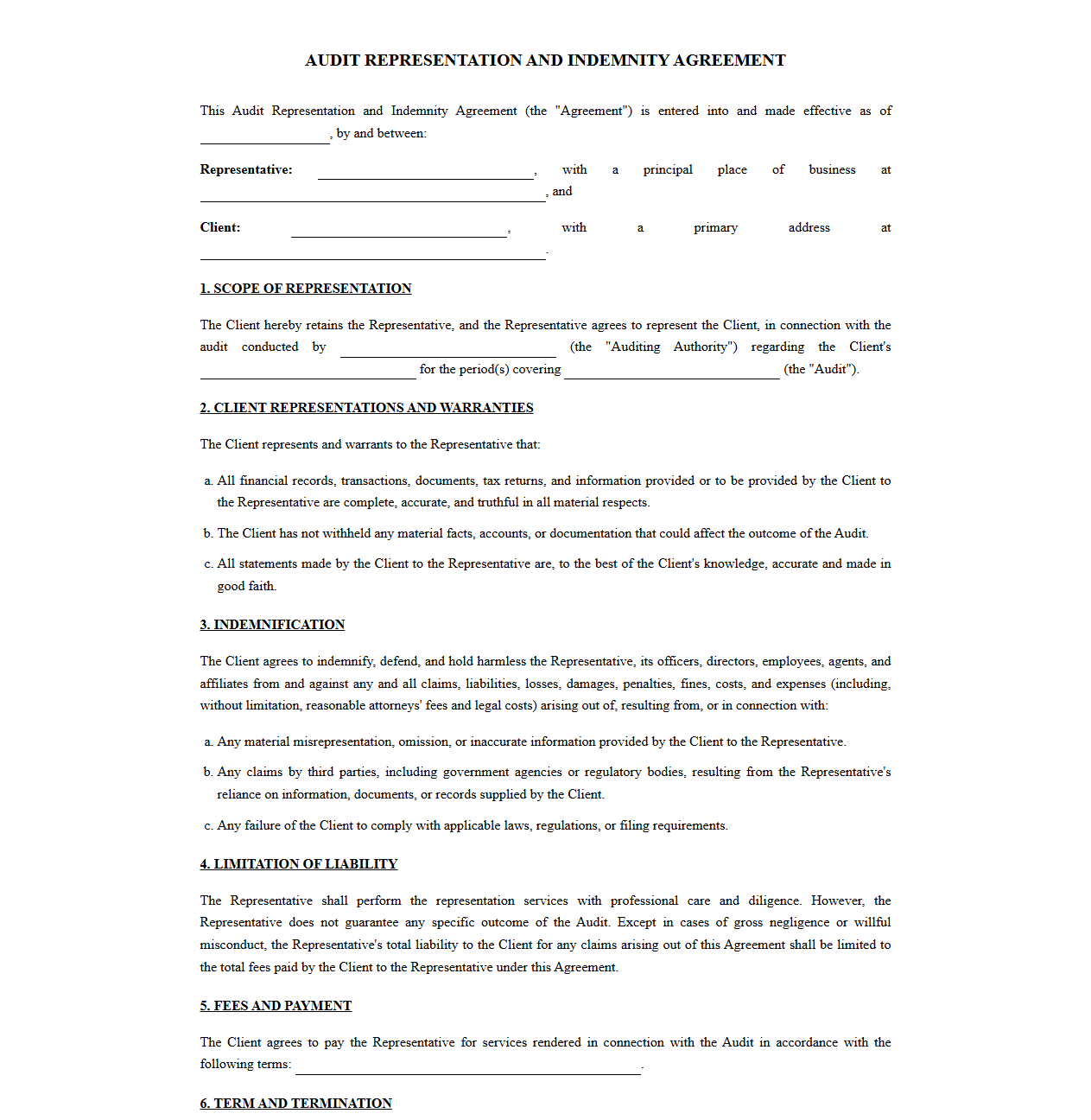
Audit Representation Letter and Indemnity Agreement
 Download: .PDF
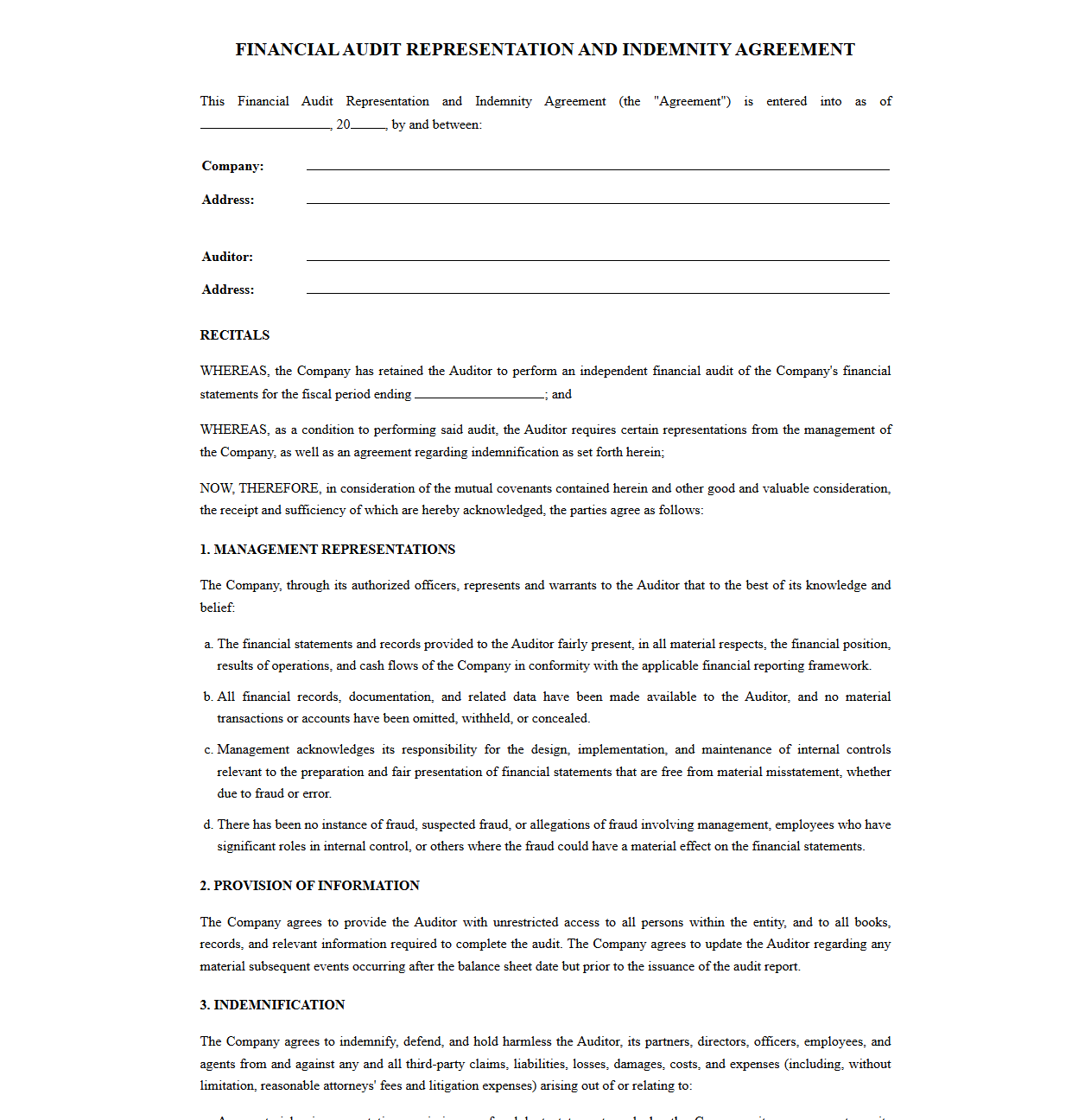
Financial Audit Representation and Indemnity Agreement
 Download: .PDF
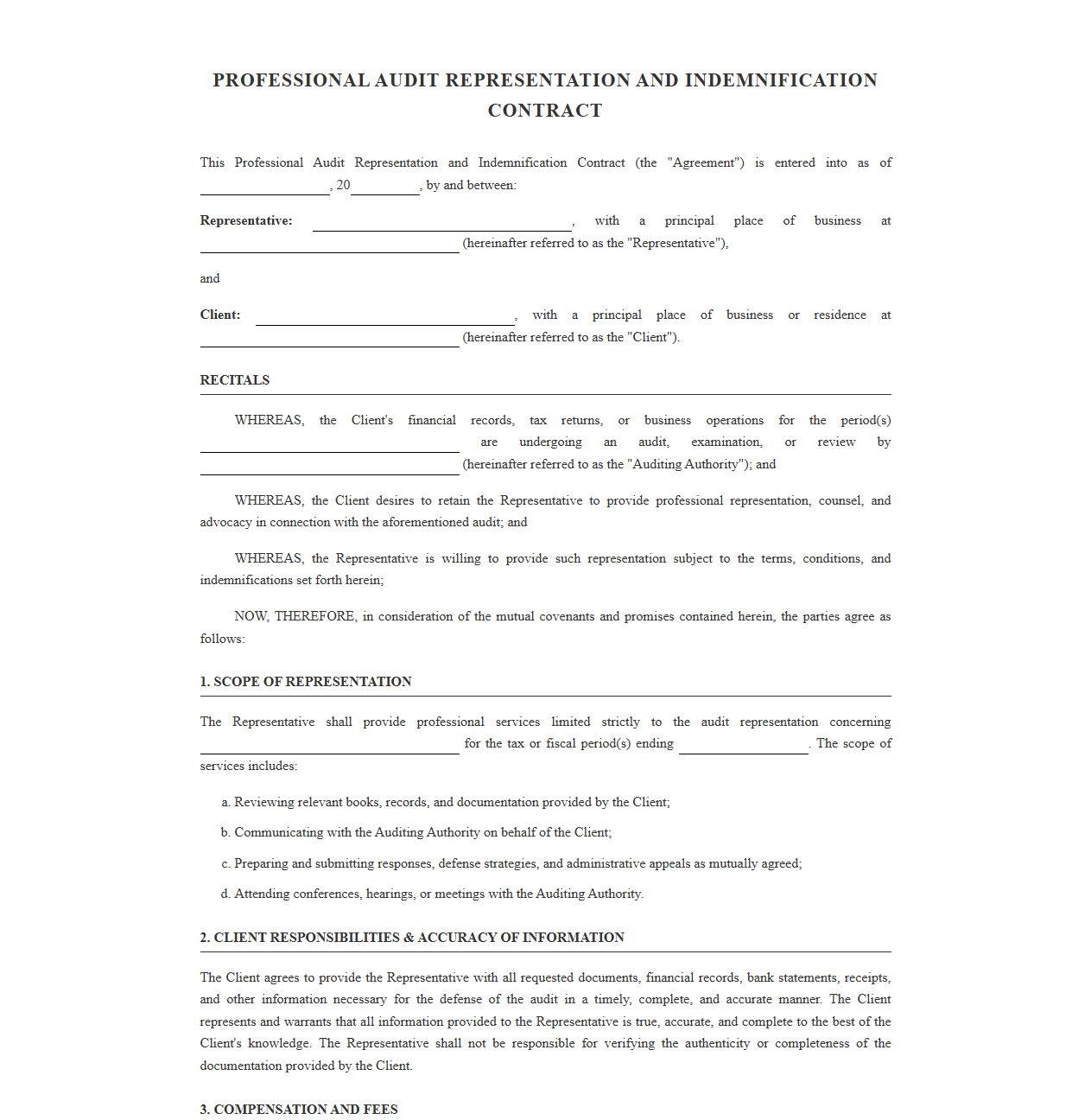
Professional Audit Representation and Indemnification Contract
 Download: .PDF
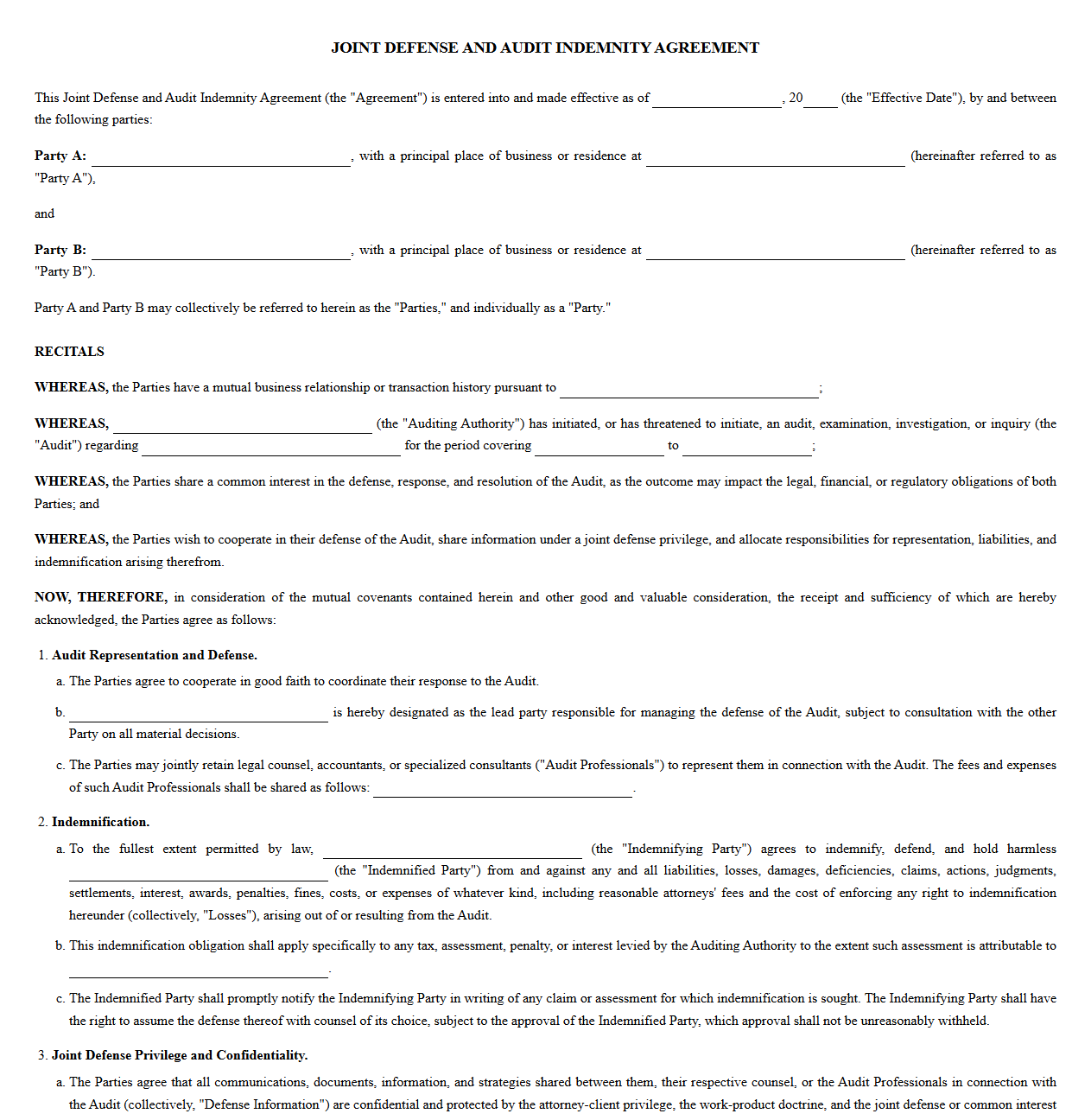
Joint Defense and Audit Indemnity Agreement
 Download: .PDF
Introduction to Audit Risk Mitigation via Representation and Indemnity
In high-stakes corporate transactions, financial and tax audits present significant uncertainties that can disrupt the financial health of the involved parties. Representation and indemnity (R&I) agreements serve as crucial risk-allocation tools that shield buyers and sellers from unexpected liabilities. By clearly defining which party bears the financial burden of pre-transaction non-compliance, these agreements establish a robust framework for managing financial exposure and mitigating regulatory liabilities before an audit ever commences.
The Core of R&I: Defining Representations and Warranties
Although often used interchangeably, representations and warranties are distinct legal concepts that serve different protective functions. Understanding the structural differences between these two pillars is essential for preventing pre-audit discrepancies and ensuring accurate financial disclosures.
- Representations: These are statements of past or present fact made by one party to another at a specific point in time, inducing them to enter into the contract. In an audit context, a representation might assert that all historical tax filings are accurate.
- Warranties: These are contractual promises or assurances that a fact is or will be true, backed by a promise of indemnification if the assertion proves false. Warranties secure the buyer against future losses arising from breach of those statements.
Structuring the Indemnity Framework for Audit Protection
An indemnity clause acts as the primary mechanism to shift financial liability when an adverse audit outcome reveals discrepancies. It obligates the indemnifying party (typically the seller) to compensate the indemnified party (typically the buyer) for losses, taxes, penalties, and legal fees resulting from a breach of representations. A well-structured indemnity clause explicitly defines the scope of recoverable losses and the exact triggers for payment.
"The Indemnifying Party hereby agrees to indemnify, defend, and hold harmless the Indemnified Party from and against any and all losses, liabilities, deficiencies, or taxes assessed by any governmental authority arising out of any inaccuracy in or breach of any representation or warranty contained in this Agreement."
Establishing Limits on Liability: Caps, Baskets, and Survival Periods
To prevent unlimited exposure, commercial contracts establish clear boundaries on indemnity claims. These contractual guardrails ensure that both parties understand their maximum risk profile before finalizing the agreement.
- Liability Caps
- The maximum aggregate amount that the indemnifying party can be held liable to pay under the indemnity provisions, often calculated as a percentage of the total transaction value.
- Baskets and Deductibles
- Thresholds designed to prevent nuisance claims. A "first-dollar" basket triggers liability for all losses once the threshold is met, whereas a "deductible" basket only obligates the indemnifier to pay for losses exceeding the specified threshold.
- Survival Periods
- The contractually agreed-upon timeframe during which a party can bring a claim for a breach of representations and warranties, typically aligned with or extending slightly beyond applicable regulatory audit windows.
Managing Third-Party Claims and Audit Defense Procedures
When a regulatory authority initiates an audit, the parties must follow a structured, chronological protocol to manage the defense and protect their mutual interests. Controlling the defense strategy is vital to mitigating the final assessment amount.
- Prompt Notice: The indemnified party must provide written notice of the audit or third-party claim to the indemnifying party within a specified timeframe.
- Defense Election: The indemnifying party decides whether to assume control of the audit defense using mutually acceptable legal counsel.
- Cooperation Covenant: Both parties must share relevant financial records, personnel access, and transaction documentation to build a robust defense.
- Settlement Consent: Neither party may settle the audit claim without the prior written consent of the other, ensuring that liabilities are not admitted unilaterally.
Specialized Tax Indemnity and Audit-Specific Clauses
Tax audits carry unique risks that general representations cannot adequately cover. For this reason, robust agreements separate pre-closing tax liabilities from general indemnification limits, ensuring they survive longer to match statutory limitation windows. These carve-outs protect buyers from historical compliance failures under Internal Revenue Code Section 482 transfer pricing audits, state-level sales tax assessments, and local payroll audit challenges.
Strategic Best Practices for Drafting Robust R&I Agreements
Drafting an agreement that survives rigorous audit scrutiny requires foresight and precise legal language. Financial and legal professionals must collaborate to align contractual definitions with active regulatory standards.
- Align survival periods directly with the statutory limitations of relevant tax authorities.
- Explicitly define "Losses" to include reasonable attorney fees, accounting costs, and pre-judgment interest.
- Utilize escrow or holdback accounts to secure indemnity obligations during the active survival window.
- Specify which party controls negotiations with tax authorities for pre-closing versus post-closing tax periods.

Leave a comment