

Managing payroll and bookkeeping services means carrying the heavy burden of client trust, where a single data leak can ruin a professional reputation overnight. As financial operations increasingly shift to cloud-based systems, safeguarding this digital pipeline has become a complex regulatory challenge. Utilizing a robust confidentiality agreement template grants practitioners immediate peace of mind and reinforces client retention by establishing clear legal boundaries.
However, while templates provide a strong foundation, they must be tailored to specific jurisdictions to ensure full legal enforceability. Standardizing protections for highly sensitive assets-such as employee Social Security numbers, bank routing details, and proprietary tax records-is essential for mitigating liability. In this guide, we will examine the critical clauses every financial agreement must include, review industry-standard templates, and outline how to customize these documents for your specific practice.
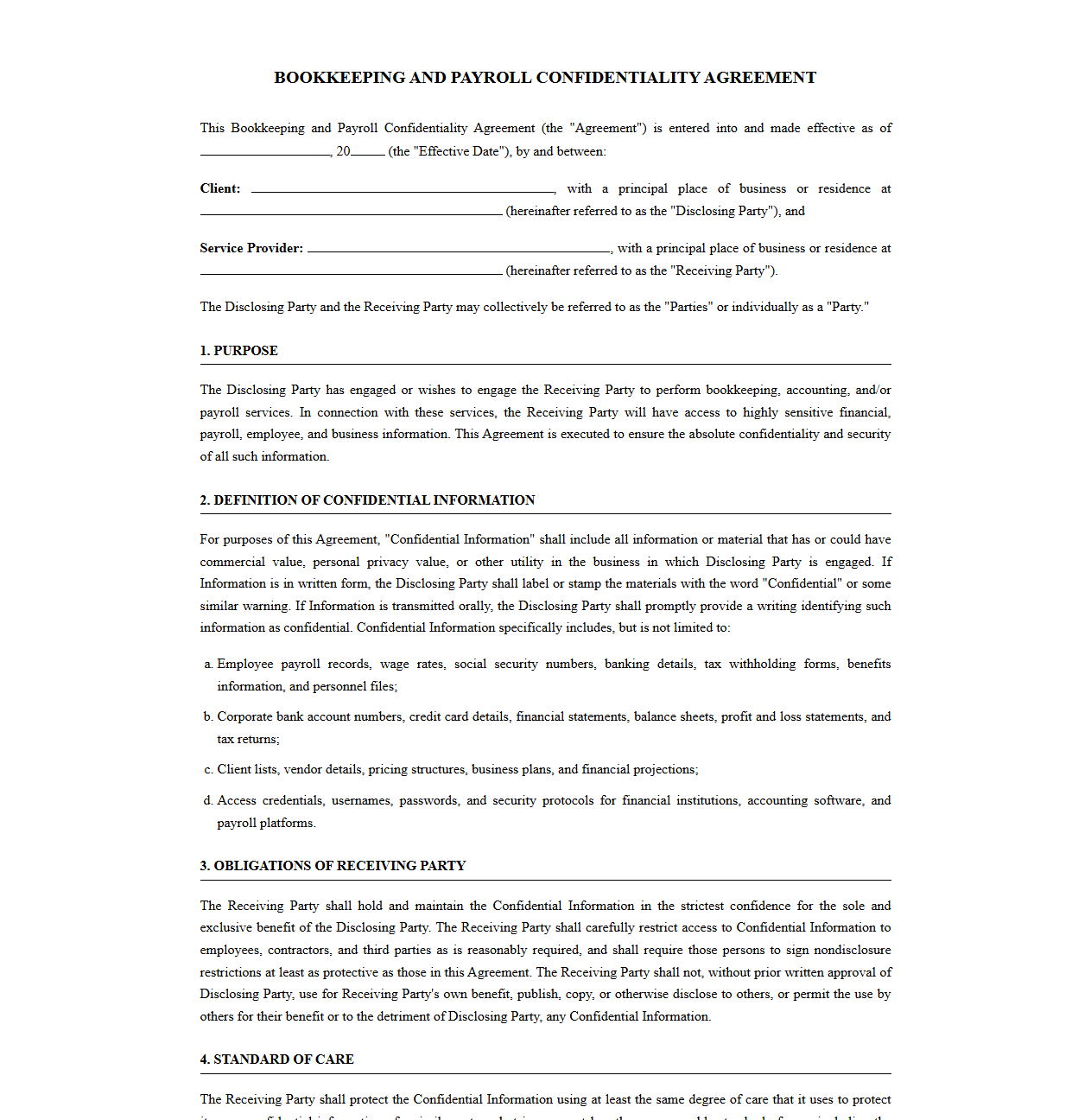
Bookkeeping and Payroll Non-Disclosure Agreement
 Download: .PDF
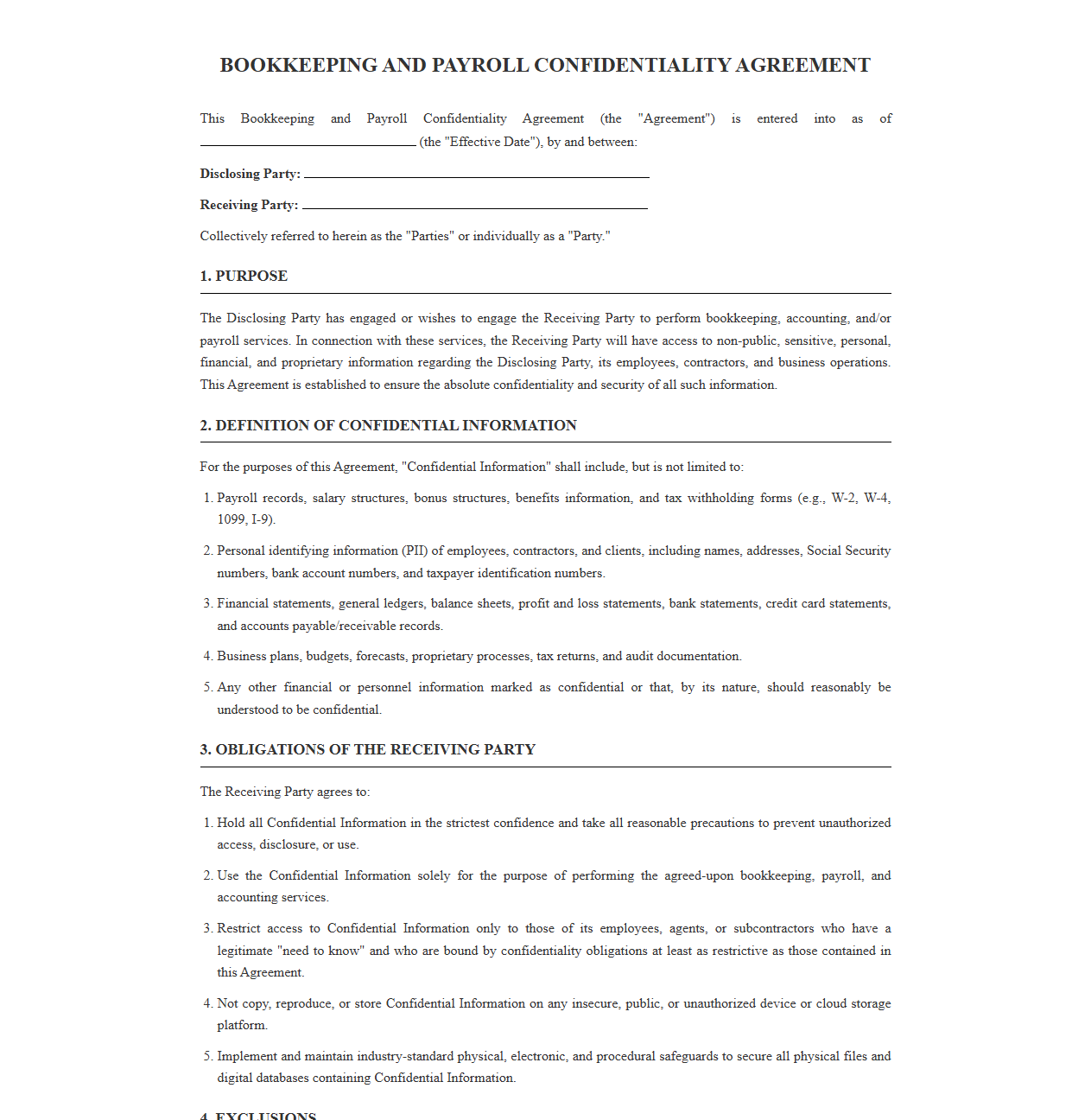
Payroll and Bookkeeping Confidentiality Agreement Template
 Download: .PDF
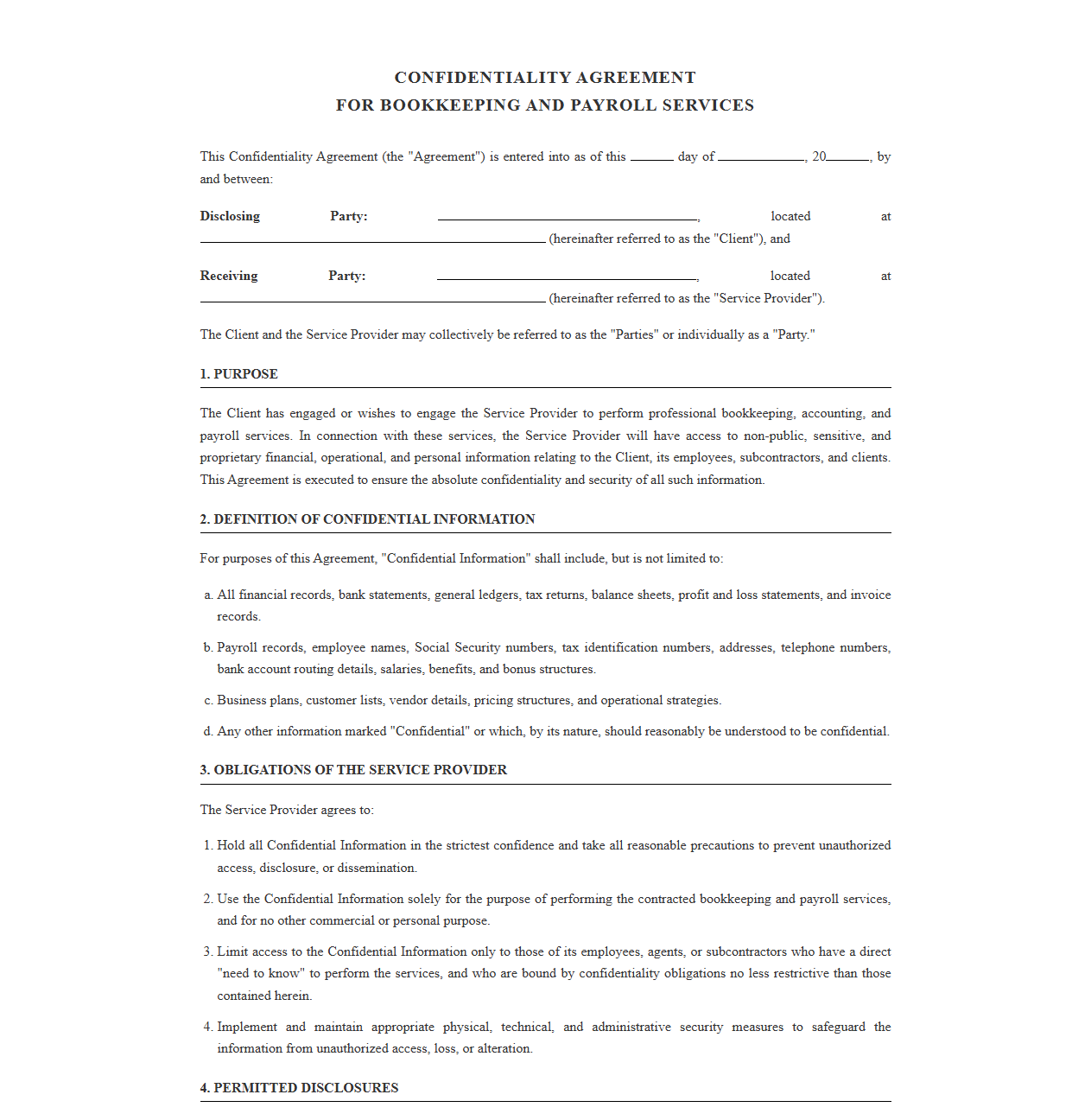
Confidentiality Agreement for Bookkeeping and Payroll Services
 Download: .PDF
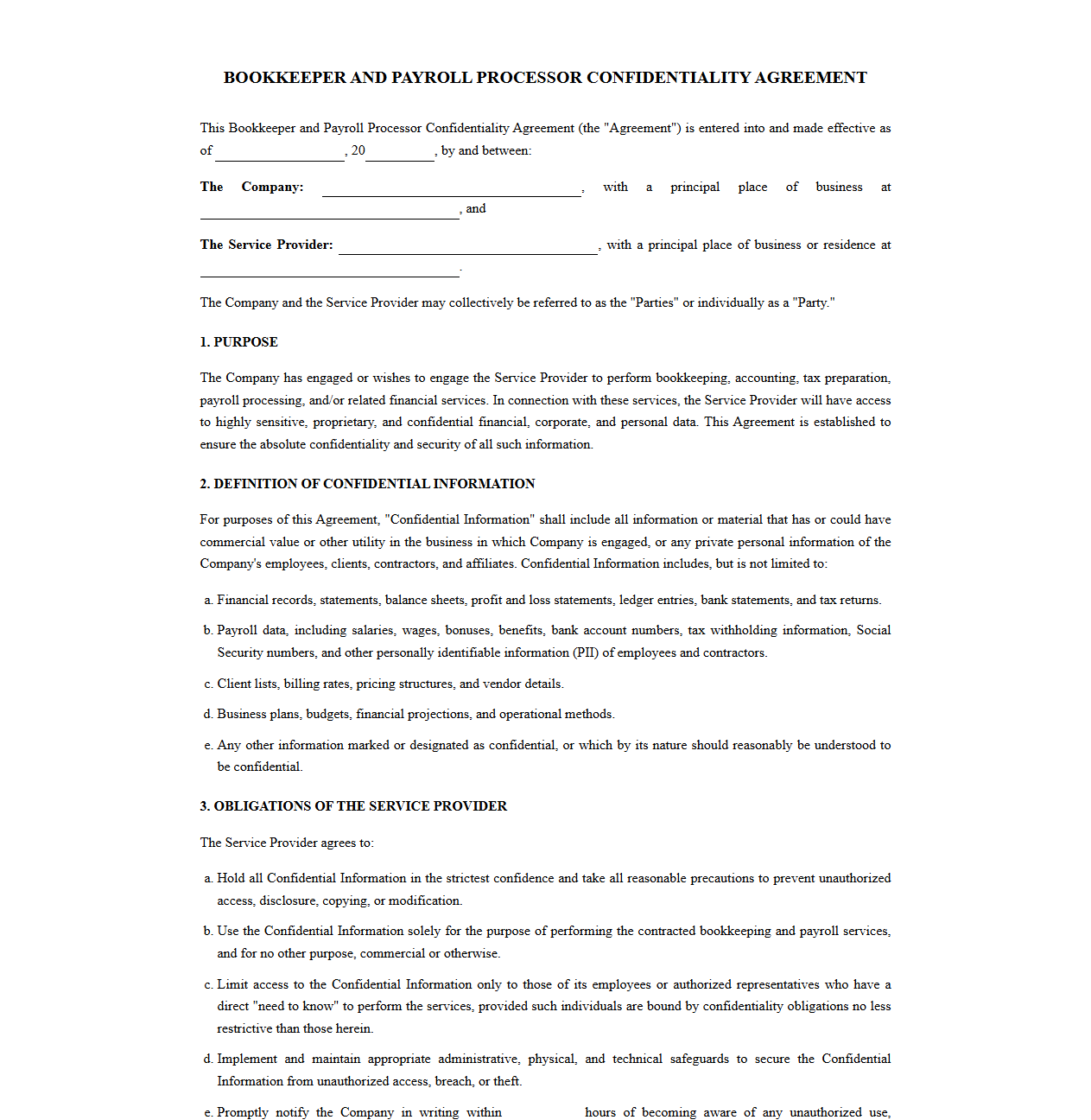
Bookkeeper and Payroll Processor Confidentiality Agreement
 Download: .PDF
Financial Records and Payroll Data Non-Disclosure Agreement
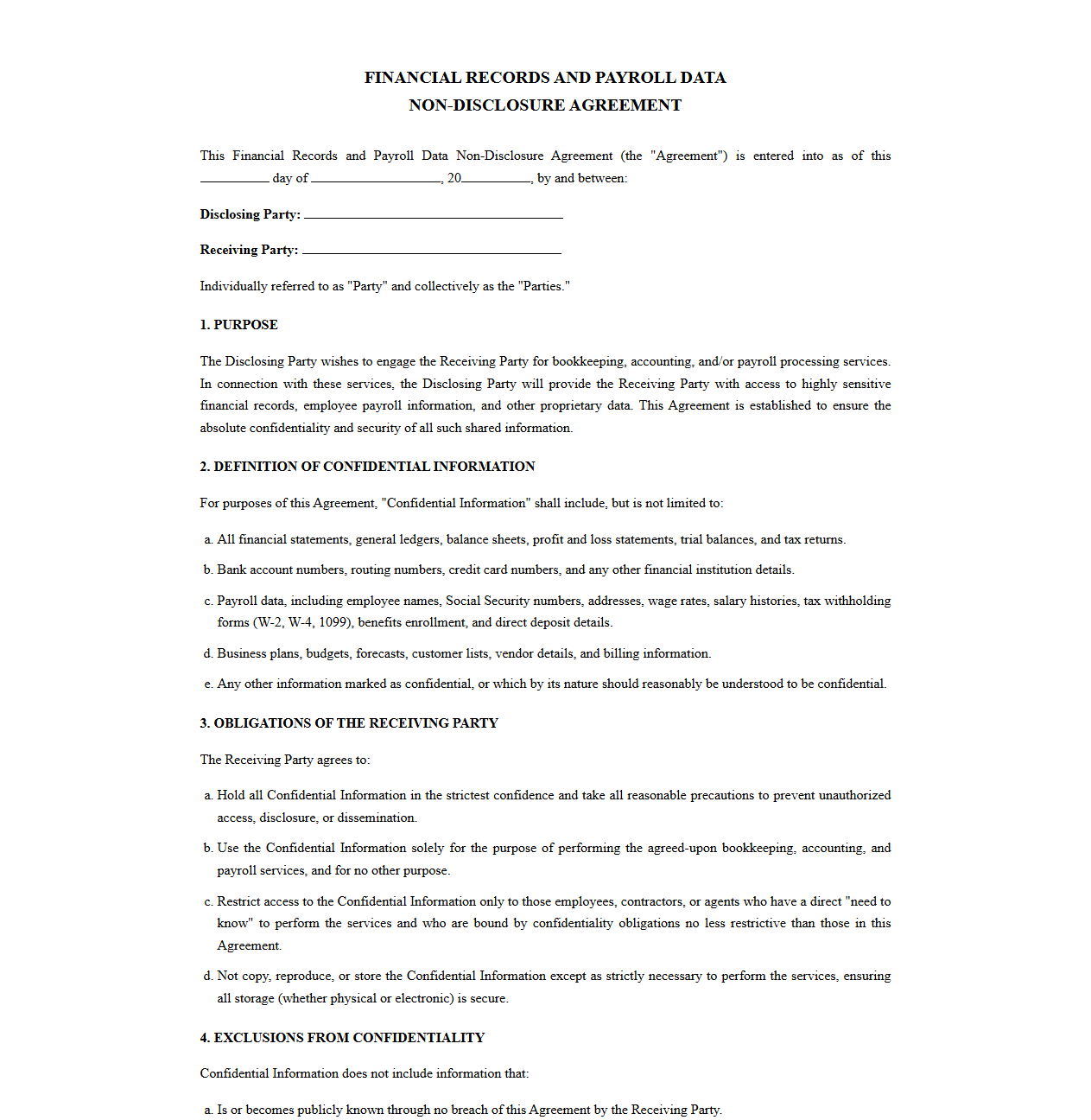 Download: .PDF
Accounting and Payroll Confidentiality Covenant
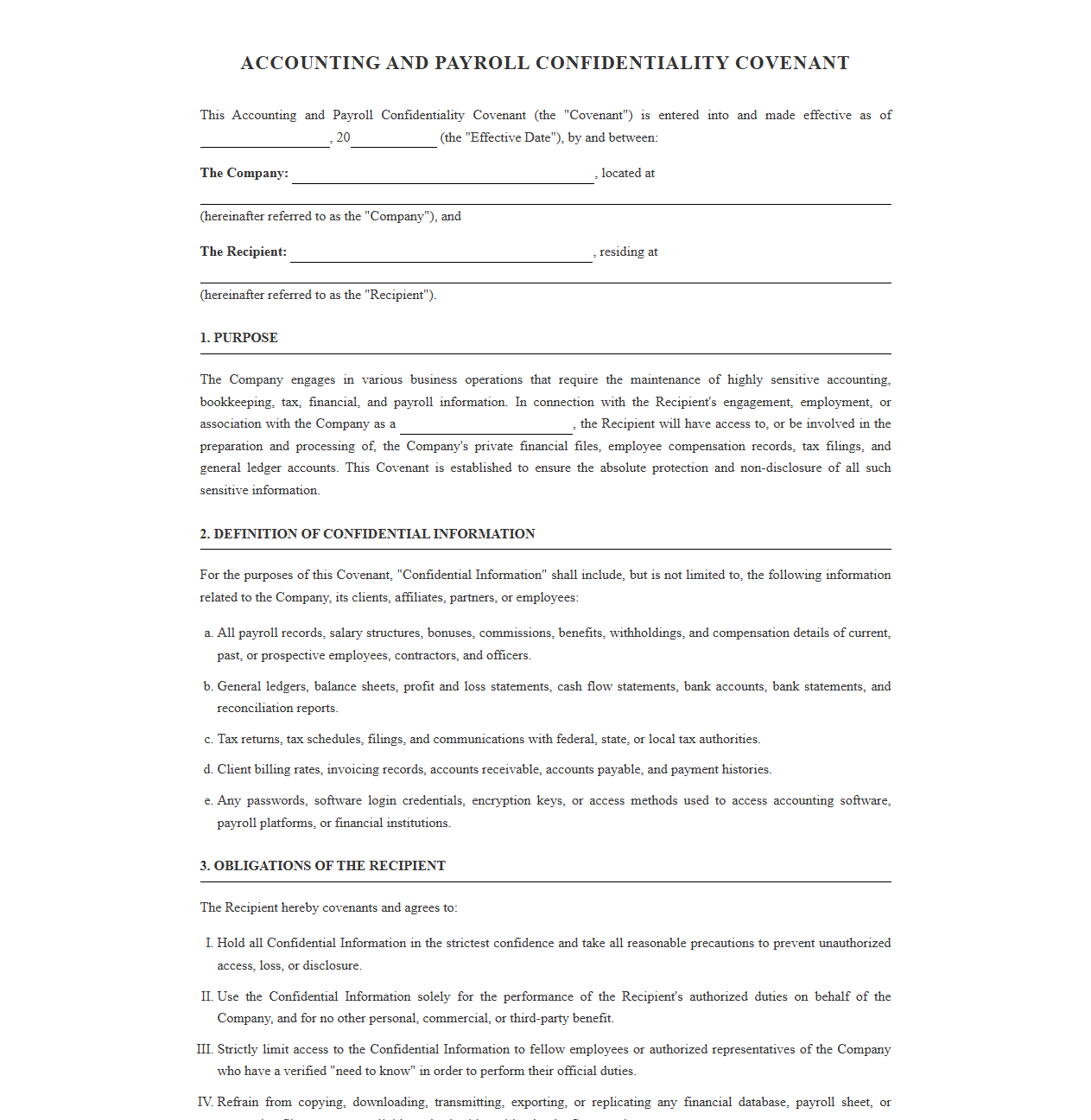 Download: .PDF
Bookkeeping Service and Payroll Privacy Agreement
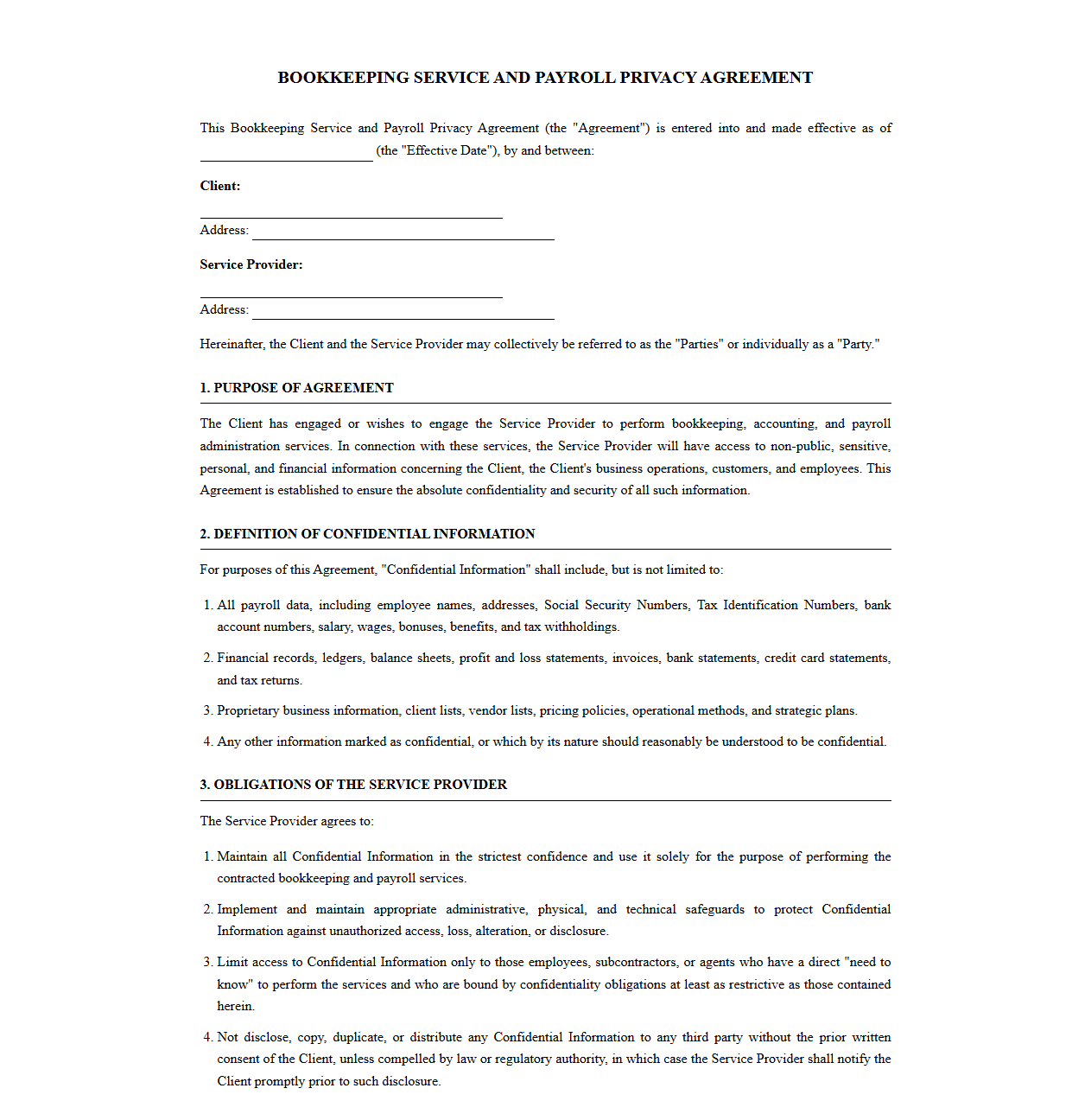 Download: .PDF
Payroll Administration and Bookkeeping Confidentiality Contract
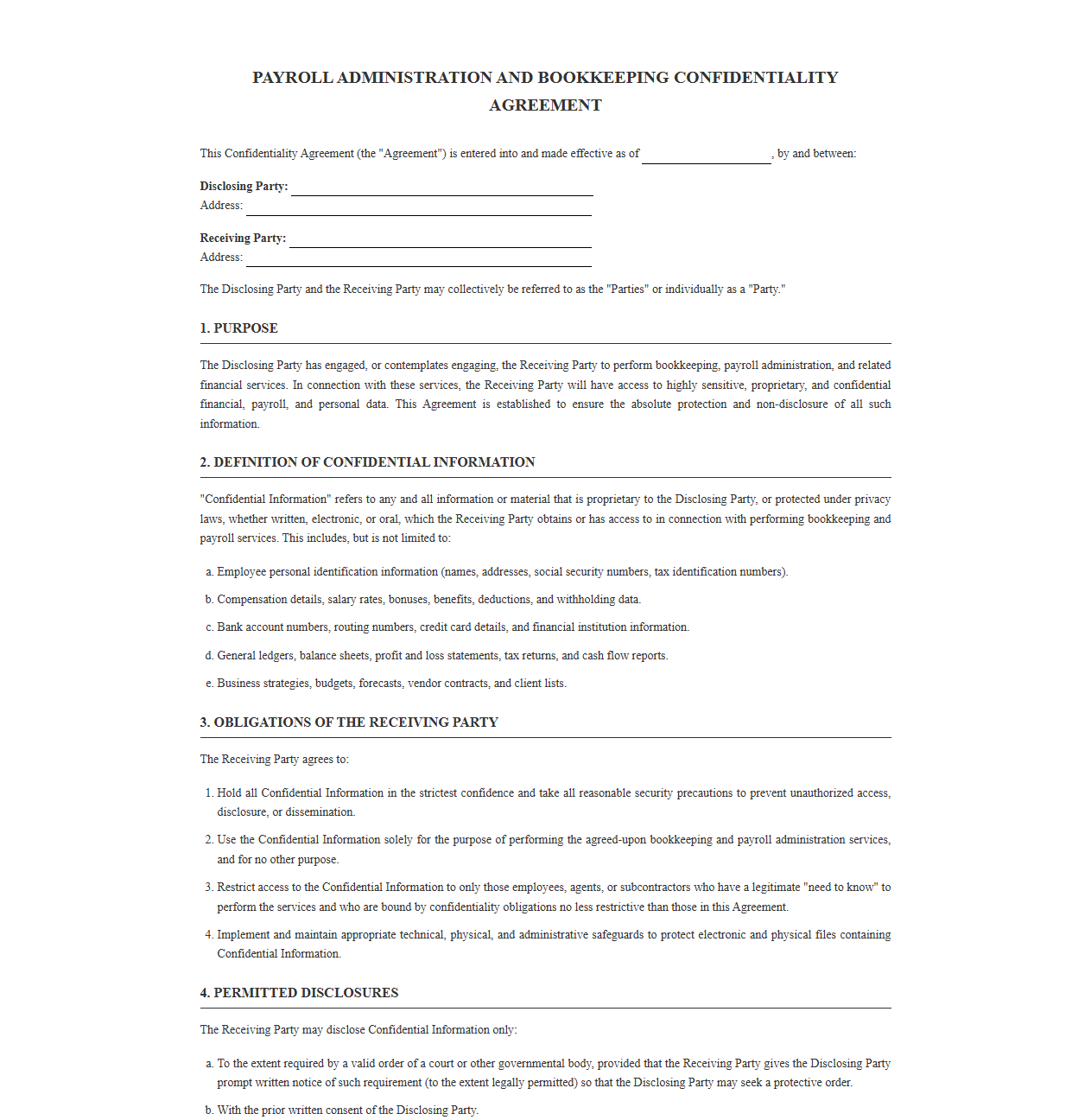 Download: .PDF
Introduction to Safeguarding Financial Data in Accounting
In the modern business landscape, financial data is one of the most sensitive assets an organization possesses. From proprietary profit margins to detailed transaction histories, the records managed during bookkeeping and payroll operations require the highest level of protection. Ensuring the safety of this information is not just a matter of operational security; it is the foundation of the professional relationship between a business and its financial specialists.
Every successful partnership between an enterprise and its accountant or bookkeeper is built on absolute trust and confidentiality. When organizations hand over their ledgers, they are trusting external partners with their financial survival. Implementing robust security protocols and legally binding confidentiality agreements is essential to protect this vulnerable data from unauthorized exposure, identity theft, and corporate espionage.
Why Bookkeeping and Payroll Require Dedicated Confidentiality Agreements
While standard non-disclosure agreements (NDAs) offer basic protection for general business discussions, they frequently fail to address the highly specific risks associated with accounting services. Financial records contain a concentrated mix of banking credentials, tax identification numbers, and proprietary pricing models. Standard agreements rarely account for the ongoing, transactional nature of bookkeeping, where data is constantly being processed, shared, and stored across multiple digital accounting platforms.
Payroll records are particularly vulnerable, containing personal identifiable information (PII) of employees alongside sensitive corporate bank routing numbers. A breach in this area does not just damage business reputation; it exposes the organization to massive regulatory fines and class-action lawsuits from affected staff. Dedicated financial confidentiality agreements establish precise parameters for how this highly sensitive information is handled and processed.
"Under compliance frameworks like the Gramm-Leach-Bliley Act (GLBA) and GDPR, financial service providers are legally mandated to implement administrative, technical, and physical safeguards to protect nonpublic personal information from unauthorized access or use."
Core Elements of a Bookkeeping Confidentiality Agreement Template
A comprehensive bookkeeping confidentiality agreement must contain clear, legally binding terms that define exactly what data is protected and how it should be handled throughout the duration of the professional relationship.
- Detailed Definition of Confidential Information: Clear language specifying that all ledgers, tax documents, bank statements, invoices, and financial projections are classified as confidential.
- Permitted Use of Data: A clause stating that the financial professional may only use the provided financial data for the explicit purpose of performing contracted bookkeeping services.
- Representative and Third-Party Access: Regulations governing whether subcontractors, junior accountants, or cloud-based software assistants are permitted to access the financial records.
- Survival Period of the Agreement: A provision defining how long the obligation of confidentiality lasts after the active business relationship has ended, typically ranging from three to five years or indefinitely for trade secrets.
- Return or Destruction of Records: Clear instructions on how financial files, cloud access credentials, and paper documents must be returned or securely destroyed once services terminate.
Crucial Clauses Specific to Payroll Data Protection
Payroll data represents a unique security challenge because it blends corporate financial metrics with highly sensitive personal employee details. Safeguarding this intersection of data requires dedicated contractual safeguards.
Protection of Employee Personally Identifiable Information (PII)
Payroll files contain Social Security numbers, home addresses, phone numbers, and direct deposit details. Agreements must feature strict clauses that limit the duplication of employee PII and mandate that such data only be transmitted via encrypted, secure HR portals.
Salary Structure and Banking Data Security
Protecting corporate salary structures, executive compensation packages, and bank routing numbers is critical to preventing internal workplace disruption and external financial fraud. The agreement must restrict access to these data points to authorized personnel only, preventing unauthorized internal distribution or external leaks.
Implementation Best Practices: Executing the Agreement Securely
Drafting a strong confidentiality agreement is only the first step; executing and managing the contract securely ensures that its protections are actively enforced in daily operations.
- Secure Digital Signature and Execution: Execute the agreement using verified e-signature platforms that provide a tamper-evident digital audit trail, ensuring the validity of the contract.
- Implement Least-Privilege Access Controls: Before sharing any financial files, configure user permissions within your accounting software so the contractor only accesses the specific ledgers necessary for their role.
- Mandate Multi-Factor Authentication (MFA): Require the bookkeeping partner to use MFA and encrypted connections (VPNs) when logging into your financial ecosystems.
- Conduct Periodic Security and Compliance Reviews: Review the agreement and access logs annually to ensure the terms align with current privacy laws and that inactive users have their access privileges revoked.
Addressing Breaches: Remedies and Legal Consequences
Even with the most rigorous safeguards, organizations must prepare for the possibility of a data breach or an unauthorized disclosure. The confidentiality agreement must clearly outline the exact legal and financial consequences of a contract violation to deter negligent handling of data.
When a breach occurs, the injured business is entitled to seek immediate legal remedies. The agreement should stipulate that the disclosing party can pursue an injunctive relief to stop further unauthorized disclosures without the necessity of posting a bond. Additionally, the contract should outline provisions for liquidated damages to cover the quantifiable financial losses, regulatory fines, and legal fees incurred as a direct result of the security compromise.
Conclusion and Customizing Your Financial NDA Templates
Securing sensitive financial workflows is a continuous commitment that starts with a legally sound framework. By implementing a targeted, comprehensive confidentiality agreement, businesses can safely collaborate with accounting professionals while keeping their payroll, tax, and banking records fully secure from external threats.
Because financial regulations and data privacy laws vary significantly by state and country, you should customize your contracts to align with local jurisdictions. To establish a strong security foundation for your bookkeeping operations, you can download customizable legal resources and start building your custom protection plans today through our collection of professional financial NDA templates.

Leave a comment