

Managing estate and trust tax compliance exposes practitioners to heightened professional liability, where even minor oversights can trigger severe beneficiary disputes or costly malpractice claims. As fiduciary standards grow increasingly complex, firms can no longer rely on informal agreements or generic engagement letters to protect their practices.
Implementing structured agreement templates directly addresses this vulnerability, granting practitioners the dual benefit of robust risk mitigation and operational peace of mind. While these templates serve as foundational frameworks rather than a substitute for localized legal counsel, they establish a critical first line of defense. For instance, integrating specific clauses-such as precise "limitation of liability" caps and explicit "scope of services" definitions-effectively prevents scope creep and clarifies executor responsibilities.
In this article, we will analyze the essential components of protective agreement templates and outline actionable strategies to safeguard your firm during trust and estate engagements.
Fiduciary and Estate Tax Preparation Engagement Agreement
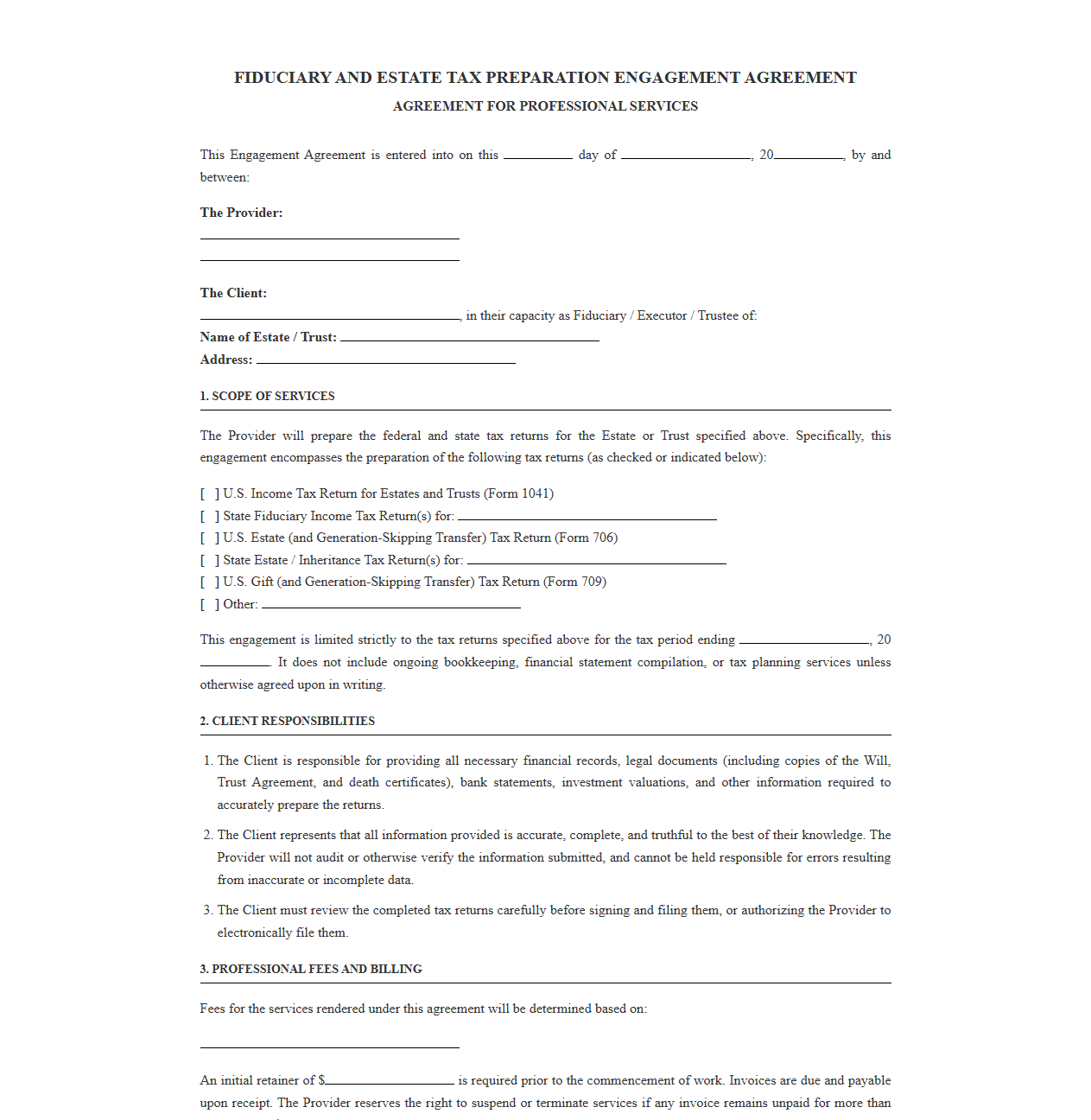 Download: .PDF
Trust and Estate Tax Return Services Agreement
 Download: .PDF
Engagement Letter for Trust and Estate Tax Services
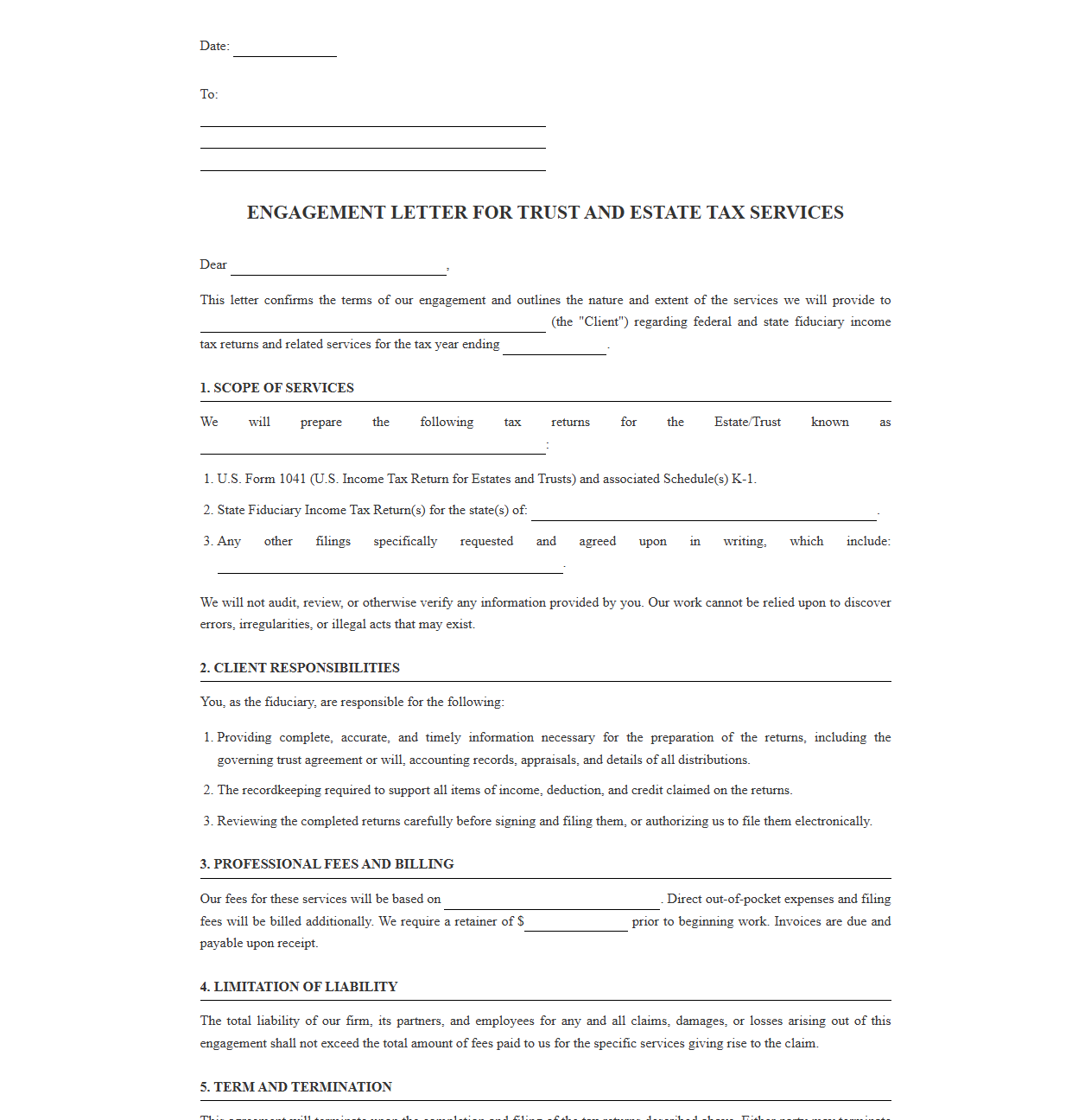 Download: .PDF
Agreement for Fiduciary Income Tax Return Preparation
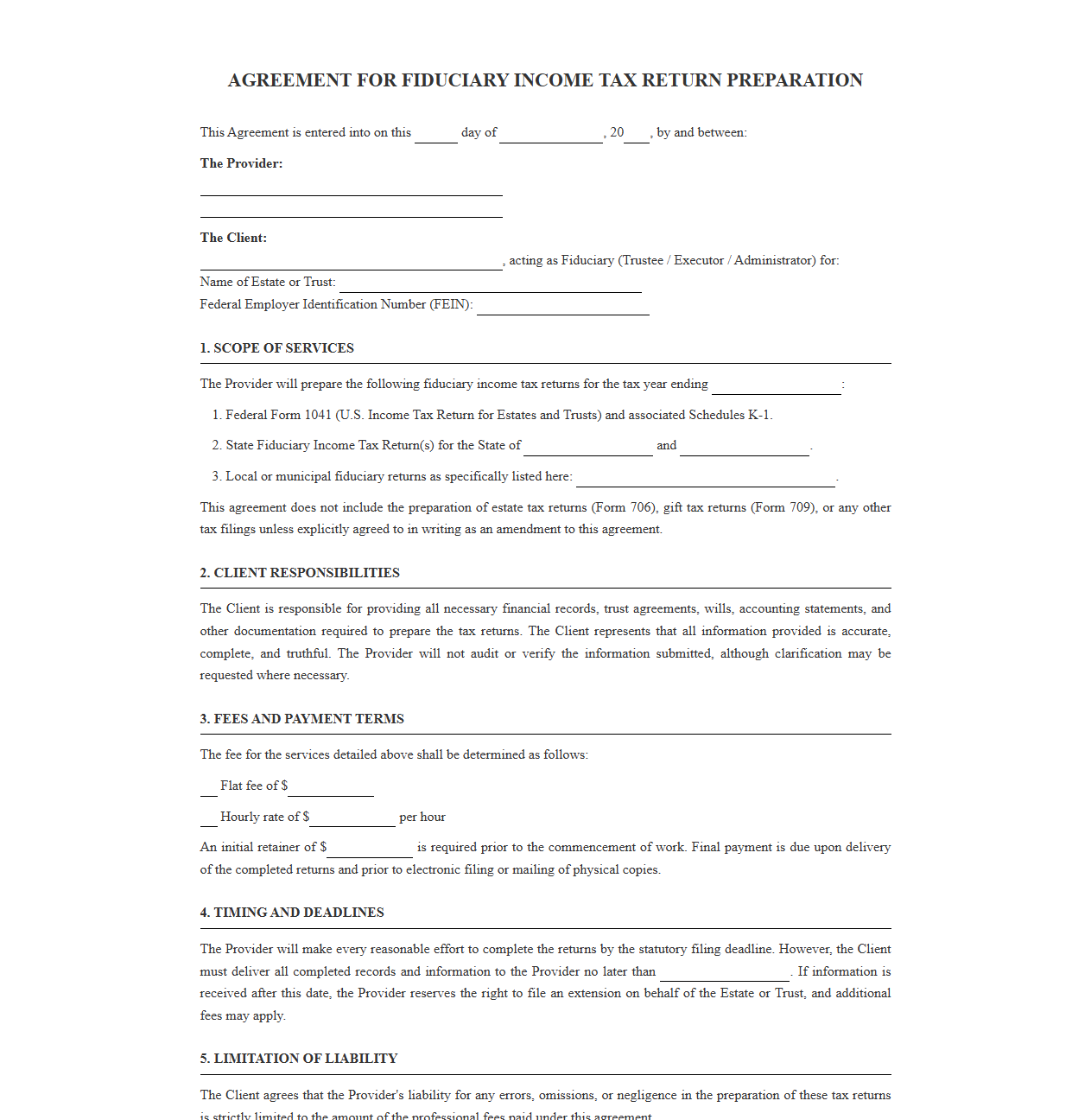 Download: .PDF
Estate and Trust Tax Compliance Services Agreement
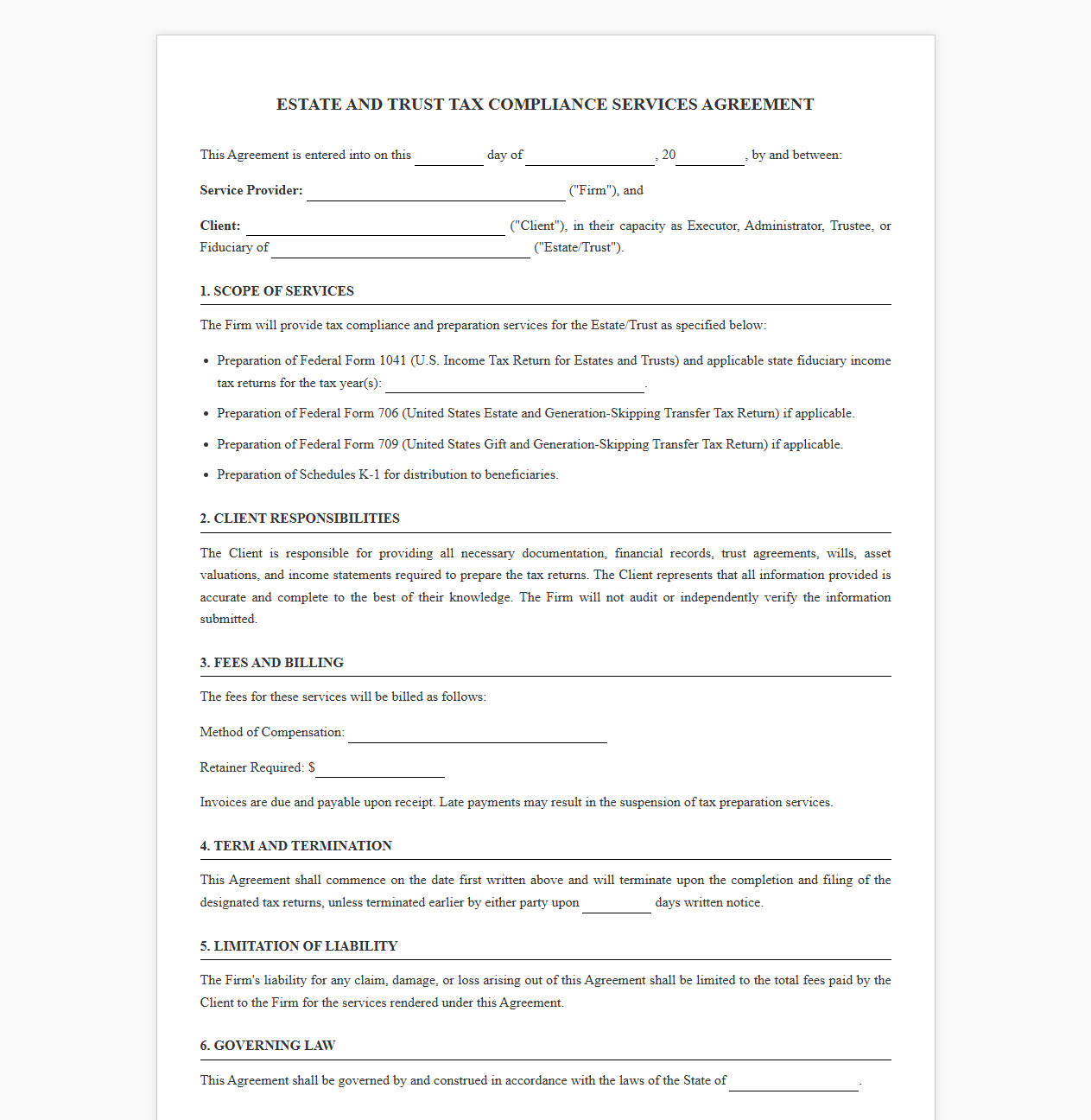 Download: .PDF
Master Service Agreement for Trust Estate Tax Planning
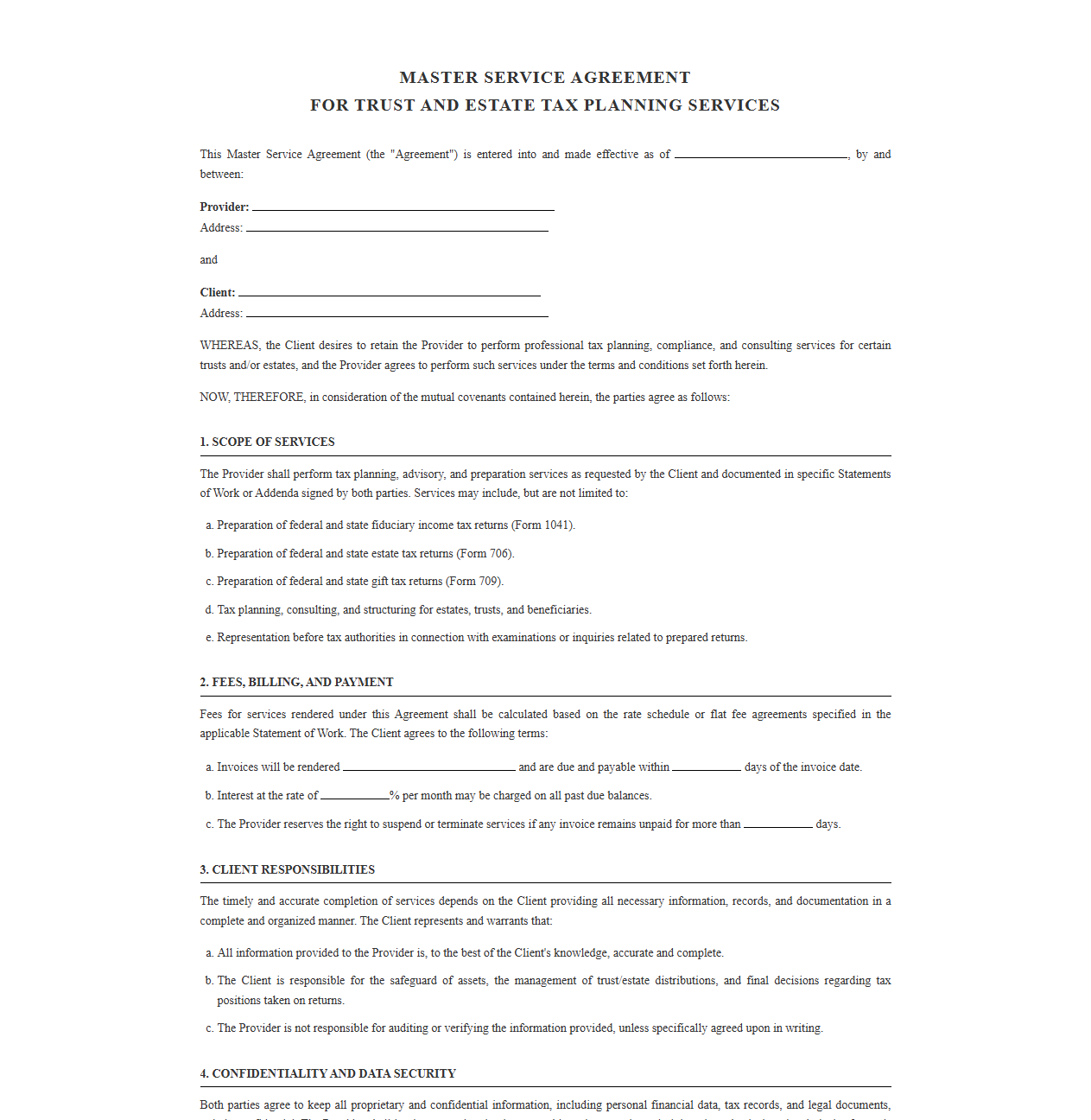 Download: .PDF
Contract for Estate and Trust Tax Advisory Services
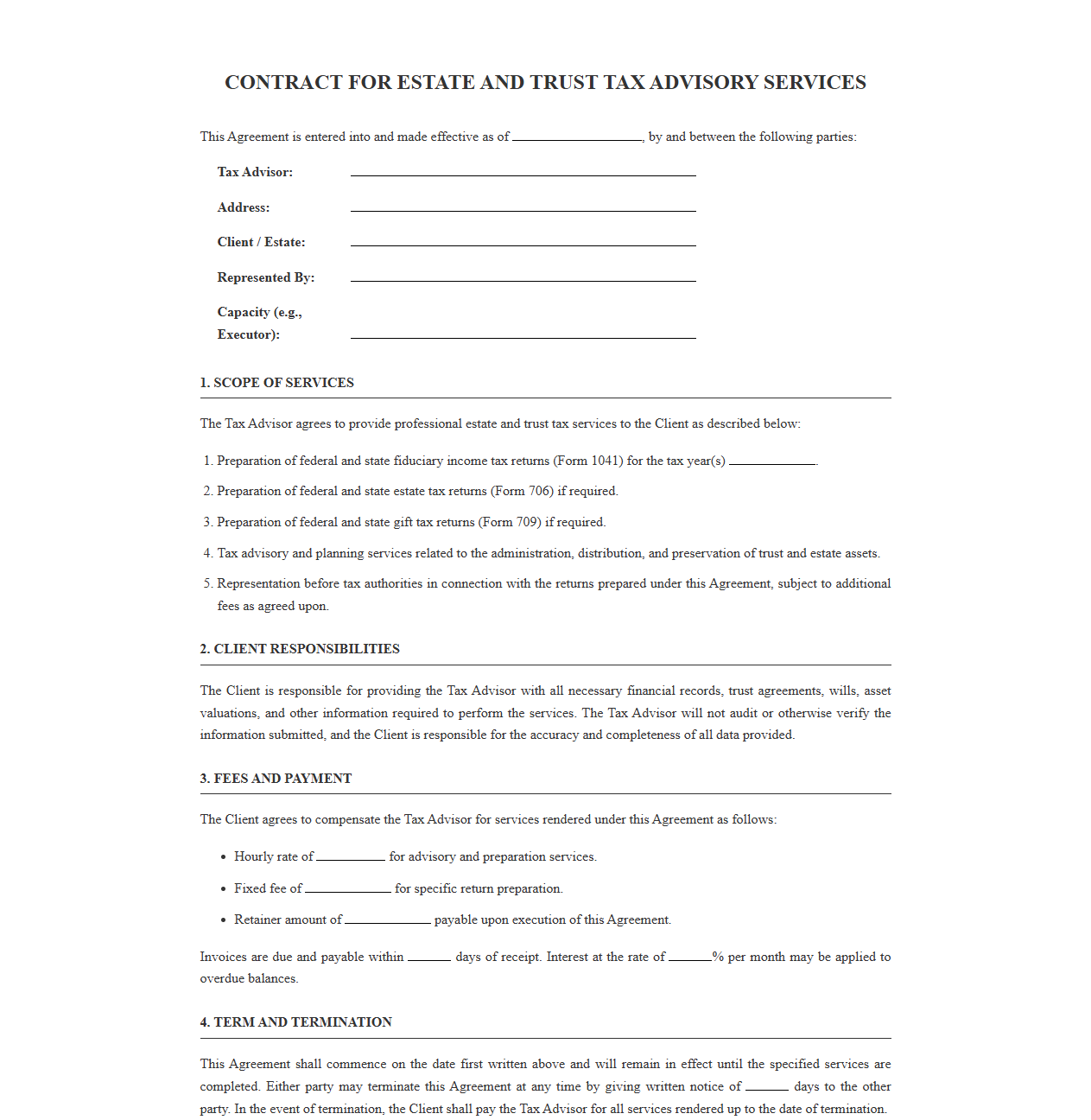 Download: .PDF
Fiduciary Tax Services and Estate Administration Agreement
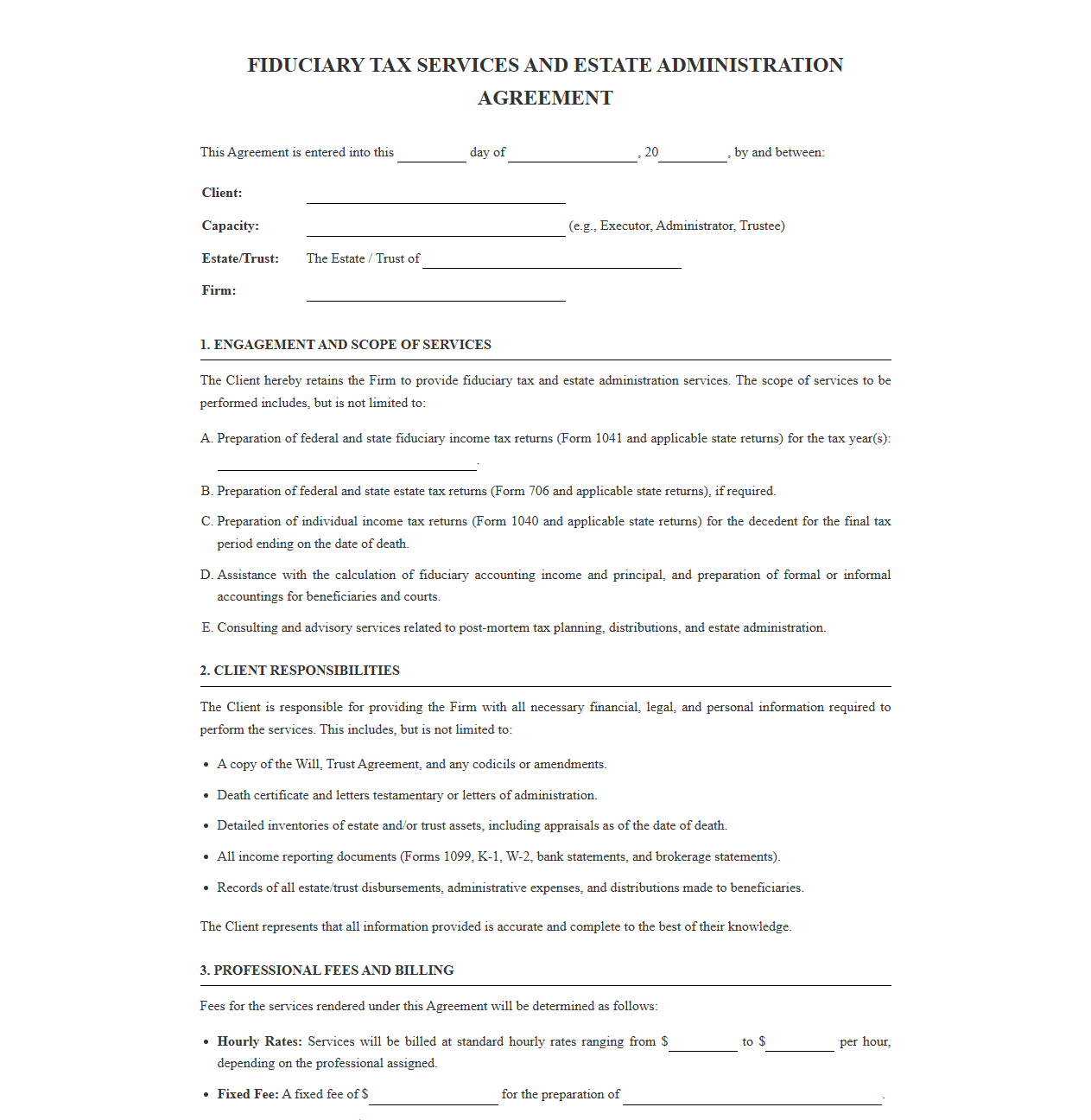 Download: .PDF
The High-Stakes Landscape of Estate and Trust Taxation
Trust and estate tax preparation is one of the most complex sectors of professional accounting, fraught with unique regulatory hurdles and heightened exposure to professional liability. Unlike standard individual tax returns, fiduciary tax compliance involves intricate distributions, principal and income allocations, and fluctuating state law requirements. The consequences of an oversight can result in severe financial damage to beneficiaries, triggering contentious disputes.
To protect their practice, firms must recognize and address several key financial risk factors. These include the mischaracterization of trust income, the failure to identify state-level nexus triggers, and the impact of delayed distribution schedules that result in punitive tax rates. Implementing robust risk mitigation strategies is a foundational necessity for professional survival.
The Power of Structured Agreement Templates
Professional liability insurance claims often stem not from technical accounting errors, but from misaligned expectations between the tax professional and the client. This is where structured engagement letters serve as a critical defense mechanism. By establishing a shared baseline of understanding from day one, firms can prevent misunderstandings before they escalate into formal disputes.
Utilizing standardized, highly structured agreement templates represents a highly proactive approach to risk management. Rather than reacting to client grievances after a tax filing has occurred, these agreements preemptively outline parameters of engagement, ensuring both parties recognize their boundaries, timelines, and legal exposures throughout the lifecycle of the fiduciary relationship.
Defining the Scope of Tax Services
Scope creep is a silent profit killer and a primary driver of malpractice claims. Without a rigid boundary defining what is covered, fiduciary clients may assume their tax preparer is also handling trust accounting, asset valuations, or multi-state inheritance filings.
Explicit Inclusions
The agreement must explicitly state the core responsibilities of the tax firm for the given period. These typically include:
- Preparation of Federal Form 1041 (U.S. Income Tax Return for Estates and Trusts).
- Preparation of corresponding Schedule K-1s for distribution to beneficiaries.
- Filing of specified state fiduciary income tax returns as detailed in the service schedule.
Explicit Exclusions
To prevent unwarranted assumptions, the agreement must clearly list services that are excluded unless a separate, written engagement is executed:
- Formal court accounting or judicial trust accounting services.
- Valuation of non-liquid estate assets or real property.
- Representation in IRS or state-level audits, which require a separate power of attorney and fee structure.
Clarifying Client and Fiduciary Responsibilities
A successful tax engagement relies heavily on the quality and timeliness of the documentation provided by the executor, trustee, or personal representative. The engagement agreement must clearly draw the line between the fiduciary's duty to supply accurate data and the tax professional's duty to prepare the returns based on that data.
"The Trustee is solely responsible for maintaining complete, accurate financial records and for providing all necessary transaction histories, trust agreements, and asset valuations within the specified timelines. Our firm will not audit or verify the information submitted, and our services cannot be relied upon to discover fraud, errors, or illegal acts committed by the trust administration."
Crafting Enforceable Limitation of Liability Clauses
Limiting a firm's financial exposure in the event of an error is a critical component of risk management. Well-drafted agreements incorporate precise legal mechanisms to insulate the firm from catastrophic financial losses, especially when dealing with high-net-worth estates where minor calculation variances can yield massive tax discrepancies.
To ensure enforceability, agreements should include a clear limitation of liability clause that caps damages at a specified multiple of the professional fees paid. Furthermore, a strong hold-harmless provision should protect the firm against third-party claims arising from inaccurate data provided by the fiduciary. Courts frequently uphold these clauses when they feature consequential damages waivers that prevent clients from seeking speculative financial remedies.
Addressing Legislative Changes and Future Amendments
Tax laws governing estates and trusts are notoriously fluid, with frequent retroactive changes, shifting exemptions, and evolving state-level residency rules. An agreement signed at the start of the year may not adequately cover the regulatory reality by tax season. Therefore, structured agreements must contain provisions to handle these fluctuations dynamically.
To manage this uncertainty, the agreement should state that services are performed based on tax laws in effect at the time of preparation. Any necessary modifications to the scope due to legislative changes must be handled via a formal, written amendment. The amendment process requires both the firm and the fiduciary to sign an addendum detailing the updated scope of work, adjusted timelines, and any revised billing rates associated with the legislative updates.
Implementing Best Practices for Firm-Wide Adoption
Standardizing these mitigation tools across your entire organization ensures that no client engagement slips through the cracks. Consistency in administrative protection is just as critical as consistency in technical tax preparation.
- Establish a centralized library of pre-approved engagement letter templates tailored specifically for estates and trusts.
- Conduct mandatory annual training for all tax staff on identifying scope creep and enforcing client boundaries.
- Implement a strict partner-level review process to approve any deviations or customized edits made to the standard liability clauses.
- Set automated reminders to review and update all templates before the start of each fiscal year to align with the latest state and federal case law.

Leave a comment