

For many accounting professionals, the gradual expansion of client demands-commonly known as scope creep-silently erodes profitability and drains valuable billable hours. Before attempting to adjust your pricing or workload, it is essential to establish a robust contractual framework that defines the exact boundaries of your professional engagement.
Utilizing a structured monthly retainer agreement template grants you predictable recurring revenue while commanding mutual respect for your time. To manage expectations effectively, these templates rely on a dedicated "services stipulation" section. For example, explicitly distinguishing standard monthly ledger reconciliation from ad-hoc tax advisory services provides concrete proof of what is covered, preventing costly misunderstandings.
In this article, we will examine the critical clauses your retainer agreements must include, provide customizable templates designed to protect your firm, and outline strategies for onboarding clients under these clear parameters.
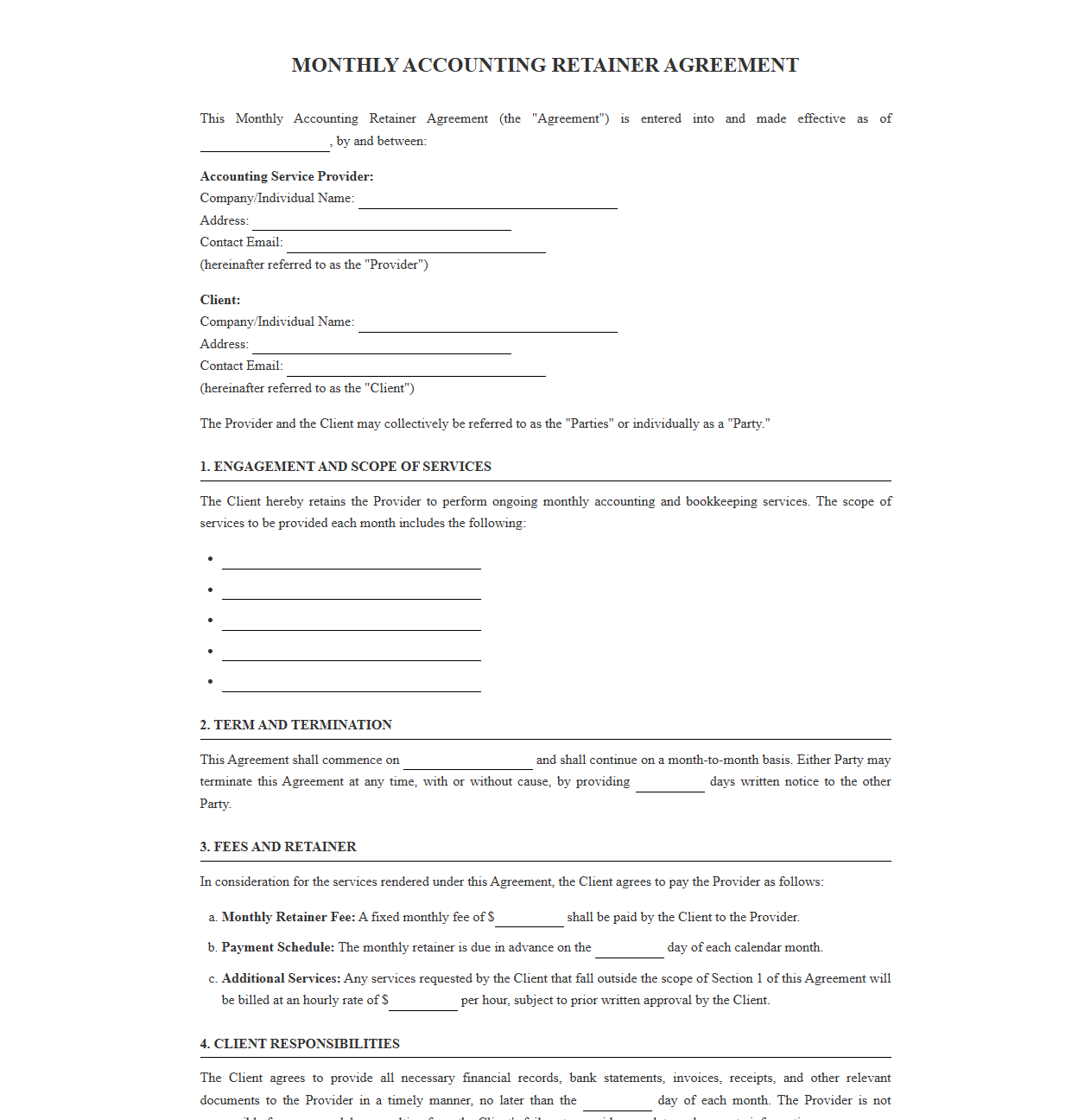
Monthly Accounting Retainer Agreement Template
 Download: .PDF
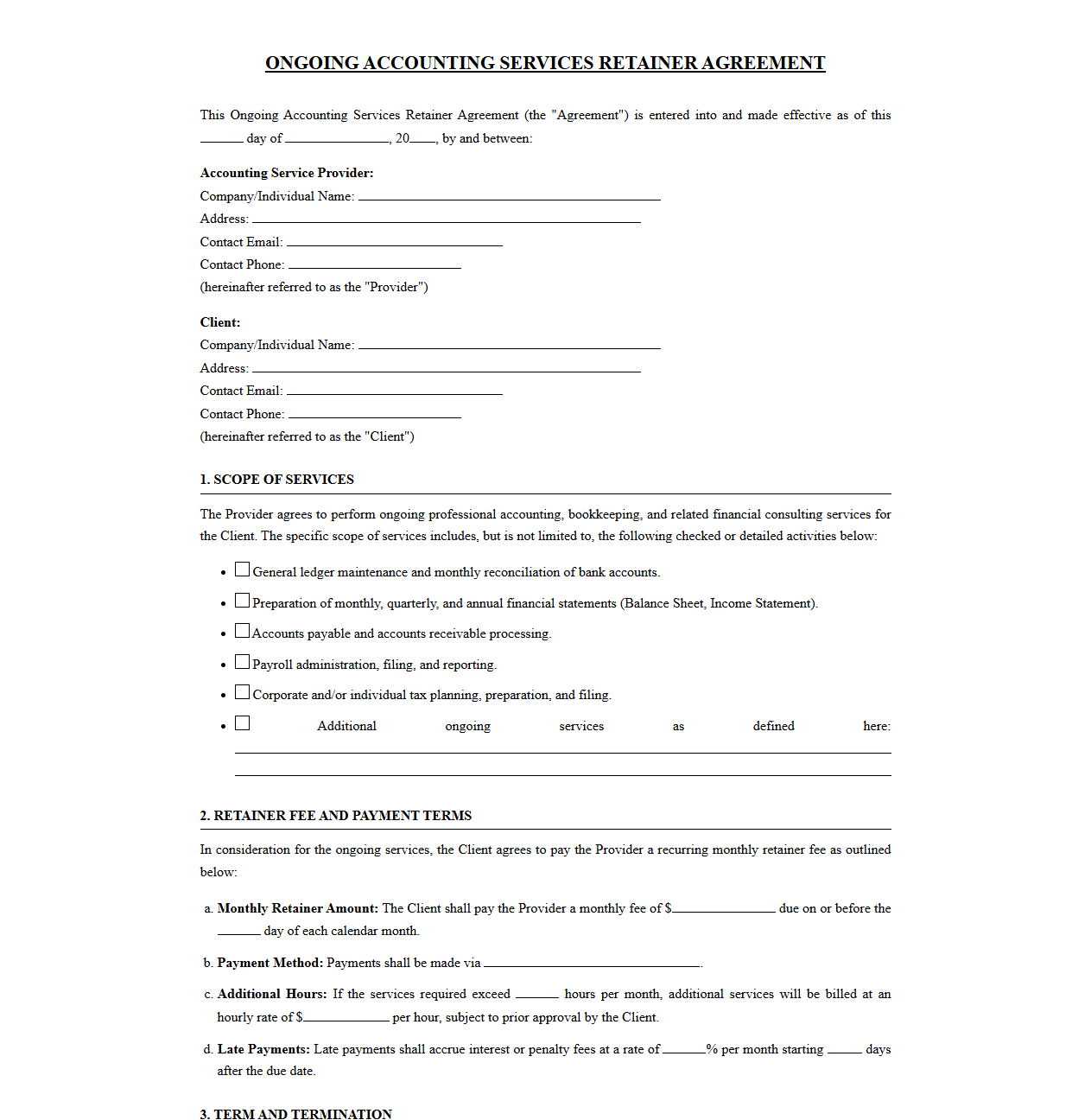
Ongoing Accounting Services Retainer Contract
 Download: .PDF
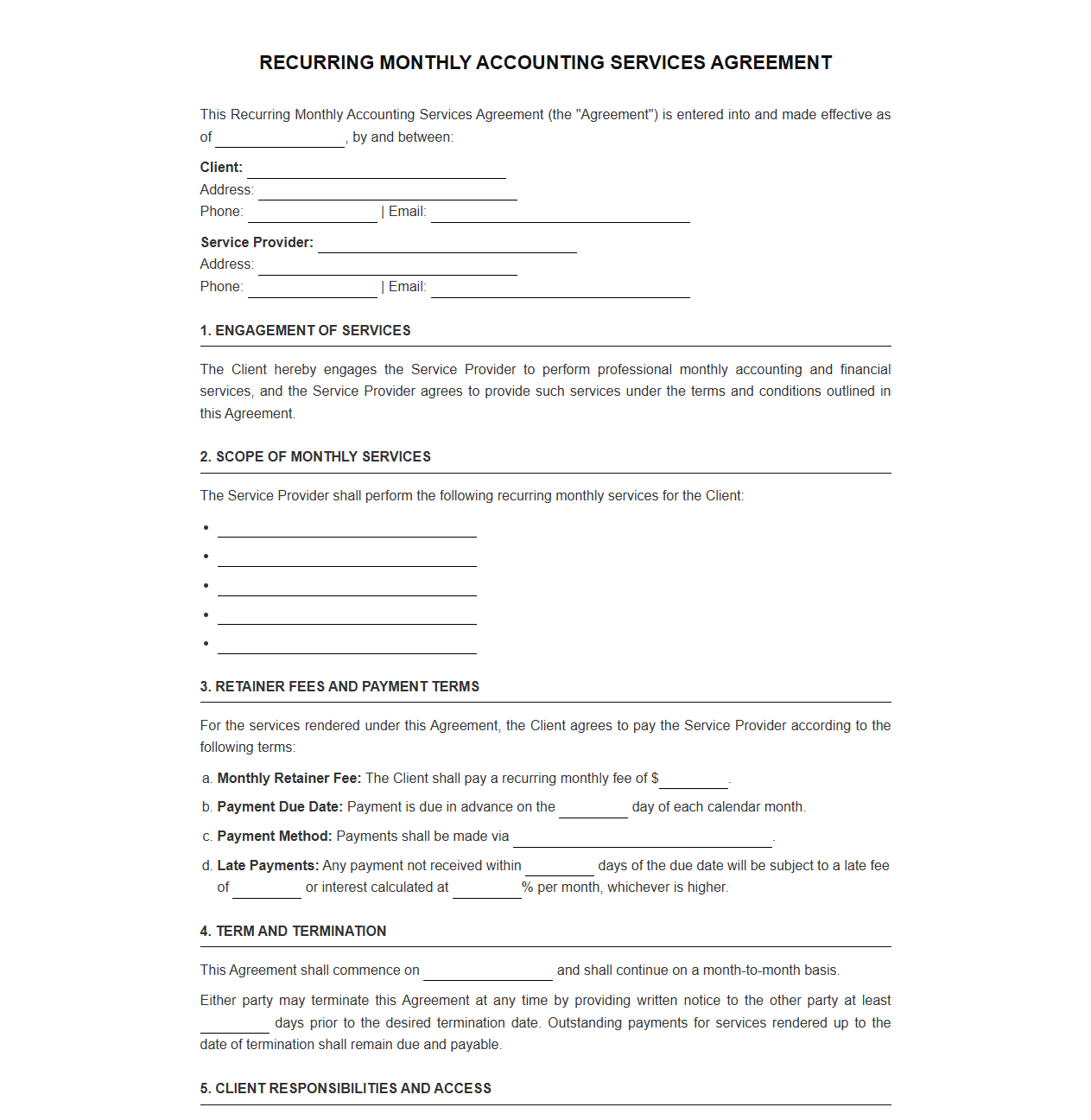
Recurring Monthly Accounting Services Agreement
 Download: .PDF
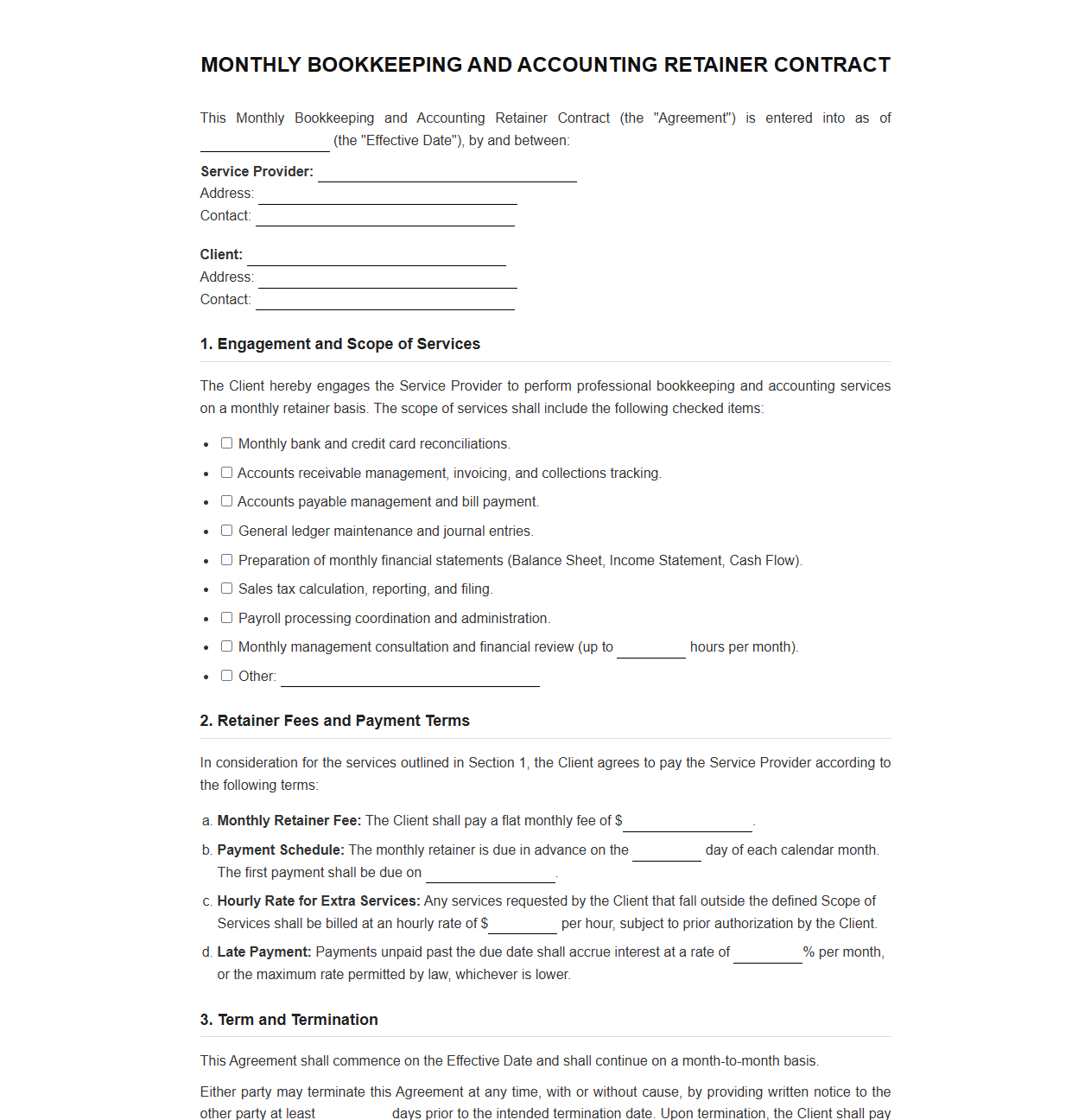
Monthly Bookkeeping and Accounting Retainer Contract
 Download: .PDF
Monthly Financial and Accounting Retainer Agreement
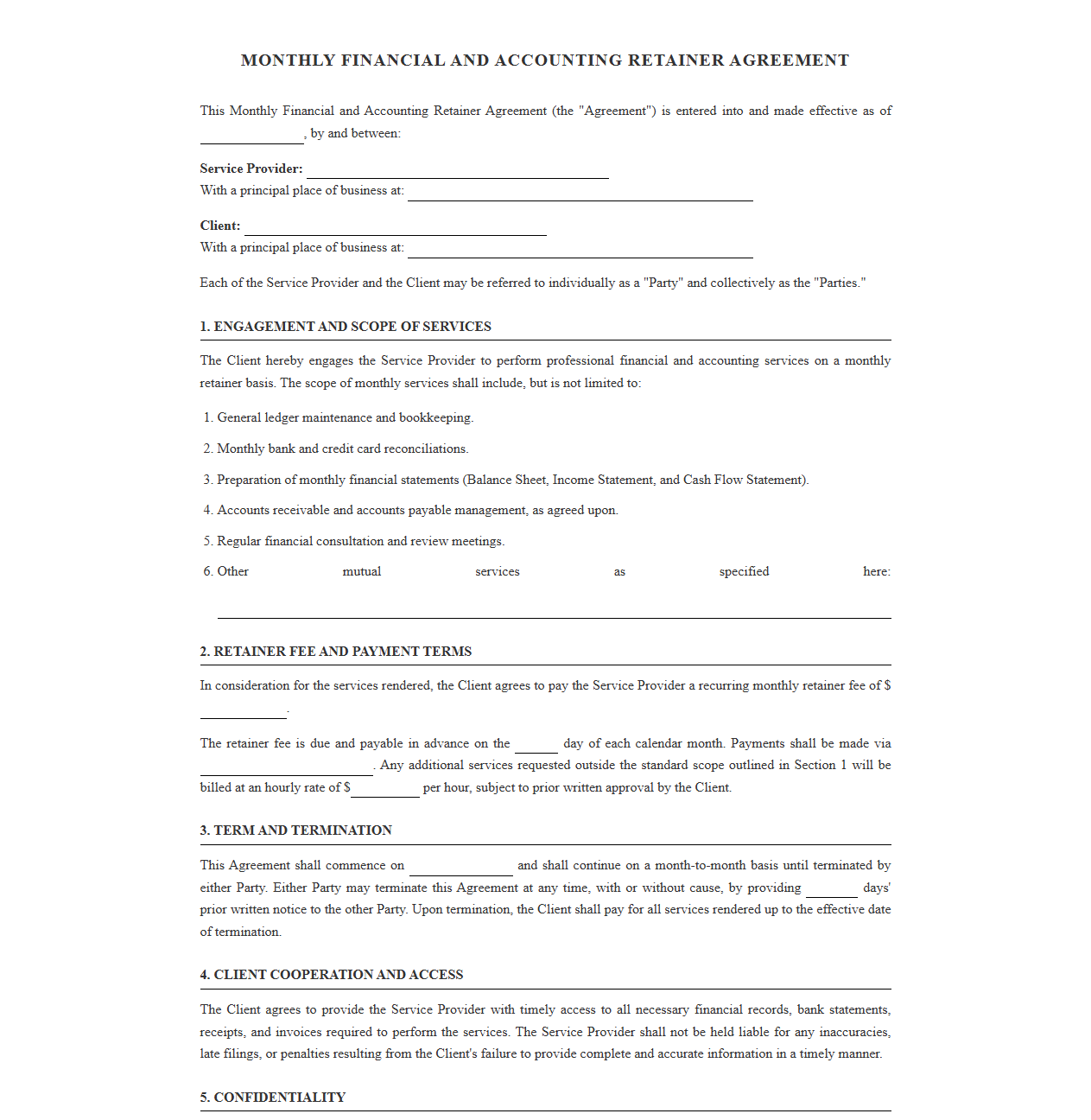 Download: .PDF
Professional Accounting Services Monthly Retainer Template
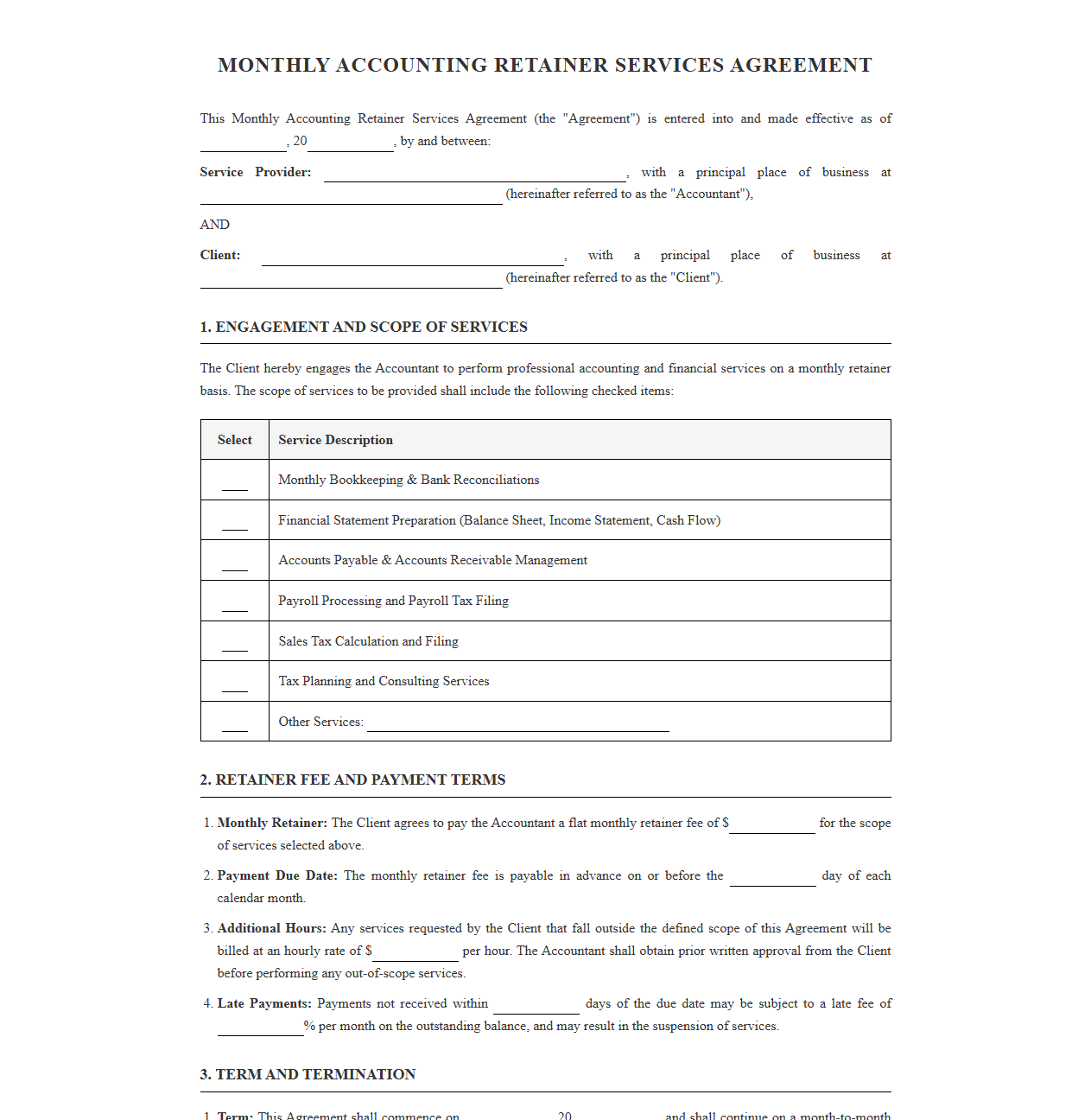 Download: .PDF
Standard Monthly Accounting Retainer Service Agreement
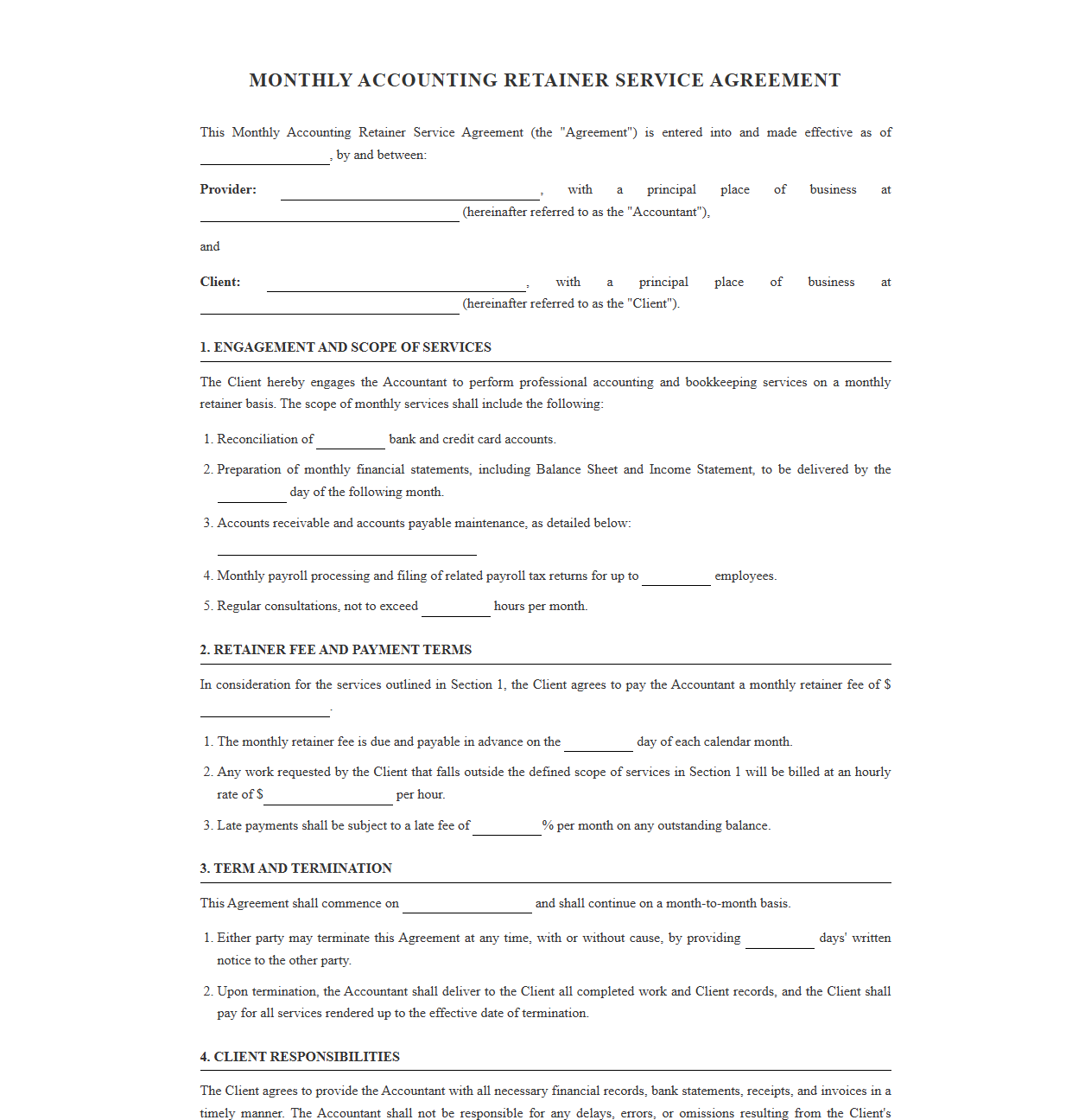 Download: .PDF
Retainer Agreement for Ongoing Monthly Accounting Support
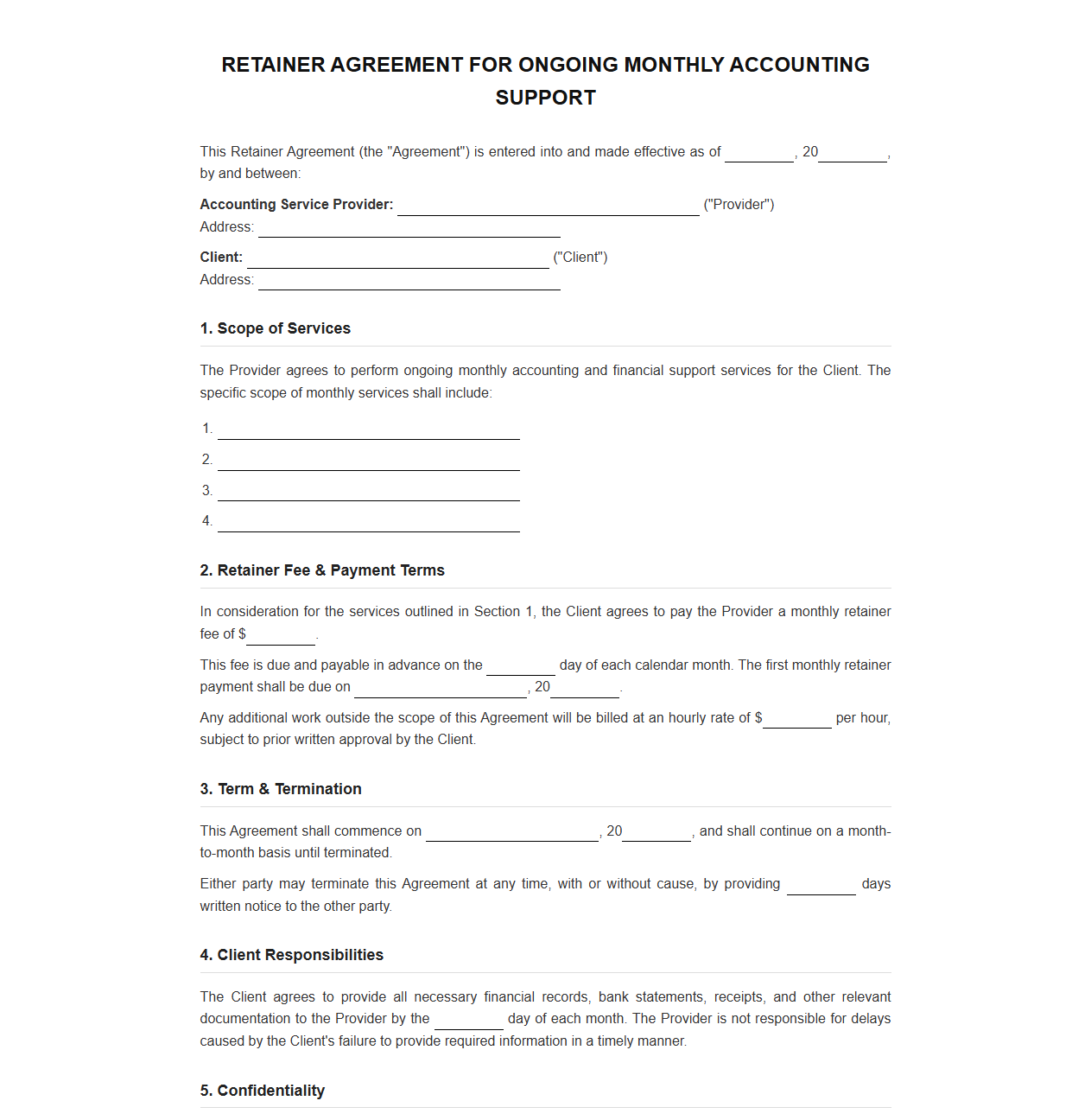 Download: .PDF
Corporate Monthly Accounting Retainer Service Contract
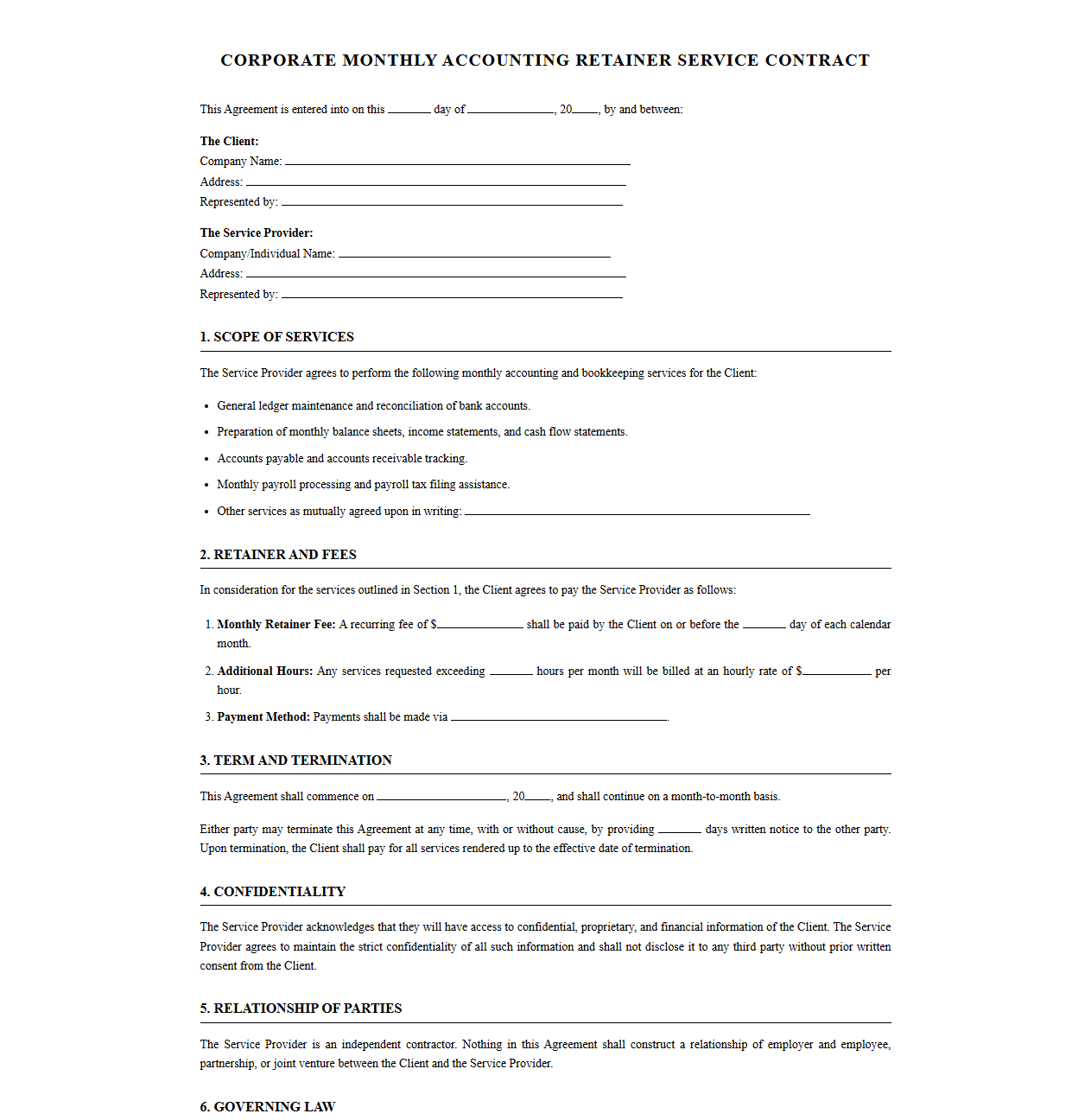 Download: .PDF
Understanding Scope Creep in Accounting Retainers
For accounting professionals, the monthly retainer model offers predictable revenue and stable client relationships. However, a silent profit killer often lurks within these arrangements: scope creep. Scope creep occurs when an accountant performs extra tasks that fall outside the original agreement without receiving additional compensation. What begins as a quick, five-minute favor quickly spirals into hours of undocumented work. Unmanaged scope creep directly erodes your hourly realization rate and severely damages firm profitability. When you absorb these extra tasks for free, you are essentially subsidizing your client's business operations at the expense of your own bottom line.
The Power of a Clear Retainer Agreement
Preventing profit loss requires a proactive defense. A structured monthly retainer agreement acts as a robust shield, protecting your time and securing fair compensation for your expertise. Rather than relying on verbal understandings, a written contract defines the exact parameters of your professional relationship. It sets healthy boundaries, ensuring clients respect your working hours and understand that additional demands require additional fees. By establishing these clear rules of engagement from day one, you foster mutual respect and eliminate the awkwardness of negotiating fees after the work has already been performed.
Outlining In-Scope Services with Precision
To avoid misunderstandings, your retainer template must define exactly what the client is paying for each month. Vague phrases like "monthly accounting support" open the door to endless, free requests. Instead, use highly specific language to list every standard monthly task included in the flat rate.
- Reconciliation of up to three business bank and credit card accounts.
- Preparation and delivery of monthly balance sheets and income statements by the 15th of the following month.
- A single, 30-minute monthly strategy call to review financial performance.
- Standard sales tax filing for one state entity.
Drawing the Line: Explicit Exclusions
Equally important as listing what is included is explicitly detailing what is excluded. By listing out-of-scope tasks directly in your agreement template, you prevent clients from assuming that complex, ad-hoc projects are covered under their standard monthly rate. If a service is not explicitly listed as "In-Scope," it must be treated as an additional, billable service. This clarity makes it incredibly easy to point to the contract when a client requests complex work outside the standard agreement.
- Historical clean-up: Forensic accounting or correcting bookkeeping errors from prior fiscal years.
- Audit support: Representing the client or preparing documentation for state or federal tax audits.
- Software migration: Transitioning the client's financial data to a new ERP or accounting platform.
Implementing a Seamless Change Order Process
When a client requests work that goes beyond their monthly retainer, you do not have to say no. Instead, you should welcome the opportunity to earn more revenue by utilizing a formalized change order process. This ensures that extra work is always billed separately and agreed upon before any labor begins.
- Acknowledge the client's request and identify it as an out-of-scope task.
- Prepare a brief Change Order document detailing the specific project, the estimated timeline, and the additional fee.
- Obtain written or digital signature approval from the client on the Change Order.
- Execute the work and bill the client according to the newly agreed terms, separate from the standard monthly retainer invoice.
Establishing Regular Review Intervals
Clients' businesses are dynamic, and their accounting needs will naturally expand as they scale. A retainer agreement that fit a client perfectly last year may be completely inadequate today. To address this growth without losing profit, you must build regular review intervals into your contracts.
Scheduling recurring reviews ensures that your pricing keeps pace with the client's actual transaction volume and operational complexity.
"Reviewing client accounts on a quarterly or bi-annual basis allows us to proactively adjust retainer pricing, ensuring we are always paid fairly for the actual volume of work we manage."
Downloadable Templates and Best Practices
Take Control of Your Firm's Profitability Today
Implementing a protective retainer framework does not require starting from scratch. By using a standardized, customizable template, you can easily onboard new clients and protect your firm from unpaid labor. Start by auditing your current client workloads, identifying where scope creep is happening right now, and updating your agreements at the next renewal cycle.
Ready to safeguard your time and scale your firm's revenue? Download our free, customizable Accounting Retainer Agreement Template today to establish clear boundaries and eliminate unpaid work for good.

Leave a comment