
For many professional bookkeepers, the silent profit killer is scope creep-the gradual, unbilled expansion of client demands that erodes your margins and causes administrative burnout. While tracking hours manually provides some operational visibility, scaling a sustainable advisory firm requires transitioning to a structured, value-based billing model.
Embracing a formal retainer structure grants your practice predictable, monthly recurring revenue while fostering healthier client relationships. Success relies on precise contractual stipulations that proactively manage client expectations. For example, explicitly defining standard monthly ledger maintenance as distinct from out-of-scope tasks-such as ad-hoc forensic cleanups or emergency audit support-ensures you are compensated for every extra task performed.
This guide provides customizable bookkeeping retainer agreement templates tailored to diverse service tiers, offering the structural framework you need to protect your time, secure your revenue, and professionalize your client onboarding.
Ongoing Bookkeeping Retainer Agreement Template
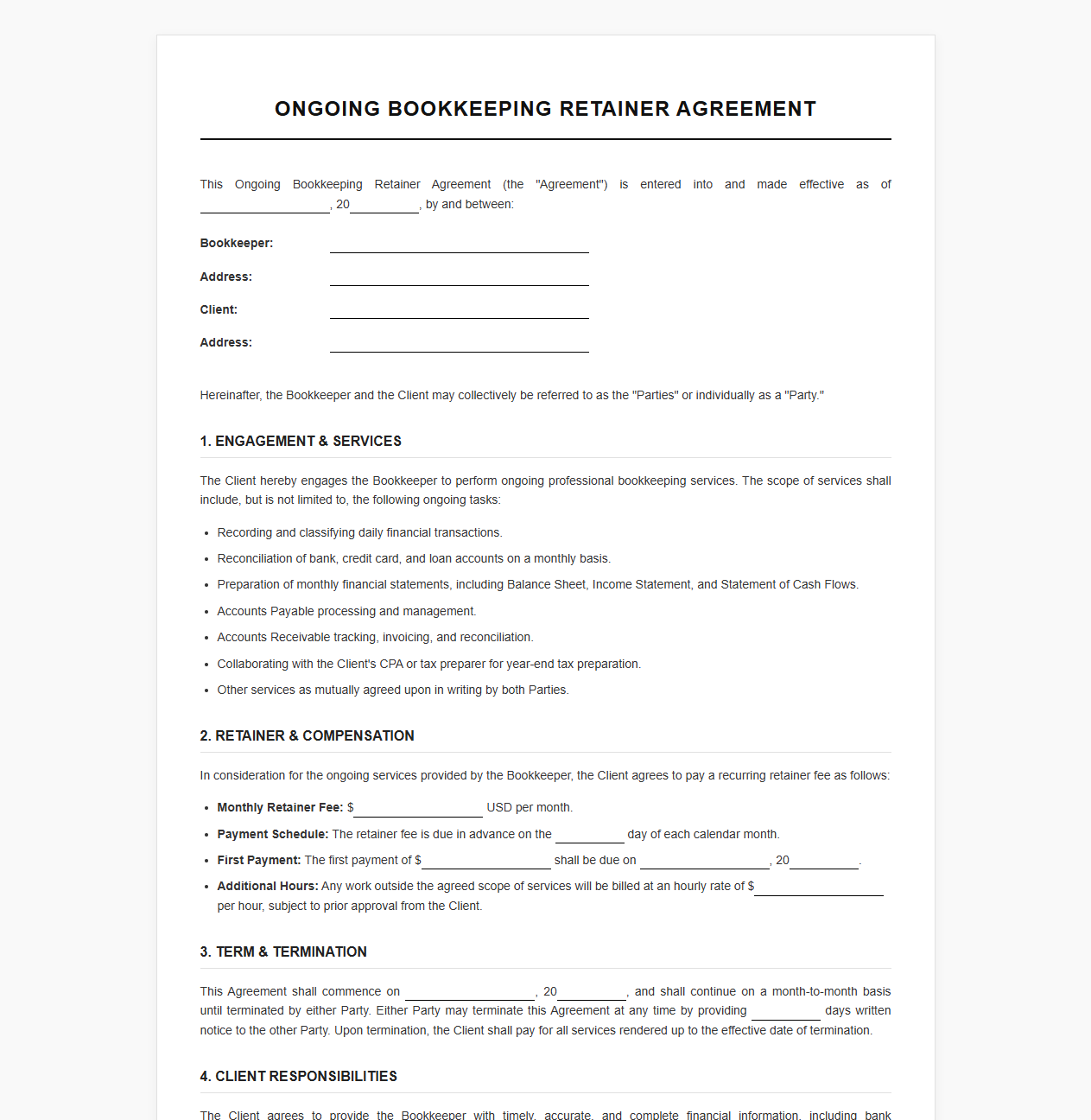 Download: .PDF
Monthly Bookkeeping Services Retainer Contract
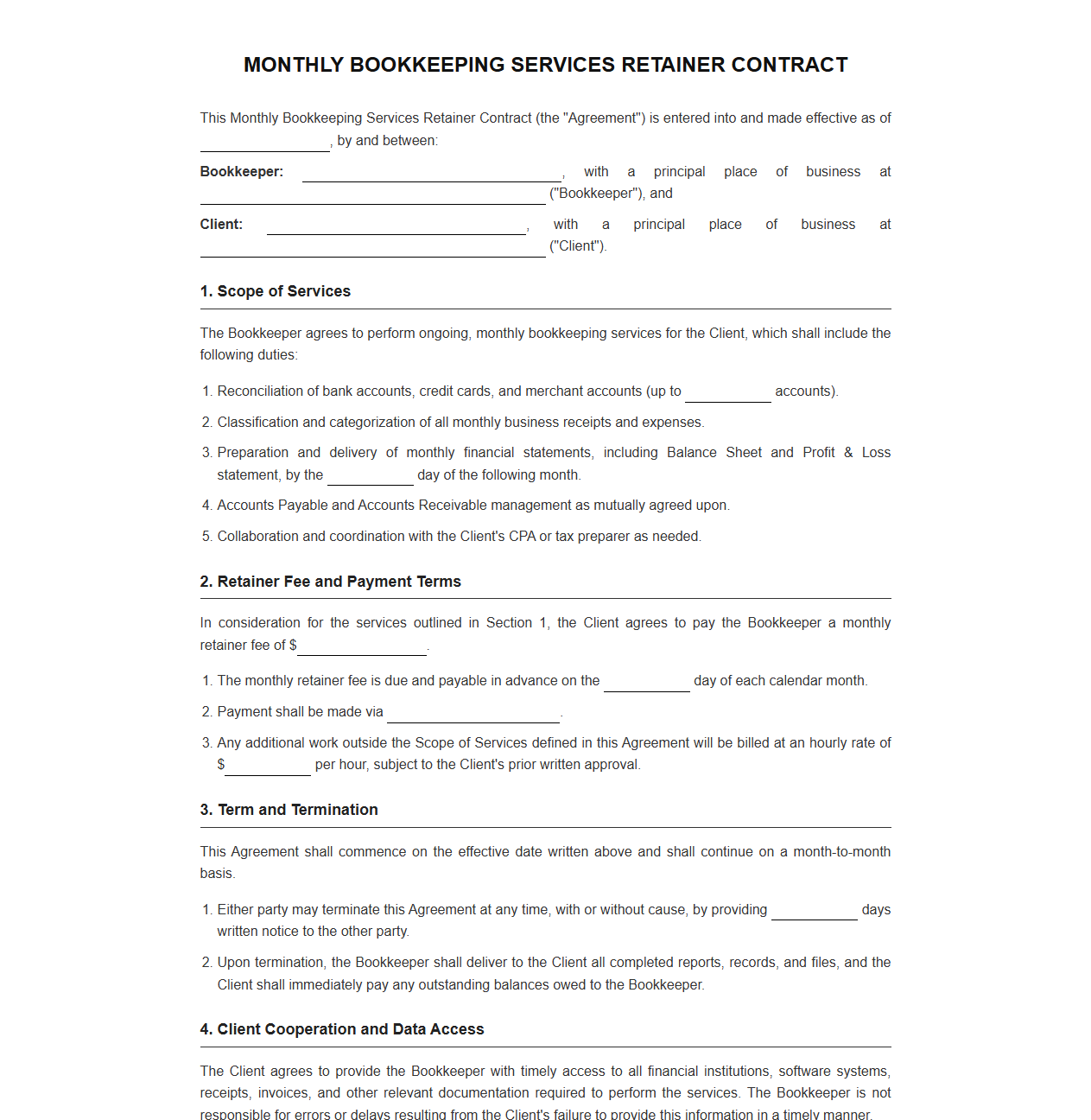 Download: .PDF
Recurring Bookkeeping and Accounting Retainer Agreement
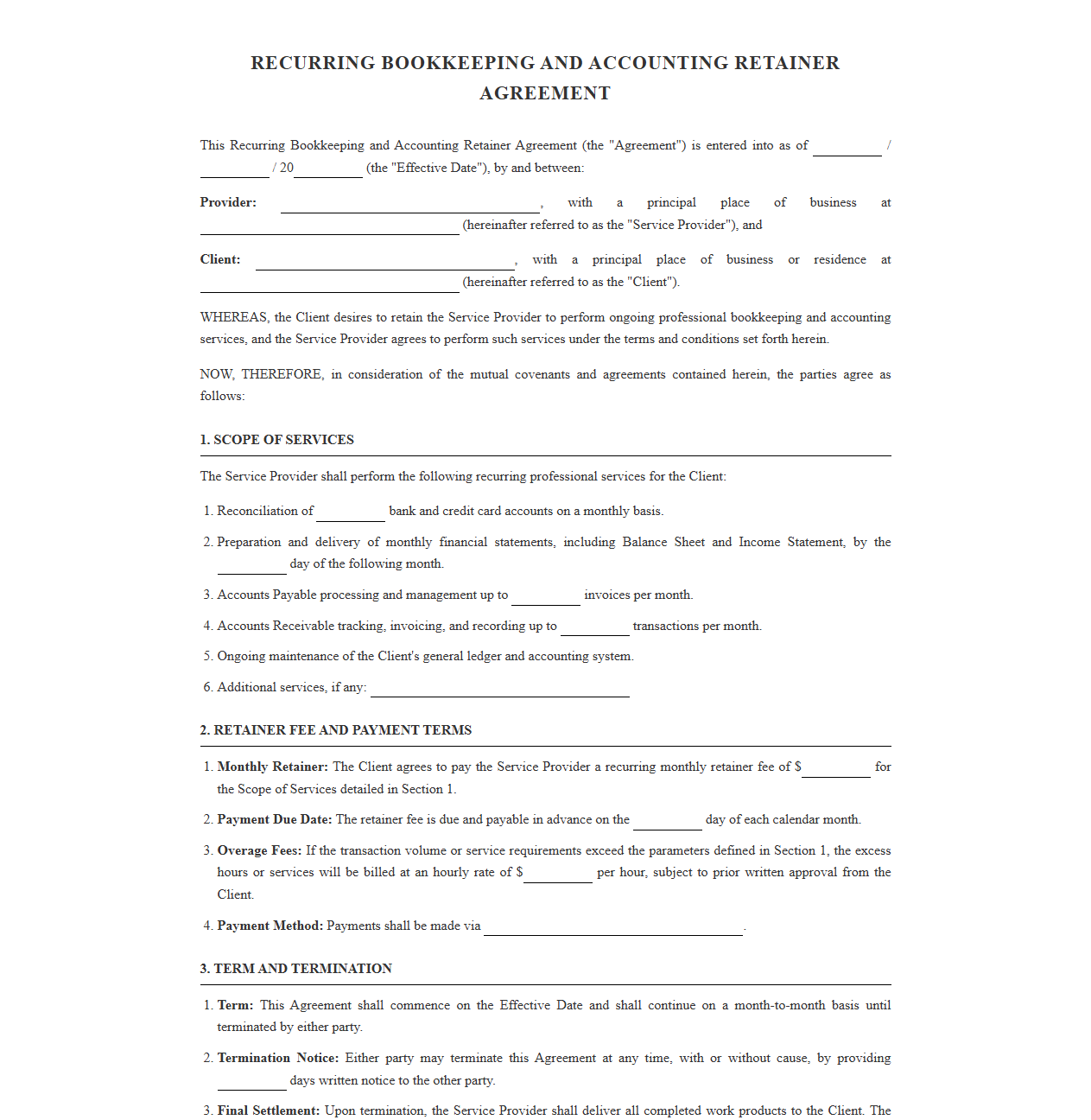 Download: .PDF
Bookkeeping Retainer Service Level Agreement
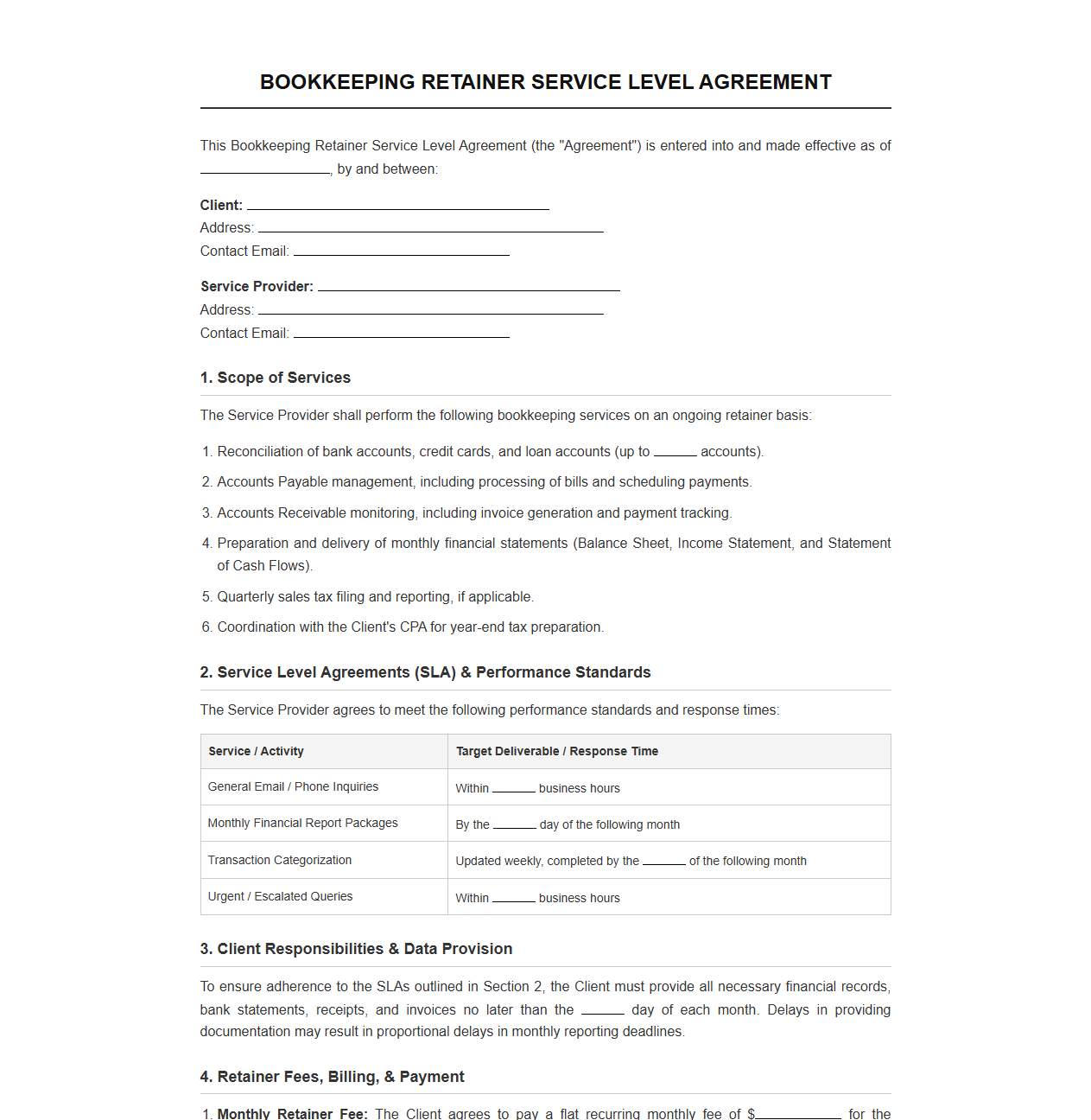 Download: .PDF
Retainer Agreement for Continuous Bookkeeping Support
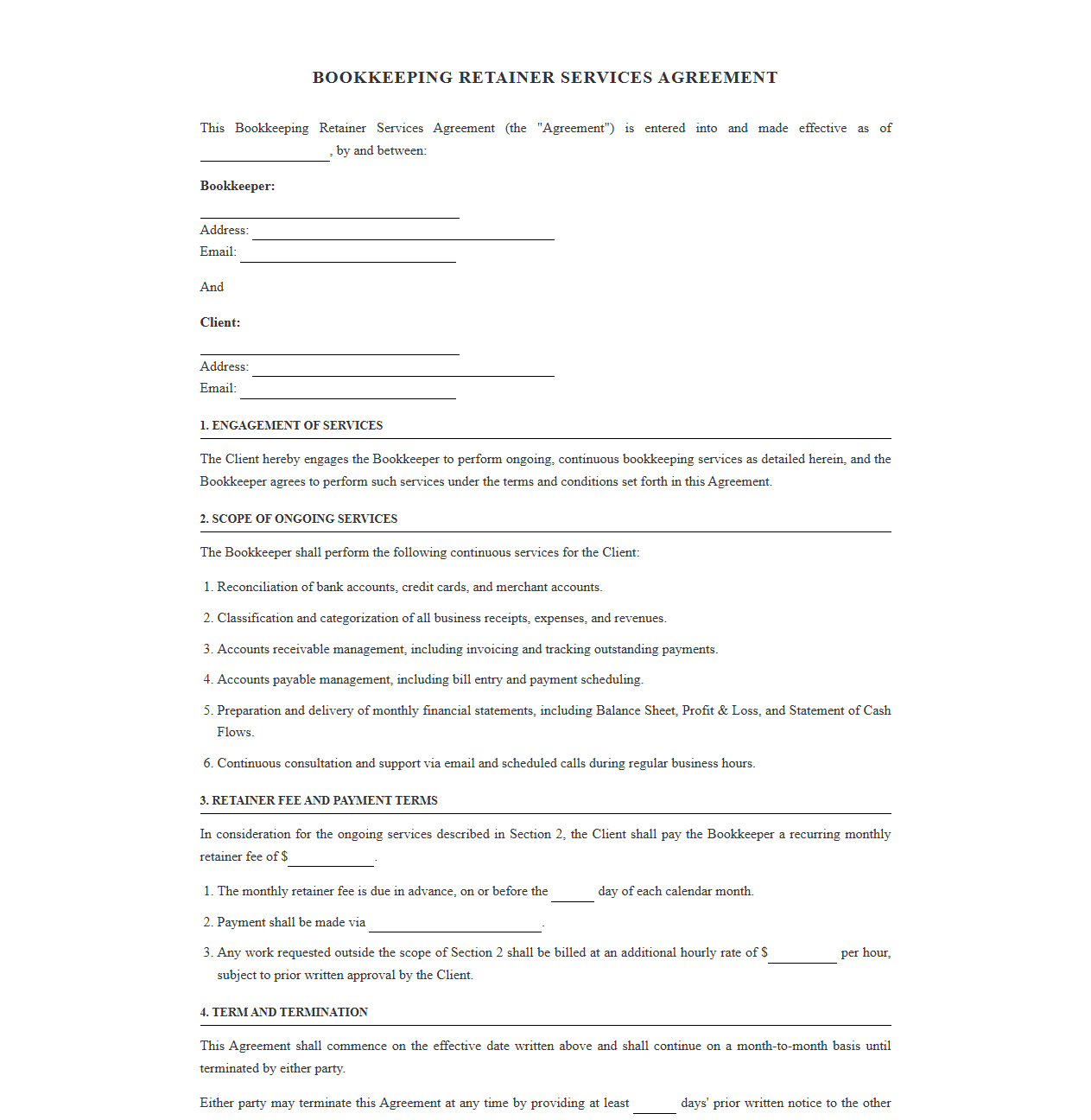 Download: .PDF
Professional Bookkeeping Services Monthly Retainer Agreement
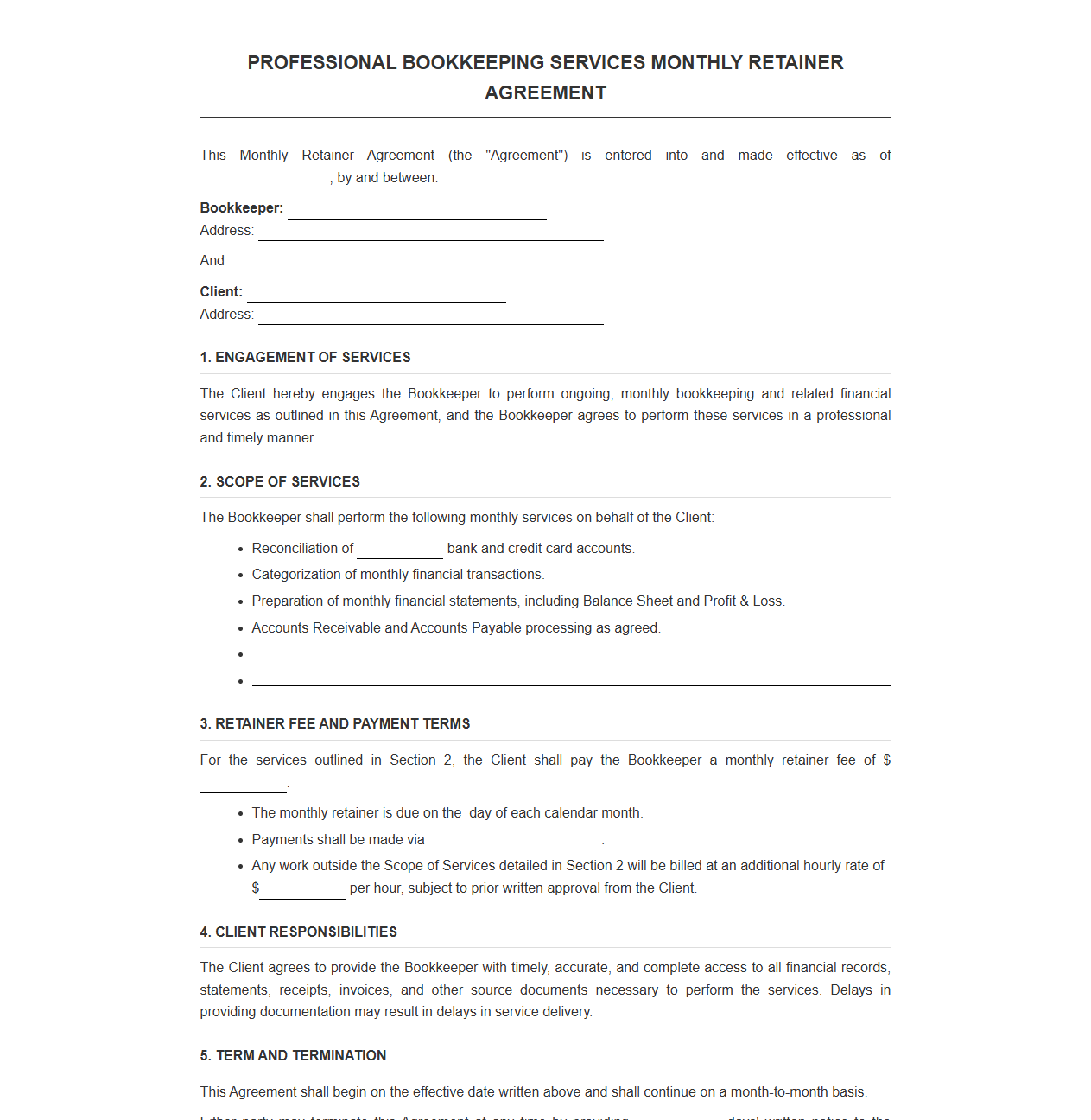 Download: .PDF
Ongoing Accounting and Bookkeeping Retainer Contract
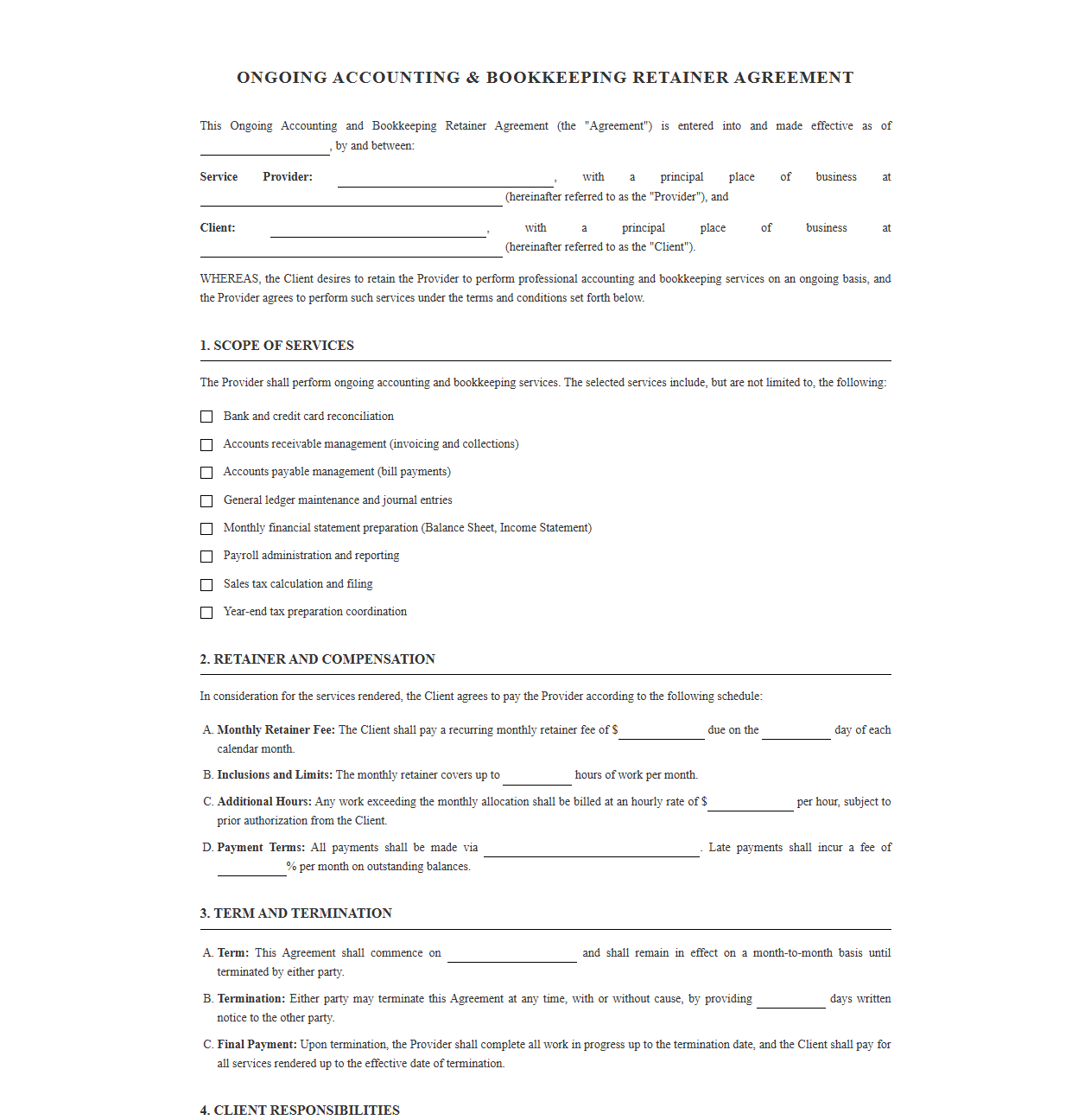 Download: .PDF
Standard Retainer Agreement for Ongoing Bookkeeping
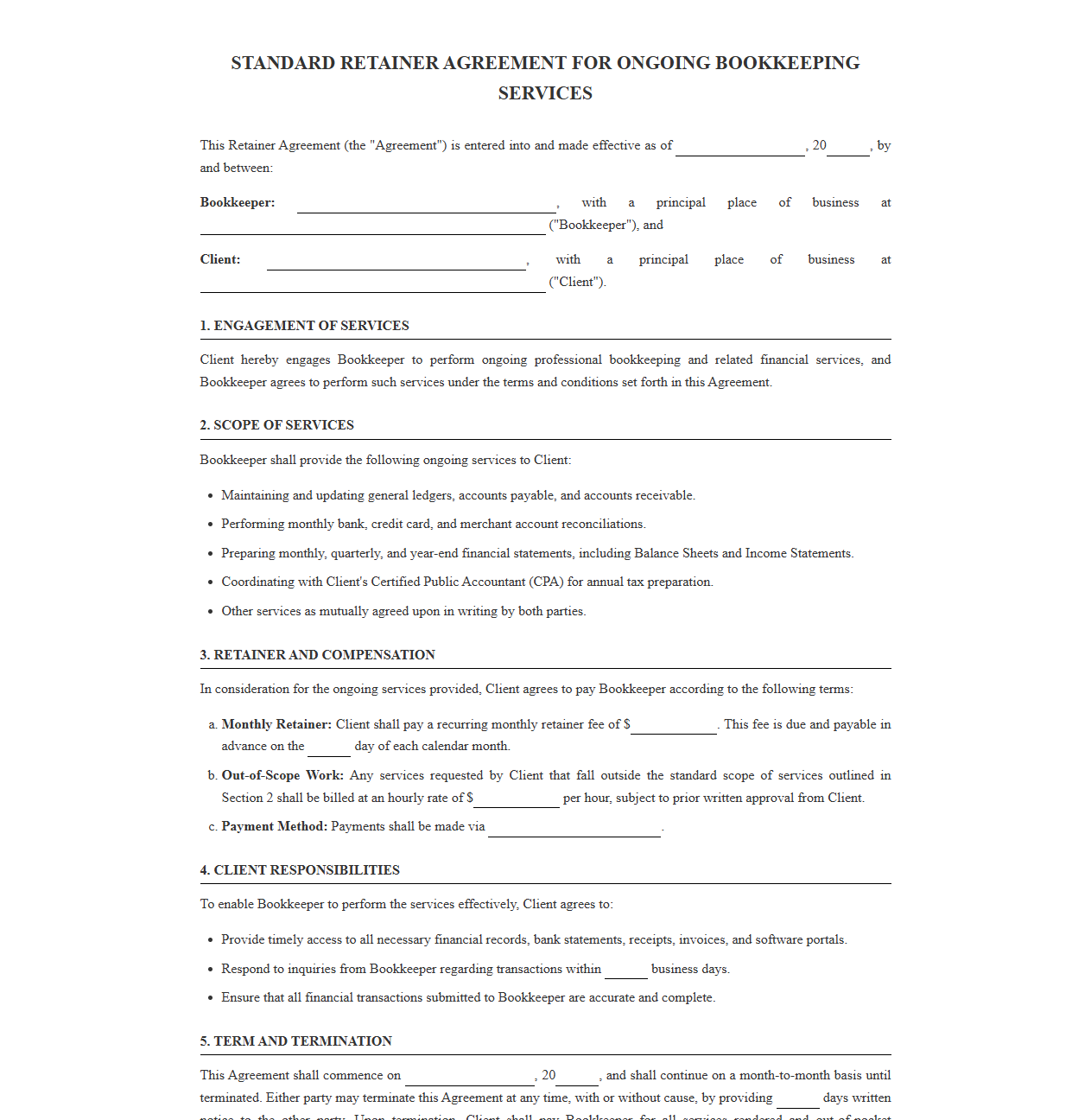 Download: .PDF
Understanding Scope Creep in Bookkeeping Services
In the financial services landscape, scope creep is the silent erosion of a firm's profitability. It occurs when a bookkeeper gradually performs additional tasks outside the original, agreed-upon parameters without receiving extra compensation. In the bookkeeping industry, this frequently happens due to a desire to please clients, vague initial agreements, or clients assuming that "just one quick question" or "sorting out a minor discrepancy" is included in their flat monthly fee.
While these small favors may seem harmless in isolation, they accumulate rapidly. Over time, unpaid labor devalues your expertise, strains your schedule, and drastically reduces your profit margins. Unchecked scope creep damages the client relationship by turning a mutually beneficial partnership into an unbalanced transaction where one party feels taken advantage of.
The Power of Structured Retainer Agreements
To protect your firm from unpaid labor, you must establish clear operational boundaries before the first bank feed is reconciled. Structured retainer agreements serve as your primary shield against scope creep, defining exactly where your responsibilities begin and end.
A well-drafted retainer agreement transforms your client onboarding process. Instead of leaving tasks open to interpretation, it establishes explicit expectations from day one. When clients know precisely what services their monthly fee covers, they are less likely to request off-the-books favors, making it easy to point back to the signed contract when out-of-scope requests arise.
Tier 1 Template: Essential Bookkeeping & Compliance
This foundational tier is designed for micro-businesses and startups requiring standard compliance and historical record-keeping.
Tier 1 Service Agreement Template
Use the following template to define the scope of baseline compliance services:
This Agreement covers the following baseline services:
- Reconciliation of up to 3 bank/credit card accounts monthly.
- Digital ledger entry of up to 50 transactions per month.
- Quarterly sales tax filing and reporting.
Explicit Exclusions:
- Accounts payable management (bill pay).
- Historical clean-ups of prior fiscal years.
- Direct communication with tax authorities or audit representation.
By setting hard limits on transaction volume and account counts, you prevent a simple business from scaling its transactions without adjusting your compensation.
Tier 2 Template: Active Financial Management
The mid-tier level caters to growing businesses requiring active operational support and structured reporting to guide monthly decisions.
Tier 2 Service Agreement Template
Use this layout to govern active management accounts:
This Agreement covers the following mid-tier management services:
- Monthly management reporting (P&L, Balance Sheet, Cash Flow).
- Accounts Payable: Processing and matching up to 20 bills per month.
- Payroll management for up to 10 employees (bi-weekly frequency).
Explicit Exclusions and Caps:
- Custom ad-hoc reporting outside standard monthly packages.
- Collection calls on delinquent Accounts Receivable.
- System migrations or software integrations.
Enforcing these caps ensures your team is not bogged down by a sudden surge in payroll headcount or processing volume without an accompanying price adjustment.
Tier 3 Template: Strategic CFO & Advisory Services
This premium service tier shifts the relationship from administrative support to strategic partnership, commanding higher fees and requiring strict boundary management.
Tier 3 Service Agreement Template
Maintain control over high-touch advisory engagements using this framework:
This Agreement covers the following premium advisory services:
- Forward-looking cash flow forecasting updated monthly.
- Quarterly tax planning and optimization strategies.
- One (1) strategic advisory meeting per month (up to 60 minutes).
Communication Boundaries:
- Standard response window: within 24 business hours.
- Ad-hoc consulting capped at 2 hours per calendar month.
- Out-of-scope consulting billed at a premium rate of $250/hour.
Limiting meeting times and communication windows prevents premium clients from consuming your calendar with unscheduled, endless consultations.
Essential Clauses for Out-of-Scope Work and Upselling
A standard retainer agreement is only effective if it contains mechanisms to handle tasks that fall outside your defined scope. Rather than saying "no" to clients, you should use structured clauses to turn extra requests into upselling opportunities. By embedding explicit Change Order and Out-of-Scope clauses into your agreements, you establish a professional pathway for billing more.
Here is standard, copy-and-paste legal language you can integrate directly into your service agreements:
Out-of-Scope Work Clause: Any services requested by the Client that are not explicitly detailed in the "Included Services" section of this Agreement will be considered Out-of-Scope. The Provider will notify the Client before performing any out-of-scope work. Out-of-scope tasks will be billed at an hourly rate of $150/hour or subject to a separate written Change Order Agreement signed by both parties.
Automatic Tier Transition Clause: Should the Client's operational volume exceed the agreed limits (e.g., transaction count, employee count) for two consecutive billing cycles, the Client will be automatically transitioned to the appropriate service tier, and billing will adjust accordingly with 30 days' written notice.
Best Practices for Seamless Retainer Implementation
Transitioning to structured retainer agreements requires strategic client communication. Whether you are onboarding a new client or updating terms for an established account, how you frame the change determines how easily they accept it.
- Introduce Tiered Packages Early: Present your service tiers during the initial discovery call so prospects view options as structured business choices rather than arbitrary pricing.
- Frame Changes as Standardization: When migrating existing clients, explain that you are standardizing agreements to guarantee consistent service quality and dedicated bandwidth.
- Address Objections with Options: If a client objects to a price increase due to scope creep, offer them the choice to reduce their service volume to fit their original budget.
- Schedule Mandated Annual Reviews: Build a recurring calendar event to review your client's actual transactional volume against their contracted limits every year.

Leave a comment