

Handing over sensitive financial operations to an external provider often triggers acute anxiety over data security and operational misalignment. While outsourcing accounting functions is a highly effective strategy for scaling business operations, successfully navigating this transition requires a structured framework to protect both parties.
Establishing robust contract templates grants stakeholders the exact operational clarity and risk mitigation needed to collaborate with confidence. However, readers should note that while standardized templates provide a strong baseline, they must be tailored to satisfy specific jurisdictional regulations. Concrete instruments-such as Service Level Agreements (SLAs) to define performance metrics and Non-Disclosure Agreements (NDAs) to secure proprietary data-are indispensable tools in this process.
This article outlines the essential agreement templates your firm needs to establish secure, compliant, and highly productive financial partnerships.
Outsourced Accounting Services Agreement Template
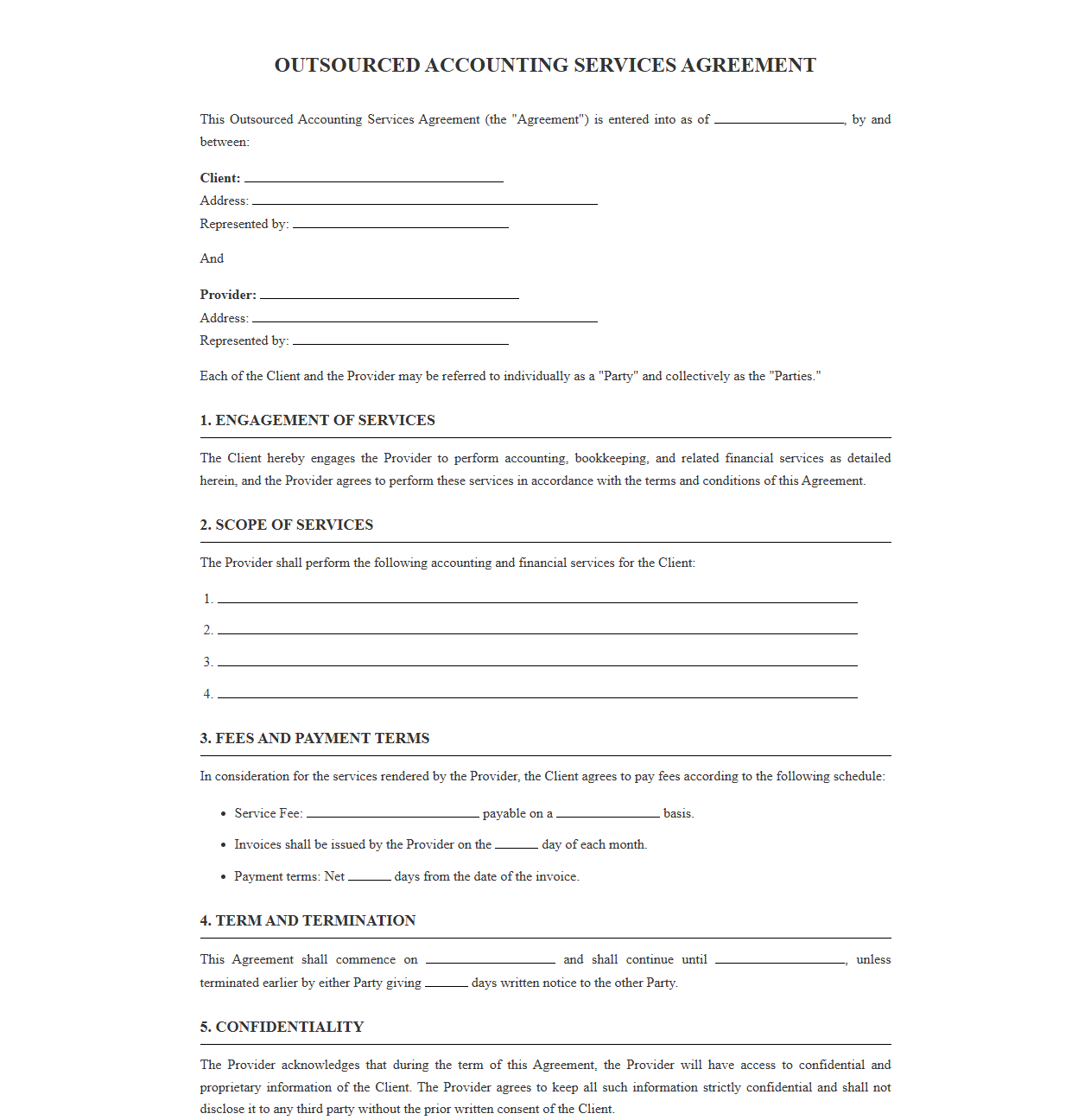 Download: .PDF
Bookkeeping and Accounting Services Contract Template
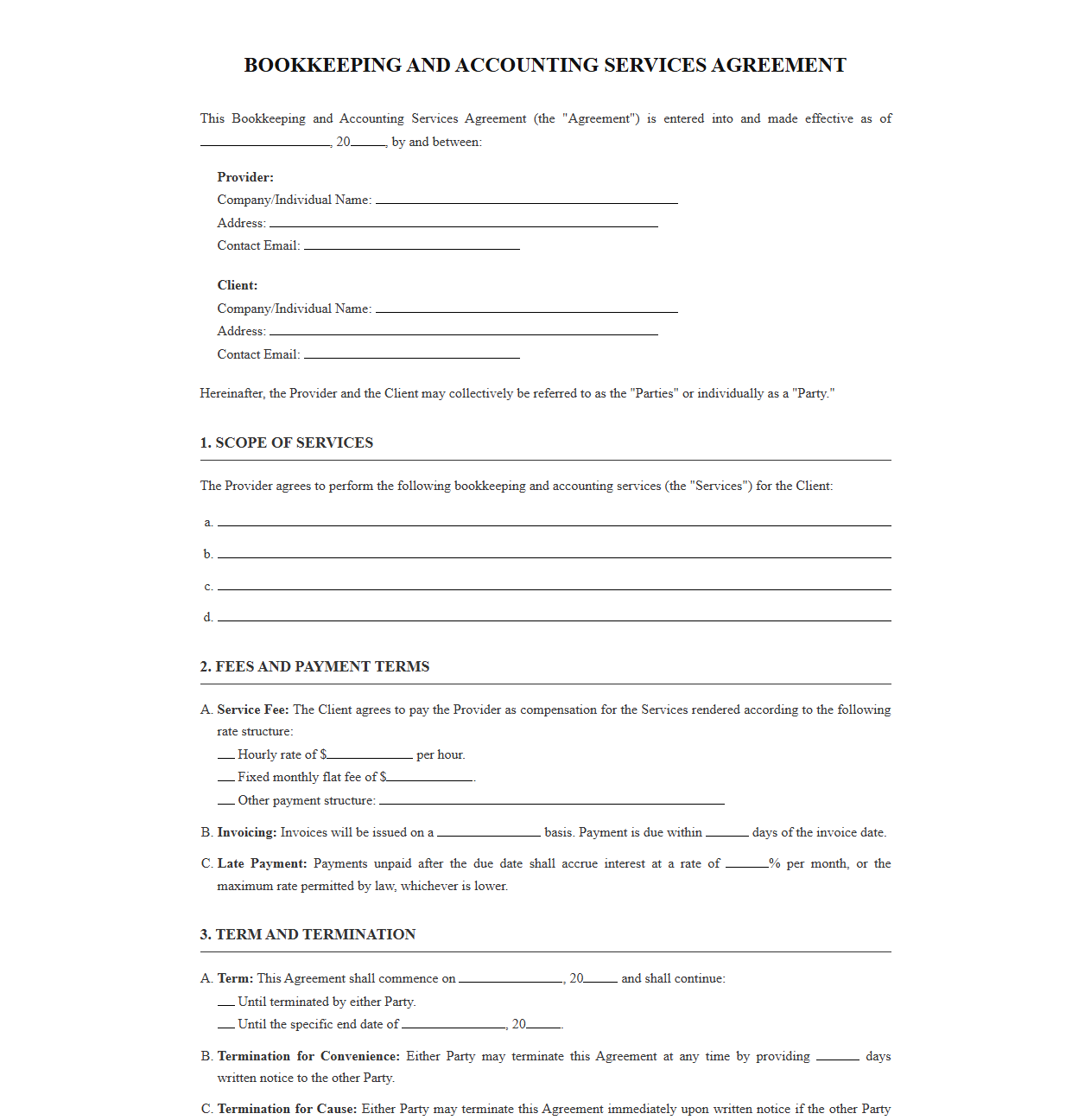 Download: .PDF
Professional Accounting Outsourcing Agreement
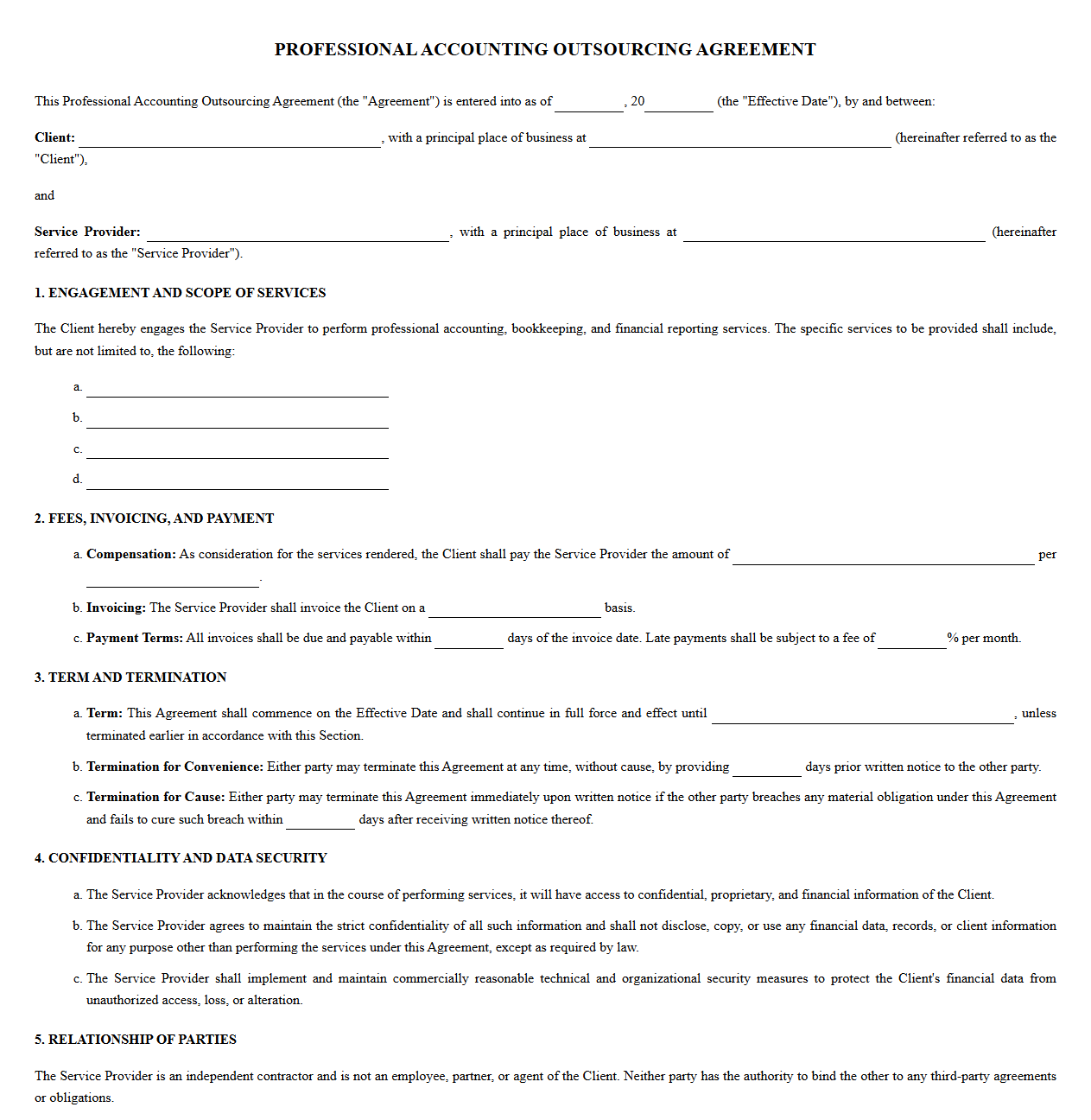 Download: .PDF
Client Agreement for Outsourced Accounting Services
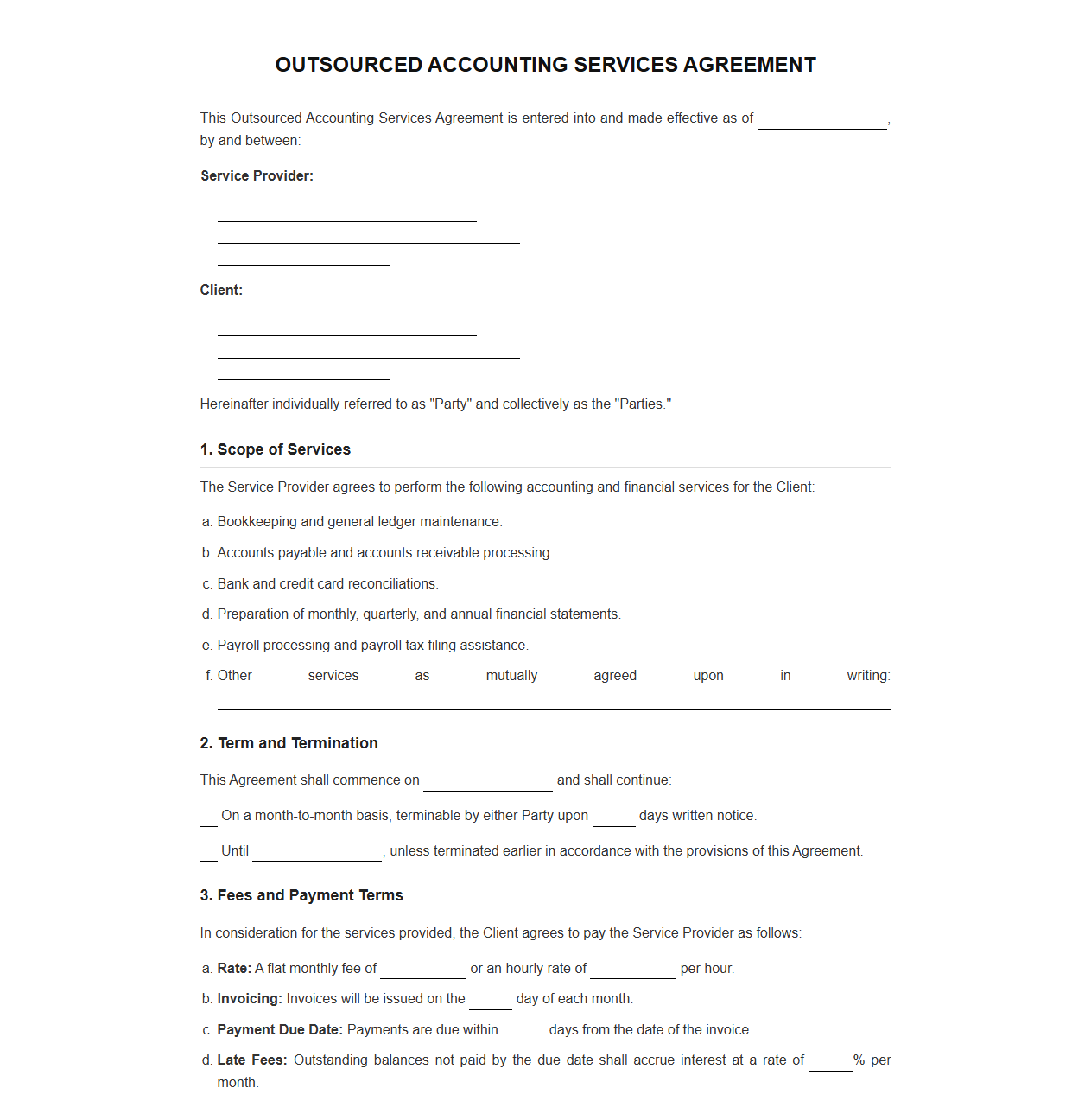 Download: .PDF
Outsourced Accounting and Financial Services Contract
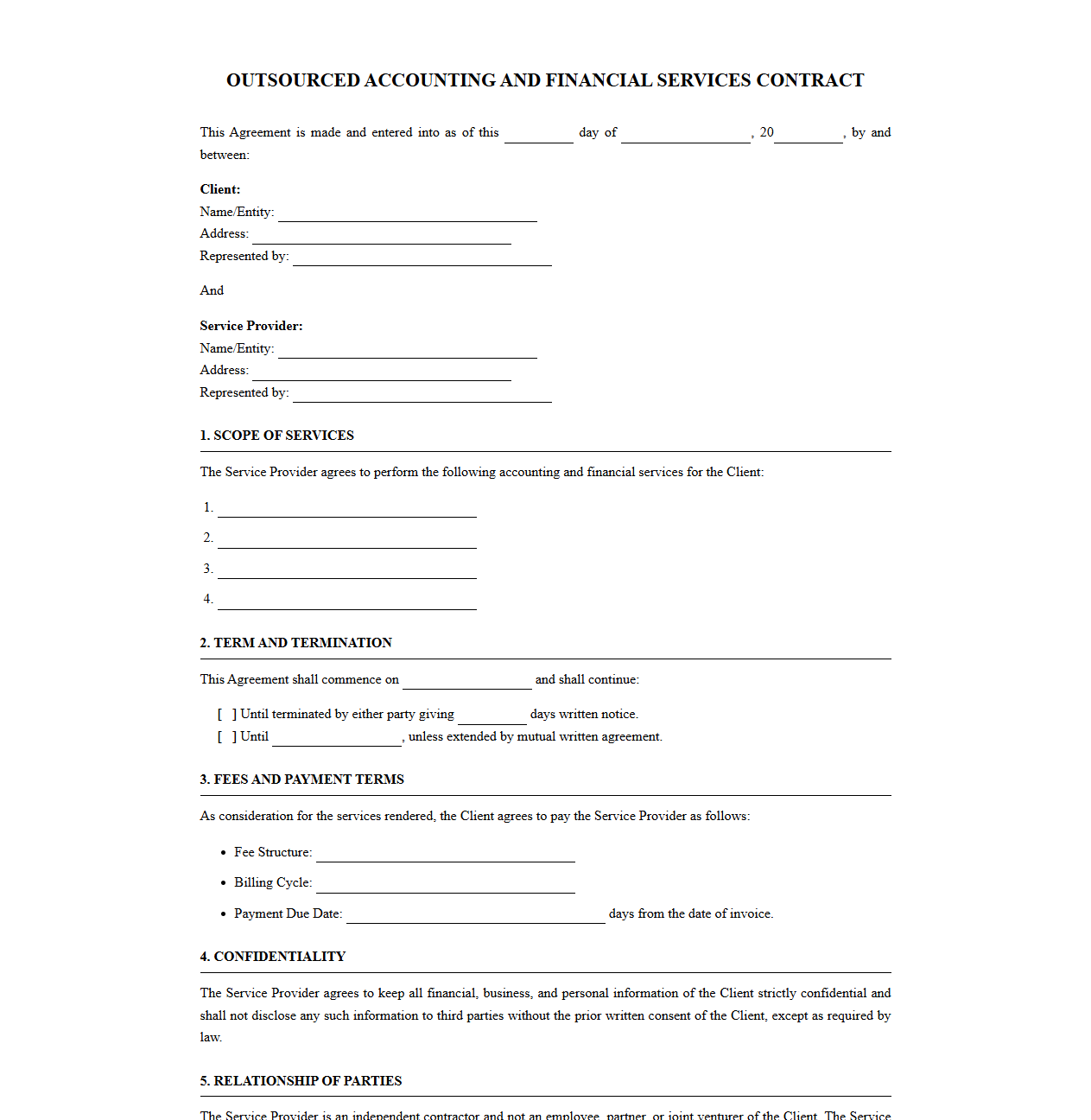 Download: .PDF
Master Services Agreement for Outsourced Accounting
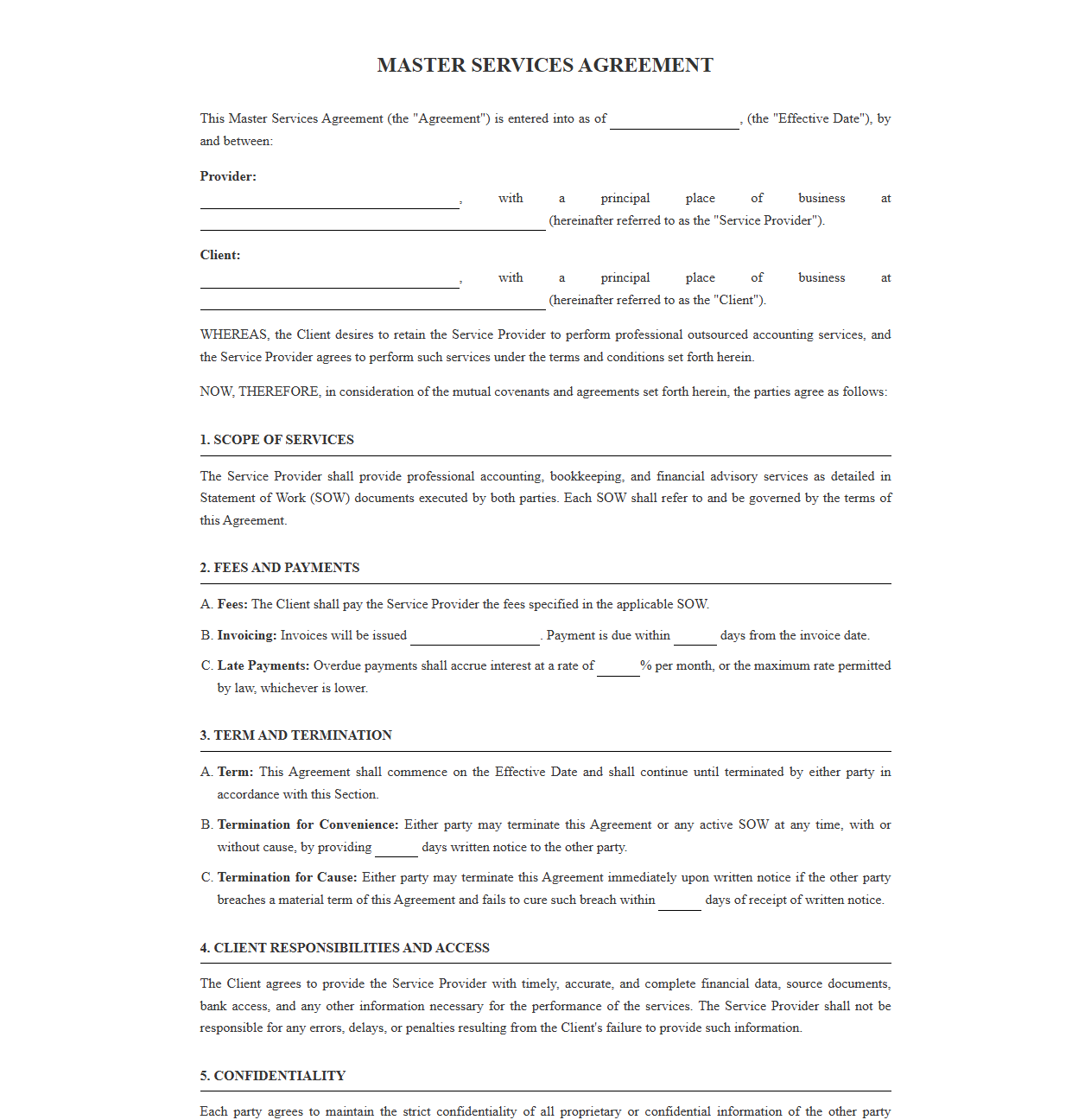 Download: .PDF
Standard Agreement for Outsourced Accounting Support
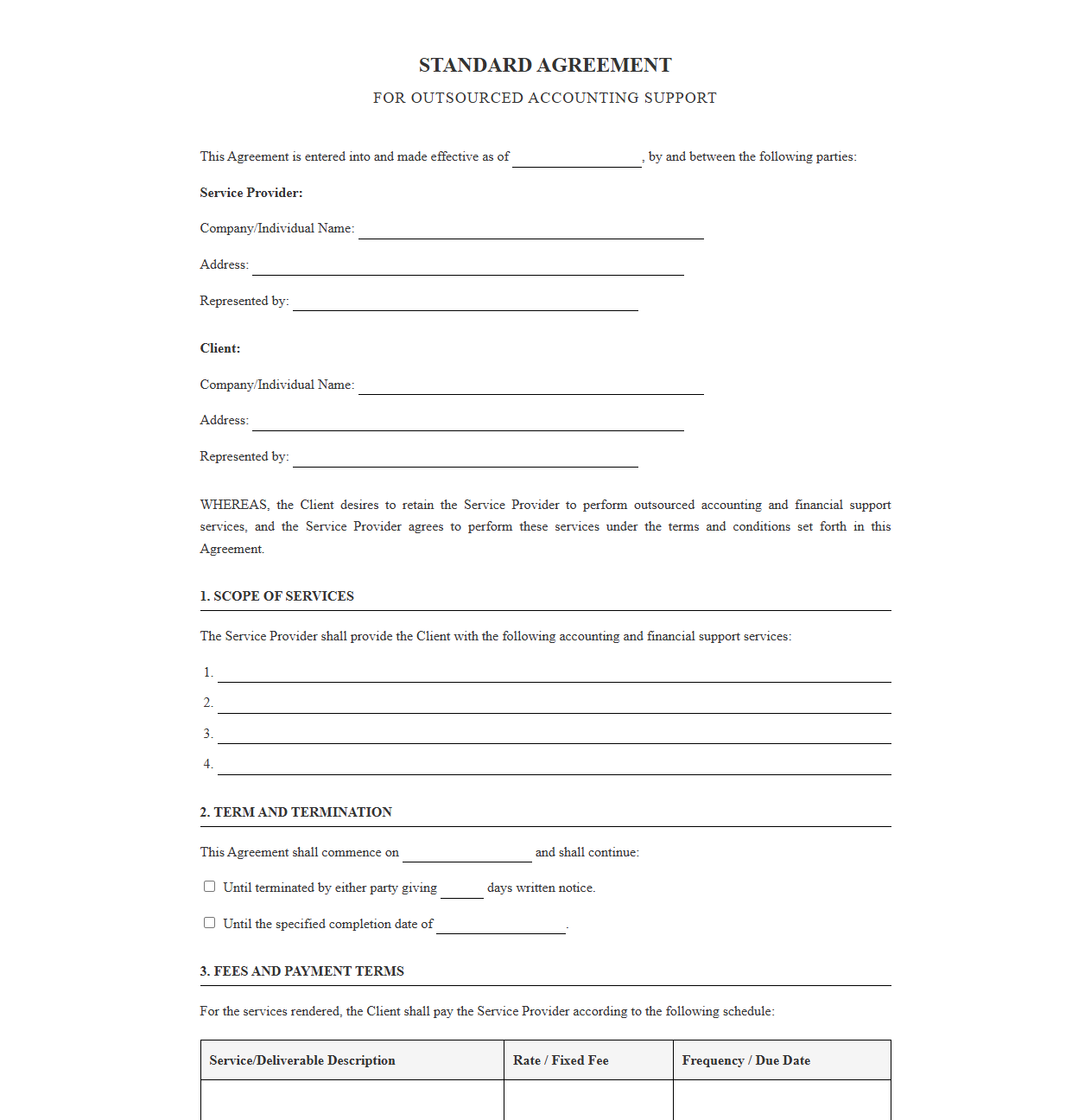 Download: .PDF
Freelance Accountant Services Agreement Template
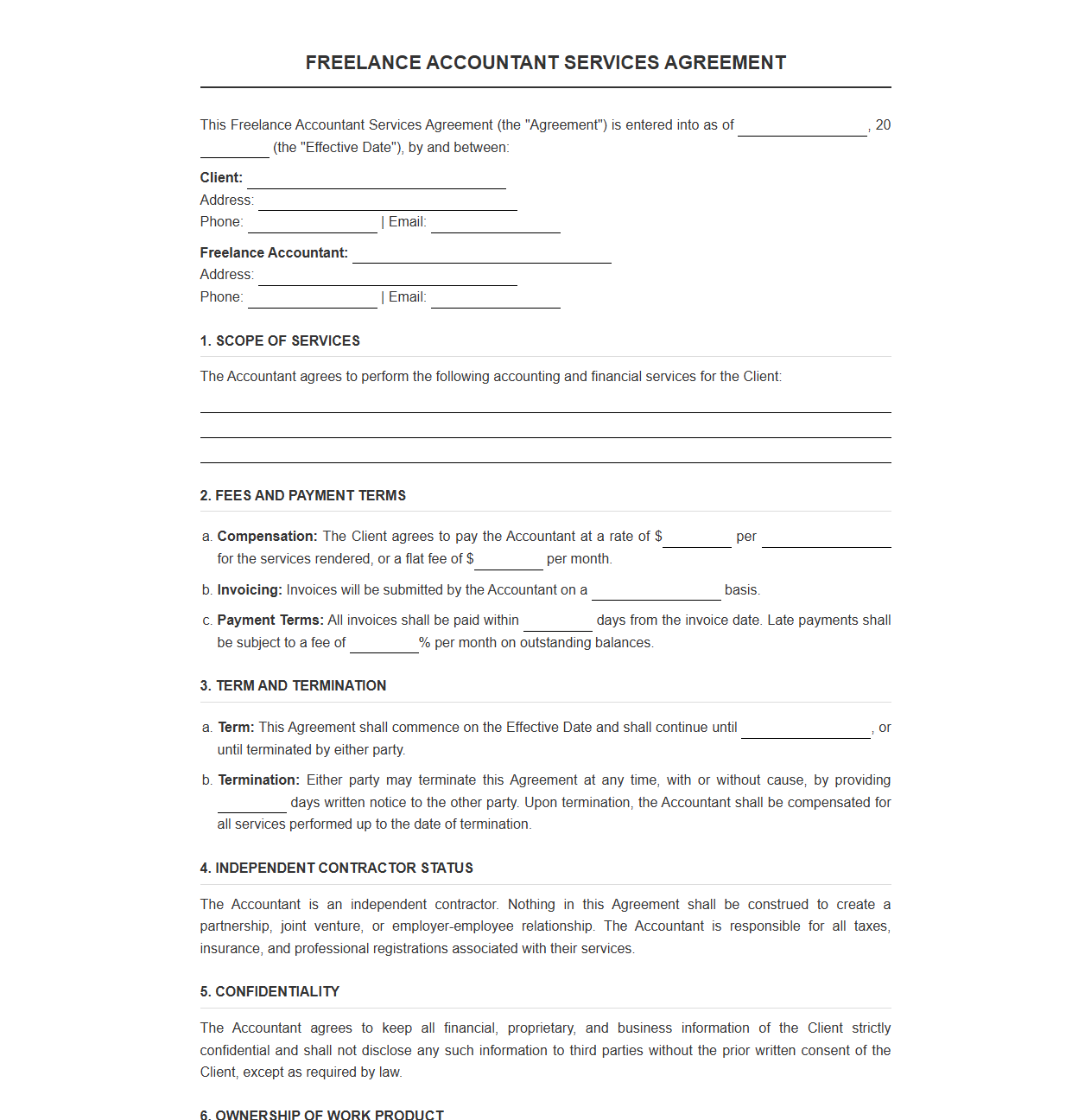 Download: .PDF
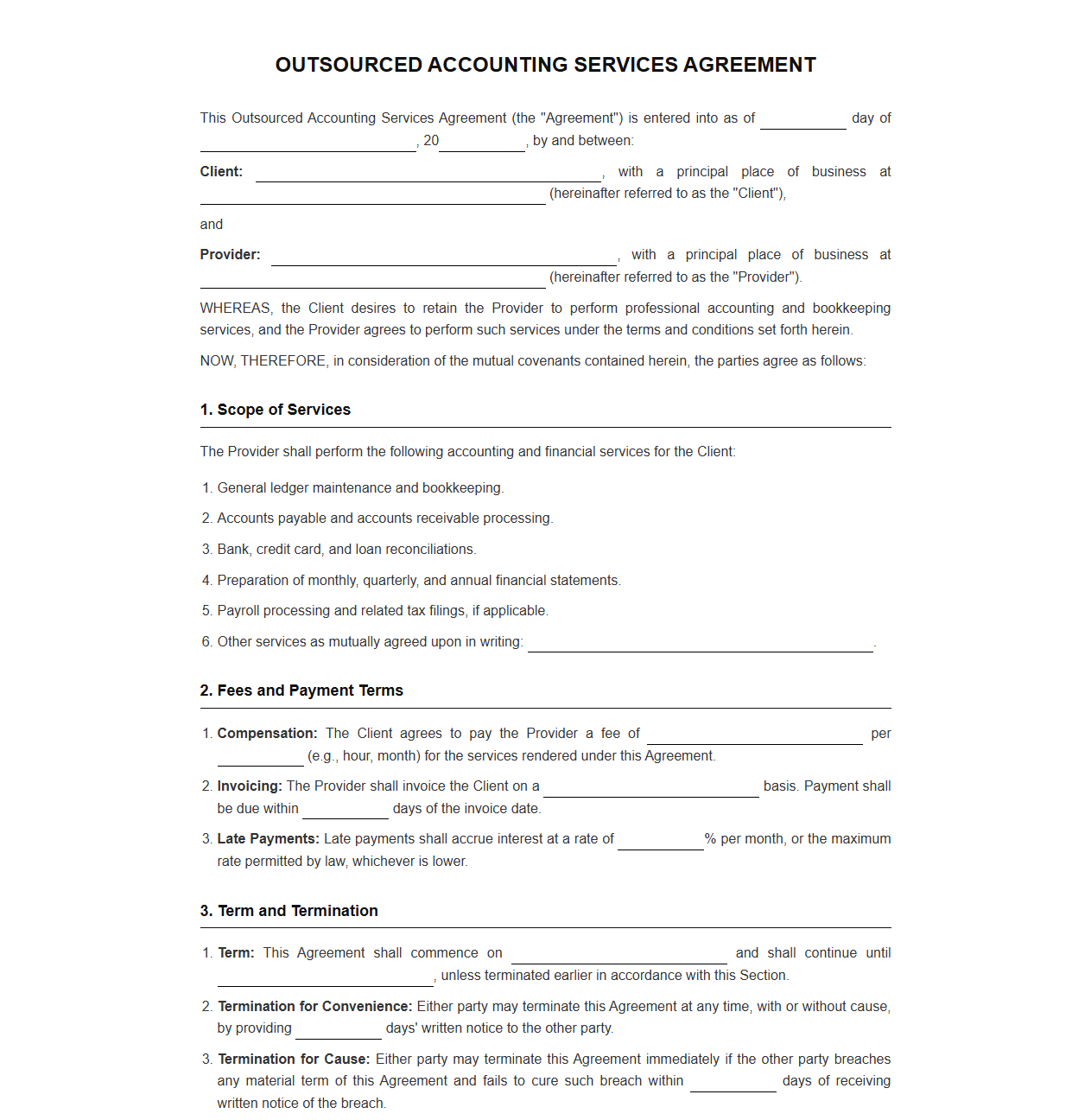
Corporate Outsourced Accounting Services Agreement
 Download: .PDF
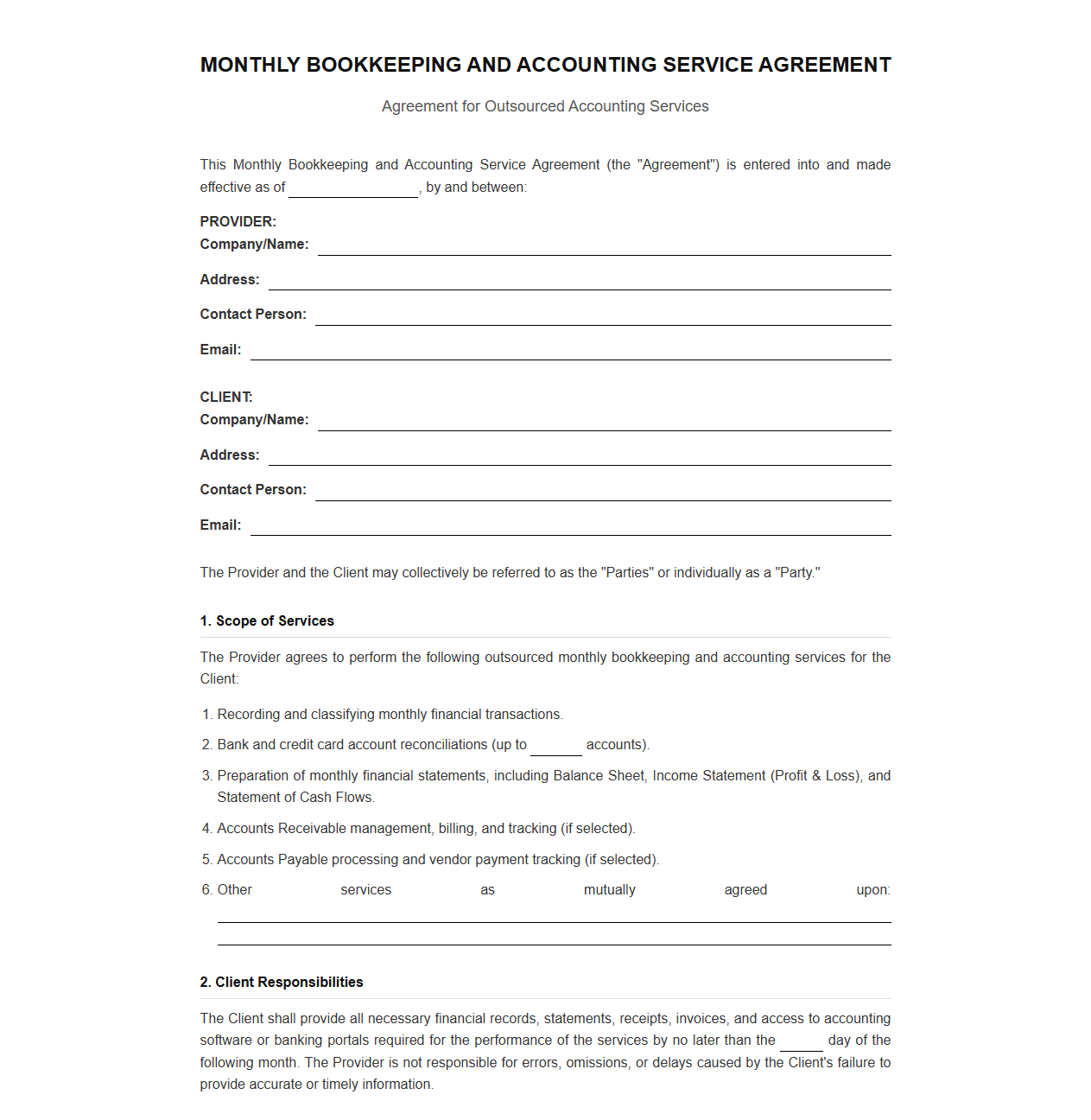
Monthly Bookkeeping and Accounting Service Agreement
 Download: .PDF
Introduction: The Stakes of Outsourced Financial Management
As businesses scale rapidly, the adoption of outsourced accounting services has emerged as a cornerstone of operational efficiency. Managing complex financial portfolios externally offers incredible flexibility, yet it also exposes organizations to heightened operational, financial, and compliance risks. Securing a robust, legally binding service agreement is not merely a formality; it is a critical safeguard that protects your organization's bottom line and establishes clear boundaries of operational accountability.
Defining the Scope: Preventing Scope Creep and Misaligned Expectations
A major friction point in outsourced financial management is the gradual drift of responsibilities beyond the initial agreement, commonly known as scope creep. To prevent billing disputes and operational friction, the contract must explicitly detail every deliverable, frequency of reporting, and boundaries of service. A well-defined scope ensures that both internal teams and external providers align their execution with strategic goals.
- Detailing specific deliverables such as weekly payroll processing, monthly tax preparation, and annual auditing.
- Setting strict reporting timelines and weekly or monthly delivery deadlines.
- Establishing a formal, written change-order procedure for reviewing and pricing out-of-scope service requests.
Safeguarding Sensitive Data: Confidentiality and Cybersecurity Protocols
Entrusting external providers with proprietary financial information demands rigorous data security protocols. Comprehensive confidentiality clauses must be integrated into the contract, establishing strict non-disclosure obligations for all partner employees. Additionally, contracts should mandate compliance with international data protection laws, such as GDPR or CCPA, and outline clear protocols for managing potential security threats. In the event of a security breach, the service provider must be contractually obligated to notify the client within a predetermined timeframe, typically 24 to 72 hours, to enable immediate mitigation efforts.
Allocation of Risk: Limitation of Liability and Indemnification
An essential legal component of any financial partnership is determining who bears the cost of operational errors, omissions, or regulatory penalties. The agreement must establish realistic limits on financial liability while establishing clear mutual indemnification clauses to protect both parties from third-party legal claims.
"Neither party shall be liable to the other for indirect, incidental, or consequential damages, and the provider's total liability for direct damages shall be capped at the total fees paid by the client during the twelve months preceding the claim."
Establishing Performance Standards: Key Metrics and Service Level Agreements
To maintain high standards of quality over the lifecycle of the partnership, the contract should outline clear expectations for day-to-day operations. Implementing formal Service Level Agreements (SLAs) ensures that both parties agree on what constitutes successful performance.
Performance Metrics and Standards
These SLA components translate general expectations into quantifiable metrics, facilitating objective performance reviews:
- Maintaining a minimum of 99.5% accuracy on all ledger entries and transactional processing.
- Resolving reconciliation anomalies or answering standard inquiries within 48 business hours.
- Achieving zero late filings for state, federal, and municipal tax declarations.
The Exit Strategy: Termination Clauses and Data Offboarding
Even the most successful partnerships eventually come to an end, making a structured exit strategy vital. The contract must delineate the exact conditions under which either party can terminate the relationship, differentiating between termination for convenience (requiring a standard notice period) and termination for cause (such as a material breach of contract). To prevent operational disruptions, a seamless offboarding plan is necessary. The agreement must mandate the secure, rapid return of all proprietary financial records, intellectual property, and system credentials, ensuring that business continuity is fully preserved throughout the transition.
Resolving Conflicts: Governing Law and Dispute Resolution Mechanisms
When disagreements arise, having pre-established legal frameworks prevents costly, prolonged court battles. The agreement should clearly designate the governing law and jurisdiction that will interpret the contract. Furthermore, a multi-tiered dispute resolution mechanism should be written into the agreement, requiring the parties to first engage in executive negotiation, proceed to structured mediation if unresolved, and leverage binding arbitration before resorting to public litigation.

Leave a comment