
Managing payroll administrative functions often leaves employers vulnerable to severe regulatory penalties, tax inaccuracies, and costly wage-and-hour disputes. As employment and tax laws grow increasingly complex, relying on informal operational agreements is no longer a viable option for businesses. Standardizing these external and internal relationships with robust legal contracts grants organizations a vital shield against financial liability and operational exposure.
However, a critical stipulation remains: while standardized templates provide an invaluable foundational framework, they must be meticulously tailored to align with jurisdiction-specific statutes to be fully enforceable. Integrating concrete provisions-such as clear indemnification clauses, strict data security protocols, and measurable Service Level Agreements (SLAs)-serves as verifiable proof of risk mitigation.
In this article, we will examine the essential agreement templates required for payroll administration, outlining how to structure them to protect your business, clarify partner responsibilities, and ensure seamless compliance.
Payroll Administration Services Agreement Template
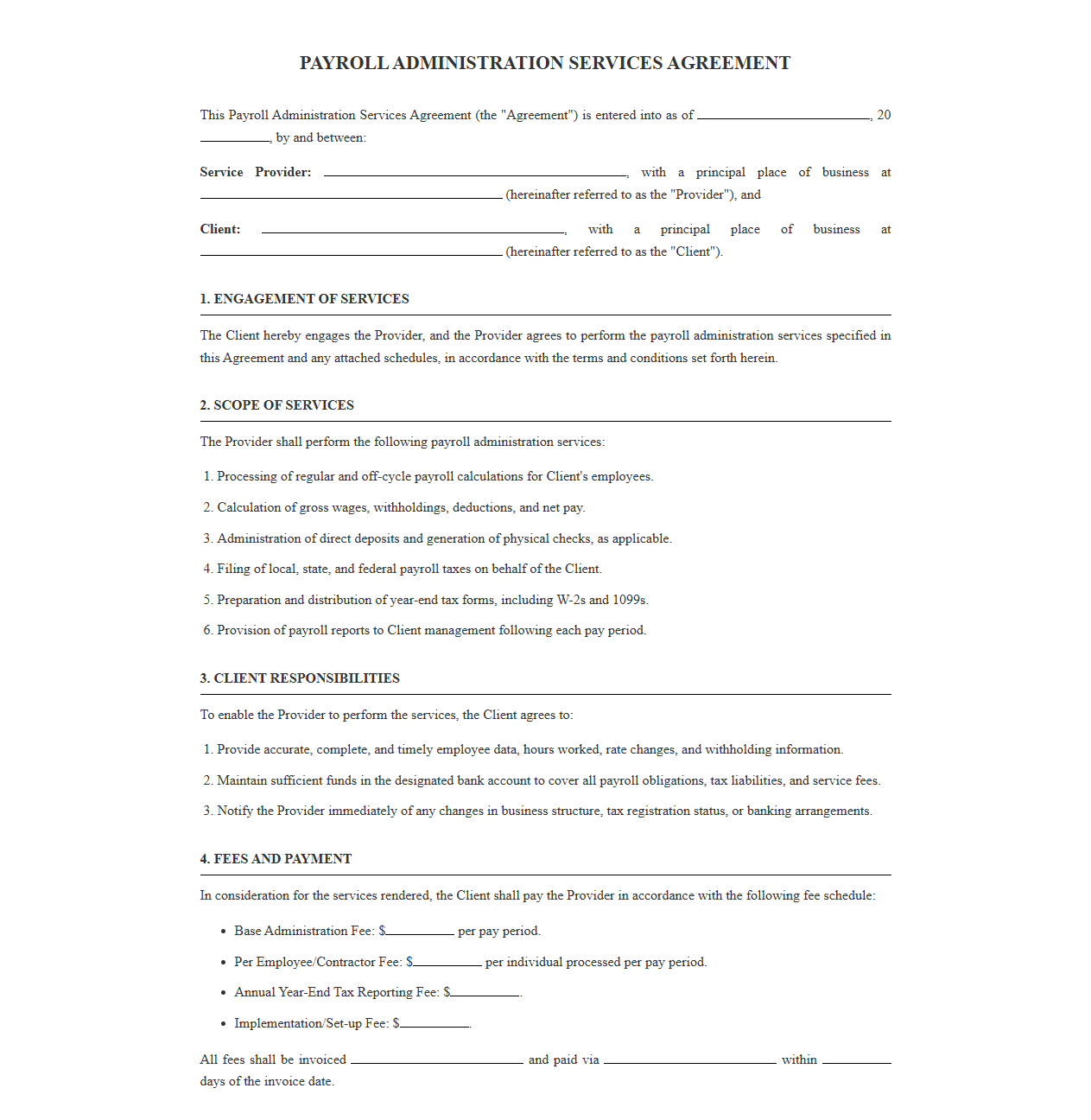 Download: .PDF
Standard Payroll Outsourcing Service Contract Template
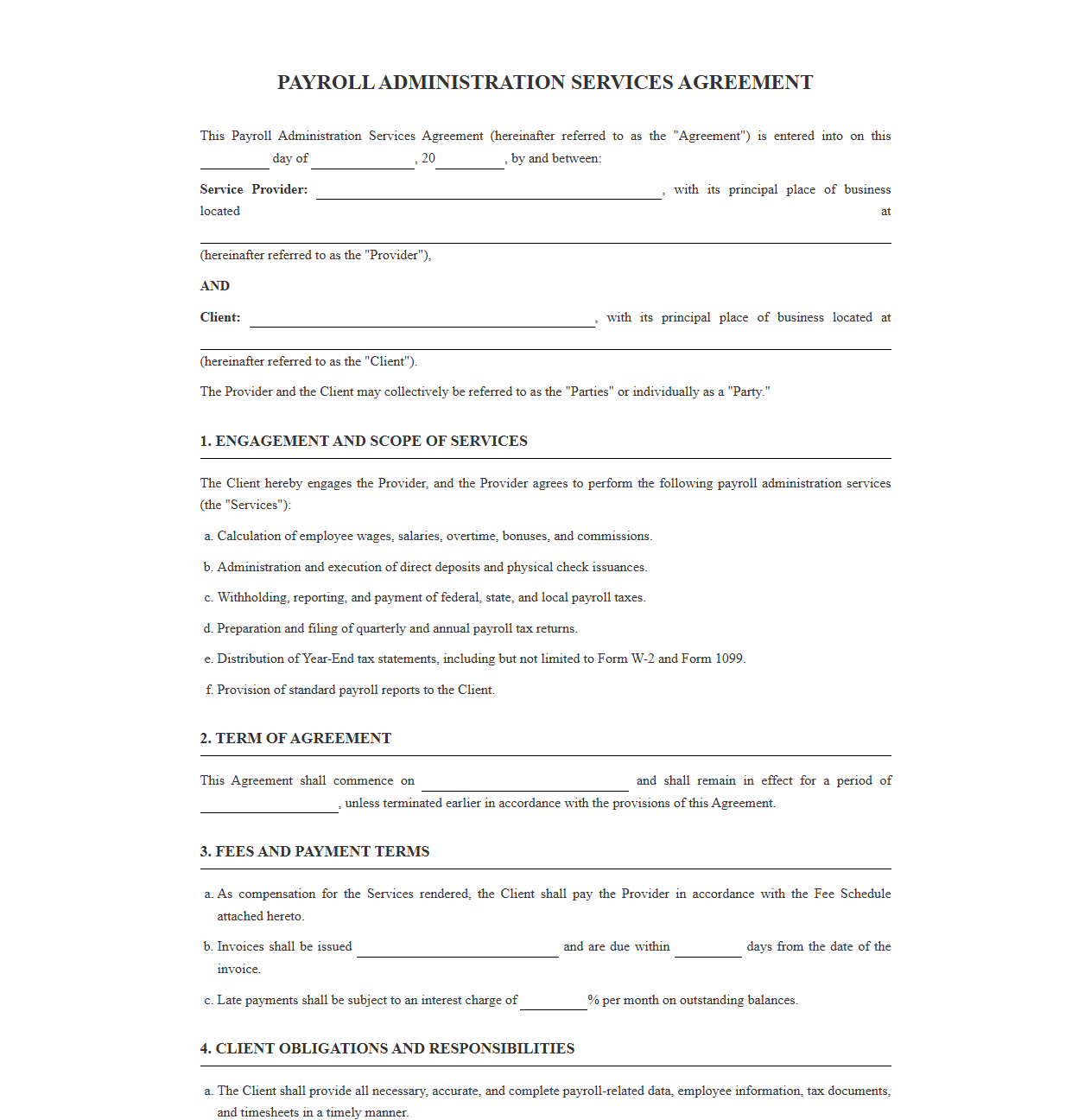 Download: .PDF
Professional Payroll Processing Services Agreement Form
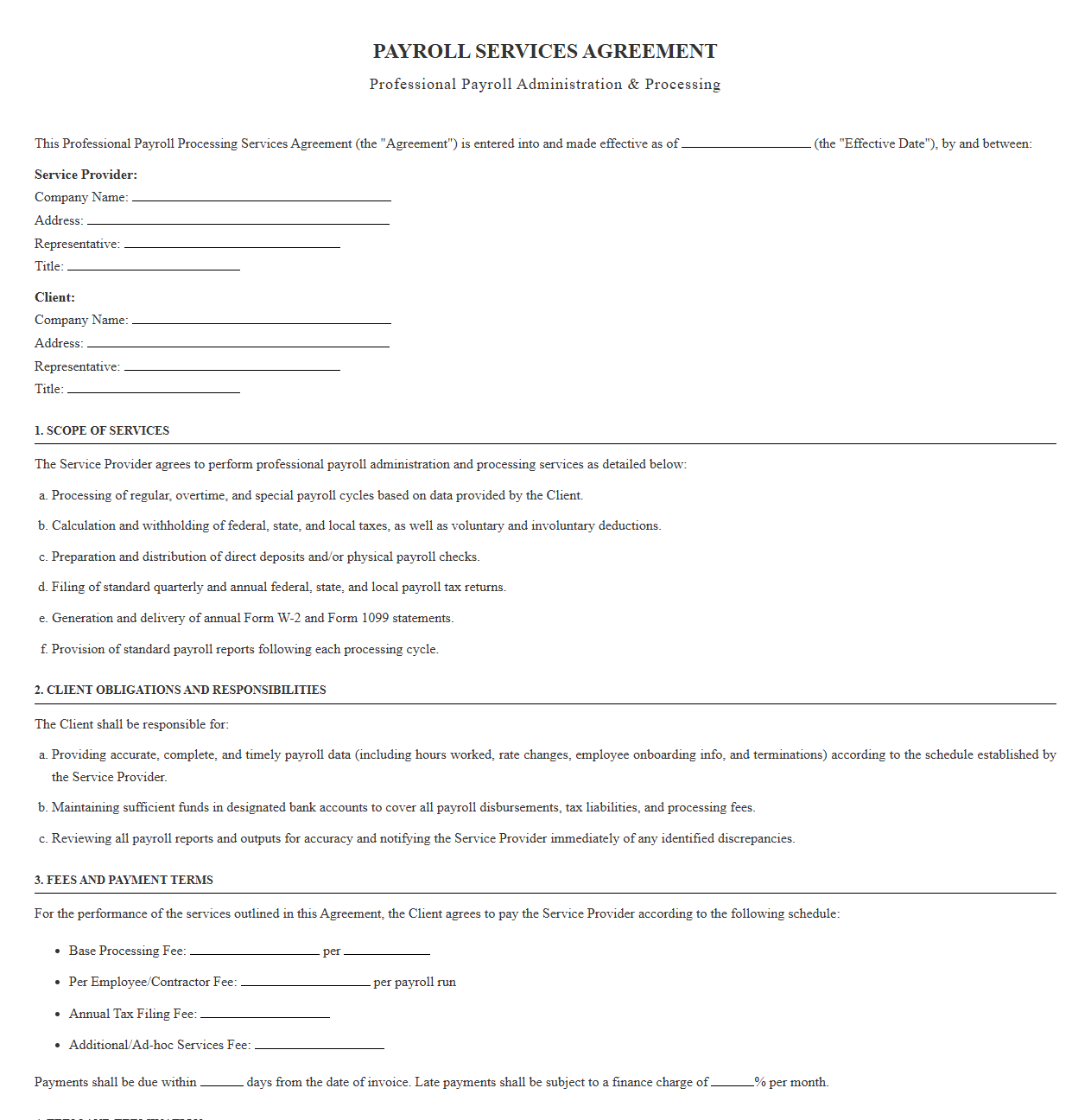 Download: .PDF
Managed Payroll Services Service Level Agreement
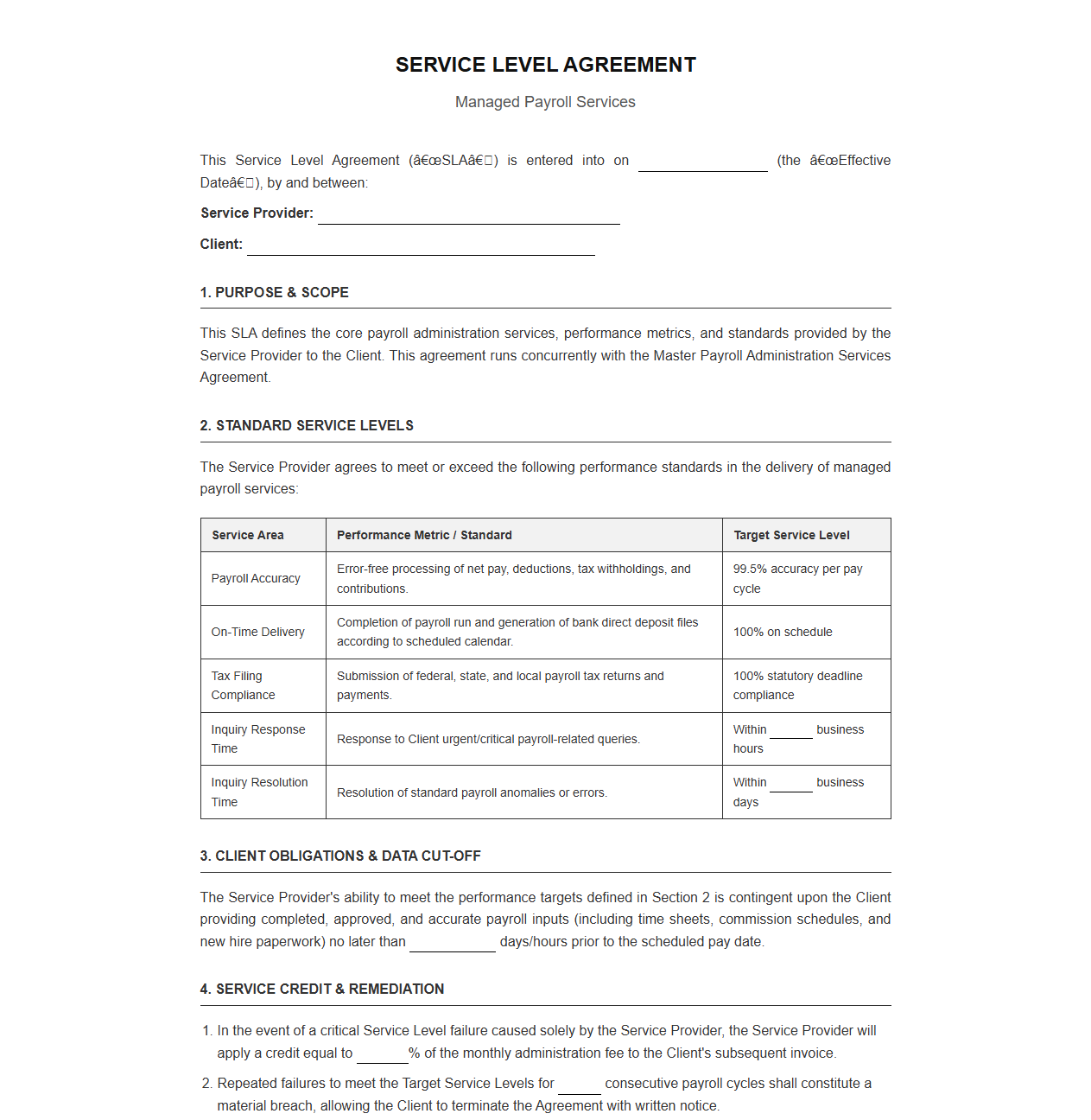 Download: .PDF
Third Party Payroll Administration Contract Template
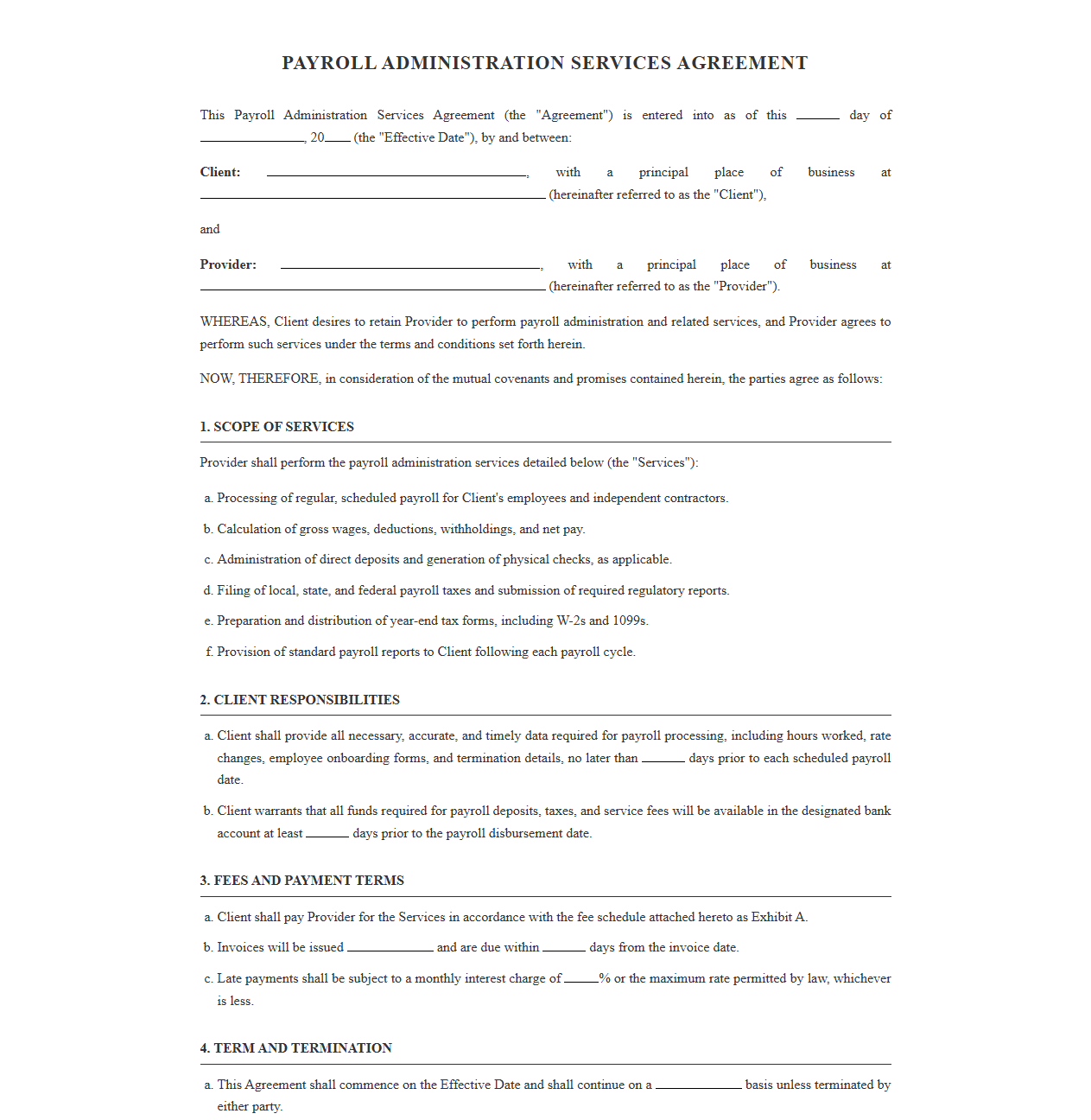 Download: .PDF
Comprehensive Payroll Management Services Agreement
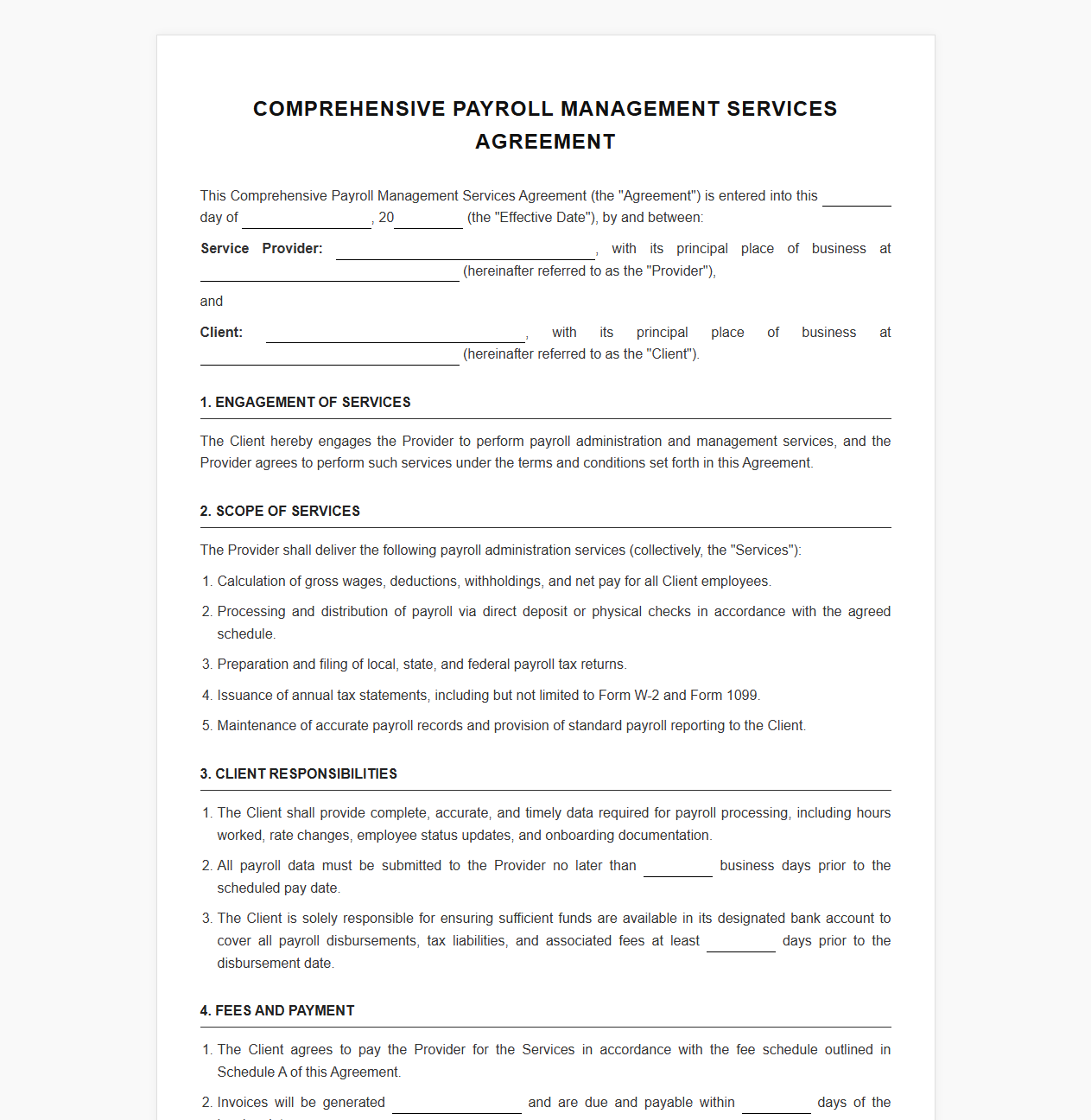 Download: .PDF
Payroll Administration and Tax Filing Agreement
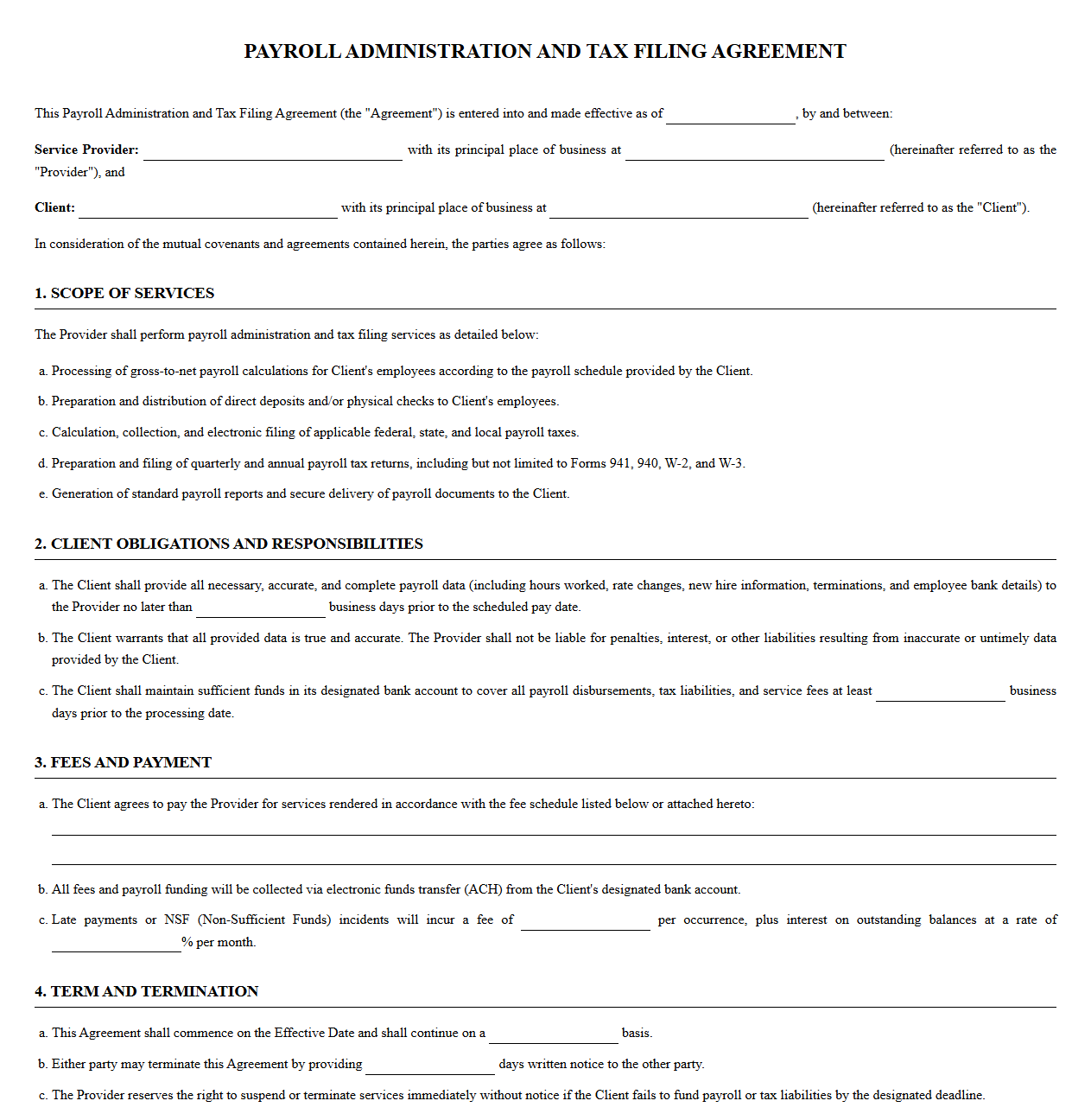 Download: .PDF
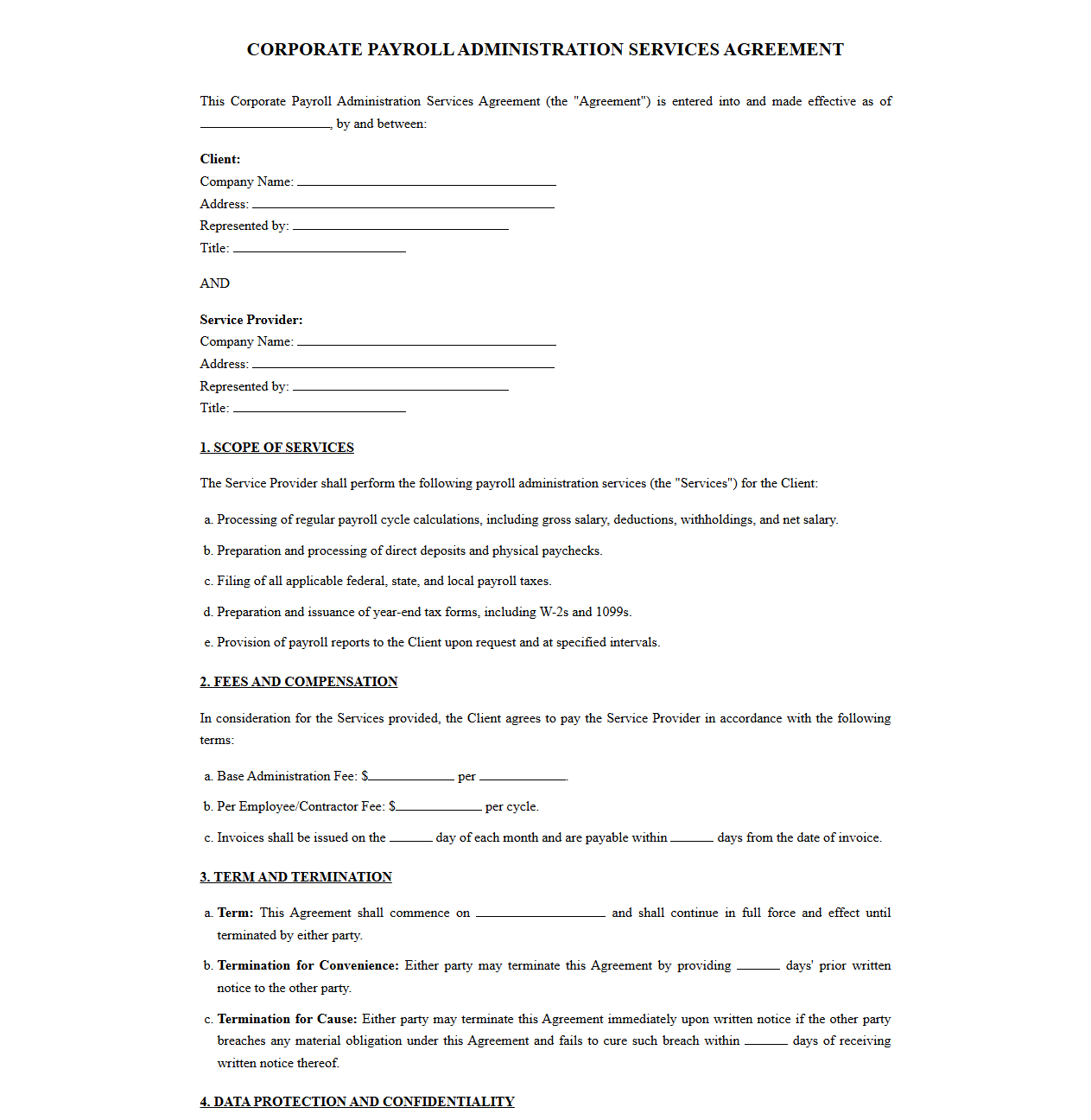
Corporate Payroll Administration Services Contract
 Download: .PDF
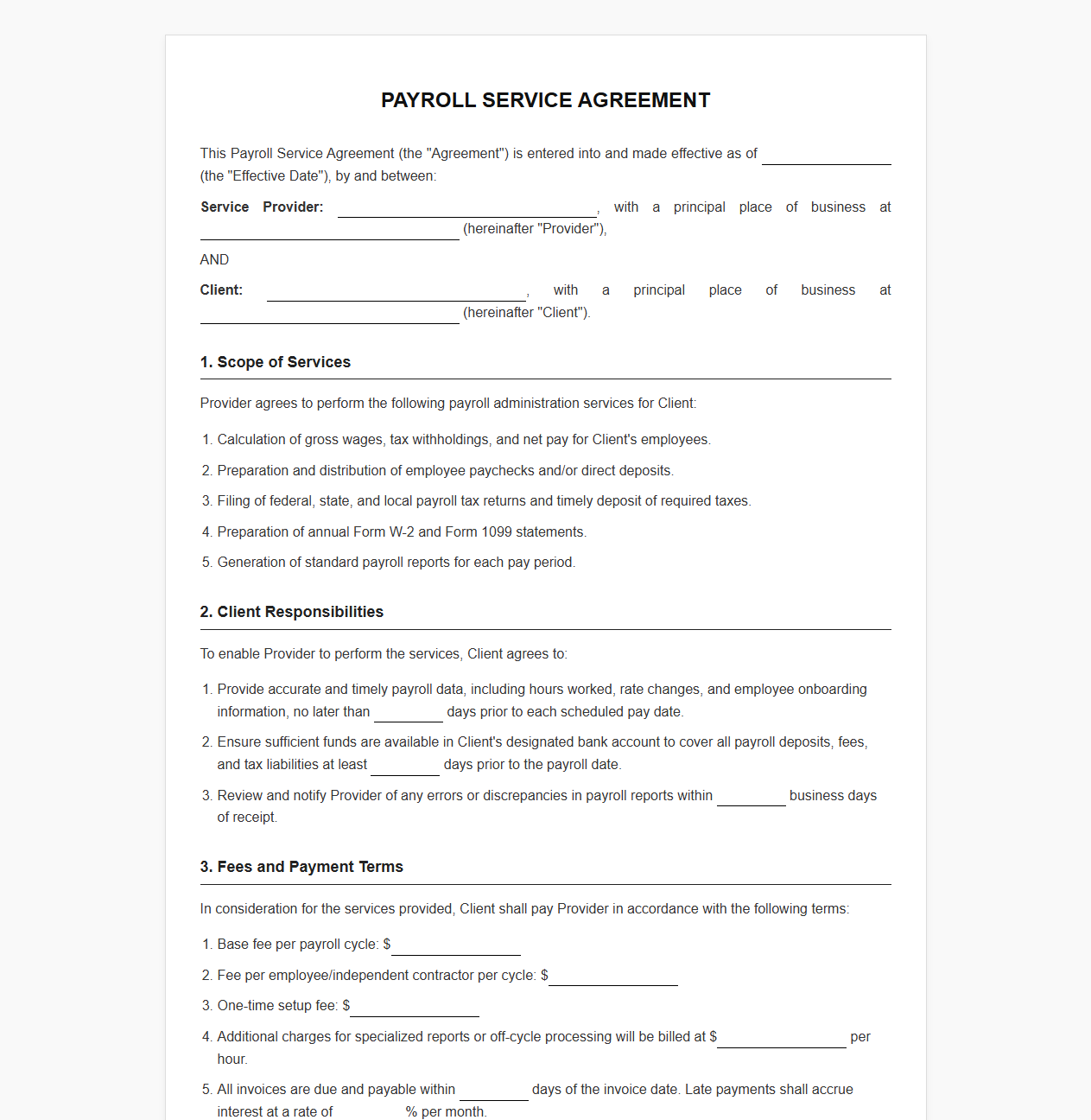
Small Business Payroll Service Agreement Template
 Download: .PDF
Introduction to Payroll Risk Management
Managing payroll is one of the most operationally sensitive tasks an employer undertakes. A single processing oversight can trigger severe regulatory compliance penalties, tax authority audits, and reputational damage. Beyond compliance, payroll administration carries massive financial risks, including cash flow disruptions and disgruntled employees due to delayed or incorrect disbursements.
To mitigate these vulnerabilities, employers must establish robust legal agreements that clearly define responsibilities, liabilities, and expectations with their service providers. Proactive risk management through structured contracts ensures that financial liabilities are controlled and regulatory mandates are met consistently.
The Master Services Agreement (MSA) Foundation
The Master Services Agreement (MSA) serves as the bedrock of the entire payroll outsourcing relationship. It establishes the overarching legal framework, defining how the two entities will interact, negotiate disputes, and maintain operational compliance over time. A well-drafted MSA ensures both parties are aligned on expectations and prevents costly scope creep.
A comprehensive MSA must include several core clauses to govern the partnership effectively:
- Scope of Services: Explicitly detailing specific payroll tasks, tax filings, and reporting duties.
- Payment Terms: Outlining service fees, invoicing schedules, and penalties for late payments.
- Relationship Governance: Defining communication protocols, amendment processes, and contract renewal terms.
Establishing Performance Standards via Service Level Agreements (SLAs)
Service Level Agreements (SLAs) translate the high-level promises of an MSA into concrete, measurable metrics. They guarantee that the payroll provider delivers accurate calculations and timely disbursements, providing clear remedies when performance drops below agreed standards.
By establishing precise benchmarks, employers can hold vendors accountable for operational errors and processing delays. Below is an example of standard metrics utilized in payroll SLAs:
| Performance Metric | Target Standard | Measurement Period | Remedy for Failure |
|---|---|---|---|
| Payroll Calculation Accuracy | 99.9% accuracy rate | Monthly payroll run | Fee credit applied to next invoice |
| Tax Filing Timeliness | 100% on-time submission | Quarterly / Annually | Provider covers any late filing penalties |
| Error Rectification Window | Resolved within 24 hours | Per occurrence | Expedited processing at no extra cost |
Safeguarding Sensitive Information with Data Protection Addendums (DPA)
Payroll databases store incredibly sensitive personal and financial data, making them prime targets for cybercriminals. A Data Protection Addendum (DPA) is an indispensable legal shield that ensures compliance with global privacy regulations, such as GDPR and CCPA, while binding the provider to strict security standards.
Without a rigorous DPA, employers remain directly liable for data breaches occurring on the vendor's side. Legal agreements must include explicit confidentiality commitments to safeguard employee trust:
"The service provider shall implement appropriate technical and organizational measures to protect personal employee data against unauthorized access, accidental loss, or destruction, maintaining absolute confidentiality of all financial and identity records at all times."
Allocating Liability and Indemnification
When payroll errors occur-such as missed tax payments or incorrect withholdings-the financial fallout can be severe. Clear contractual terms must determine who bears the financial burden of these mistakes.
Understanding Indemnification Clauses
Indemnification clauses require the service provider to compensate the employer for losses resulting from the provider's negligence or failure to perform contracted duties. This is particularly vital for tax filing omissions, where tax authorities hold the employer legally responsible, but the provider must ultimately reimburse those costs.
Establishing Reasonable Liability Caps
While providers often try to limit their liability to a multiple of monthly fees, employers must negotiate caps that reflect the actual risk. A balanced liability clause ensures that carve-outs exist for gross negligence and data security breaches, protecting the employer from catastrophic financial exposure.
Implementing Dispute Resolution and Termination Clauses
When relationships break down or operational standards fail, a structured exit strategy prevents chaos. Dispute resolution clauses outline how to resolve disagreements, while termination guidelines ensure the safe, uninterrupted transition of historical payroll data.
To prevent immediate litigation, contracts should mandate a sequential dispute resolution process:
- Formal Notification: The aggrieved party submits a written description of the service failure.
- Executive Mediation: Senior leadership from both organizations meet to negotiate an amicable solution.
- Binding Arbitration: If mediation fails, the dispute is referred to an independent arbitrator for a final, legal resolution.
Conclusion and Actionable Next Steps
Securing your payroll operations through comprehensive MSAs, SLAs, and DPAs is not just a legal formality-it is a strategic necessity. By establishing clear guardrails around performance, liability, and data security, employers can confidently outsource their payroll while insulating their organizations from regulatory and financial harm. Employers should immediately audit their current vendor agreements to identify gaps in protection and update their legal frameworks.
Failing to secure your payroll agreements today can lead to devastating regulatory penalties and financial consequences tomorrow.

Leave a comment