

Navigating the final phases of a corporate acquisition is often overshadowed by the looming dread of inherited financial exposure. Corporate buyers and legal teams frequently struggle to isolate and secure themselves against a seller's undisclosed, pre-transaction tax liabilities.
Before drafting protective clauses, dealmakers must first contextualize the historical audit risks inherent to corporate tax allocations. Utilizing a structured Pre-Closing Tax Liability Indemnity Agreement grants the acquisition team vital financial recourse, effectively ring-fencing the buyer from retroactive assessments.
However, as a crucial stipulation, templates should be treated as foundational frameworks rather than plug-and-play solutions; they require meticulous tailoring. For instance, addressing concrete exposures like unpaid state franchise taxes or pending federal transfer pricing audits demands highly specific carve-outs.
This article will dissect the essential clauses of these indemnity templates, outline key negotiation strategies, and demonstrate how to customize them to safeguard your transaction's value.
Pre-Closing Tax Indemnity Agreement Template
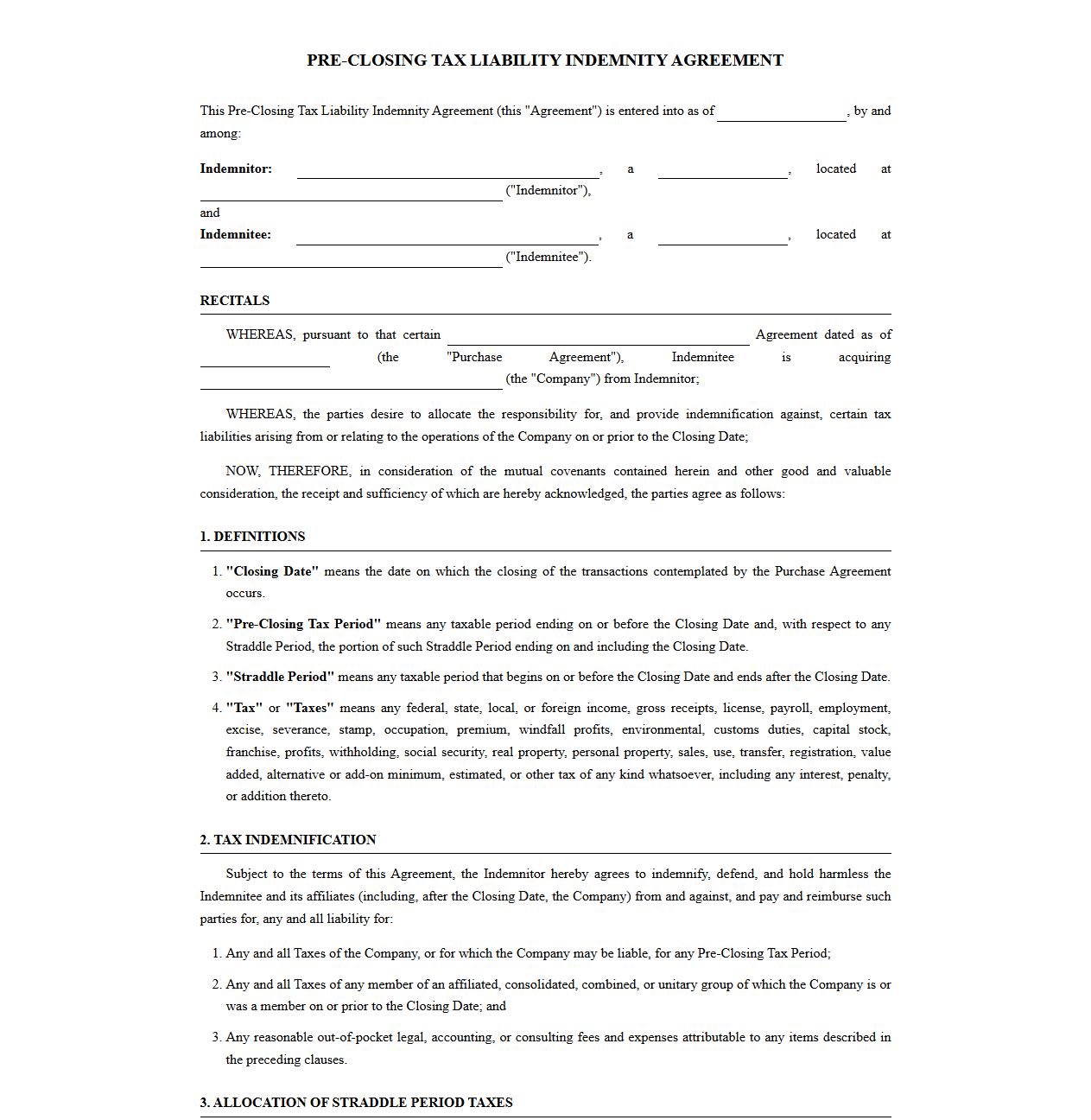 Download: .PDF
Tax Indemnity Agreement for Pre-Closing Liabilities
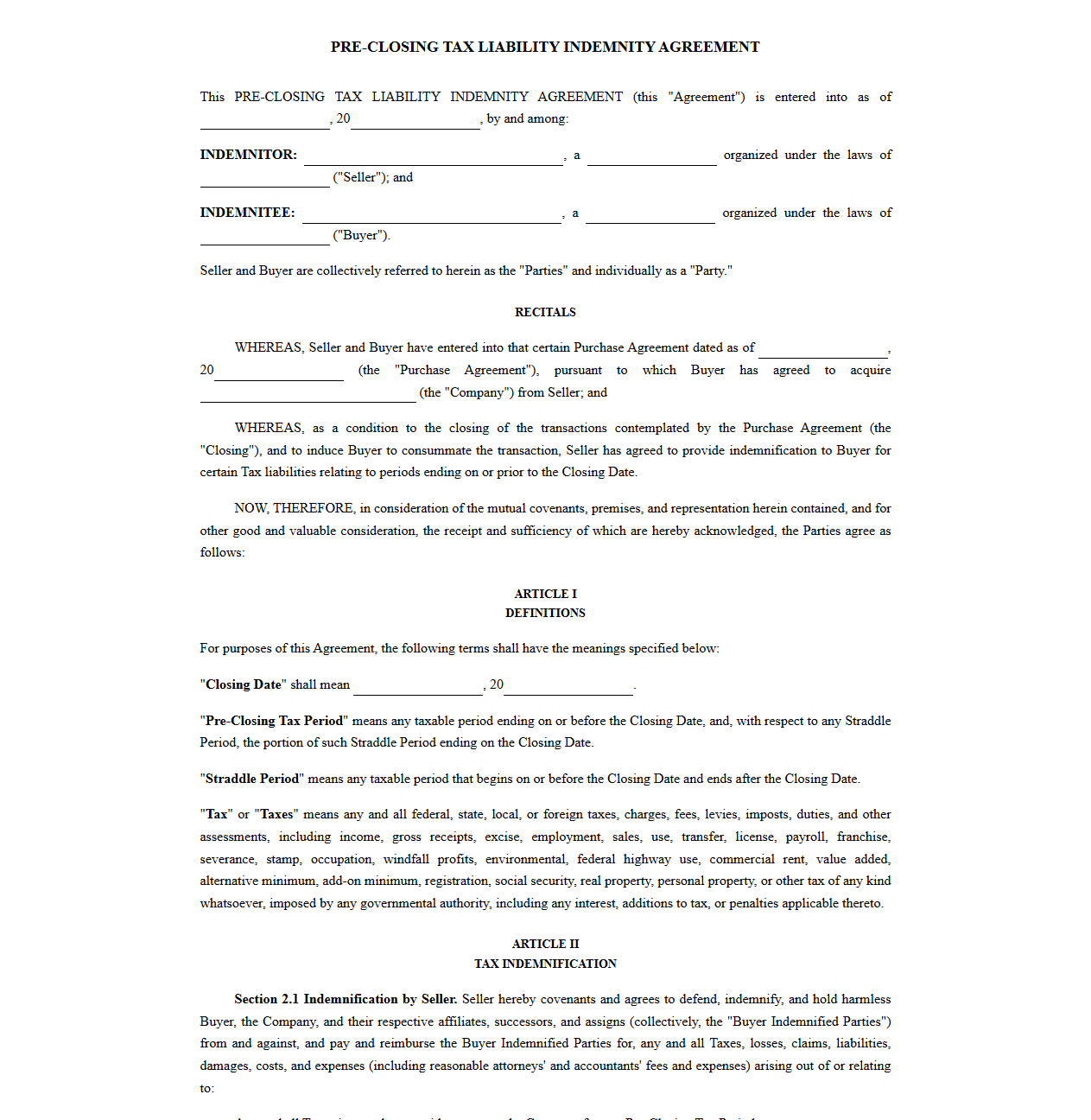 Download: .PDF
Pre-Closing Tax Liability Indemnification Contract
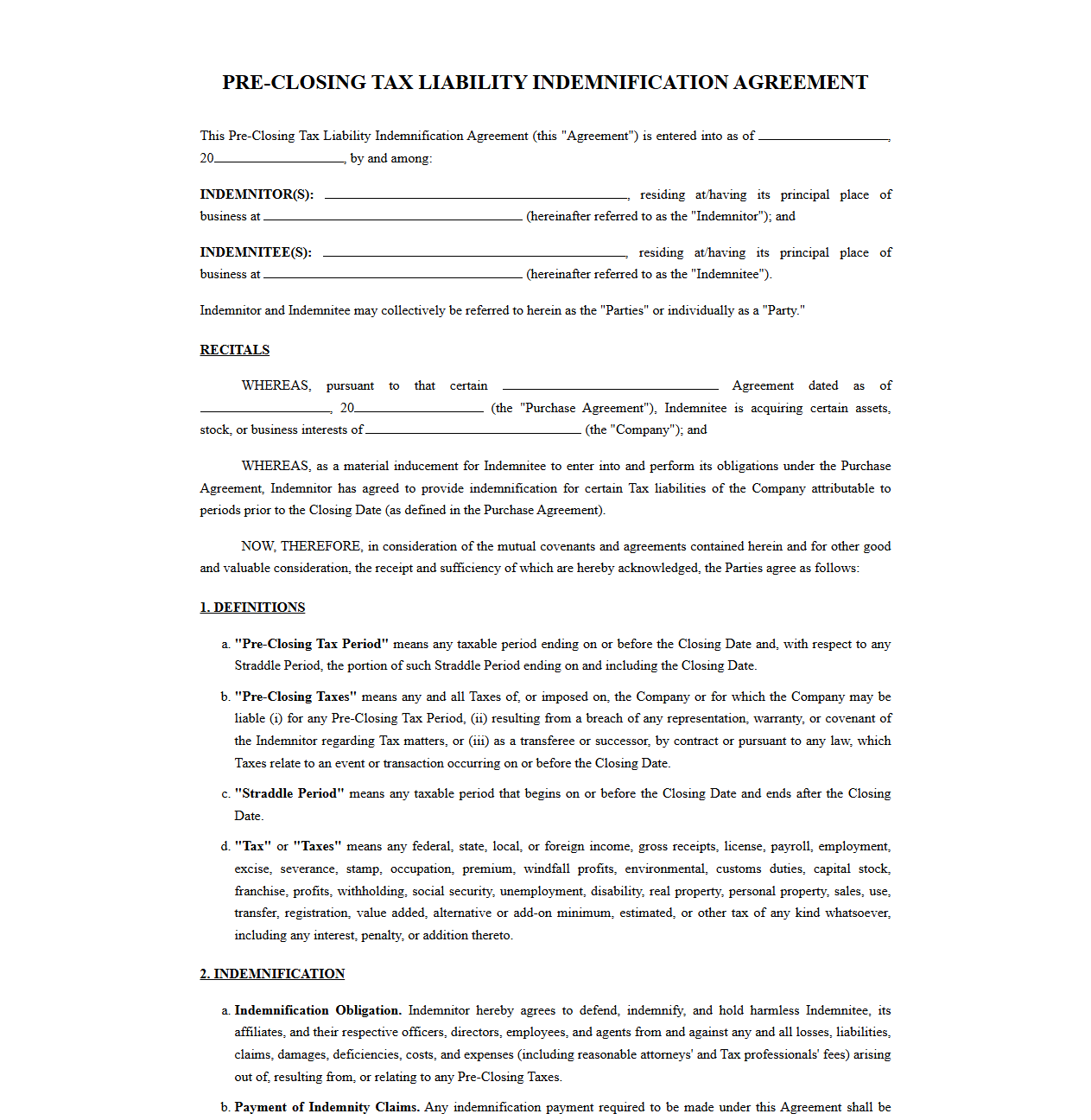 Download: .PDF
Share Purchase Agreement Tax Indemnity Covenant
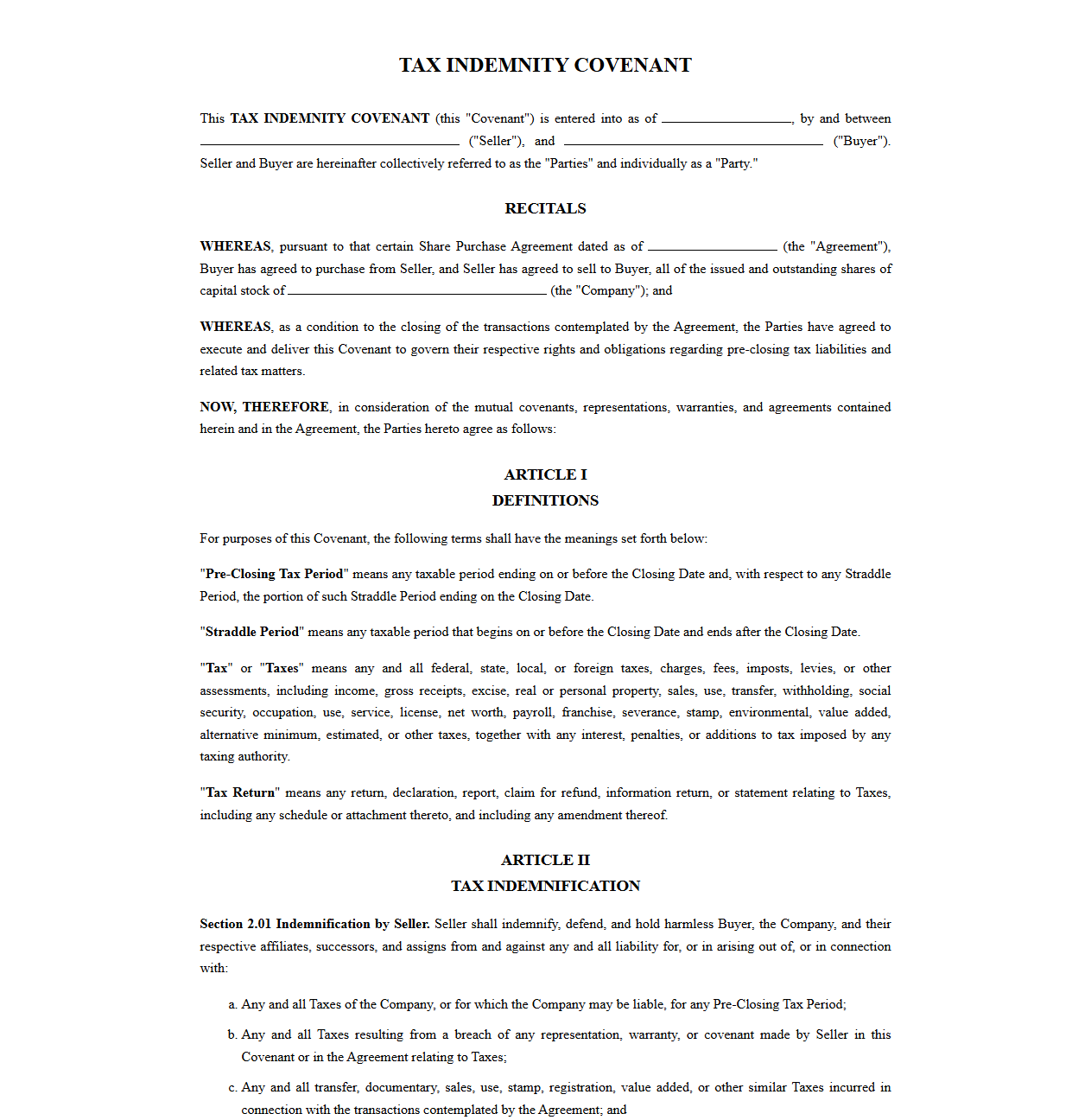 Download: .PDF
Pre-Closing Tax Matters Indemnity Agreement
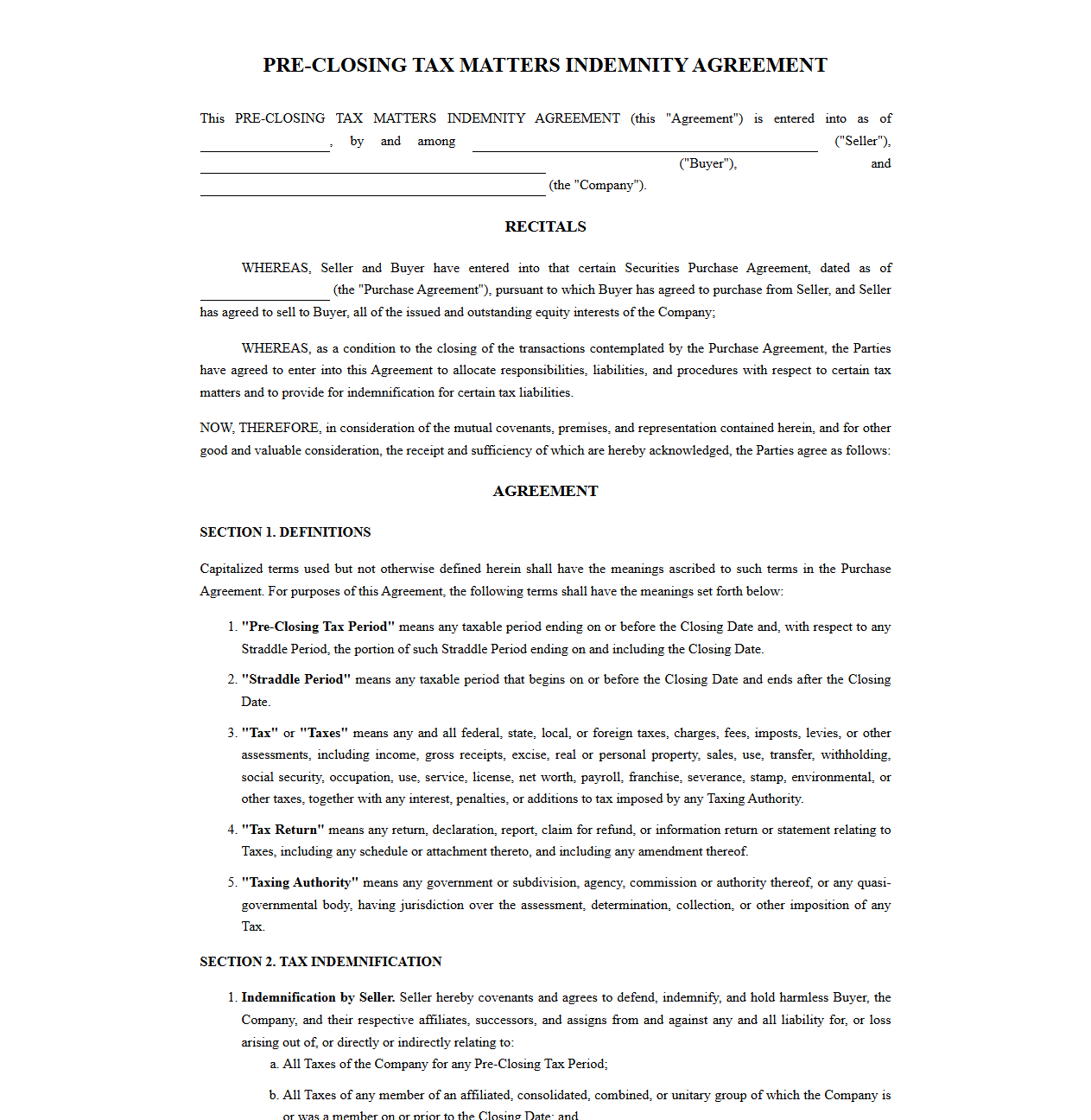 Download: .PDF
M&A Pre-Closing Tax Liability Indemnity Deed
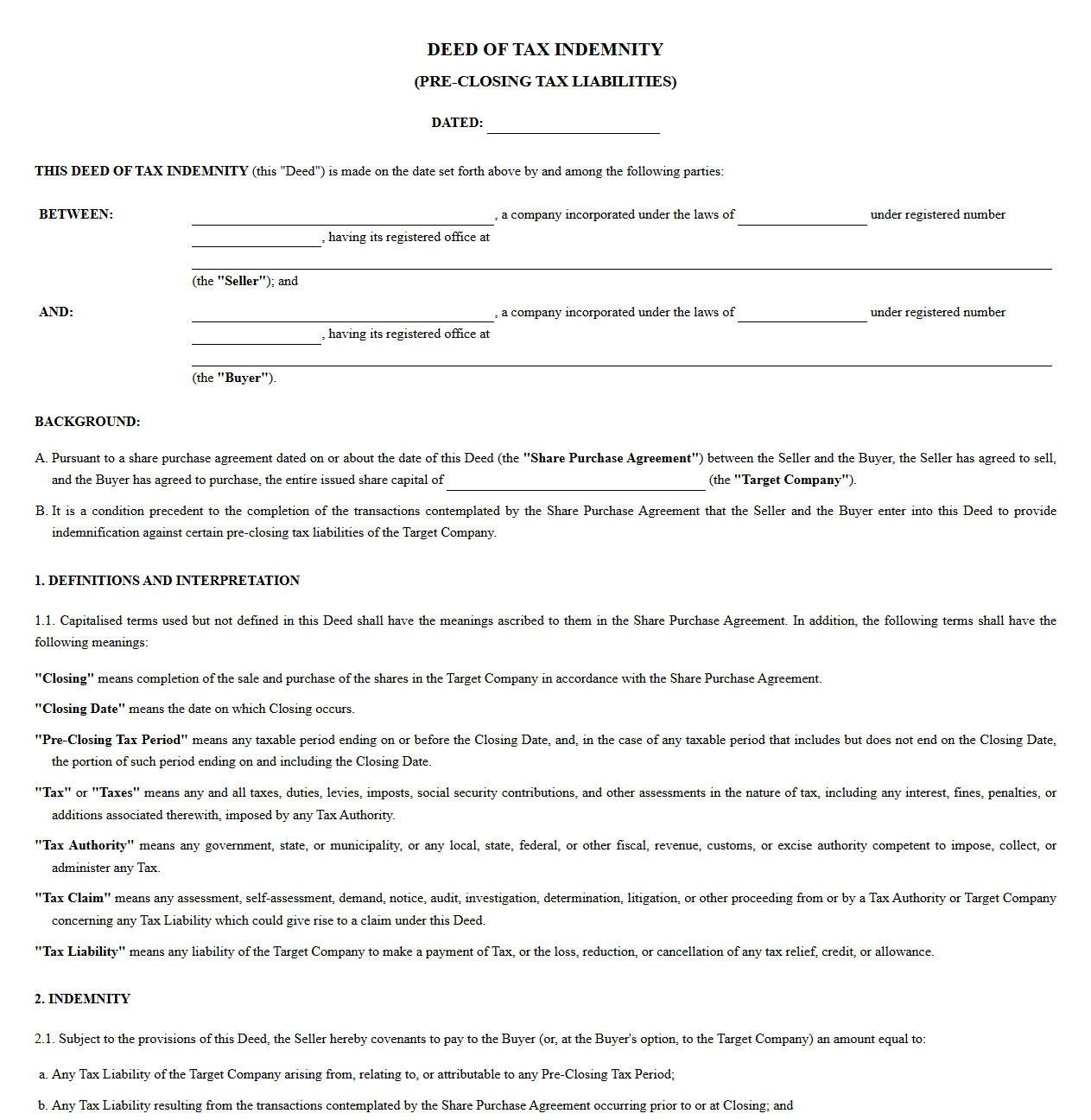 Download: .PDF
Standalone Pre-Closing Tax Indemnity Agreement
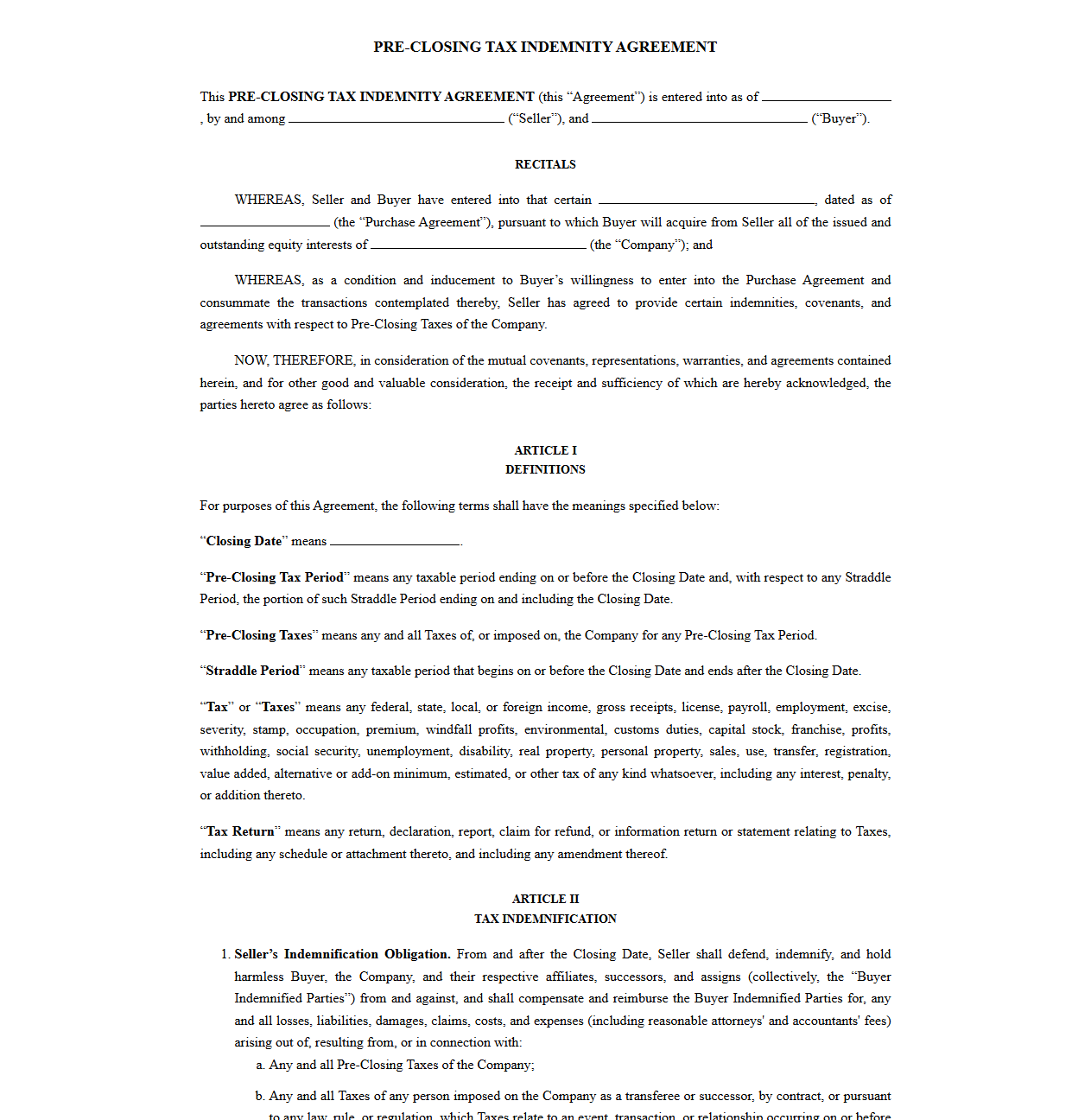 Download: .PDF
Pre-Closing Tax Liability Indemnity Side Letter
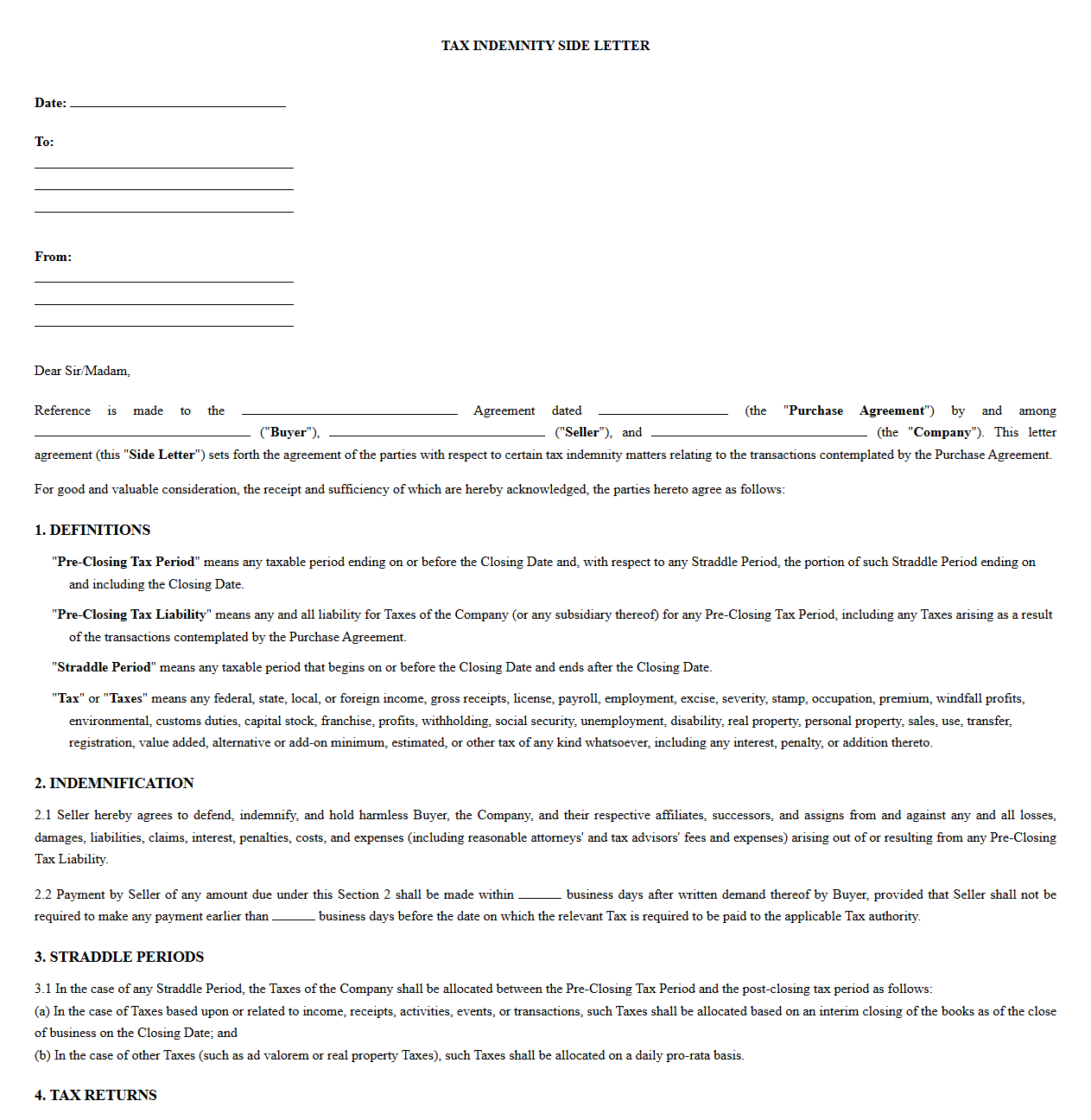 Download: .PDF
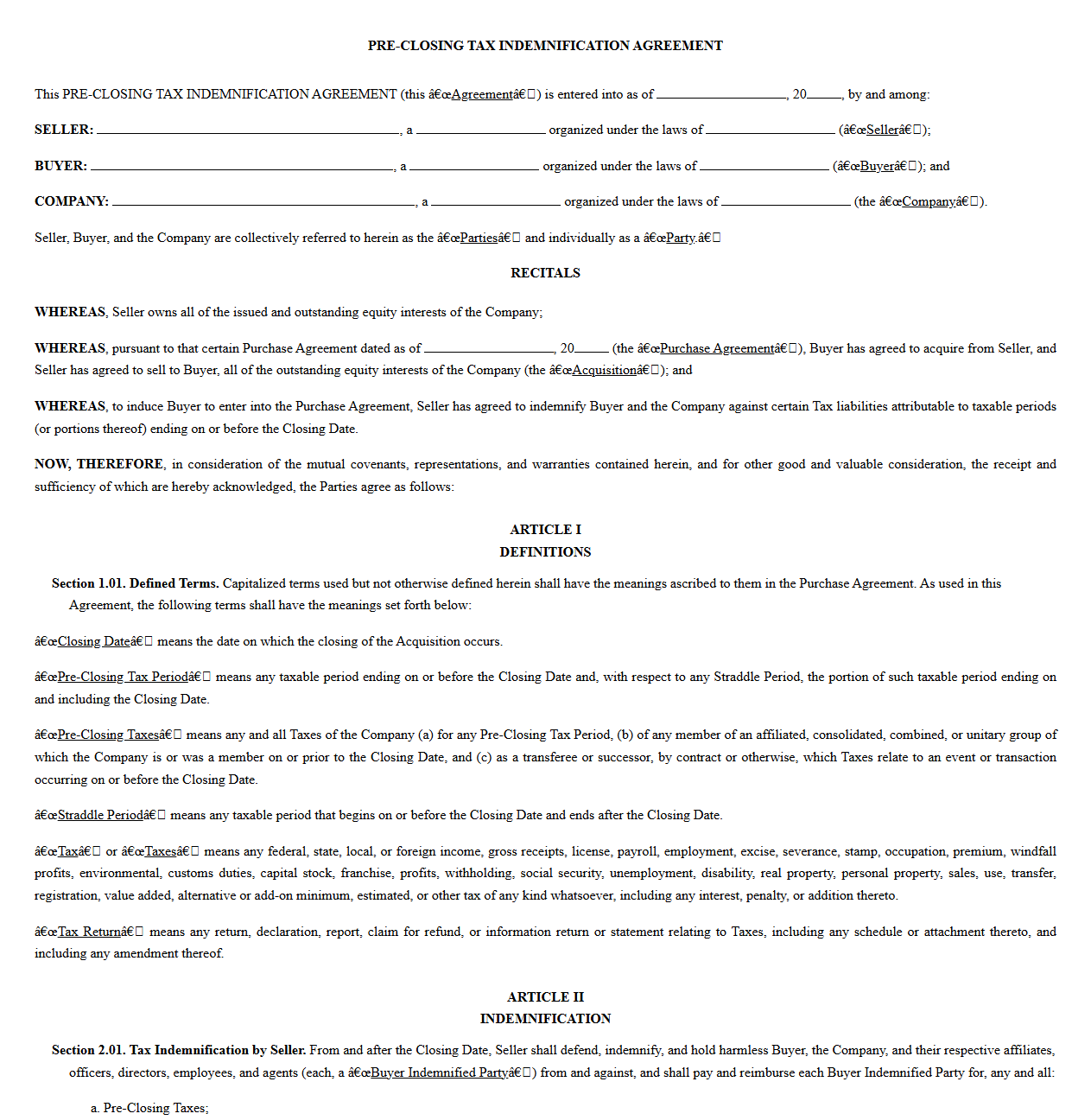
Corporate Acquisition Pre-Closing Tax Indemnification Agreement
 Download: .PDF
Understanding Pre-Closing Tax Liabilities in M&A Transactions
In the high-stakes arena of mergers and acquisitions (M&A), buying a company means acquiring not just its assets and market share, but also its historical financial baggage. Among the most volatile of these legacy risks are pre-closing tax liabilities-unpaid, underreported, or disputed taxes incurred by the target company before the transaction officially closes. Because tax authorities can audit corporate filings years after a deal is finalized, these latent liabilities represent a significant transaction risk that can quietly erode the value of an acquisition long after the ink has dried.
To navigate this minefield, dealmakers rely on a pre-closing tax indemnity agreement. This critical risk-mitigation tool acts as a legal shield, establishing a clear contractual mechanism to dictate who pays for past tax errors. By formalizing these obligations prior to closing, both parties can proceed with the transaction, confident that historical tax exposures have been identified, quantified, and allocated appropriately.
The Strategic Role of a Pre-Closing Tax Indemnity Agreement
The primary purpose of a Pre-Closing Tax Liability Indemnity Agreement is to establish a clean break between the historical ownership of the seller and the future stewardship of the buyer. Without this agreement, a buyer could inherit massive bills for state, federal, or international taxes that accrued under the seller's watch. The indemnity agreement ensures that the party who operated the business when the taxable income was generated remains financially responsible for those obligations.
"The fundamental principle of transactional tax indemnity is simple: the seller bears the financial burden of all taxes attributable to the pre-closing period, while the buyer assumes responsibility for all taxes arising in the post-closing period."
By drawing a sharp line at the closing date, the agreement provides crucial post-transaction stability. It prevents costly post-deal litigation by providing a pre-negotiated roadmap for resolving tax claims, ensuring that both the buyer's investment thesis and the seller's net proceeds remain secure.
Key Clauses and Essential Components of the Template
A comprehensive pre-closing tax indemnity template must contain precise legal mechanics to function effectively under regulatory scrutiny. Dealmakers should ensure that several foundational clauses are meticulously drafted to prevent future disputes.
The following clauses form the backbone of a standard tax indemnity framework:
Pre-Closing Tax Definition: Explicitly defines what constitutes a pre-closing tax, including income, sales, employment, and franchise taxes accrued up to the closing date.Survival Period: Specifies how long the tax representations will remain actionable, typically aligned with the applicablestatute of limitationsplus an additional period (often 30 to 60 days) to allow for processing.Indemnification Caps and Baskets: Sets the financial limits on liability, defining whether tax claims are subject to a minimum threshold (basket) or a maximum recovery limit (cap).Control of Tax Audits: Outlines which party has the right to defend, settle, or contest a post-closing audit initiated by tax authorities that relates to a pre-closing period.Straddle Period Allocation: Defines the methodology for splitting tax liabilities for tax years that begin before the closing date and end after it.
Balancing Buyer Protection and Seller Exposure
Negotiating a pre-closing tax indemnity is a delicate balancing act. Buyers naturally seek expansive, uncapped protection to insulate themselves from historical risks, while sellers strive to limit their ongoing exposure and achieve clean, liquid exit proceeds. This tension often centers on a few highly contested friction points.
The Buyer's Perspective
Buyers generally push for survival periods that extend fully to the statutory limitation periods, demanding that tax indemnities be excluded from standard liability caps. Since tax audits can occur years down the road, buyers argue that any pre-closing tax issue is a direct breach of ownership integrity and should be indemnified in full, backed by a robust escrow holdback to secure payment.
The Seller's Perspective
Sellers, conversely, aim to minimize post-closing contingencies. They advocate for tight survival limits, low liability caps, and sole control over any audits concerning pre-closing periods. Sellers want to prevent buyers from settling tax disputes too quickly with authorities when the seller is the one ultimately footing the bill.
Customizing the Template for Your Specific Transaction
A generic template is merely a starting point. Every corporate transaction features unique variables-such as geographic footprint, industry regulations, and deal structure-that require tailored legal language.
To customize your pre-closing tax indemnity template effectively, follow these sequential steps:
- Analyze the Tax Due Diligence Findings: Identify specific high-risk areas discovered during diligence, such as unresolved state nexus issues or pending audits, and draft targeted indemnities for those known exposures.
- Align with the Deal Structure: Adjust the indemnity provisions depending on whether the transaction is structured as an asset purchase, a stock purchase, or a merger, as tax flow-through rules differ significantly across these formats.
- Incorporate Jurisdictional Nuances: Ensure the definitions of "Taxes" and "Taxing Authorities" cover all relevant local, state, national, and international jurisdictions where the target operates.
- Coordinate with the Escrow Agreement: Tie the indemnity claims process directly to the transaction's escrow mechanics, defining how and when funds can be released to cover valid tax claims.
Best Practices for Drafting and Integrating Tax Indemnities
Drafting a legally resilient indemnity agreement requires close coordination between corporate attorneys, tax accountants, and M&A advisors. Professional diligence during the drafting phase prevents costly misinterpretations when an audit eventually occurs.
When finalizing your transaction documents, keep the following best practices in mind:
- Coordinate with Representation and Warranty Insurance (RWI): Ensure the indemnity agreement clearly defines how claims interact with RWI policies, specifying whether the buyer must exhaust insurance coverage before seeking direct indemnification from the seller.
- Establish Clear Straddle-Period Rules: Use precise formulas (such as the interim closing-of-the-books method) to allocate property taxes, payroll taxes, and income taxes for tax periods spanning the closing date.
- Address Transfer Taxes Explicitly: Do not leave transaction-related taxes to chance; define exactly which party pays for sales, transfer, use, or stamp taxes generated by the transaction itself.
Compliance Warning: Failing to explicitly state whether the indemnity covers interest, penalties, and professional defense fees can leave the buyer exposed to significant out-of-pocket costs during a protracted audit.
Securing Transaction Value through Robust Indemnity Frameworks
A well-structured pre-closing tax liability indemnity agreement is more than just standard legal boilerplate; it is a fundamental pillar of transactional security. By clearly delineating financial responsibilities and establishing predictable mechanisms for dispute resolution, this agreement protects the underlying economics of the deal. In doing so, it provides both buyers and sellers with the structural certainty required to close transactions with confidence.
To ensure your next transaction is fully protected against hidden tax exposures, download our professional legal templates to start building your customized agreement. Access our library of M&A transaction templates and indemnity frameworks today.

Leave a comment