

Financial consultants and accounting professionals frequently struggle with scope creep and mismatched client expectations during system migrations. Before introducing any cloud accounting software, establishing a rigorous operational boundary is essential for maintaining project profitability.
Utilizing a standardized QuickBooks implementation agreement grants firms the structural clarity needed to protect their billable hours while elevating their professional positioning. By incorporating precise stipulations within your service contracts, you can successfully manage client expectations from day one. For example, explicitly outlining the exact parameters of chart of accounts customization or limiting historical bank feed reconciliations to a specific fiscal year prevents costly misunderstandings.
In this article, we will examine how to leverage comprehensive agreement templates to streamline your onboarding workflow, secure your advisory margins, and establish a highly professional framework for training delivery.
QuickBooks Setup and Staff Training Agreement
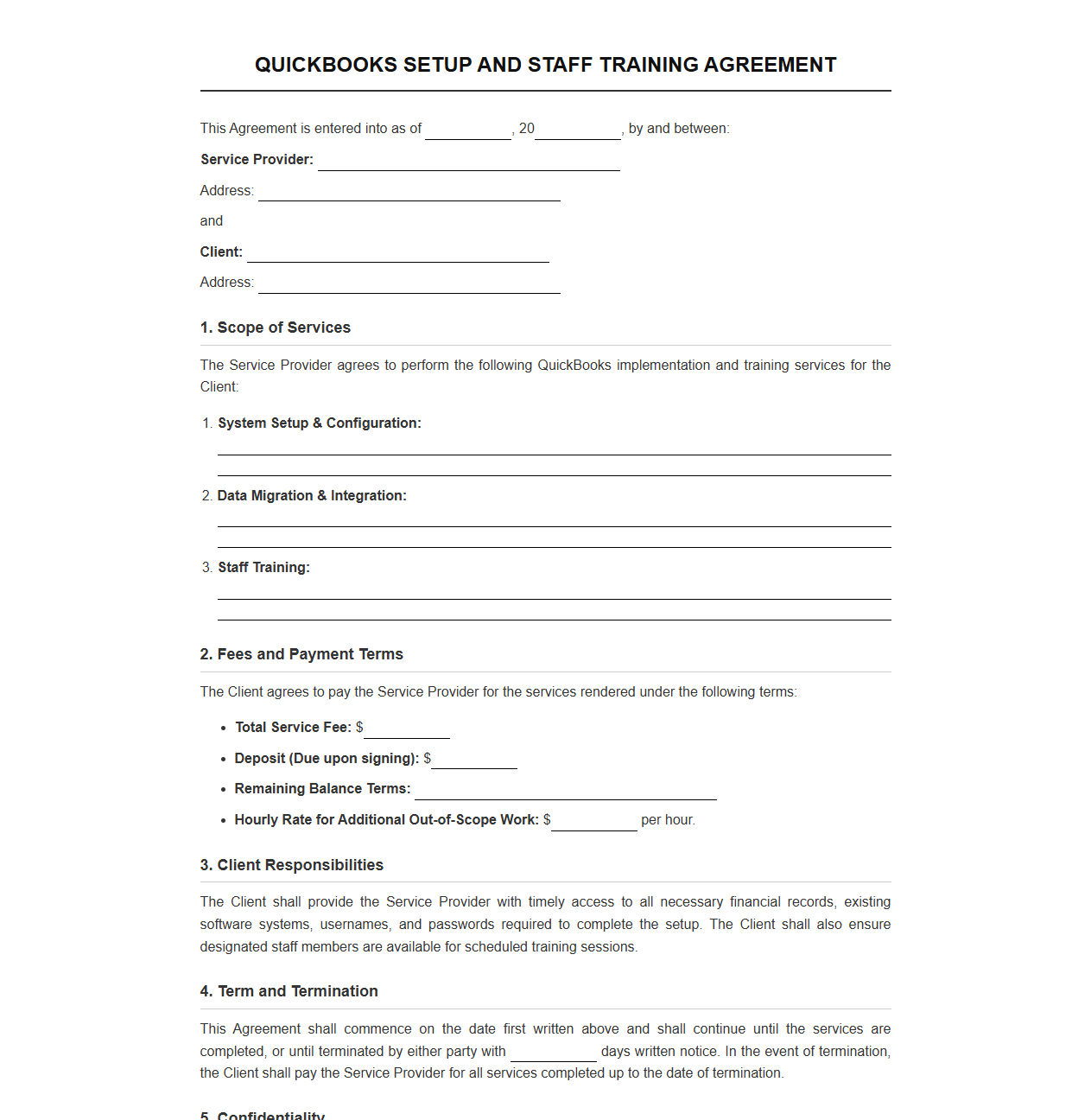 Download: .PDF
Professional Services Agreement for QuickBooks Integration and Training
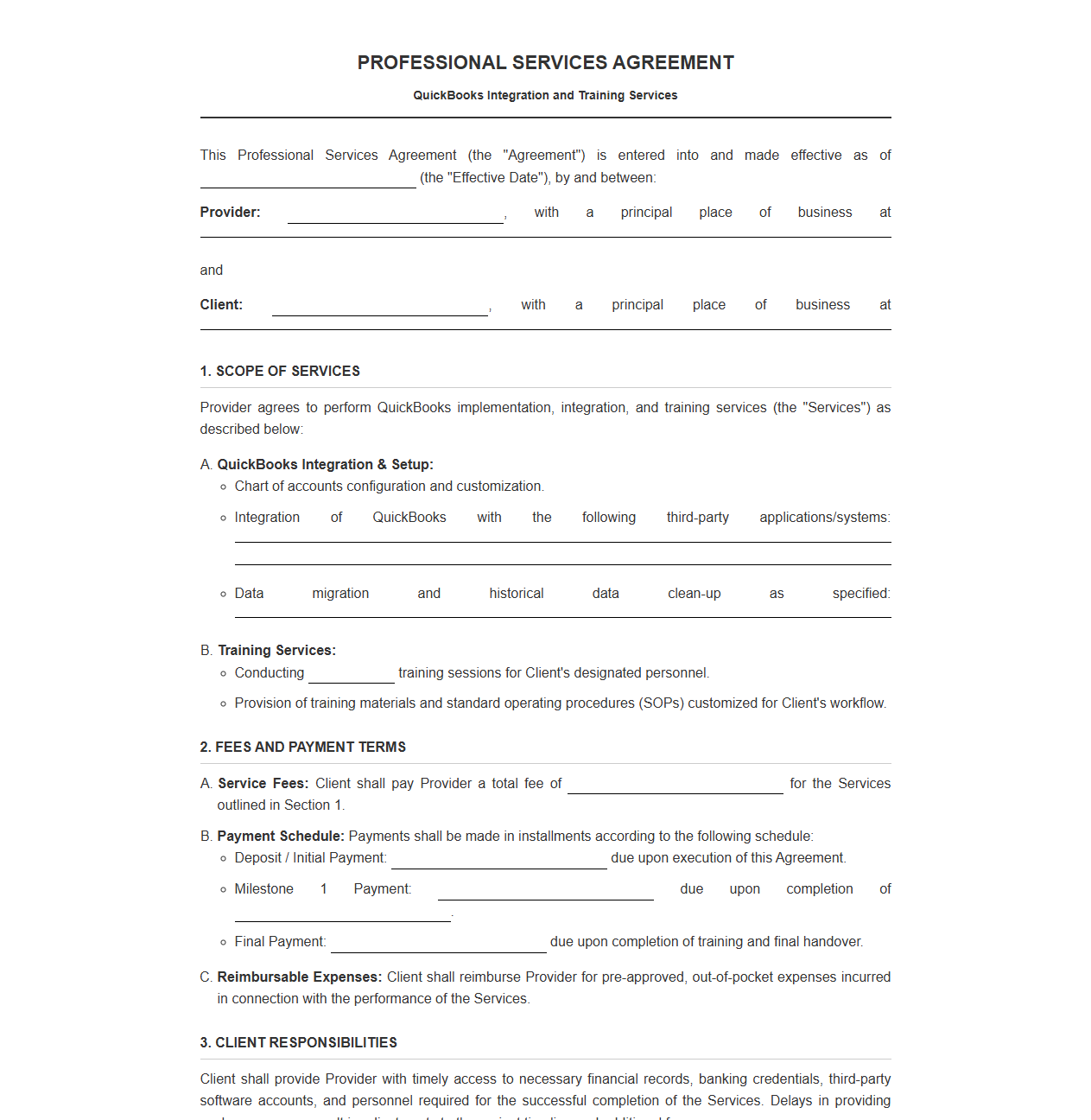 Download: .PDF
QuickBooks Implementation and Training Services Contract
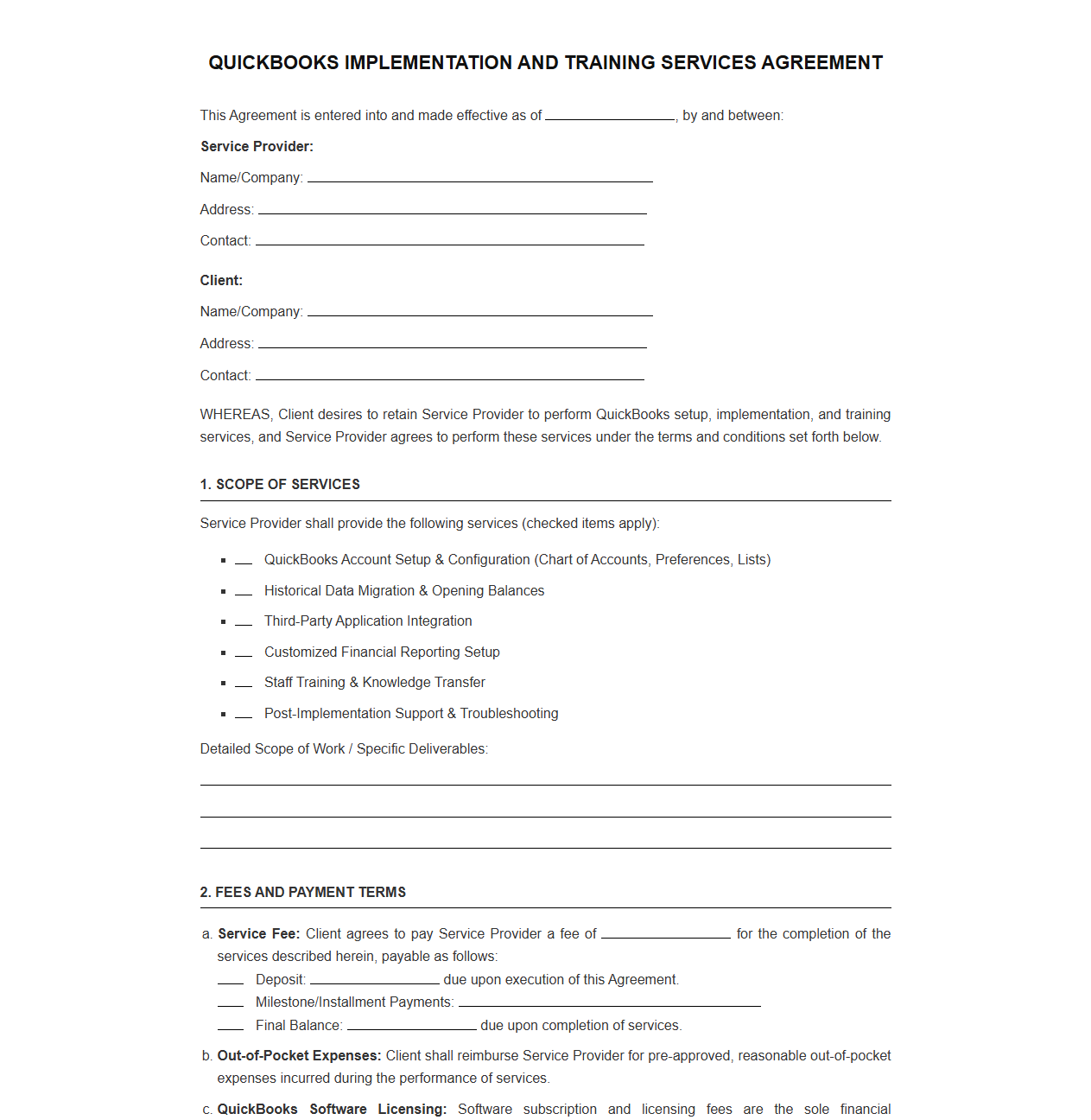 Download: .PDF
QuickBooks Consulting, Onboarding, and Education Agreement
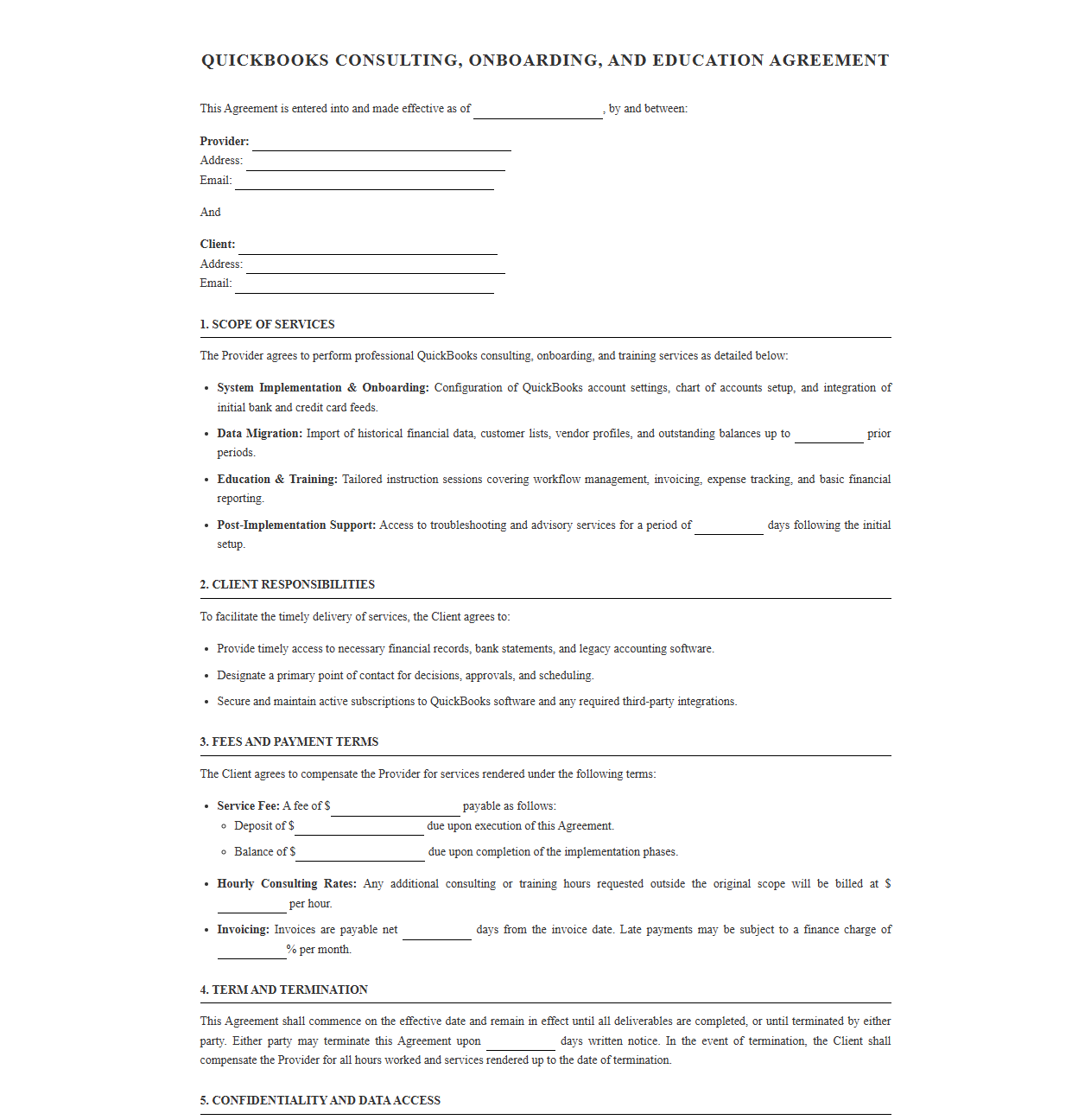 Download: .PDF
Master Services Agreement for QuickBooks Implementation and Training
 Download: .PDF
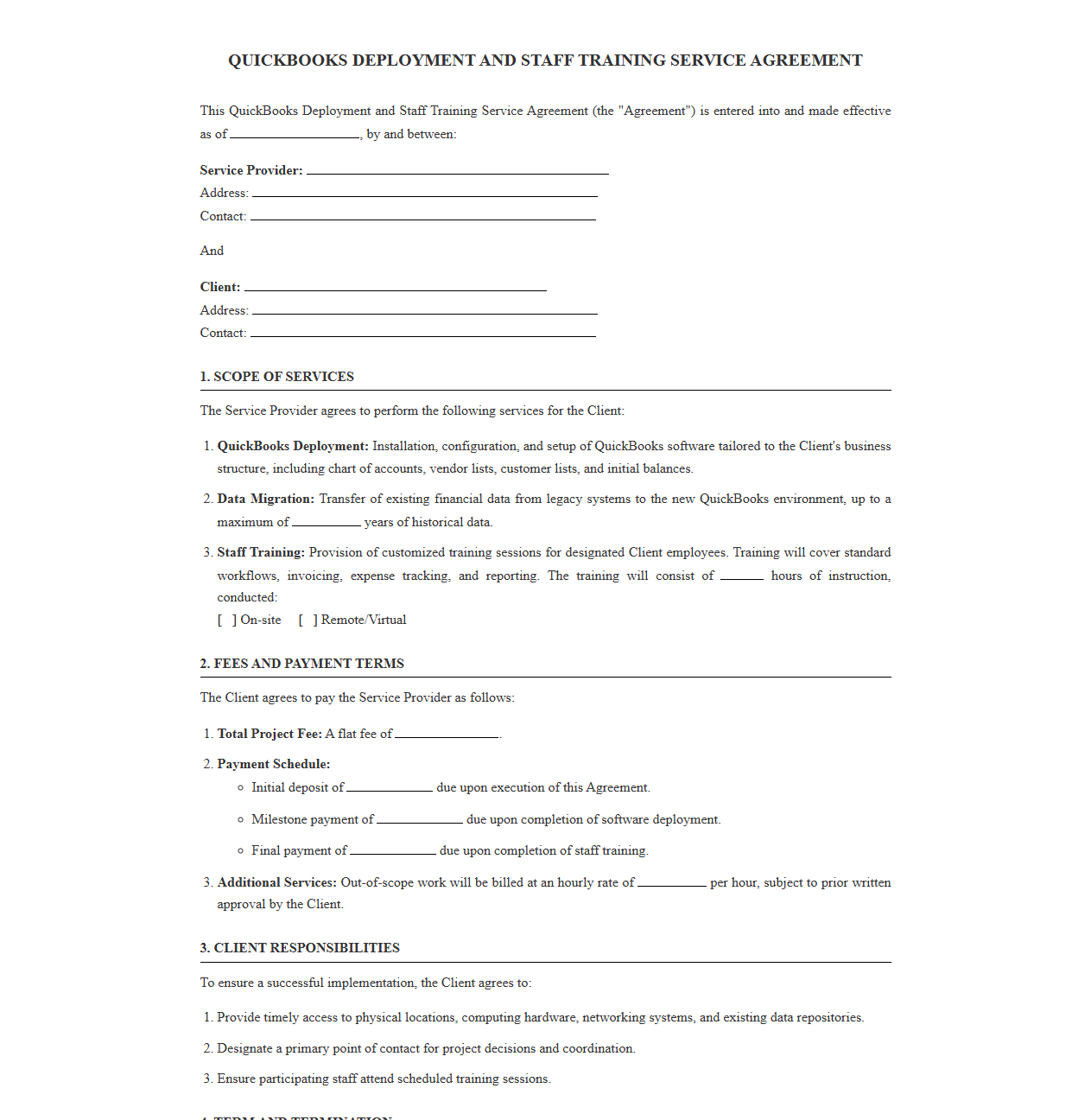
QuickBooks Deployment and Staff Training Service Agreement
 Download: .PDF
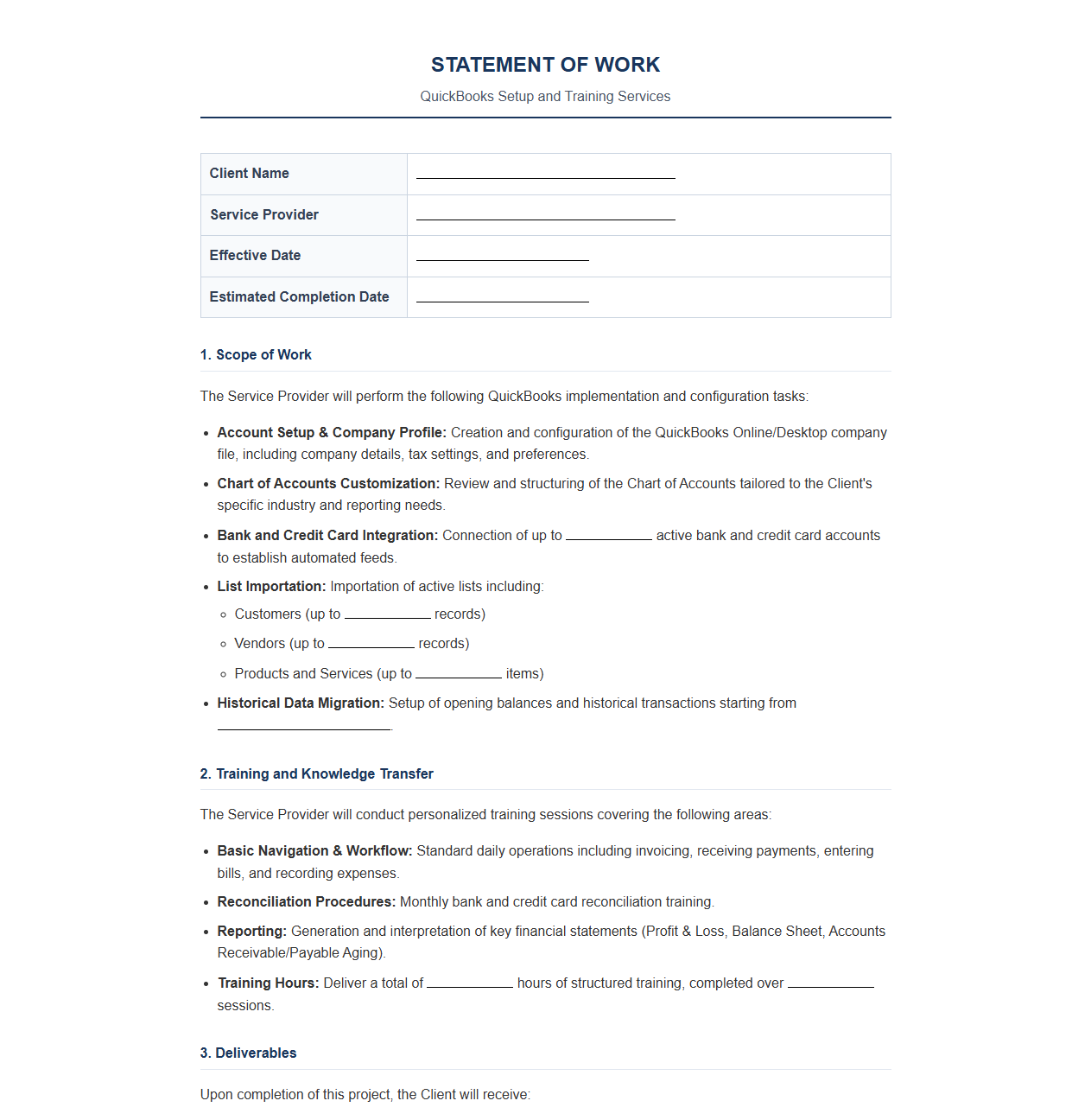
Statement of Work for QuickBooks Setup and Training
 Download: .PDF
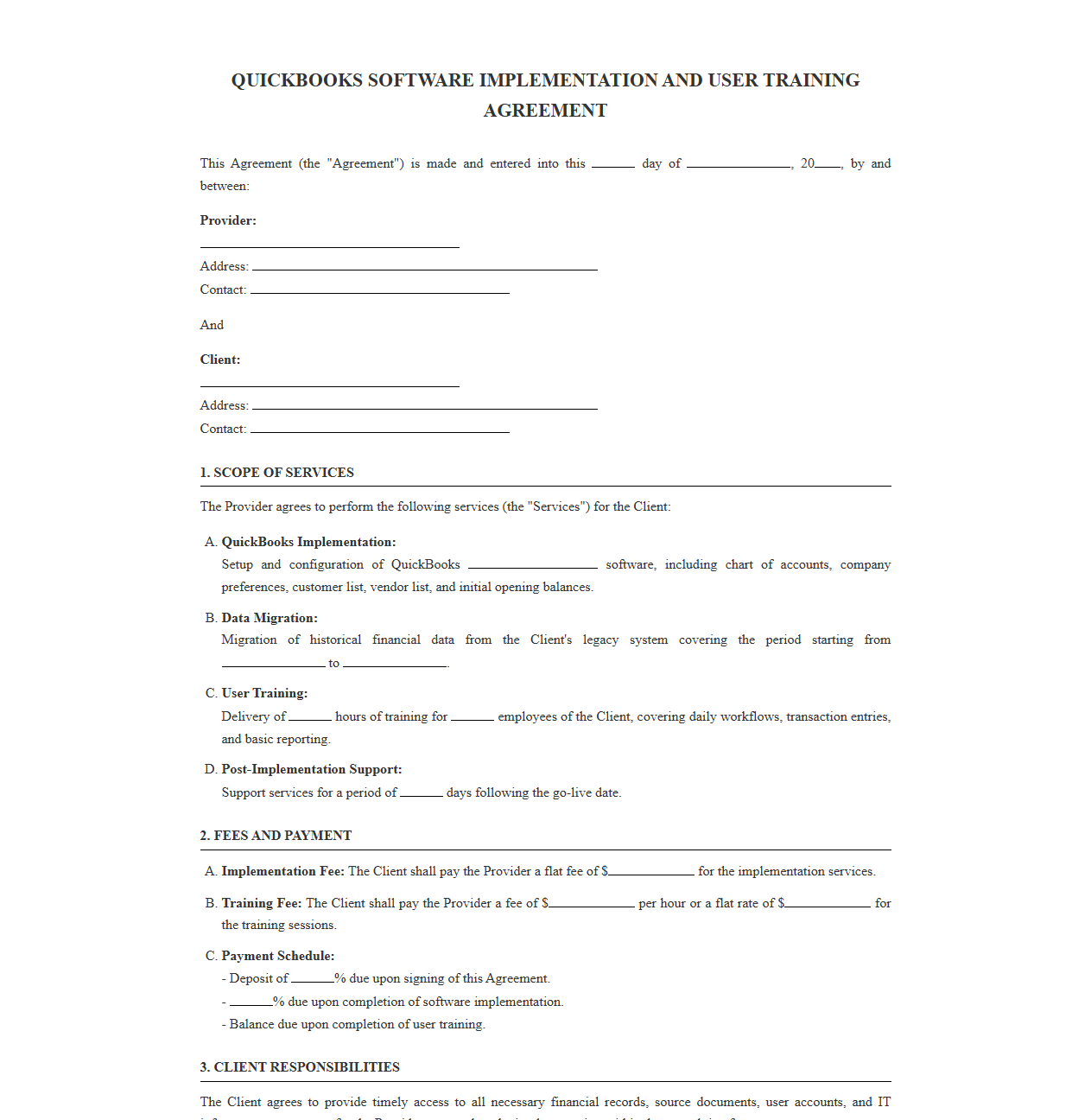
QuickBooks Software Implementation and User Training Agreement
 Download: .PDF
Standard Agreement for QuickBooks System Integration and Training
 Download: .PDF
Introduction to Standardized Financial Setups
Establishing a standardized financial foundation is critical for any growing business. A structured accounting system ensures compliance, facilitates accurate reporting, and provides clear insights for strategic decision-making. Utilizing a professional accounting platform like QuickBooks allows businesses to maintain clean, organized financial records from day one.
To ensure a seamless setup, a comprehensive QuickBooks implementation agreement is essential. This agreement protects both the consultant and the client by establishing clear boundaries, defining expectations, and outlining responsibilities. By detailing the project parameters upfront, both parties avoid misunderstandings, secure their financial interests, and establish a transparent framework for a successful, collaborative partnership.
Defining the Scope of QuickBooks Services
A successful implementation requires a clear definition of the technical and administrative tasks involved. The standard QuickBooks setup services provided under this agreement encompass the following essential activities:
- Chart of Accounts Customization: Tailoring the structure of asset, liability, equity, income, and expense accounts to align precisely with the client's industry standards and reporting needs.
- Bank Feed Integration: Connecting active business bank accounts and credit cards to facilitate automated transaction downloads and streamline daily tracking.
- Historical Data Migration: Importing historical financial transactions, customer lists, vendor details, and open invoices from legacy systems for the designated fiscal period.
- Product and Service Item Configuration: Structuring the inventory and service lists to ensure accurate sales tracking, invoicing, and cost of goods sold (COGS) reporting.
Structured Training and Support Modules
To ensure long-term operational success, the client's internal team must be fully equipped to manage daily financial workflows. A structured training curriculum is designed to transfer essential platform knowledge systematically.
Module 1: Navigation and Data Entry
This introductory session familiarizes staff with the QuickBooks interface, user dashboard, and primary data entry pathways.
- Understanding the user interface, sidebar navigation, and search functions.
- Creating, editing, and managing customer and vendor profiles.
- Processing customer invoices, receiving payments, and entering vendor bills.
Module 2: Daily Reconciliation and Reporting
This session focuses on transactional accuracy and key financial control mechanisms to ensure the ledger remains precise.
- Matching downloaded bank feed transactions to existing ledger entries.
- Handling exceptions, split transactions, and recurring bank rules.
- Generating standard financial statements, including the Balance Sheet and Profit & Loss report.
Implementation Milestones and Timeline
The implementation project is executed in chronological phases to ensure thorough validation and steady progress. Below is the scheduled timeline for the deployment process:
| Phase | Description | Estimated Duration |
|---|---|---|
| 1. Discovery & Planning | Reviewing legacy systems, gathering requirements, and finalizing the custom Chart of Accounts layout. | Week 1 |
| 2. System Configuration | Setting up the QuickBooks file, linking bank feeds, and importing customer and vendor lists. | Weeks 2-3 |
| 3. Data Migration & Testing | Migrating historical transactions and reconciling opening balances to ensure complete accuracy. | Weeks 4-5 |
| 4. Staff Training & Go-Live | Conducting active training modules and transitioning daily operational tasks to the client's team. | Week 6 |
| 5. Post-Go-Live Support | Providing weekly review sessions and troubleshooting support for the first month-end close. | Weeks 7-10 |
Financial Investment and Payment Terms
The total fee for the defined QuickBooks implementation is structured as a fixed project cost, payable in scheduled installments. To secure the resource allocation and initiate the discovery phase, an upfront retainer is required prior to the commencement of any system work.
"All invoices are payable within fifteen (15) days of receipt. Out-of-scope work, including additional custom integrations or support requests beyond the standard training modules, will be billed at an hourly rate of $150 per hour, subject to prior written approval from the client."
Legal Terms, Data Security, and Confidentiality
Financial Data Security and Compliance
Both parties agree to adhere to strict security protocols to safeguard sensitive financial information. The consultant will utilize secure, encrypted connections and multi-factor authentication (MFA) when accessing any client accounts or QuickBooks files. No financial data will be stored on unsecured local devices.
Software Licensing and Ownership
The client is solely responsible for acquiring and maintaining active, valid software licenses for QuickBooks and any associated third-party integrations. The consultant acts as an authorized administrator but holds no liability for software service interruptions, subscription price changes, or platform downtime initiated by the software provider.
Mutual Confidentiality and Limitation of Liability
Each party agrees to maintain the strict confidentiality of all proprietary business operations, trade secrets, and financial disclosures shared during this project. The consultant's maximum liability under this agreement for any errors, omissions, or negligent acts shall not exceed the total amount paid by the client for the specific services rendered under this statement of work.
Agreement Execution and Signatures
By signing below, both the consultant and the client formally accept the scope of work, timeline, payment terms, and legal clauses outlined in this QuickBooks implementation agreement. Work will commence immediately upon receipt of both signatures and the designated initial retainer payment.
Consultant Representative:Apex Financial Solutions LLC
Signature: __________________________
Date: ______________________________ Client Representative:
Client Business Name: _________________
Signature: __________________________
Date: ______________________________

Leave a comment