

Navigating the departure of a business partner can be one of the most stressful phases of organizational leadership, often fraught with emotional tension and financial uncertainty. Before addressing the legal paperwork, it is vital to recognize that partner exits are a natural evolution of any enterprise's lifecycle, requiring a strategic rather than reactive approach.
Utilizing structured templates grants founders the clarity and confidence needed to protect ongoing operations and preserve professional relationships. However, we must stipulate that these documents serve as foundational frameworks rather than a complete substitute for state-specific legal counsel. For example, pre-defining concrete asset valuation methods and structured payout schedules can prevent ruinous litigation down the road.
In this article, we will break down essential retirement scenarios, analyze critical buyout clauses, and provide customizable templates designed to ensure a seamless, legally sound transition for your firm.
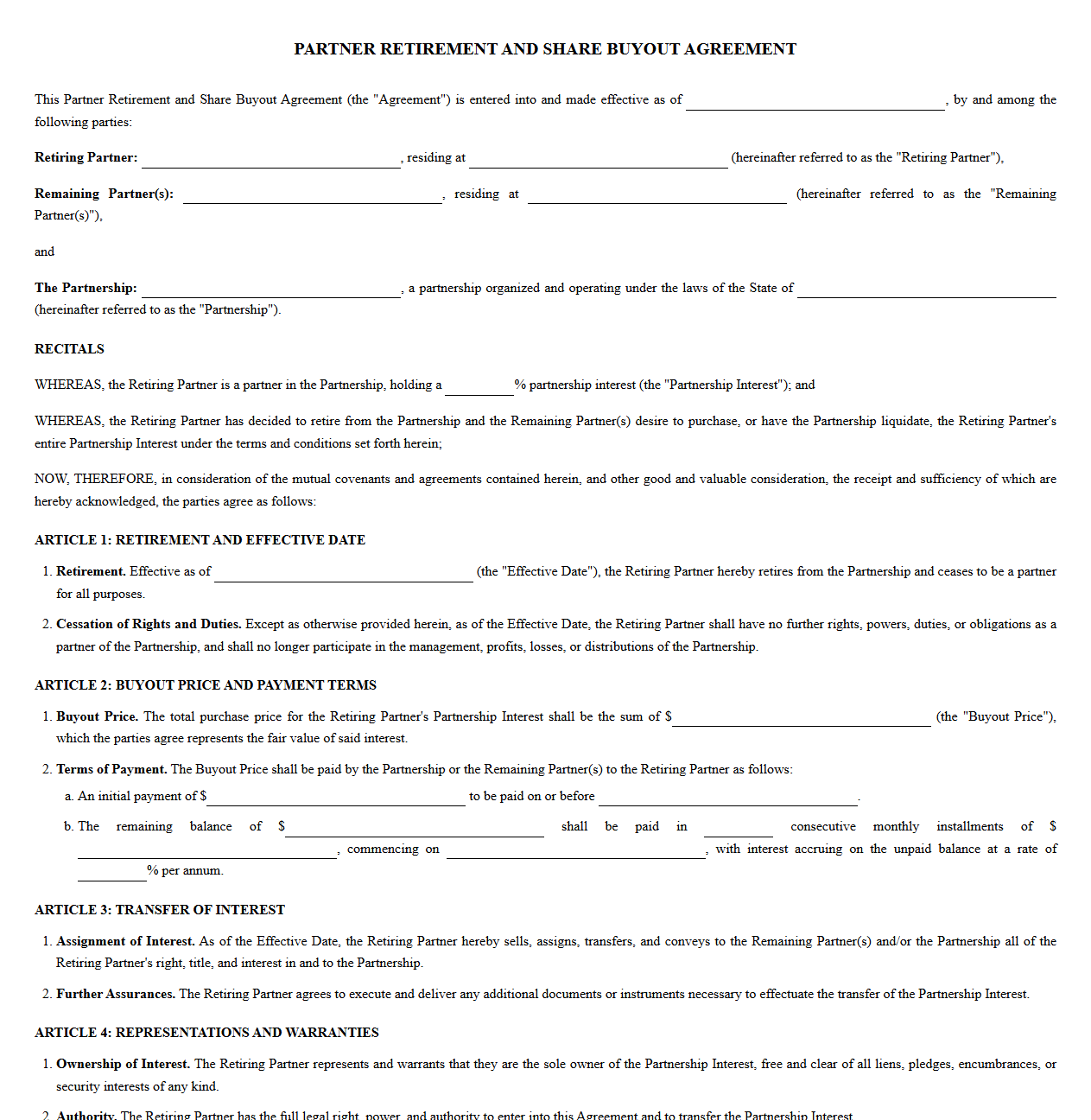
Partner Retirement and Share Buyout Agreement Template
 Download: .PDF
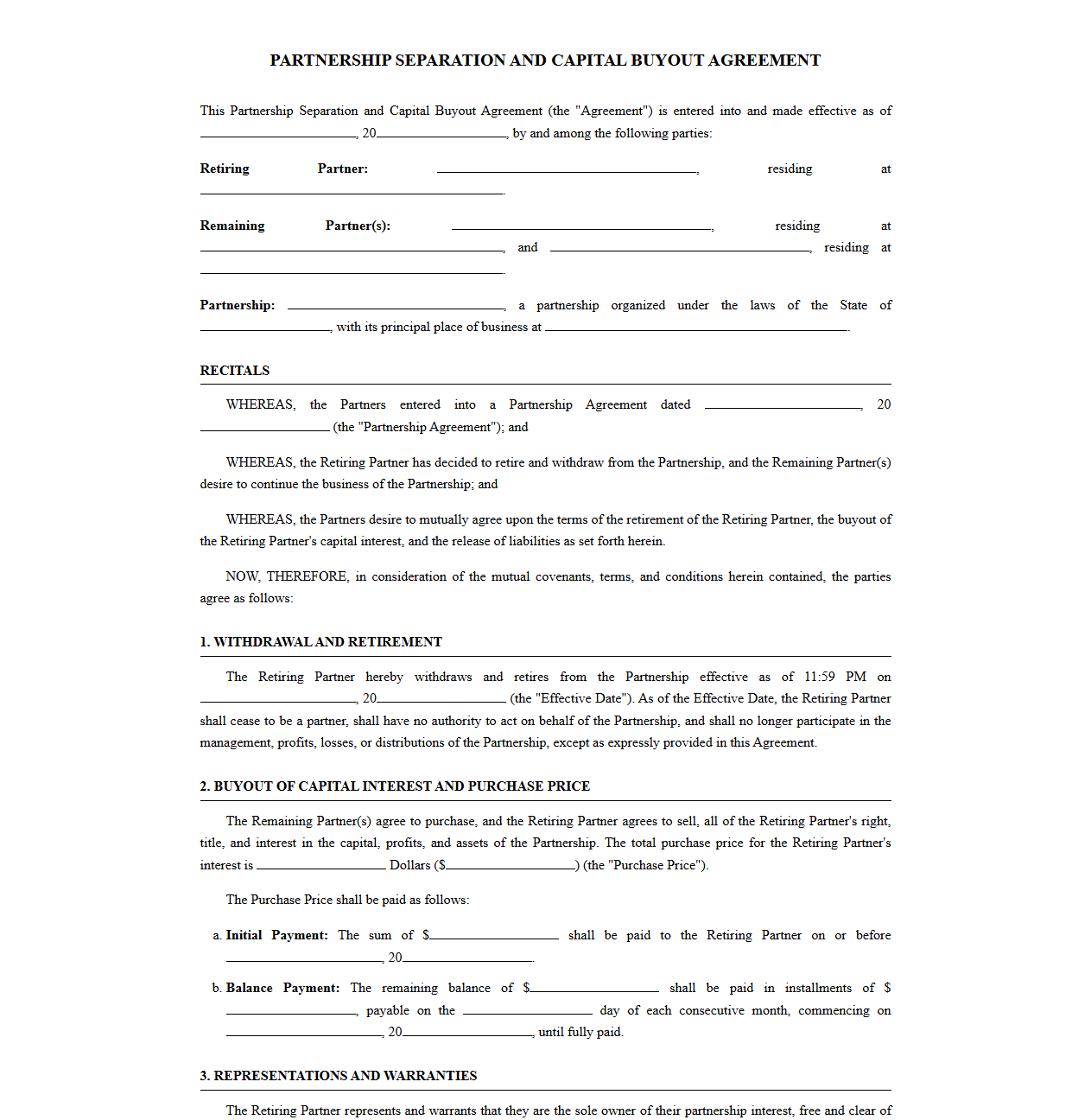
Partnership Separation and Capital Buyout Agreement
 Download: .PDF
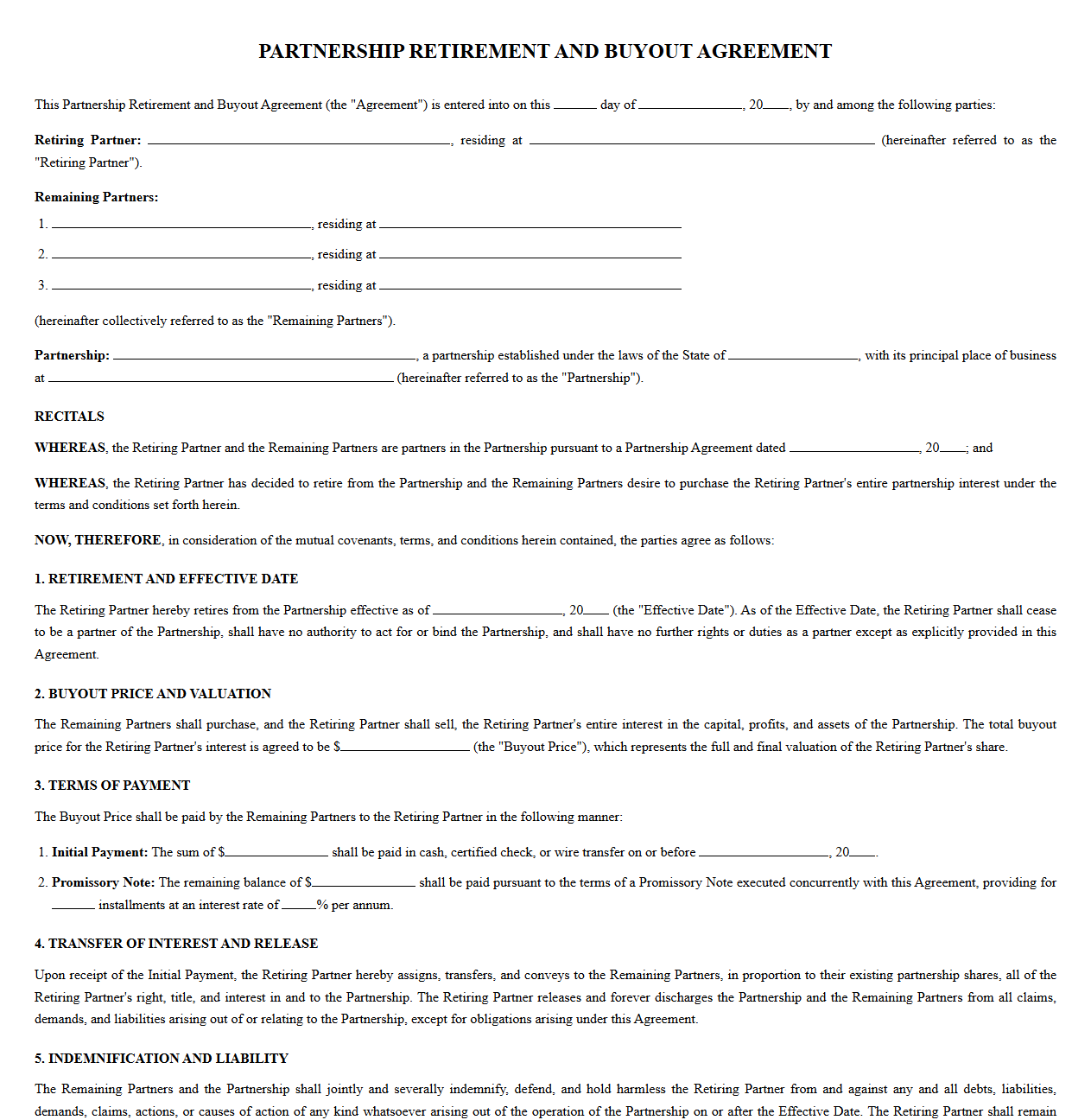
Retirement Buyout Agreement for Partnership Members
 Download: .PDF
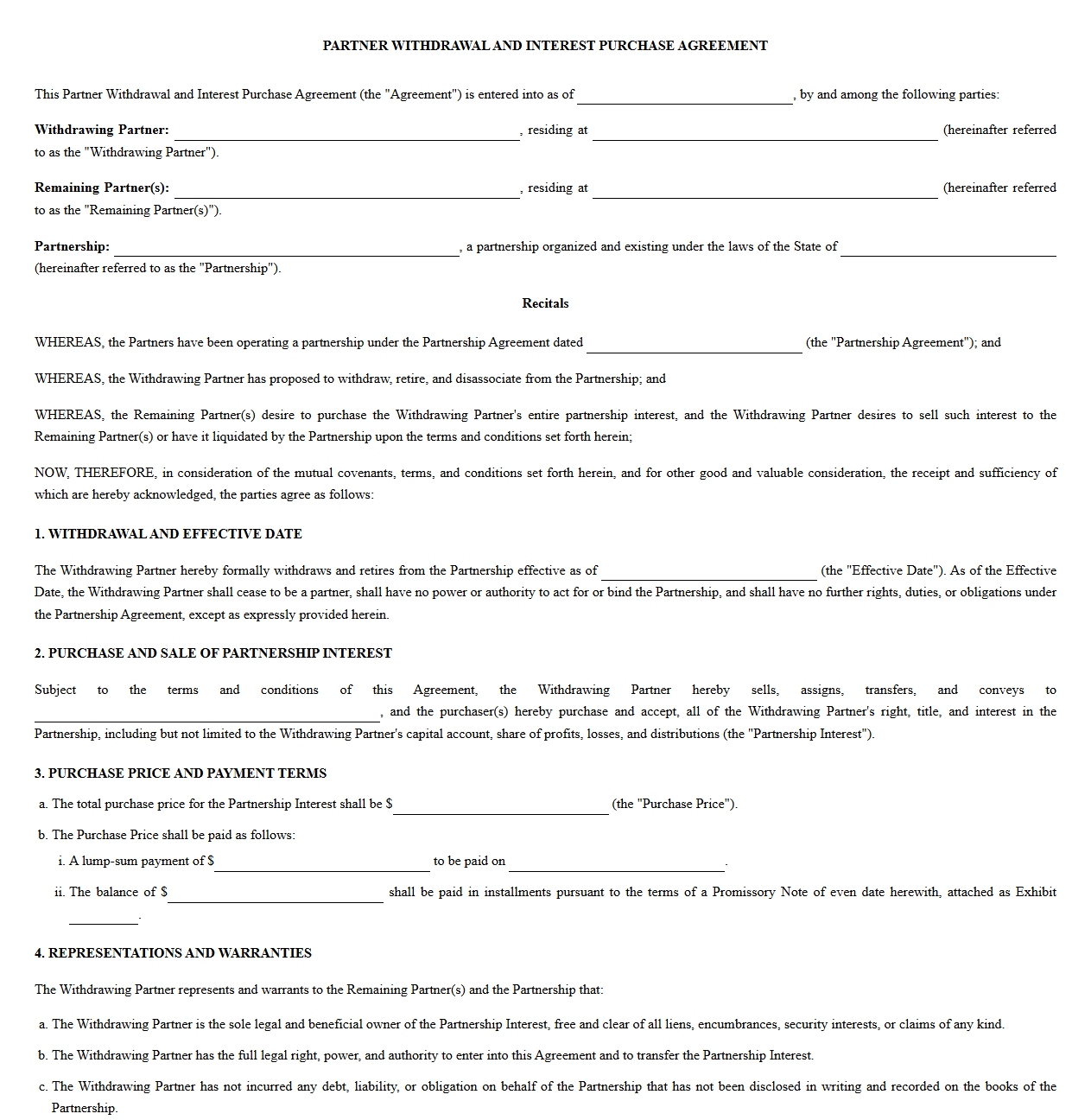
Partner Withdrawal and Interest Purchase Agreement
 Download: .PDF
Partnership Dissolution and Partner Buyout Agreement
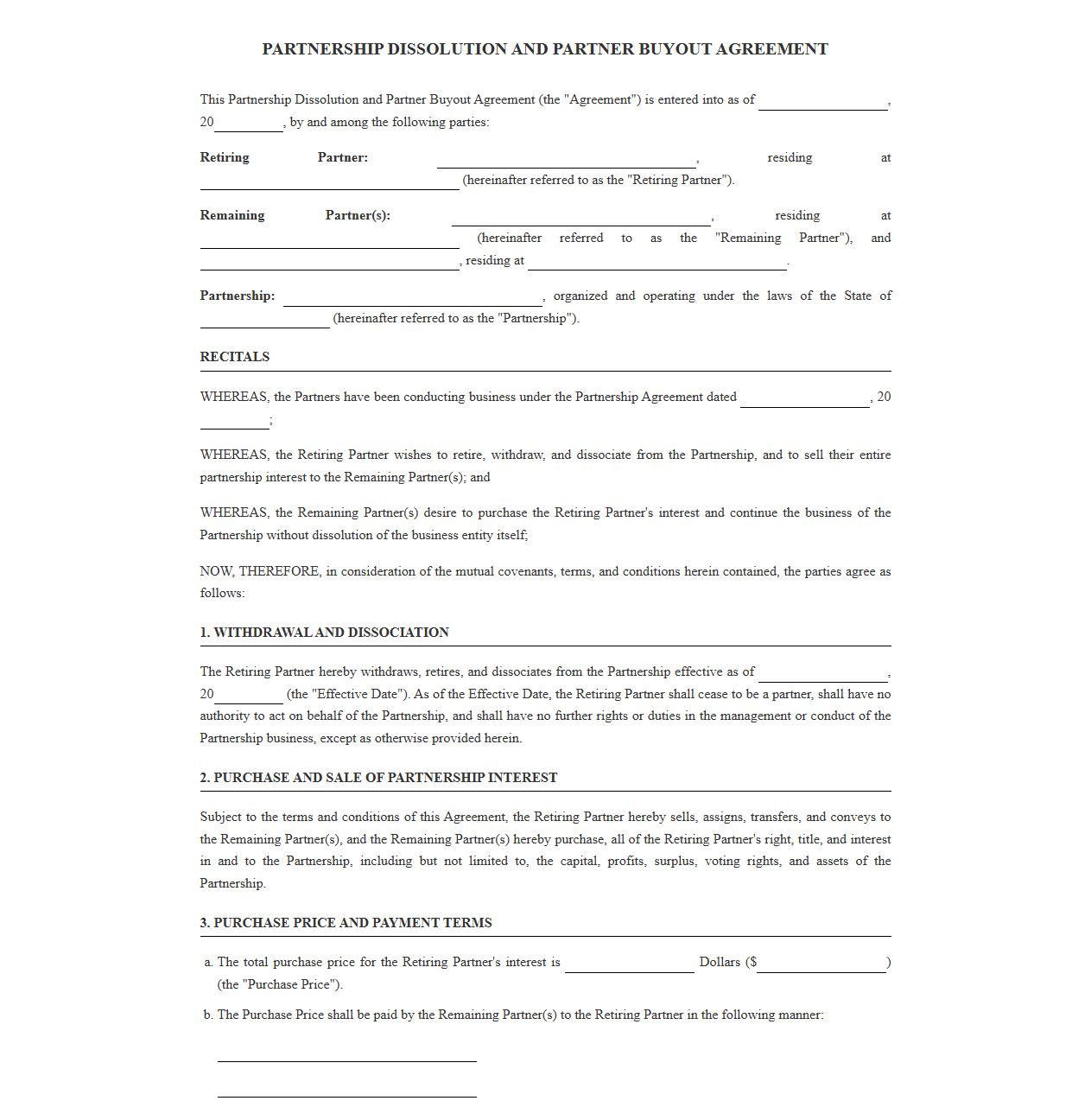 Download: .PDF
LLC Member Retirement and Buyout Contract Template
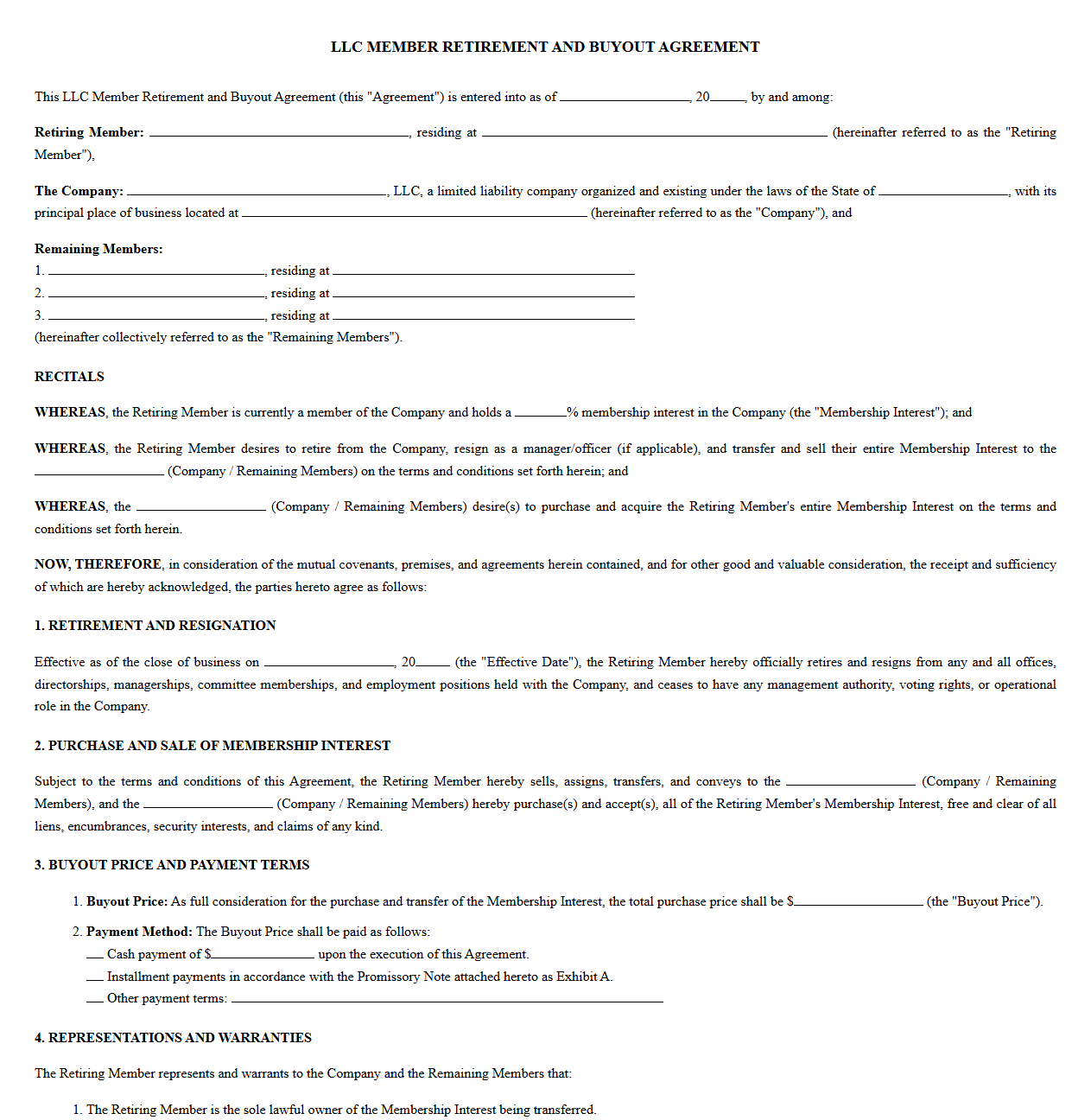 Download: .PDF
Standard Partner Exit and Equity Buyout Agreement
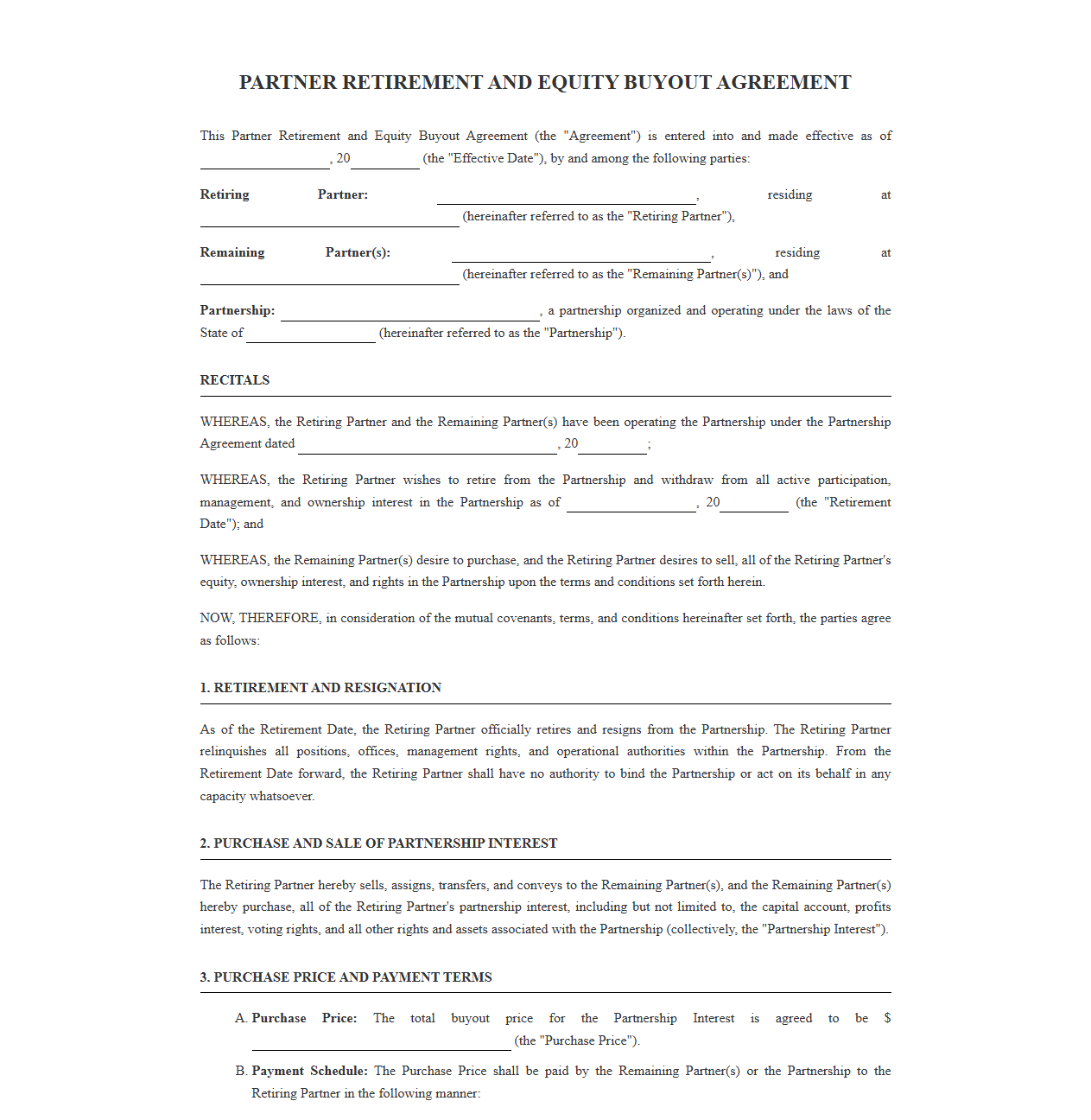 Download: .PDF
Equity Purchase and Partnership Retirement Agreement Template
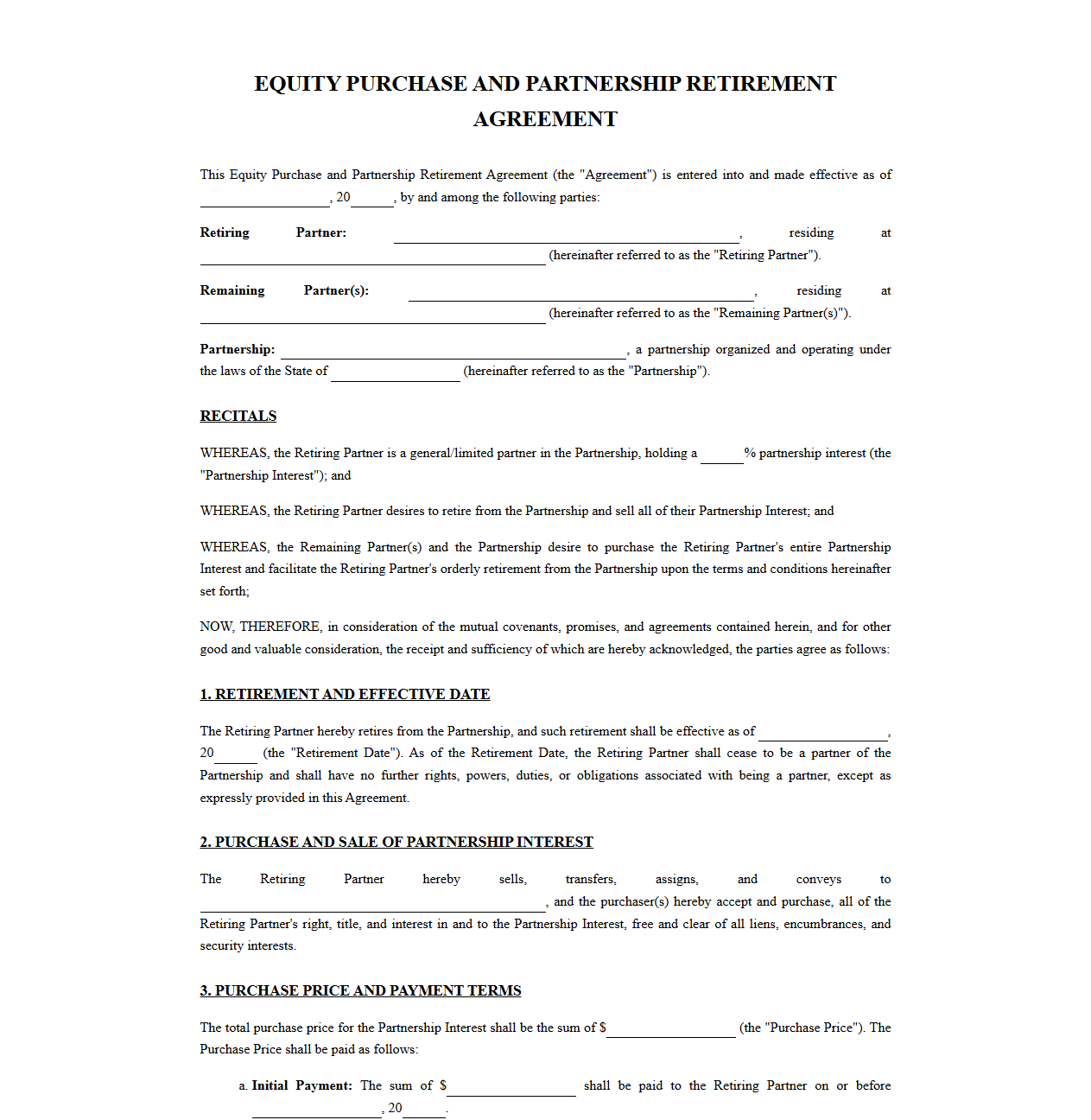 Download: .PDF
Section 1: Introduction to Partner Exits and the Role of Buyout Agreements
The departure of a business partner is a pivotal moment in any company's lifecycle. Whether driven by retirement, career redirection, or internal disagreements, the exit of a co-owner introduces complex operational and financial challenges. Without a structured framework, these transitions can quickly devolve into costly legal battles that threaten the continuity of the business. A well-drafted buyout agreement serves as the foundational safeguard during these transitions.
Having a proactive exit strategy protects both the departing partner and the remaining entity. For the partner who is leaving, it guarantees a fair, predictable path to liquidate their equity and realize the value of their hard work. For the remaining owners, it provides a stable mechanism to maintain control of the company without crippling its cash flow. Planning for these transitions early ensures that the business remains resilient and focused on its growth objectives.
Section 2: Defining Trigger Events for Retirement and Buyouts
To ensure a smooth transition, a buyout agreement must clearly define the specific "trigger events" that initiate the transfer of ownership. These events establish when a buyout is permitted or mandatory, leaving no room for ambiguity when a partner decides to move on.
- Planned Retirement: A pre-scheduled exit timeline that allows the business to prepare financially and operationally for the partner's departure.
- Voluntary Resignation: Instances where a partner chooses to leave the company to pursue other personal or professional opportunities.
- Disability or Incapacity: Sudden physical or mental limitations that prevent a partner from fulfilling their daily operational responsibilities.
- Irreconcilable Disputes: Severe internal disagreements that stall decision-making and require a clean separation to save the business.
Section 3: Business Valuation Methodologies for Equitable Buyouts
Determining a fair and mutually acceptable price for a departing partner's equity is often the most sensitive part of the exit process. The agreement must explicitly outline the financial formulas and appraisal processes used to calculate the company's worth, preventing future disputes over valuation.
- Book Value: This method calculates the net value of the company's physical assets minus its liabilities, often used for asset-heavy industries.
- Market Value: This approach assesses the company's worth based on recent sales of comparable businesses within the same industry and geographic region.
- Earnings-Based Approaches: Valuation is calculated using multiples of earnings before interest, taxes, depreciation, and amortization (EBITDA) to reflect future profitability.
Section 4: Structuring Payment Terms and Funding Mechanisms
Once the valuation is established, the next critical step is structuring how the buyout will be funded and paid. A sudden drain on cash reserves to pay out a departing partner can jeopardize the daily operations of the remaining business. Therefore, agreements typically outline flexible funding mechanisms designed to balance fairness with company stability.
Lump-sum payments offer a clean break but are often financially impractical. Instead, many agreements utilize installment plans or seller notes, allowing the company to pay the departing partner over a set period with reasonable interest. Additionally, companies often fund buyouts triggered by death or disability using key-person life insurance policies, which provide immediate liquidity to buy out the partner's estate without disrupting company capital.
Section 5: Restrictive Covenants and Liability Releases
Protecting the company's intellectual assets, market position, and client relationships after a partner exits is vital for long-term survival. The buyout agreement must contain strict post-employment boundaries to ensure the departing partner does not immediately become a direct competitor.
- Non-Compete Clauses: Restricts the departing partner from starting or working for a competing business within a specified geographic area and time frame.
- Non-Solicitation: Prevents the former partner from poaching active clients, vendors, or current employees.
- Confidentiality Agreements: Safeguards proprietary trade secrets, financial records, and operational strategies from public exposure.
- Mutual Liability Releases: Frees both the departing partner and the remaining business from future claims, ensuring a clean legal break.
Section 6: Managing the Transition of Authority and Knowledge Transfer
An orderly operational hand-off is just as important as the financial transaction. The buyout agreement should detail the step-by-step transfer of daily responsibilities, intellectual property rights, and external relationships to prevent operational gaps during the transition.
The departing partner must formally hand over access to all corporate accounts, digital assets, and proprietary systems. Additionally, a structured schedule for introducing clients and key vendors to the remaining leadership team helps preserve trust and business continuity. Clearly defining this transition period ensures that institutional knowledge remains within the company, protecting its market share.
Section 7: Finalizing the Agreement and Implementing the Template
Executing a comprehensive buyout template requires careful customization to reflect the unique structure of your specific business. Following a systematic process ensures that the finalized document is legally binding and operationally sound.
- Gather Financial Records: Collect up-to-date valuations, asset registries, and tax documents to establish a clear baseline.
- Customize the Template: Tailor the payment terms, trigger events, and restrictive covenants to align with your business goals.
- Conduct Legal Review: Ensure independent legal counsel reviews the agreement on behalf of both the departing partner and the remaining entity.
- Formal Signing and Notarization: Execute the document with formal signatures and witness notarization to secure legal enforceability.

Leave a comment