

Managing unpredictable state and local tax (SALT) liabilities during corporate transactions often leaves executive teams vulnerable to unforeseen, costly financial exposure. Before addressing these risks directly, organizations must first evaluate their broader transaction structures and pre-closing due diligence processes to identify where historical exposures lie. Standardizing risk-shifting mechanisms through robust indemnification agreement templates grants corporate leaders immediate financial predictability and peace of mind during complex deals.
However, an important educational stipulation remains: while standardized templates significantly streamline drafting, they are not a one-size-fits-all remedy and must be tailored to specific state jurisdictions. For instance, protecting a buyer from retroactive sales tax audits or unexpected municipal gross receipts tax assessments requires highly localized, precise language. Below, we will explore the essential components of SALT indemnification clauses, outline key negotiation strategies, and provide actionable templates to safeguard your next transaction.
State and Local Tax Indemnity Agreement Template
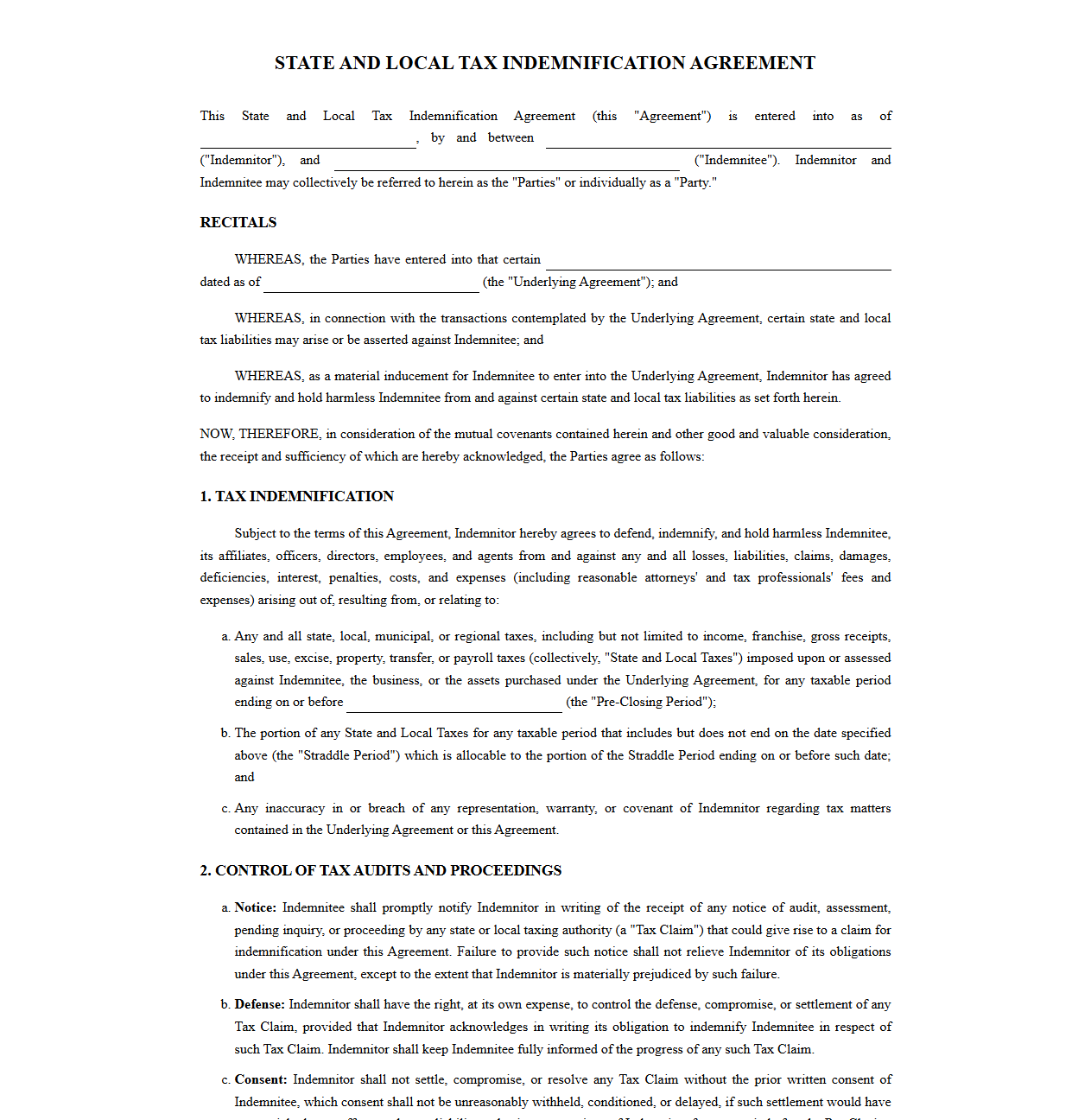 Download: .PDF
SALT Indemnification Agreement Form
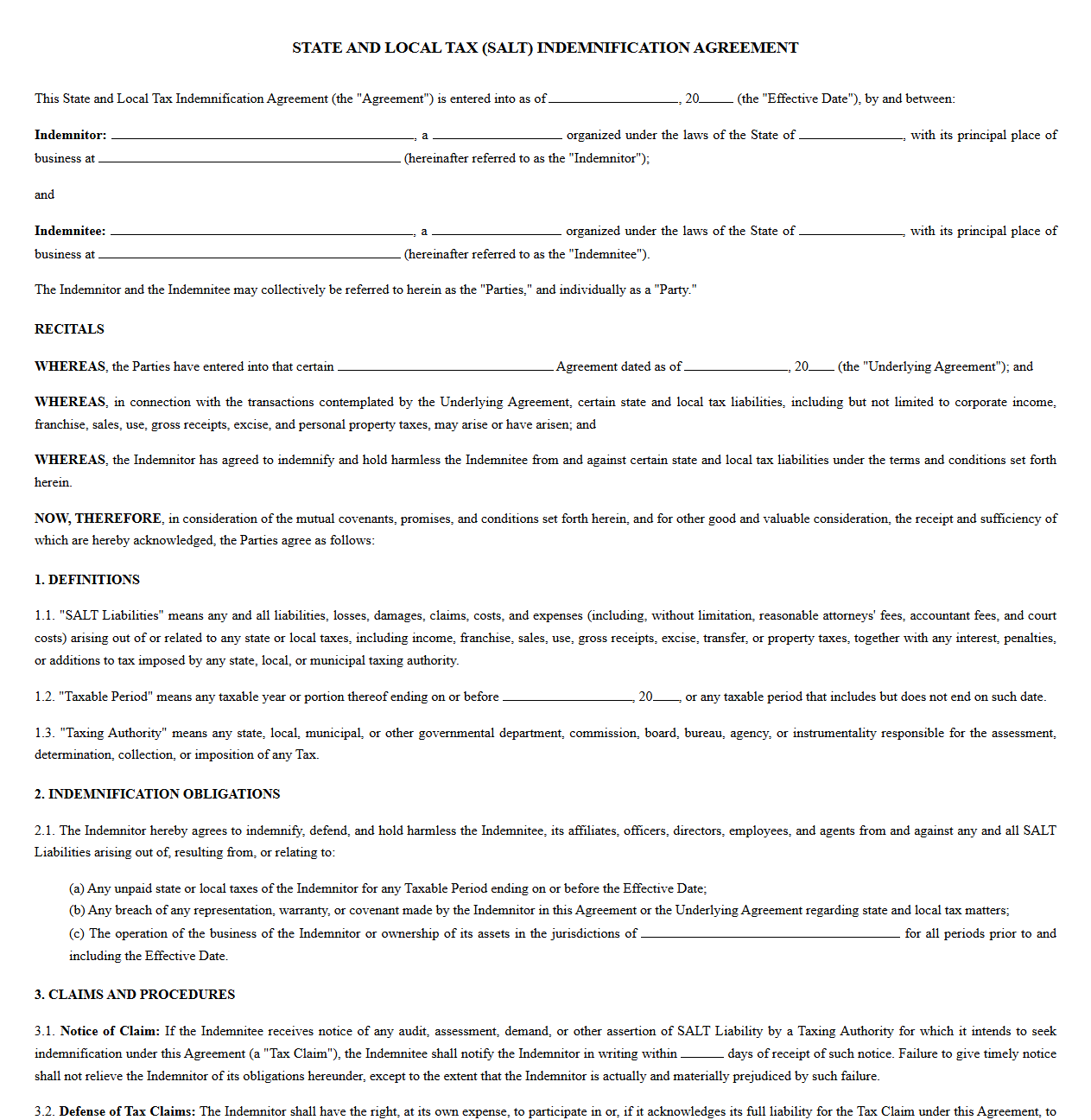 Download: .PDF
State and Local Tax Liability Indemnification Contract
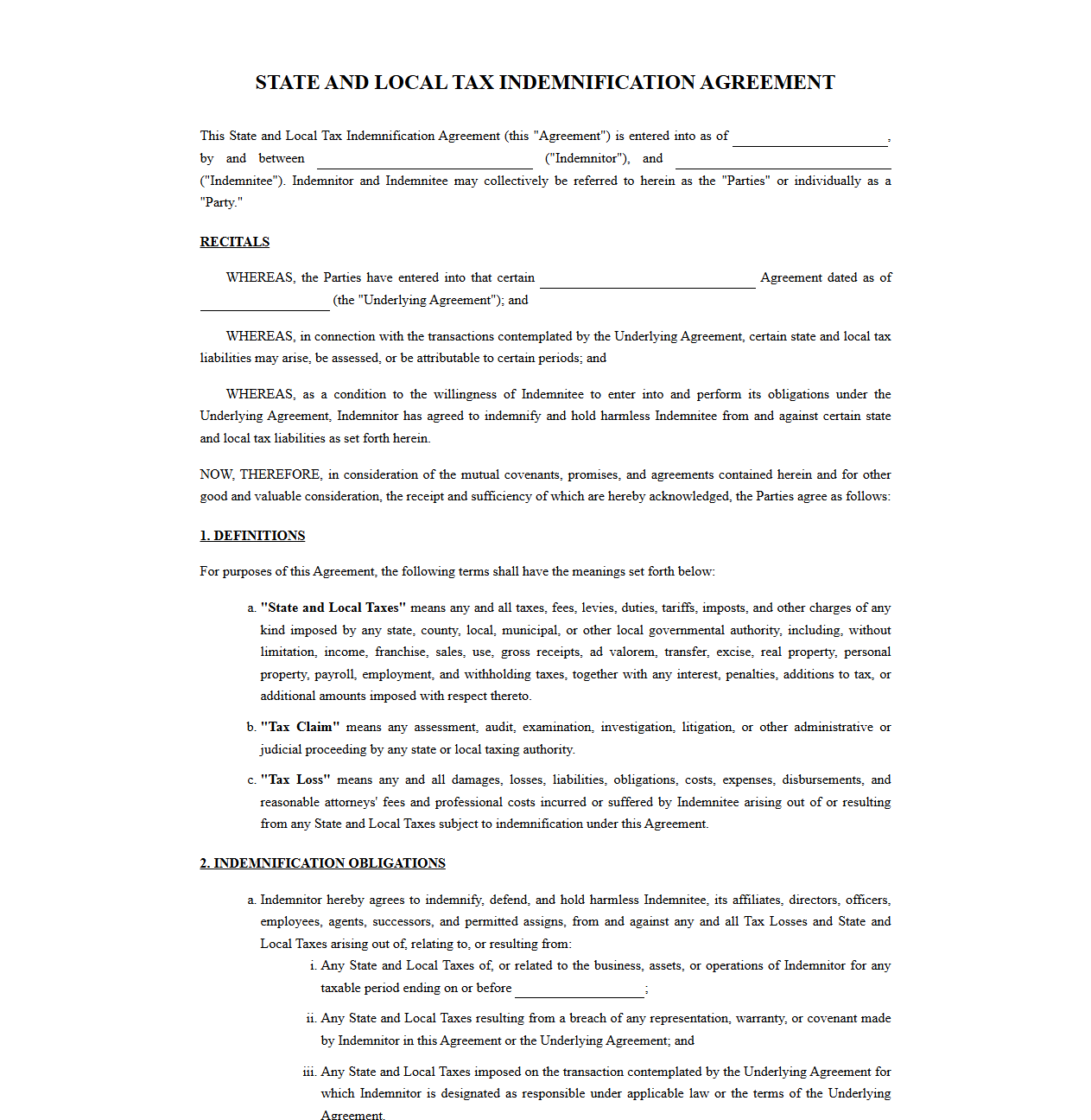 Download: .PDF
Agreement for Indemnification of State and Local Taxes
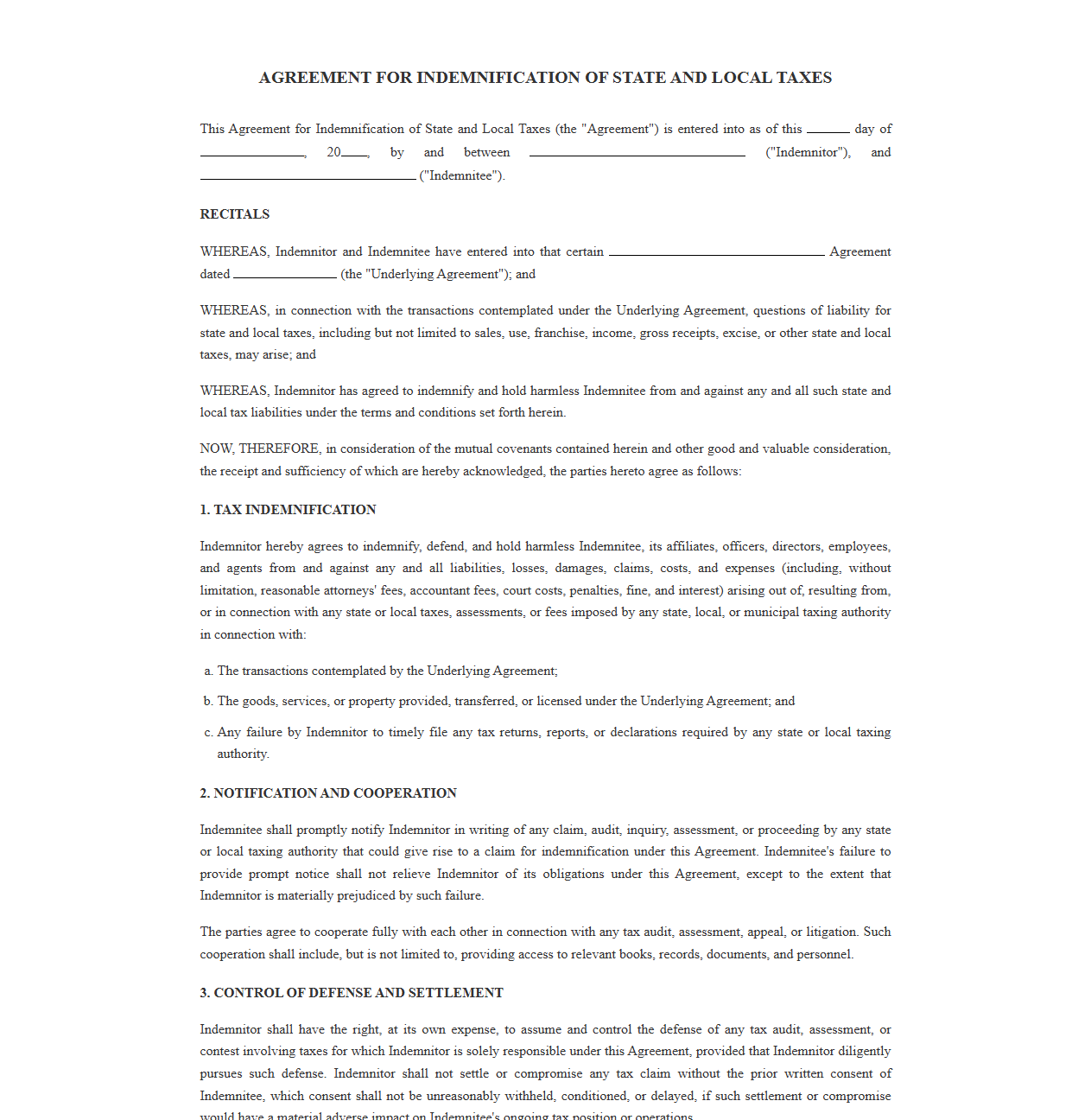 Download: .PDF
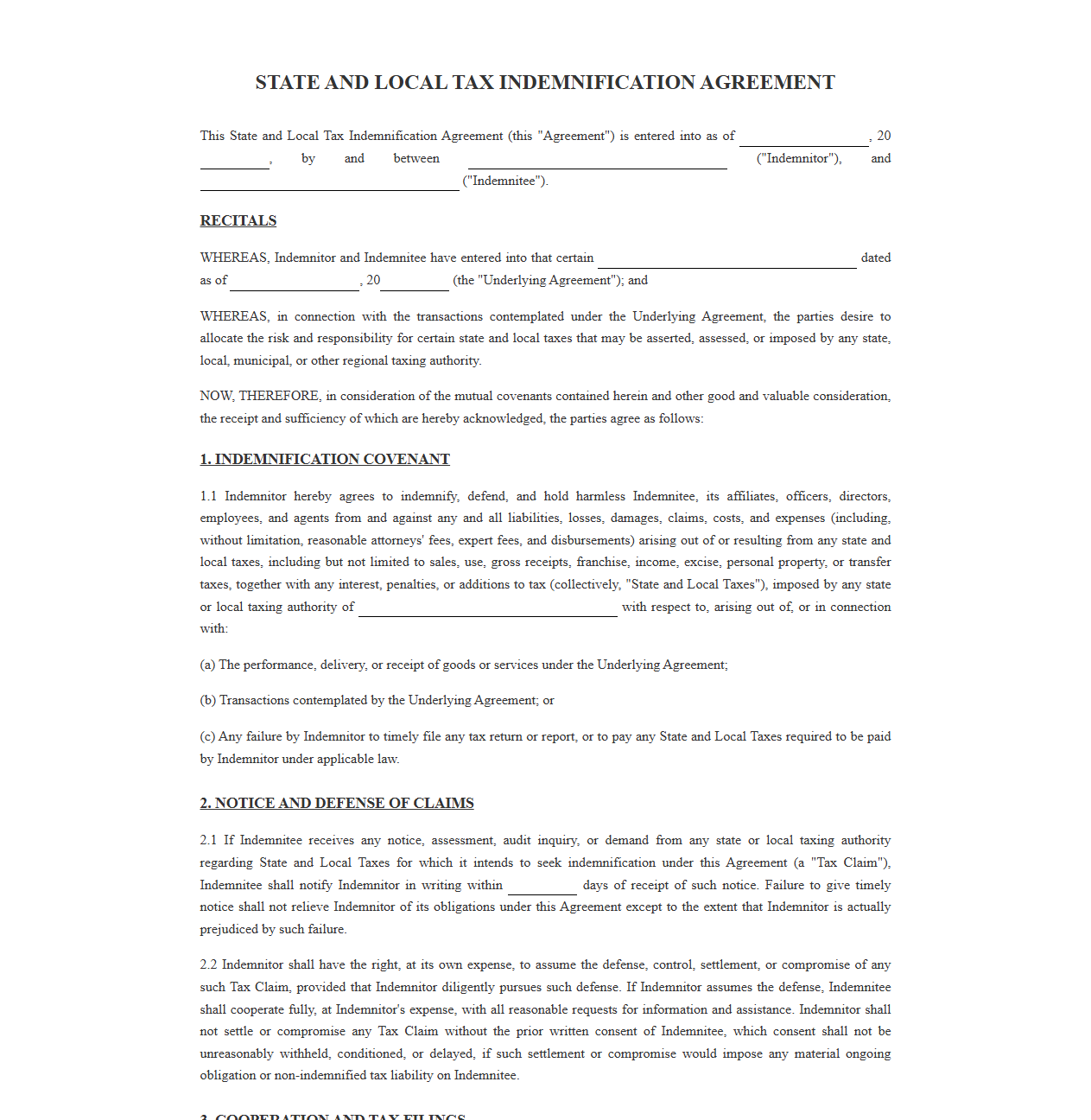
Standard State and Local Tax Indemnity Clause Template
 Download: .PDF
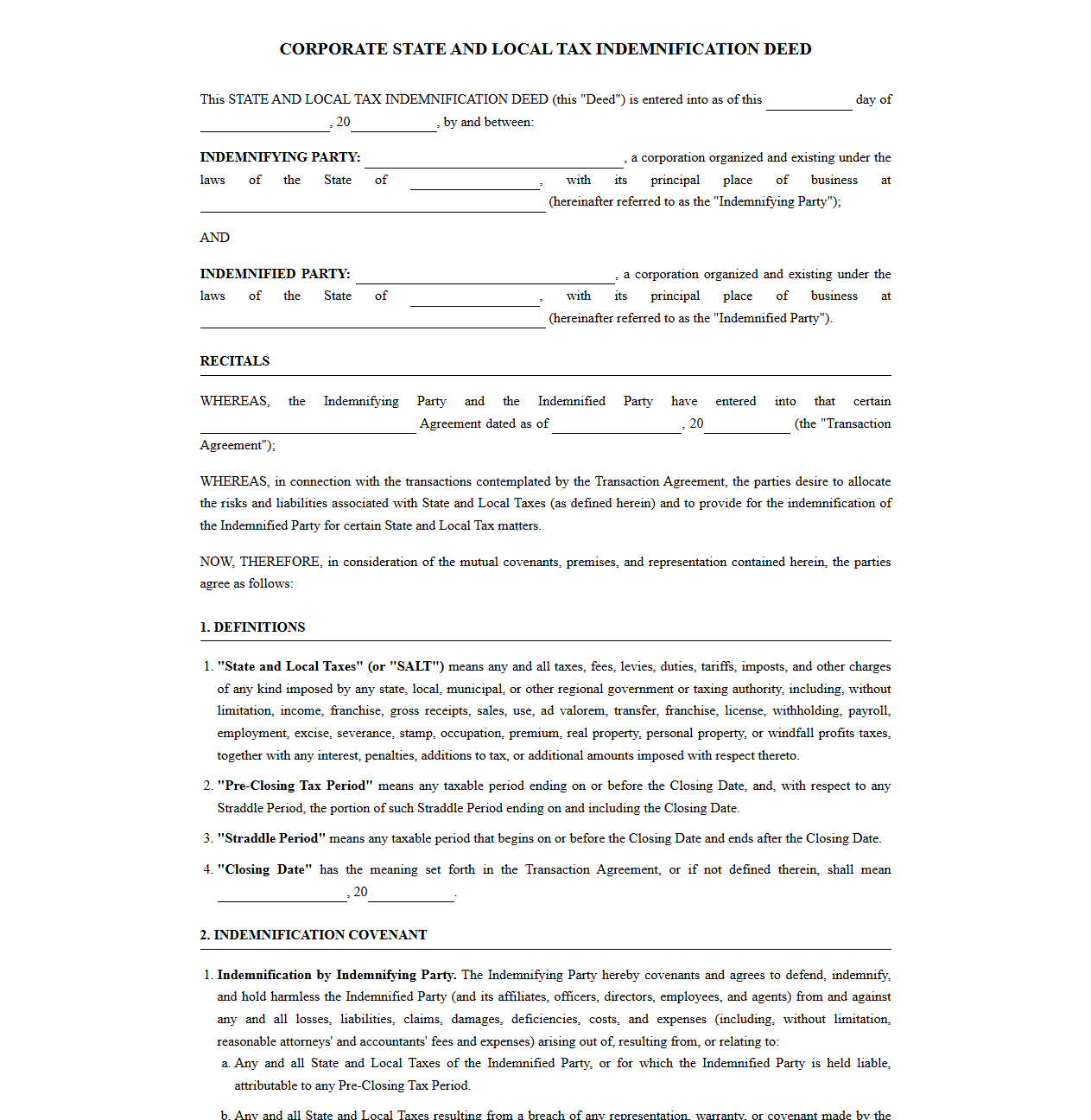
Corporate State and Local Tax Indemnification Deed
 Download: .PDF
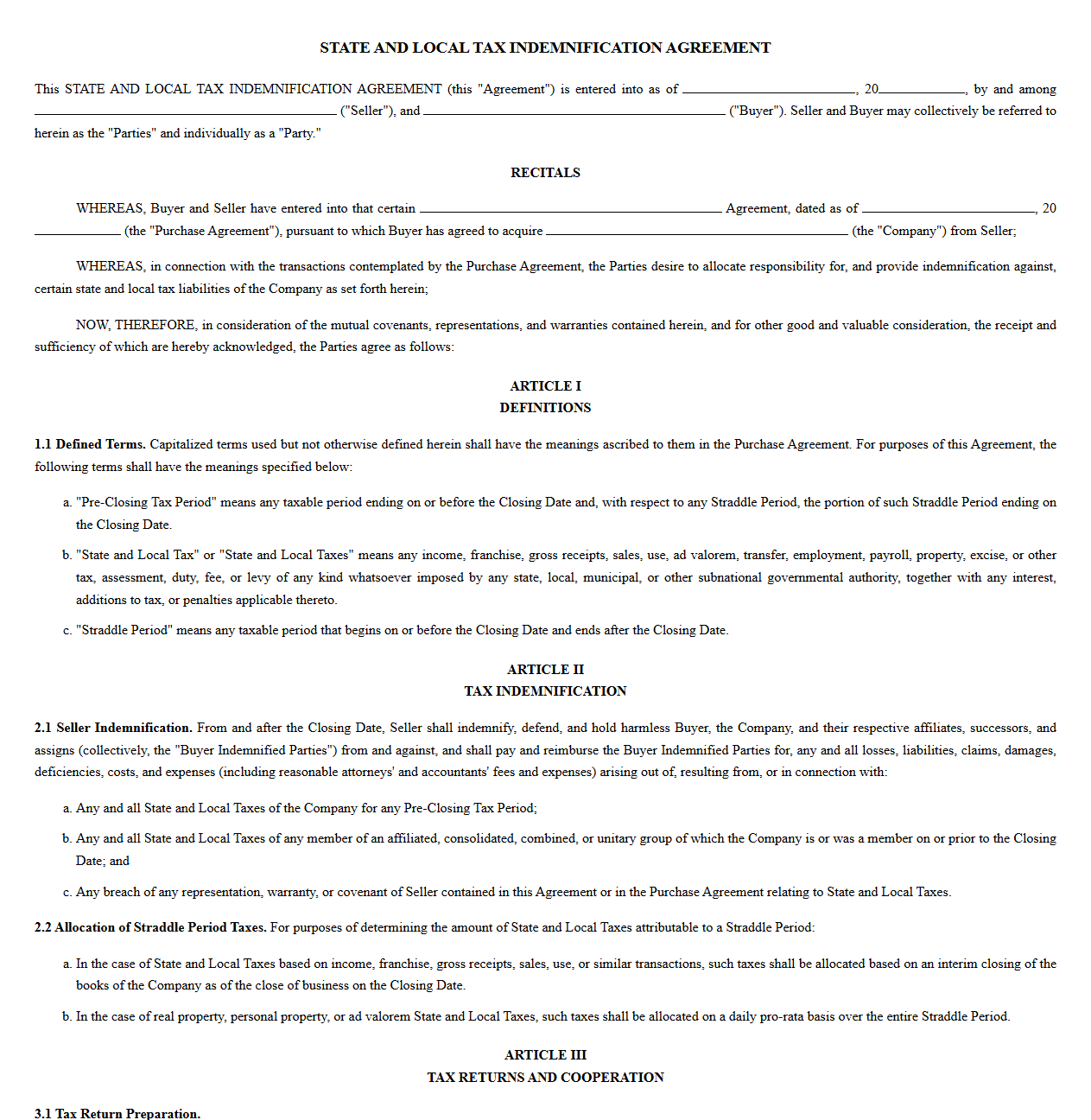
M&A State and Local Tax Indemnity Agreement
 Download: .PDF
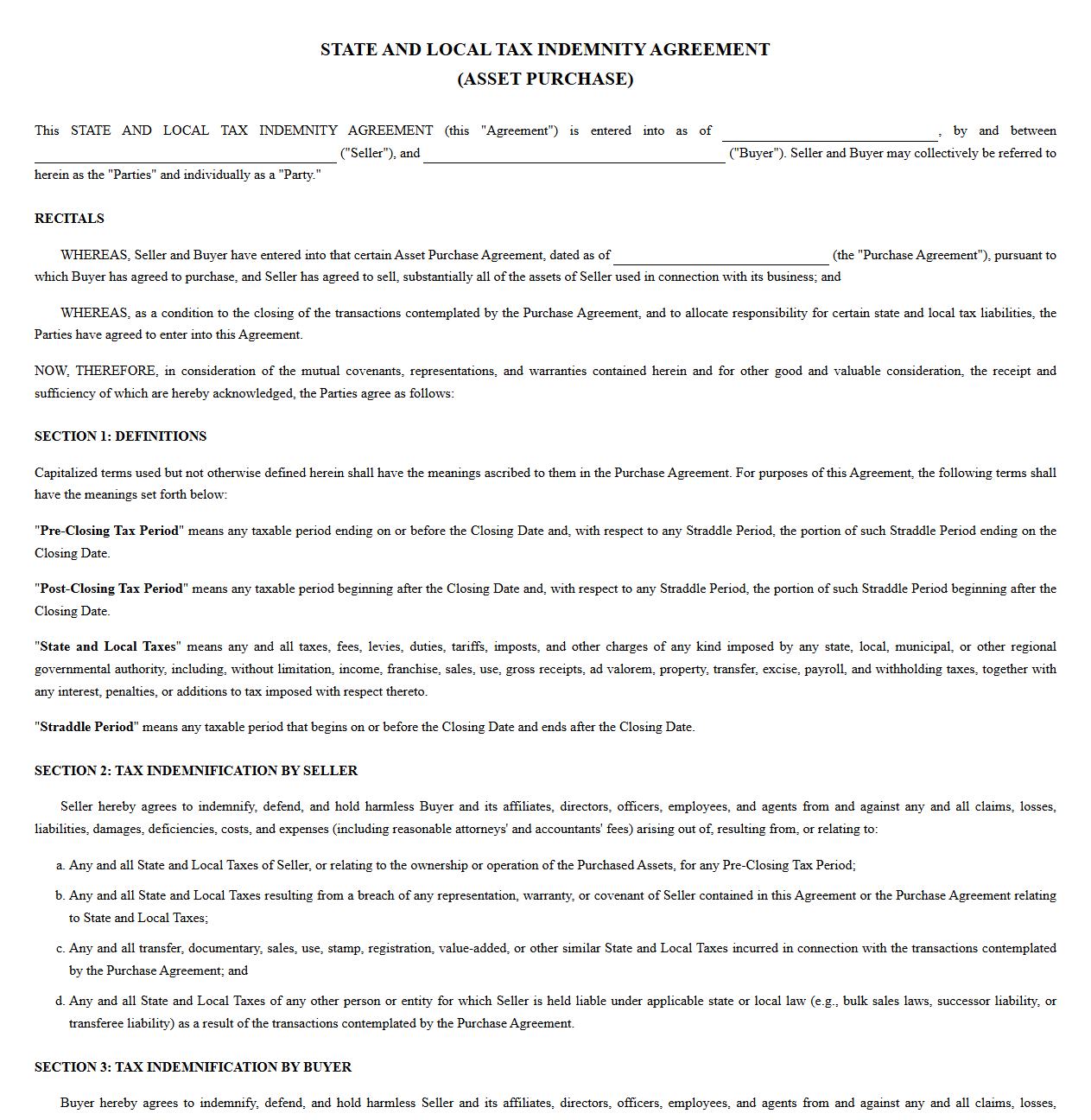
State and Local Tax Indemnity Agreement for Asset Purchase
 Download: .PDF
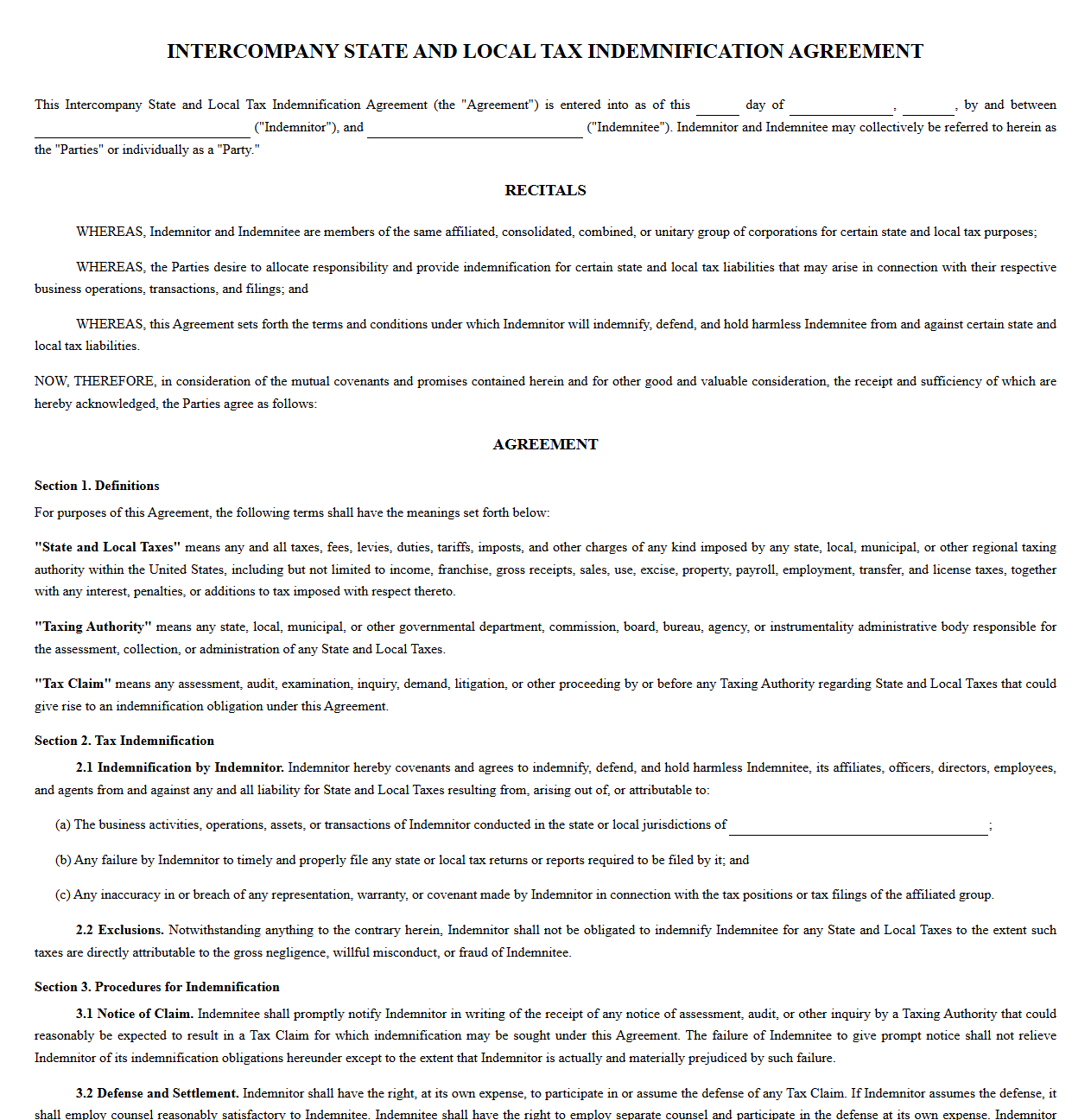
Intercompany State and Local Tax Indemnification Agreement
 Download: .PDF
Understanding State and Local Tax Risks in Corporate Transactions
During corporate mergers and acquisitions, the focus is often on valuation, synergy, and market share. However, undisclosed state and local tax (SALT) liabilities can quietly emerge post-transaction, quickly eroding deal value and disrupting the expected return on investment. These hidden exposures-ranging from unpaid sales and use taxes to unfiled corporate income tax returns in jurisdictions where the target had unrecognized nexus-represent a severe financial risk that can derail an otherwise lucrative deal.
To protect against these unforeseen liabilities, transaction parties rely on a primary risk-mitigation tool: the tax indemnification agreement. By clearly defining which party bears the financial burden of historical tax errors, these agreements convert unquantifiable tax exposure into manageable, contractually allocated risks.
The Mechanics of a SALT Indemnification Agreement
A state and local tax indemnification agreement functions as a contractual reallocation of risk between the transaction parties. When unexpected tax exposures are discovered after the transaction closes, the agreement dictates who is financially responsible. The indemnifying party-typically the seller-promises to hold harmless and compensate the indemnified party-typically the buyer-for any losses arising from pre-closing tax liabilities.
This mechanism operates through a process of claims and reimbursement. If a state department of revenue issues an assessment for a pre-closing period, the indemnified party notifies the indemnifying party, triggering the contractual obligation to resolve or pay the liability, thereby maintaining the bargained-for value of the acquired business.
Essential Clauses for Your Tax Indemnity Template
A robust tax indemnity template must contain precise provisions to prevent disputes over coverage and execution. These clauses serve as the structural framework for allocating potential liabilities.
Tax Representations and Warranties
These are statements of fact made by the seller regarding the target company's historical tax compliance, filing history, and outstanding audits.
Tax Covenants
Covenants govern the conduct of the parties between the signing of the agreement and the closing of the transaction, such as restricting the filing of amended returns without buyer consent.
Specific Indemnity Provisions
These provisions explicitly define the scope of the seller's obligation to cover tax liabilities that are identified as high-risk during due diligence.
An effective template should explicitly compile these elements to ensure comprehensive protection:
- Survival Periods: The timeframe during which the buyer can bring an indemnity claim, typically matching or exceeding the state's statute of limitations.
- Basket and Cap Limits: Financial thresholds that define the minimum claim size (basket) and the maximum aggregate liability (cap) for the seller.
- Notice Requirements: Strict timelines and procedures for notifying the seller of a tax claim or audit.
Allocating Pre-Closing versus Post-Closing Tax Liabilities
A fundamental aspect of any corporate transaction is establishing a clean cutoff date for tax responsibilities. Generally, the seller is responsible for all tax liabilities incurred up to the closing date, while the buyer assumes responsibility for taxes accruing thereafter. However, because tax years do not always align with transaction dates, agreements must address "straddle periods"-tax periods that begin before and end after the closing date-by allocating the tax liability on a pro-rata or closing-of-the-books basis.
"For any Straddle Period, the portion of any Taxes that is allocable to the Pre-Closing Tax Period shall be determined on a closing-of-the-books basis as of the end of the Closing Date, provided that in the case of real property, personal property, or ad valorem Taxes, such Taxes shall be allocated on a daily pro-rata basis."
Establishing Procedures for SALT Audits and Contests
When a state tax authority initiates an audit, the purchase agreement must dictate how the controversy is managed. Clear procedural guidelines ensure that both parties' interests are protected and that the defense is handled efficiently without unnecessary expenses.
- Notification of Audit: The indemnified party must promptly notify the indemnifying party in writing upon receiving an audit notice or assessment from a state agency.
- Control of Defense: The agreement defines which party has the right to control the audit proceedings, typically granting the seller control over audits affecting pre-closing periods, provided they acknowledge their indemnity obligation.
- Participation and Consent Rights: The non-controlling party is granted the right to participate in the proceedings at their own expense, and the controlling party is prohibited from settling the dispute without the other party's prior written consent.
- Expense Allocation: The template specifies how defense costs, legal fees, and administrative expenses are distributed, usually assigning these costs to the party responsible for the underlying tax liability.
Tailoring Indemnification Templates to Specific Jurisdictions
A generic, one-size-fits-all tax indemnity template is rarely sufficient due to the complex web of state and local tax laws. Different states impose distinct nexus standards, particularly in the wake of economic nexus laws for sales tax, which can create exposure even without a physical presence. Failing to customize the agreement to address these local nuances can leave substantial gaps in protection.
When finalizing a transaction, parties must tailor the indemnity template to reflect local filing requirements, specific state apportionment formulas, and regional administrative practices. For instance, states with aggressive gross receipts taxes or unique local-level sales taxes require highly customized representations to ensure that all potential local exposures are thoroughly covered.
Safeguarding Transactions with Robust Tax Indemnity Frameworks
Managing state and local tax risks is a critical component of successful corporate transactions. By utilizing structured indemnification agreements, buyers and sellers can systematically isolate historical tax exposures, ensuring that pre-closing liabilities remain with the party that generated them. This clear division of responsibility minimizes post-closing friction and prevents unexpected assessments from eroding the transaction's financial viability.
A well-drafted tax indemnity template serves as a vital safeguard, providing the contractual certainty required to close complex deals with confidence.

Leave a comment