

Many organizations struggle with costly operational disruptions and misaligned expectations during enterprise system rollouts, which frequently lead to project delays and critical data integrity failures. This friction typically stems from a deeper structural gap: the lack of alignment between technical IT execution and rigorous financial compliance requirements. Utilizing a structured System Implementation and Accounting Advisory Agreement Template grants organizations an immediate, pre-engineered safeguard, ensuring both software deployment and accounting controls are legally and operationally synchronized from day one.
While these templates offer an invaluable baseline, they should be treated as foundational frameworks rather than plug-and-play solutions, requiring adaptation to your specific regulatory landscape. Incorporating concrete provisions-such as milestone-based acceptance criteria, defined service level agreements (SLAs), and data migration protocols-serves as actionable proof of how these documents mitigate risk.
In this article, we will dissect the essential components of these agreements, explore critical risk mitigation strategies, and outline how to customize templates for maximum organizational protection.
System Implementation and Accounting Advisory Agreement
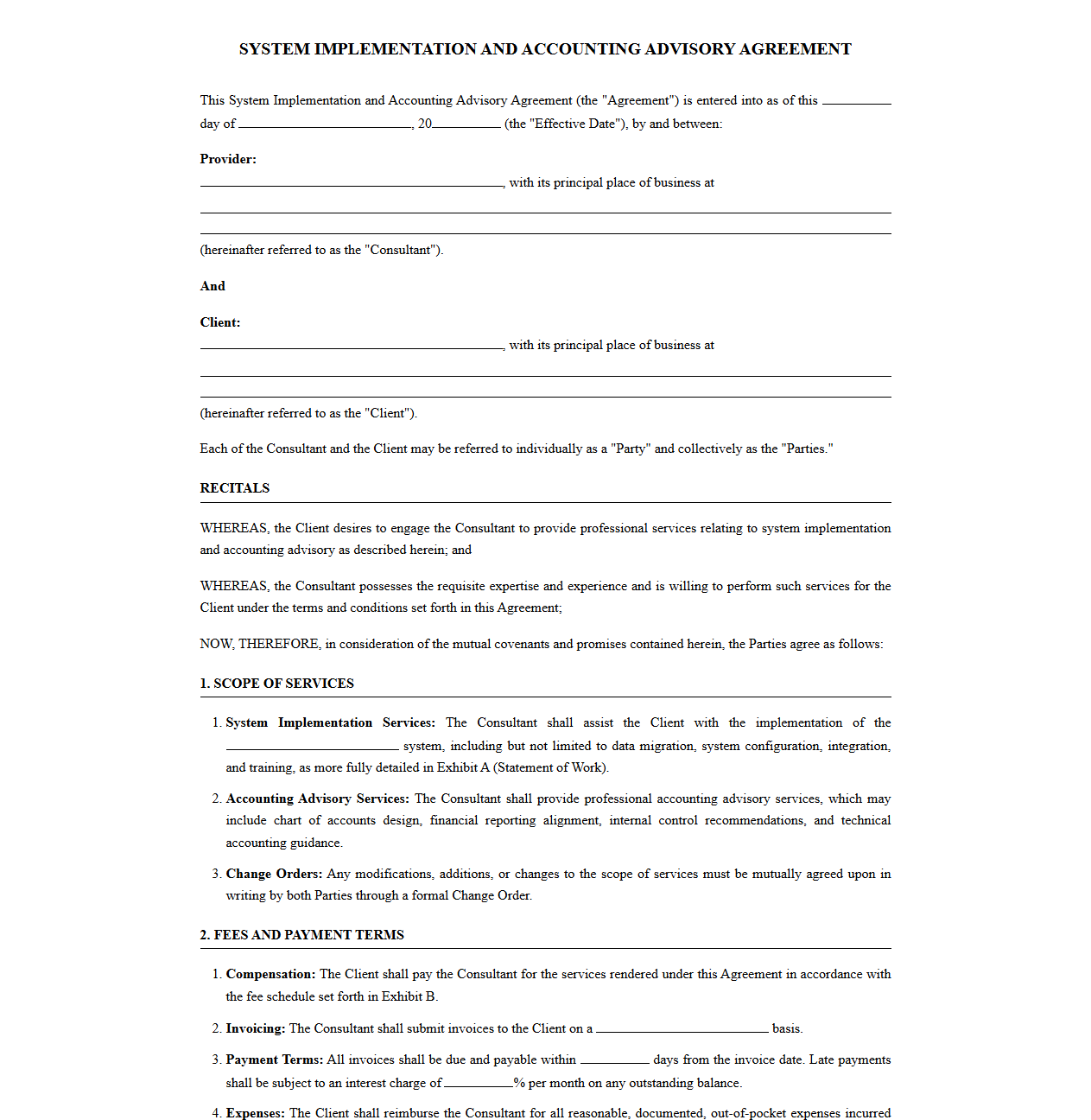 Download: .PDF
ERP Implementation and Accounting Advisory Services Contract
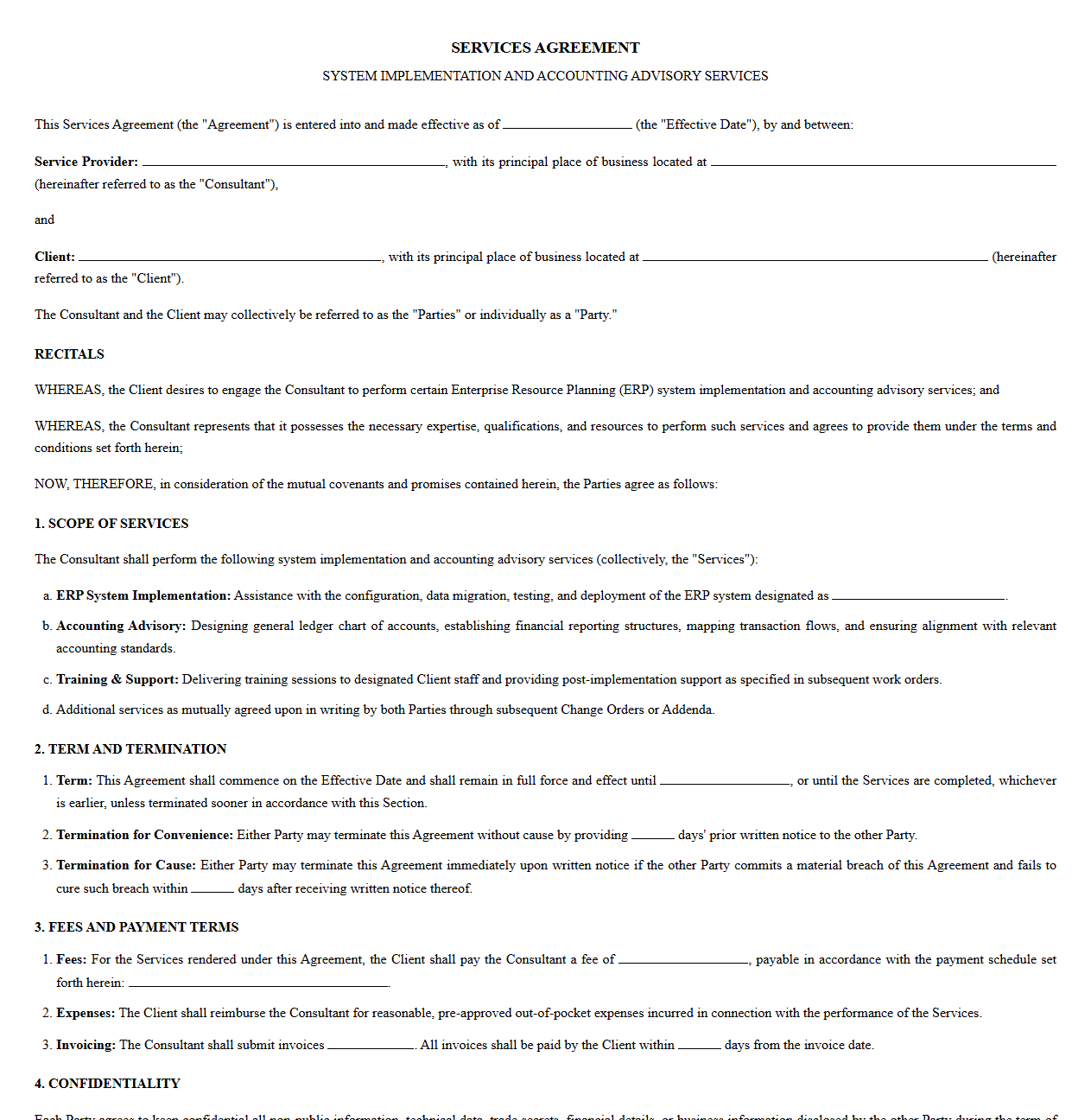 Download: .PDF
Accounting Advisory and IT System Implementation Agreement
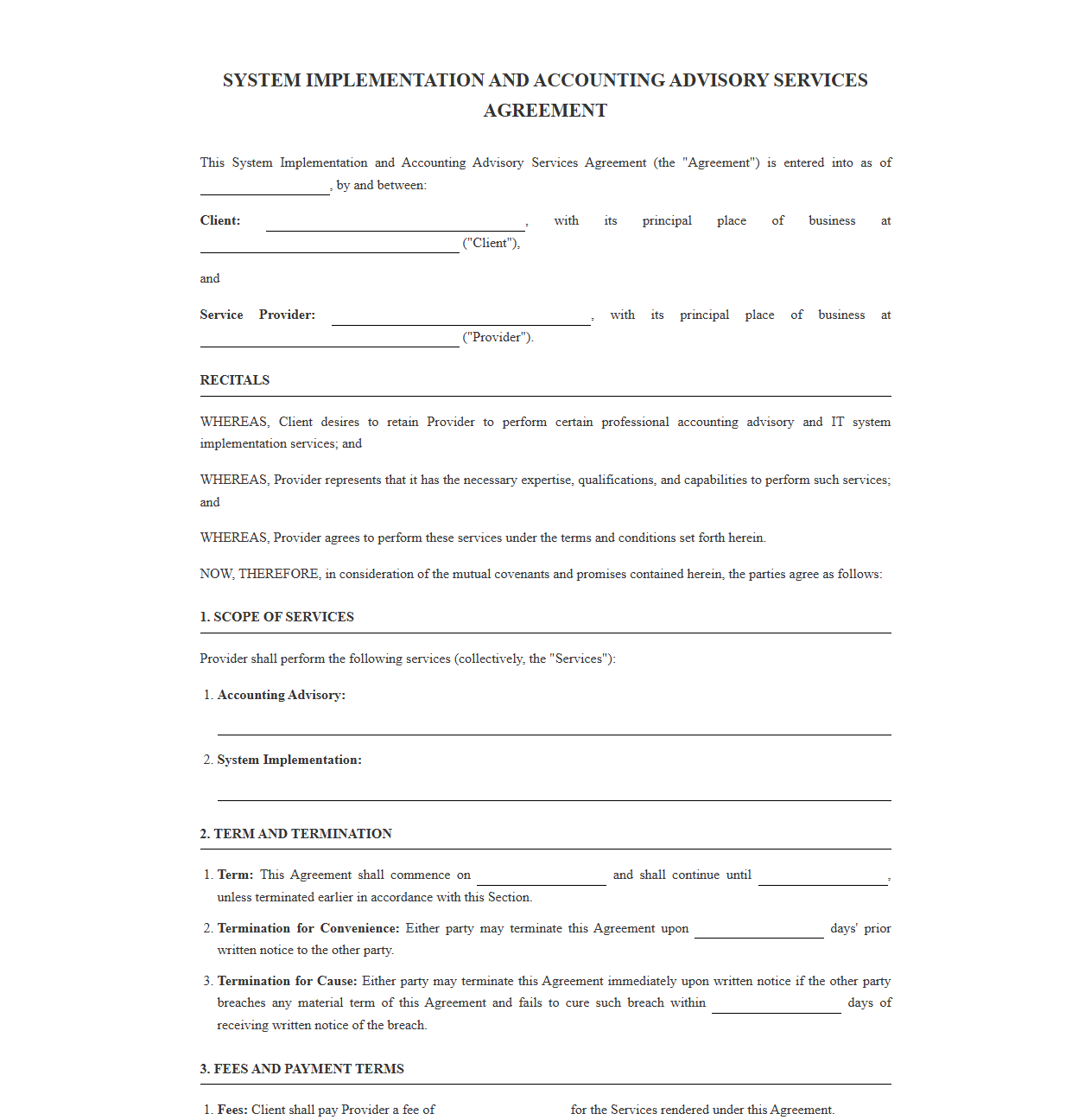 Download: .PDF
Master Services Agreement for System Implementation and Accounting
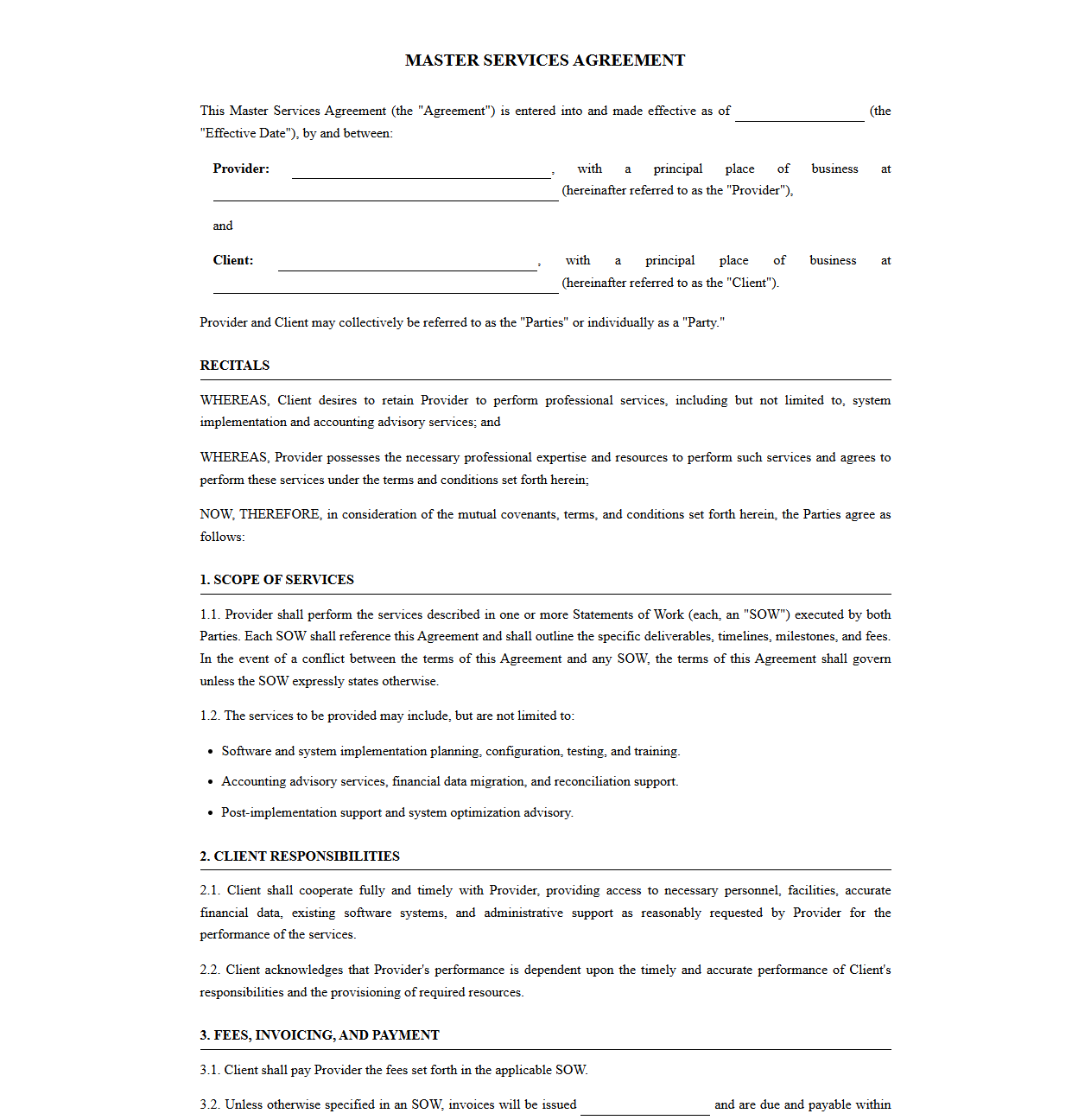 Download: .PDF
Financial Systems Implementation and Accounting Advisory Agreement
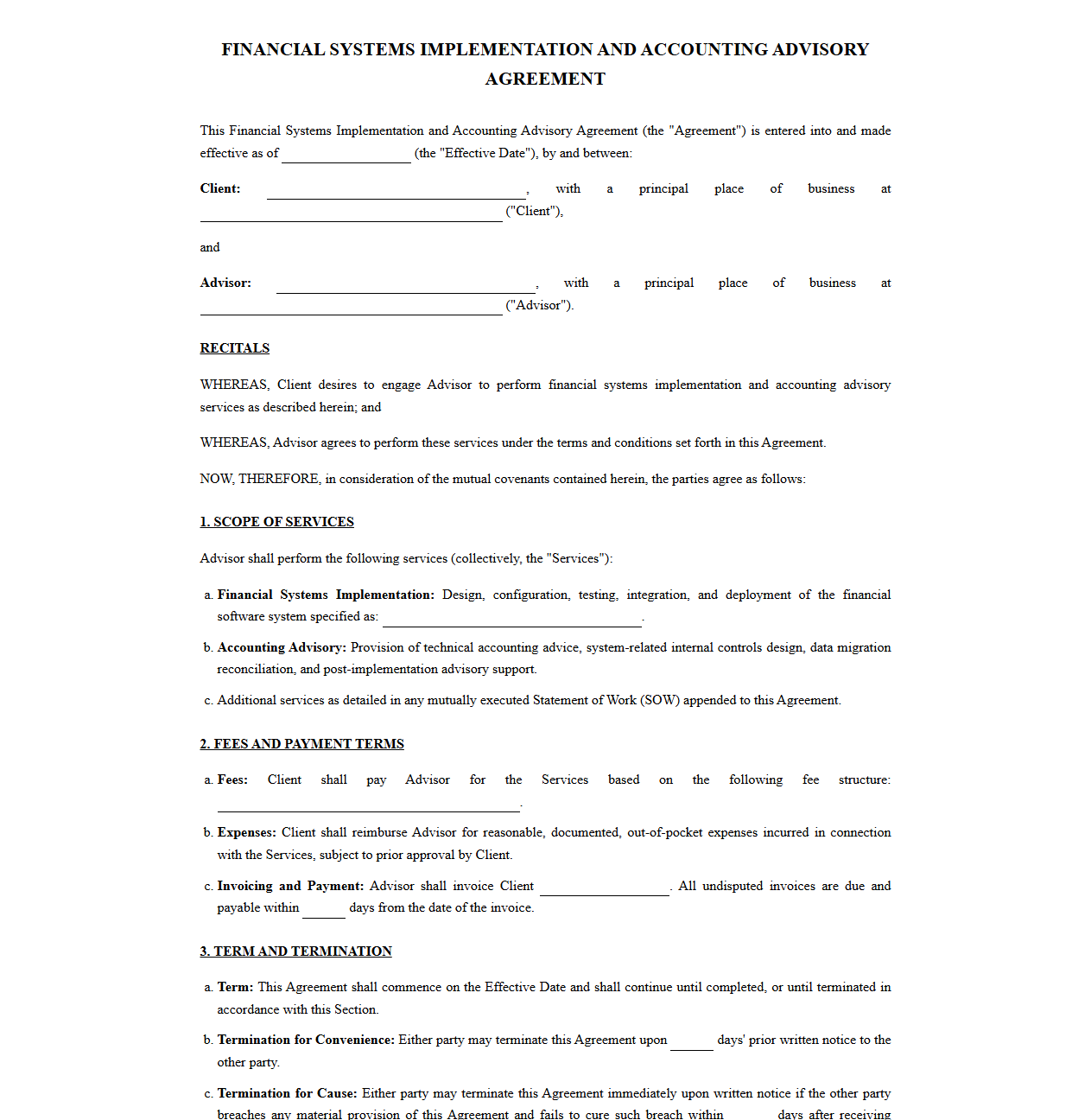 Download: .PDF
Consulting Agreement for System Implementation and Accounting Advisory
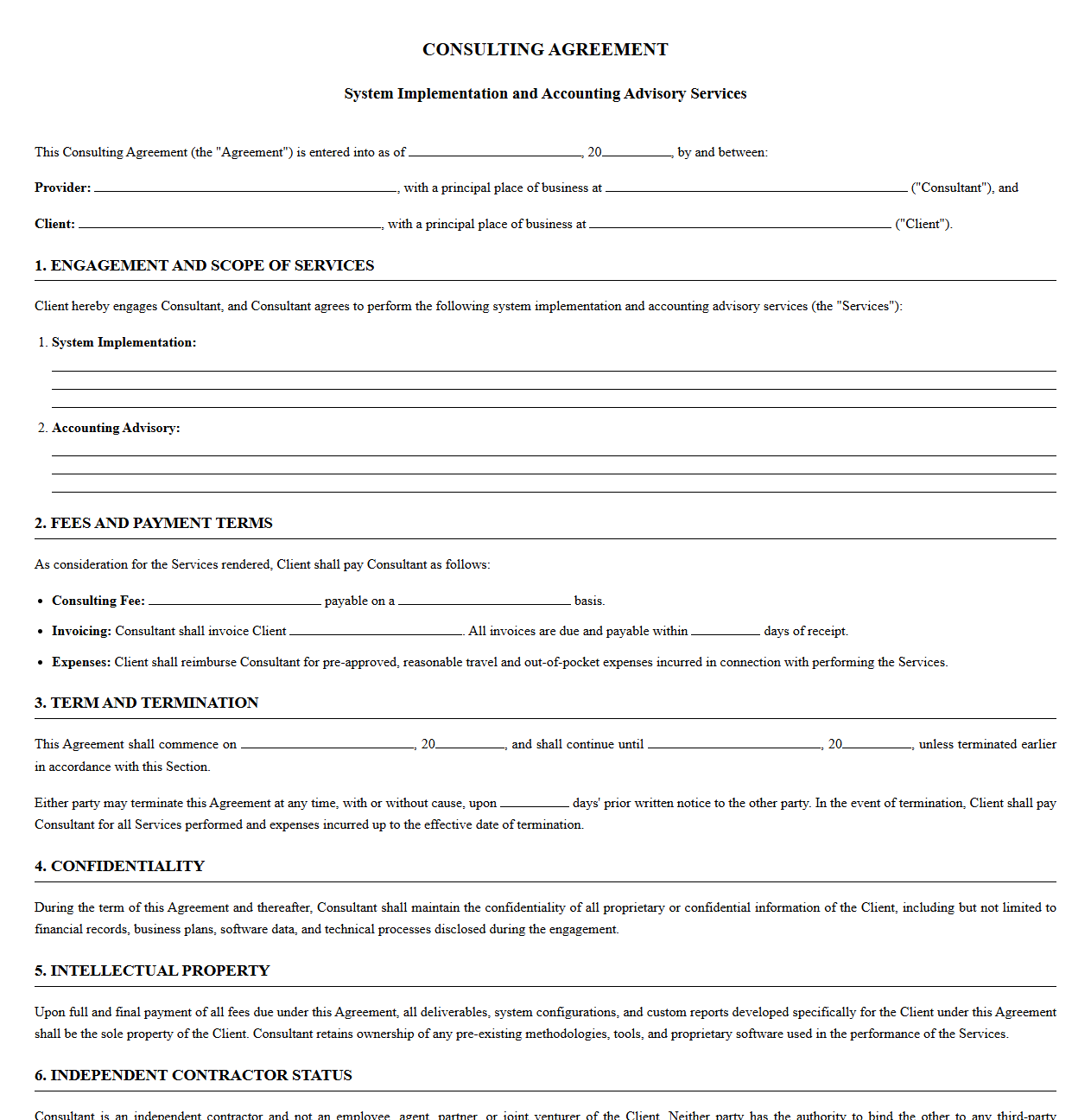 Download: .PDF
Software Deployment and Accounting Advisory Services Contract
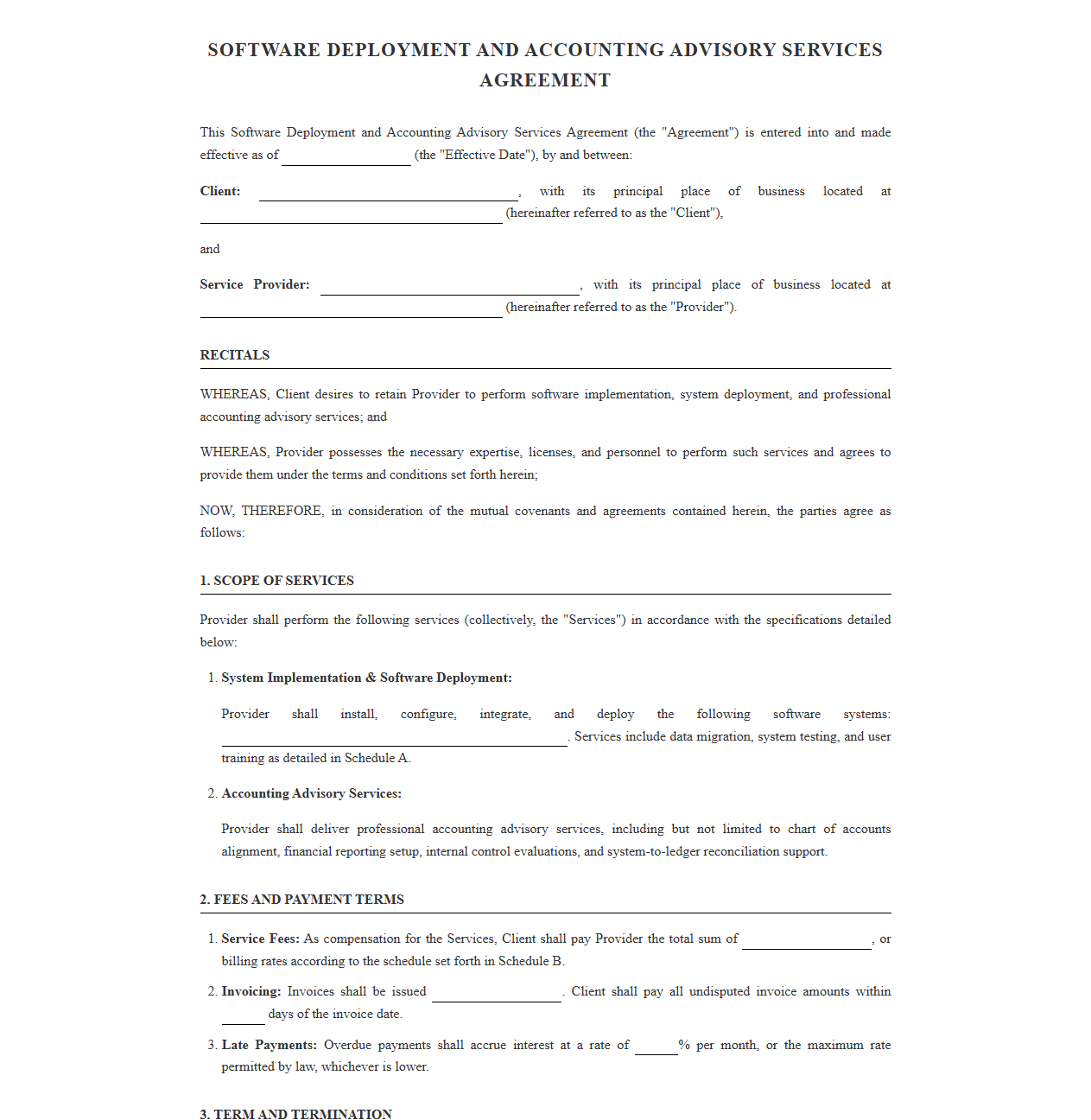 Download: .PDF
System Integration and Financial Advisory Services Agreement
 Download: .PDF
Understanding Integration Risks in ERP and System Implementation
Implementing an Enterprise Resource Planning (ERP) system is a transformative milestone for any organization, yet it is fraught with hidden operational hazards. One of the most critical failure points in complex system rollouts is the profound misalignment between technical IT teams and financial accounting departments. While IT specialists focus on system architecture, database performance, and software deployment, they often lack a deep understanding of accounting standards, tax configurations, and internal control frameworks. When this communication gap occurs, financial data mapping errors arise, leading to inaccurate ledger balances, broken audit trails, and severe reconciliation discrepancies that can paralyze a business's reporting capabilities.
The Strategic Role of Accounting Advisory Services
To bridge the divide between technical deployment and strict financial compliance, organizations leverage accounting advisory services. Advisory professionals translate complex accounting policies into technical requirements that system integrators can easily implement. By validating financial data pipelines, testing journal entry logic, and verifying reporting outputs, these experts ensure complete data integrity and regulatory adherence. Their oversight guarantees that the newly deployed system is not merely operational from an IT perspective, but fully compliant with GAAP, IFRS, and internal control mandates from day one.
Structuring the Agreement: Key Components of the Template
A standardized System Implementation and Accounting Advisory Agreement aligns both parties on objectives, deliverables, and timelines. Utilizing a structured template ensures that technical, financial, and legal teams have a shared understanding of their obligations, preventing mismatched expectations. A robust template should always incorporate the following key components:
- Detailed Scope of Services: A comprehensive breakdown of the specific IT integration and advisory tasks to be performed.
- Data Governance and Security Protocol: Clear guidelines on data ownership, security measures, and compliance with data protection laws.
- Project Timeline and Milestones: A structured schedule defining target completion dates for key phases of the implementation.
- Payment Terms and Fee Structure: Clear definitions of resource rates, milestone payments, and reimbursement parameters.
Proactive Risk Mitigation Through Clear Contractual Terms
System integrations rarely progress without unexpected obstacles, making proactive risk mitigation essential. The advisory agreement must address potential operational disruptions, system downtime, data migration failures, and the terms of post-go-live support to prevent prolonged project stalling. By outlining clear escalation paths and liability structures directly in the contract, organizations establish predictable protocols for handling system errors. A well-crafted agreement should feature protective language to handle these contingencies:
"In the event of data migration anomalies or critical system downtime exceeding the agreed-upon threshold during the transition phase, the Advisor shall deploy dedicated remediation resources within four hours, prioritizing the restoration of financial data integrity and transaction processing capabilities."
Defining Scope of Work and Preventing Scope Creep
Establishing the Boundaries of the Statement of Work (SOW)
Scope creep is one of the primary drivers of budget overruns and delayed launch dates in system implementation projects. Without a meticulously detailed Statement of Work (SOW) appended to the primary agreement, the boundaries of the integration quickly blur. When stakeholders request minor system adjustments, custom reports, or extra training sessions without formal change-control processes, the project's timeline inevitably slips. Defining clear boundaries within the SOW keeps both the client and the advisory firm accountable to the original project plan.
Allocating Liability and Establishing Dispute Resolution
When system integrations encounter severe technical failures, assigning responsibility is crucial to avoiding protracted legal conflicts. A robust advisory agreement addresses these vulnerabilities by establishing clear thresholds for limitation of liability, ensuring that neither party faces disproportionate financial ruin. Furthermore, the inclusion of mutual indemnification clauses protects both the client and the advisory firm from third-party claims arising from breaches of security or intellectual property infringement. Implementing a structured, multi-tiered dispute resolution framework-commencing with executive negotiation and advancing to mediation-ensures that disagreements are resolved constructively without halting project momentum.
Achieving Seamless Integration with Standardized Templates
A successful system implementation requires a perfect balance of technical precision, financial accuracy, and legally sound partnerships. Utilizing a comprehensive, pre-drafted agreement template allows businesses to quickly establish clear operational boundaries, protect their financial systems, and accelerate deployment timelines. By removing ambiguity before the integration begins, organizations can confidently execute their digital transformation strategies while minimizing financial and operational risks.

Leave a comment