

Tax practitioners frequently struggle with "scope creep," where high-value strategic planning sessions quietly dissolve into uncompensated advisory hours. As firms transition from seasonal, reactive compliance to year-round advisory models, establishing clear operational boundaries becomes paramount before delivering any high-level advice.
Implementing a robust, structured retainer agreement grants practitioners both predictable monthly cash flow and ironclad liability protection. By educating clients through clear contractual stipulations-such as explicitly defining the limits of "consultative hours" and specifying separate pricing for unexpected IRS audit representation-you protect your firm's expertise and prevent boundary erosion.
This article explores the essential retainer templates, strategic clauses, and deployment methods necessary to secure your advisory engagements, manage client expectations, and ensure you are fairly compensated for your specialized intellectual capital.
Tax Consultation and Planning Retainer Agreement
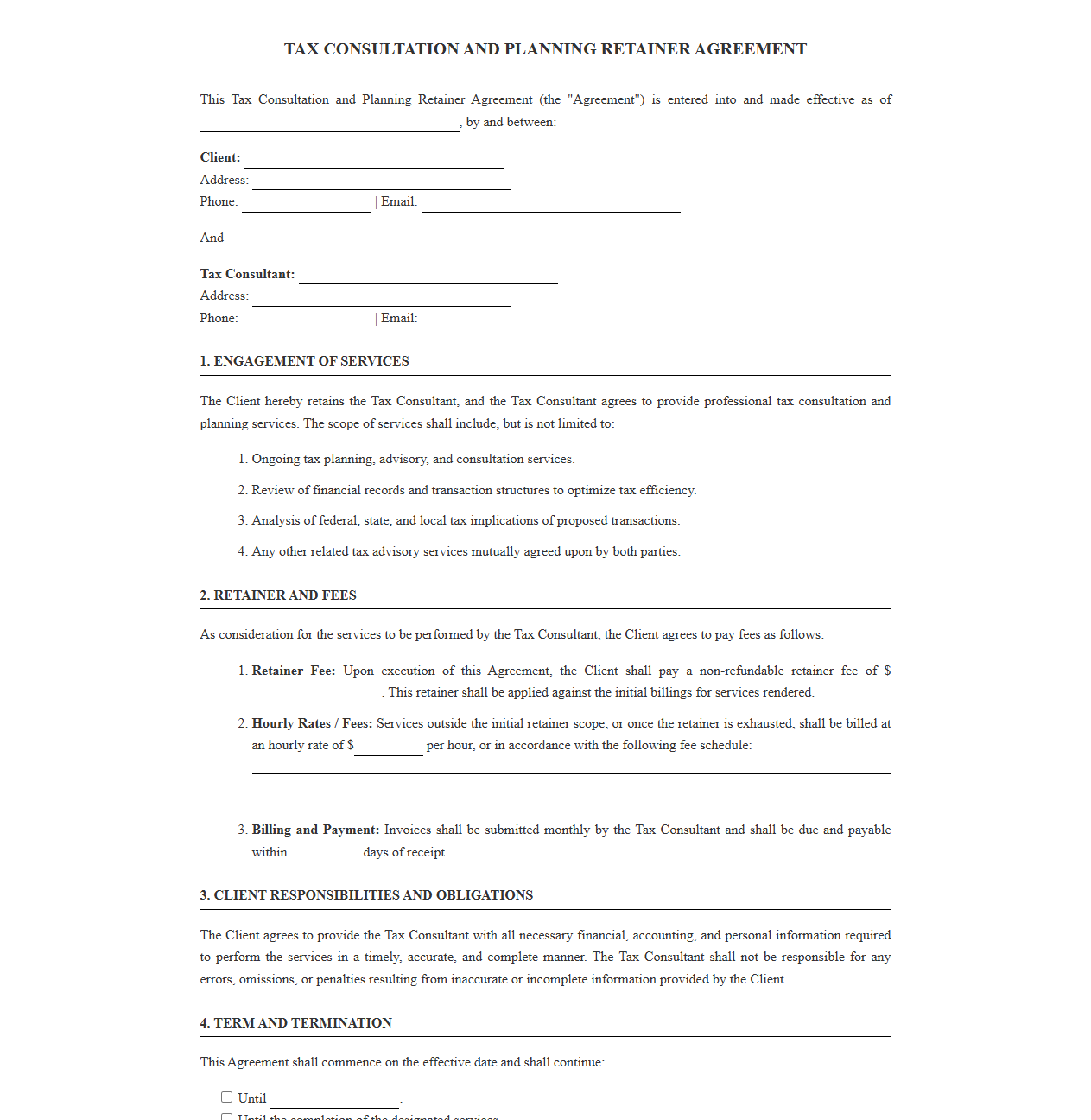 Download: .PDF
Retainer Agreement for Tax Advisory and Planning Services
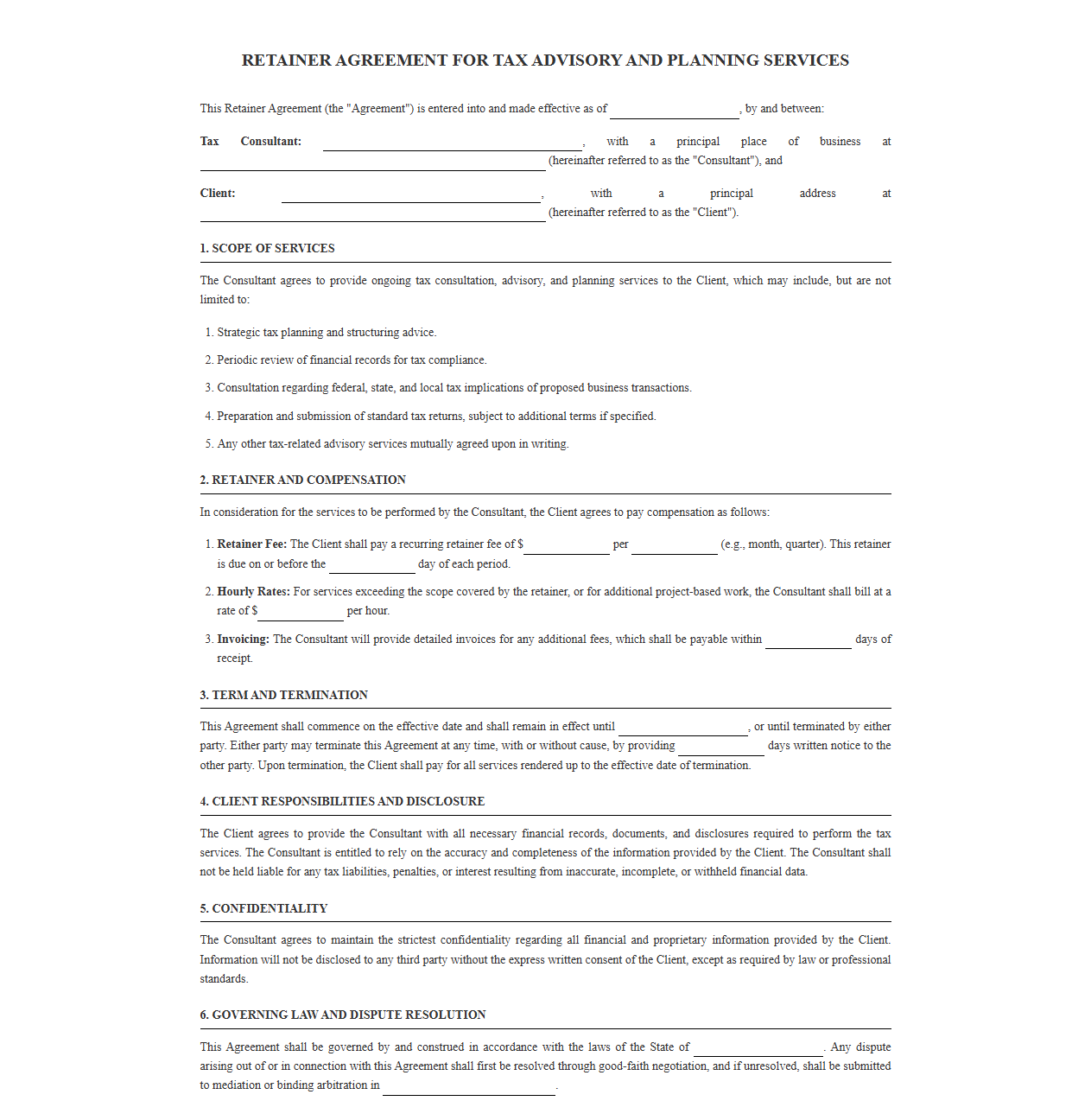 Download: .PDF
Tax Planning and Advisory Retainer Contract Template
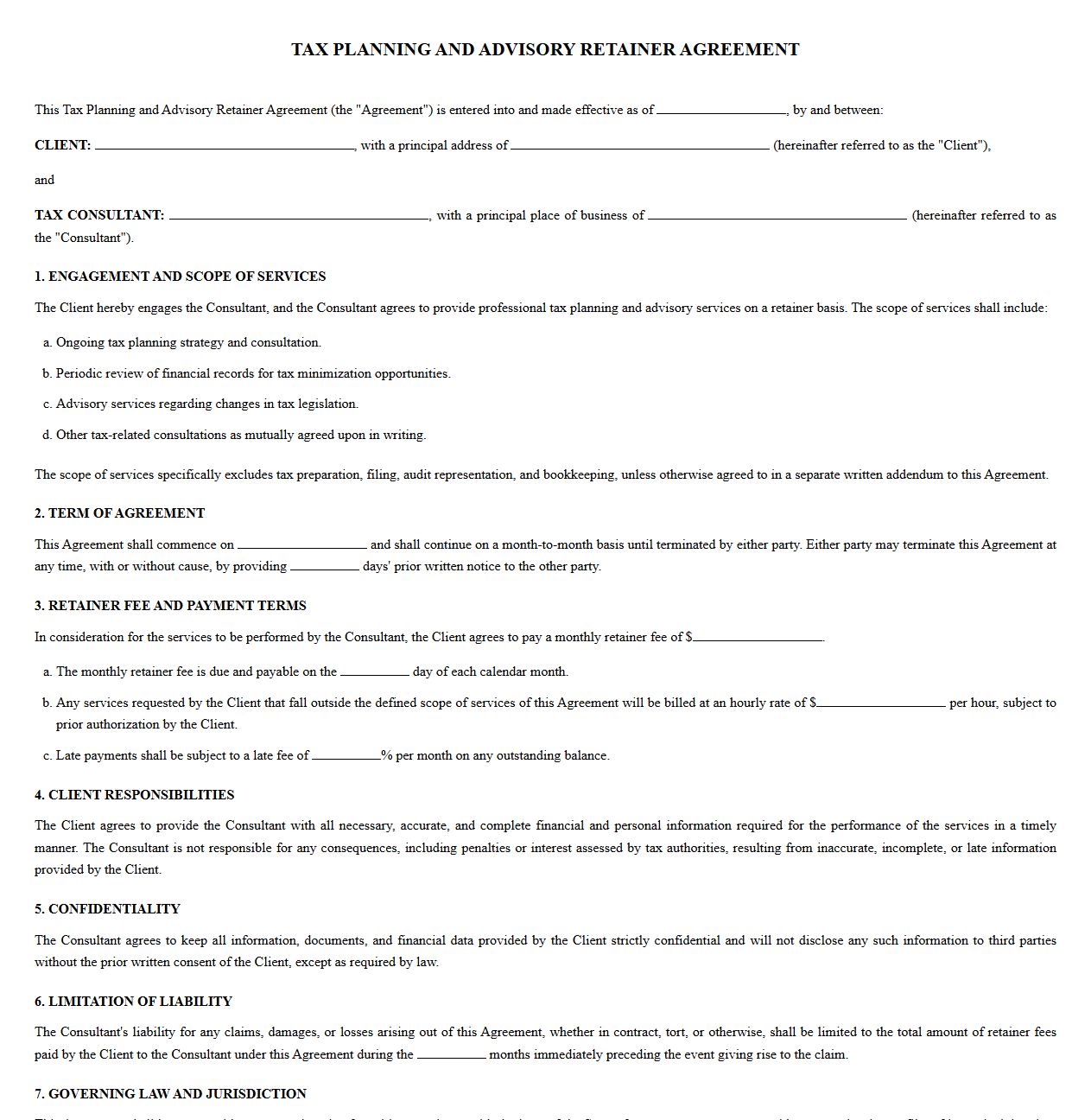 Download: .PDF
Annual Tax Consultation Retainer Agreement Form
 Download: .PDF
Tax Planning Services Engagement and Retainer Contract
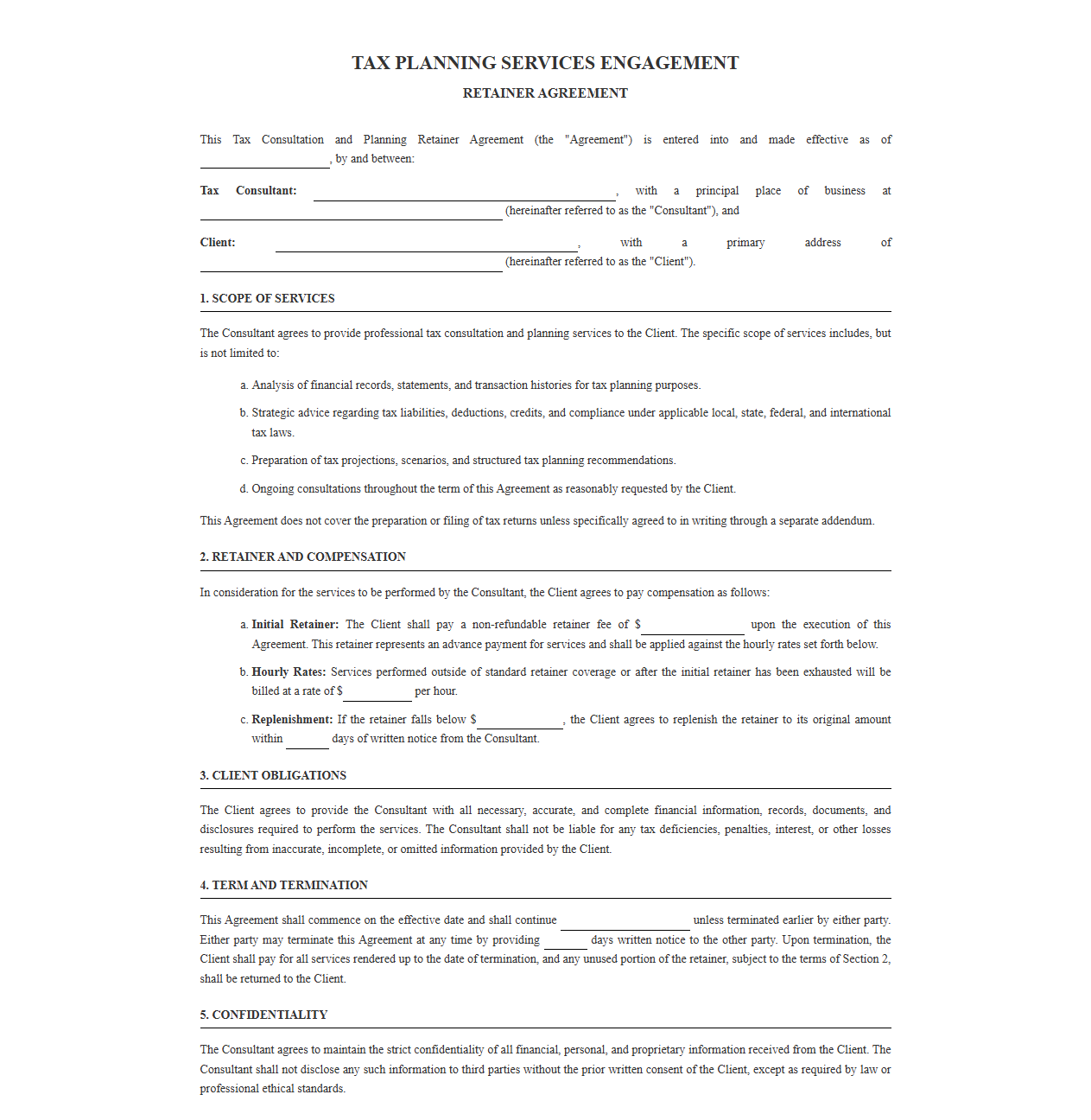 Download: .PDF
Professional Tax Consultation Retainer Agreement Template
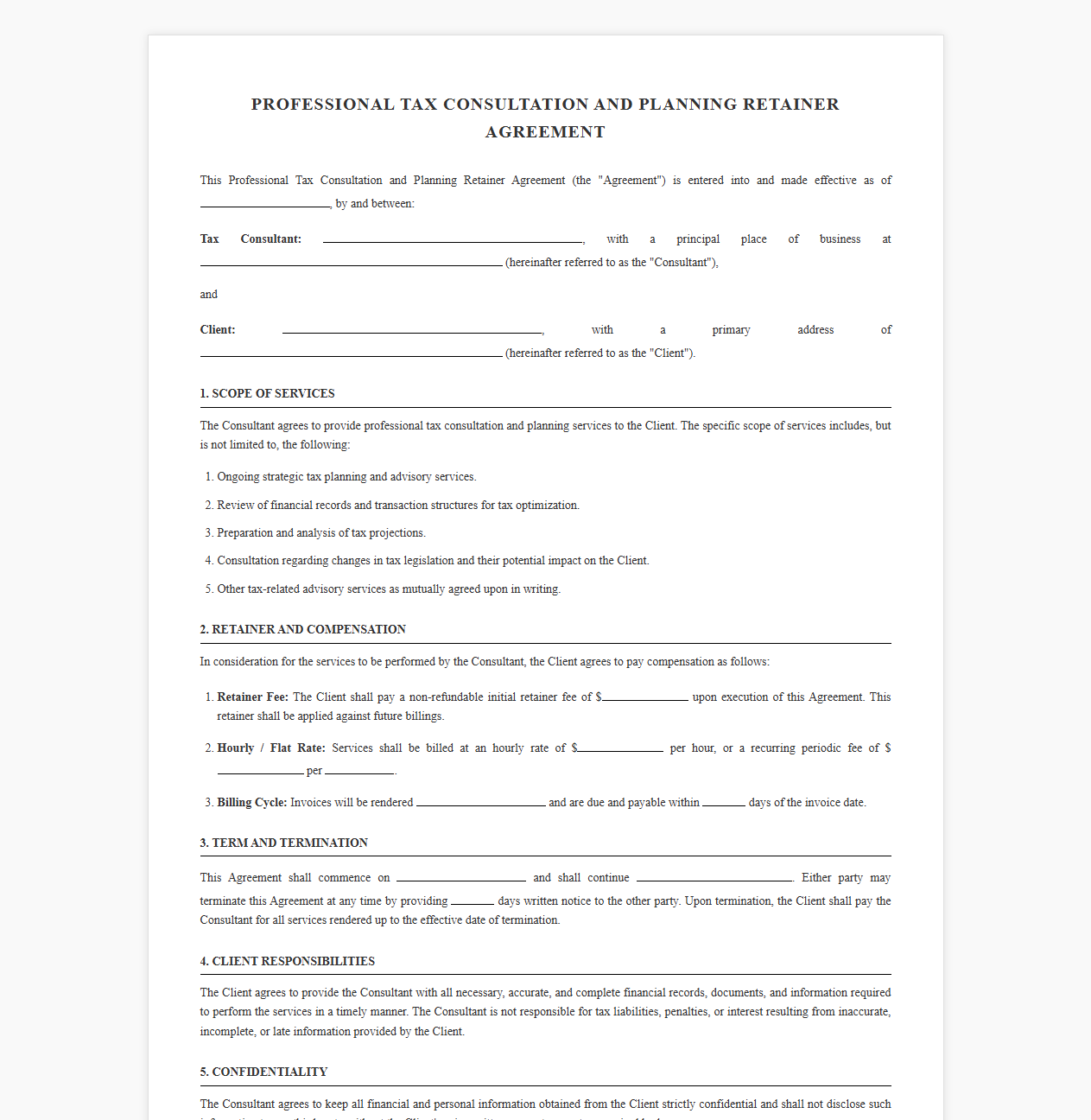 Download: .PDF
Strategic Tax Planning Retainer Services Agreement
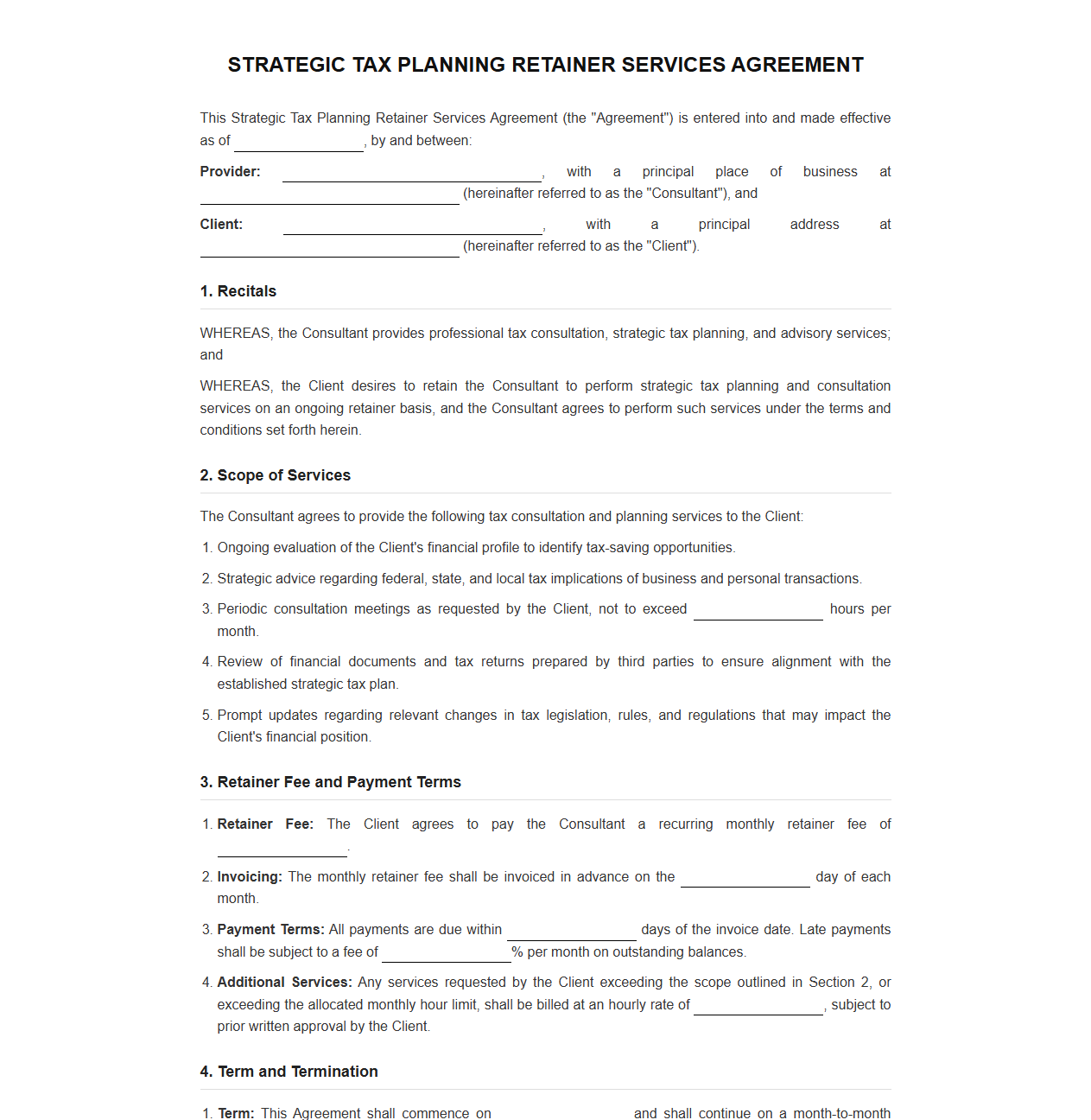 Download: .PDF
Retainer Contract for Tax Consulting and Compliance
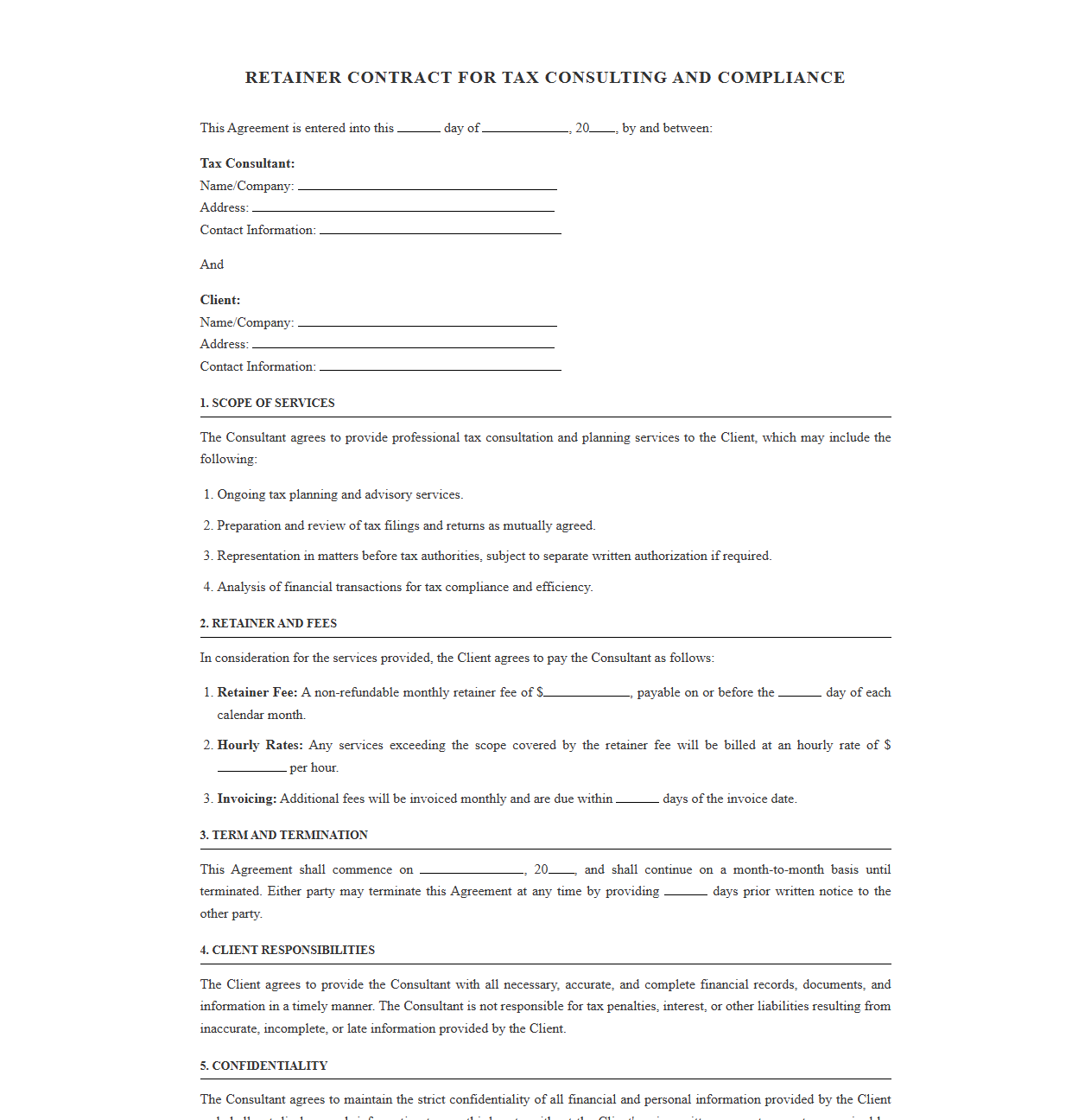 Download: .PDF
Establishing the Foundation: Why Tax Advisory Needs Strategic Retainers
Tax advisory operates in a high-stakes environment where regulatory landscapes shift rapidly and financial decisions carry long-term consequences. Unlike standard compliance work, strategic tax planning involves ongoing consultation, making advisors vulnerable to unique professional liabilities. Without a clear contract, misunderstandings regarding oral advice or shifting tax strategies can quickly escalate into costly legal disputes.
A robust retainer agreement acts as the first line of defense for tax advisors. It establishes a formal legal framework that defines the parameters of the professional relationship before any advisory work begins. By securing a strategic retainer, firms can mitigate high-risk exposure factors such as retroactive audit liabilities, undocumented verbal guidance, and uncompensated research hours spent on complex tax codes.
Defining the Scope of Engagement: Preventing Scope Creep
One of the most common challenges in tax consulting is scope creep-the gradual expansion of a project beyond its original boundaries without a corresponding increase in fees. To protect firm profitability, advisors must clearly outline what is included in the advisory package and what constitutes an additional billable service. A well-drafted engagement clause draws a sharp line between routine maintenance and specialized consultations.
To prevent unpaid advisory work, retainer agreements should explicitly categorize services. Here is an example of how to segment these boundaries:
- In-Scope Services: Standard quarterly tax planning, regular monitoring of federal tax policy updates, and scheduled monthly advisory calls.
- Out-of-Scope Services: Representation during IRS audits, preparation of retroactive state and local tax (SALT) filings, and transactional restructuring advice for mergers or acquisitions.
- Discretionary Consultations: Ad-hoc financial modeling and estate planning reviews, which are billed at standard hourly rates unless otherwise agreed in writing.
Fee Structures and Retainer Payment Terms
Aligning financial expectations prevents cash flow disruptions and minimizes collection hurdles. Tax advisors typically employ one of three retainer models: evergreen retainers (where the client replenishes a set deposit), advanced retainers (pre-paying for a block of hours), or monthly recurring consulting fees. To ensure seamless billing, the contract must outline an explicit payment workflow.
Establishing a structured process for payment collections ensures transparency and protects the firm's accounts receivable:
- The client deposits the initial retainer fee into the designated firm account prior to the commencement of any advisory services.
- The firm issues an itemized monthly statement detailing the advisory hours consumed and the remaining balance.
- The client must replenish the retainer to its original agreed-upon threshold within ten business days of receiving the statement.
- Late payments exceeding fifteen calendar days will incur a standard interest charge of 1.5% per month, and work will be suspended until the balance is cleared.
Managing Liability and Indemnification Clauses
Tax advisors often rely on financial data provided directly by the client. If a client submits inaccurate bookkeeping records, the resulting tax strategy may lead to penalties or audits. To manage this risk, the retainer agreement must include language that limits the advisor's liability and shifts the responsibility for data accuracy back to the client.
An effective agreement features a strong indemnification clause that protects the firm from errors resulting from client negligence or misinformation. Below is a standard limitation of liability template designed for tax advisory engagements:
"The Client agrees to indemnify, defend, and hold harmless the Advisor from any and all claims, liabilities, damages, or costs (including reasonable attorneys' fees) arising from tax positions taken based on incomplete, inaccurate, or misleading financial information provided by the Client. The Advisor's maximum aggregate liability for any errors or omissions under this agreement shall be strictly limited to the total fees paid by the Client to the Advisor during the preceding twelve-month period."
Confidentiality and Data Protection in Tax Consulting
Because tax advisors handle highly sensitive financial data, incorporating robust security and privacy clauses is both a operational necessity and a legal requirement. Firms must demonstrate strict compliance with federal regulations governing tax preparers and advisors. Neglecting these standards can lead to severe statutory penalties and a loss of client trust.
Retainer agreements must explicitly reference compliance with IRC Section 7216, which prohibits the unauthorized disclosure or use of tax return information by preparers. Additionally, clauses should detail the written information security plan (WISP) protocols utilized by the firm to safeguard digital assets, ensuring that client data is protected by industry-standard encryption, multi-factor authentication, and secure document portals during transmission.
Dispute Resolution and Termination Protocols
Even with clear boundaries, disagreements can arise regarding tax strategies or billing expectations. To avoid expensive litigation, the retainer agreement should outline a clear, step-by-step mechanism for resolving disputes outside of the courtroom. This typically involves structured negotiation followed by binding mediation or arbitration in a mutually agreed-upon jurisdiction.
Similarly, the contract must establish clear protocols for wrapping up the relationship if either party decides to part ways. This prevents sudden disruptions and ensures a clean transition of records.
Executing the Agreement: Best Practices for Client Onboarding
A well-drafted retainer agreement is only effective if it is executed properly. When onboarding a new tax advisory client, take the time to walk them through the document, highlighting the scope boundaries, payment expectations, and liability limits. This transparent approach builds mutual trust and ensures that both parties are aligned before any advisory work begins.
To streamline this process, integrate the contract directly into your digital onboarding workflow. Utilize secure, legally binding electronic signature platforms to obtain authorizations quickly. By establishing clear boundaries, secure systems, and written consent from day one, your firm can focus on delivering high-value tax strategies while remaining fully protected against administrative and legal risks.

Leave a comment