

Corporate transactions often stall under the weight of unforeseen tax liabilities, leaving buyers and sellers locked in high-stakes disputes over indemnity limits. Traditionally, dealmakers relied on restrictive escrow accounts to mitigate these exposures, a practice that frequently ties up crucial capital for years.
Implementing a structured Tax Representation and Warranty Indemnity Agreement Template grants transaction partners the robust legal framework needed to close deals swiftly while safeguarding liquid capital. However, it is critical to note that these templates serve as foundational guides rather than universal remedies; their efficacy relies entirely on precise customization. For example, addressing specific risks like pre-closing income tax liabilities or historical state sales tax audits requires highly tailored carve-outs.
This article will examine how to effectively deploy these templates to mitigate transactional friction, allocate risk equitably, and secure your next transaction.
Tax Representation and Warranty Indemnity Agreement Template
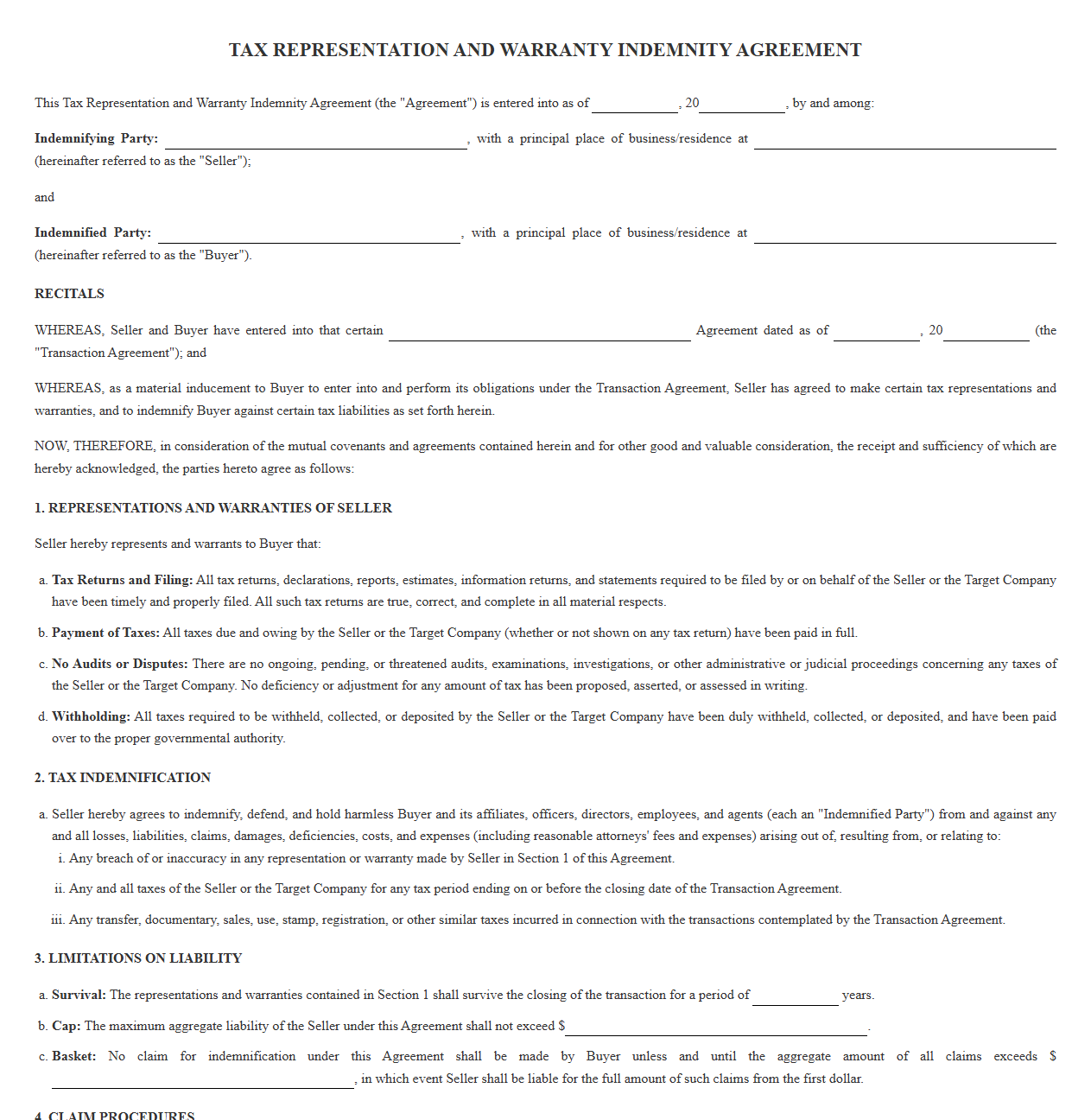 Download: .PDF
Tax Indemnity Agreement for Representations and Warranties
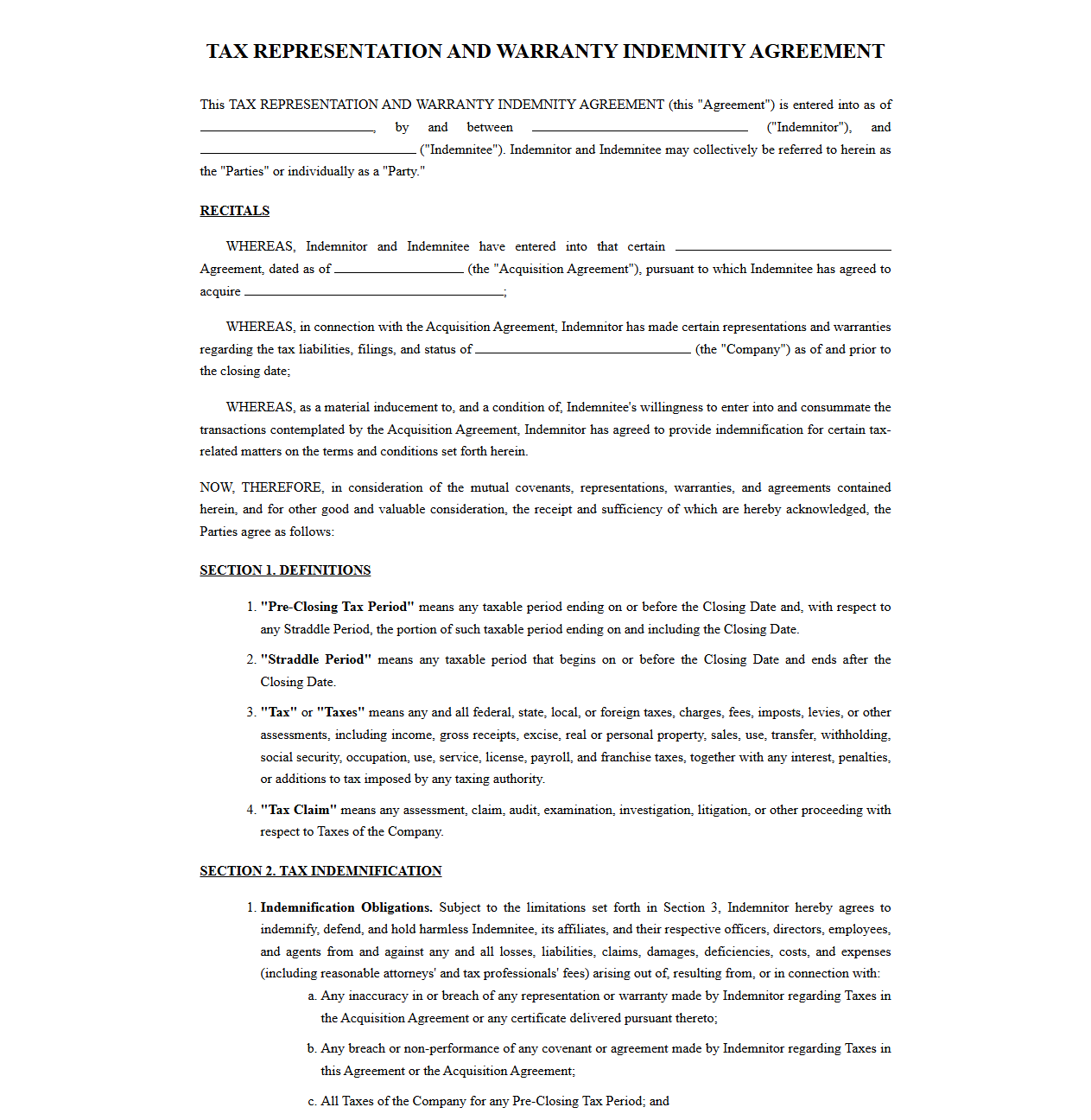 Download: .PDF
Share Purchase Tax Representation and Warranty Indemnity Deed
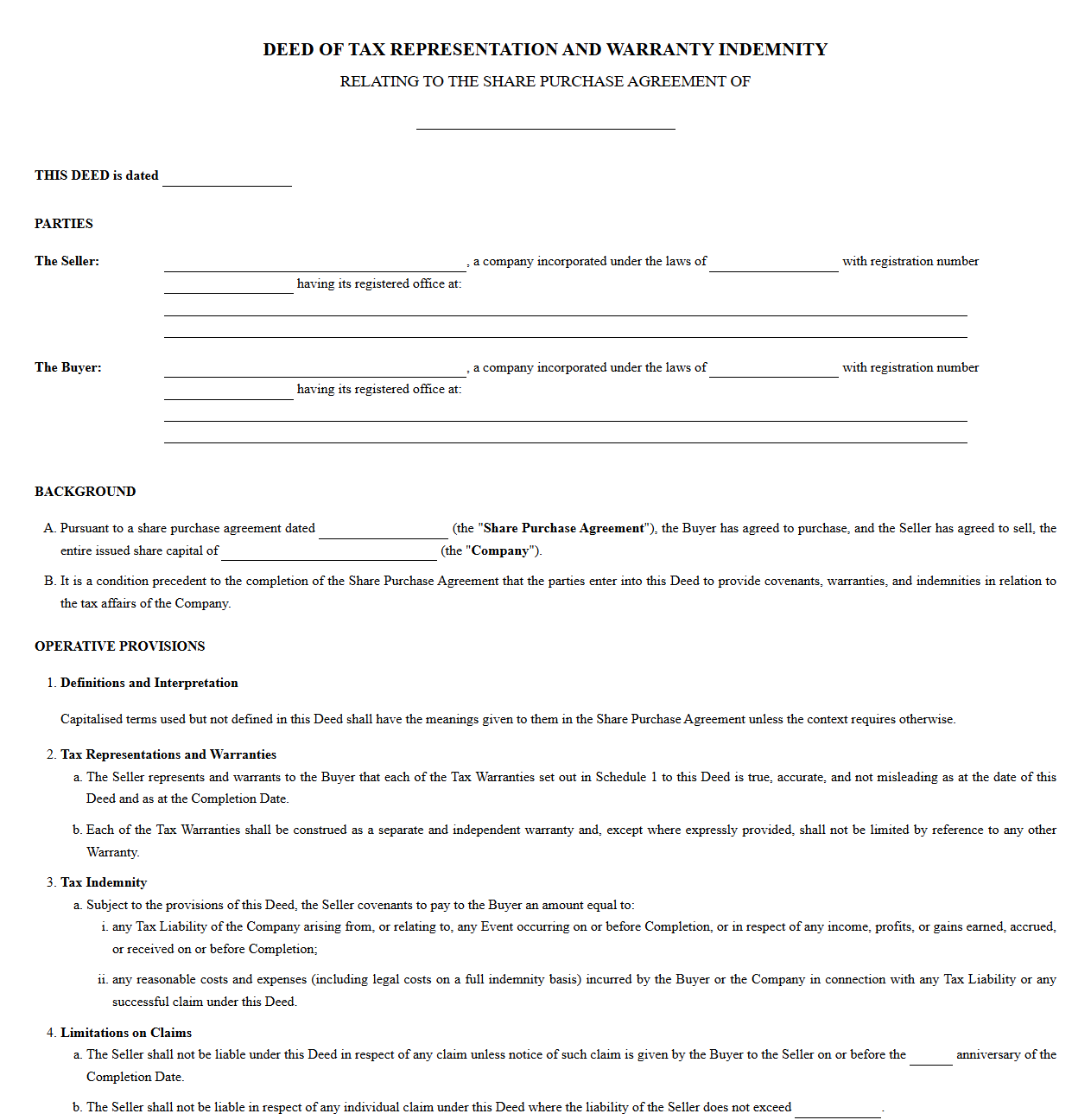 Download: .PDF
Asset Purchase Tax Representation and Indemnification Agreement
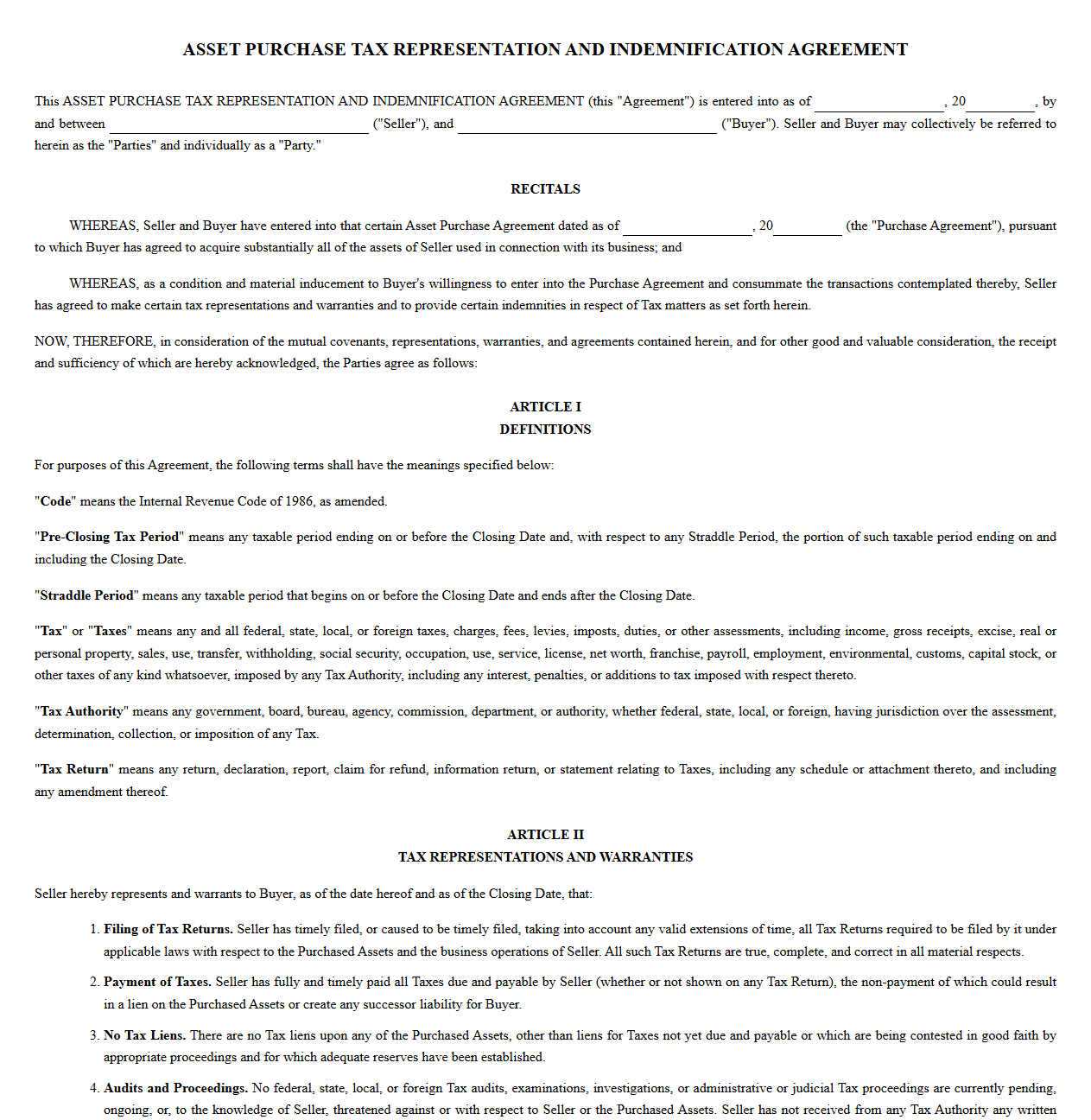 Download: .PDF
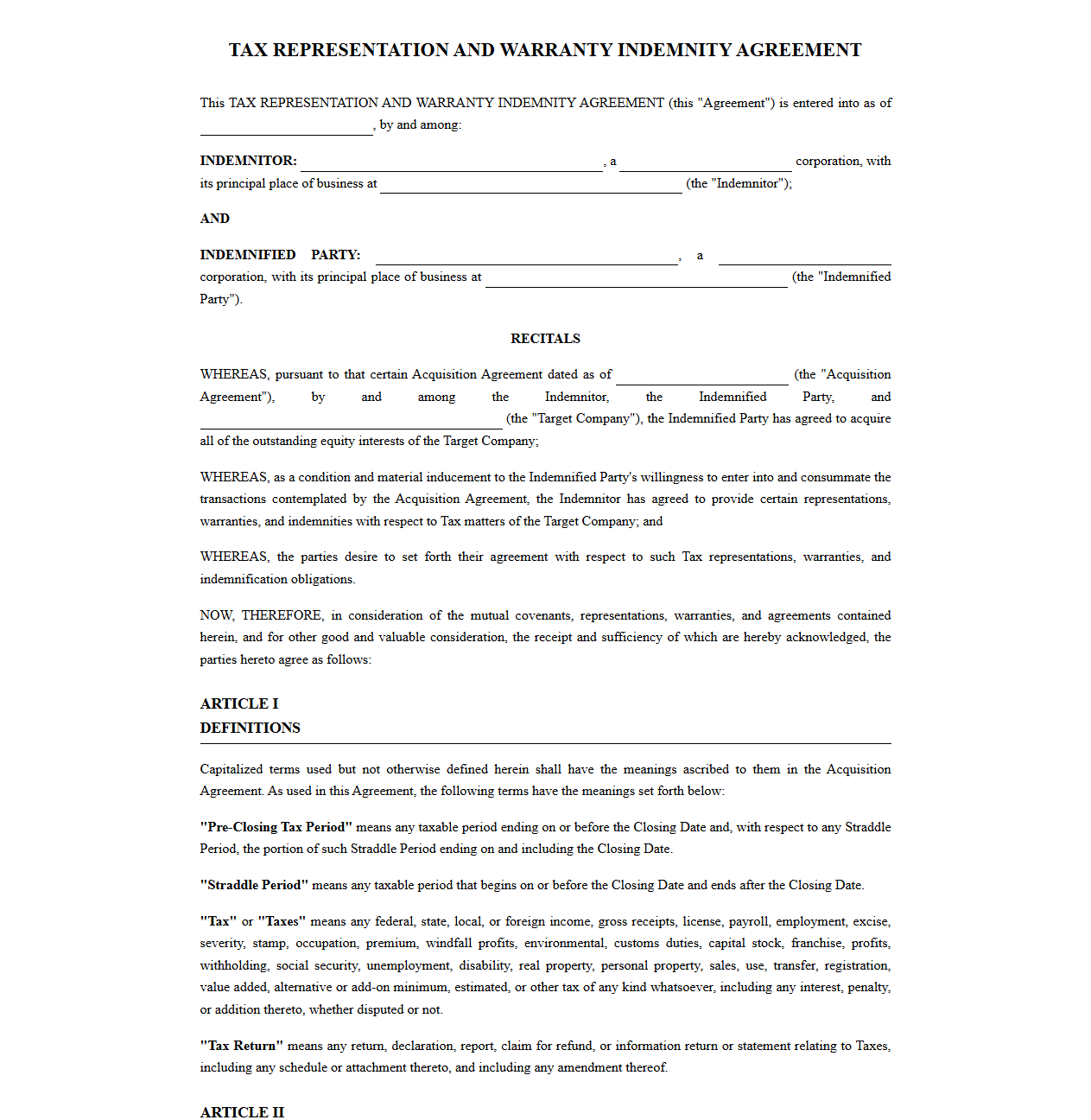
Corporate Acquisition Tax Rep and Warranty Indemnity Agreement
 Download: .PDF
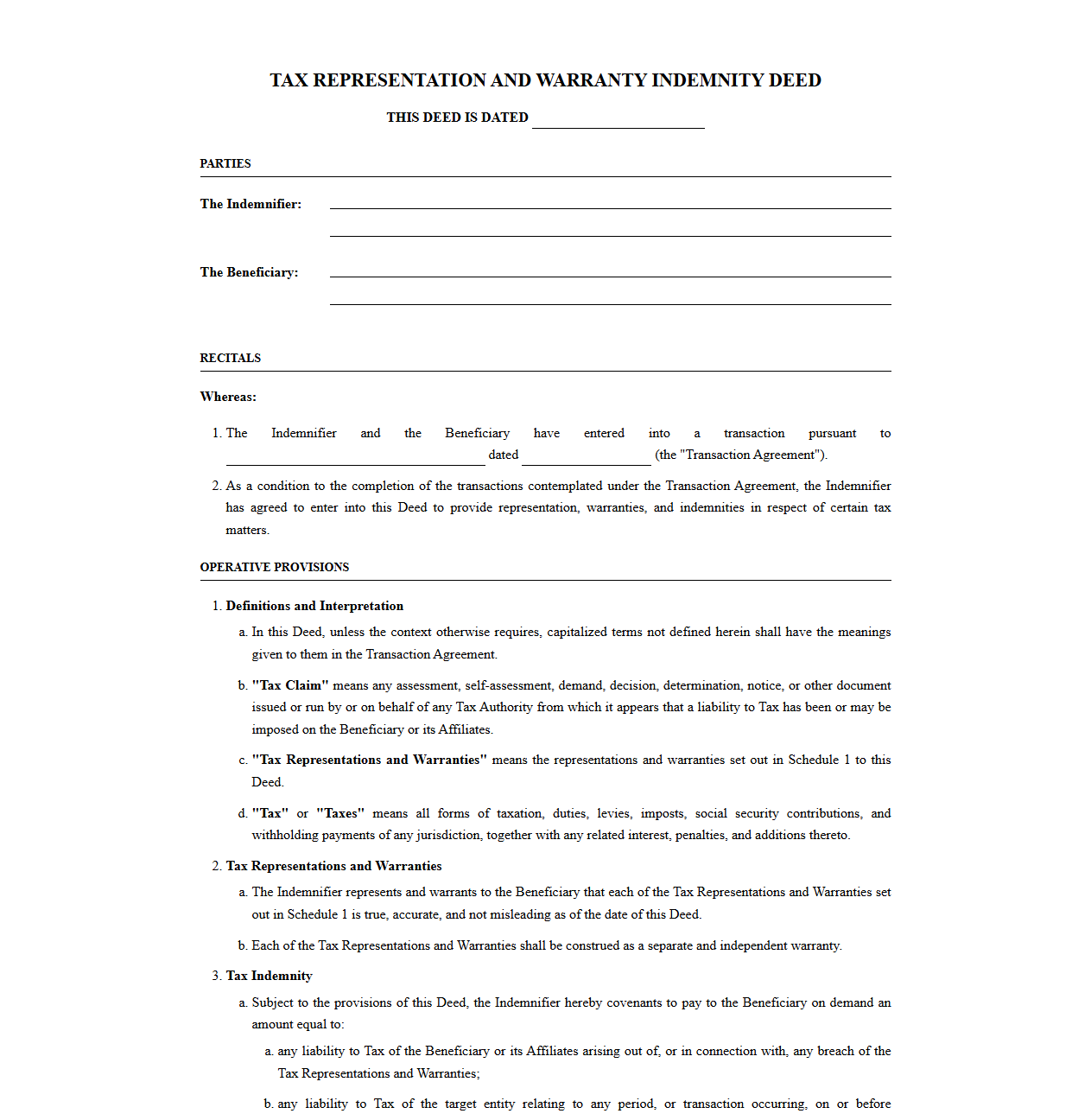
Standalone Tax Representation and Warranty Indemnity Deed
 Download: .PDF
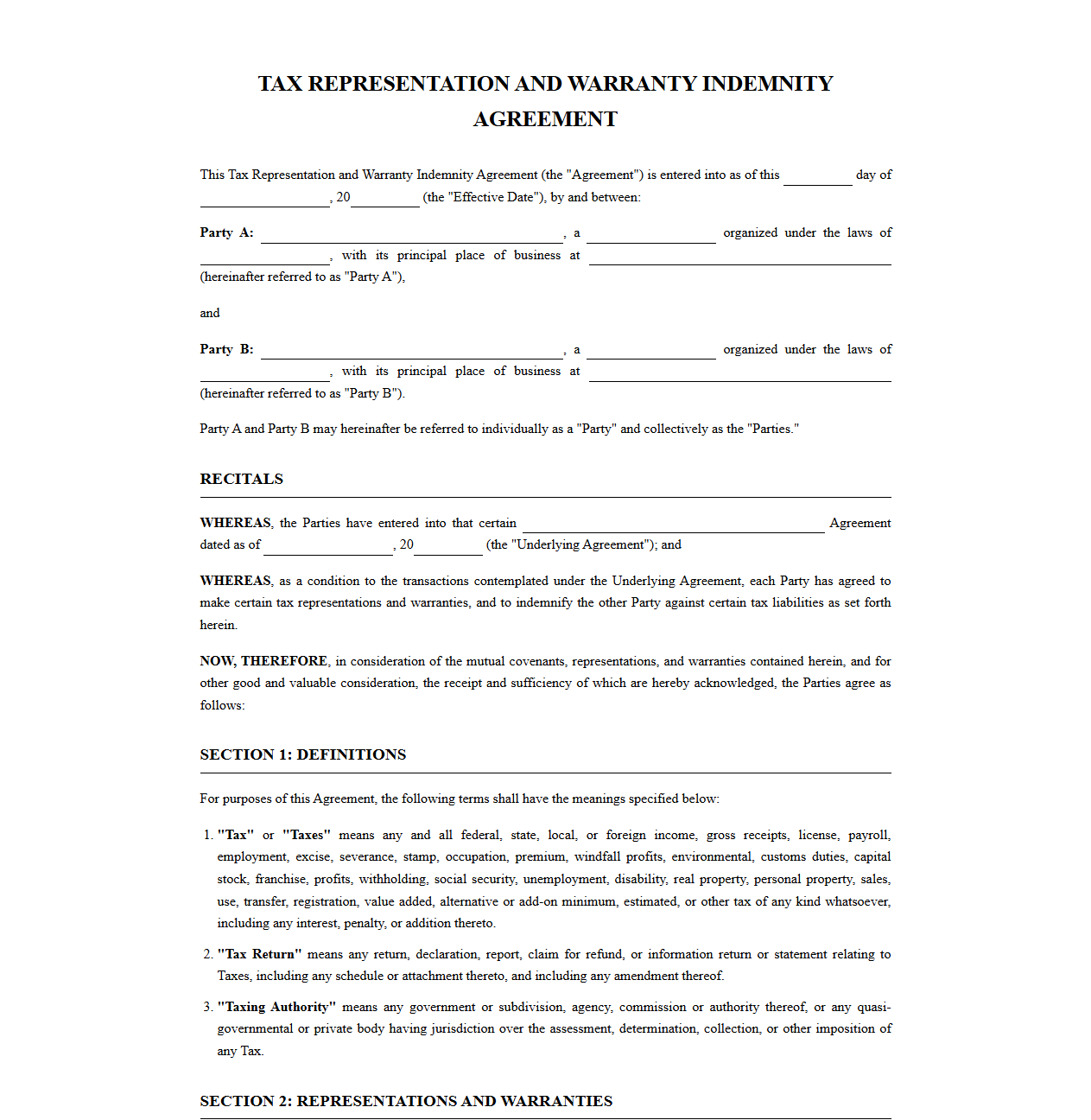
Bilateral Tax Representation and Warranty Indemnification Contract
 Download: .PDF
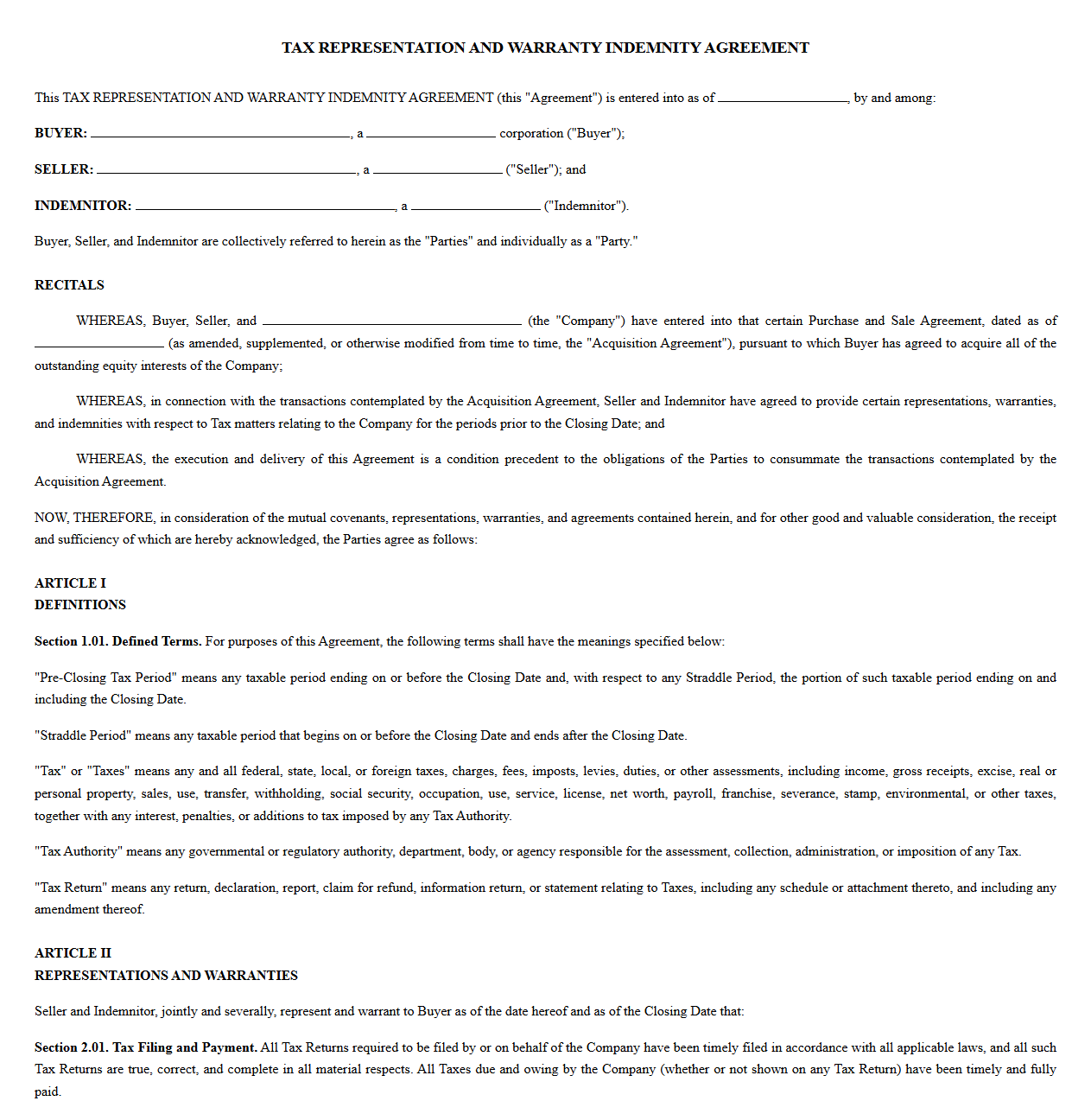
Mergers and Acquisitions Tax Warranty Indemnity Agreement
 Download: .PDF
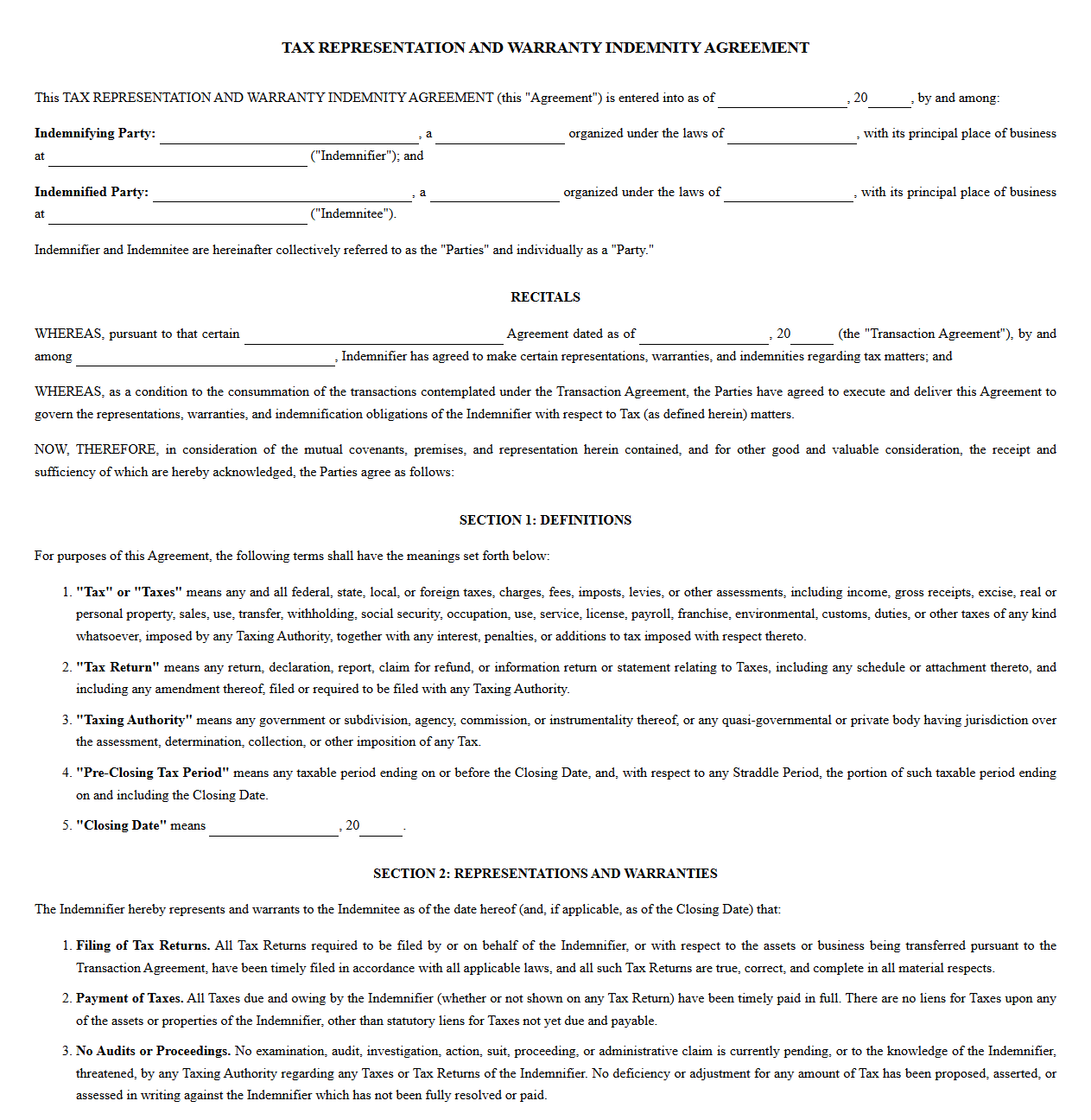
Standard Tax Representation and Warranty Indemnity Agreement
 Download: .PDF
Introduction to Transactional Liability in M&A
In the high-stakes arena of mergers and acquisitions, undisclosed liabilities can quietly dismantle a transaction long after the ink has dried on the definitive agreement. Among these hidden hazards, unforeseen tax liabilities represent some of the most destructive variables. A sudden post-closing audit revealing historical tax evasion, misclassified independent contractors, or unpaid state sales taxes can instantly erode the target company's valuation, turning a promising acquisition into a financial drain.
Managing these transactional liabilities requires robust risk-allocation mechanisms. Without structured safeguards, buyers risk inheriting successor tax liability, undisclosed delinquent tax interest, and costly post-closing audit defense fees. To insulate against these severe financial exposures, dealmakers rely on Tax Representation and Warranty Indemnity Agreements. This specialized legal instrument serves as the definitive financial safety net, ensuring that pre-closing tax mistakes remain the responsibility of the seller rather than the unsuspecting buyer.
Decoding Tax Representations and Warranties
Tax representations and warranties are formal, legally binding statements of fact made by the seller regarding the target company's historical tax compliance and current tax status. These assertions establish a clear baseline of tax risk, allowing the buyer to verify that the target has properly calculated, reported, and paid all of its obligations to relevant revenue authorities.
Sellers are typically required to make a comprehensive set of representations during the due diligence phase. The most common tax representations include:
- Filing and Payment: Assertion that all required federal, state, local, and foreign tax returns have been accurately filed and all due taxes have been paid.
- Audits and Disputes: Confirmation that no tax audits, examinations, or disputes are currently active, pending, or threatened by any taxing authority.
- Statutes of Limitations: Verification that the target company has not waived or extended the statute of limitations for the assessment of any tax.
- Transfer Pricing: Affirmation that all intercompany transactions comply with arm's-length standards and applicable transfer pricing regulations.
- Withholding Taxes: Representation that the target has properly withheld and paid over all required taxes associated with employees, independent contractors, and foreign entities.
The Mechanics of Tax Indemnity Agreements
A Tax Indemnity Agreement operates as a contractually agreed-upon legal shield. While representations and warranties define the status of the company's taxes, the indemnity clause defines the precise consequences if those representations prove false. It shifts the financial burden of pre-closing tax liabilities entirely to the seller, protecting the buyer from paying for historical errors discovered post-transaction.
When a breach occurs or a pre-closing tax liability is assessed by a tax authority, the indemnity agreement dictates the indemnification process, requiring the seller to reimburse the buyer or directly satisfy the tax debt. A typical allocation of this liability is outlined in the purchase agreement:
"The Seller shall defend, indemnify, and hold harmless the Buyer Indemnified Parties from and against any and all Losses attributable to (i) any Taxes of the Company with respect to any Pre-Closing Tax Period, (ii) any breach of or inaccuracy in any Tax Representation or Warranty, and (iii) any Taxes of any member of an affiliated, consolidated, or combined group of which the Company was a member prior to the Closing Date."
Essential Clauses in a Tax Indemnity Template
A standard Tax Representation and Warranty Indemnity Agreement template relies on several highly specialized clauses to govern how claims are handled and how long the parties remain liable.
Survival Periods
Unlike standard commercial representations that may expire after one to two years, tax representations typically survive until the expiration of the applicable statute of limitations plus an additional period (often 30 to 60 days). This extended survival period ensures that the buyer remains protected through the full window in which a tax authority can legally assess a deficiency.
Claim Procedures and Notice
This clause outlines the exact steps the buyer must take when notifying the seller of a tax claim or audit. It sets strict deadlines for written notices and specifies what information must be included to trigger the seller's obligation to indemnify, preventing procedural delays from invalidating a valid claim.
Control of Tax Contests
One of the most heavily negotiated clauses determines who directs the defense of a post-closing tax audit. The seller usually wants to control the defense to minimize the payout, while the buyer wants control to protect their newly acquired company's reputation and ongoing tax position. Compromise positions often grant joint control or veto rights over settlements.
Negotiating Limitations: Caps, Baskets, and Deductibles
Negotiations between buyers and sellers often center on the financial limits placed on indemnity claims. Sellers seek to limit their post-closing exposure, while buyers strive for maximum recourse. These boundaries are structured using specific threshold mechanisms.
Sellers often negotiate a cap, which represents the absolute maximum aggregate amount the seller is obligated to pay for indemnity claims. To prevent being nickel-and-dimed over minor tax discrepancies, parties also establish a basket-a threshold that total claims must exceed before the seller has any obligation to pay. This basket can be structured as a tipping basket, where the seller becomes liable for all claims from the very first dollar once the threshold is crossed, or as a deductible, where the seller is only liable for amounts exceeding the threshold.
Tax Indemnity Agreements vs. Representation and Warranty Insurance
In modern deal structures, transactional risk management has evolved beyond bilateral seller-buyer agreements. Dealmakers now frequently choose between traditional, self-funded Tax Indemnity Agreements and third-party Representation and Warranty Insurance (RWI) policies.
While a self-funded agreement relies on the seller's balance sheet or an escrow account, RWI transfers the risk to a commercial insurer, altering the deal dynamics.
| Feature | Tax Indemnity Agreement (Self-Funded) | Representation & Warranty Insurance (RWI) |
|---|---|---|
| Source of Funds | Seller's proceeds or escrow/holdback account | Third-party commercial insurance carrier |
| Impact on Deal Terms | Can create friction; requires larger buyer escrows | Sellers exit clean; highly competitive in auctions |
| Coverage Limits | Directly negotiated; capped at a portion of purchase price | Flexible; policy limits can match full transaction value |
| Known Risks | Can explicitly cover specific identified tax risks | Generally excludes known tax risks identified in diligence |
Best Practices for Customizing Indemnity Templates
Relying on a generic contract template can leave critical gaps in protection. Legal teams must customize their tax indemnity templates to align with the specific deal size, industry sector, and risk profile of the target company.
To ensure adequate protection, legal counsel should follow this structured customization workflow:
- Conduct Rigorous Diligence: Tailor the representations based on the target's operating footprint, paying close attention to state nexus issues and international transfer pricing practices.
- Align Survival Periods with Jurisdictions: Match the survival language of the agreement with the specific statutes of limitations of the relevant state and federal taxing authorities involved in the transaction.
- Establish Clear Escrow Mechanics: If using a holdback, ensure the escrow agreement details the precise release dates and the exact mechanisms for resolving disputed tax claims.
- Coordinate with RWI Policies: If RWI is utilized, draft the indemnity template to act as a excess-coverage vehicle for any specific tax risks excluded by the primary insurance policy.

Leave a comment