

Managing highly sensitive financial records leaves tax professionals and business owners constantly battling the anxiety of potential data breaches and severe legal liabilities. However, before investing in complex cybersecurity software, organizations must first establish a clear, legally binding framework of confidentiality to govern their data-sharing relationships.
Implementing structured Taxpayer Information Protection Agreements grants your business immediate regulatory compliance while fostering deep client trust. As an essential stipulation, remember that while templates provide an invaluable foundation, they are not one-size-fits-all; they must be tailored to satisfy specific statutory requirements. For example, your agreements must explicitly align with rigorous standards like the FTC Safeguards Rule and IRS Section 7216 to ensure total legal coverage.
This guide will explore specialized agreement templates designed for various business scenarios, helping you select and customize the exact protection framework your practice requires.
Taxpayer Data Security and Non Disclosure Agreement
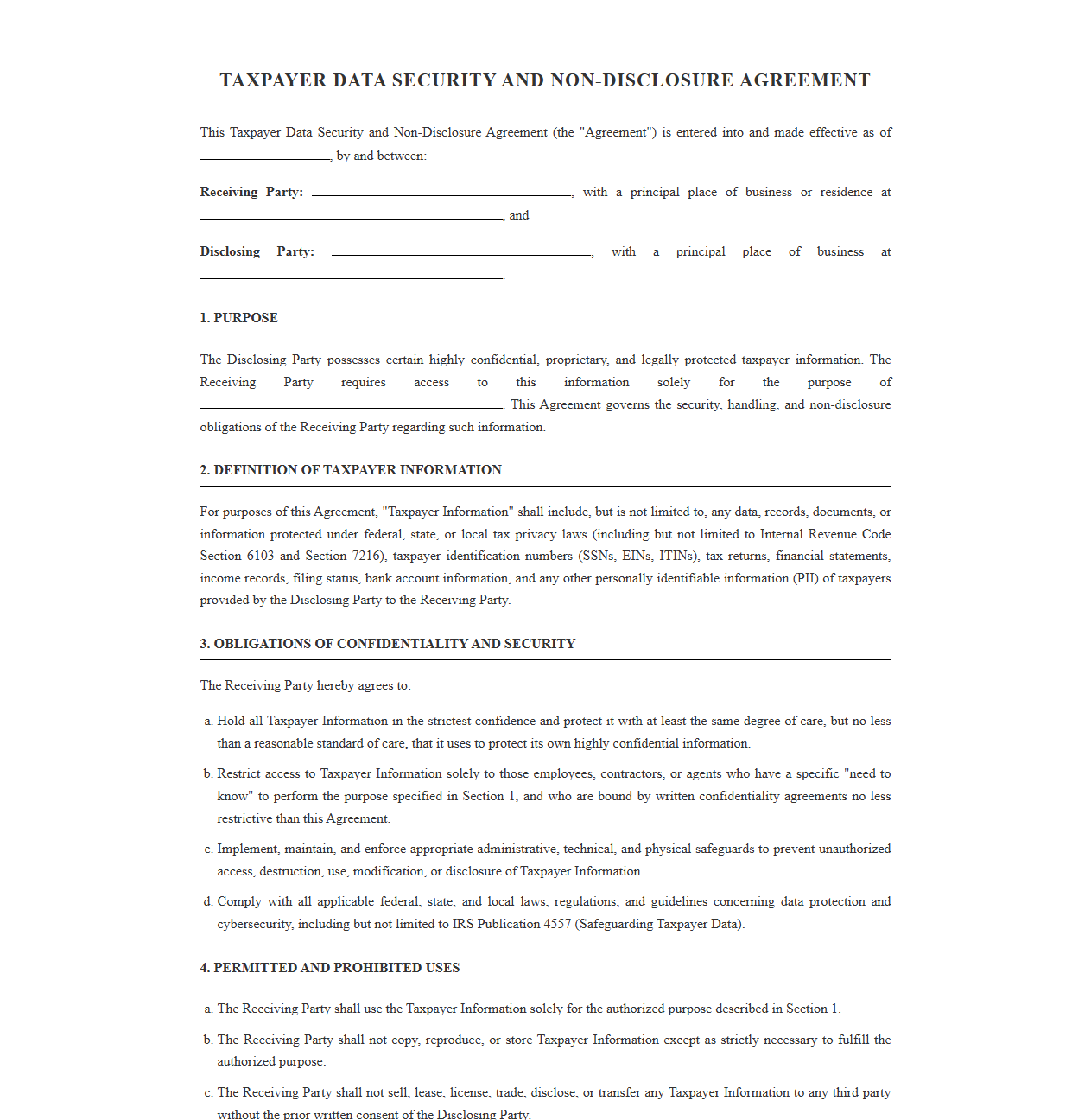 Download: .PDF
Confidentiality Agreement for Taxpayer Information Protection
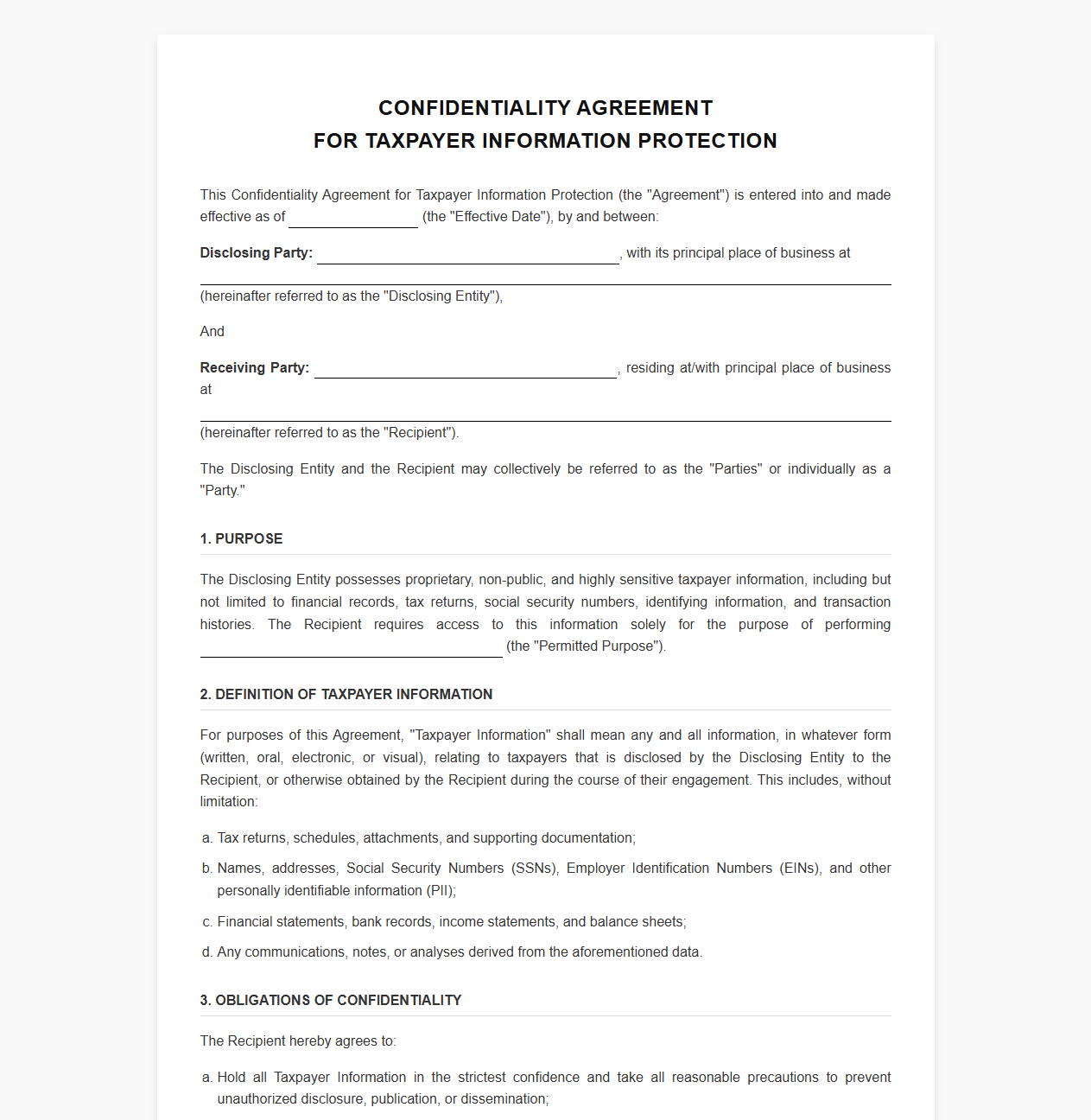 Download: .PDF
Taxpayer Information Security Covenant
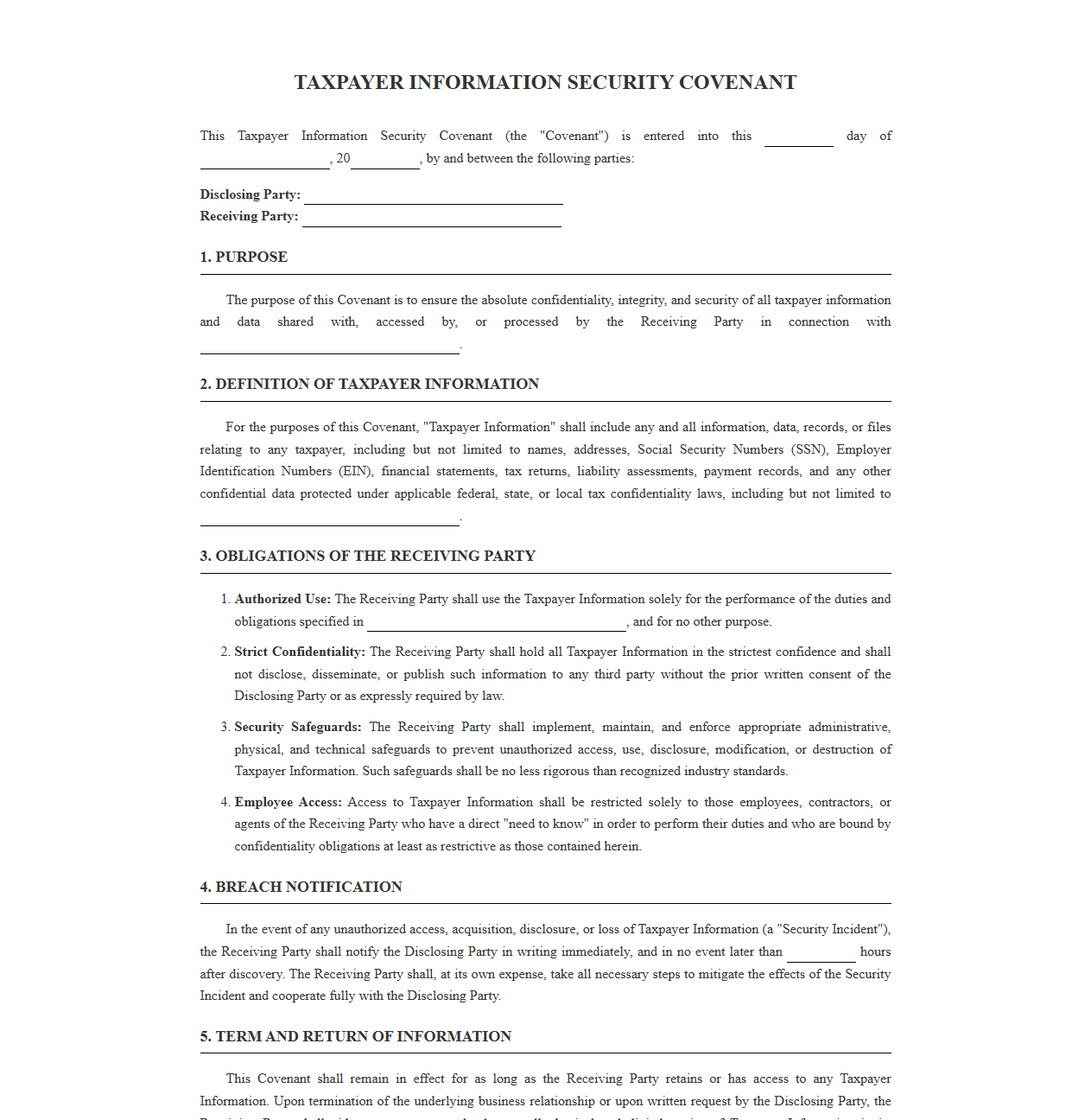 Download: .PDF
Tax Return Preparer Non Disclosure Agreement
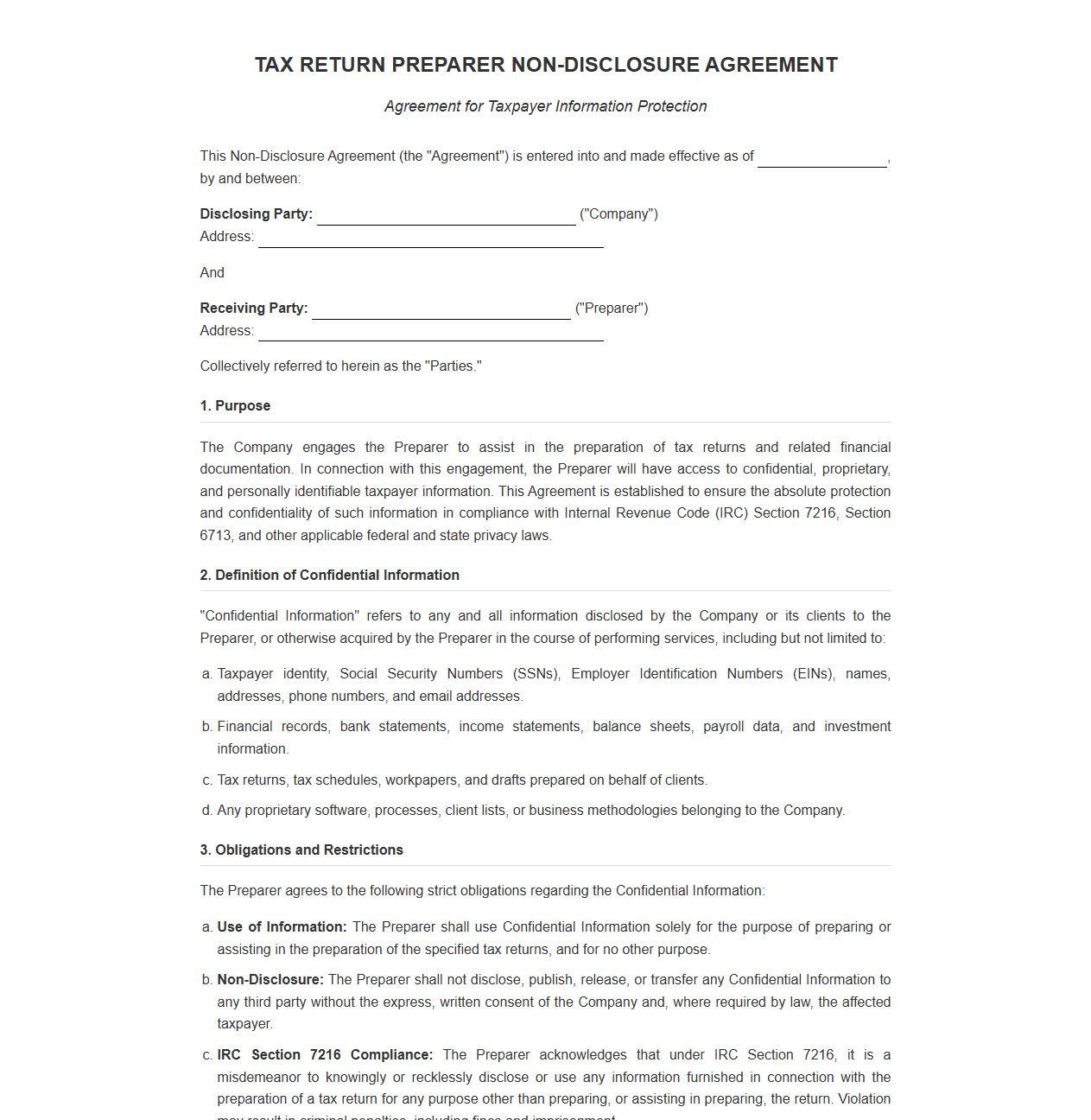 Download: .PDF
Taxpayer Privacy and Data Protection Agreement
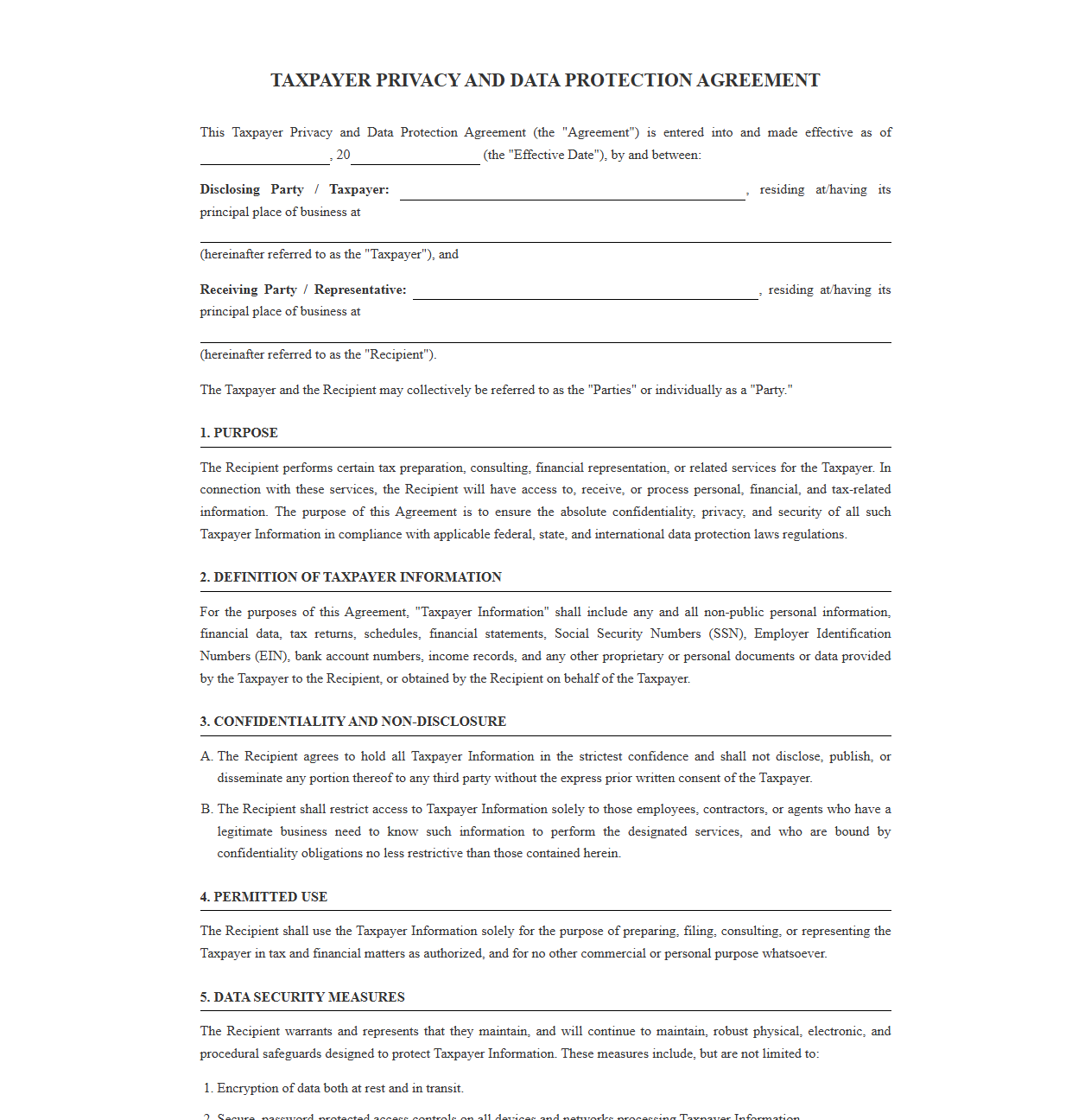 Download: .PDF
Agreement for Safeguarding Taxpayer Information
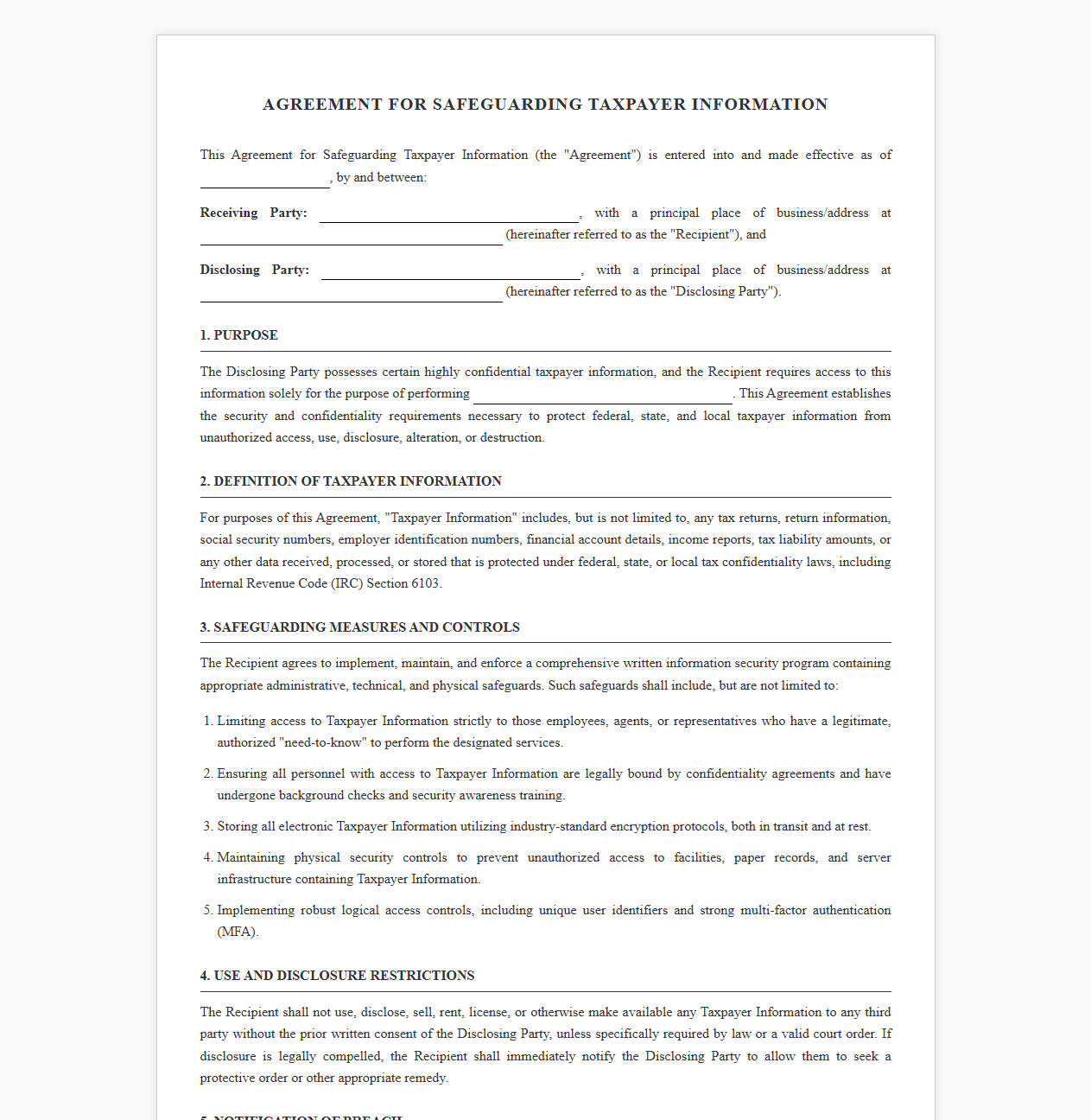 Download: .PDF
Taxpayer Record Confidentiality and Security Agreement
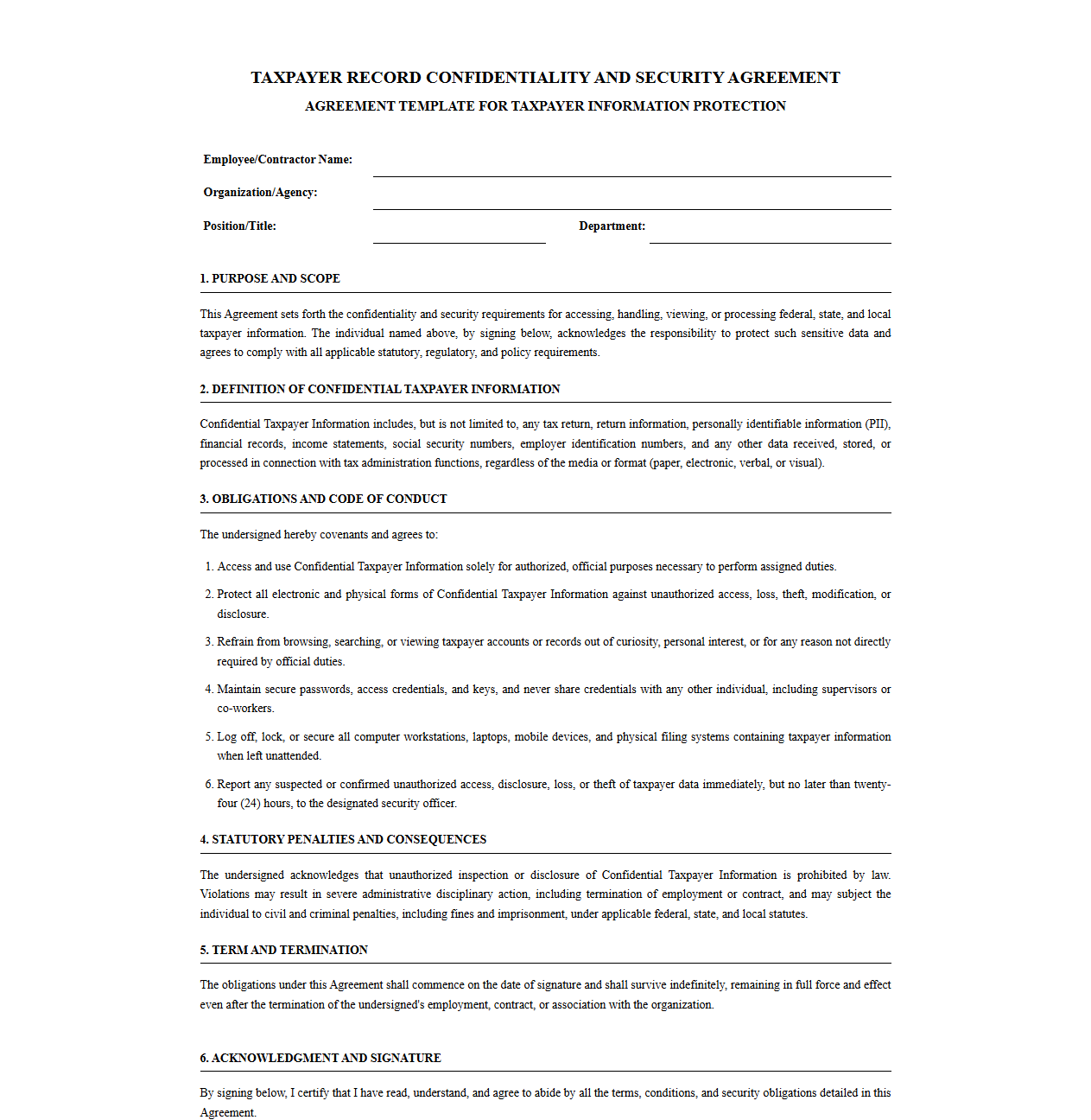 Download: .PDF
IRS Section 7216 Information Consent Agreement
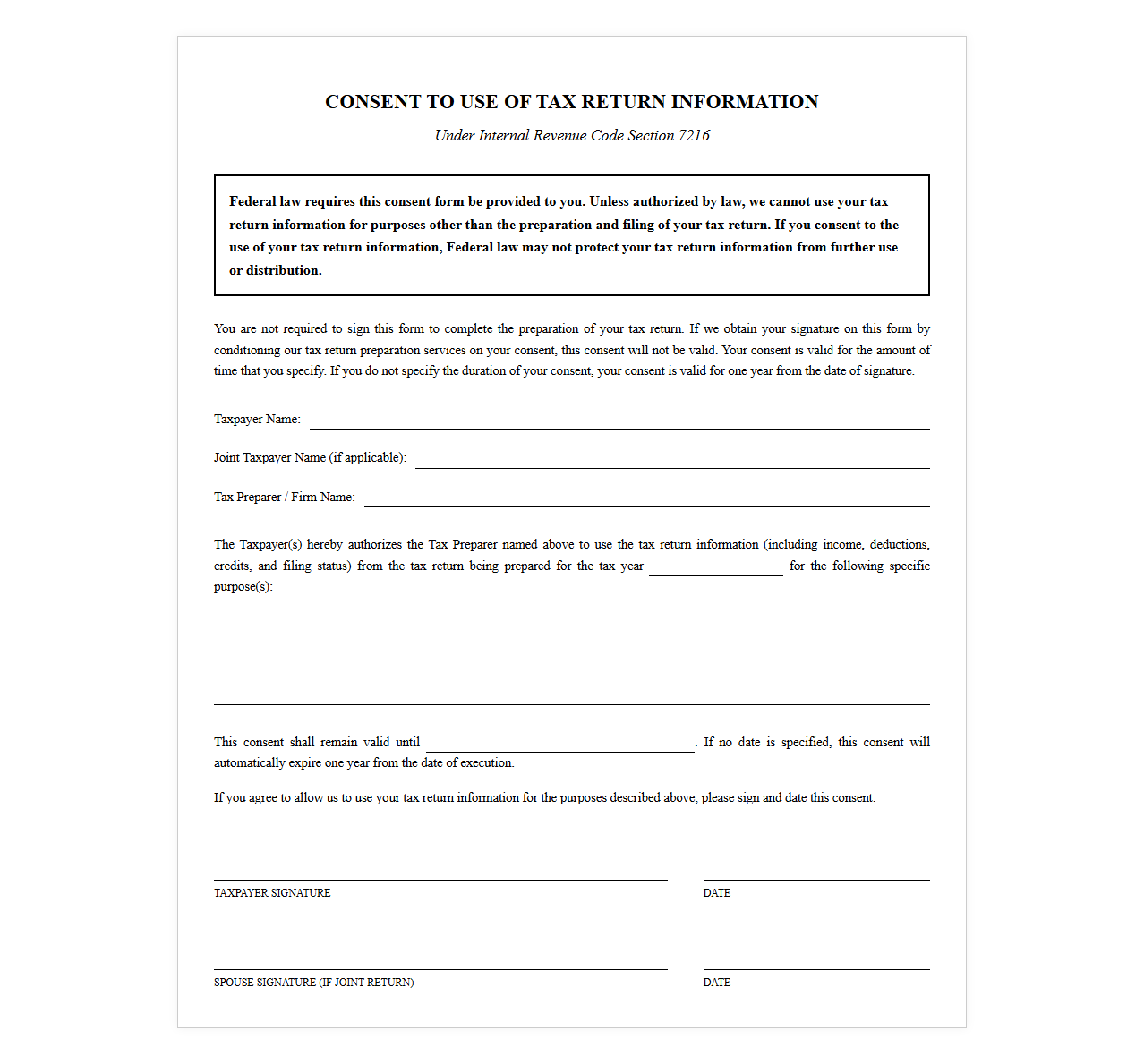 Download: .PDF
Why Protecting Taxpayer Data is Non-Negotiable
For modern accounting and tax preparation firms, safeguarding client financial information is much more than a routine operational task. It represents a fundamental legal and ethical commitment. Every tax return contains a wealth of highly sensitive personal data, from Social Security numbers and bank routing codes to detailed income portfolios and business assets.
Failing to secure this information exposes accounting practices to catastrophic risks. A single security failure can lead to devastating consequences, including rampant identity theft, severe financial fraud, and crippling compliance penalties from state and federal regulators. Protecting this data is not just about avoiding litigation; it is about honoring the trusted relationship between an advisor and their client.
The Legal Framework: FTC Safeguards Rule and IRS Guidelines
Tax professionals operate under a strict and evolving regulatory umbrella designed to protect consumer financial privacy. Adhering to these federal mandates is mandatory for any individual or firm offering tax preparation services.
- FTC Safeguards Rule: Requires non-banking financial institutions, including professional tax preparers, to develop, implement, and maintain a comprehensive written information security plan (WISP).
- IRS Publication 4557: Outlines a seven-step checklist for safeguarding taxpayer data, advising firms on how to secure client records, protect computer networks, and establish secure physical premises.
- Gramm-Leach-Bliley Act (GLBA): Mandates that financial institutions explain their information-sharing practices to their customers and safeguard sensitive data.
- IRC Section 7216: Imposes criminal penalties on tax return preparers who knowingly or recklessly disclose or use tax return information for any purpose other than preparing, or assisting in preparing, a return.
Essential Clauses of a Taxpayer Information Protection Agreement
To ensure absolute clarity regarding data security expectations, accounting firms must deploy legally binding confidentiality and security agreements with everyone who handles client data.
- Definition of Confidential Information
- Explicitly identifies what constitutes protected data, encompassing all tax documents, financial statements, communications, and personally identifiable information (PII) of clients.
- Authorized Access and Use Restrictions
- Restricts the handling of client data strictly to authorized tasks and prohibits any copying, saving, or extracting of client records for unauthorized personal or professional use.
- Security and Technical Protocols
- Mandates compliance with specific technical baselines, such as multi-factor authentication (MFA), virtual private networks (VPNs), and encrypted messaging systems.
- Breach Notification Procedures
- Defines a strict timeline and process for reporting potential or confirmed security incidents, ensuring immediate mitigation protocols can be enacted.
Template Scenario 1: Internal Employee and Seasonal Contractor Agreements
Whether onboarding a full-time CPA or hiring a temporary contractor for tax season, you must bind them to strict data security protocols before they access client portals or tax software.
This Employee & Contractor Data Security Agreement ("Agreement") is entered into by and between [Insert Firm Name] ("Firm") and [Insert Employee/Contractor Name] ("Recipient").
1. Strict Confidentiality: Recipient agrees to hold all taxpayer documents, tax software credentials, and PII in the strictest confidence. Accessing client data from public networks or unencrypted personal devices is strictly prohibited.
2. Credential Security: Recipient shall utilize unique, complex passwords and mandatory Multi-Factor Authentication (MFA) to access any tax database. Credentials must never be shared under any circumstances.
3. Immediate Reporting: Recipient must report any suspected or actual unauthorized access, malware infection, or credential compromise to the designated Security Officer within [Insert Number, e.g., 2] hours of discovery.
Template Scenario 2: Third-Party Vendor and IT Provider Agreements
Outsourcing IT support, utilizing cloud hosting environments, or licensing tax software introduces external attack surfaces. Firms must hold third-party partners to the same rigid security standards.
This Business Associate and Data Protection Agreement ("Agreement") is executed between [Insert Firm Name] ("Company") and [Insert IT/Software Vendor Name] ("Vendor").
The Vendor warrants that its systems conform to the administrative, technical, and physical safeguards prescribed by the FTC Safeguards Rule. Vendor agrees to store all Company-provided taxpayer records on encrypted servers and to permit third-party security audits upon request. In the event of a security incident affecting Company data, Vendor will notify Company in writing within 24 hours of confirmation.
Best Practices for Implementing Data Security Agreements
Having written policies is only the first step. To ensure these agreements effectively mitigate cybersecurity risks, your practice must actively manage and enforce them through a structured compliance lifecycle.
- Conduct Annual Security Training: Require all personnel to undergo interactive cybersecurity training prior to signing their annual agreement updates.
- Implement Digital Signature Tracking: Use verifiable electronic signature platforms to archive completed agreements, making certain that no contractor gains network access until their document is signed.
- Schedule Regular Policy Reviews: Review and update all protection agreements annually to address evolving cyber threat landscapes and changes to state or federal tax laws.
Next Steps: Securing Your Practice Against Modern Threats
Proactive risk management is the single most effective defense against devastating data breaches. Waiting for an incident to occur before formalizing your security protocols is a strategy that guarantees costly operational, legal, and reputational damage. Take control of your firm's compliance posture today by conducting a thorough audit of your current internal and external agreements.
To assist in this process, you can download pre-formatted, fully customizable templates to establish clear security boundaries across your practice. Download our Taxpayer Information Protection Templates (PDF) and take a definitive step toward safeguarding your clients and your business.

Leave a comment