

Transfer pricing consultants constantly struggle to draft airtight agreements that satisfy both demanding clients and aggressive tax authorities. A single oversight in contractual language can expose multinational enterprises to severe audit risks and double taxation.
As tax administrations globally align with stricter OECD guidelines, bridging the gap between operational reality and legal documentation has become paramount. Implementing standardized, high-quality templates grants advisory firms immediate risk mitigation, transforming administrative overhead into a robust line of defense.
However, practitioners must note that these templates serve as adaptable frameworks rather than rigid legal absolutes; they require tailoring to specific transactional realities. Specifically, utilizing structured Master Services Agreements (MSAs) and localized Intercompany Agreements (ICAs) ensures precise delineation of risk and functional profiles.
This article outlines the essential agreement templates your practice requires, highlighting the critical clauses needed to secure compliance and protect your clients.
Master Transfer Pricing Consulting Services Agreement Template
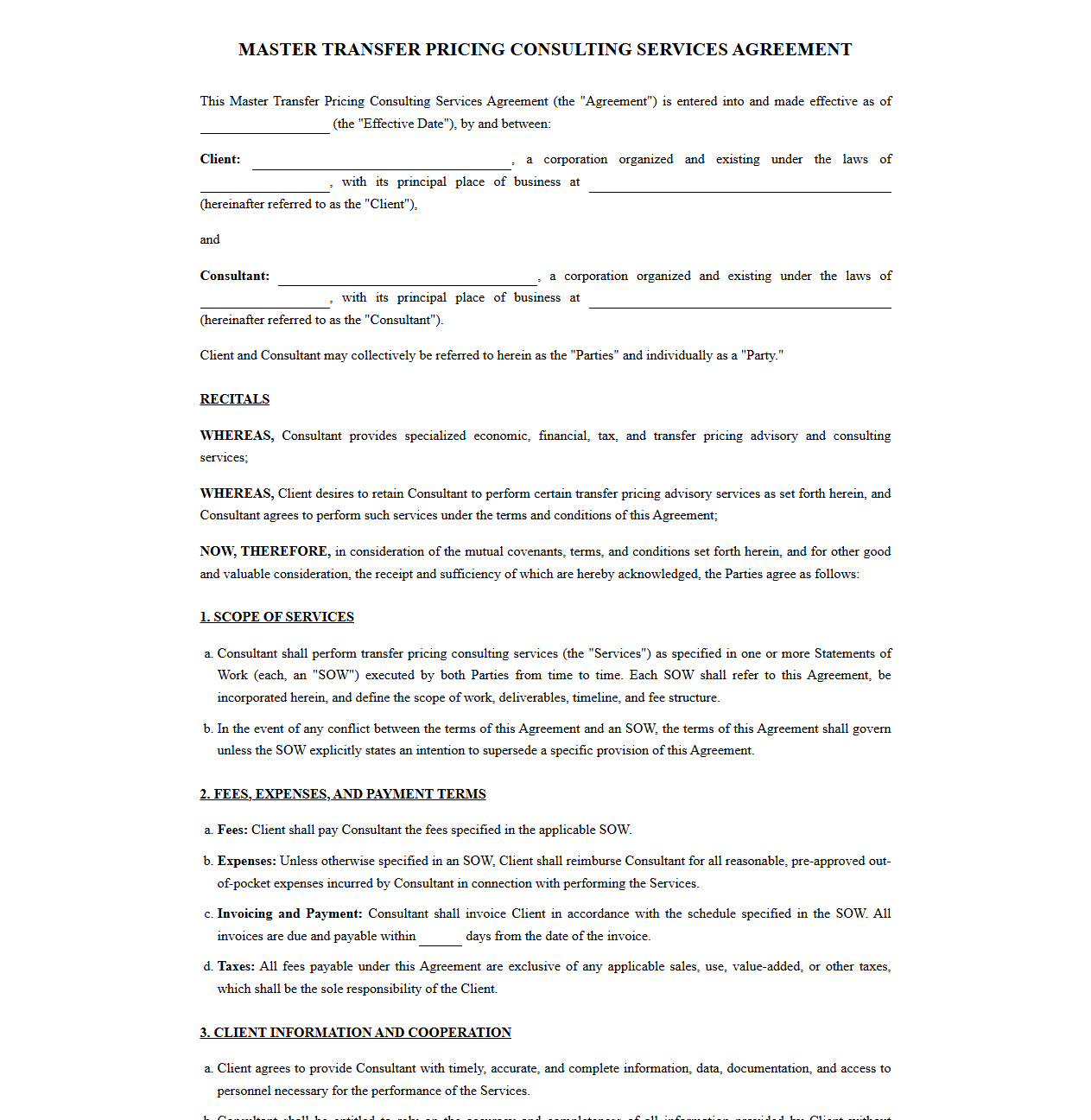 Download: .PDF
Intercompany Transfer Pricing Advisory Services Contract
 Download: .PDF
Transfer Pricing Study and Documentation Engagement Letter
 Download: .PDF
Global Transfer Pricing Consulting Services Agreement
 Download: .PDF
Bilateral Transfer Pricing Policy Advisory Agreement
 Download: .PDF
Transfer Pricing Benchmarking Analysis Service Contract
 Download: .PDF
Standard Transfer Pricing Consulting and Compliance Agreement
 Download: .PDF
Arm's Length Pricing Consulting Services Agreement
 Download: .PDF
Introduction to Transfer Pricing Compliance
In the complex landscape of international taxation, multinational enterprises face unprecedented scrutiny from tax authorities worldwide. For transfer pricing consultants, establishing a robust contractual framework is the first line of defense against disputes. A well-drafted service agreement defines the boundaries of the advisory relationship, ensures compliance with global guidelines, and protects both parties during regulatory reviews.
By utilizing precise contract templates, consultants can clearly outline their methodology, manage client expectations, and mitigate the risks associated with tax audits. Establishing these legal boundaries ensures that the advice provided adheres strictly to the arm's length principle and fulfills the rigorous requirements of local transfer pricing documentation laws.
Defining the Scope of Services and Deliverables
A frequent source of friction in tax advisory relationships is scope creep. To prevent misunderstandings, the engagement contract must explicitly define the exact documentation and analysis the consultant will perform. This clarity ensures that multinational clients receive the precise reports required by tax administrations to justify their pricing policies.
- Master File: Providing a high-level global overview of the multinational enterprise's business operations and transfer pricing policies.
- Local File: Detailed documentation focusing on the specific transactional transfer pricing analysis of the local affiliate.
- Benchmarking Studies: Economic analyses utilizing specialized databases to identify comparable uncontrolled transactions and establish arm's length ranges.
- Country-by-Country (CbC) Reporting: Tax, income, and allocable economic activity templates prepared for jurisdictions requiring automated exchange of information.
Structuring Fee Arrangements and Payment Milestones
Structuring the financial terms of a transfer pricing engagement requires transparency and adherence to professional ethics. While fixed-fee arrangements provide budget predictability for clients, complex audits may necessitate hourly billing models. Tax advisory agreements must also account for regulatory prohibitions against success-based or contingent fees on transfer pricing compliance work.
To maintain healthy cash flow and manage project phases effectively, contracts should utilize a milestone-based payment schedule:
- Retainer Fee: 25% due upon the execution of the engagement agreement.
- Data Collection & Functional Analysis: 25% due upon completion of client interviews and financial data gathering.
- Drafting & Benchmarking: 30% due upon delivery of the draft Master File and Local File for client review.
- Final Delivery: 20% due upon the final delivery and sign-off of all compliance documentation.
Leveraging Standard Intercompany Agreement Templates
Beyond the consultant-client relationship, transfer pricing consultants must advise clients on documenting transactions between their own related entities. Tax authorities expect to see written intercompany agreements that reflect the economic reality of transactions and align with the arm's length standard before transactions take place.
Consultants should provide and customize standardized intercompany agreement templates to legally bind related parties to their transfer pricing arrangements. These agreements serve as critical evidence during tax audits, demonstrating that transactions are conducted in a manner consistent with independent third-party dealings.
"The contracting parties hereby agree that the transfer price for the licensed intangible assets shall be determined in accordance with the arm's length principle, utilizing the Comparable Uncontrolled Price (CUP) method or, where appropriate, the Transactional Net Margin Method (TNMM), as outlined in the OECD Transfer Pricing Guidelines."
Confidentiality and Proprietary Financial Data Security
Transfer pricing engagements require access to highly sensitive corporate information, including segmented financial statements, profit margins, intellectual property valuations, and strategic business plans. Agreements must feature stringent non-disclosure covenants to protect this valuable intellectual property from unauthorized access or exposure.
In addition to standard non-disclosure terms, modern consulting contracts must address digital security standards. Consultants must guarantee that client data is processed and stored in compliance with modern security infrastructure, ensuring that financial databases and custom pricing algorithms remain secure against cyber threats. Parties must ensure compliance with General Data Protection Regulation (GDPR) and equivalent national data security frameworks.
Liability Limitations and Dispute Resolution
Given the significant financial stakes of international tax audits, advisory contracts must contain robust liability limitation clauses. Consultants must limit their financial exposure to a multiple of the fees collected under the agreement, specifically excluding liability for consequential damages, penalties, or back taxes assessed by tax administrations.
Dispute resolution clauses are equally vital to prevent costly, public litigation. Agreements should mandate alternative dispute resolution paths to settle any disagreements regarding deliverables, project execution, or billing practices. The contract must specify that all disputes shall be resolved through confidential binding arbitration under the rules of the International Chamber of Commerce (ICC), with the governing law designated as the laws of the consultant's home jurisdiction.
Finalizing the Agreement: Implementation Checklist
Before launching a transfer pricing project, both the consulting team and the client's corporate legal counsel should perform a final review. Utilizing a structured checklist ensures that all risk-mitigation measures, regulatory standards, and financial terms are mutually agreed upon and legally binding.
| Review Category | Key Requirement | Responsible Party |
|---|---|---|
| Scope Verification | Confirm all local files, master files, and benchmarks are listed. | Lead Tax Consultant |
| Financial Terms | Verify milestone billing dates and the exclusion of contingent fees. | Client Finance Director |
| Data Protection | Ensure encryption protocols and secure portals are specified. | IT / Security Officer |
| Legal & Liability | Confirm liability limits and arbitration clauses are intact. | Corporate Legal Counsel |

Leave a comment