

Navigating cross-border transactions often exposes businesses to unexpected and costly withholding tax liabilities, turning potentially lucrative ventures into administrative and financial burdens. Before addressing mitigation strategies, however, one must understand how shifting double taxation treaties and complex local tax jurisdictions interact to create these exposures in the first place.
Implementing a structured withholding tax indemnity agreement grants companies vital financial predictability and contractual certainty by clearly allocating risk between parties. It is important to stipulate that while these templates provide robust protection in common scenarios-such as international software licensing or cross-border consulting services-they must be customized to specific jurisdictions and should not replace qualified tax counsel.
In this article, we will explore the essential clauses of these indemnity templates, analyze practical implementation strategies, and outline how to effectively safeguard your organization's bottom line against unforeseen tax demands.
Withholding Tax Indemnity Agreement
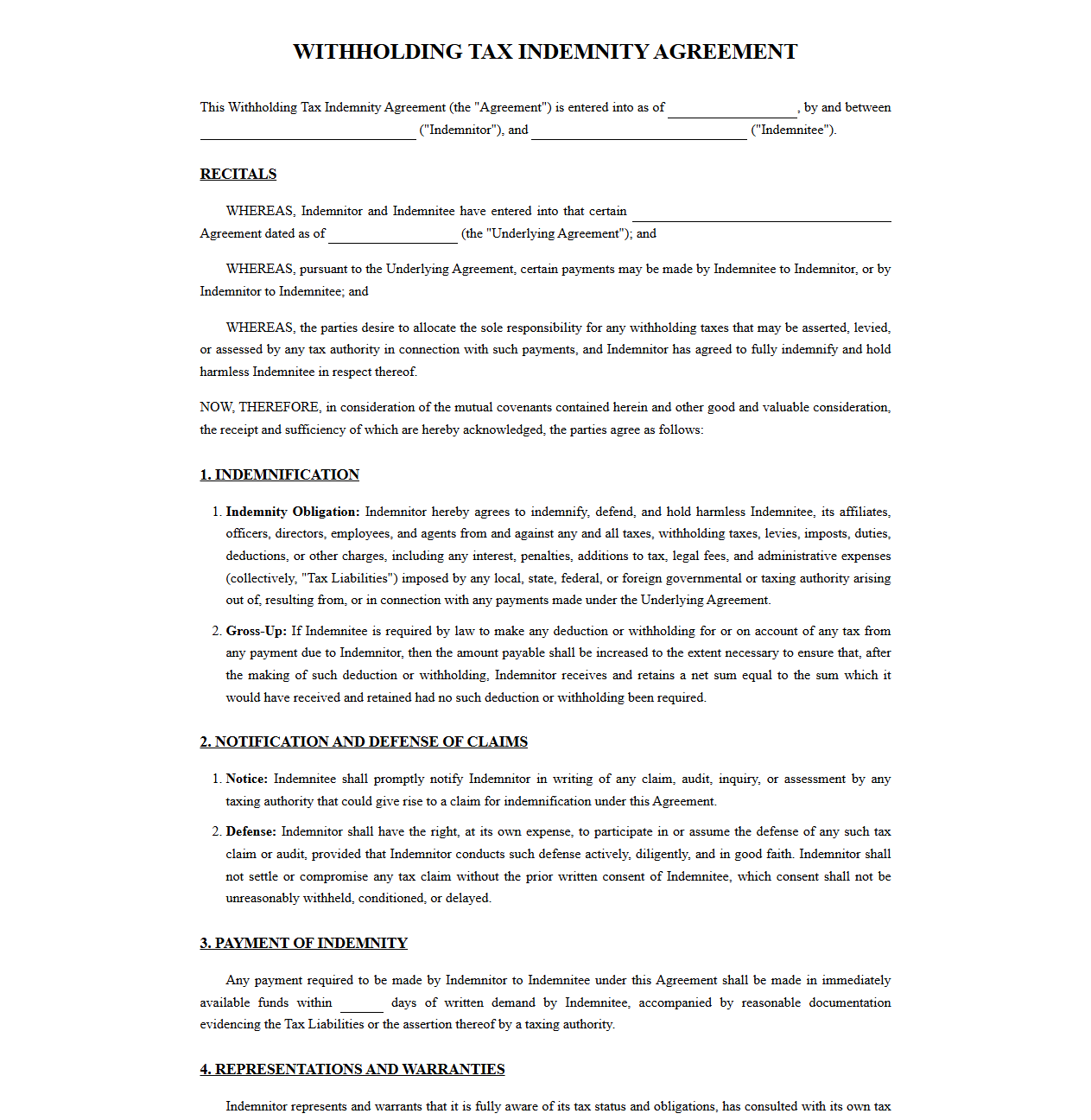 Download: .PDF
Tax Indemnification Agreement Template
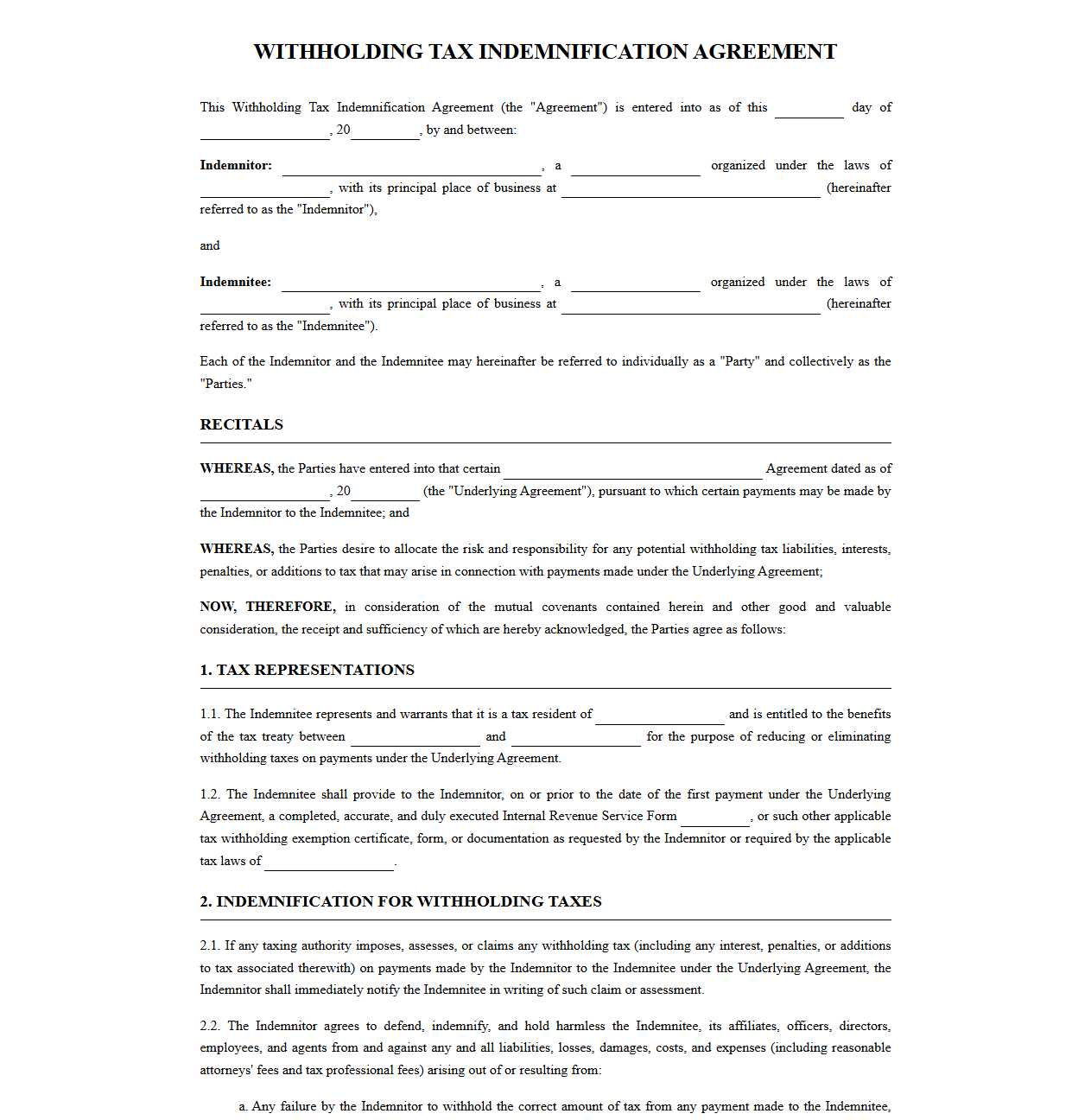 Download: .PDF
Agreement for Withholding Tax Indemnification
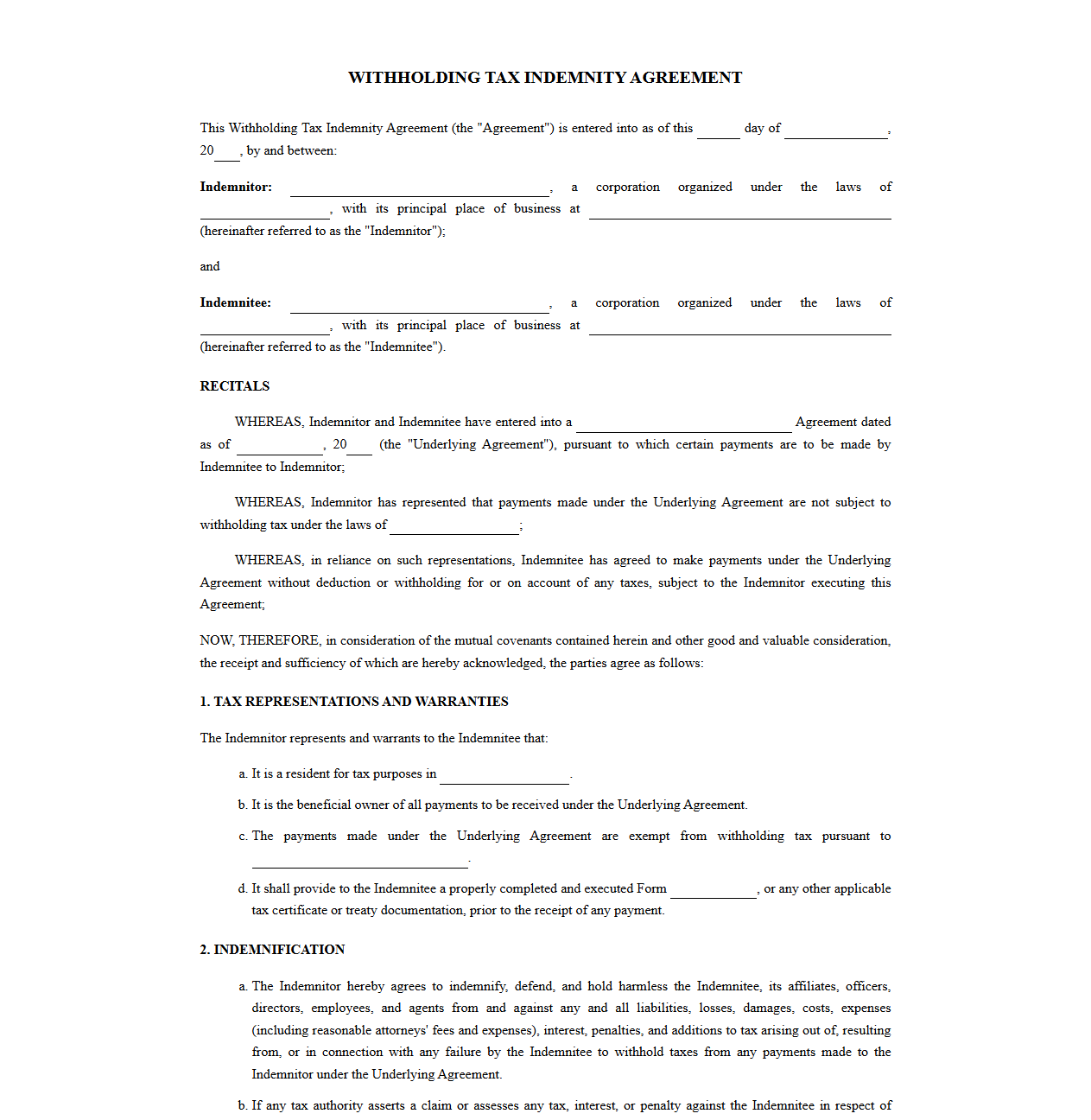 Download: .PDF
Withholding Tax Indemnity Deed
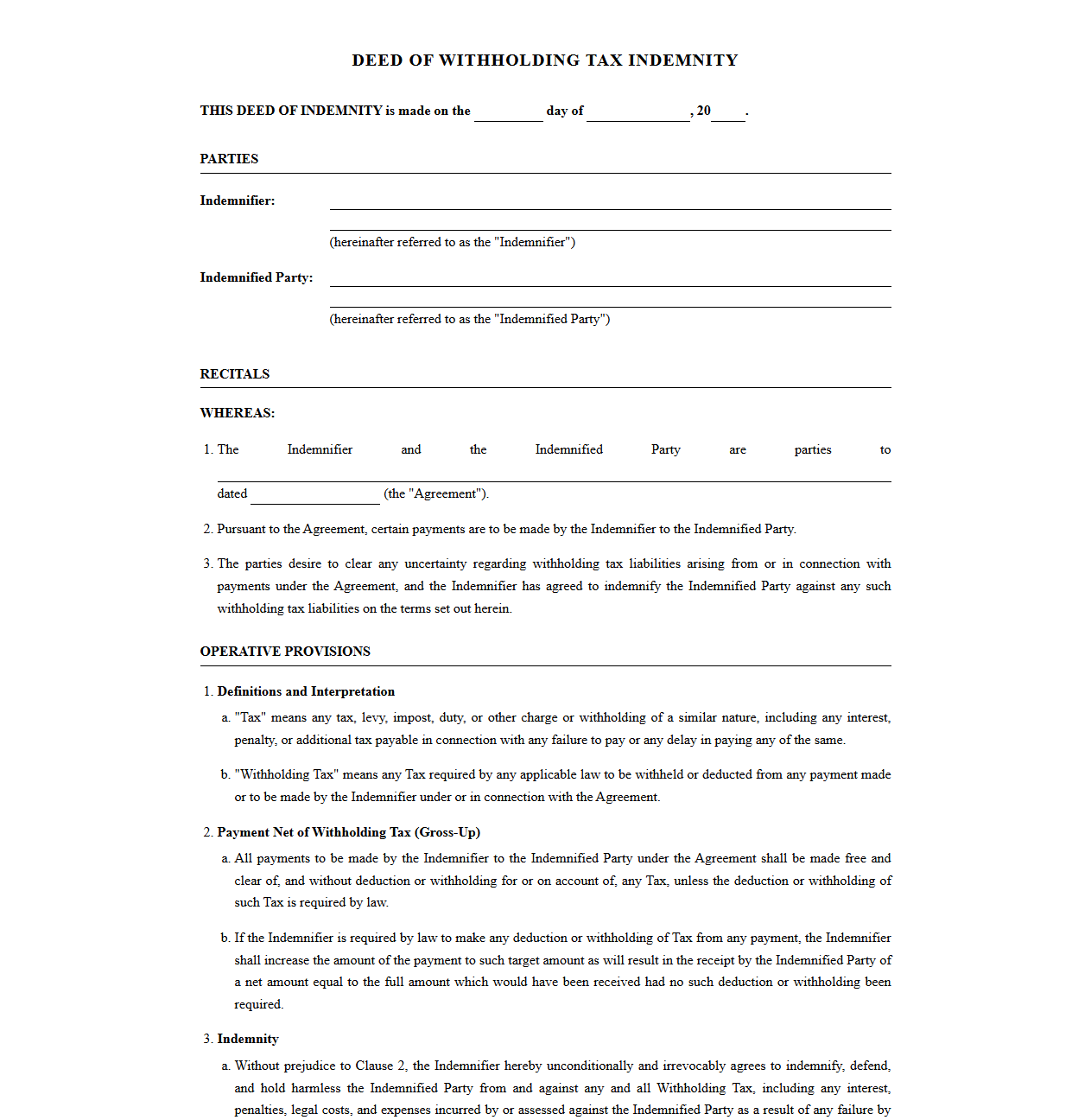 Download: .PDF
Standard Tax Withholding Indemnity Agreement
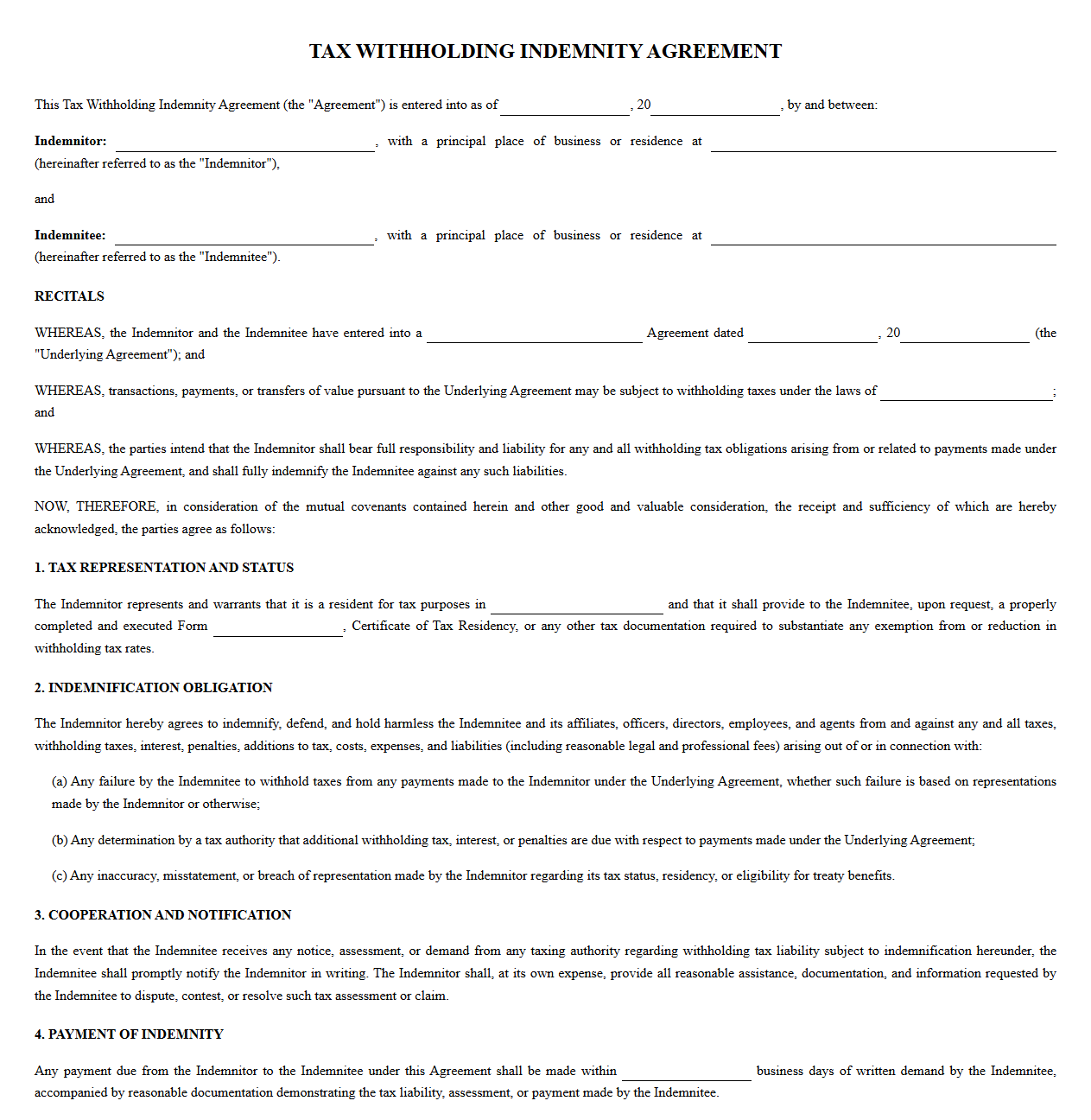 Download: .PDF
Deed of Indemnity for Withholding Tax
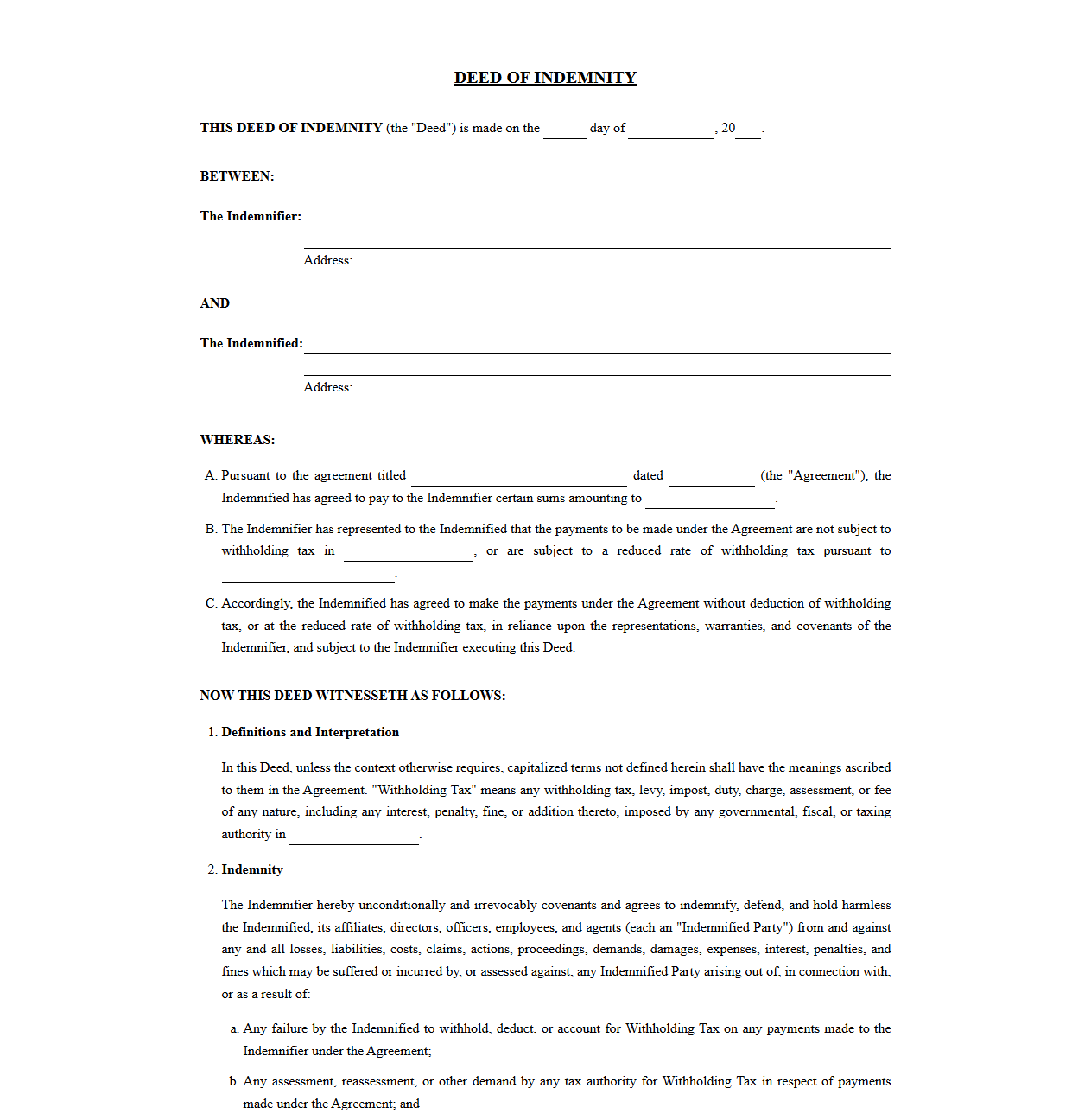 Download: .PDF
Withholding Tax Indemnity Letter Agreement
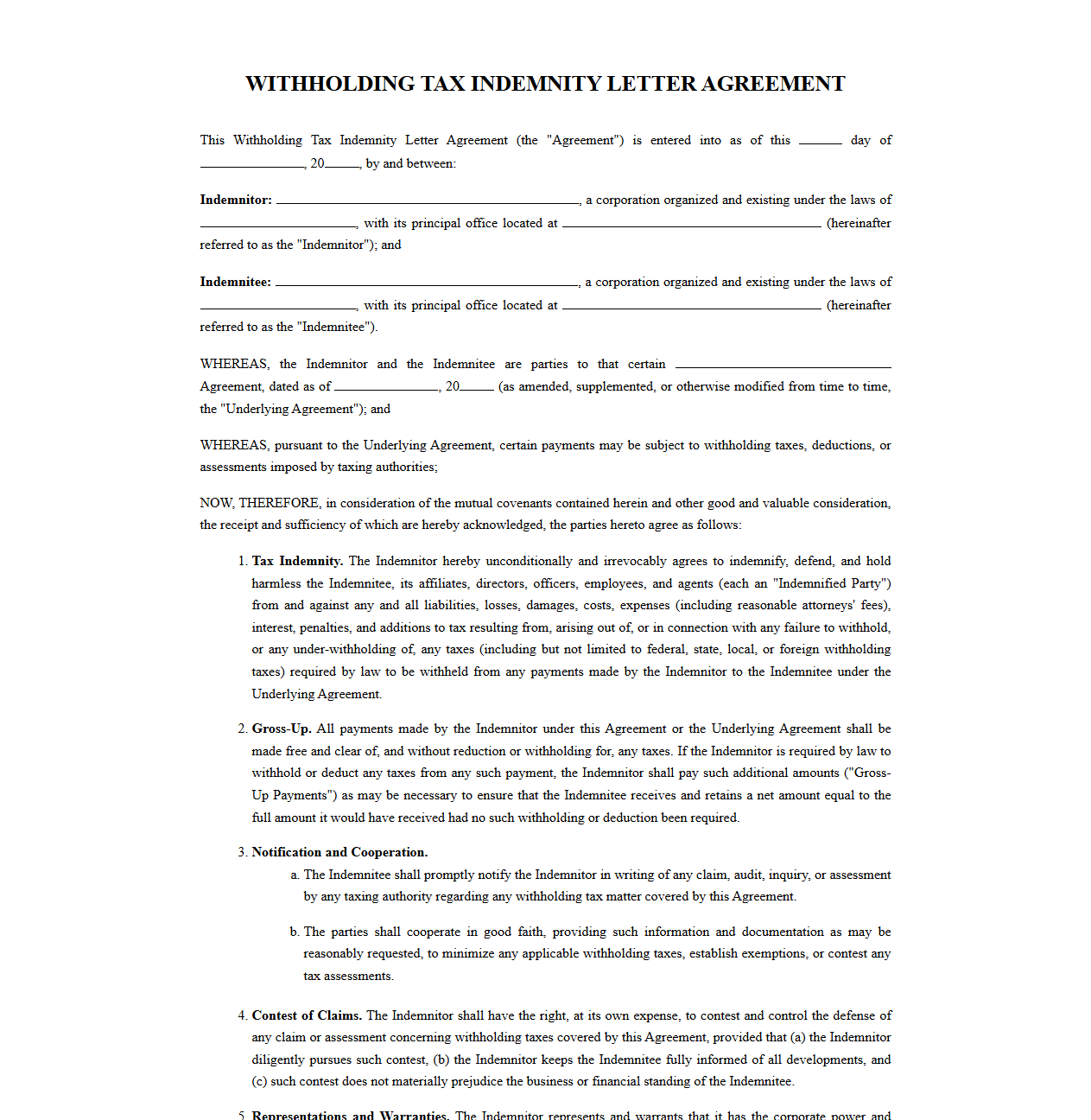 Download: .PDF
Indemnity Agreement for Foreign Withholding Tax
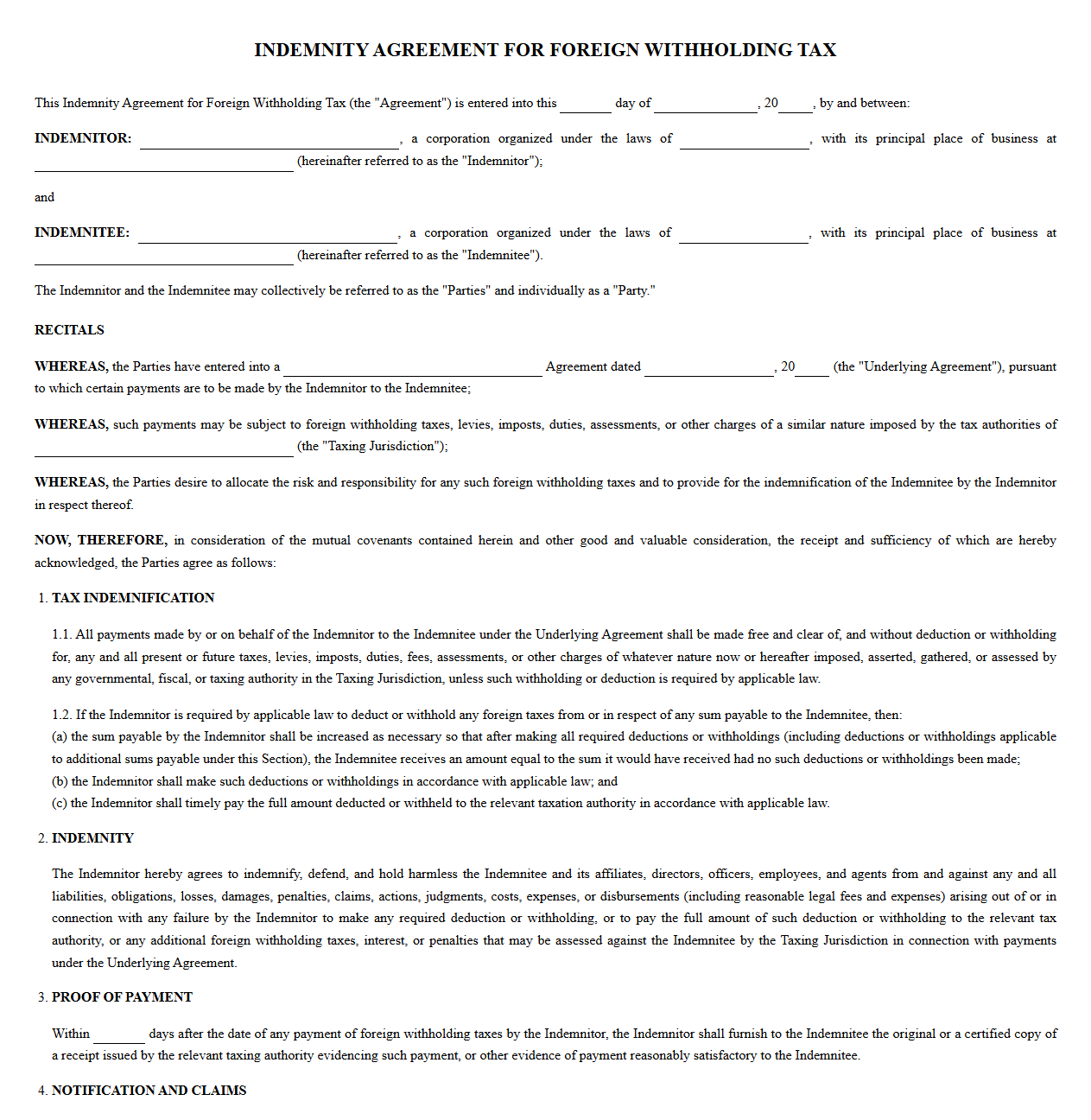 Download: .PDF
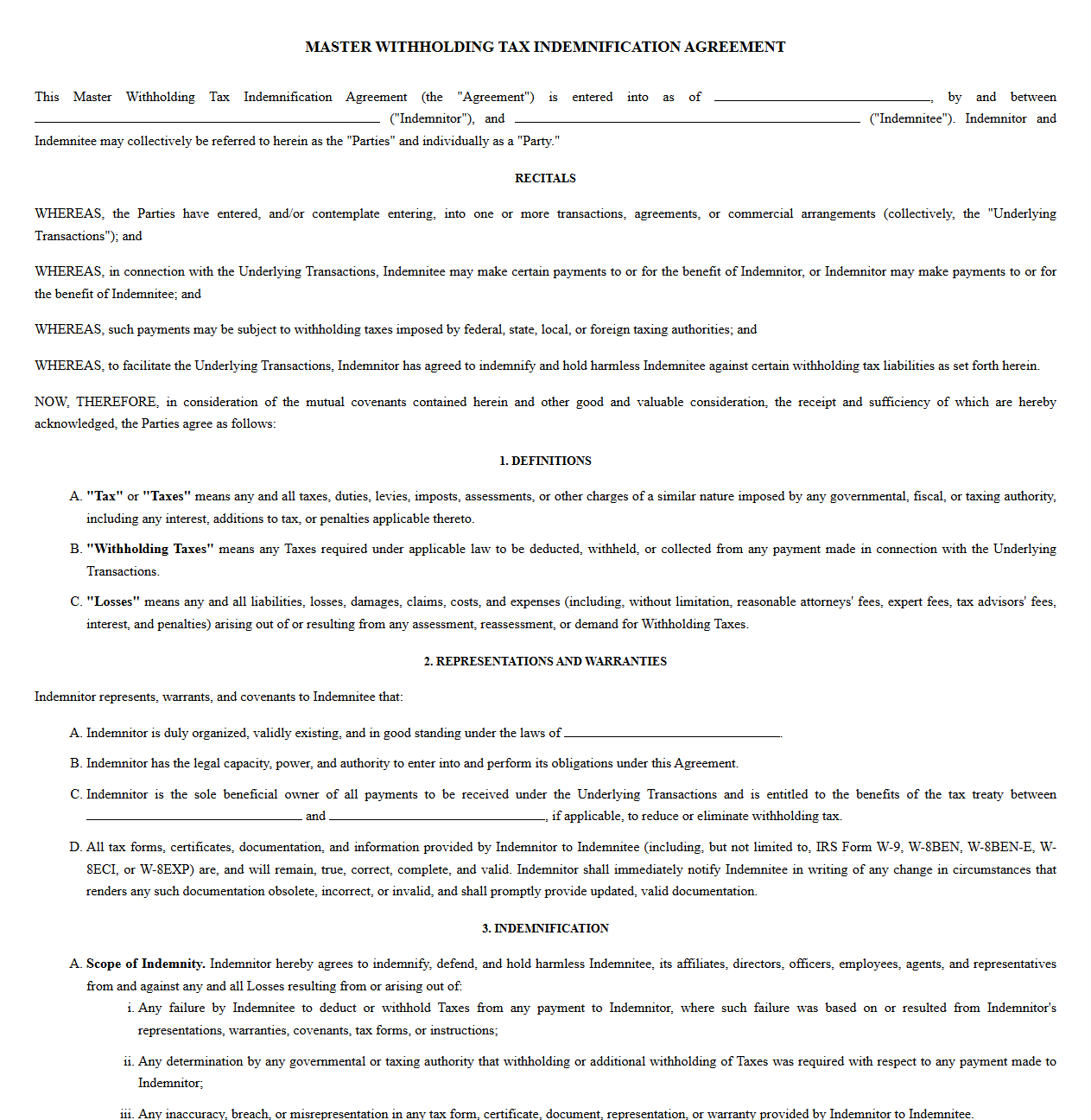
Master Withholding Tax Indemnification Agreement
 Download: .PDF
Navigating the Complexities of Withholding Tax Liabilities
In the arena of international business transactions, withholding tax liabilities present a formidable obstacle for unsuspecting enterprises. When a company makes a cross-border payment-such as royalties, dividends, interest, or service fees-the jurisdiction of the payer often requires that a portion of that payment be withheld and paid directly to the local tax authority. This mechanism ensures that foreign entities pay taxes on income sourced within that country, but it frequently catches multinational corporations off guard.
Without robust contractual protections, companies face severe financial risks, including sudden cash flow disruptions, unexpected tax assessments, and double taxation. When tax authorities dispute the classification of a transaction or find non-compliance, they hold the payer liable for the unpaid tax, interest, and penalties. Failing to address these exposures before executing foreign transactions can quickly turn a profitable cross-border deal into a costly financial liability.
Demystifying the Withholding Tax Indemnity Agreement
A withholding tax indemnity agreement serves as a vital risk-shifting mechanism in international trade and finance. It is a legally binding commitment where one party agrees to compensate the other for any unforeseen withholding tax liabilities that arise from a specific transaction. By allocating the financial responsibility of potential tax assessments to the party best suited to manage or bear the risk, this agreement provides financial certainty in volatile regulatory environments.
Using a standardized template to govern these arrangements ensures that cross-border deals proceed with clear, predictable guidelines. A well-drafted indemnity agreement establishes a clear protocol for which party bears the economic burden of taxes, preventing disputes when local tax authorities demand unexpected withholdings. Through these templates, multinational enterprises can standardize their risk management frameworks across multiple foreign subsidiaries and jurisdictions.
Essential Clauses within a Standard Indemnity Template
To provide comprehensive protection, a standard withholding tax indemnity template must contain precise and carefully negotiated clauses that address the allocation of liability, procedural steps, and tax adjustments.
Tax Representations and Warranties
These clauses require both parties to declare their tax status, residency, and eligibility for treaty benefits at the time of the transaction. Accurate representations prevent administrative surprises by establishing the factual baseline for how the transaction should be taxed.
Gross-Up Provisions
A gross-up clause mandates that if a payment is subject to a mandatory withholding tax, the payer must increase the payment amount so that the recipient receives the net amount originally agreed upon. This guarantees the seller or lender receives their full economic benefit, shifting the tax cost entirely to the payer.
Administrative Cooperation Covenants
Parties must agree to cooperate fully during tax audits and disputes, ensuring the exchange of necessary documentation and tax certificates.
- Document Sharing: Timely provision of withholding tax certificates and tax residency documents.
- Filing Obligations: Mutual assistance in filing tax returns or claiming refunds from foreign jurisdictions.
- Audit Notification: Immediate written notice if a tax authority initiates an inquiry into the transaction.
Operationalizing the Indemnification and Claim Process
When a tax authority issues an assessment or challenges a tax-free transaction, the parties must act swiftly to trigger the indemnity protections. The operational success of the agreement relies on a clear, step-by-step process that prevents delays and mitigates legal exposure.
- The indemnified party must provide prompt written notice to the indemnifying party of any pending tax audit, assessment, or claim.
- The indemnifying party is granted the right to participate in or control the defense against the tax authority, ensuring they can contest unjustified tax demands.
- The parties must consult in good faith to resolve whether to pay the tax under protest, appeal the decision, or settle with the government.
- Upon final determination of the tax liability, the indemnifying party must transfer the required funds to the indemnified party or directly to the tax authority within the contractually specified timeline.
Aligning Indemnity Templates with Double Taxation Treaties
Cross-border transactions are heavily influenced by Double Taxation Treaties (DTTs), which are bilateral agreements designed to prevent the same income from being taxed by two different countries. These treaties often reduce or entirely eliminate domestic withholding tax rates on interest, dividends, and royalties. Therefore, a generic indemnity agreement cannot be applied blindly; it must be carefully aligned with the specific treaty networks of the involved jurisdictions.
"An indemnity template must be drafted to leverage treaty benefits effectively, ensuring that gross-up obligations do not trigger unnecessary double taxation or prevent the recovery of foreign tax credits."
If the recipient is eligible for a reduced rate under a treaty, the agreement should obligate them to submit all necessary certificates of residence and tax forms to the payer before payments commence. Failing to align the indemnity with active treaties can lead to excessive tax withholdings that strain the financial feasibility of the deal.
Best Practices for Tailoring and Executing the Agreement
Generic legal templates provide an excellent starting point, but they must be customized to fit the unique characteristics of each transaction, the corporate entities involved, and the specific foreign tax jurisdictions.
Customization for Transaction Types
A debt financing agreement requires different tax indemnity considerations than a technology licensing agreement or a cross-border mergers and acquisitions transaction.
Proactive Compliance and Monitoring
Tax regulations, treaty networks, and transfer pricing guidelines are constantly evolving. Legal and tax departments must implement a system of continuous oversight.
- Review indemnity templates annually against domestic tax reforms and international treaty updates.
- Verify that foreign counterparties maintain their qualified tax residency status throughout the life of the agreement.
- Establish clear internal procedures to track tax certificates and verify that foreign withholdings are correctly paid to government accounts.
Securing Transaction Value Through Proactive Tax Risk Management
Managing the hidden dangers of international withholding taxes requires foresight, precise drafting, and structured legal protections. By implementing a comprehensive, well-structured withholding tax indemnity agreement, businesses can insulate themselves from unexpected tax assessments, preserve their projected cash flows, and maintain transaction certainty across international borders.
In the global market, tax risks are inevitable, but their financial impact can be carefully managed. Deploying robust indemnity templates ensures that cross-border deals remain profitable, predictable, and compliant with international tax standards, safeguarding long-term enterprise value.

Leave a comment