

Tracking daily commuting expenses like toll fees and parking receipts often devolves into a chaotic administrative burden, resulting in lost receipts and delayed reimbursements for mobile employees. As organizations adapt to hybrid work models and stricter corporate auditing standards, establishing a unified reporting framework has become essential for operational efficiency.
Implementing standardized templates grants finance departments immediate administrative clarity while accelerating reimbursement cycles. However, users must note that while these tools streamline data collection, they must be paired with clear internal policies to ensure alignment with local tax regulations.
By utilizing structured formats-such as Excel spreadsheets, fillable PDFs, and Google Sheets integrated with toll transponder logs-companies can ensure bulletproof record-keeping. Below, we will explore the core components of accurate commute tracking, provide downloadable multi-format templates, and outline best practices for seamless expense integration.
Parking and Toll Expense Report
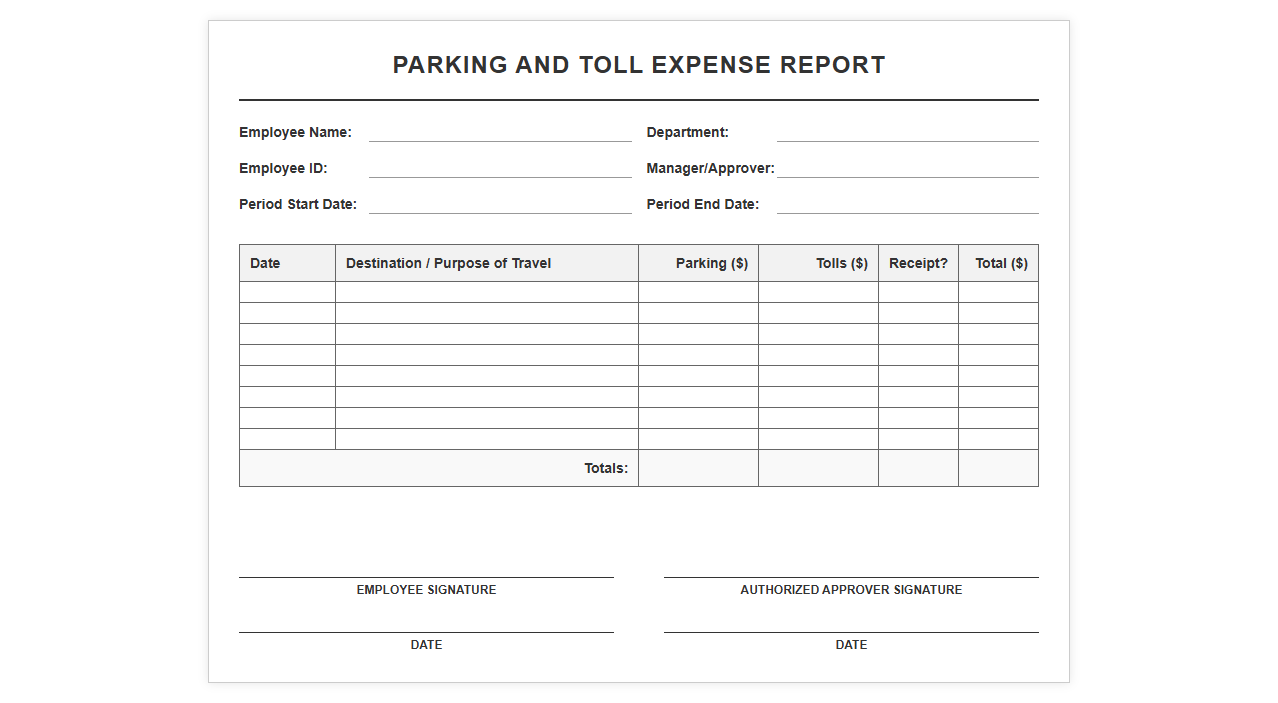 Download: .PDF
Travel Parking and Toll Claim Form
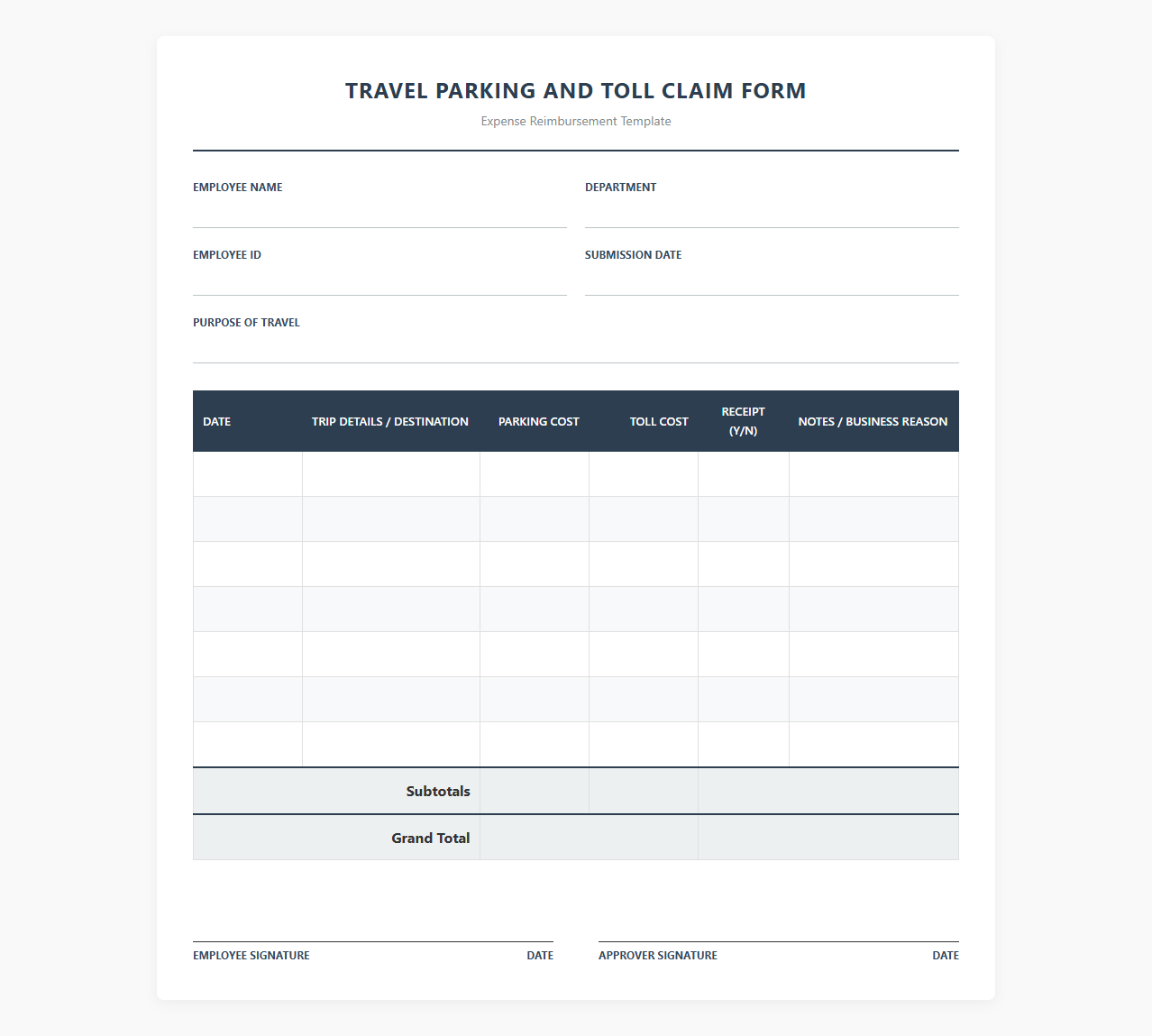 Download: .PDF
Parking and Tolls Reimbursement Template
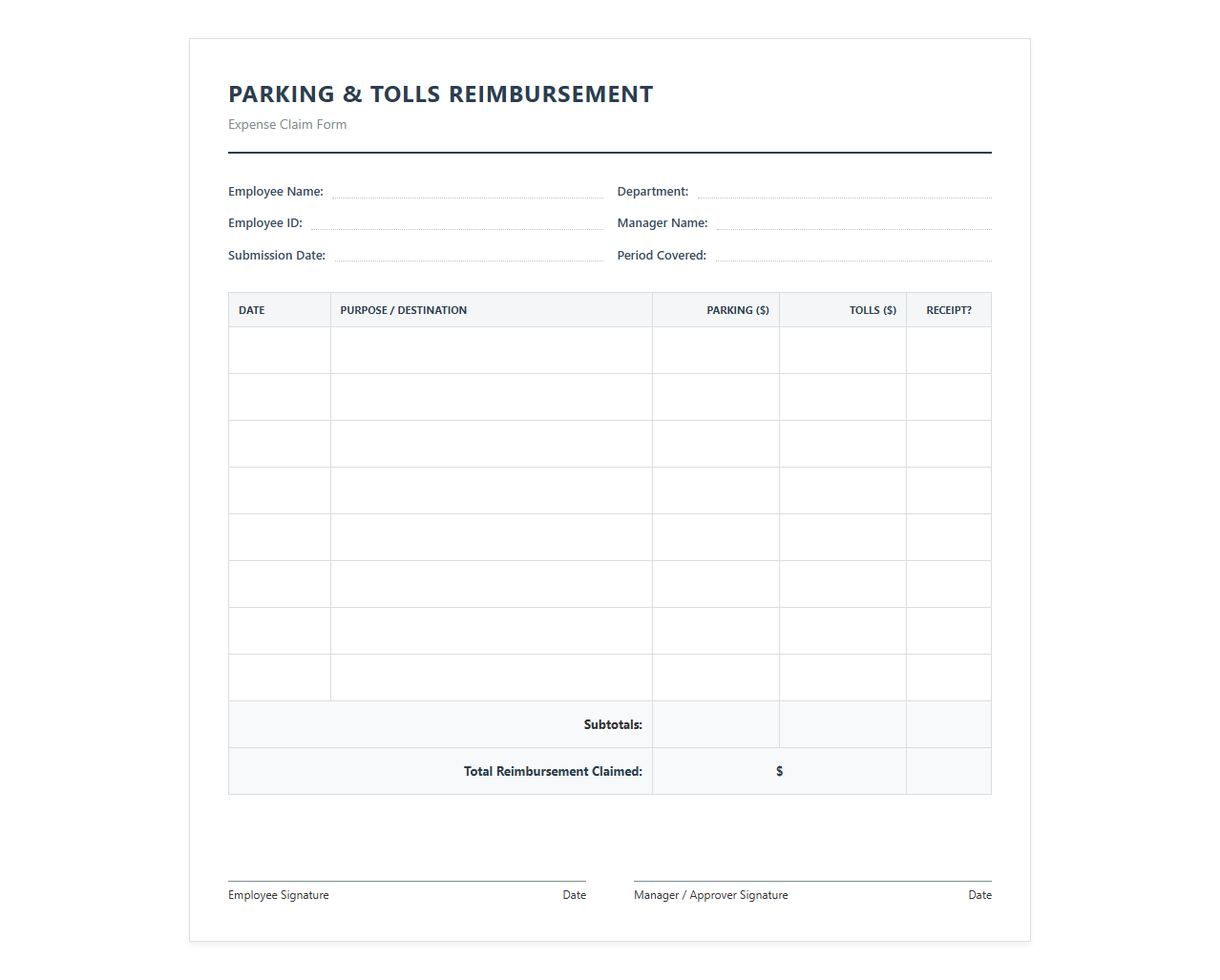 Download: .PDF
Commuter Parking and Toll Expense Log
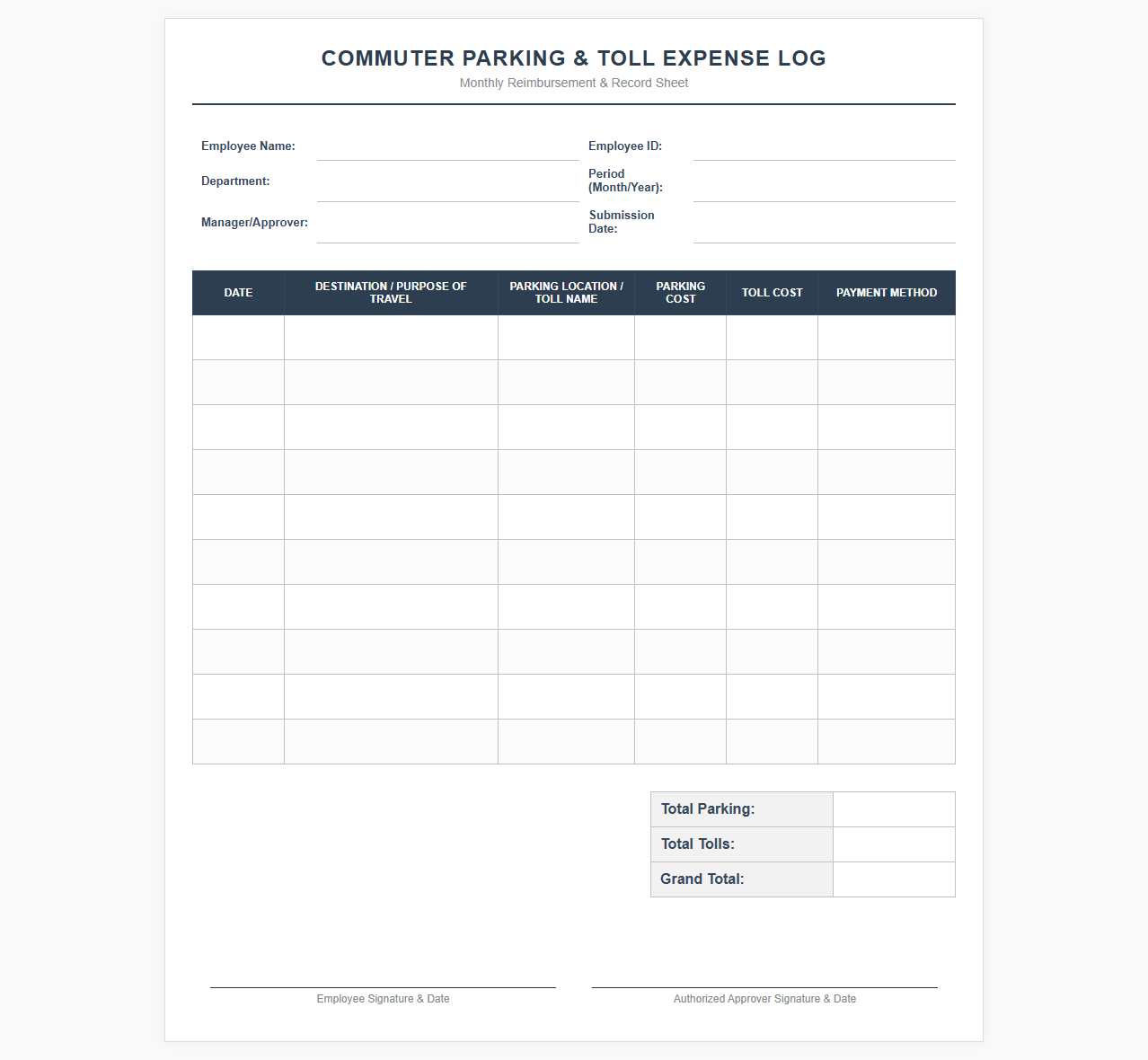 Download: .PDF
Vehicle Parking and Tollway Expense Sheet
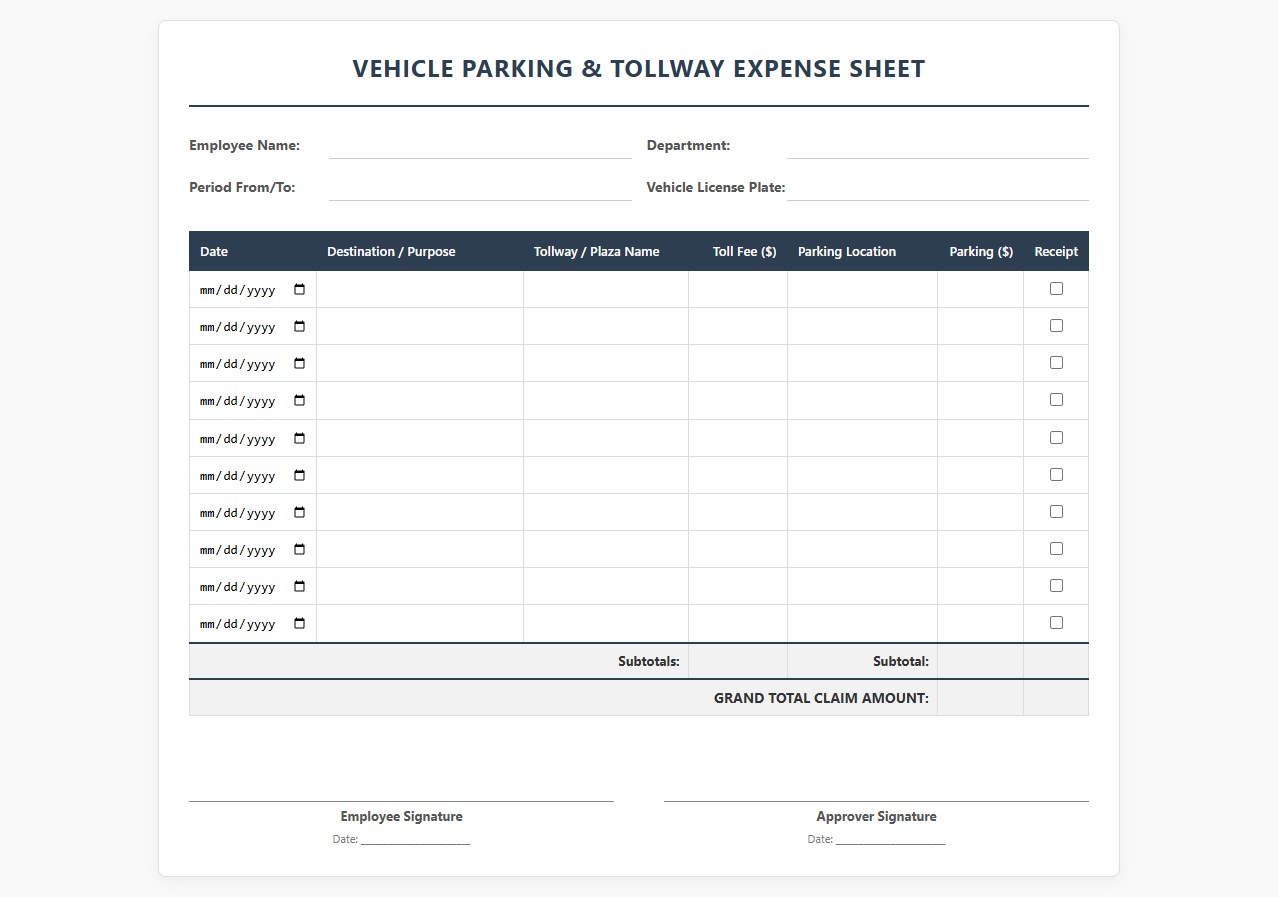 Download: .PDF
Parking Fee and Toll Road Receipt Template
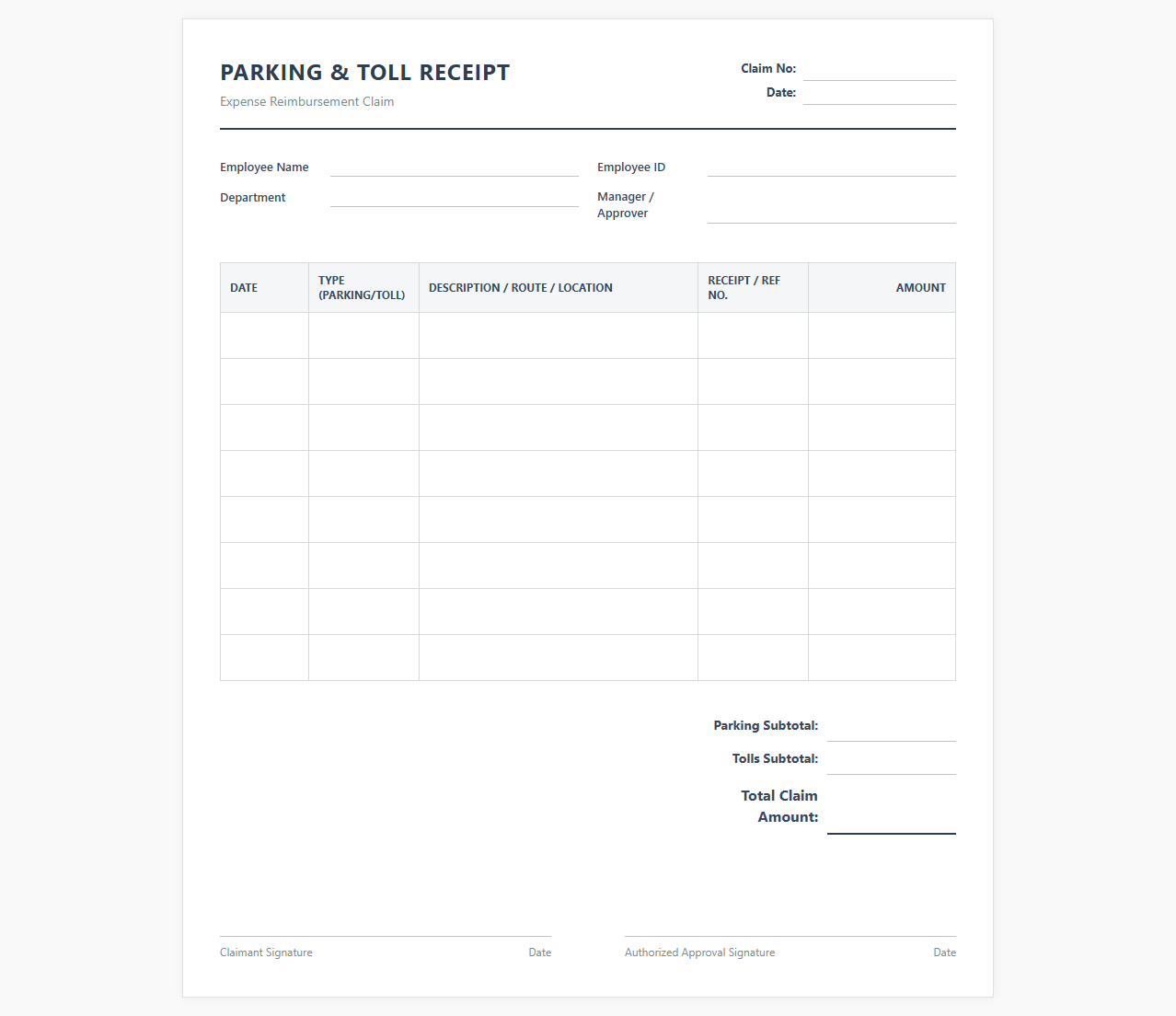 Download: .PDF
Business Parking and Toll Expense Tracker
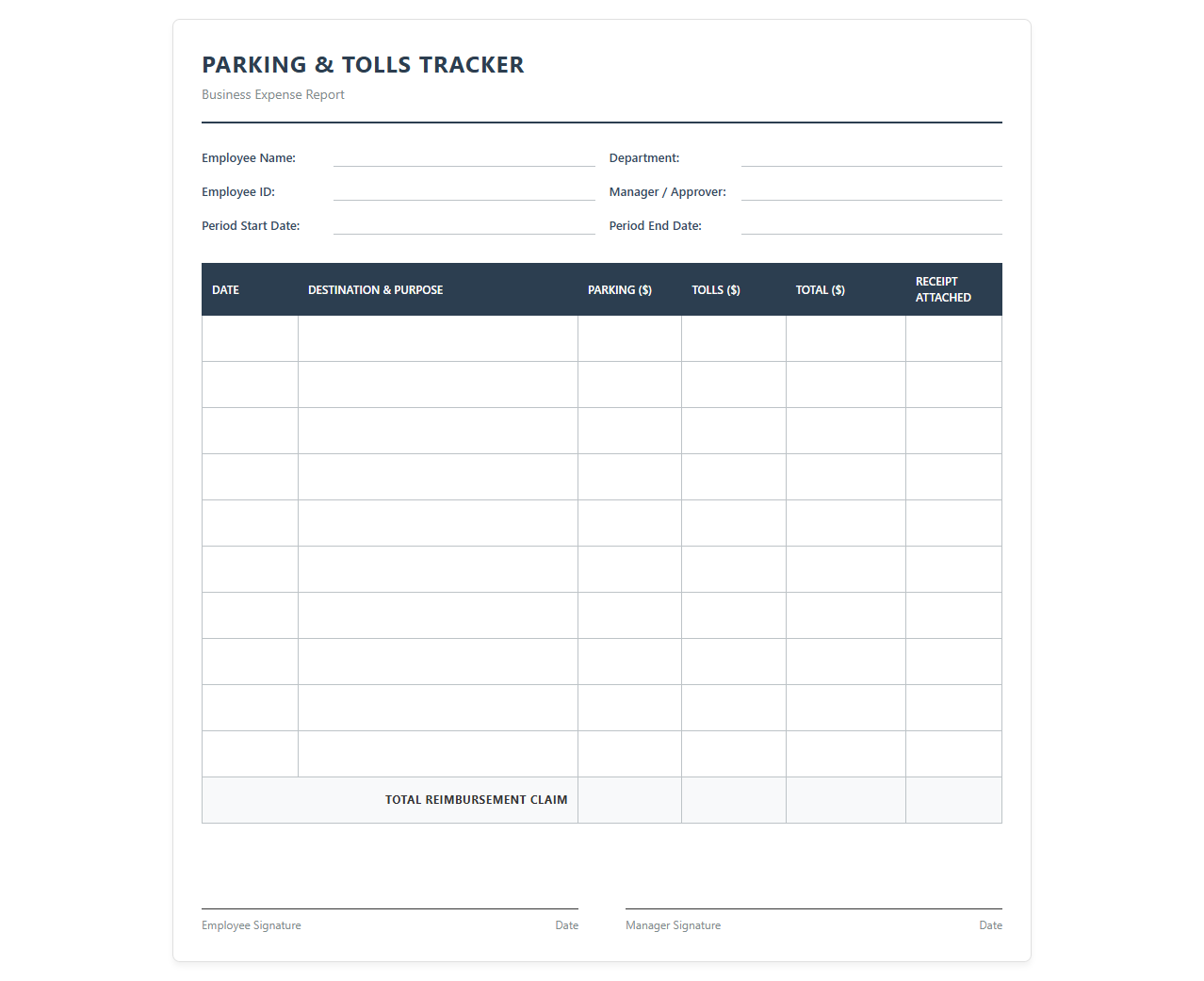 Download: .PDF
Monthly Parking and Toll Reimbursement Form
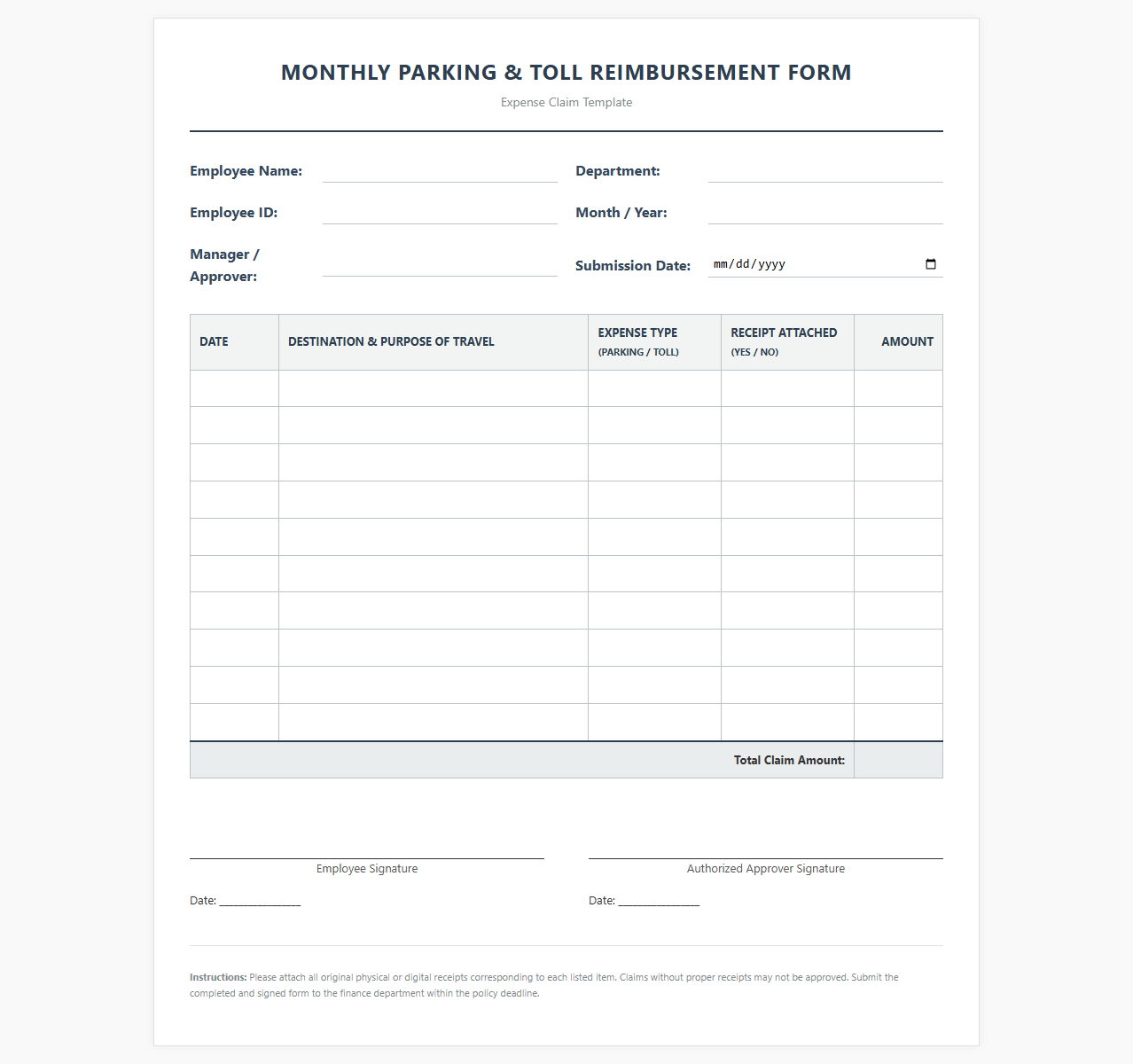 Download: .PDF
The Hidden Costs of Commuting: The Need for Standardized Expense Tracking
Every week, thousands of employees find themselves buried under a mountain of crumpled paper receipts, faded parking stubs, and digital toll statements. Manual expense tracking is inherently chaotic and prone to errors. When commuters are forced to piece together their travel history manually, it creates a massive administrative bottleneck.
This disorganization leads to significant reimbursement delays, frustrating team members who are left waiting for their hard-earned money. For finance departments, the administrative burden of verifying mismatched dates and illegible receipts is an expensive waste of valuable time.
The Business Case for Unified Reimbursement Templates
Standardizing the way your organization tracks commute expenses is not just about reducing paperwork; it is a strategic business decision that directly impacts your bottom line.
- Enhanced Regulatory Compliance: Standardized templates ensure all required tax documentation is collected uniformly, reducing legal and financial risks.
- Accelerated Approval Speeds: When finance teams receive clean, structured data, processing times drop from weeks to hours.
- Audit Readiness: Having centralized, uniform records means your business can confidently navigate internal and external financial audits without scrambling for missing papers.
Anatomy of an Effective Parking and Toll Tracking Template
To eliminate ambiguity, an expense template must capture specific, high-fidelity data points right at the moment of entry. This ensures that every claim is verifiable and leaves no room for guesswork.
- Transaction Date
- The exact calendar day the parking or toll expense was incurred to match against bank statements.
- Expense Location
- The specific city, facility, or highway where the charge took place.
- Toll Booth Identifier
- The specific gate, plaza number, or electronic transponder ID used during transit.
- Parking Duration
- The total time parked, calculated in hours or days, to justify the tier of the rate charged.
- Receipt Reference Number
- The unique digital invoice or paper receipt number used for direct verification.
Design 1: The Automated Spreadsheet Solution
For desktop users, a structured spreadsheet template provides immediate clarity. By leveraging automated formulas, you can calculate mileage reimbursements and applicable taxes without manual math.
| Date | Description | Distance (Miles) | Rate Per Mile | Subtotal | Tax Rate | Total Claim |
|---|---|---|---|---|---|---|
| 2023-11-01 | Client Visit Tolls | 45 | 0.65 | 29.25 | 0.08 | 31.59 |
| 2023-11-02 | Airport Parking | 0 | 0.00 | 45.00 | 0.08 | 48.60 |
Design 2: Mobile-First Tracking for On-the-Go Commuters
Field workers and traveling executives need a quick, distraction-free interface to log their parking fees and upload toll receipts directly from their smartphones.
Establishing a Seamless Verification and Approval Workflow
An effective expense tracking system is only as good as its verification process. Finance departments must establish a consistent routine to ensure accuracy and prevent fraud.
- Step 1: Cross-Reference: Match the date and timestamp on the employee's submitted template directly against the digital toll receipt or parking ticket.
- Step 2: Validate Transponder Logs: Check the electronic toll transponder statement to confirm that the vehicle was actively on the route specified during the logged hours.
- Step 3: Confirm Cost Center Allocations: Verify that the commute expense is assigned to the correct client project or internal department budget code.
- Step 4: Execute Fast Approval: Once verified, push the approved claim directly to the payroll queue for immediate disbursement.
Driving Efficiency Home: Implementing Your Standardized Templates
Transitioning to a standardized expense tracking framework requires clear communication and a structured rollout strategy to ensure complete organizational alignment.
Providing your team with clear training modules and accessible templates is the fastest path to widespread compliance. When employees realize how quickly they get paid back, adoption happens organically.
Maintain an open channel for continuous feedback loops. Encourage employees to share their thoughts on template usability, and use their insights to refine and simplify the process over time.

Leave a comment