

Energy procurement managers and corporate finance teams constantly battle the administrative chaos of disparate utility invoices, volatile market rates, and erratic billing cycles. Before investing in complex software solutions, however, organizations must first establish a unified, manual data foundation to reconcile these disparate sources. Standardizing your internal expense documentation grants immediate financial clarity, unlocking hidden cost-recovery opportunities and ensuring audit readiness.
Note: This framework serves as an operational blueprint for data categorization; it is not a replacement for automated enterprise resource planning (ERP) integrations.
By systematically capturing precise metrics-such as Dekatherm (Dth) conversions, pipeline transport tariffs, and local distribution company (LDC) franchise fees-organizations can eliminate costly billing discrepancies. Below, we outline the essential pillars of a standardized tracking framework, provide step-by-step logging workflows, and deliver actionable templates to optimize your natural gas accounting today.
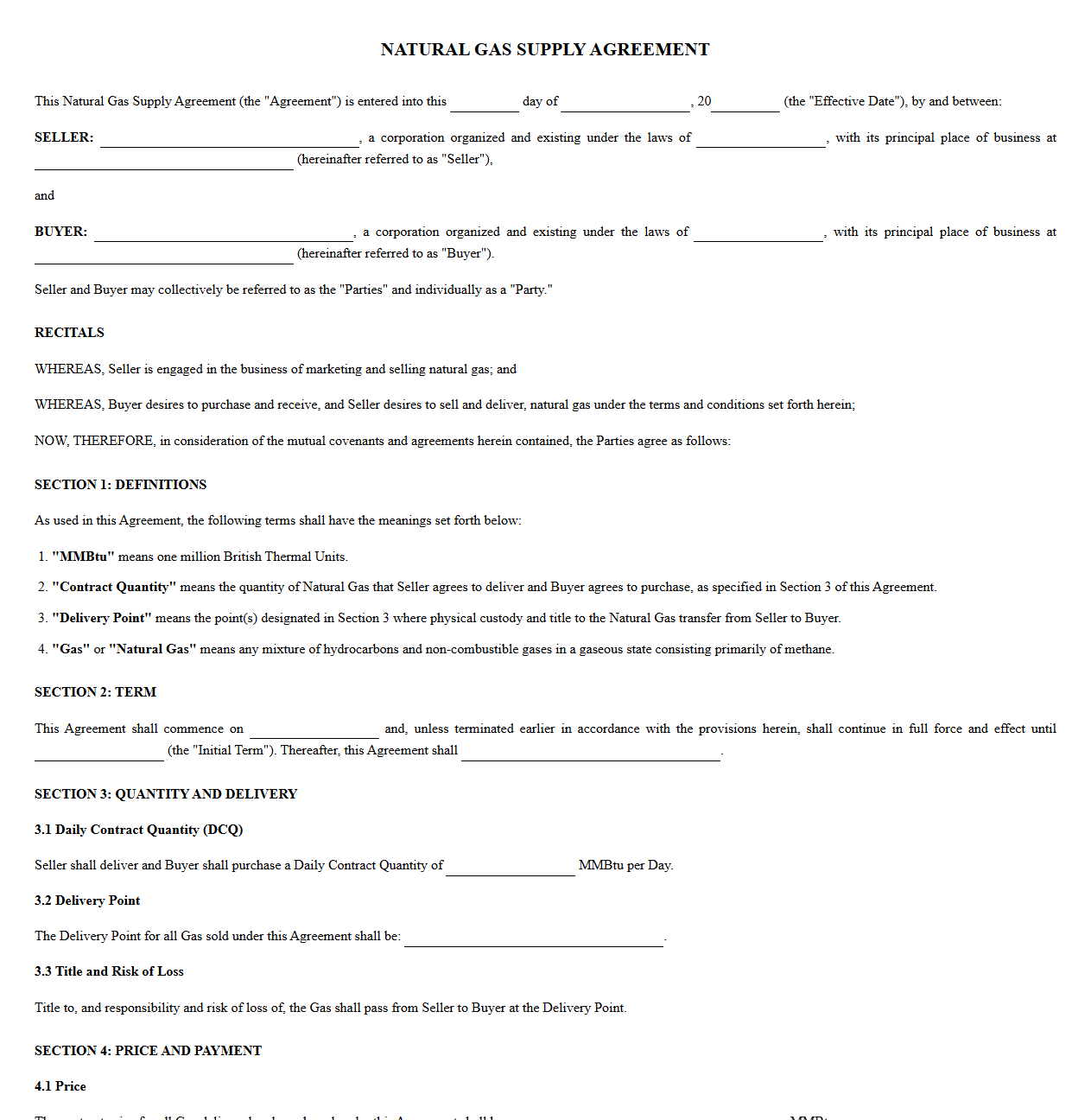
Natural Gas Supply Agreement
 Download: .PDF
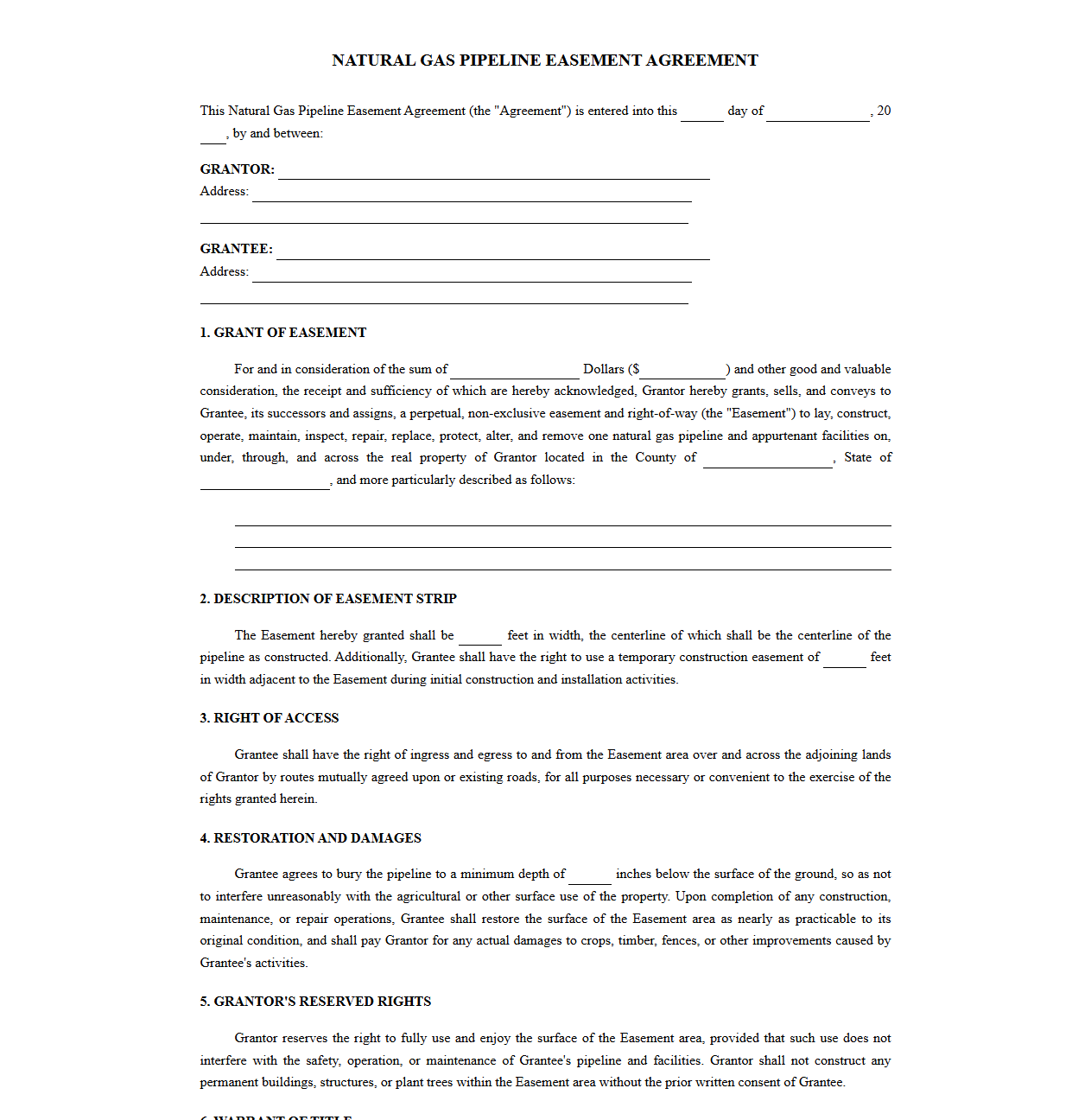
Natural Gas Pipeline Easement Agreement
 Download: .PDF
Natural Gas Purchase and Sale Contract
 Download: .PDF
Natural Gas Lease and Royalty Agreement
 Download: .PDF
Natural Gas Transportation Services Agreement
 Download: .PDF
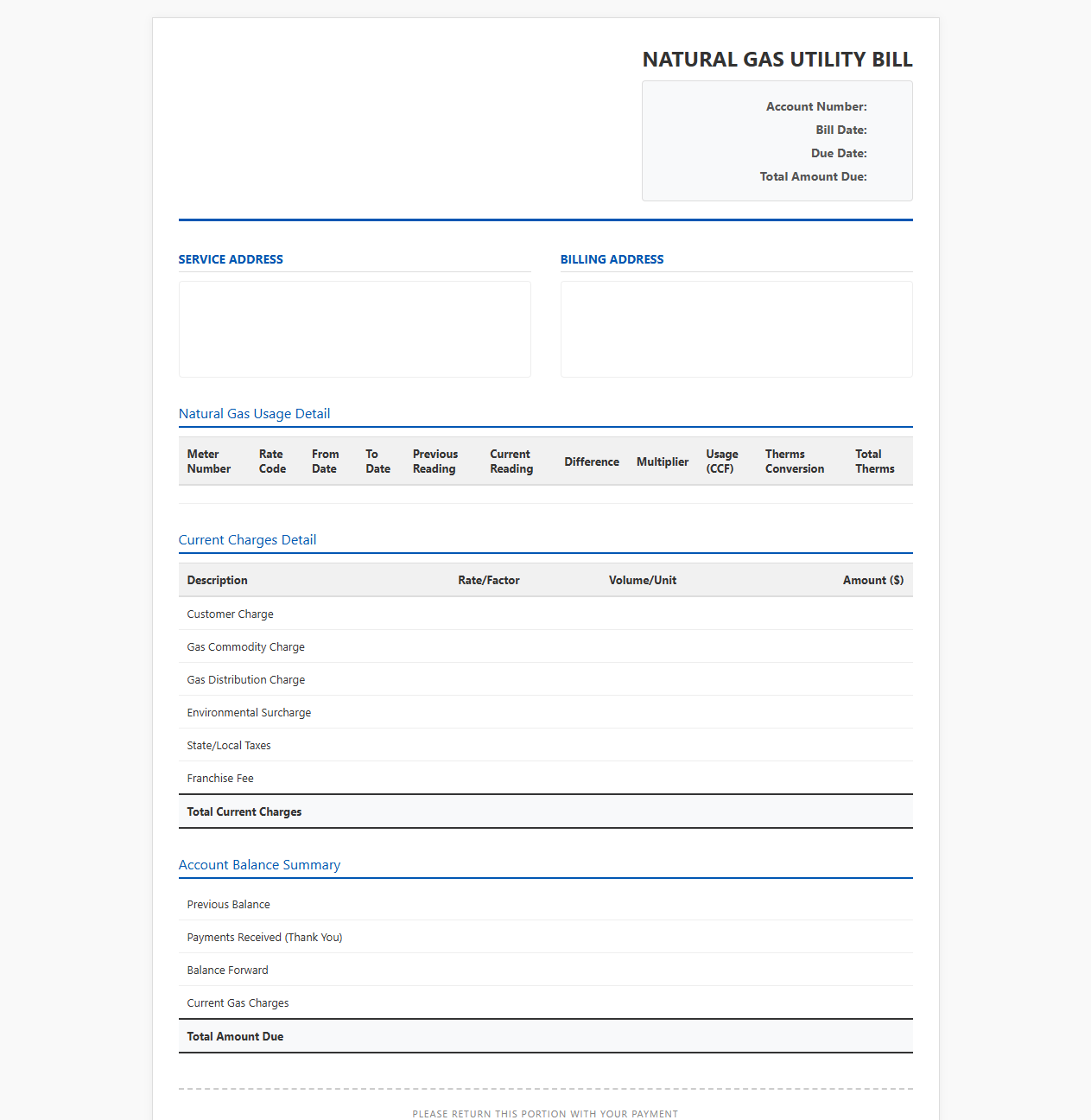
Natural Gas Utility Bill Template
 Download: .PDF
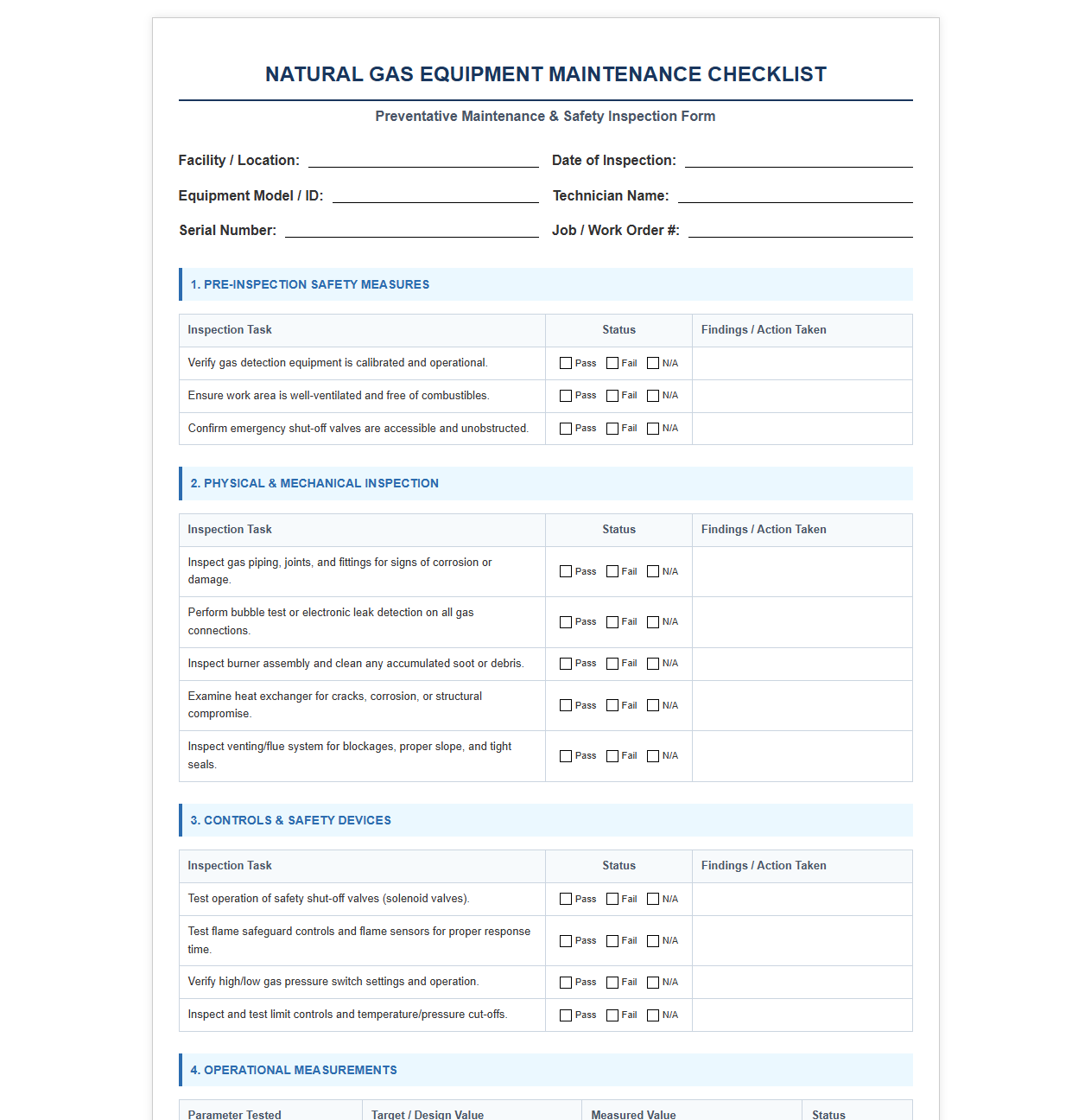
Natural Gas Equipment Maintenance Checklist
 Download: .PDF
Natural Gas Safety and Emergency Response Plan
 Download: .PDF
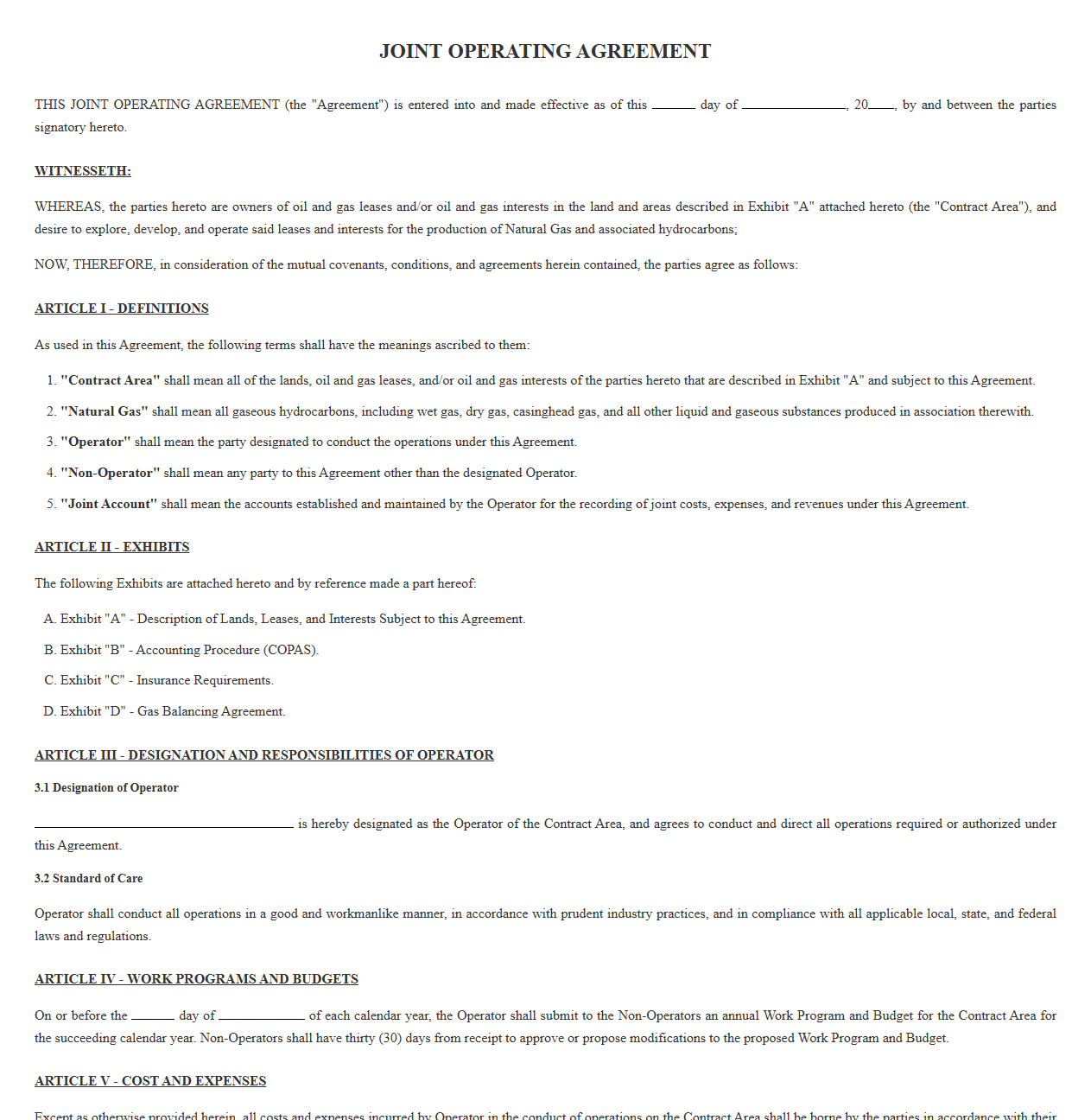
Natural Gas Joint Operating Agreement
 Download: .PDF
Introduction: The Cost of Fragmented Gas Expense Tracking
For multi-site enterprises, managing utility expenses is often a chaotic exercise in administrative endurance. Natural gas billing remains particularly notoriously non-standardized, with different local distribution companies employing varied terminology, billing cycles, and regional rate structures. When organizations rely on fragmented data collection methods-such as manually entering mismatched PDF invoices into disconnected spreadsheets-they invite costly inefficiencies and invisible financial leaks.
Without centralized, standardized documentation, accounting teams struggle to compare consumption patterns across facilities. Hidden costs, such as undetected leaks, incorrect meter readings, and sluggish tariff adjustments, go completely unnoticed. Implementing a standardized gas expense tracking protocol is not merely an administrative upgrade; it is a critical foundation for enterprise energy management that directly protects the corporate bottom line.
Identifying Key Metrics for Natural Gas Documentation
To establish an actionable framework for gas expense tracking, organizations must look beyond the total balance due and capture the granular data points that dictate actual utility costs. Standardizing these metrics across all facility profiles ensures peer-to-peer comparability.
- Therms/MMBtu Usage: The standardized unit of energy content consumed, crucial for indexing raw usage independent of volumetric fluctuations.
- Delivery Charges: The cost assessed by the local utility to transport the gas through their physical pipeline infrastructure to your facility.
- Supply Rates: The commodity charge per unit of gas, which may fluctuate based on market indices or reflect a fixed-price agreement with a retail supplier.
- Taxes and Surcharges: State, local, and environmental regulatory fees that vary drastically by geographic jurisdiction.
- Demand Charges: Peak usage penalties assessed during high-volume periods, designed to cover the utility's infrastructure maintenance.
Designing a Standardized Ledger Template
Consolidating diverse invoicing formats into a singular source of truth requires a highly structured database architecture. Using a uniform ledger template prevents billing discrepancies and ensures that financial analysts are always comparing equivalent values.
| Billing Period | Facility ID | Total Usage (Therms) | Supply Cost ($) | Delivery Cost ($) | Total Amount Due ($) |
|---|---|---|---|---|---|
| 2026-01-01 | FAC-0912 | 14,250 | $7,837.50 | $3,135.00 | $10,972.50 |
| 2026-01-01 | FAC-0411 | 9,800 | $5,390.00 | $2,156.00 | $7,546.00 |
Leveraging Automation and Digital Invoicing
Manual data entry is the primary bottleneck of modern energy accounting. Transitioning to modern digital intake systems eliminates human error and vastly speeds up processing cycles.
OCR Scraping and Automated Data Extraction
Using Optical Character Recognition (OCR) technology allows software tools to automatically scan incoming PDF utility bills. These programs identify key-value pairs, such as invoice dates and total therms, and automatically populate the standardized database without requiring human keystrokes.
EDI Integration for Large Enterprises
For larger commercial portfolios, establishing an Electronic Data Interchange (EDI 810) connection with major utility suppliers allows invoice data to be sent directly from the utility to the enterprise ERP system, bypassing document imaging altogether and establishing a seamless pipeline of raw data.
Auditing Protocols and Identifying Billing Errors
Utility invoices are surprisingly prone to administrative errors. Establish a recurring, structured review protocol to compare logged ledger data against physical invoices and check for common red flags.
- Verify the billing basis: Check if the invoice is marked as an "estimated read" rather than an actual meter reading, which can lead to significant overcharges over time.
- Confirm the assigned rate code: Utilities occasionally misclassify commercial accounts into higher-tariff residential or industrial rate classes.
- Audit late payment fee structures: Ensure that late penalties are not being charged on accounts with active electronic funds transfers (EFT).
- Cross-reference historical usage: Flag any unexpected spikes in consumption that could indicate physical pipeline leaks or mechanical malfunctions.
Driving Strategic Procurement with Historical Data
Standardized financial ledger records are not merely retrospective; they are powerful tools for future cost reduction. Possessing a clean, multi-year dataset of natural gas usage gives energy managers unprecedented leverage during procurement cycles.
"Having access to precise historical consumption intervals allows organizations to approach third-party marketers with confidence, secure in their load-profile accuracy."
This historical transparency enables companies to evaluate whether to enter fixed-price contracts to guarantee budgetary certainty or opt for index-based pricing strategies to capitalize on seasonal market downturns.
Conclusion: Building a Resilient Energy Management Strategy
Standardizing natural gas tracking is a critical investment in corporate transparency and operational efficiency. Removing fragmentation from utility data processing directly improves cash flow forecasting, auditing accuracy, and procurement negotiations.

Leave a comment