

Advisory firms often grapple with chronic payment delays, despite delivering high-impact strategic guidance. Before addressing the invoices themselves, we must first recognize how the shift from tangible deliverables to abstract consultation complicates client procurement processes.
Successfully aligning your billing structures to meet these corporate expectations grants your firm accelerated cash flow and positions you as a highly sophisticated partner. However, this transition requires adhering to a crucial stipulation: advisory billing must never be ambiguous; transparency is a non-negotiable prerequisite for prompt settlement. For instance, replacing a vague "monthly consulting" line item with a structured breakdown-such as separating strategic roadmapping sessions from ongoing executive coaching hours-removes administrative hurdles instantly.
This article outlines how to format your invoice documents systematically, align billing cycles with client accounts payable workflows, and eliminate the common bottlenecks stalling your advisory revenue.
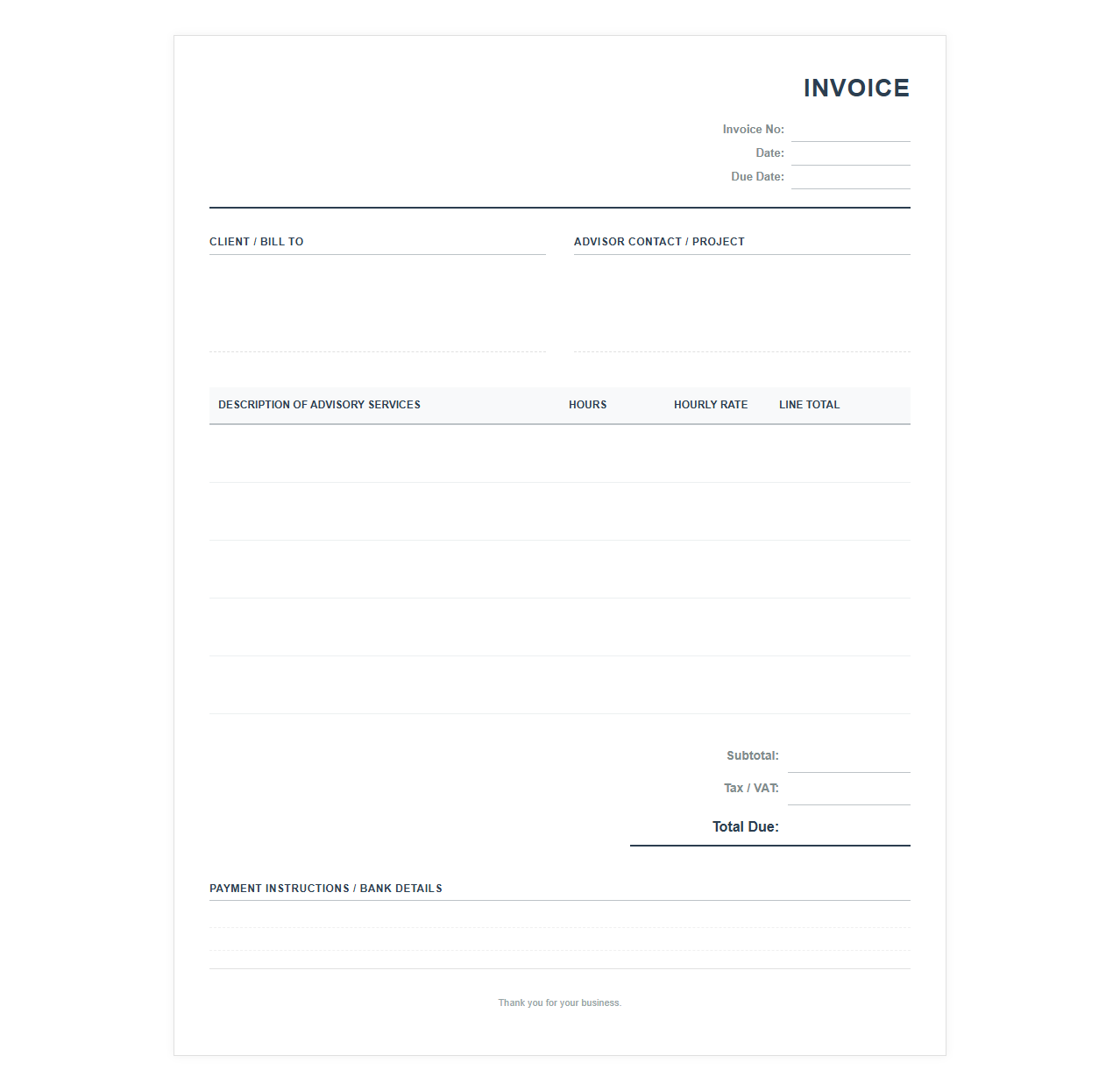
Hourly Advisory Services Invoice Template
 Download: .PDF
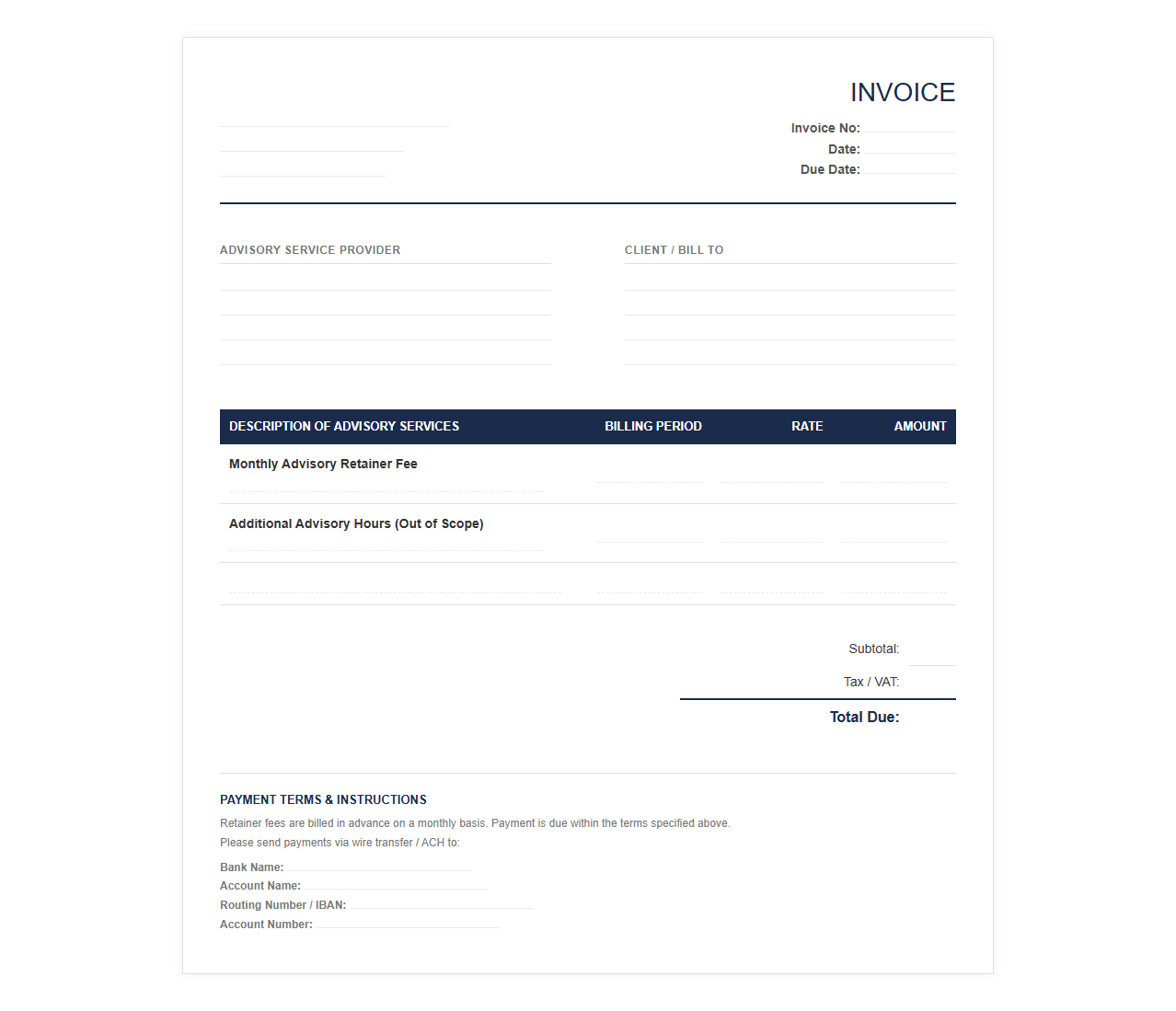
Monthly Retainer Advisory Invoice Template
 Download: .PDF
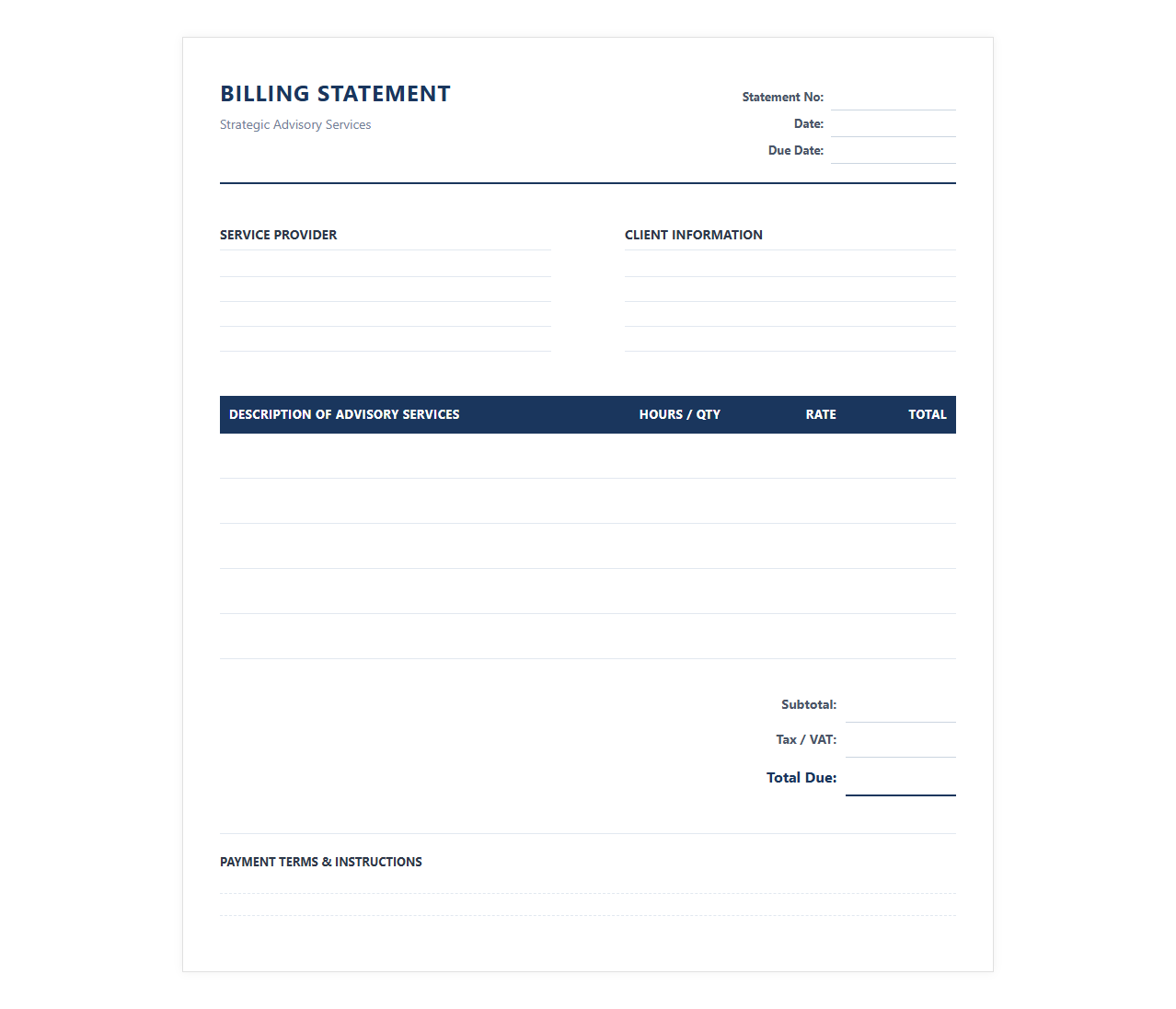
Strategic Advisory Services Billing Statement
 Download: .PDF
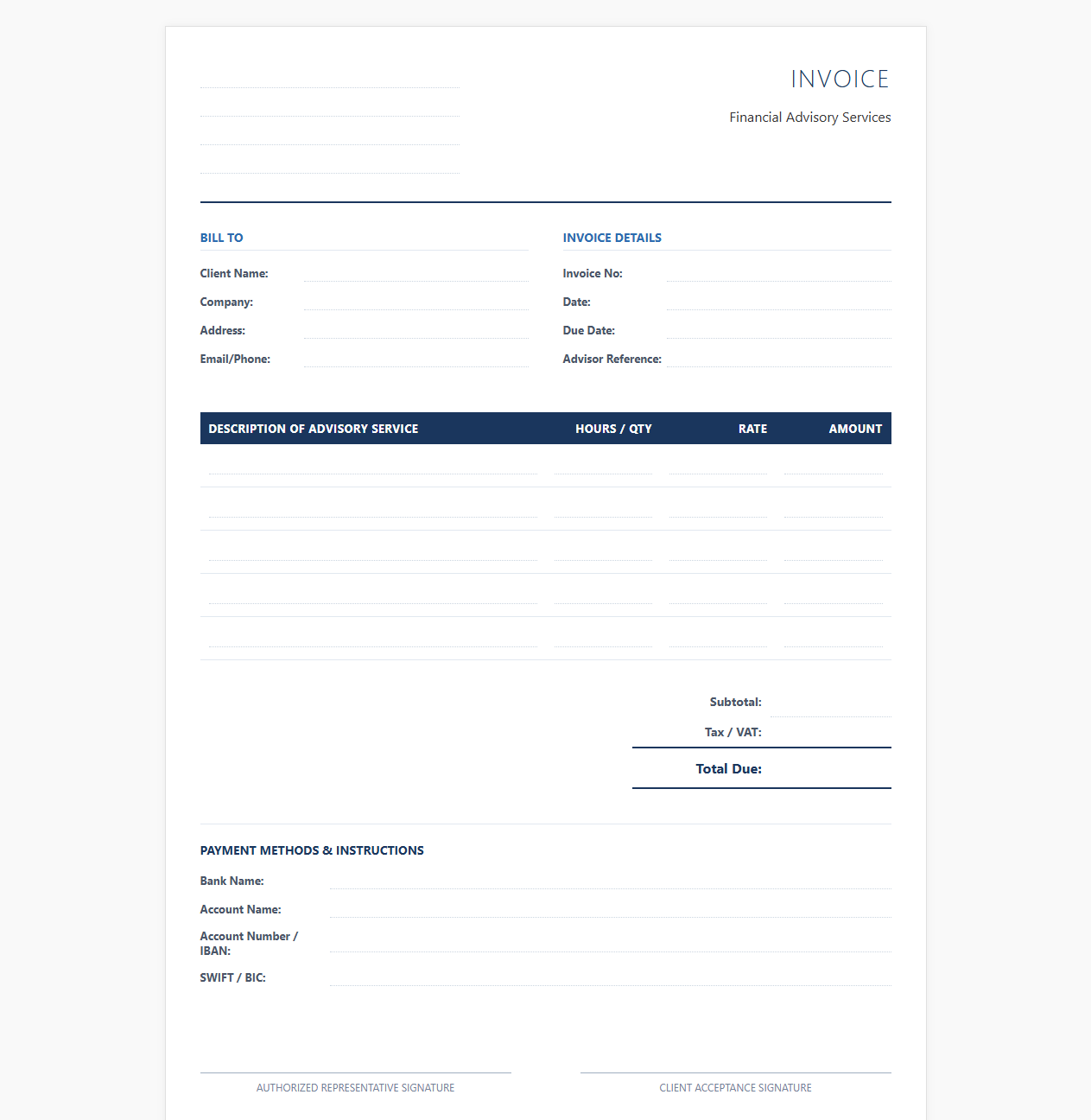
Financial Advisory Service Invoice Form
 Download: .PDF
Corporate Advisory Consultation Invoice Template
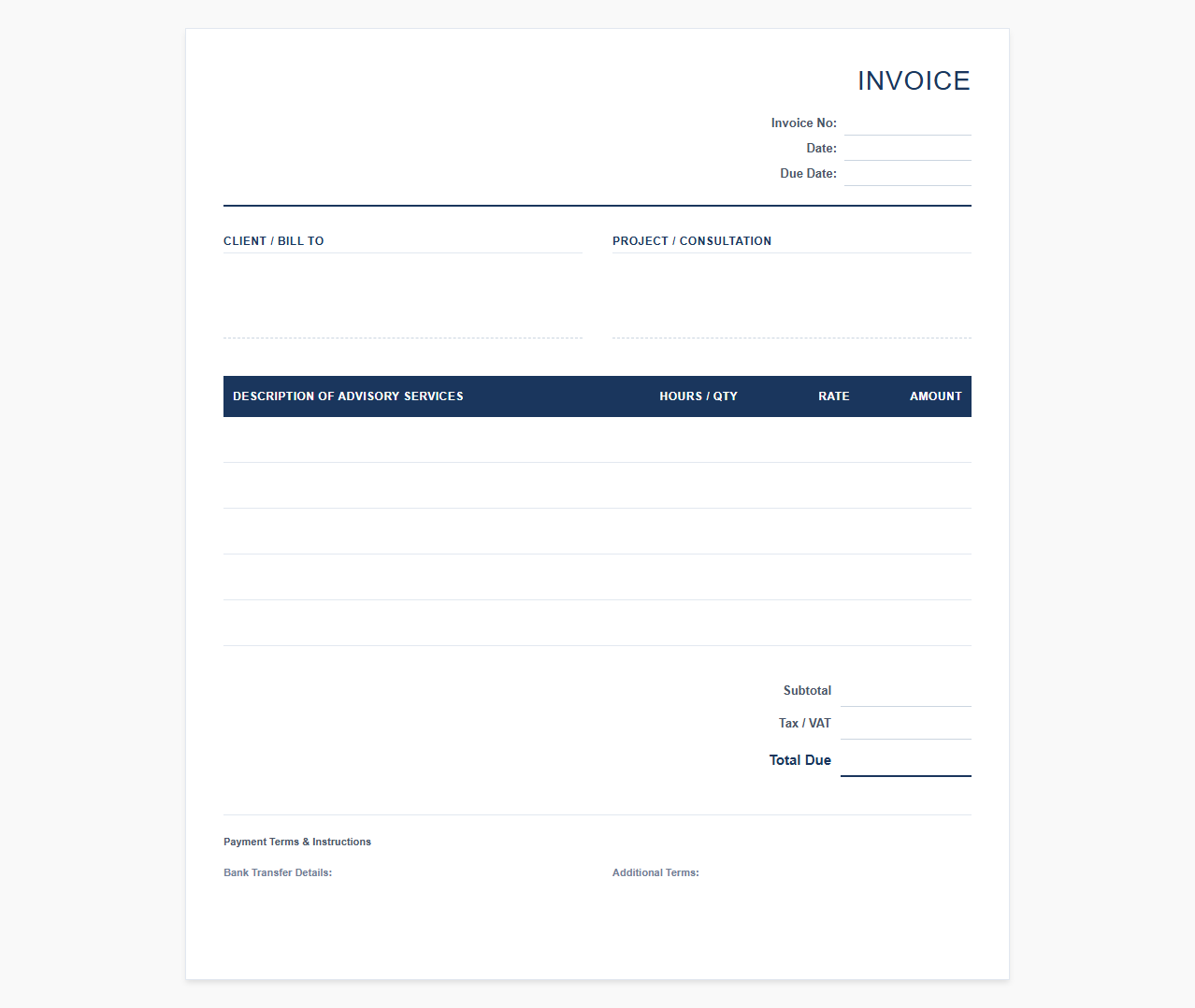 Download: .PDF
Professional Advisory Services Tax Invoice
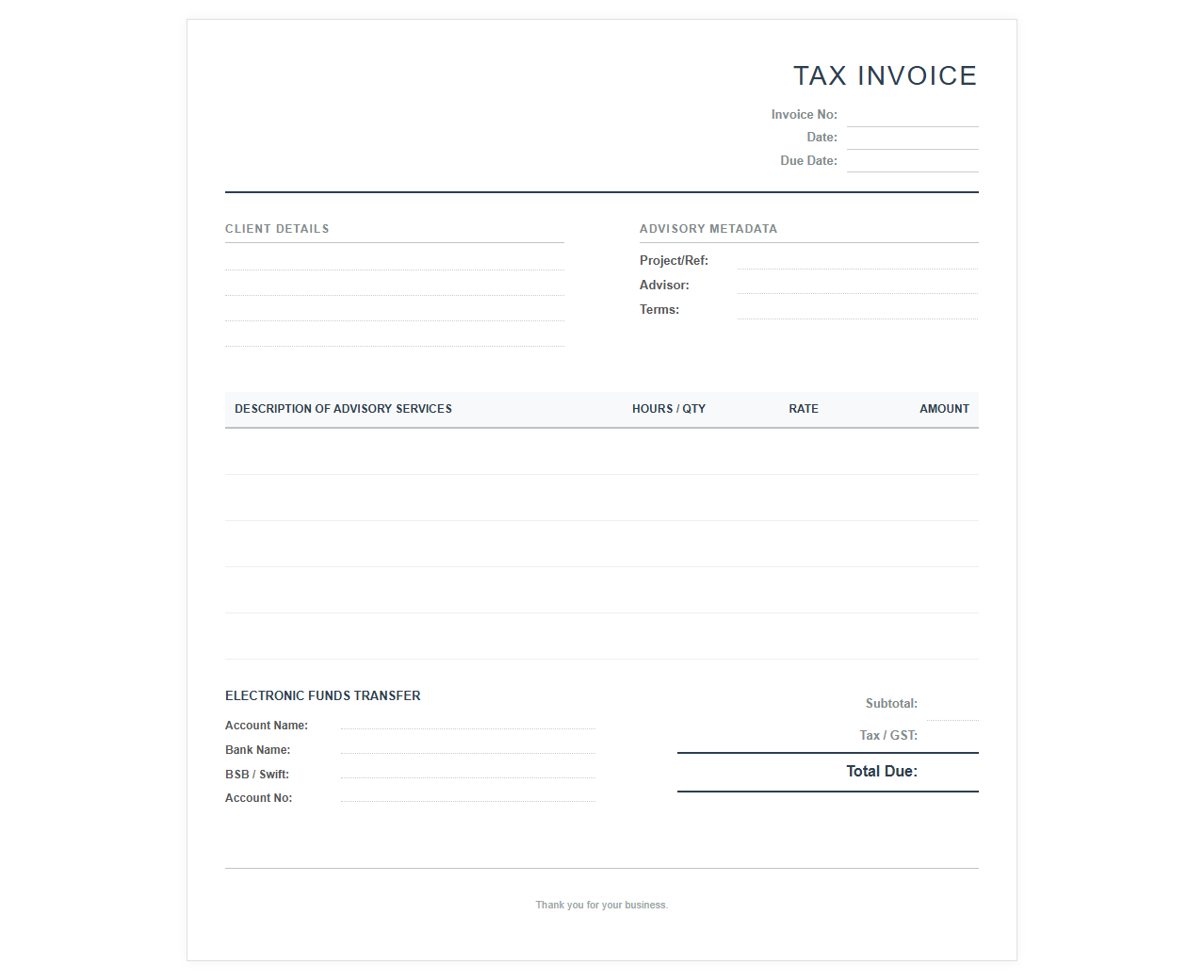 Download: .PDF
Project-Based Advisory Services Invoice
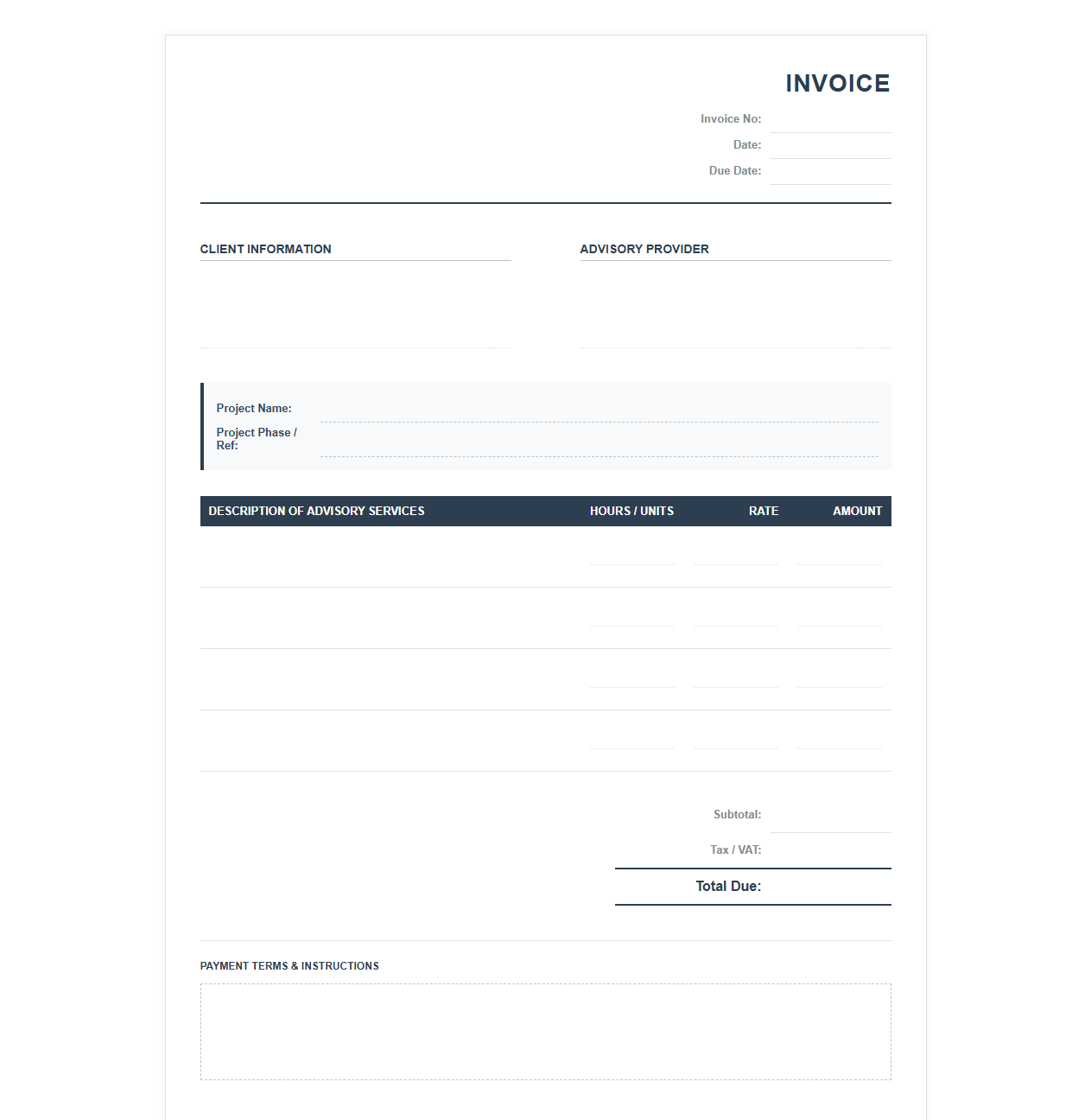 Download: .PDF
Business Advisory Fee Invoice Template
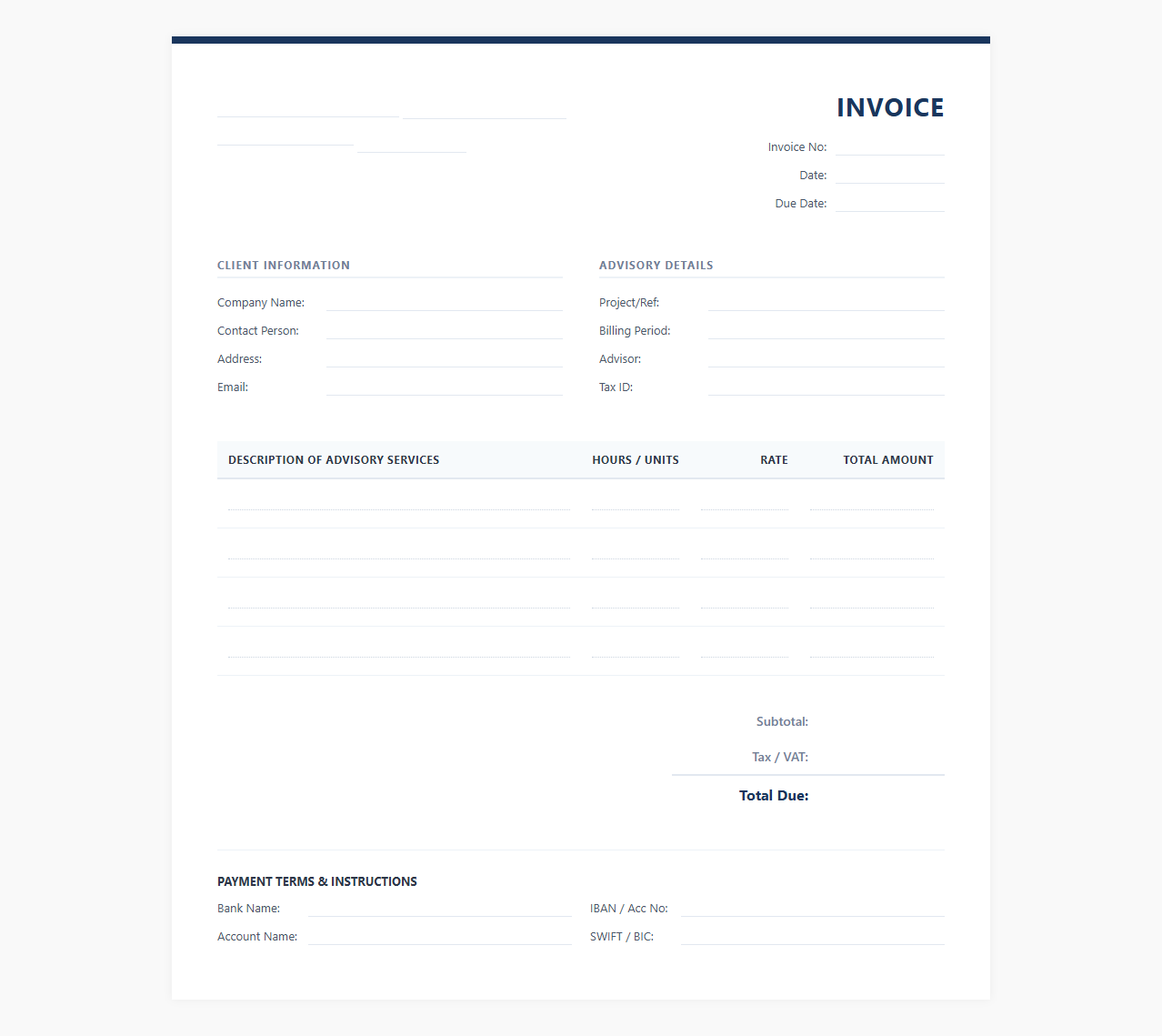 Download: .PDF
The Financial Friction of Misaligned Invoicing
In professional advisory services, the invoice is often the final point of contact in a billing cycle, yet it frequently becomes a primary source of operational friction. When financial documents lack clarity or structural consistency, client accounting departments must halt processing to initiate manual reviews. This breakdown in communication leads to extensive internal verification delays, extending the days sales outstanding and straining professional relationships.
Establishing clear billing communications is critical for maintaining trust. When advisory firms present vague or poorly formatted bills, clients experience administrative burden. Standardizing document structures eliminates these ambiguities, creating a seamless path from invoice submission to rapid payment approval.
Analyzing the Root Causes of Billing Delays
Automated accounts payable portals enforce strict validation rules. When a submitted document fails to meet these systemic criteria, it is instantly rejected, requiring manual intervention and restarting the payment clock. Identifying the common points of failure allows advisory firms to preemptively address administrative roadblocks.
The most frequent formatting and data errors include:
- Missing Purchase Order (PO) Numbers: Corporate procurement systems cannot match invoices to approved budgets without a valid PO reference.
- Vague Line Items: Descriptions like consulting services without context trigger internal audits and client inquiries.
- Mismatched Billing Entities: Listing incorrect legal names or outdated addresses causes immediate system rejection.
Establishing a Semantic Metadata Standard
A structured header ensures that automated parsers and accounting personnel can index the document without delay. Consolidating essential metadata into a clean, predictable layout dramatically accelerates initial routing.
| Metadata Field | Description | Purpose |
|---|---|---|
| Invoice ID | A unique, sequential alphanumeric identifier. | Prevents duplicate processing and facilitates tracking. |
| Tax Identifier | The sender's official business tax registration number. | Ensures legal compliance and tax audit readiness. |
| Submission Date | The exact date the invoice is officially issued. | Establishes the baseline for payment terms. |
| Billing Contacts | Names, emails, and phone numbers for both parties. | Allows direct resolution of payment queries. |
Translating Advisory Deliverables into Clear Line Items
Advisory services often involve subjective or complex deliverables, making transparent itemization crucial. Breaking down services into verifiable components prevents disputes and speeds up the reconciliation process.
- Define the Phase or Milestone: Ground the work in a specific project phase so the reviewer understands the context of the billing.
- Specify the Rate Structure: Clearly state whether the charges are based on hourly rates, fixed milestone fees, or retainer allocations.
- Quantify the Effort: Provide the exact number of hours worked or deliverables completed, supported by dates of service.
By transforming abstract advisory hours into quantifiable milestones, you eliminate the ambiguity that often prompts clients to delay payments.
Codifying Payment Terms and Processing Instructions
Ambiguity regarding when and how to pay is a common driver of delayed collections. Payment terms, late-payment policies, and transfer instructions must be explicit, prominent, and legally binding.
Payment is due within 30 days of the invoice date (Net 30). Late balances are subject to a 1.5% monthly interest fee. Please remit all electronic funds transfers (EFT) to Bank of Commerce, Routing Number: XXXXXXX, Account Number: XXXXXXX.
Choosing the Right Digital Format and E-Invoicing Protocols
While PDF documents are easily read by humans, they require optical character recognition or manual entry when processed by enterprise resource planning (ERP) systems. In contrast, modern e-invoicing relies on structured data exchange protocols like Peppol, XML, or JSON, which transfer machine-readable files instantly.
For automated systems, utilizing standard formats ensures seamless integration. Below is an example of structured invoicing metadata represented in JSON format:
{
  "Invoice": {
    "ID": "INV-2023-089",
    "IssueDate": "2023-10-25",
    "TotalAmount": 15000.00,
    "Currency": "USD"
  }
}
Implementing Automated Reconciliation and Escalation Workflows
Managing receivables manually is inefficient and prone to human error. Implementing an automated workflow ensures that invoices are tracked from the moment they are generated until payment is settled. Reminders are dispatched systematically, removing the personal friction often associated with collection follow-ups.
A structured approach protects the core advisory partnership while maintaining cash flow integrity and driving operational efficiency.

Leave a comment