

Dealing with bounced checks and failed electronic payments is a frustrating reality for many businesses, resulting in unexpected bank charges and administrative delays. Before attempting to recover these losses, organizations must establish a clear administrative framework that justifies passing these bank-imposed penalties back to the client.
Utilizing structured invoice templates grants accounts receivable teams a professional, friction-free mechanism to recoup these costs while preserving vital client relationships. However, as a crucial stipulation, businesses must ensure their assessed recovery charges align strictly with state-mandated legal caps. For example, deploying a standardized $30 NSF recovery invoice provides clear, professional documentation of the payment failure and the contractual obligation to resolve it.
In this guide, we provide customizable NSF fee invoice templates, outline the legal boundaries of fee recovery, and share best practices for communicating payment failures diplomatically.
NSF Returned Payment Fee Invoice Template
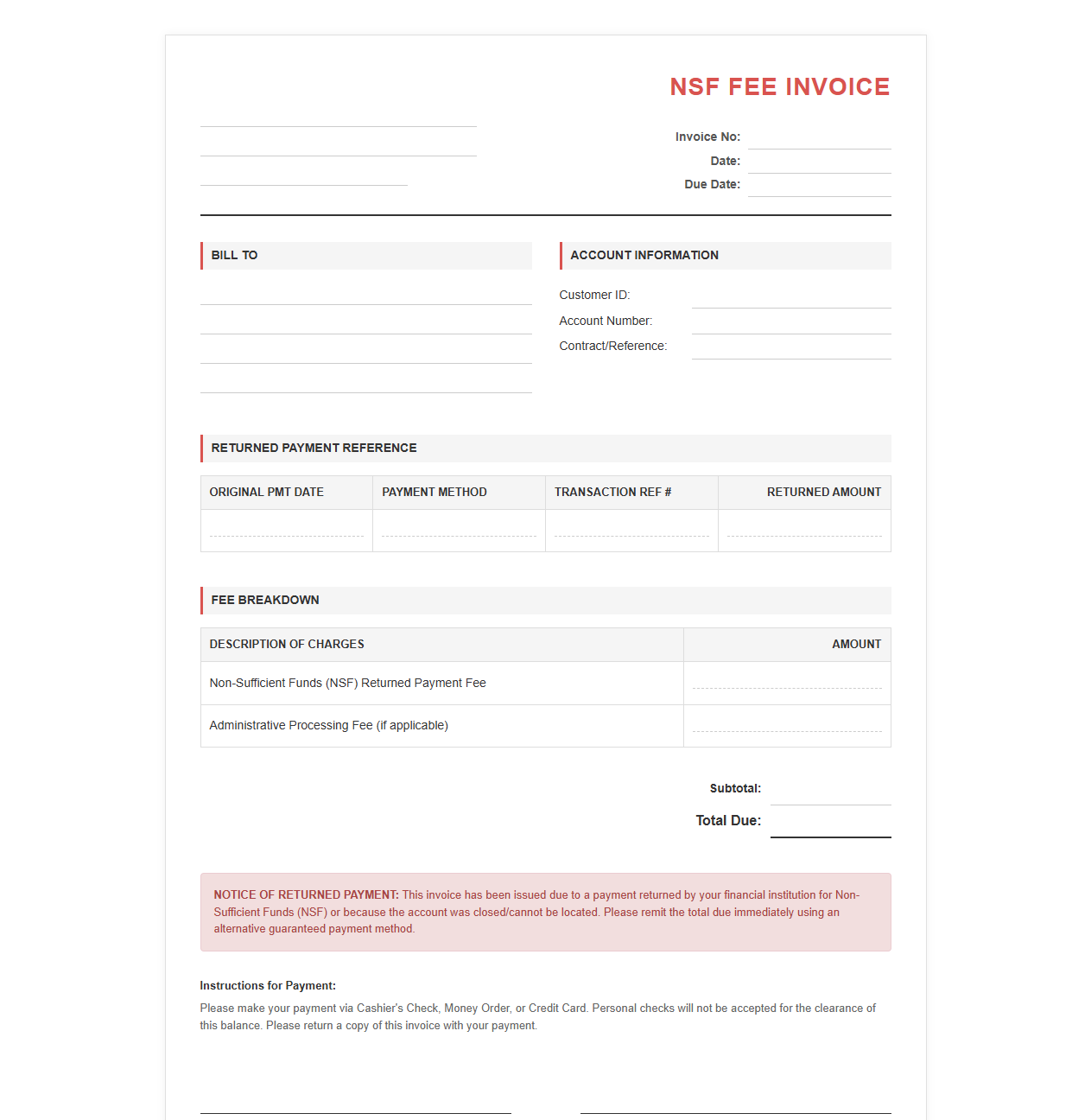 Download: .PDF
Non-Sufficient Funds Debit Fee Invoice
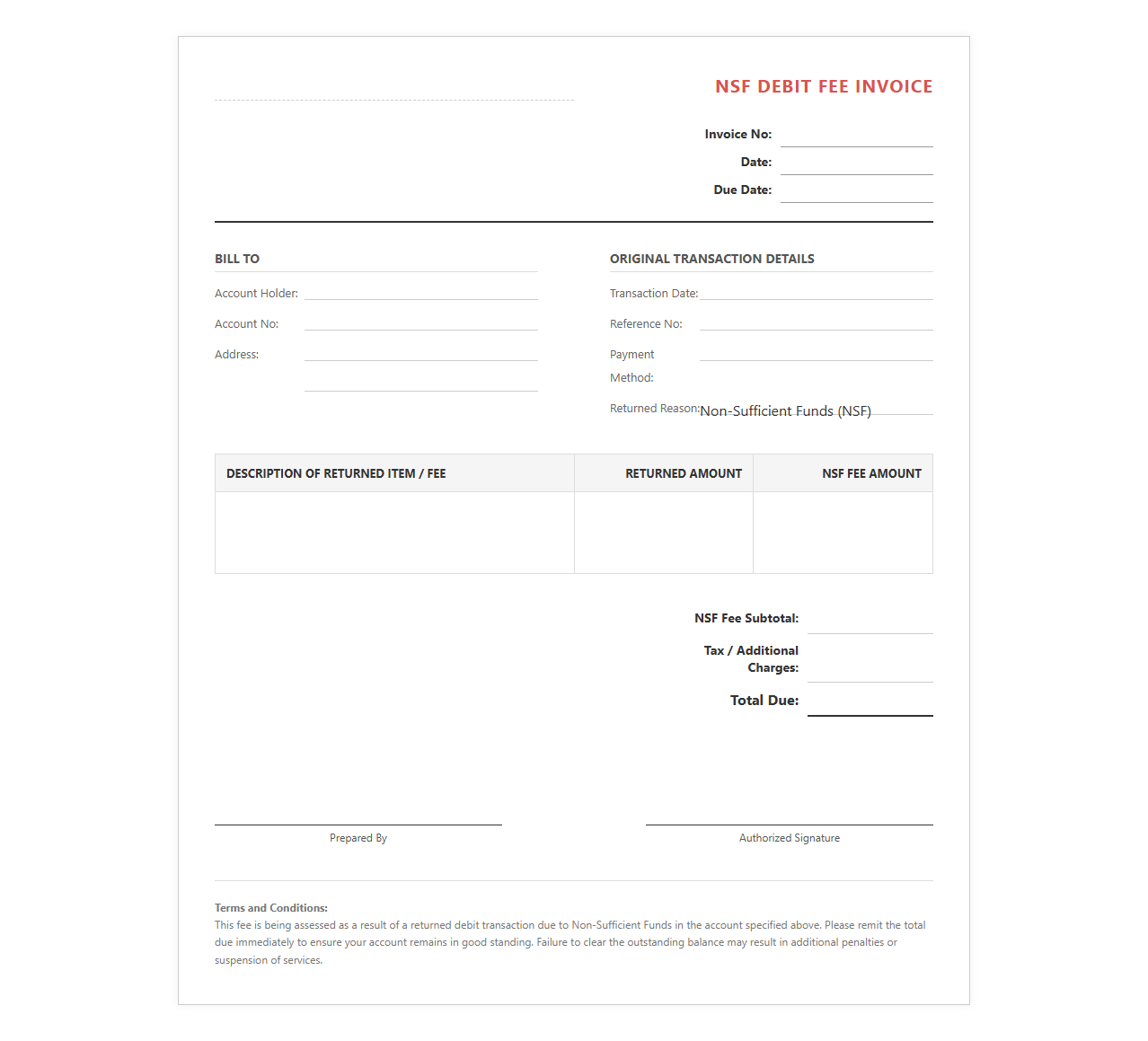 Download: .PDF
Returned ACH Payment Fee Invoice Template
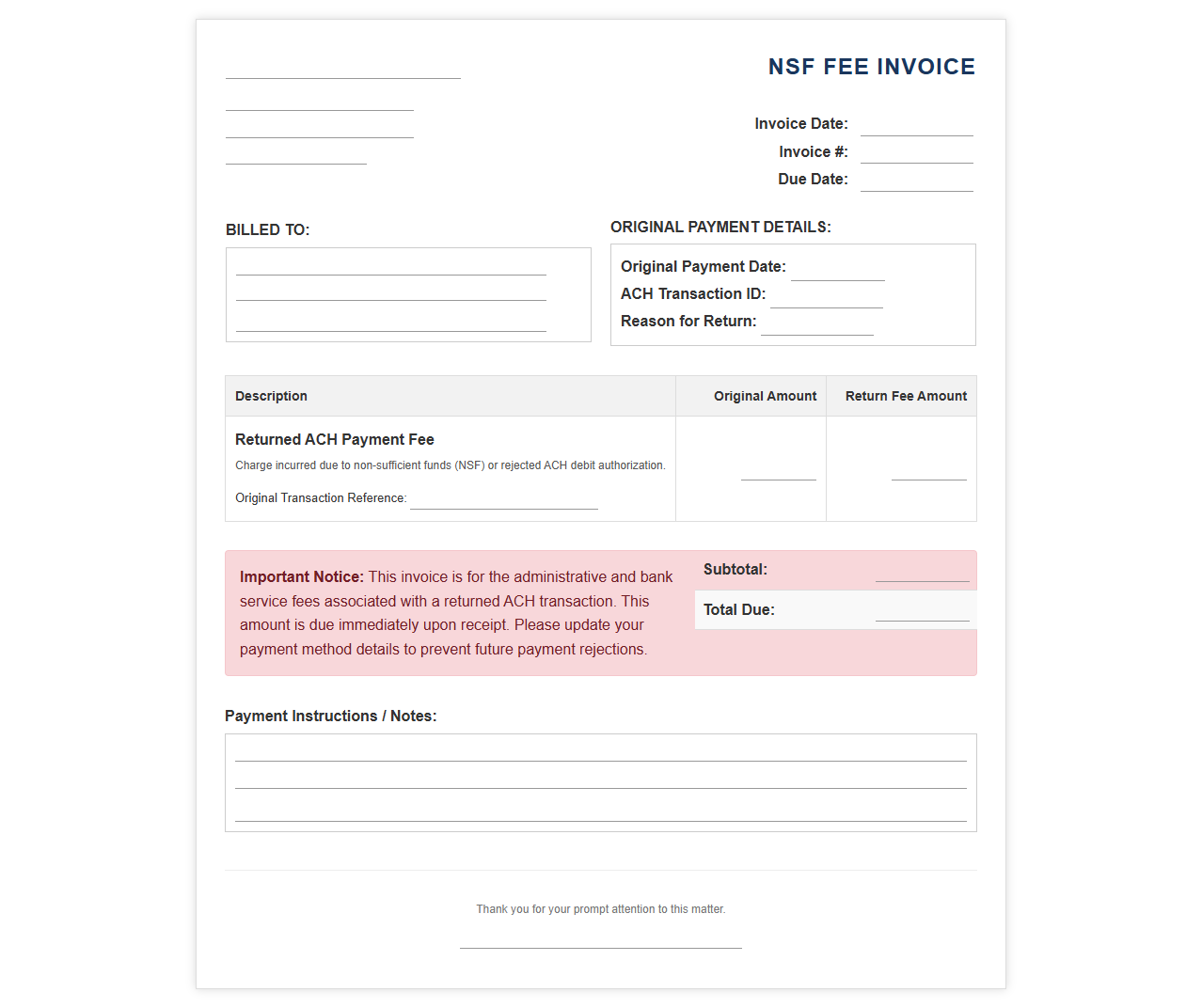 Download: .PDF
Bounced Check Fee Invoice Template
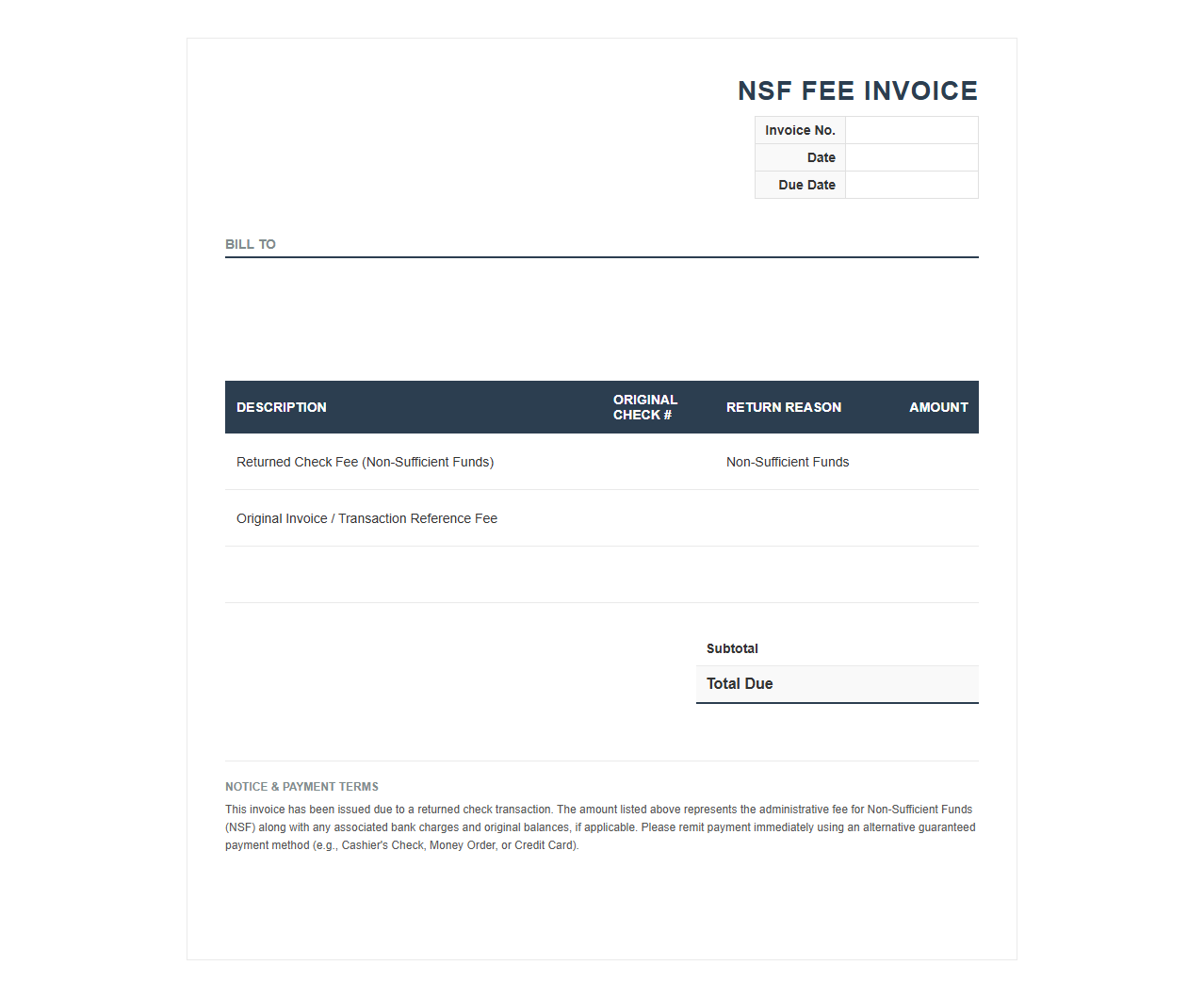 Download: .PDF
Insufficient Funds Bank Charge Invoice
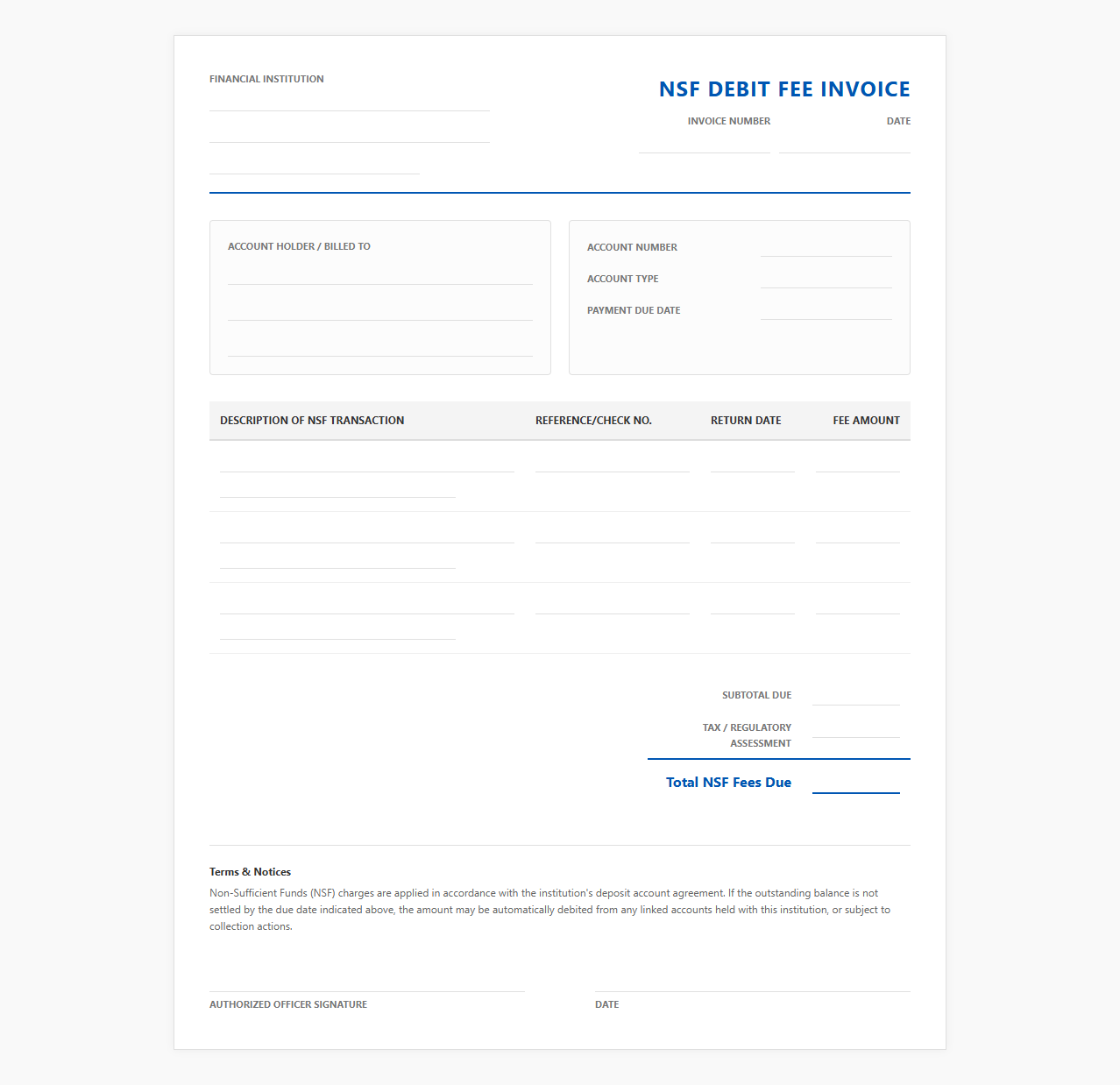 Download: .PDF
Returned Item Fee Statement Template
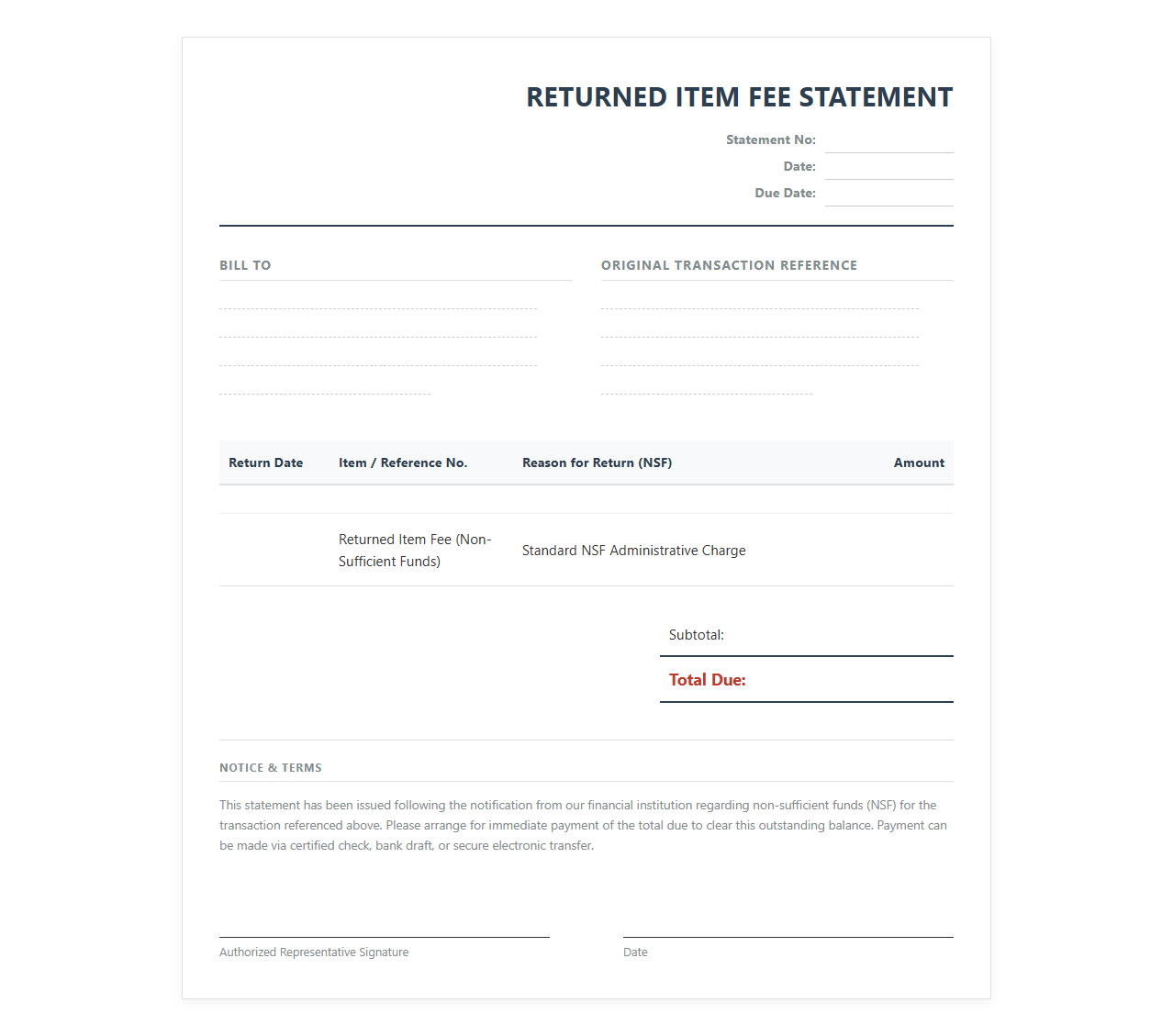 Download: .PDF
Failed Direct Debit Charge Invoice Template
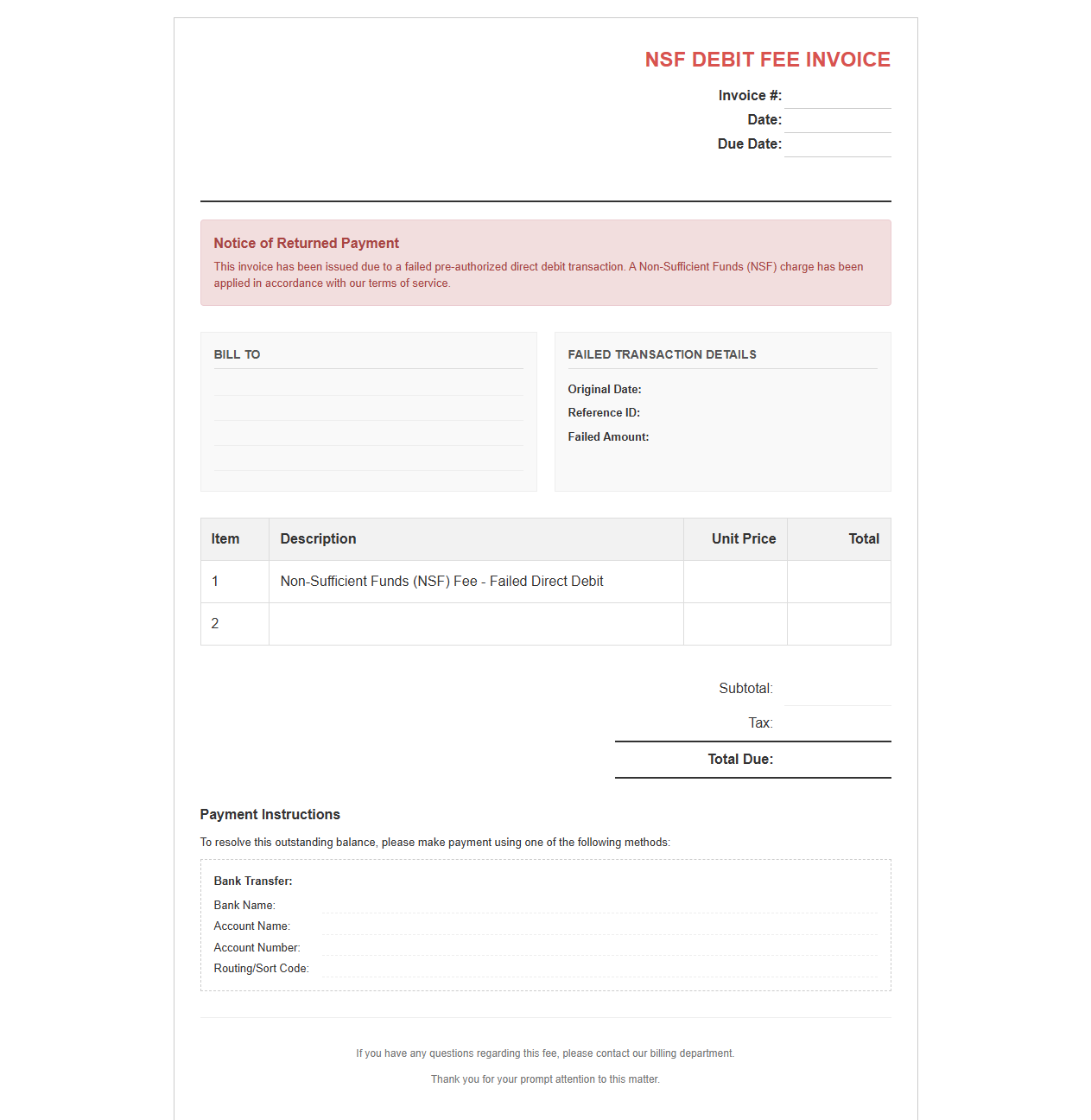 Download: .PDF
NSF Bank Fee Rebill Invoice Template
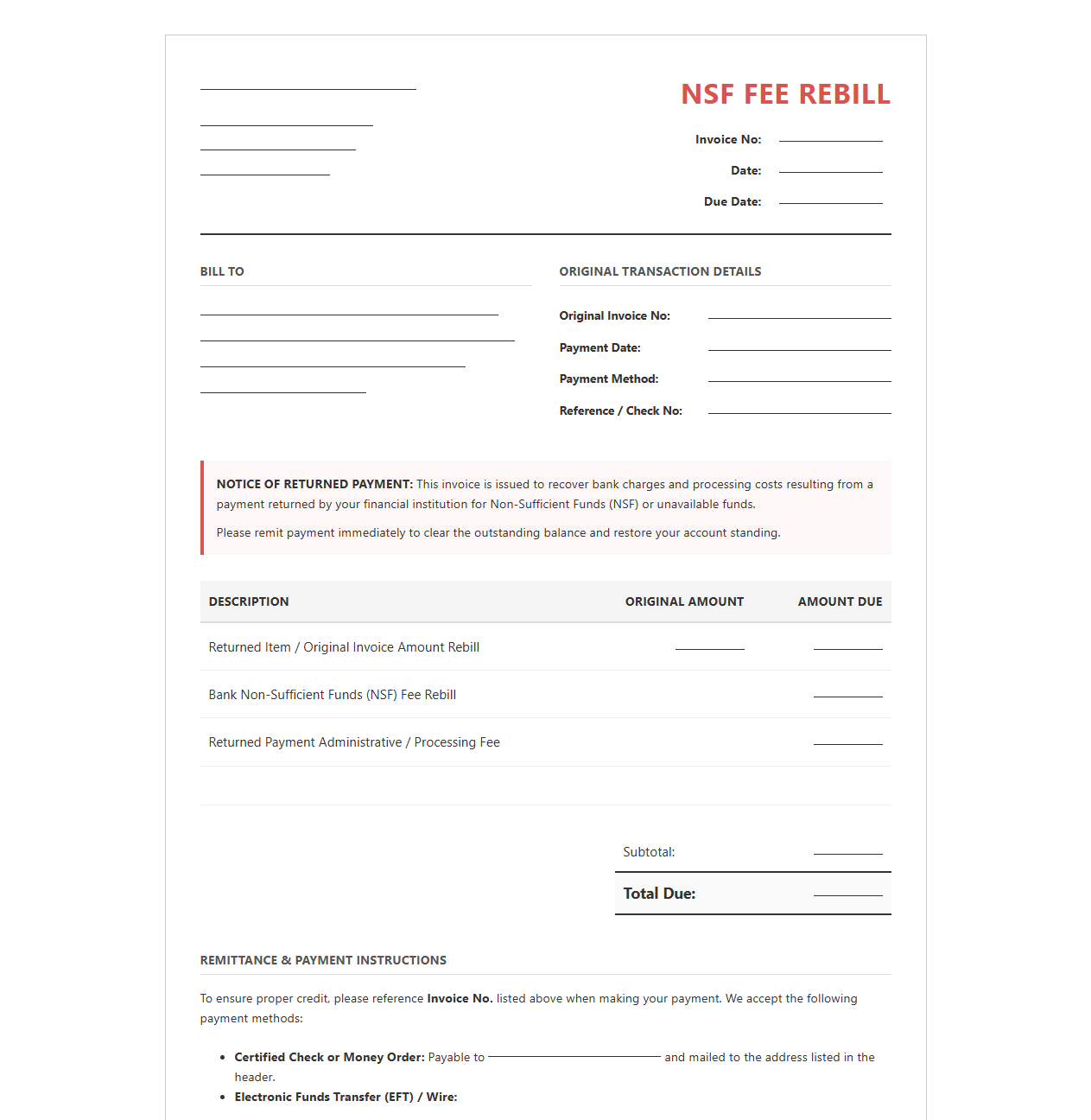 Download: .PDF
Dishonored Payment Fee Invoice Template
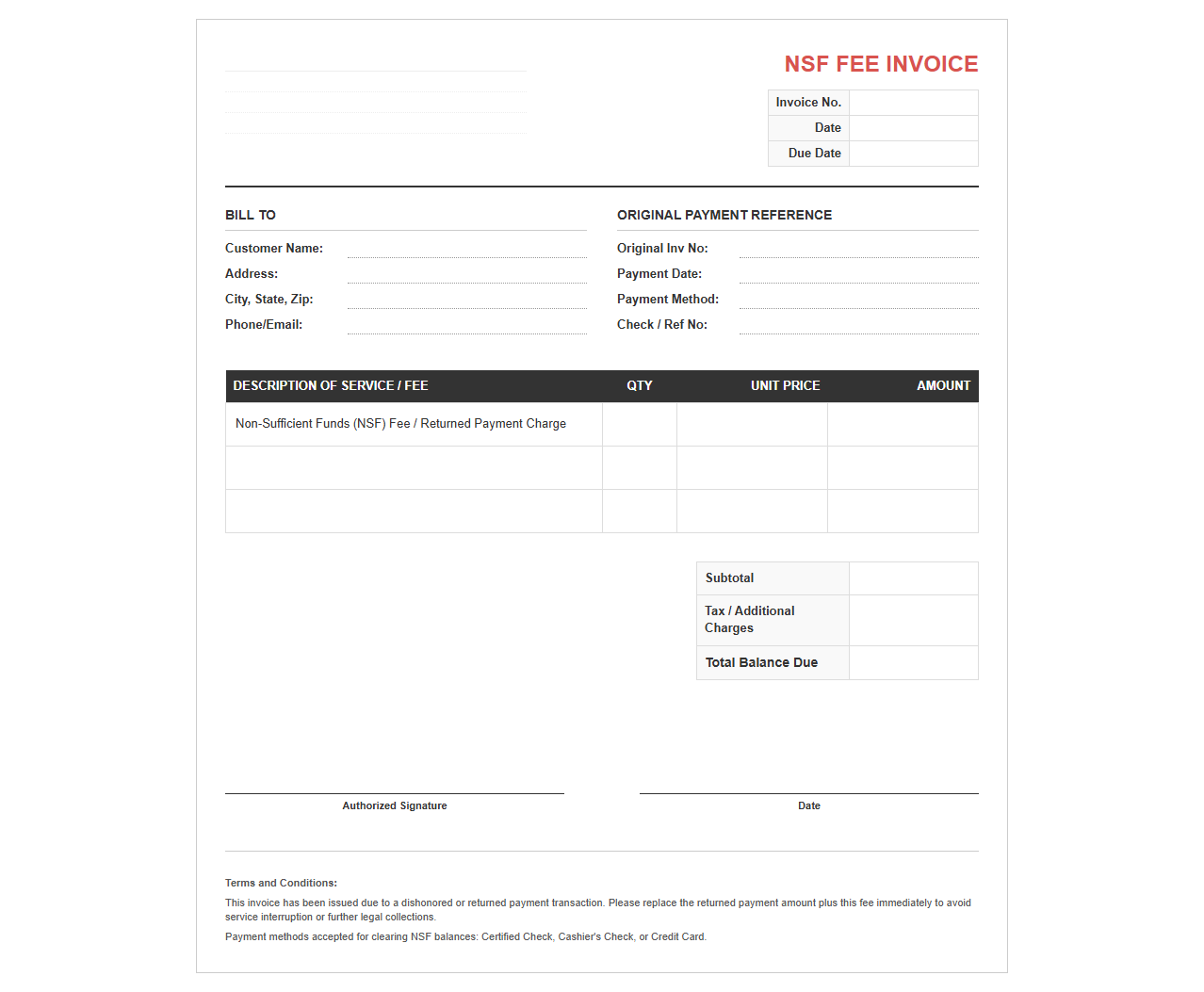 Download: .PDF
Understanding NSF Fees and the Cost of Returned Payments
Non-Sufficient Funds (NSF) fees occur when a client attempts to make a payment via check or electronic bank transfer, but their account lacks the necessary balance to cover the transaction. When this happens, financial institutions reject the payment, leaving the merchant with a failed deposit and a bank-imposed penalty fee. For businesses, these returned payments directly disrupt cash flow predictability and introduce administrative burdens as staff must spend valuable hours tracking down the client, correcting financial records, and reprocessing payments.
Recovering these administrative costs through a dedicated NSF invoice is a critical step in maintaining healthy profit margins. When a customer's payment bounces, your bank charges your business a fee for processing a bad check. Passing this charge back to the client via a formal invoice ensures that your business does not absorb the financial penalty for another party's banking oversight. Furthermore, it reinforces accountability and encourages clients to manage their payment accounts more carefully in future transactions.
Legal Guidelines and Compliance for Charging NSF Fees
Before issuing an NSF fee invoice, businesses must understand the legal parameters surrounding returned check fees. State laws strictly govern the maximum amount a business can charge for a bounced payment. These limits vary significantly; some states permit a flat fee ranging from $20 to $40, while others allow a percentage-based charge relative to the total value of the bounced payment.
Compliance hinges on transparency and prior agreement. You cannot legally impose a returned payment fee unless the client agreed to the terms beforehand. To ensure your business is fully protected and legally compliant, incorporate the following guidelines into your client onboarding process:
- Explicitly state the NSF fee amount in your standard contracts, service agreements, and terms of service.
- Display a visible warning at your point of sale or on your digital payment portal regarding returned check fees.
- Research your specific state regulations to verify the maximum legal cap for administrative penalties.
- Ensure your contract outlines the timeline for payment of both the original balance and the newly issued NSF fee.
Essential Elements of a Professional NSF Fee Invoice
To ensure clarity and accelerate the payment recovery process, an NSF invoice must be structured professionally and contain specific transaction details. Ambiguity can lead to further payment delays or client disputes. Your invoice should clearly connect the penalty to the original transaction so the client immediately understands the nature of the charge.
- Original Invoice Reference: Clearly state the invoice number, date, and original payment amount of the transaction that was returned.
- Bank Return Details: Include the date the payment was rejected and the specific reason provided by the bank, such as "Non-Sufficient Funds" or "Account Closed."
- Itemized Bank Fee: Break down the exact charge, showing the direct bank-imposed penalty alongside any standard administrative handling fees allowed by your contract.
- Updated Payment Terms: Specify a strict, shortened due date for the outstanding balance and the NSF fee to encourage immediate action.
- Accepted Payment Methods: Outline alternative, highly secure payment methods, such as wire transfers or credit cards, to prevent a secondary bounced payment.
Standard Business-to-Business (B2B) NSF Invoice Template
Professional Fee Recovery Invoice
Enterprise Solutions Group LLC100 Corporate Parkway, Suite 500
New York, NY 10001
billing@enterprisesolutions.com
======================================================================
                         NSF FEE INVOICE
======================================================================
Invoice Number: INV-2023-894-NSF
Date of Issue:  October 24, 2023
Due Date:       Upon Receipt
PREPARED FOR:
Apex Global Logistics
450 Industrial Drive
Chicago, IL 60609
----------------------------------------------------------------------
REFERENCE ORIGINAL TRANSACTION:
Original Invoice: #INV-2023-894
Original Payment Method: ACH Transfer (Failed)
Return Date: October 22, 2023
Reason for Return: Non-Sufficient Funds (NSF)
----------------------------------------------------------------------
DESCRIPTION                                                 AMOUNT
1. Original Unpaid Balance (INV-2023-894)                $4,500.00
2. Returned Payment Bank Fee (Per contract terms)           $35.00
3. Administrative Processing Surcharge                      $15.00
----------------------------------------------------------------------
TOTAL AMOUNT DUE IMMEDIATELY:                            $4,550.00
======================================================================
PAYMENT INSTRUCTIONS:
Please note that due to the returned ACH transfer, we require this
balance to be settled immediately. We cannot accept another standard
ACH payment for this transaction.
Please remit payment via Credit Card or Wire Transfer.
For wire details, contact billing@enterprisesolutions.com.
Landlord and Tenant NSF Fee Invoice Template
Notice of Bounced Rent Payment & Late Fees
| Item Description | Due Date | Original Rent Amount | NSF Bank Penalty | Late Payment Fee | Total Balance Due |
|---|---|---|---|---|---|
| Rent Payment - Apartment 4B (October 2023) | Immediate | $1,850.00 | $30.00 | $50.00 | $1,930.00 |
Best Practices for Communicating Returned Payment Fees
Communicating a returned payment requires a delicate balance between professionalism and firmness. While a bounced check can be frustrating, it is often the result of an honest accounting mistake on the client's part. Keeping your tone neutral and constructive prevents damage to valuable client relationships while signaling that you take your payment terms seriously.
"Dear Client, we received notice from our financial institution that the check/ACH payment for Invoice #104 was returned due to non-sufficient funds. Per our signed agreement, an NSF fee of $35.00 has been applied to cover processing costs. Please find the updated invoice attached. We request that the updated balance be settled via wire transfer or credit card by Friday to keep your account in good standing."
When sending your communication, always include a direct copy of the new invoice and clearly state the accepted guaranteed payment methods. By offering swift, alternative solutions, you pave the way for a smooth resolution without unnecessary back-and-forth communication.
Automating NSF Recovery and Bounced Payment Prevention
Managing returned payments manually drains resources and increases the time your outstanding cash remains uncollected. Modern cloud accounting platforms allow businesses to automate the recovery process, reducing administrative strain and accelerating time-to-resolution.
By implementing systemized rules, your billing software can automatically trigger a sequence of events the moment a payment is rejected:
- The software detects the failed payment status from the integrated payment gateway.
- An updated invoice is automatically generated, appending the pre-configured NSF penalty fee.
- An automated email notification is sent to the client, providing direct links to secure, alternative payment portals.
- The system blocks future automated ACH attempts until the client updates their billing profile or resolves the issue manually.
To reduce the occurrence of NSF incidents altogether, consider encouraging payment methods that verify funds instantly, such as credit card authorizations or modern open-banking APIs that check account balances before executing a transfer.

Leave a comment