
Managing payroll for dynamic teams frequently introduces costly administrative bottlenecks, discrepancies in logged hours, and compliance risks. Before organizations invest in expensive, automated enterprise software, they must first establish a standardized system for baseline data collection. Transitioning to specialized bi-weekly timesheet document formats grants businesses immediate operational clarity and significantly reduces manual processing errors.
However, these templates are only as effective as the organizational protocols supporting them; clear internal guidelines are required to ensure consistent employee adoption. When properly formatted to include dedicated sections for overtime calculations, PTO accrual, and department-specific codes, these documents serve as robust tools for financial accuracy.
This article will explore how to select the optimal bi-weekly layout for your business structure, implement best practices for document management, and seamlessly integrate these formats into your existing accounting workflows.
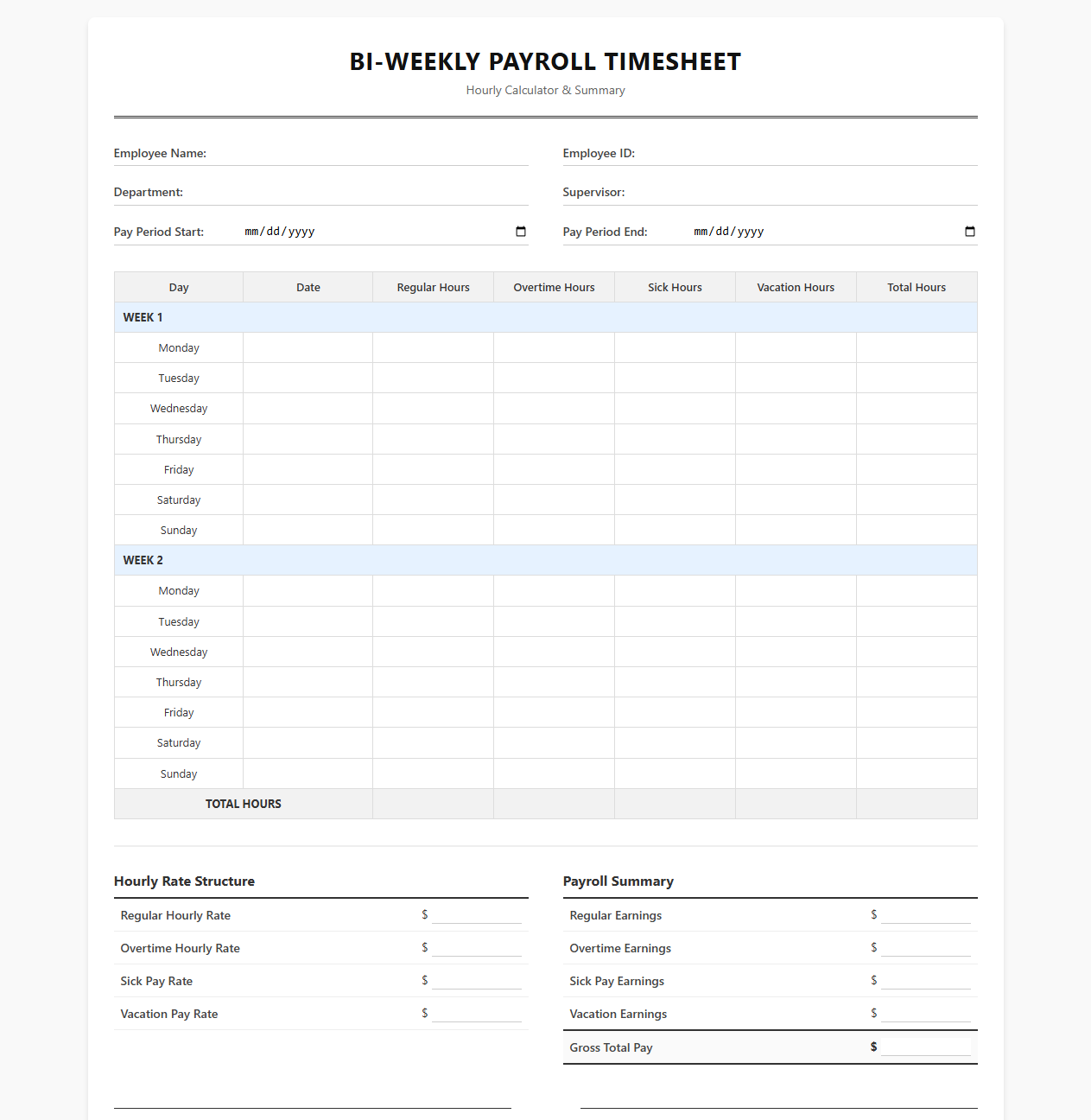
Bi-Weekly Payroll Timesheet with Hourly Calculator
 Download: .PDF
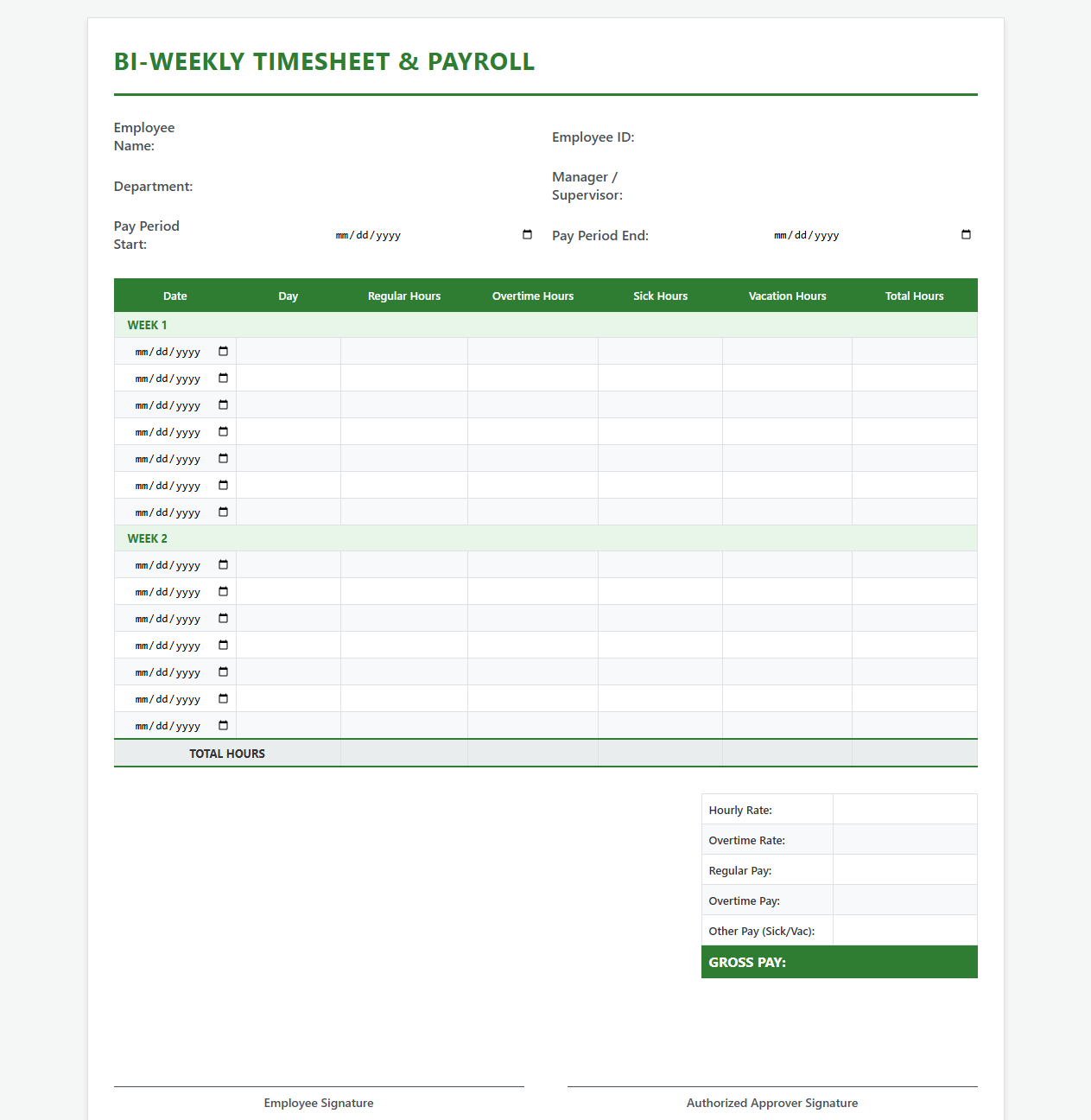
Excel Bi-Weekly Employee Timesheet and Payroll Template
 Download: .PDF
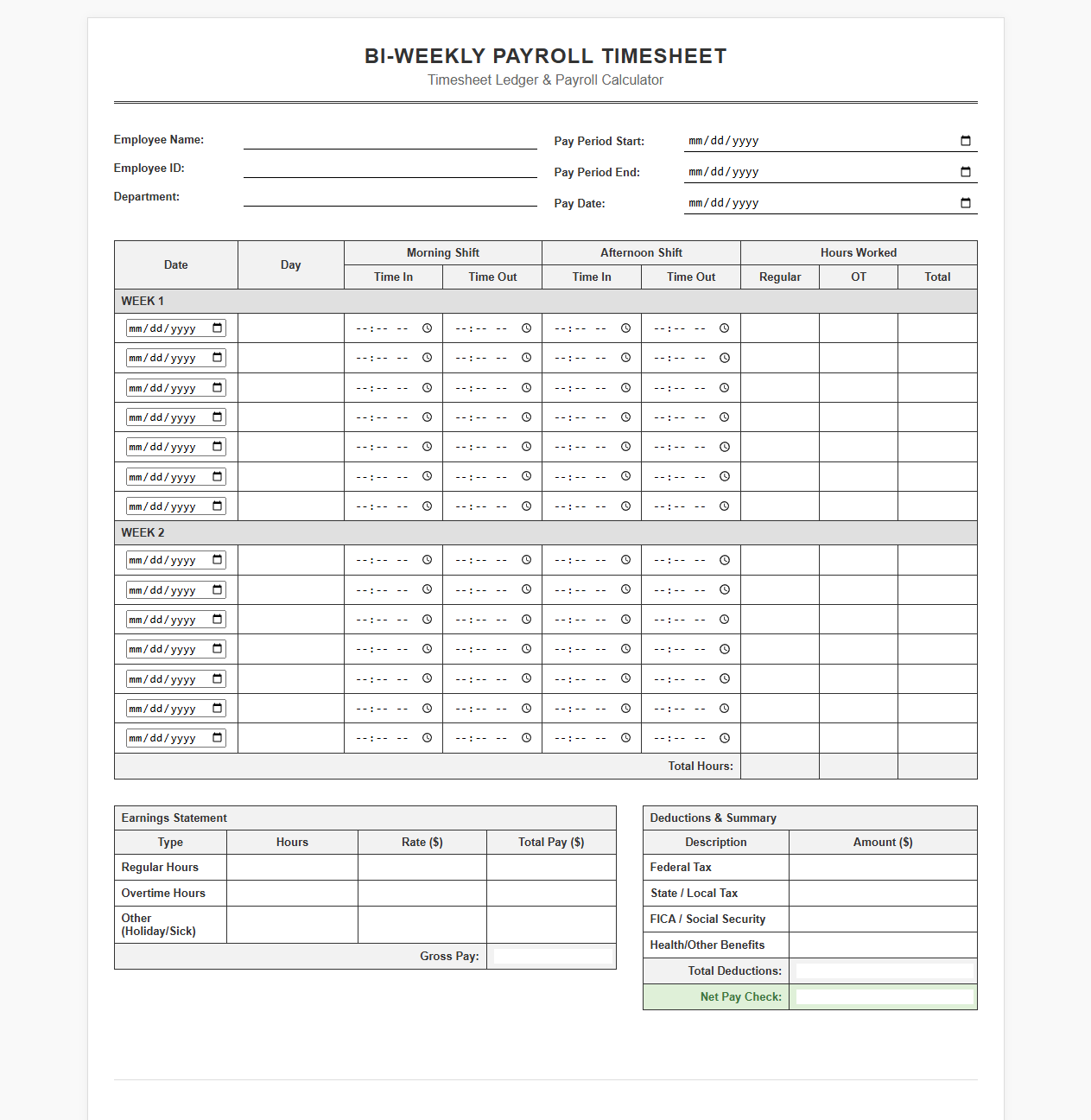
Bi-Weekly Payroll Calculator and Timesheet Ledger
 Download: .PDF
Employee Bi-Weekly Time Card and Payroll Record
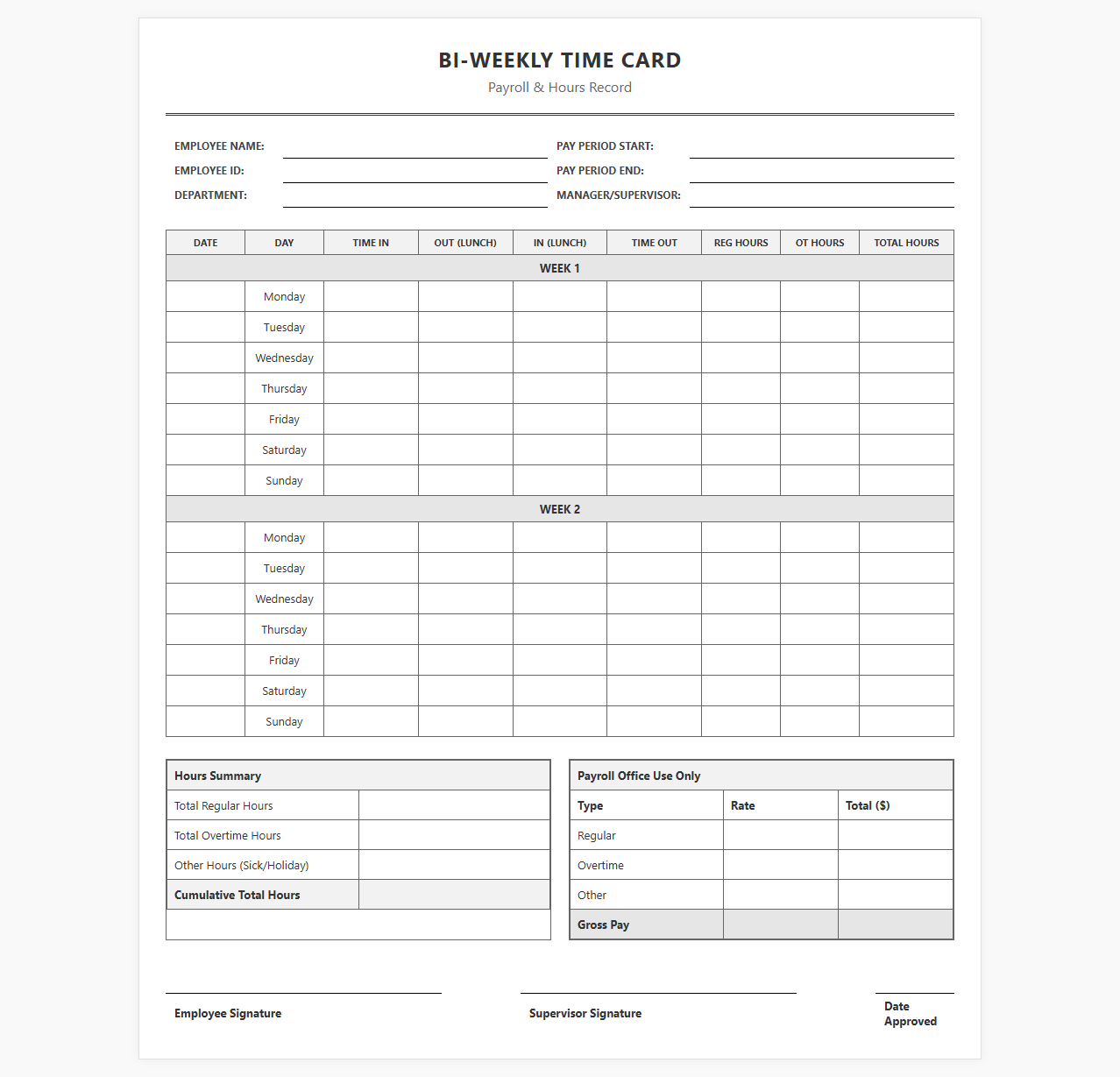 Download: .PDF
Bi-Weekly Timesheet Template with Overtime Calculation
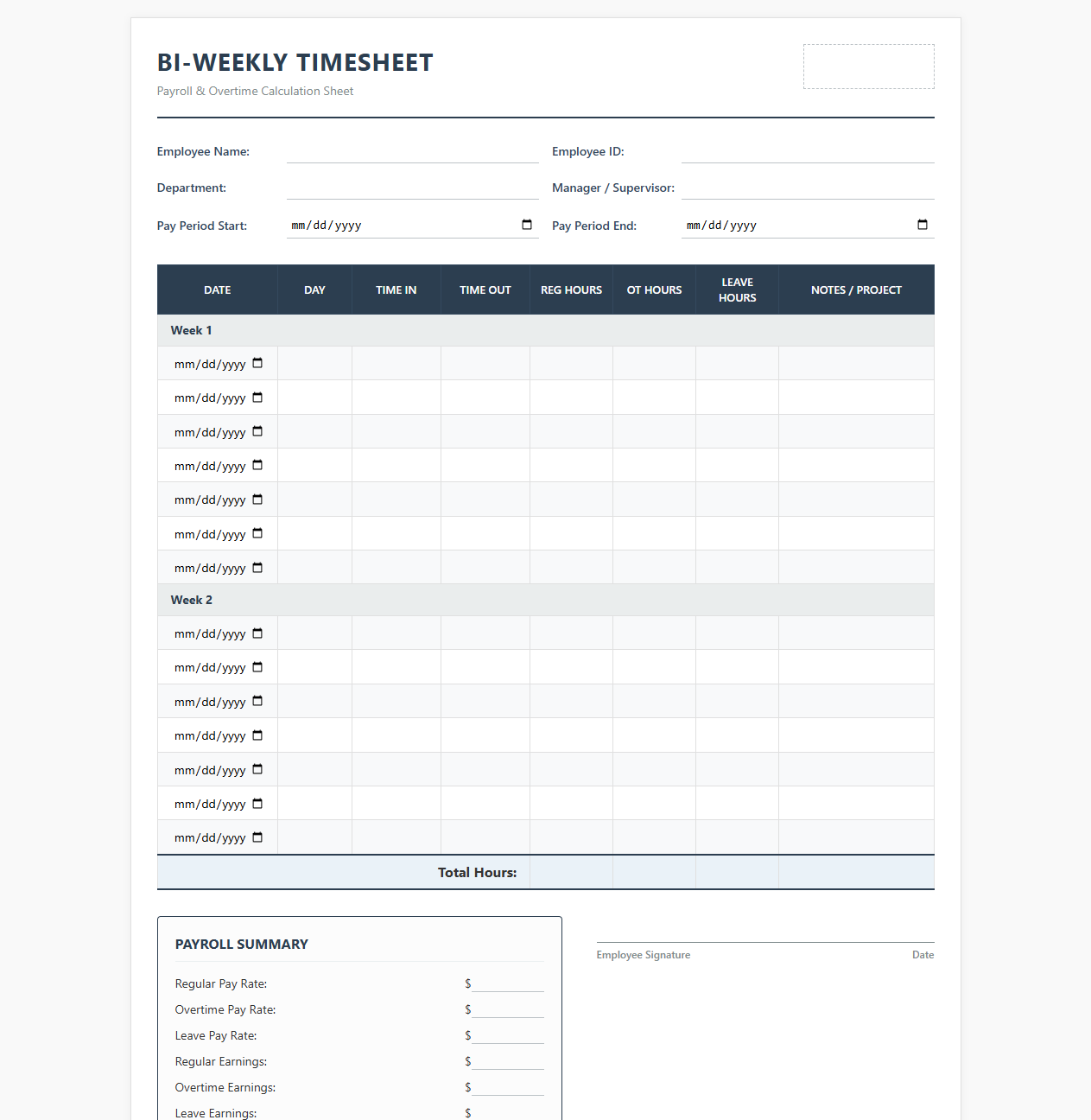 Download: .PDF
Hourly Employee Bi-Weekly Payroll Timesheet
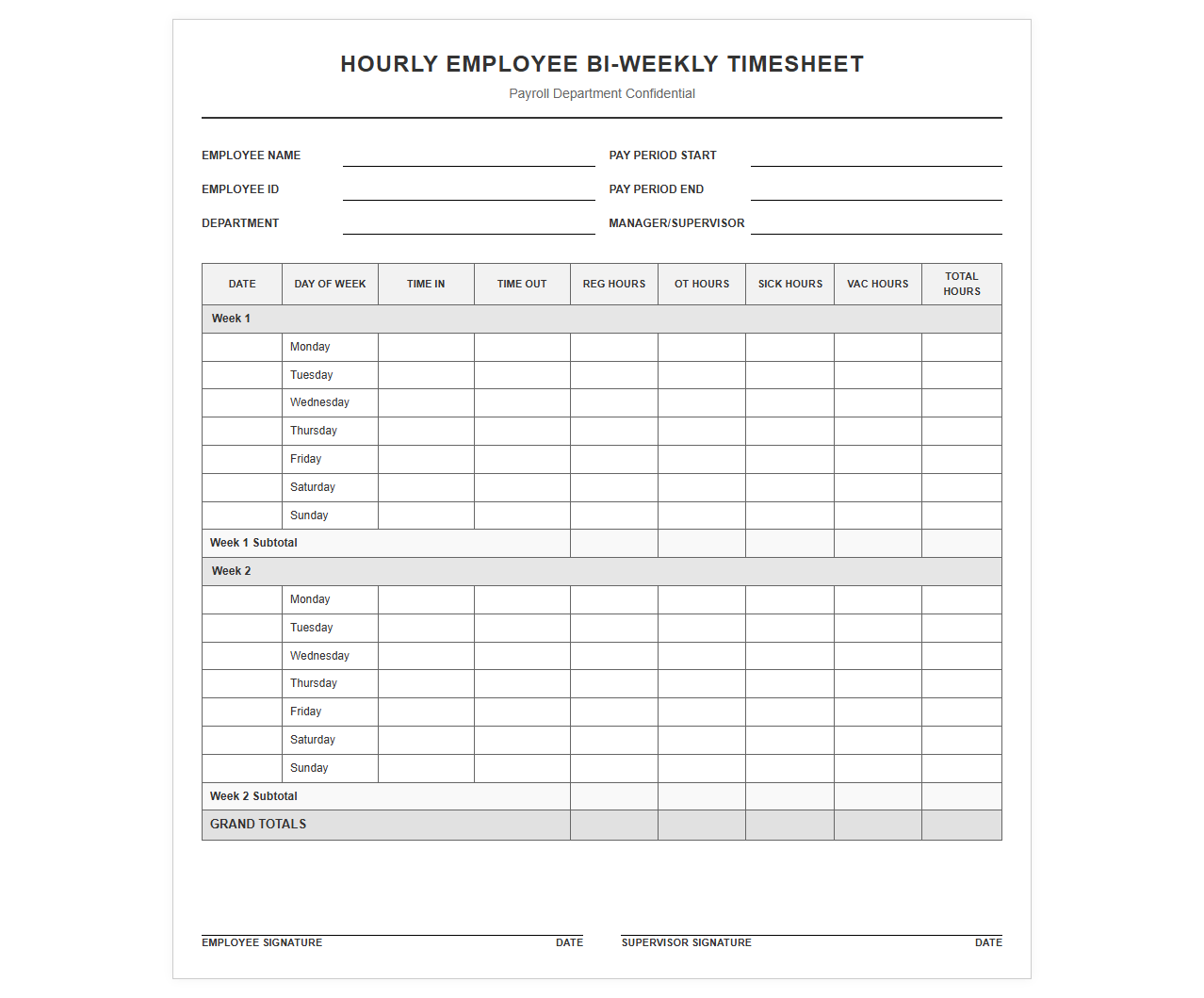 Download: .PDF
Automated Bi-Weekly Payroll and Timesheet Tracker
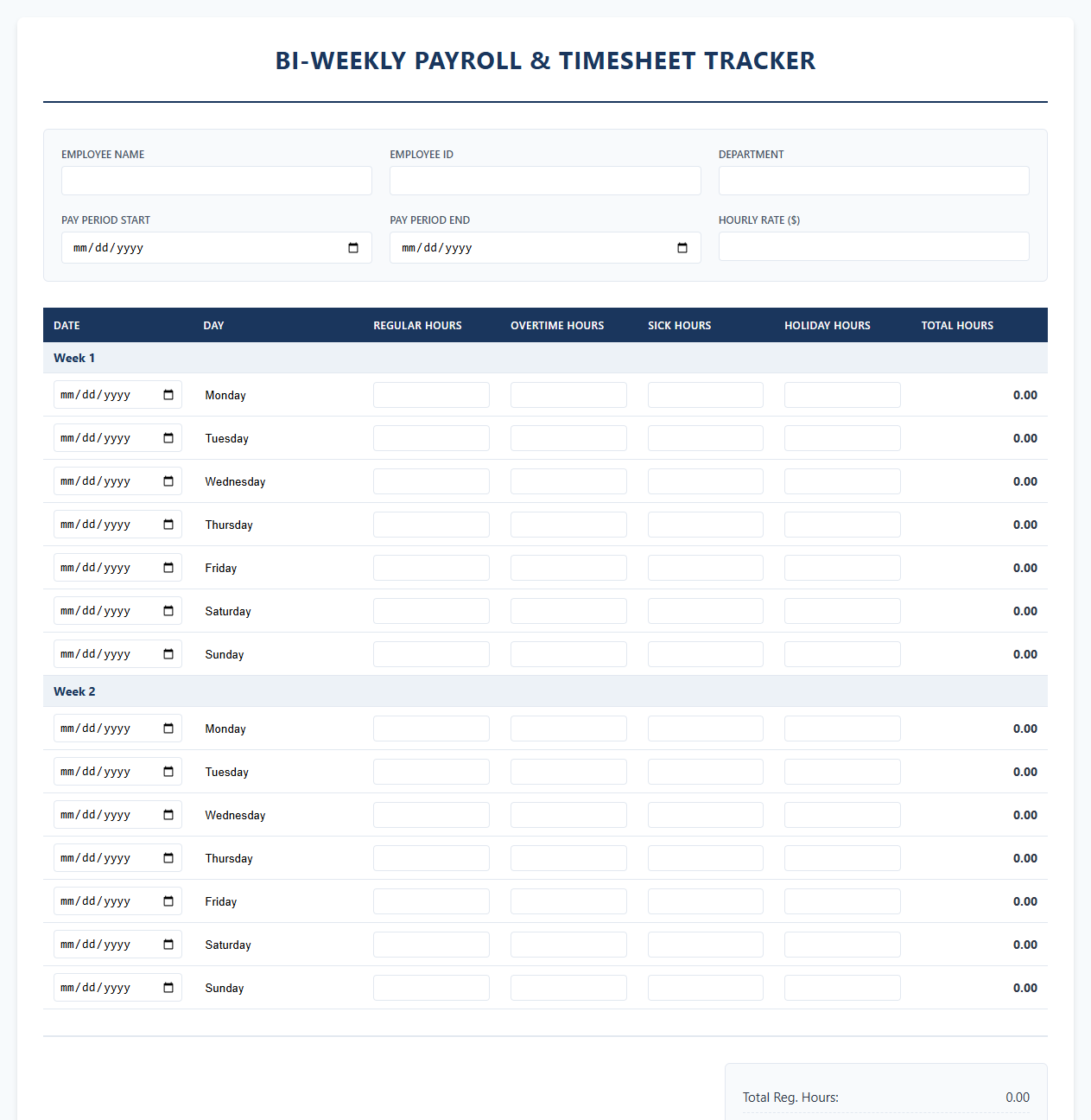 Download: .PDF
Simple Bi-Weekly Timesheet and Payroll Summary
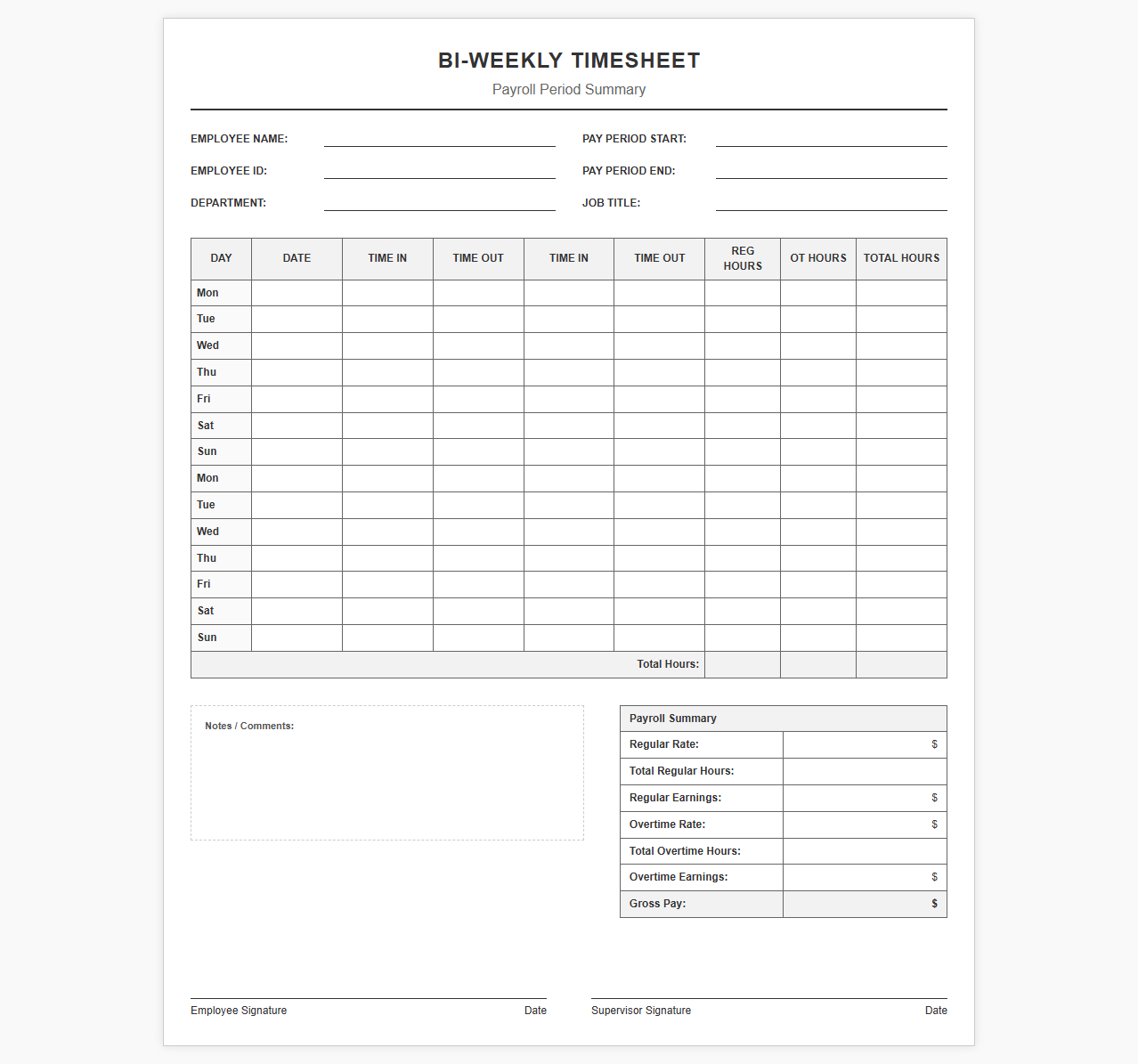 Download: .PDF
The Hidden Cost of Manual Payroll Processing
Many organizations still rely on outdated, manual processes to track employee hours, unaware of the compounding losses in administrative productivity. Human error, mismatched spreadsheets, and delayed submissions slow down operations and frustrate staff. To combat these inefficiencies, modern businesses are adopting specialized bi-weekly timesheets. These targeted tools streamline time tracking, eliminate guesswork, and ensure that every worked hour is logged with absolute precision.
Why Bi-Weekly Cycles Demand Tailored Formats
Managing a bi-weekly payroll cycle presents distinct operational challenges that generic weekly or monthly templates simply cannot handle. Because a bi-weekly period covers exactly fourteen days, it frequently triggers mid-month splits where pay periods straddle different calendar months. This complicates budget forecasting and accrual accounting.
Furthermore, calculating overtime across a two-week span requires precise compliance with labor laws. Standard templates fail because they do not easily accommodate variable work schedules or differentiate between standard hours and overtime thresholds over a multi-week horizon. Specialized layouts prevent these miscalculations before they reach the accounting desk.
Anatomy of a High-Performance Timesheet Document
An optimized bi-weekly timesheet is more than a simple grid; it is a carefully structured tool designed to minimize data entry errors and accelerate processing times.
Key Design Elements
- Clear Categorization: Distinct sections for regular hours, overtime, sick leave, and paid time off (PTO).
- Daily Breakdowns: Individual rows for morning and afternoon shifts, allowing employees to log exact clock-in and clock-out times.
- Automated Summary Rows: Built-in formulas that instantly calculate weekly and bi-weekly totals, reducing manual arithmetic errors.
Bridging the Gap Between Tracking and Payroll Software
Standardized document formats act as a critical bridge between raw employee inputs and sophisticated financial platforms. When timesheets use clean, structured data columns, HR professionals can quickly map fields to accounting and HRIS platforms. This structure minimizes manual data re-entry, which is often the primary source of payroll discrepancies.
Safeguarding Compliance and Audit Trails
Maintaining flawless records is not just an operational preference; it is a legal necessity. Federal and local labor laws mandate exact documentation of hours worked, meal breaks, and overtime compensation. Specialized bi-weekly timesheets establish an airtight, verifiable log that serves as a shield during regulatory audits.
Under the Fair Labor Standards Act (FLSA), employers must maintain accurate records of hours worked. Standardized timesheets provide the verifiable audit trail necessary to prove compliance and resolve payment disputes objectively.
Step-by-Step Transition to Specialized Formats
- Audit Current Workflows: Identify the specific bottlenecks and error rates in your existing payroll tracking system.
- Introduce the New Template: Deploy the specialized bi-weekly timesheet format to a small pilot department to gather initial feedback.
- Conduct Employee Training: Run brief walkthrough sessions to explain how to input hours, log overtime, and submit documents.
- Establish Submission Deadlines: Set firm, clear deadlines for timesheet submissions to ensure the payroll team has adequate processing time.
- Full-Scale Launch: Phase out legacy tracking systems completely and mandate the new format company-wide.
Measurable Returns on Payroll Optimization
Transitioning to optimized bi-weekly tracking delivers immediate, quantifiable advantages. Organizations save hundreds of administrative hours annually by eliminating manual calculations and reducing dispute-resolution times. These accuracy gains directly translate into lower overhead costs and improved employee trust.
By prioritizing precision and structure, businesses establish a highly efficient foundation for payroll processing. The adoption of dedicated tools ensures that time tracking is no longer a liability, but a streamlined asset that drives corporate efficiency and compliance.
Leave a comment