
Managing payroll for piece-rate workers is notoriously complex, frequently resulting in tracking discrepancies, wage disputes, and administrative burnout. Before investing in high-cost software, establishing a standardized documentation workflow is the critical first step toward maintaining organizational control and ensuring regulatory compliance.
Utilizing structured templates grants your payroll team the operational precision needed to streamline calculations, significantly reducing processing times while safeguarding against audit penalties. However, these tools are not one-size-fits-all; they must be carefully calibrated to account for localized minimum wage makeup laws and non-productive work time.
To help you build a compliant system, this guide introduces essential, ready-to-use resources, including daily production logs, piece-rate timesheets, and gross-to-net calculation sheets. Below, we will break down how to implement these templates effectively, address key compliance considerations, and optimize your entire piecework tracking pipeline.
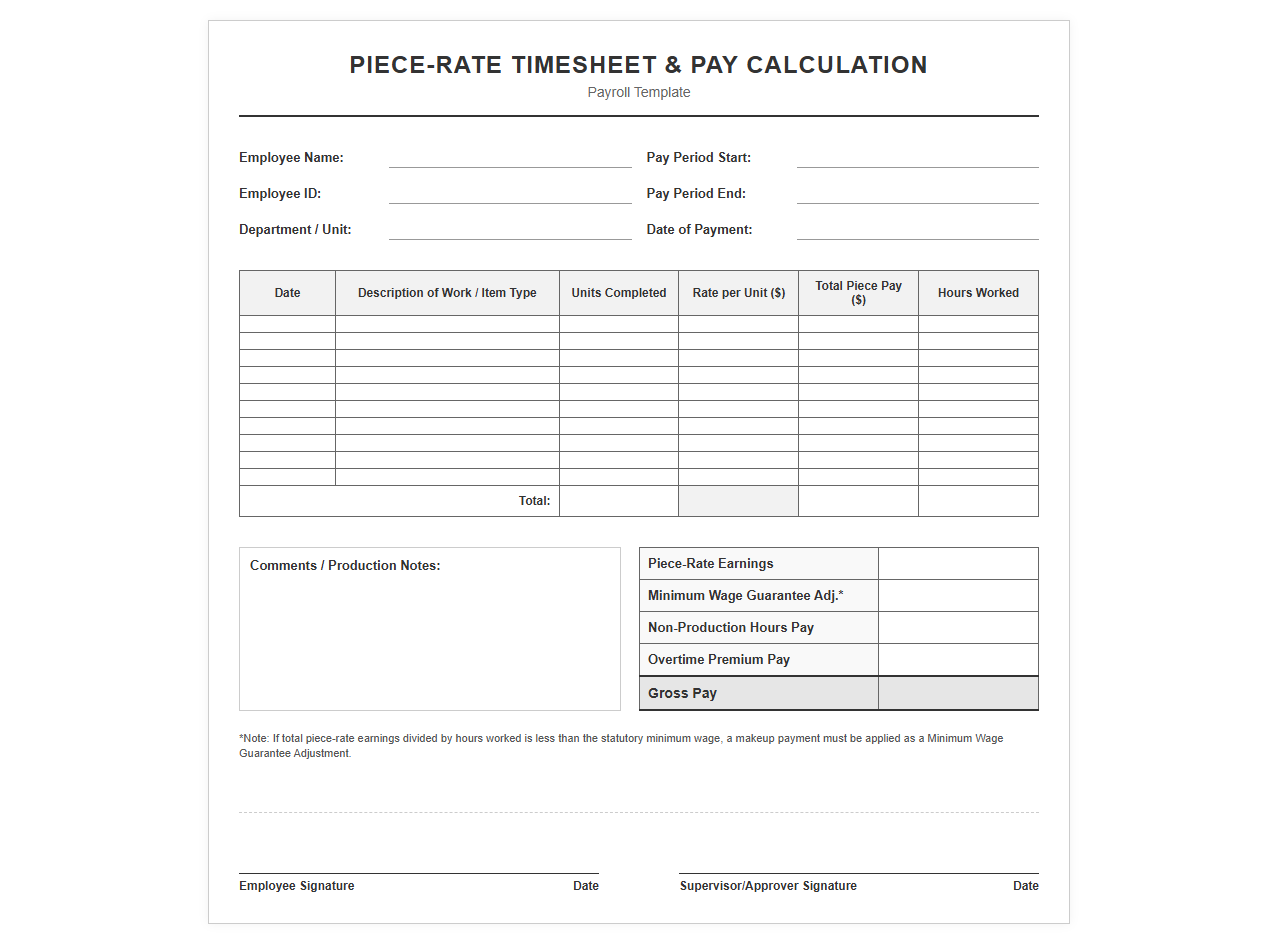
Piece-Rate Timesheet and Pay Calculation Template
 Download: .PDF
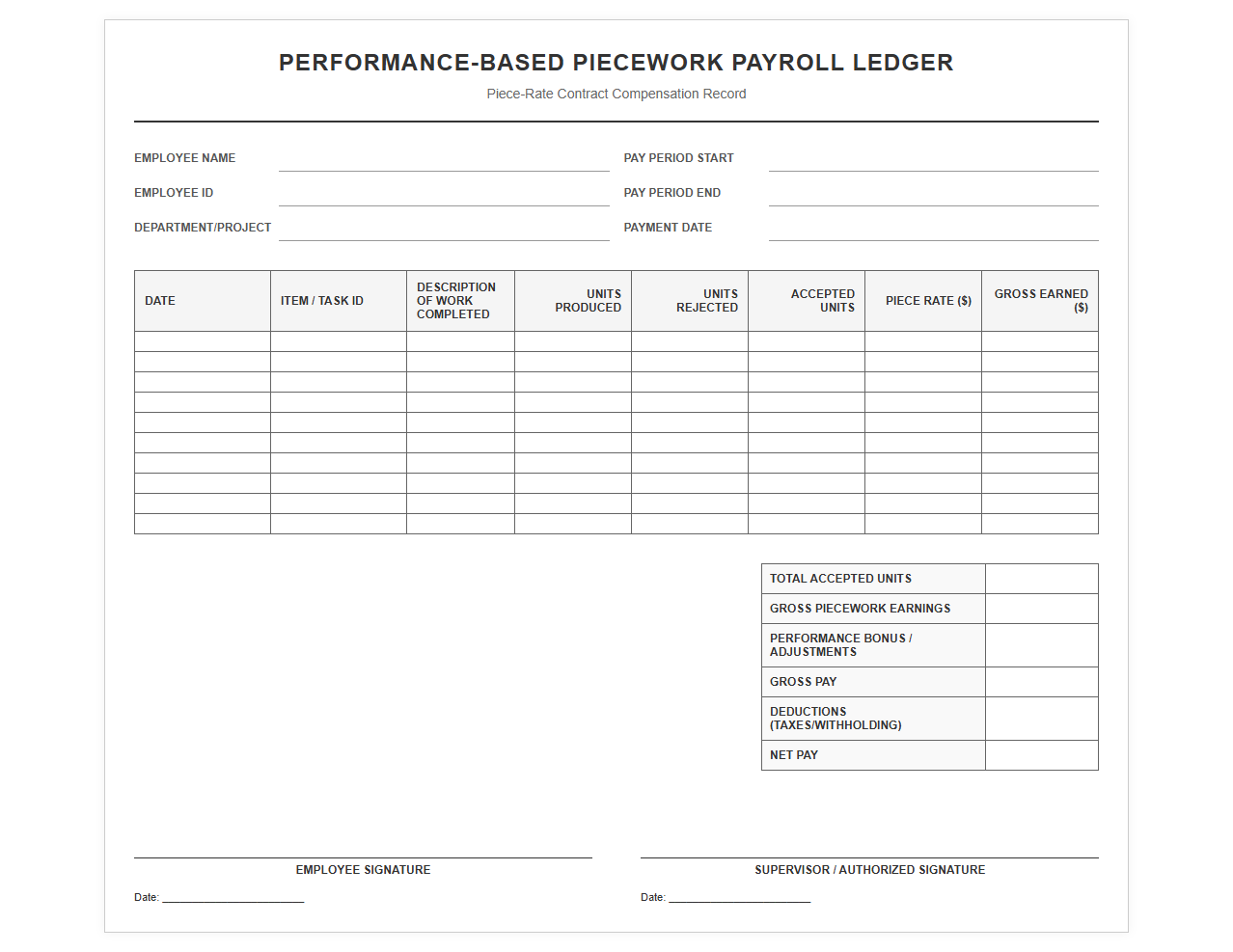
Performance-Based Piecework Payroll Ledger
 Download: .PDF
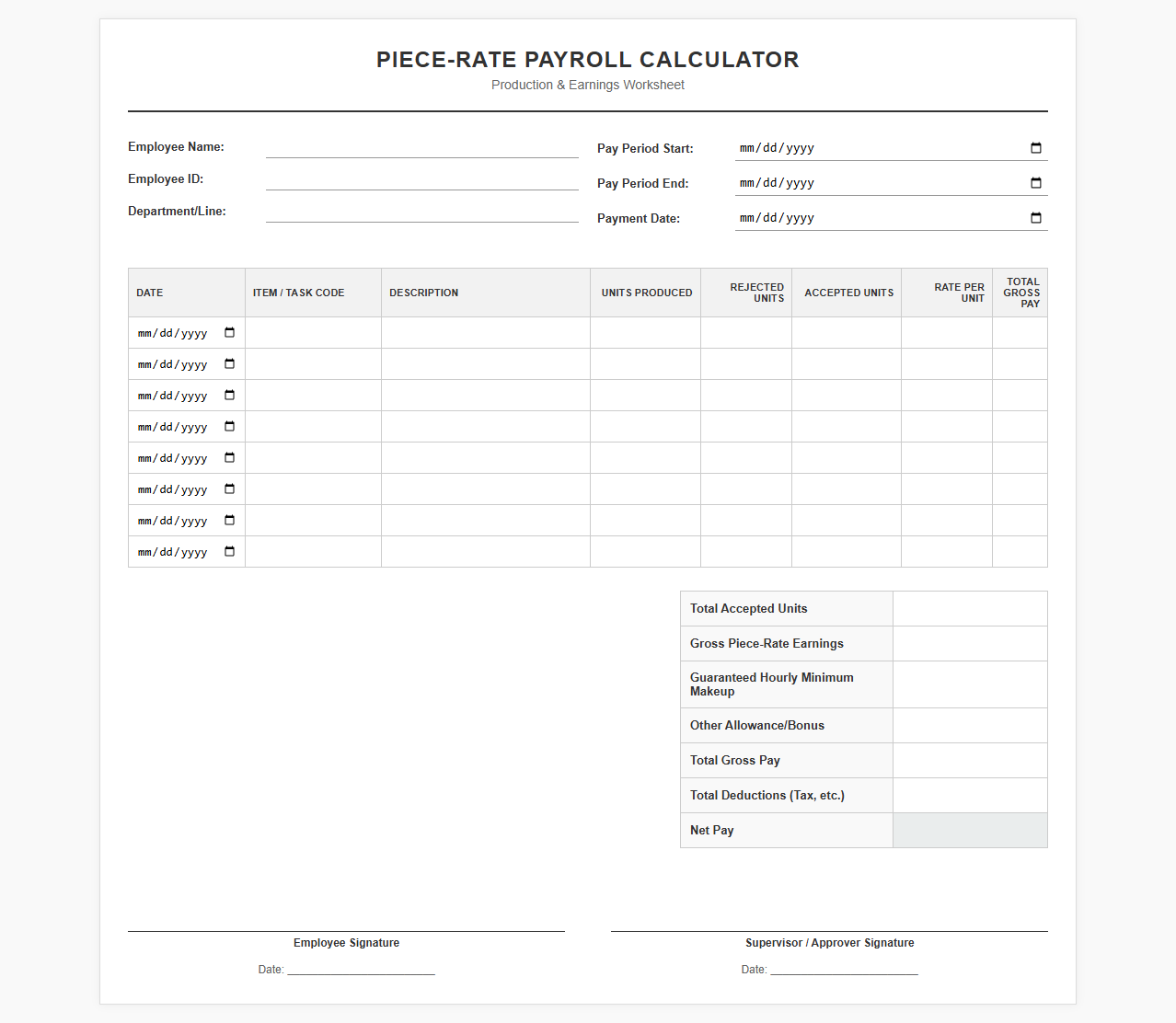
Production-Based Piece-Rate Payroll Calculator
 Download: .PDF
Agricultural Piece-Rate Payroll Ledger
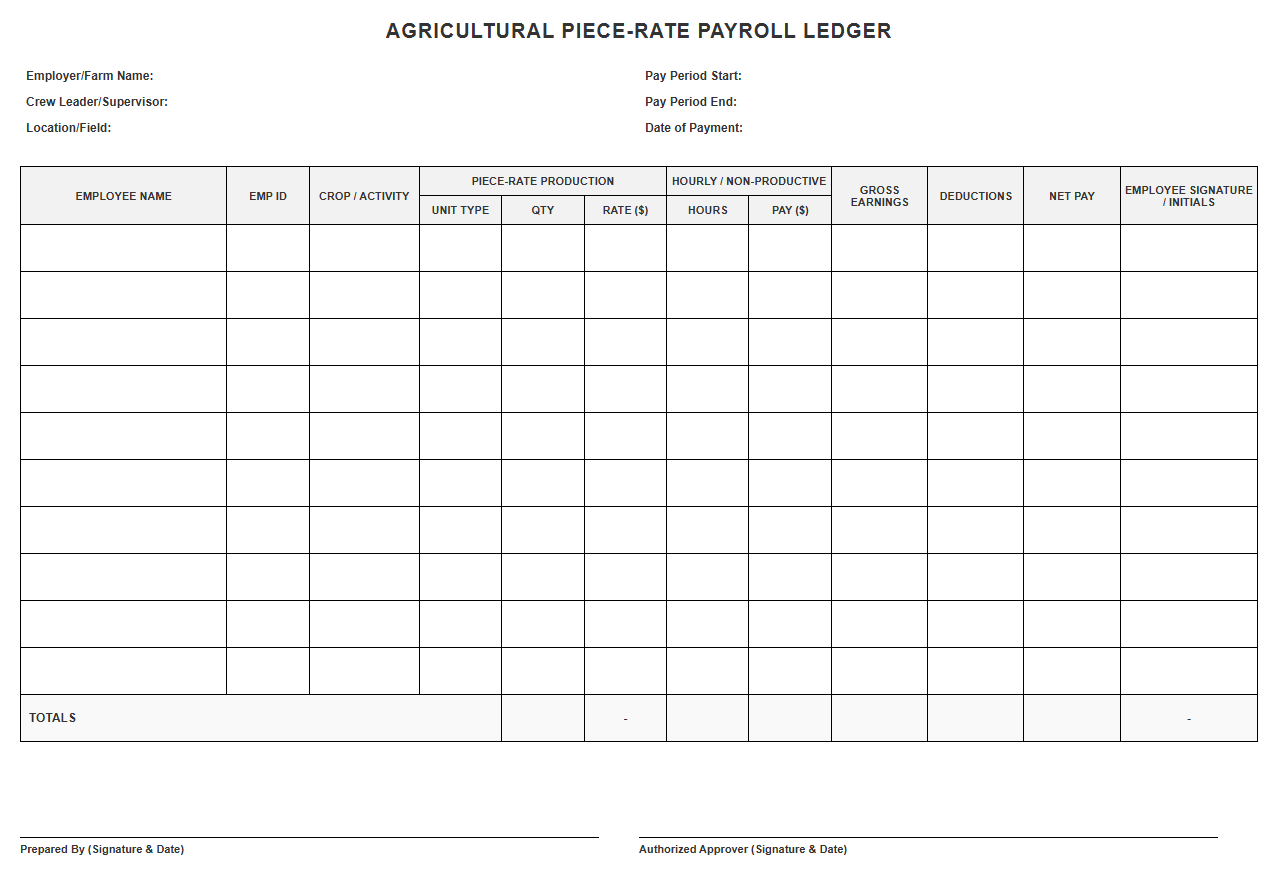 Download: .PDF
Manufacturing Piece-Rate Compensation Statement
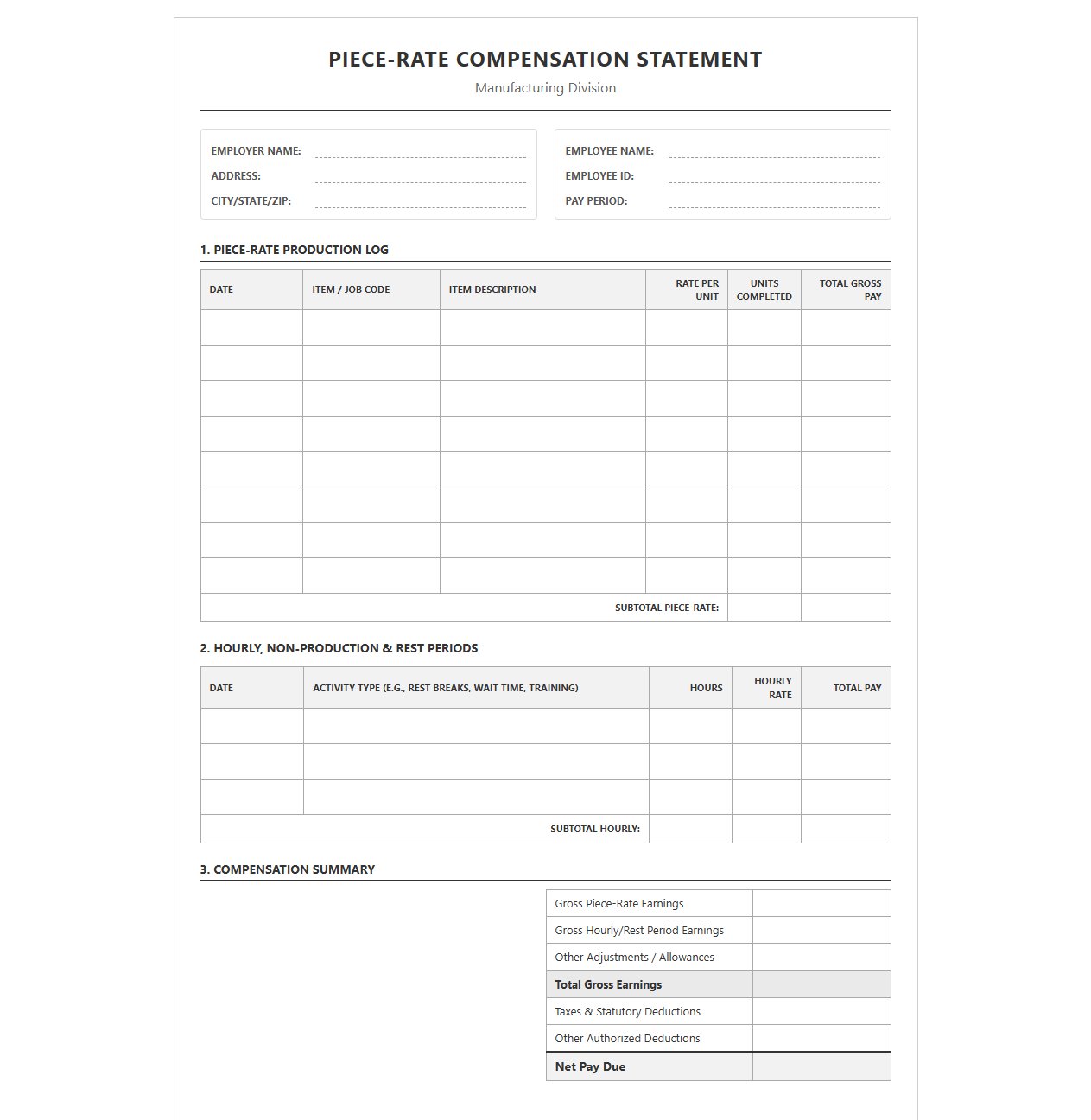 Download: .PDF
Daily Piecework Output and Payroll Tracker
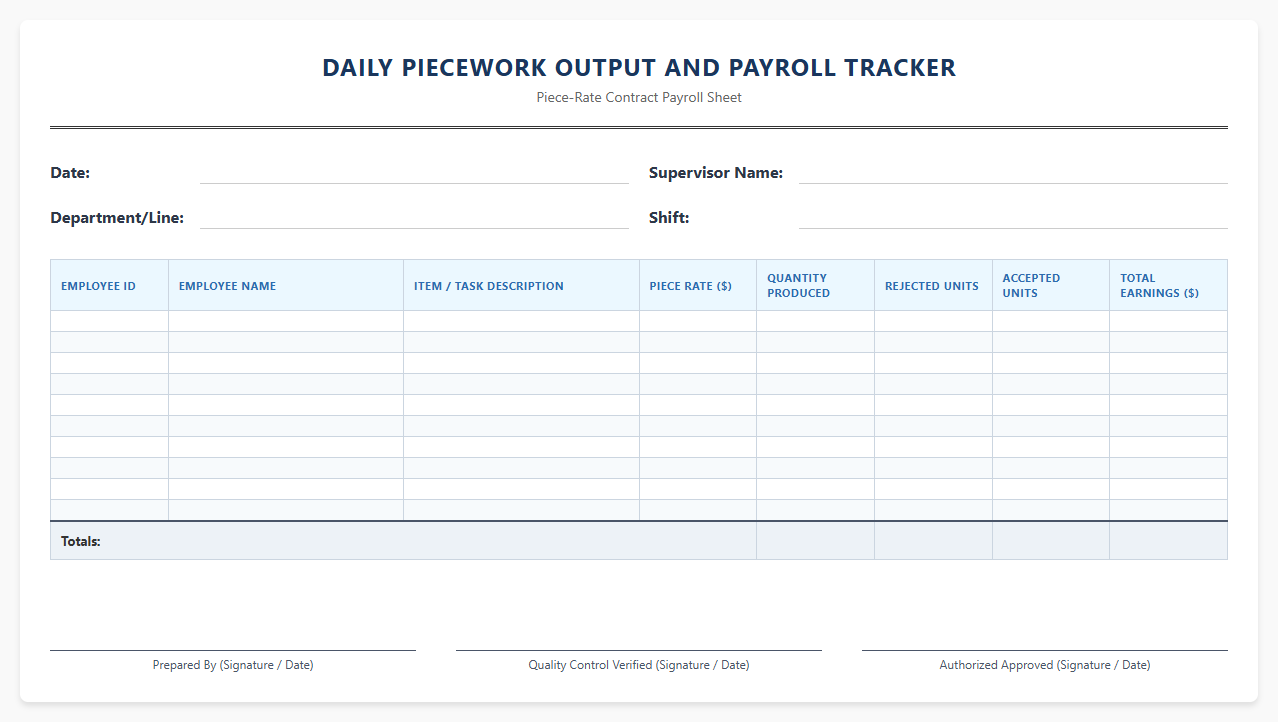 Download: .PDF
Hybrid Hourly and Piecework Payroll Template
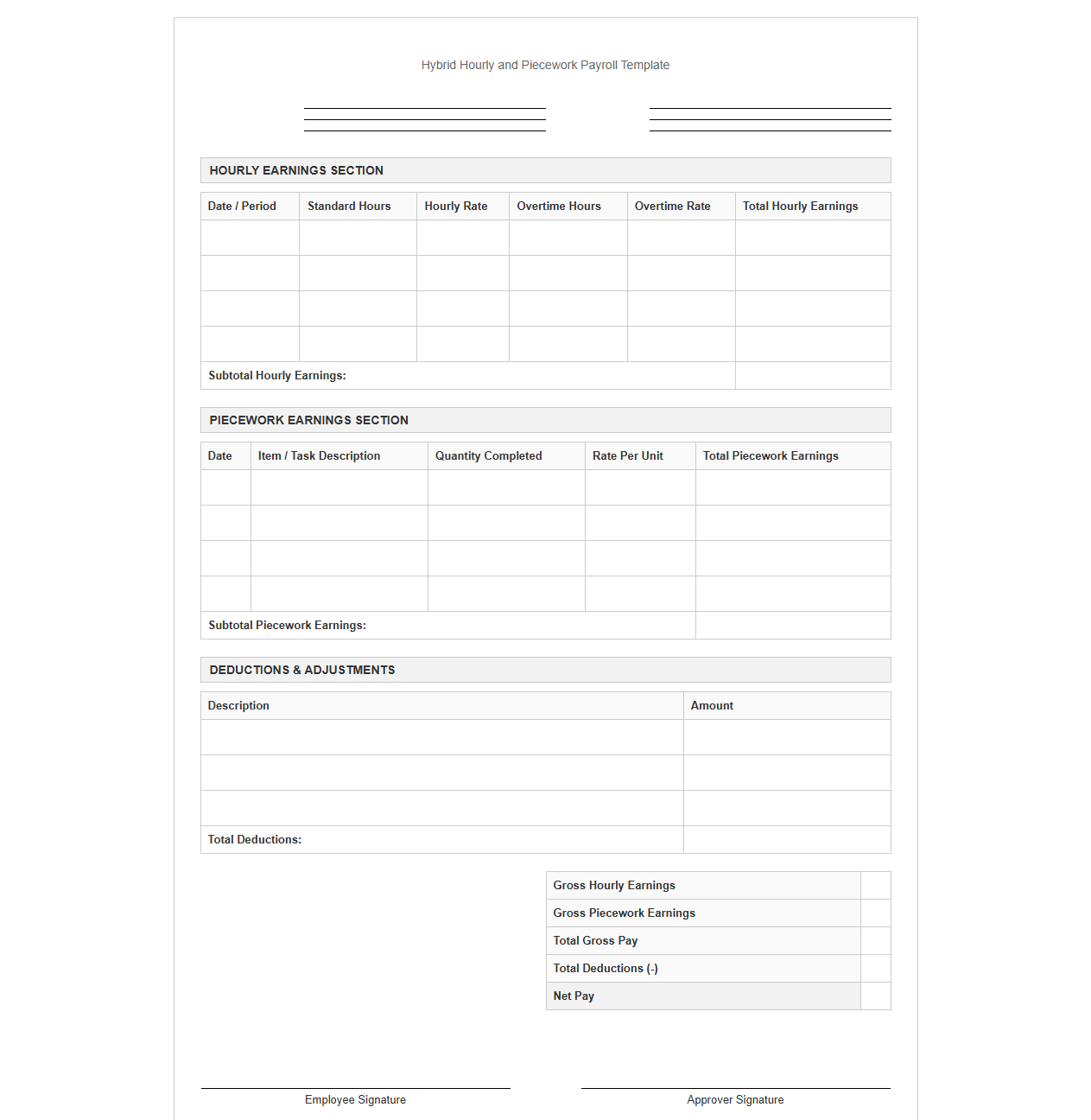 Download: .PDF
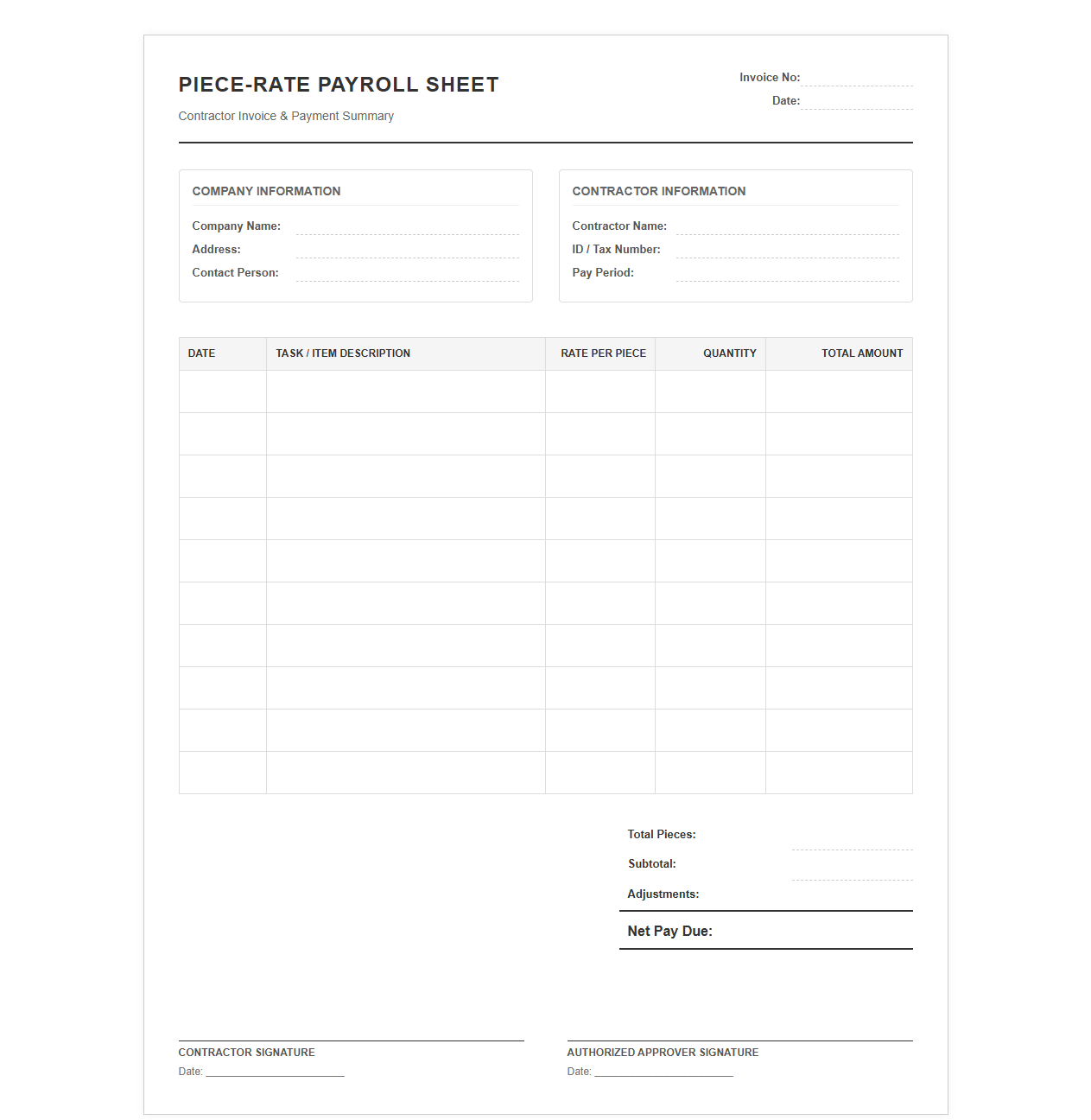
Contractor Piece-Rate Invoice and Payroll Sheet
 Download: .PDF
The Foundations of Efficient Piecework Tracking
In piece-rate compensation models, workers are paid based on their output rather than the hours they log. While this system incentivizes high productivity, it demands rigorous administrative oversight. Accurate piecework tracking is absolutely vital for maintaining payroll accuracy and ensuring strict labor compliance. Without precise records, businesses risk underpaying staff or violating complex labor laws.
The Importance of Payroll Accuracy in Piece-Rate Contracts
When piece-rate contracts are active, tracking every completed unit ensures that compensation is fair and transparent. Precise documentation prevents costly payroll disputes and establishes a reliable audit trail.
Labor Compliance and Fair Compensation
Failing to monitor output accurately can lead to severe legal penalties. Employers must safeguard their operations by implementing structured tracking frameworks that prove full compliance with state and federal labor standards.
Essential Template 1: The Daily Piece-Rate Timesheet
A daily piece-rate timesheet serves as the primary source of truth for shift-level production. This template captures real-time data to bridge the gap between hours spent on-site and physical output.
The structure of a compliant timesheet must contain the following fields:
Employee ID: Unique identifier for the individual worker.Units Produced: Total count of accepted units completed during the shift.Hours Worked: The exact clock-in and clock-out times to track active labor hours.Supervisor Sign-Off: Verification signature to authenticate the daily records.
Essential Template 2: The Production Quality Log
While speed is a natural byproduct of piece-rate work, quality must never be sacrificed. A production quality log acts as a critical quality control gate before data is sent to the payroll department.
Essential Template 3: The Piece-Rate Earnings Statement
A compliant piece-rate pay stub must provide a transparent breakdown of how an employee's total compensation was calculated. This ensures clarity and satisfies legal requirements for detailed wage statements.
| Earnings Component | Rate | Units/Hours | Total |
|---|---|---|---|
| Regular Piecework | $1.50 per unit | 400 units | $600.00 |
| Overtime Premium | $0.75 per unit | 50 units | $37.50 |
| Deductions | N/A | Standard Tax | -$85.00 |
Essential Template 4: The Minimum Wage Guarantee Reconciliation Sheet
Even under a piece-rate system, employers are legally obligated to ensure that workers earn at least the equivalent of the local minimum wage for all hours worked during a pay period.
If an employee's piecework earnings fall below the minimum wage threshold, the employer must pay a makeup differential to bridge the gap.
Transitioning from Paper to Digital Tracking Systems
Manual paper templates are highly susceptible to errors, physical damage, and processing delays. Transitioning to digital tracking solutions streamlines operations and ensures immediate access to historical data.
- Utilize cloud-based spreadsheets to auto-calculate daily totals.
- Implement specialized payroll software to sync timesheets with accounting platforms.
- Explore the advantages of automated piecework tracking tools to eliminate manual entry altogether.
Leveraging Software for Seamless Operations
Digital systems significantly reduce administrative overhead by automating calculation workflows, allowing payroll teams to process checks faster and with greater confidence in the underlying data.
Best Practices for Implementing Piecework Templates
Successfully executing a piecework tracking system requires more than just templates; it demands a cultural commitment to accuracy. Managers should regularly train staff on reporting protocols to ensure everyone understands how output translates to pay.
Ensuring Audit Readiness and Long-Term Success
Organizations must maintain immaculate records and perform periodic internal audits of their piecework payroll templates. This proactive approach ensures regulatory compliance and protects the business against future labor audits.
Read More

Leave a comment