
Managing salaried non-exempt employees often introduces a compliance minefield for HR departments, particularly when tracking fluctuating hours and calculating overtime. Before implementing complex tracking software, organizations must establish a solid grasp of how the Fair Labor Standards Act (FLSA) governs these hybrid compensation models.
Utilizing structured payroll templates grants administrators immediate operational clarity and safeguards the organization against costly wage-and-hour audits. However, as a crucial stipulation, these templates should be treated as operational frameworks rather than a substitute for certified legal counsel. For example, a well-designed template can seamlessly handle complex calculations like the Fluctuating Workweek (FWW) method, automatically adjusting the half-time overtime rate as weekly hours vary.
In this article, we will examine the legal nuances of this employment classification, break down the essential components of an effective tracking template, and outline best practices for seamless payroll integration.
Salaried Non-Exempt Timesheet Template with Overtime Calculation
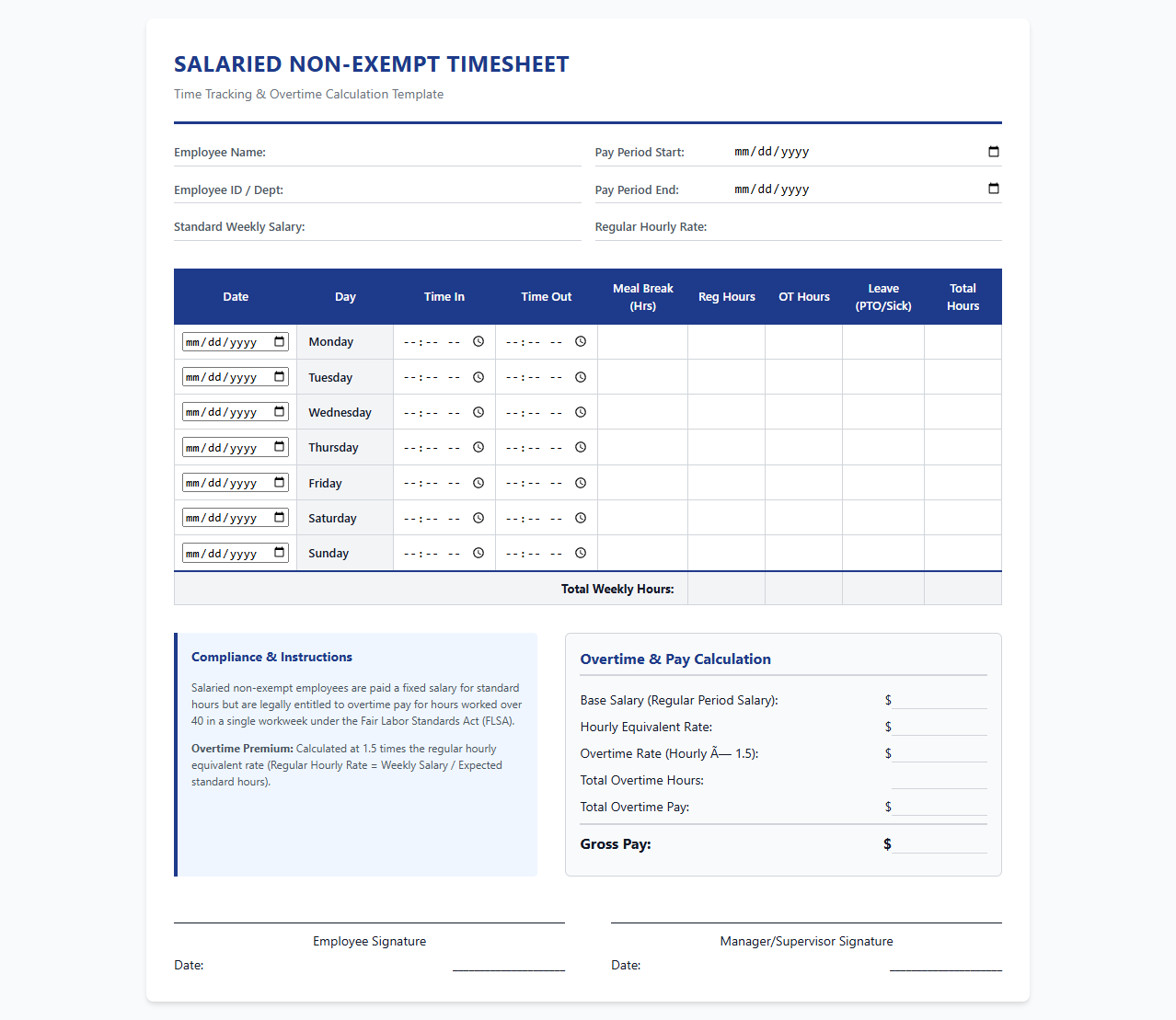 Download: .PDF
Semi-Monthly Salaried Non-Exempt Payroll Tracking Sheet
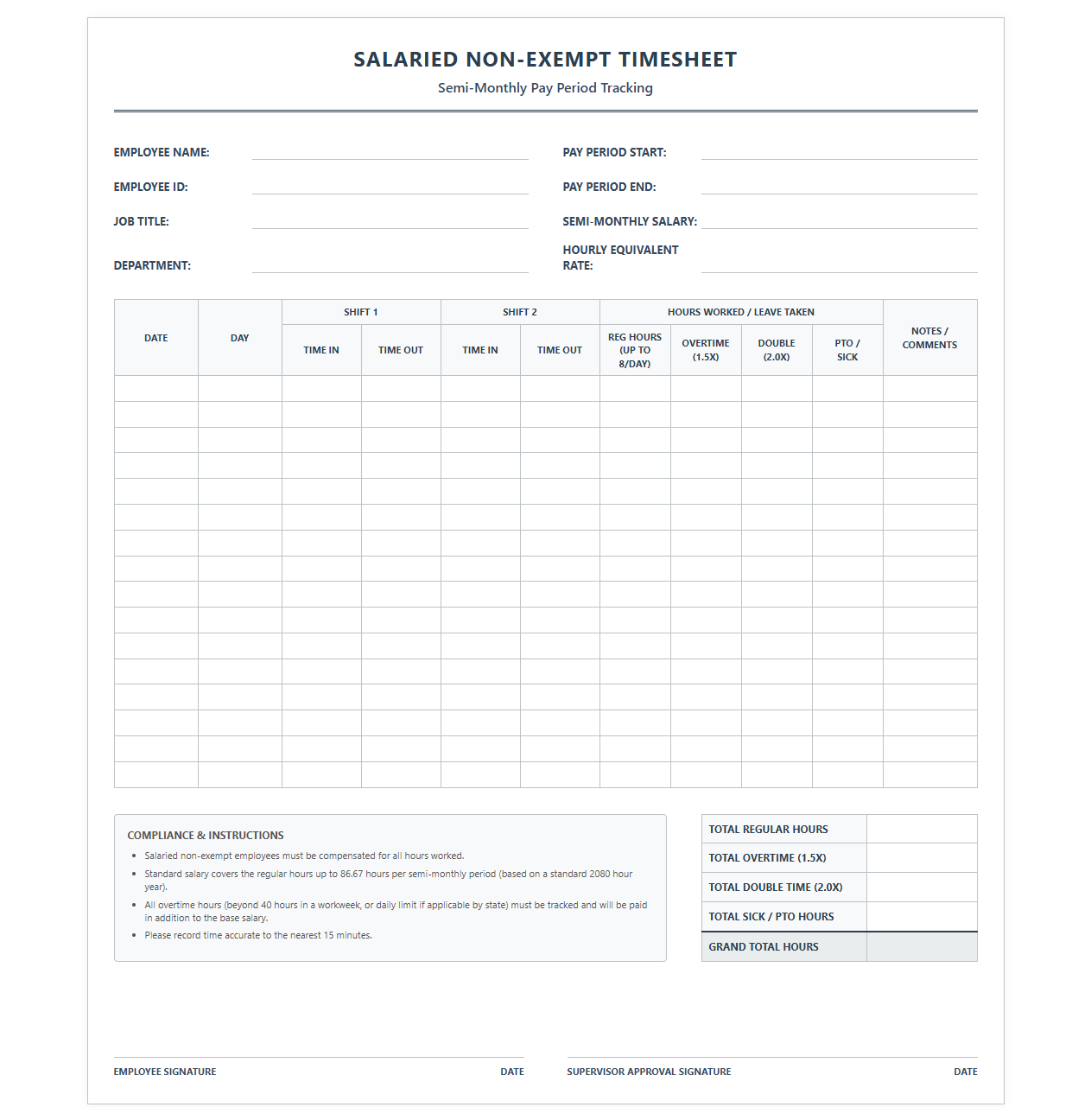 Download: .PDF
Bi-Weekly Salaried Non-Exempt Time Card Template
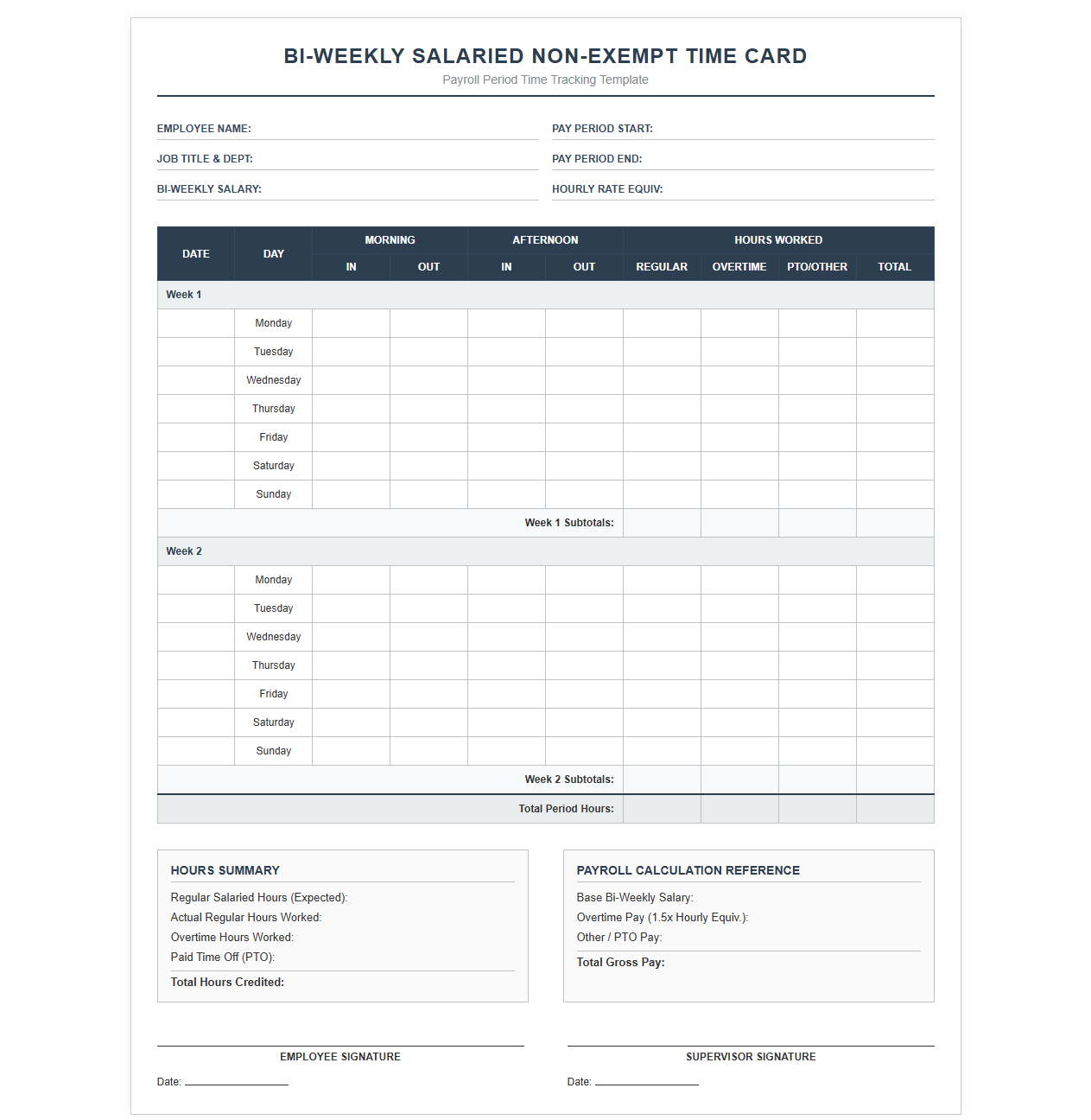 Download: .PDF
Salaried Non-Exempt Employee Hours and Payroll Tracker
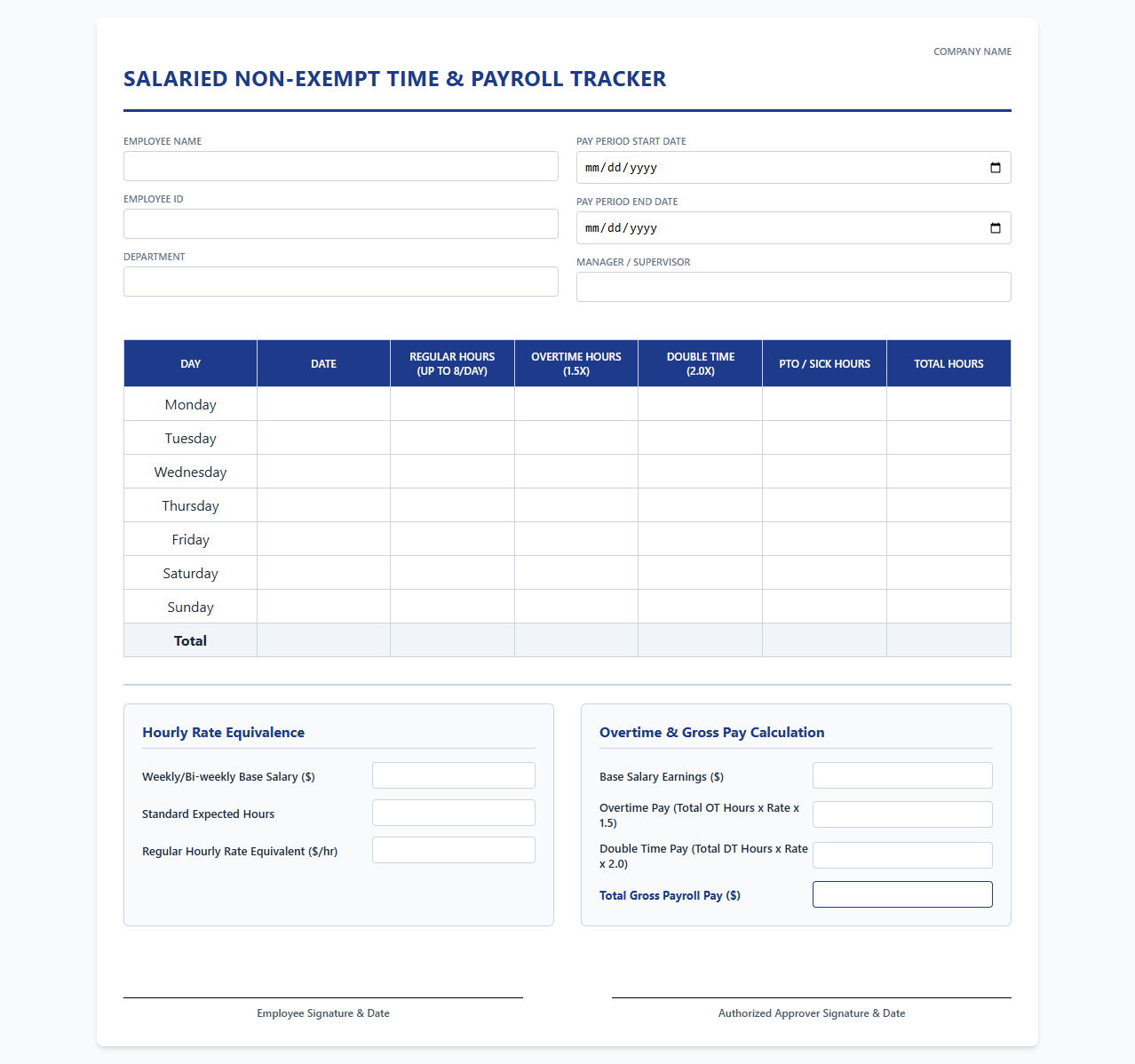 Download: .PDF
Monthly Salaried Non-Exempt Time Tracking Spreadsheet
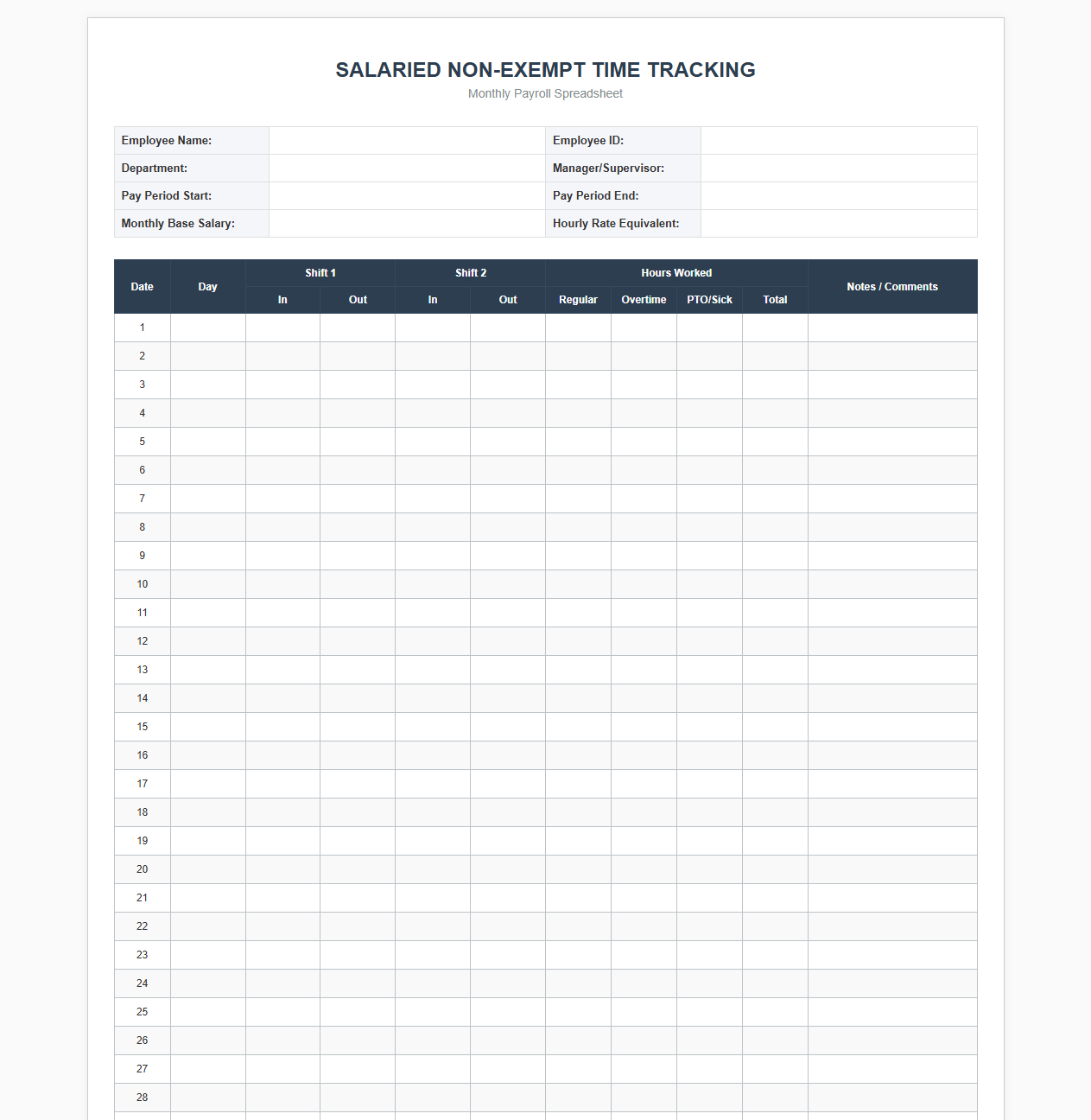 Download: .PDF
Salaried Non-Exempt Overtime and PTO Payroll Template
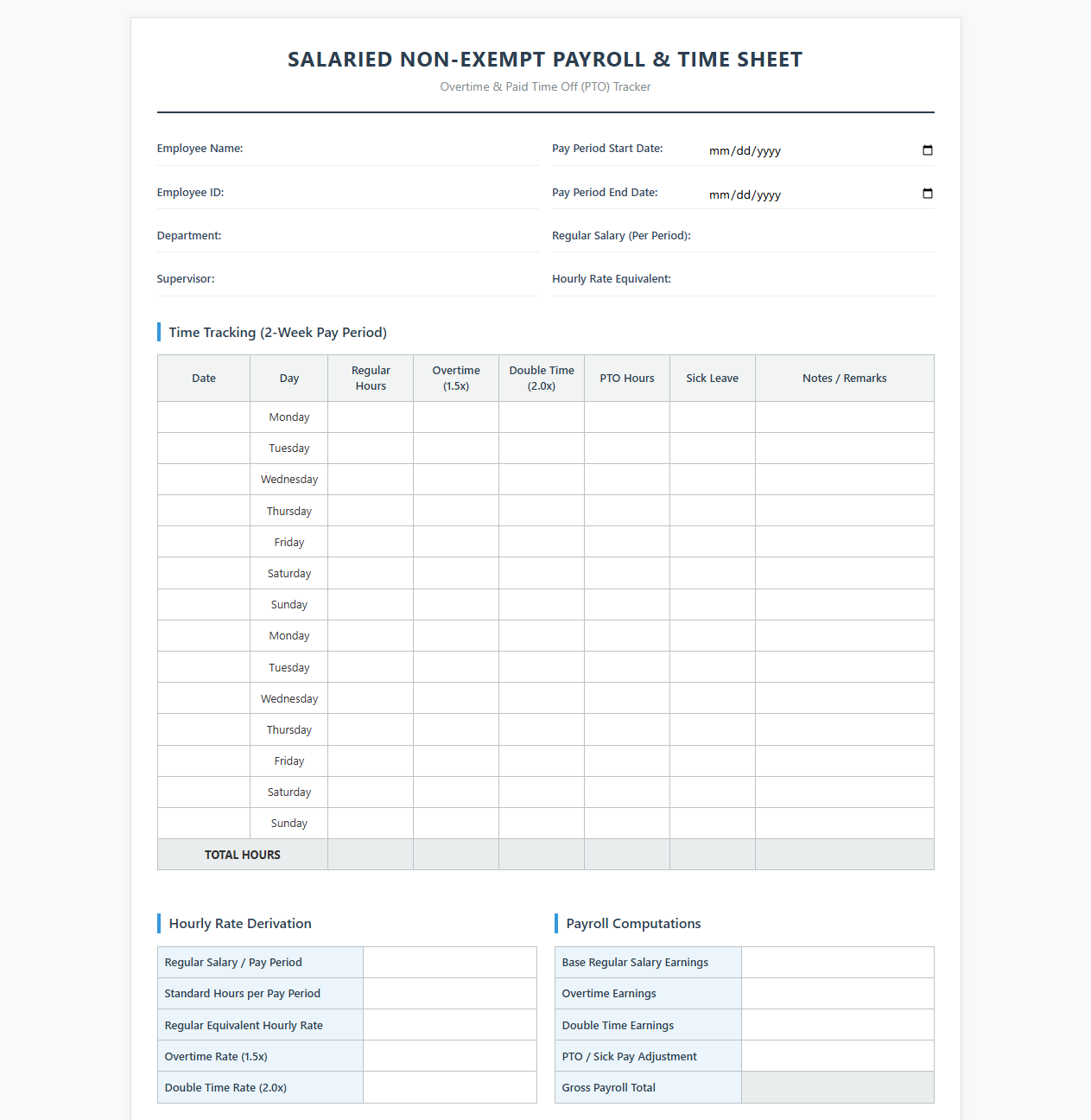 Download: .PDF
Standard Salaried Non-Exempt Timekeeping and Payroll Log
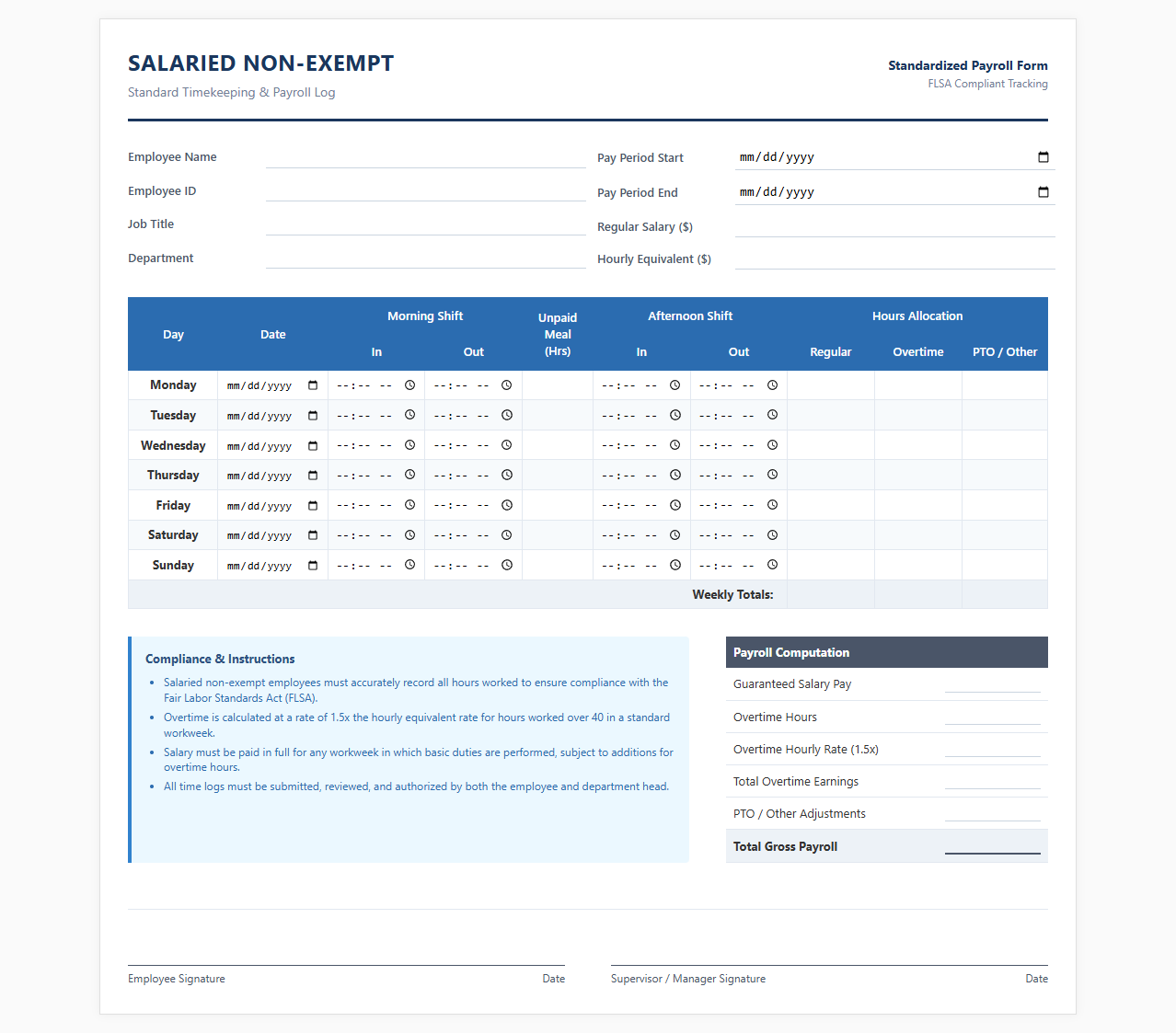 Download: .PDF
Hourly Salaried Non-Exempt Payroll Calculator Template
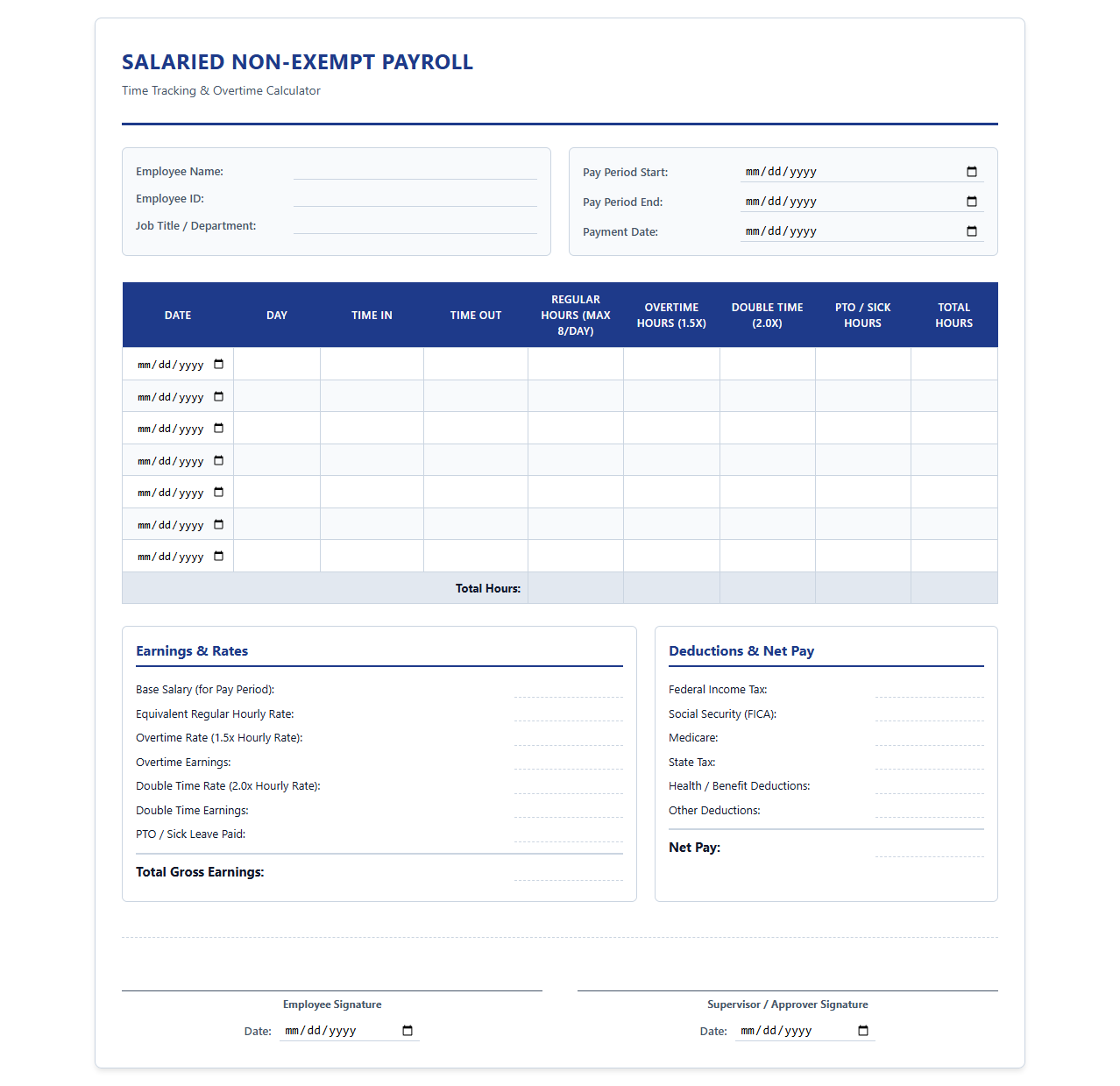 Download: .PDF
Demystifying the Salaried Non-Exempt Dilemma
The salaried non-exempt employment status is one of the most misunderstood classifications in workforce management. Employees in this category receive a guaranteed base salary, yet they remain legally entitled to overtime pay for any hours worked beyond the standard 40-hour workweek. This hybrid structure often confuses both managers and workers, leading to critical operational errors.
Human resources departments frequently stumble into compliance traps by assuming salaried status automatically waives the need for meticulous time tracking. Without rigorous tracking protocols, organizations face major pitfalls, including undocumented off-the-clock work, inaccurate calculations of the regular rate of pay, and administrative friction during payroll processing.
The Hidden Compliance Risks of Inaccurate Tracking
Failing to maintain precise records for salaried non-exempt employees exposes organizations to severe regulatory scrutiny. Under the Fair Labor Standards Act (FLSA), employers are legally obligated to record all hours worked, regardless of how pay is structured. Sloppy bookkeeping can rapidly trigger formal audits and class-action lawsuits.
The financial consequences of negligence are steep. Businesses found in violation face heavy penalties, including mandatory back pay for all unrecorded overtime hours, liquidated damages that double the unpaid wages owed, and hefty civil money penalties levied by the Department of Labor. Additionally, systemic compliance failures can severely damage an organization's public reputation and destroy employee morale.
Blueprint of an Effective Payroll Template
To mitigate compliance risks, HR professionals must deploy a structured payroll template designed specifically for the nuances of salaried non-exempt roles. A standardized template ensures every hour is accounted for and mathematically processed without manual intervention.
- Employee Identifiers: Name, department, unique employee ID, and designated pay period.
- Base Compensation Parameters: Weekly equivalent salary, contracted standard hours, and the calculated base hourly rate.
- Daily Hour Logs: Separate columns for standard hours, actual hours worked, sick leave, and paid time off (PTO).
- Automatic Overtime Identifiers: Built-in formulas that automatically segment hours worked over 40 into a designated overtime column.
- Total Pay Summaries: Mathematical fields that combine regular salary earnings with calculated overtime pay for a transparent gross total.
Automating Overtime and Regular Rate Calculations
Calculating overtime for salaried non-exempt employees is more complex than simply multiplying an hourly rate by 1.5. Because the base salary covers a fixed number of hours, the "regular rate of pay" must be mathematically established each workweek to ensure legally compliant overtime calculations.
Establishing Bulletproof Time Logging Workflows
Technology alone cannot guarantee compliance; human processes must support your payroll templates. Implementing a highly structured time logging workflow helps eliminate tracking gaps and ensures data integrity before payroll is finalized.
- Daily Real-Time Logging: Train employees to record their exact start, break, and end times daily rather than estimating hours at the end of the pay period.
- Weekly Employee Attestation: Require employees to review and digitally sign off on their weekly timesheets, confirming that all recorded hours are accurate and no off-the-clock work occurred.
- Managerial Verification: Establish a strict approval deadline where direct supervisors audit timesheet submissions against scheduled projects to verify accuracy.
- Discrepancy Resolution: Implement a formal feedback loop where managers and employees promptly resolve timesheet anomalies before sending data to HR.
Seamless Integration with Existing Payroll Systems
Manual data entry is a major source of administrative errors and payroll delays. To maintain data integrity, structure your Excel or Google Sheets tracking template to match the exact schema required by your payroll software.
Most modern accounting and HRIS platforms allow direct bulk uploads. Ensure your tracking template can easily export data into a standardized .csv, .xlsx, or .xml format. By aligning the column headers of your template with the import fields of your payroll provider, you can achieve seamless data transfers, eliminate human error, and keep a clean digital audit trail.
Long-Term Benefits of Standardized Tracking
Embracing a systematic approach to salaried non-exempt tracking yields advantages that extend far beyond simple regulatory compliance. By standardizing templates and workflows, organizations drastically reduce administrative overhead, allowing payroll teams to focus on strategic initiatives rather than manual calculations.
Moreover, consistent and transparent payroll practices foster deep organizational trust. When employees have clear visibility into how their hours are logged and calculated, payroll disputes disappear. This commitment to accuracy builds a more engaged, secure, and productive workforce.

Leave a comment