
Managing complex shift differentials is a recurring headache for payroll professionals, frequently resulting in costly processing errors, compliance risks, and employee dissatisfaction. Before attempting to implement fully automated software solutions, organizations must first establish a structured methodology for capturing and verifying varied hourly rates. Adopting specialized payroll document templates grants HR departments immediate operational relief, significantly reducing manual calculations and enhancing processing accuracy.
Regulatory Note: While these standardized templates streamline administrative workflows, they must be tailored to align with specific state-level overtime calculations and collective bargaining agreements to ensure complete legal compliance.
For example, pre-configuring templates with dedicated fields for a 15% late-night premium or a flat $2.50 weekend rate multiplier eliminates manual math errors at the source. In this article, we will examine the essential components of these specialized templates, discuss best practices for customization, and outline how to seamlessly integrate them into your existing payroll workflow.
Shift Differential Payroll Spreadsheet
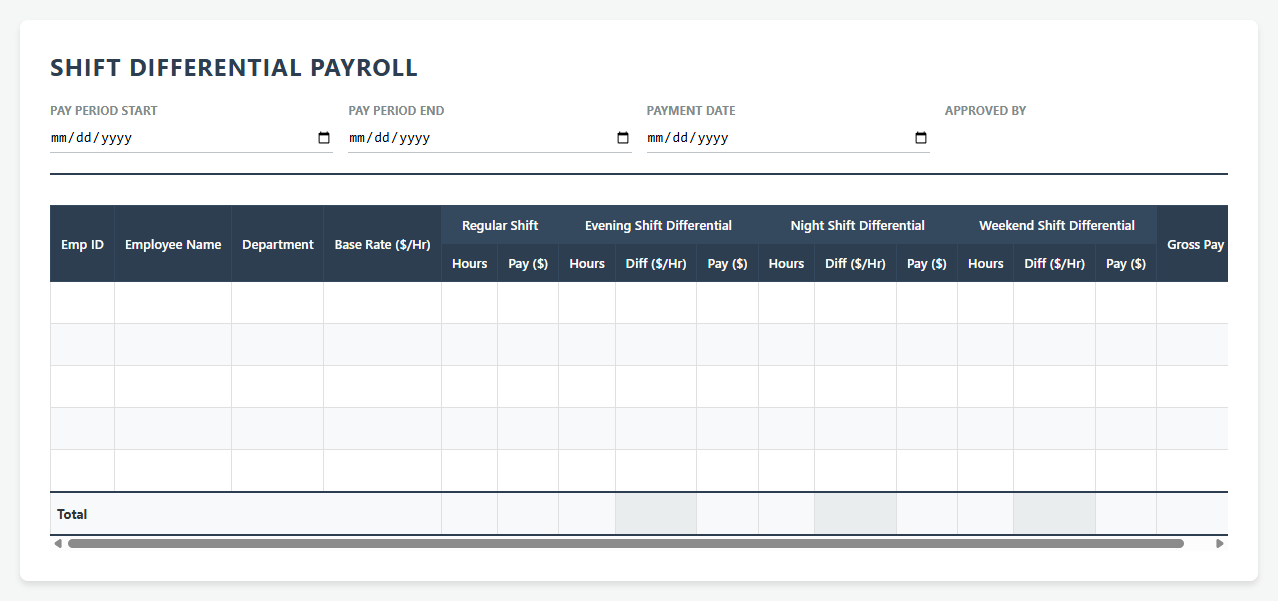 Download: .PDF
Night and Weekend Shift Premium Payroll Tracker
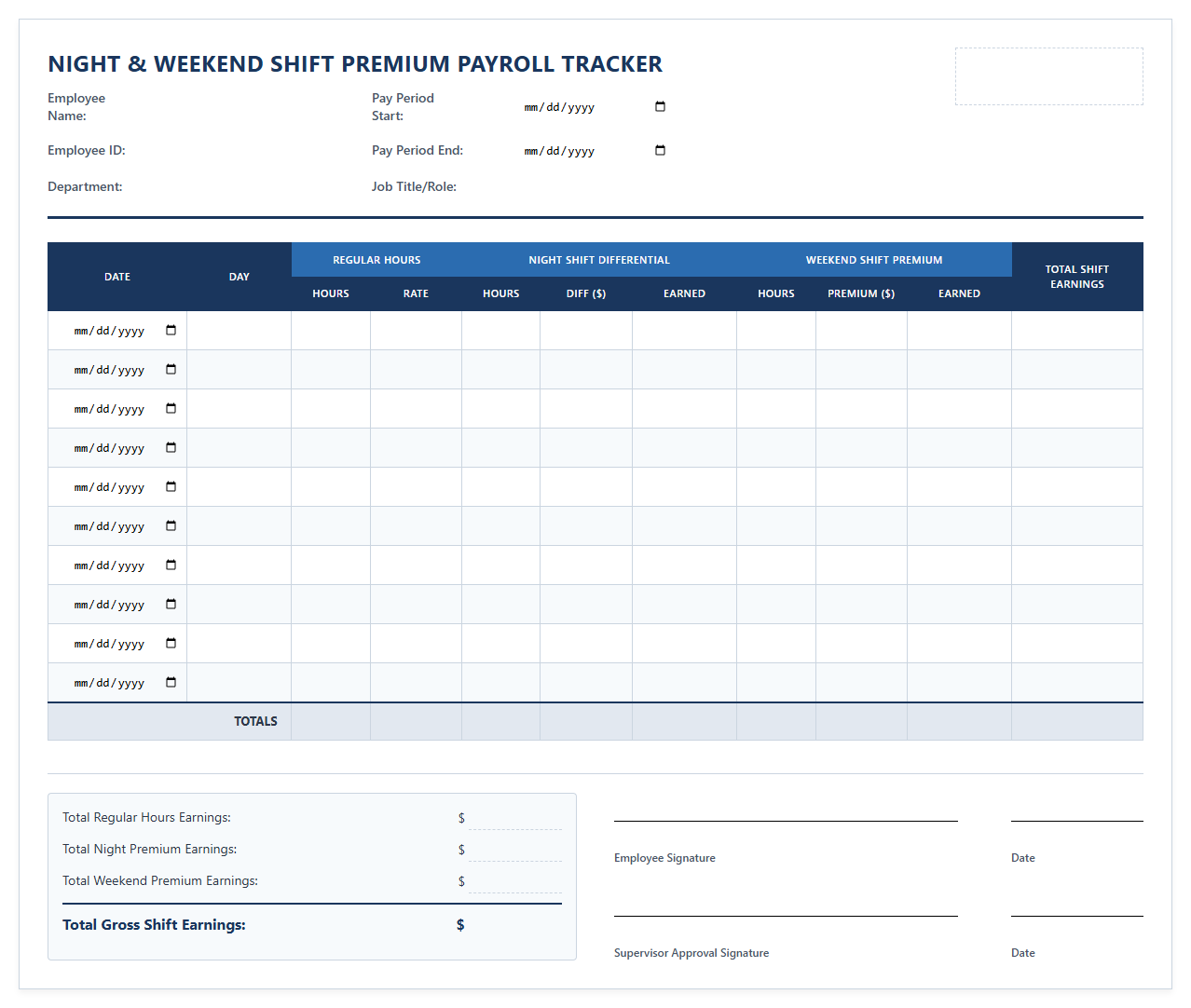 Download: .PDF
Shift Premium Compensation Payroll Template
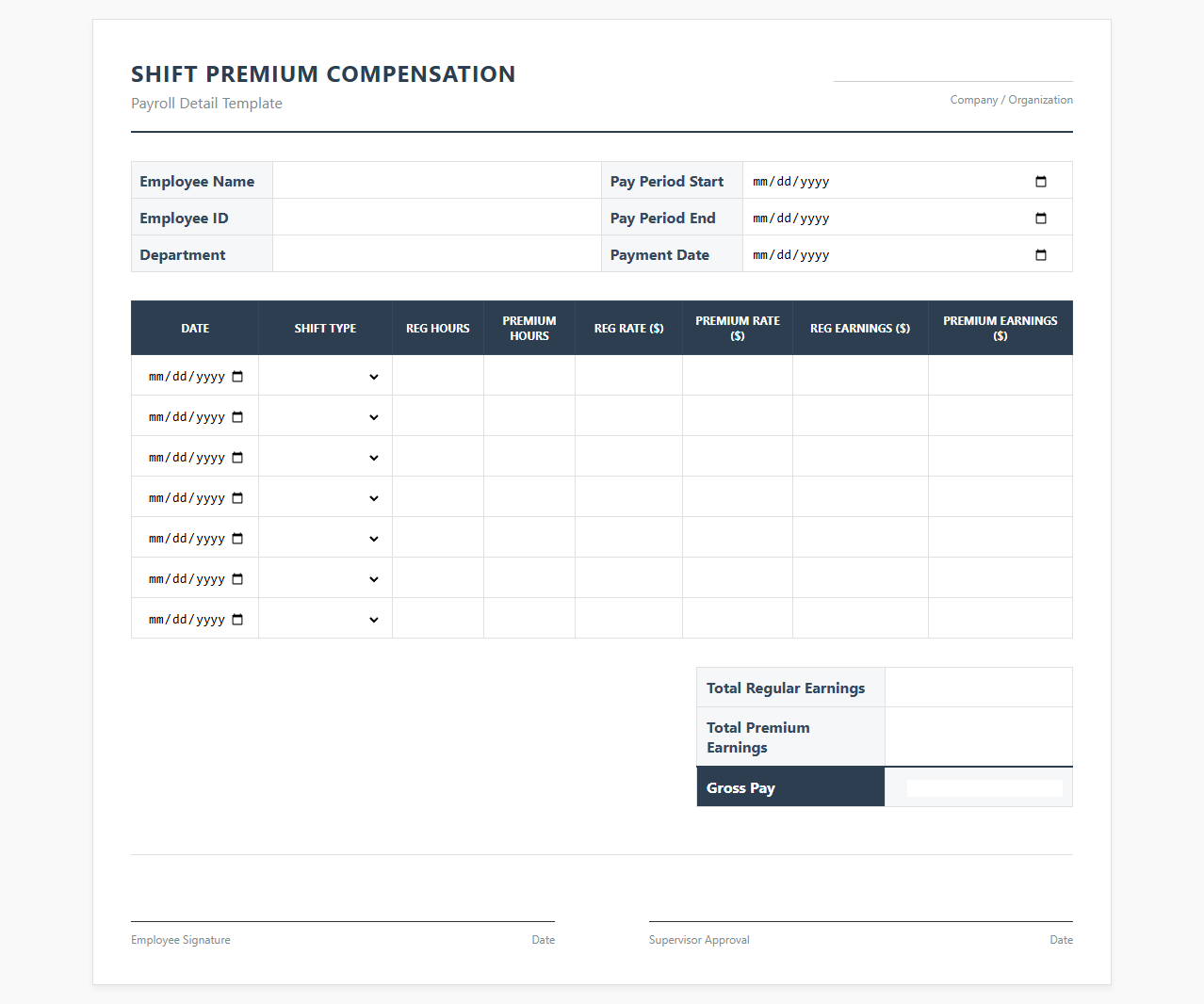 Download: .PDF
Shift Differential Wage Calculation Sheet
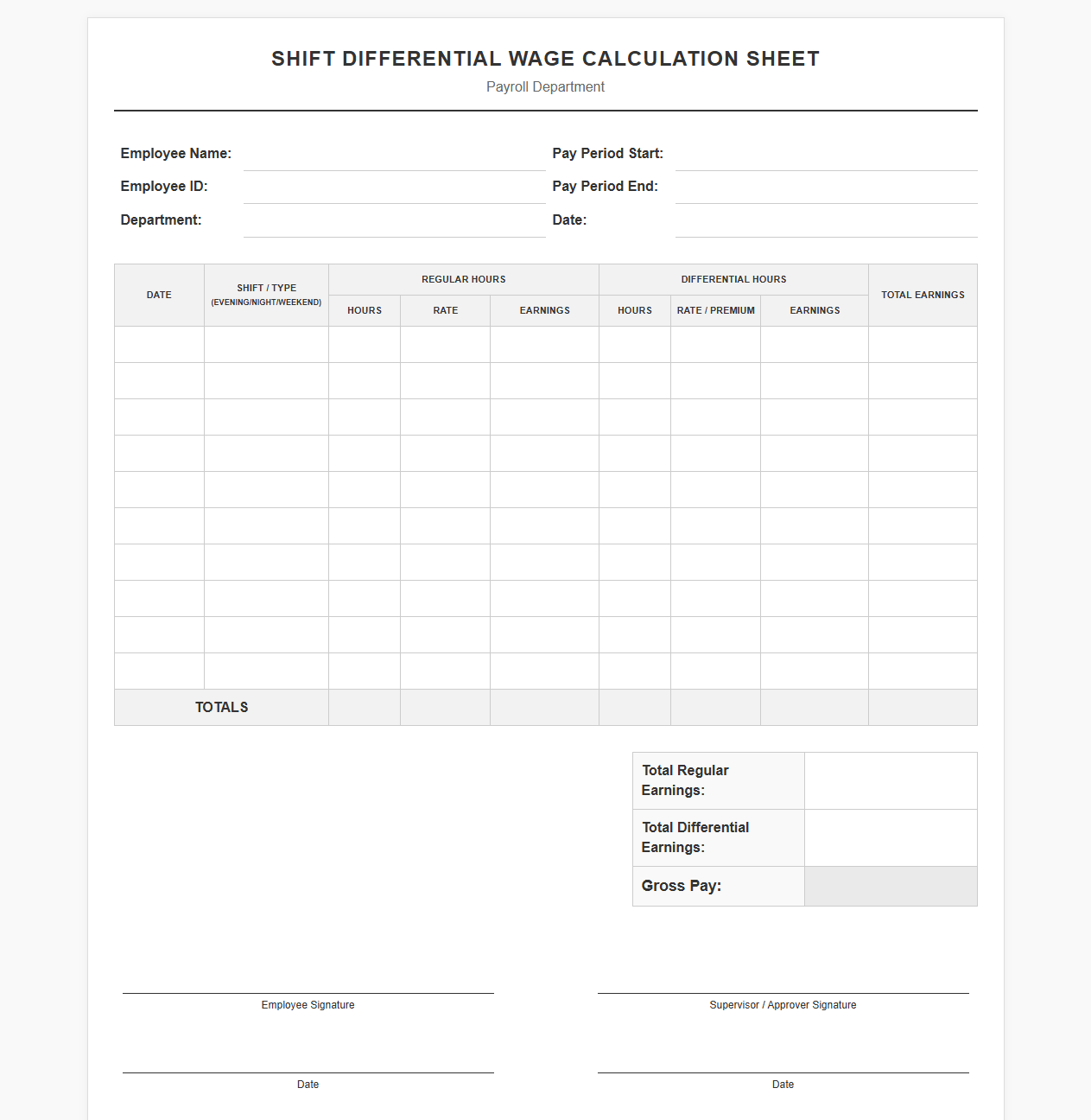 Download: .PDF
Hourly Employee Shift Differential Payroll Ledger
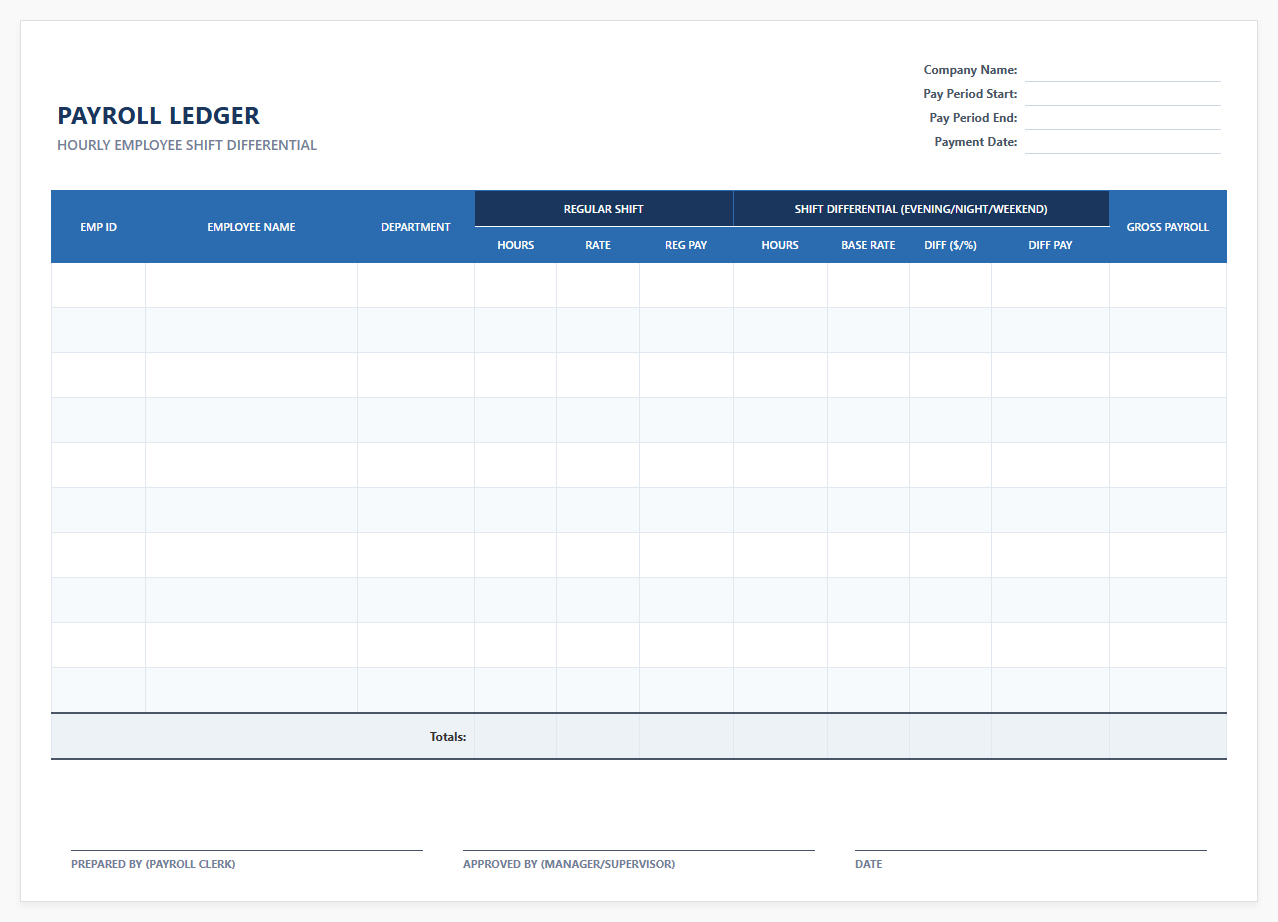 Download: .PDF
Shift Work Differential Payroll Calculator
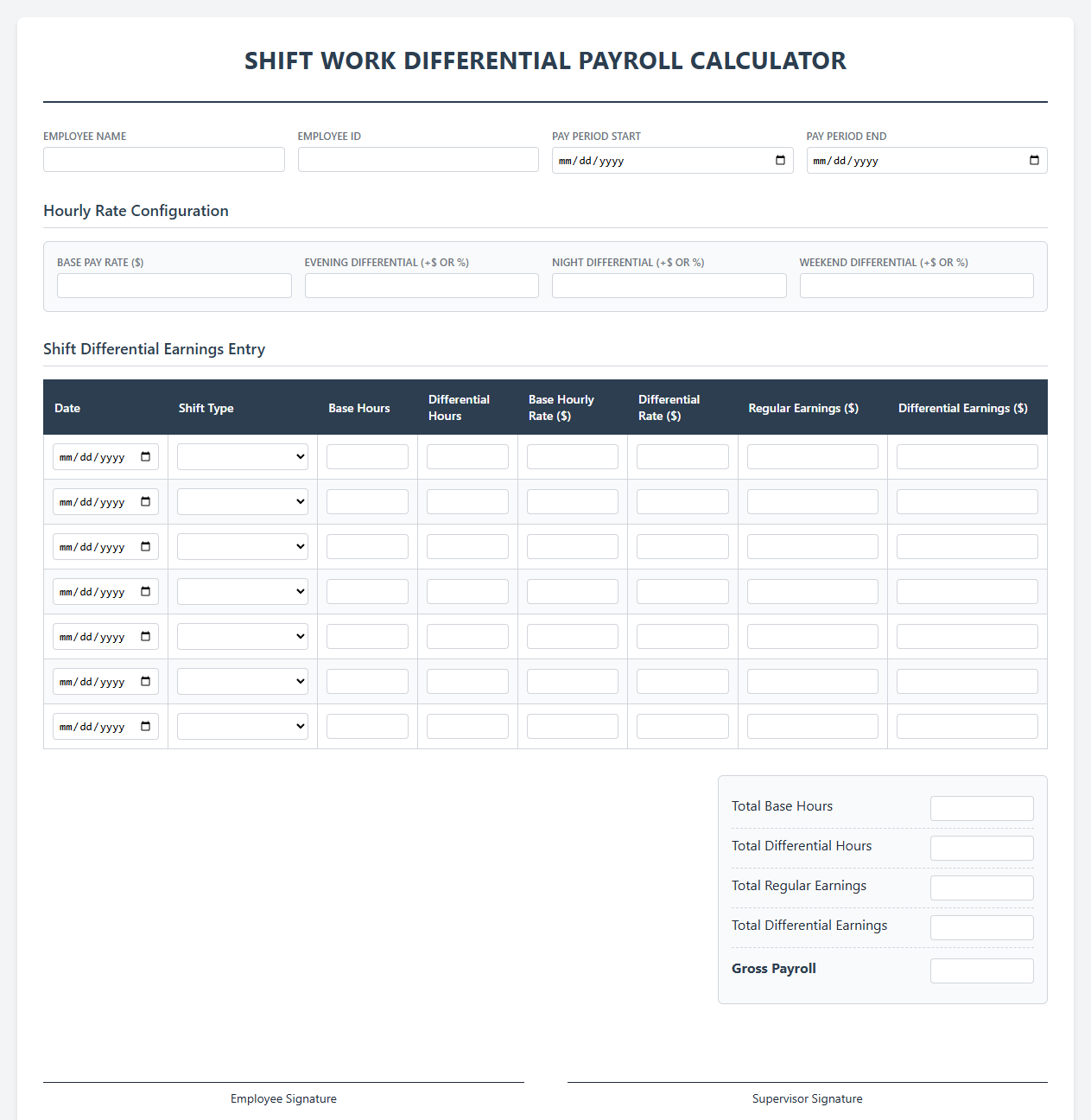 Download: .PDF
Shift Premium and Differential Pay Template
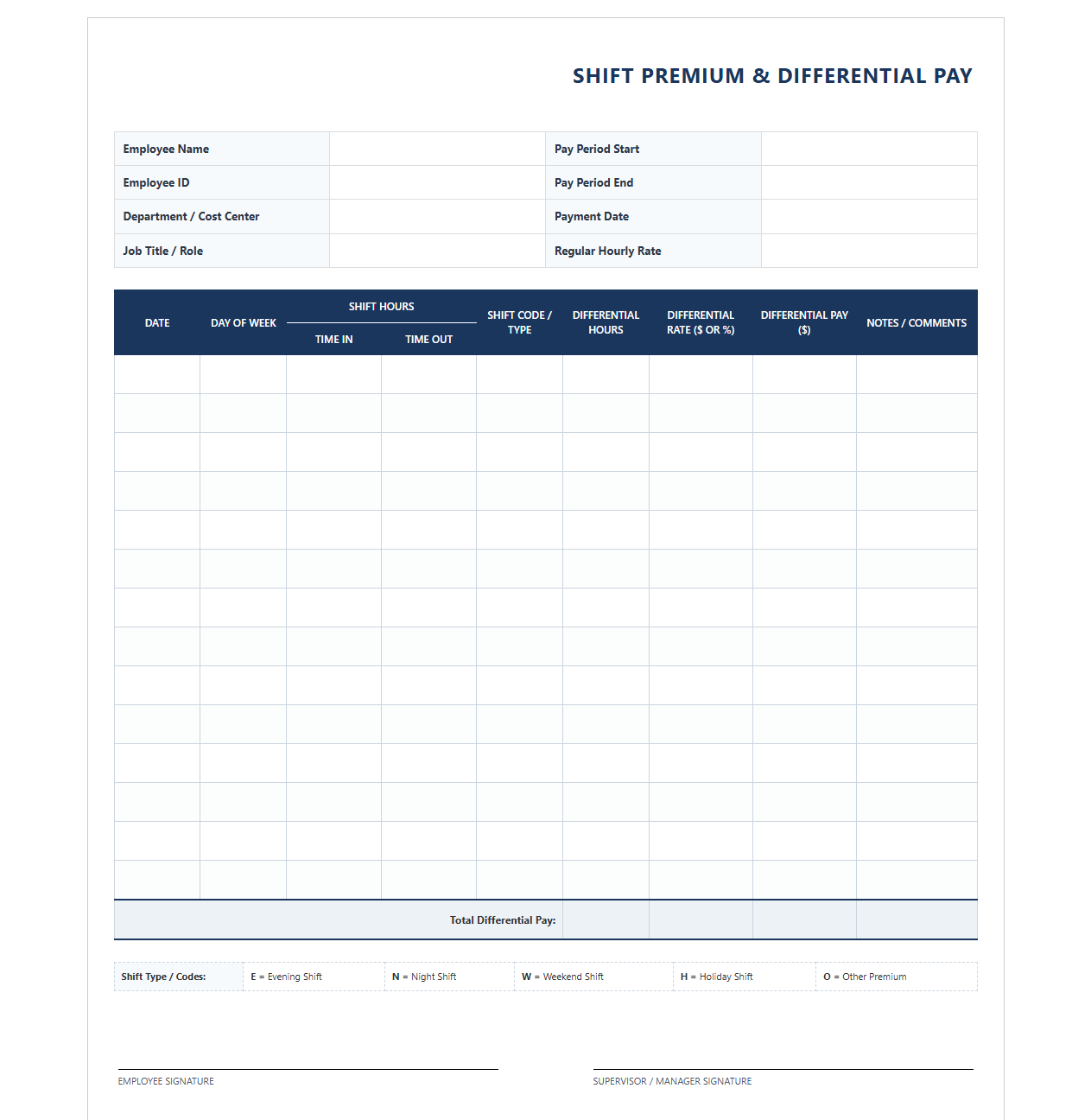 Download: .PDF
Multi-Shift Payroll Differential Calculator
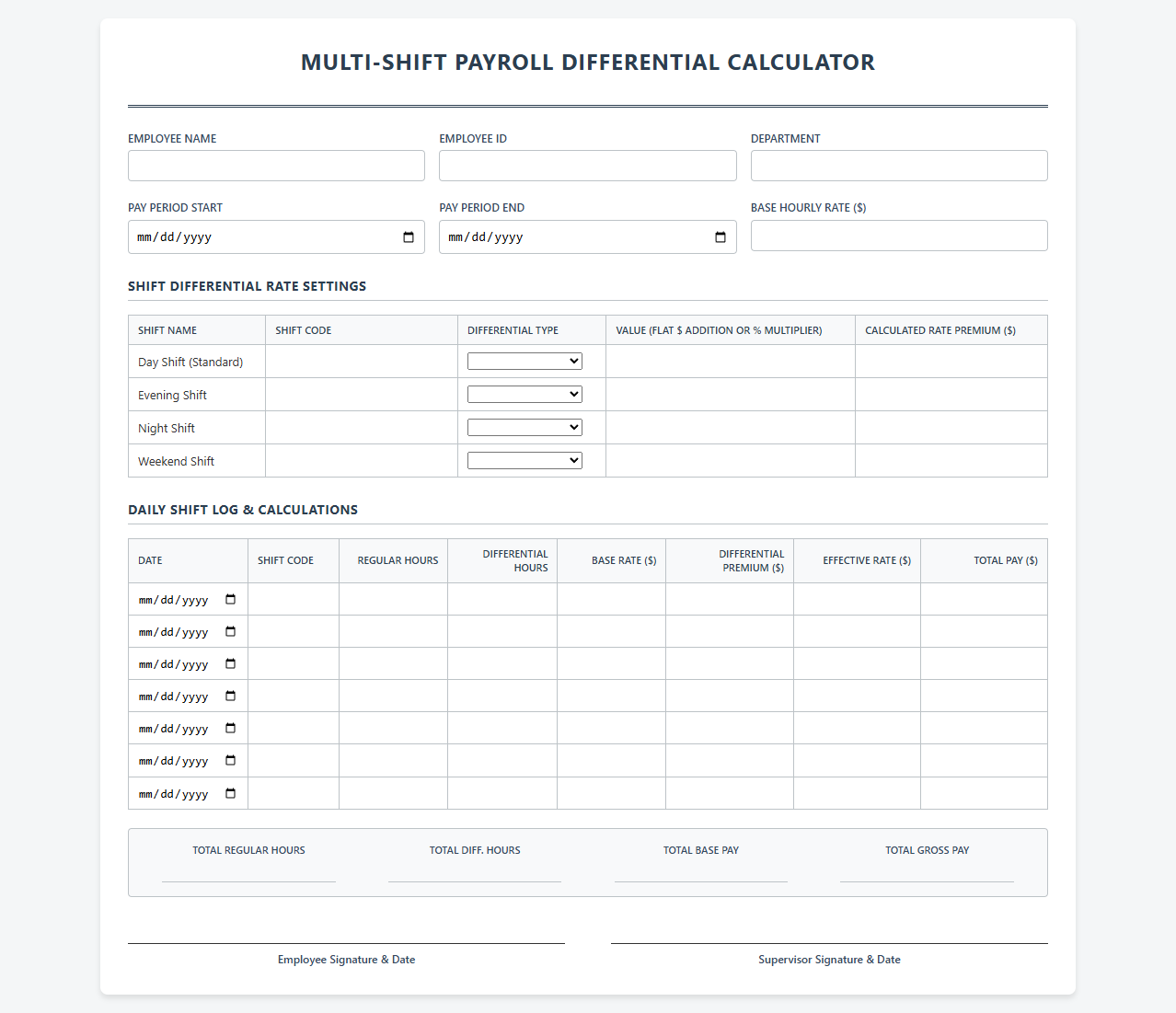 Download: .PDF
The Cost of Complexity in Shift Differential Payroll
Managing a 24/7 workforce requires meticulous coordination, but the real administrative headache begins when payroll processing rolls around. For HR and payroll departments, manually calculating shift differentials for multi-shift operations is a high-stakes balancing act. Tracking who worked the night shift, who covered the afternoon, and who qualifies for holiday premiums often leads to a chaotic mess of spreadsheets. When payroll administrators must manually apply varying rate multipliers to complex schedules, the risk of burnout and costly operational bottlenecks increases exponentially.
Understanding Shift Differentials and Their Importance
A shift differential is additional compensation paid to employees who work less desirable hours, such as night shifts, evening shifts, weekends, or holidays. Companies offer these premium rates to incentivize staff to cover non-standard hours, ensuring continuous operations without compromising on productivity.
- Fair Compensation: It recognizes the physical and social disruptions associated with working non-standard hours.
- Employee Retention: Offering competitive differential rates helps reduce turnover in demanding, round-the-clock industries.
- Recruitment Incentive: Premium pay makes hard-to-fill shifts highly attractive to prospective talent.
Why Manual Calculations Drain Payroll Resources
Relying on manual input to calculate varying shift rates is a recipe for operational distress. Human error is inevitable when payroll staff must hand-key hours and cross-reference shifting pay scales, leading to frequent underpayments or overpayments. Furthermore, these manual interventions waste valuable administrative hours that could be spent on strategic HR initiatives.
Manual payroll processes increase the risk of wage-and-hour compliance violations, exposing organizations to costly legal penalties and damaged employee trust.
Enter Specialized Payroll Document Templates
To combat the inefficiencies of manual entry, organizations are turning to specialized payroll document templates. These structured tools serve as a highly effective solution for streamlining shift differential tracking and calculations. By utilizing pre-configured layouts, payroll departments can easily input raw hourly data and let built-in systems handle the calculations. Standardizing your workflow with these templates ensures that shift premium calculations are consistent, rapid, and transparent across all departments.
Anatomy of a High-Performing Payroll Template
A specialized payroll template must have a clear structure to handle the complexities of multi-shift pay rates. Rather than basic columns, high-performing templates integrate specific formulas and dedicated sections to automate the calculation process.
- Employee Identification and Base Pay: A section capturing employee details and their core base rate.
- Shift Type and Hours Worked: Clear columns separating standard, evening, weekend, and holiday hours.
- Premium Rate Multipliers: Pre-set cells using formulas like
=(Base_Rate * Differential_Percentage)to dynamically compute the increased rate. - Automated Gross Pay Calculation: A final summary column leveraging the
SUMformula to compile base pay and differential earnings instantly.
Direct Business Benefits of Standardized Templates
Transitioning from manual calculations to standardized templates provides immediate, measurable improvements to your organizational workflow.
- Improved Accuracy: Embedded formulas eliminate human mathematical errors during complex rate calculations.
- Faster Processing Times: Automated calculations slash the time required to close payroll cycles each pay period.
- Seamless Audit Trails: Standardized templates leave a clear paper trail, making internal and external payroll audits simple and stress-free.
Best Practices for Integrating Templates into Your Workflow
Successfully adopting new payroll templates requires a structured implementation plan. Start by testing the templates with a small sample of historical payroll data to verify formula accuracy before rolling them out company-wide. Provide comprehensive training to your payroll and HR staff to ensure they understand how to input data correctly and troubleshoot basic formula discrepancies. Additionally, keep your templates updated in accordance with changing local and federal labor laws to guarantee ongoing compliance and fair pay for all shifts.
Leave a comment