

Calculating final pay is a recurring administrative headache for HR and payroll professionals, but integrating outstanding commissions and discretionary bonuses into a departing employee's final check escalates the complexity tenfold. Before streamlining this process, organizations must first navigate the intricate web of state labor laws and employment contracts that dictate when variable compensation is legally considered "earned." Mastering these nuances not only insulates your business from costly wage-and-hour litigation but also ensures seamless organizational transitions.
As a crucial educational stipulation, payroll administrators must distinguish between contractually guaranteed commissions and discretionary bonuses, as jurisdictions regulate them differently. For example, a sales commission tied to a cleared client invoice requires a highly specific tracking template compared to a pro-rated annual retention bonus.
Below, we provide standardized payroll templates and a step-by-step framework to help you calculate complex termination payouts accurately, compliantly, and efficiently.
Final Payroll Termination Commission and Bonus Template
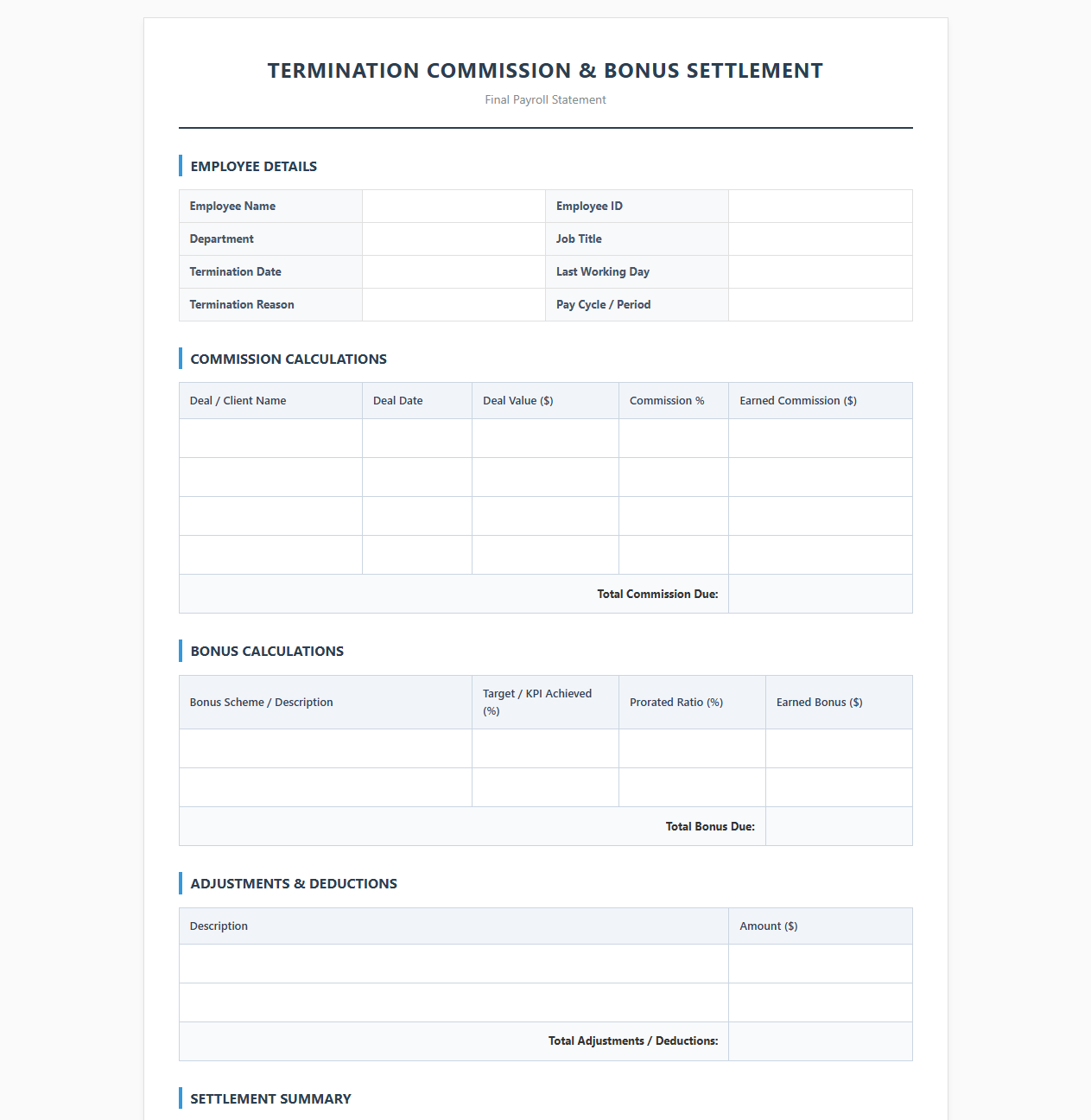 Download: .PDF
Employee Offboarding Commission and Bonus Payout Sheet
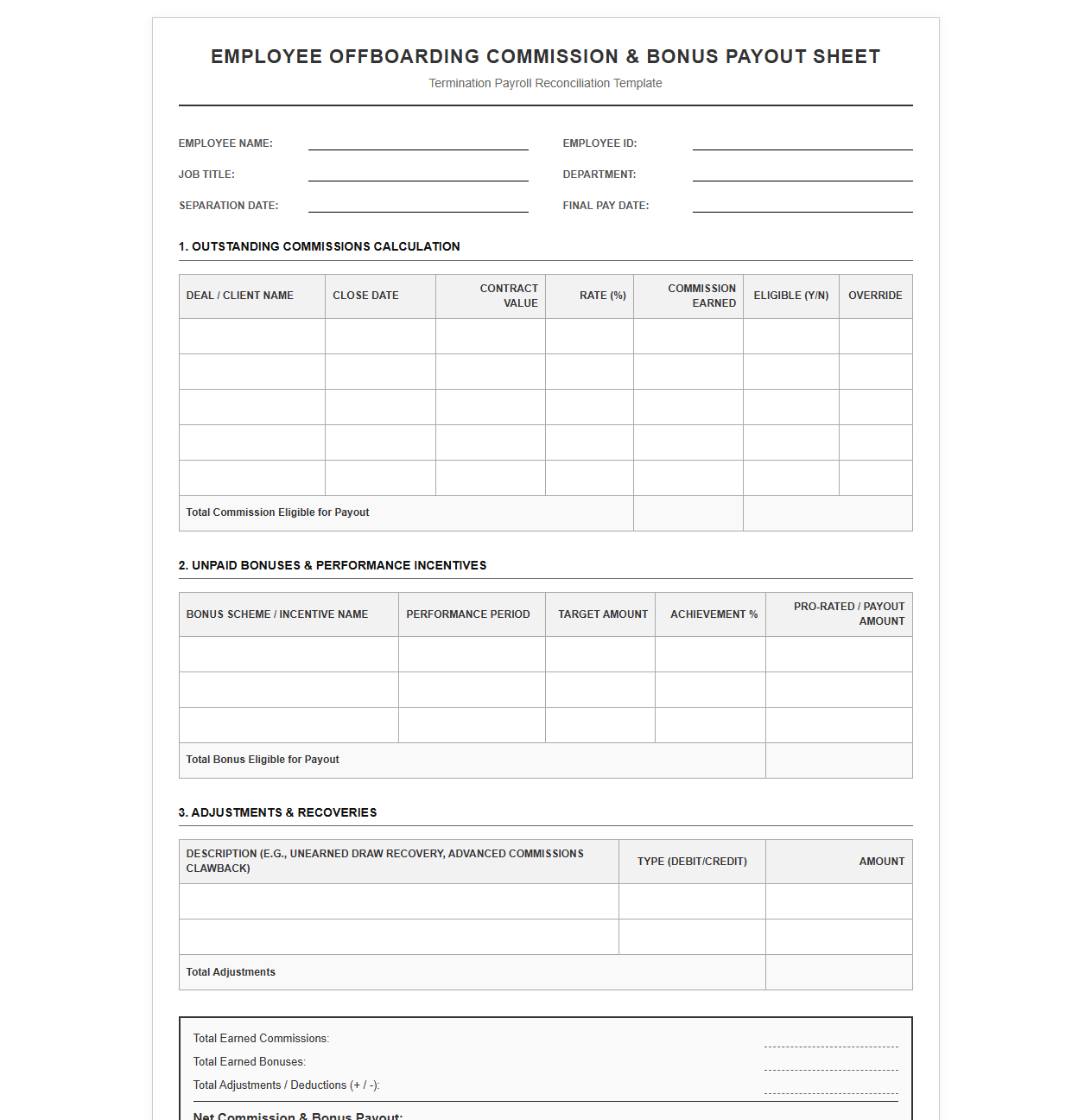 Download: .PDF
Termination Bonus and Commission Payroll Calculator
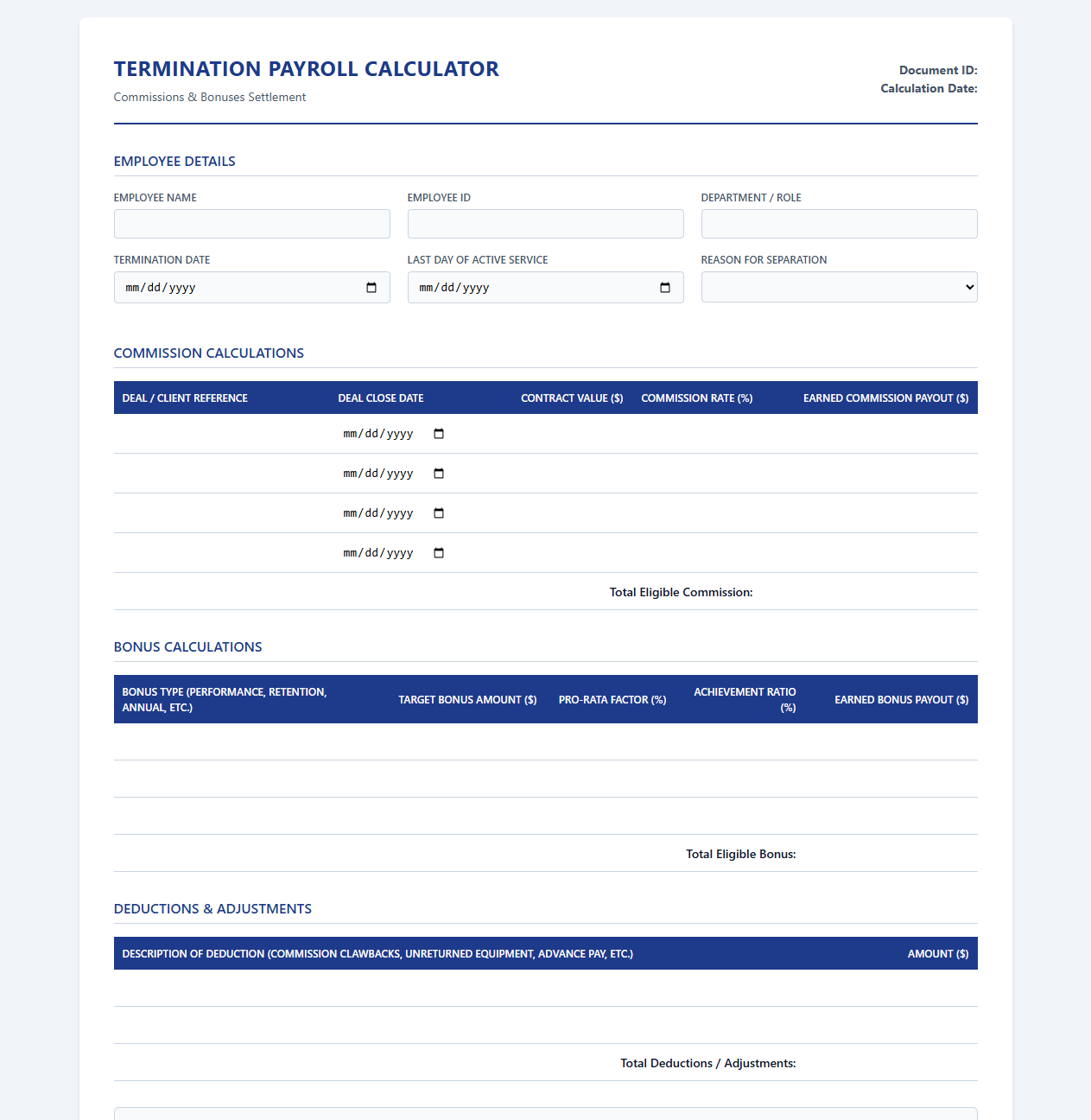 Download: .PDF
End of Employment Commission and Bonus Settlement Form
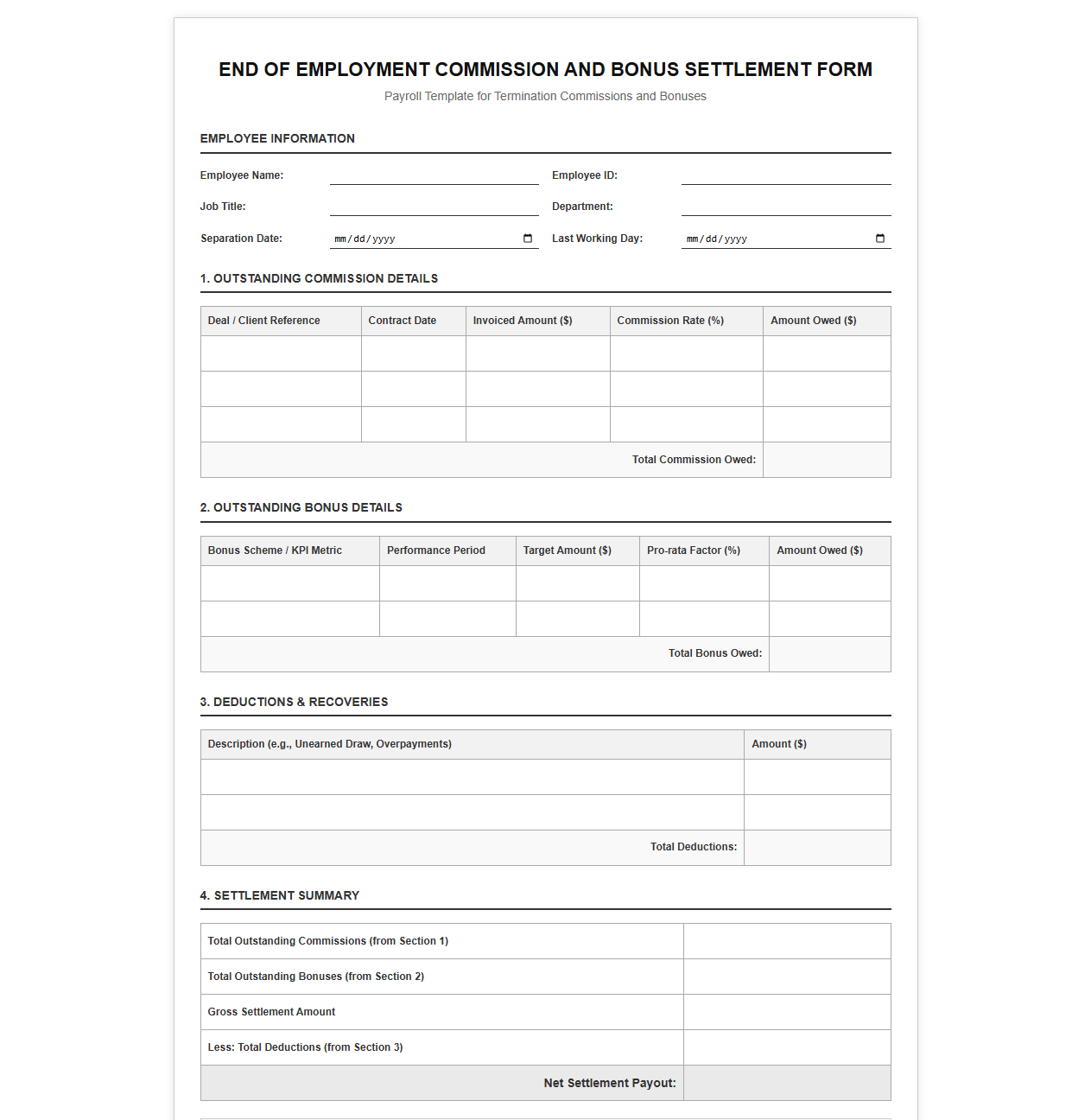 Download: .PDF
Separation Payroll Template for Commissions and Bonuses
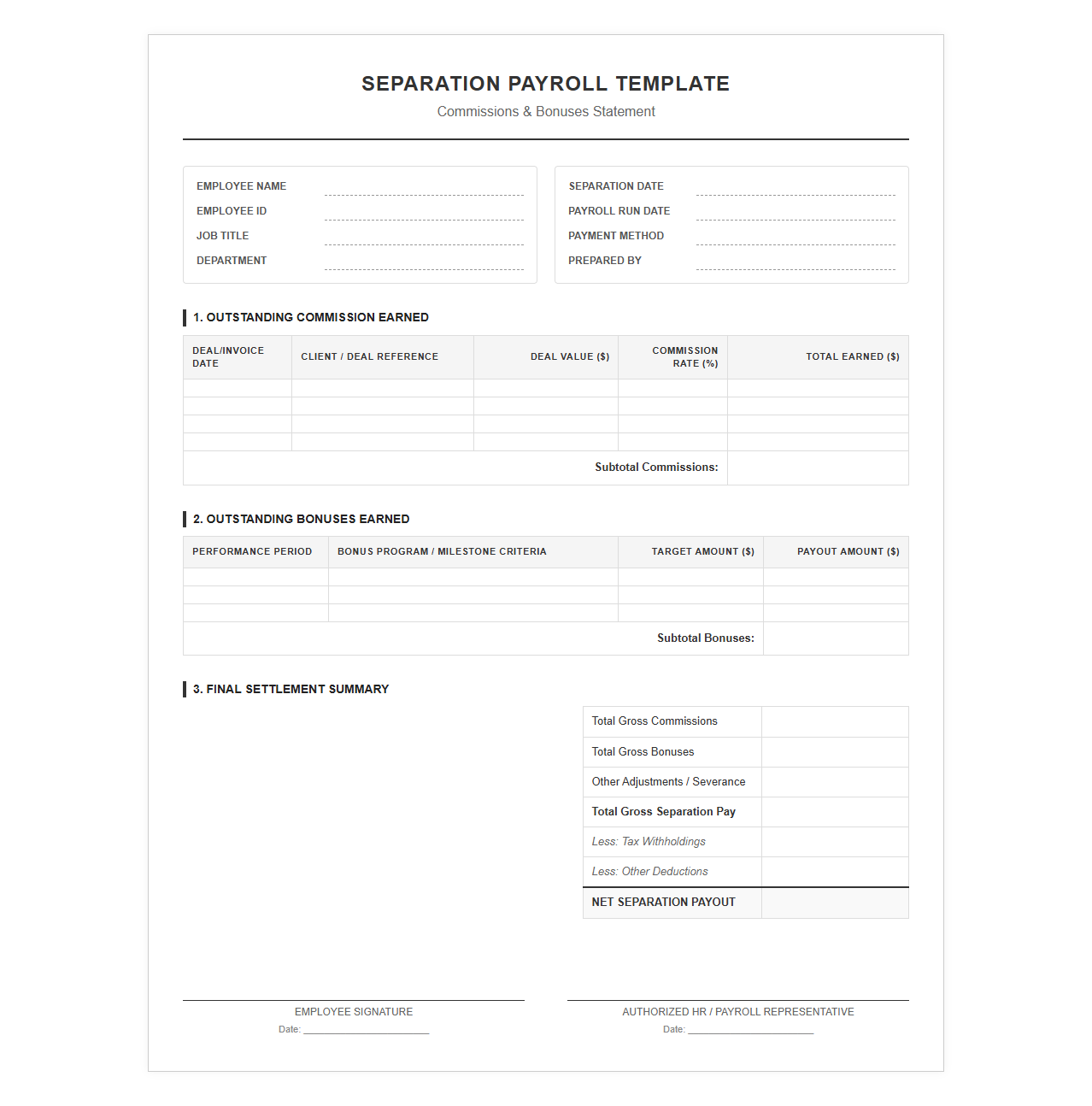 Download: .PDF
Post-Termination Bonus and Commission Payroll Ledger
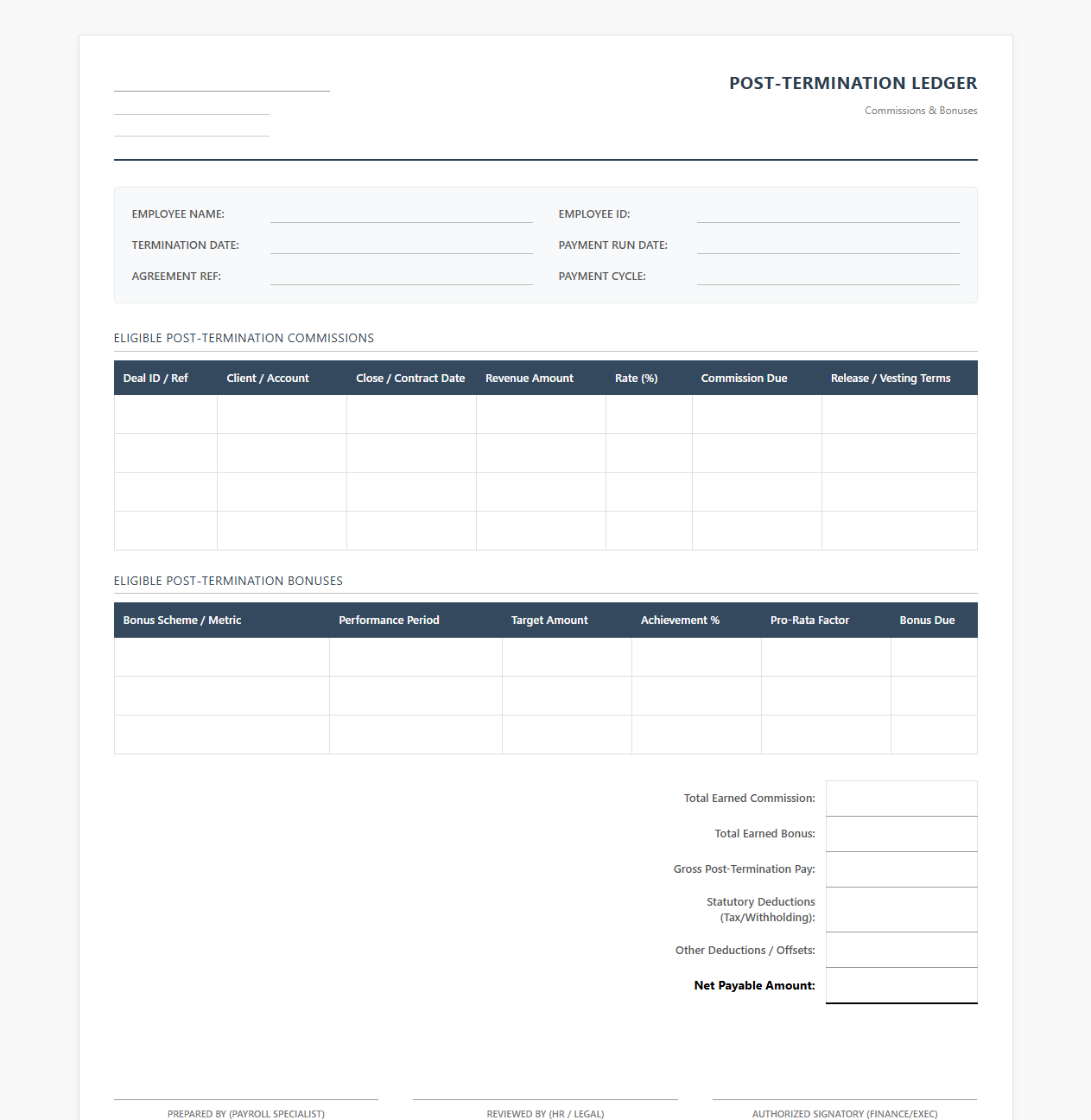 Download: .PDF
Final Pay Commission and Bonus Calculation Template
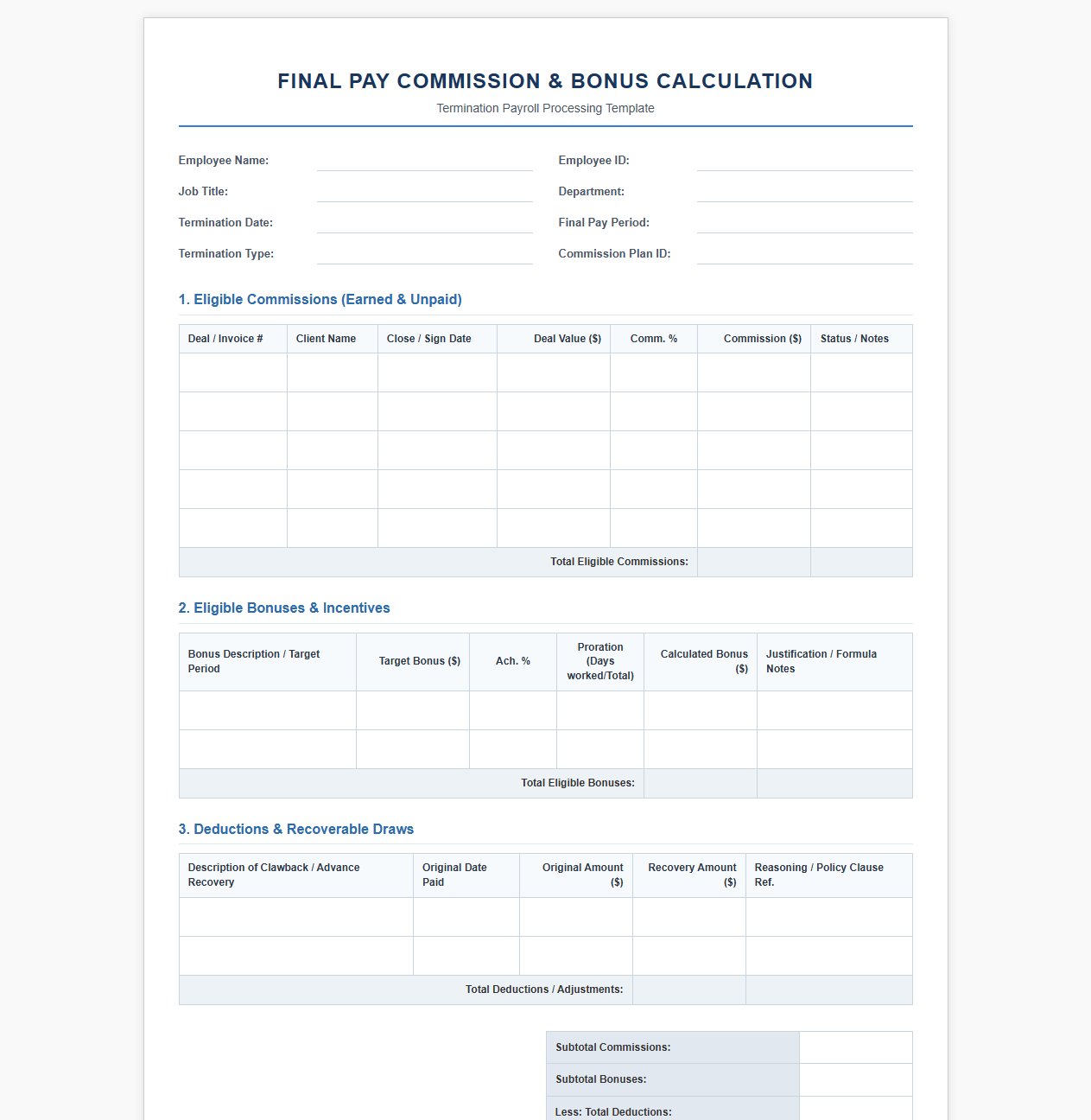 Download: .PDF
Employee Termination Commission and Bonus Reconciliation Sheet
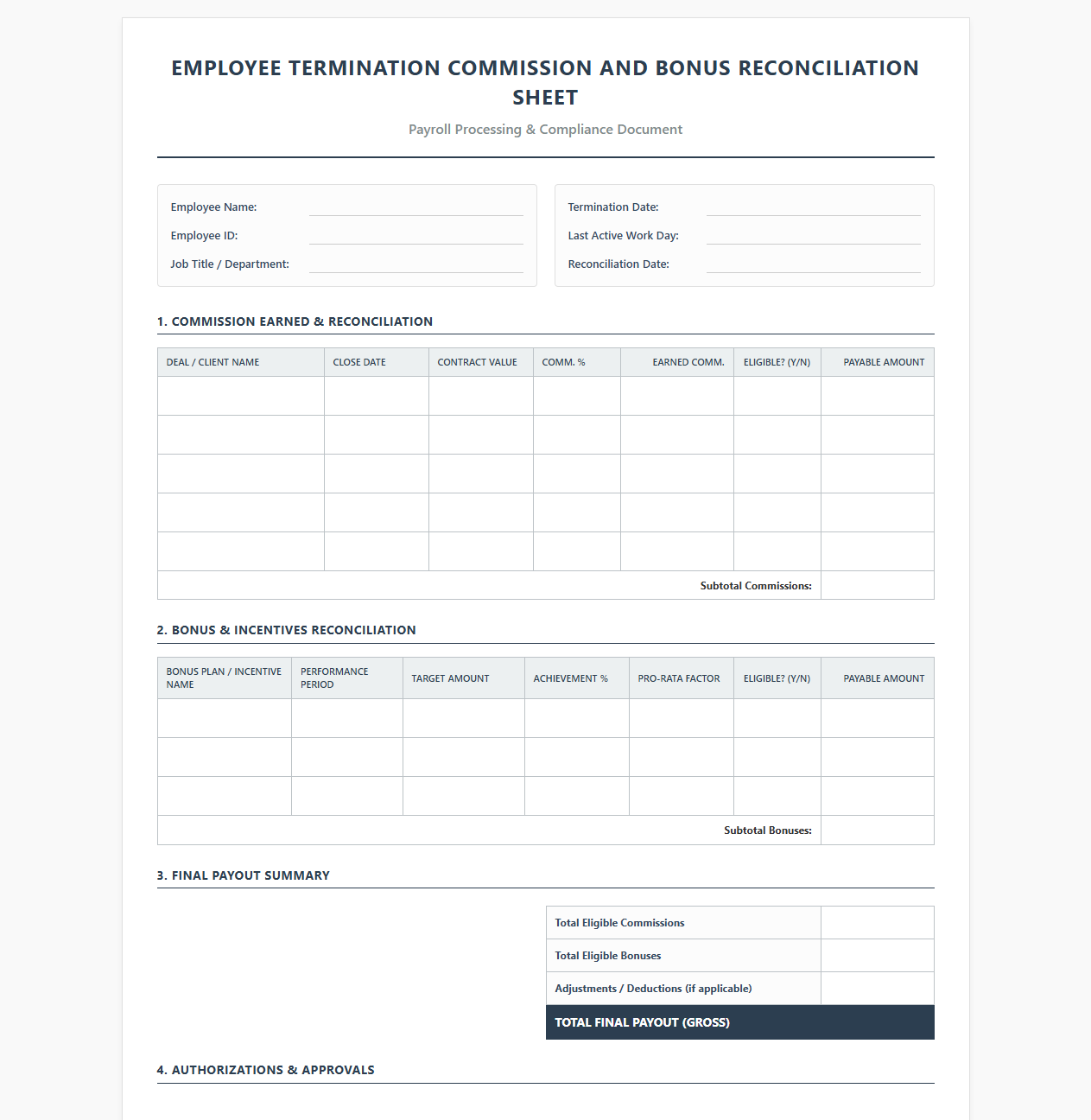 Download: .PDF
The High Stakes of Final Pay: Why Termination Commissions and Bonuses Trigger Disputes
Managing offboarding is one of the most critical phases of the employee lifecycle, yet it is frequently compromised by administrative oversights. When an employee departs, calculating their final pay is rarely a straightforward task of multiplying hours by an hourly rate. The integration of variable compensation, such as sales commissions and performance-based bonuses, introduces layers of complexity that can easily lead to costly errors.
Miscalculating these final payouts presents severe operational and legal risks. Organizations face the prospect of wage-and-hour lawsuits, regulatory fines, and damaged employer branding. To mitigate these vulnerabilities, HR leaders and payroll administrators must move away from ad-hoc calculations. Establishing structured payroll templates is essential to standardize the offboarding workflow, ensuring every dollar owed is accurately accounted for and documented.
Navigating the Legal Landscape: Earned Wages and State Compliance
The core legal challenge of final pay lies in how different jurisdictions define what constitutes an "earned" wage. Under federal guidelines like the Fair Labor Standards Act (FLSA), basic rules apply, but the true regulatory battleground exists at the state level. State laws vary dramatically regarding when a commission or bonus transitions from an expectation to a legally binding debt that must be paid upon separation.
For example, jurisdictions like California and New York maintain highly employee-favorable standards. In these states, if the employee has completed the core actions necessary to secure a sale, the commission is generally deemed "earned," even if the client has not yet paid the invoice. Conversely, other states allow employers more latitude to define the terms of earning within a written employment agreement. Failure to comply with these localized statutes can trigger treble damages and mandatory attorney fees. Organizations must align their payroll procedures with local Department of Labor standards to remain compliant.
Categorization Criteria: Differentiating Earned vs. Unearned Variable Pay
To prevent disputes, payroll departments must establish clear, objective criteria to distinguish between earned and unearned variable compensation at the exact moment of termination. This distinction typically rests on the following criteria:
- The Event of Realization: Whether the underlying transaction (such as a signed contract, product shipment, or client payment) was fully completed prior to the employee's last day.
- Contractual Exclusions: Written terms in the commission plan stating that active employment is a prerequisite for receiving payouts on specific dates.
- Calculation Milestones: Whether performance metrics for a bonus period were officially finalized and calculated before the separation date.
- Proration Clauses: Explicit policy language detailing whether bonuses are prorated for partial performance periods or forfeited entirely upon resignation.
By systematically applying these benchmarks, employers can confidently categorize each pending payment, establishing a defensible position in the event of an employee challenge.
Blueprint of a Standardized Termination Payroll Template
A standardized termination payroll template serves as the single source of truth for final wage calculations. It acts as an operational shield, ensuring that no variable compensation component is overlooked during the exit process.
| Data Field | Description / Purpose | Applicable Pay Type |
|---|---|---|
| Separation Date | The official final day of employment used to establish the payout cutoff. | All Pay Components |
| Pending Deal ID | Specific identifiers for closed transactions currently awaiting payout processing. | Commissions |
| Proration Factor | The percentage of the performance period completed prior to separation. | Bonuses |
| Accrual Status | Verification of whether the compensation has met the definition of "earned." | Commissions & Bonuses |
Step-by-Step Calculation Protocol for Final Variable Compensation
Administrators should follow a structured sequence to calculate final variable payouts, reducing human error and ensuring transparency:
- Review the Active Agreements: Retrieve and analyze the signed commission structure or bonus plan specific to the departing employee.
- Identify Pending Transactions: Compile all sales and pipeline activities attributed to the employee up to their official termination date.
- Apply the Earned Threshold Test: Determine which pending transactions meet the legal and contractual definition of "earned" wages.
- Calculate Prorated Allocations: For performance bonuses, apply the calculated proration factor based on the portion of the performance cycle completed.
- Deduct Allowable Offsets: Subtract any legally permissible adjustments, such as advanced commission draws or unreturned company property, where state laws permit.
Mitigating Errors Through HRIS and Payroll System Integration
Manual data entry is the primary catalyst for payroll discrepancies. By integrating standardized final pay templates directly into your Human Resources Information System (HRIS) and automated payroll software, you can significantly reduce these operational vulnerabilities. Automation ensures that real-time sales data and employee status updates sync effortlessly, eliminating the need for disconnected spreadsheets.
When a termination workflow is initiated within an integrated HRIS, the system can automatically flag pending commission schedules and calculate prorated bonuses based on pre-programmed rules. This integration not only secures data integrity but also preserves compliance continuity, ensuring that final checks are generated within state-mandated timeframes without administrative delays.
Safeguarding the Organization: Audit Trails, Sign-offs, and Dispute Resolution
Securing the organization against future liability requires a rigorous documentation process that concludes the offboarding cycle.
"An airtight audit trail, complete with clear calculations and signed acknowledgments, is the most effective defense against post-termination wage disputes."
Every calculation, policy reference, and system override must be fully documented and stored in the employee's payroll file. During the exit interview, provide the departing worker with a detailed breakdown of their final compensation. Obtaining a signed written acknowledgment confirming that the calculations are understood and accepted serves as a powerful deterrent to future claims. Should a dispute arise, having a standardized, transparent resolution protocol ensures the issue can be addressed swiftly and professionally before escalating to legal action.

Leave a comment