

Managing fragmented electronic payment methods often leaves accounting departments struggling to maintain consistent, audit-ready documentation across various platforms. Before implementing any standardizing tool, organizations must first evaluate their unique transaction workflows against evolving financial regulatory compliance standards. Standardizing these records grants finance teams immediate operational clarity, dramatically reducing reconciliation errors and audit preparation times. However, it is important to stipulate that templates are only effective when aligned with precise data-capture protocols across your enterprise resource planning (ERP) systems.
Integrating dedicated fields for specific transaction parameters-such as ACH routing numbers, SWIFT codes for international wire transfers, and unique transaction IDs for merchant P2P systems-serves as concrete proof of a secure transfer. This article explores the core architecture of compliant receipt designs, provides adaptable templates for diverse payment methods, and outlines best practices for automating your transaction documentation.
EFT Transaction Receipt Template
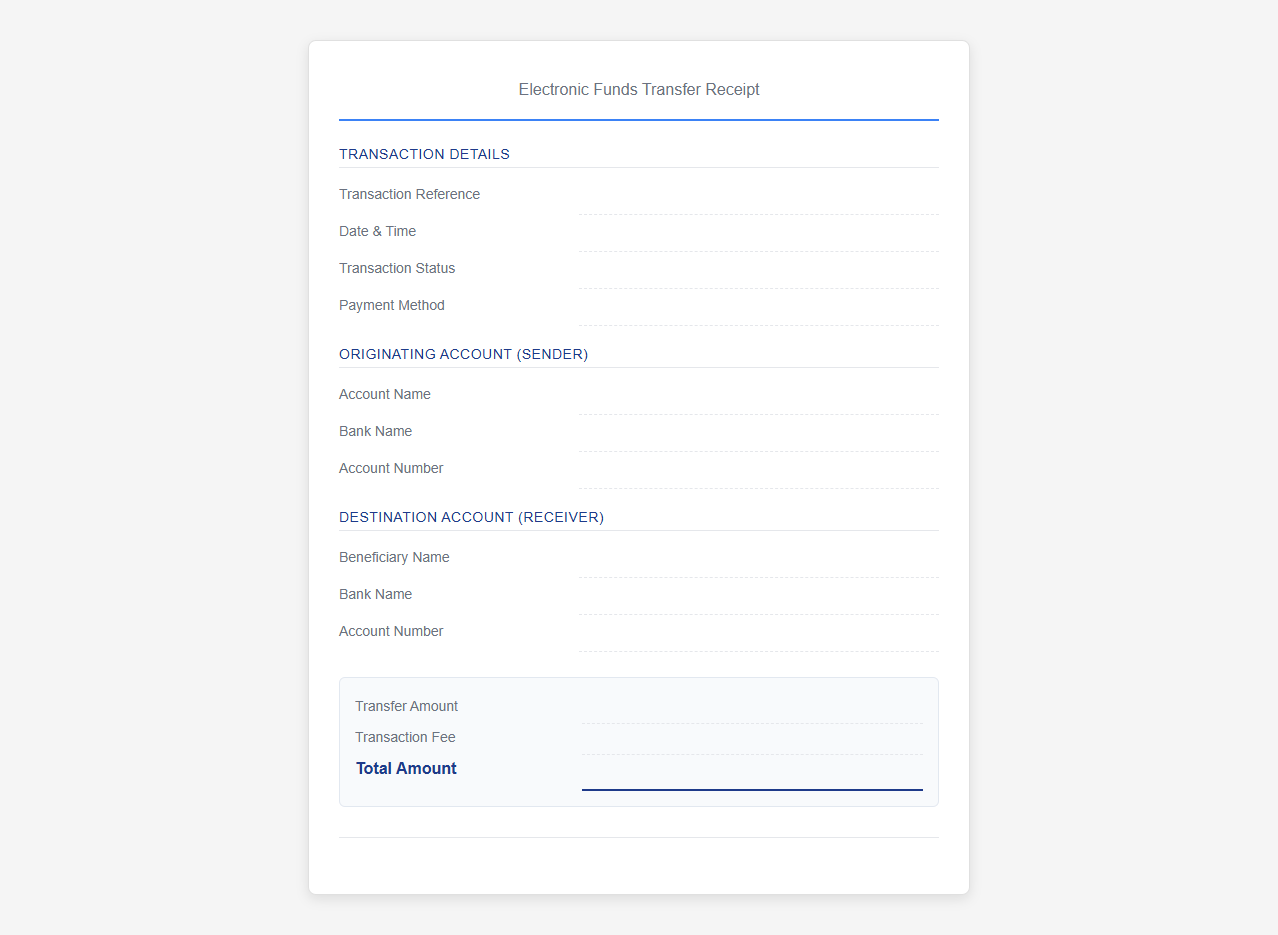 Download: .PDF
Electronic Bank Transfer Receipt Layout
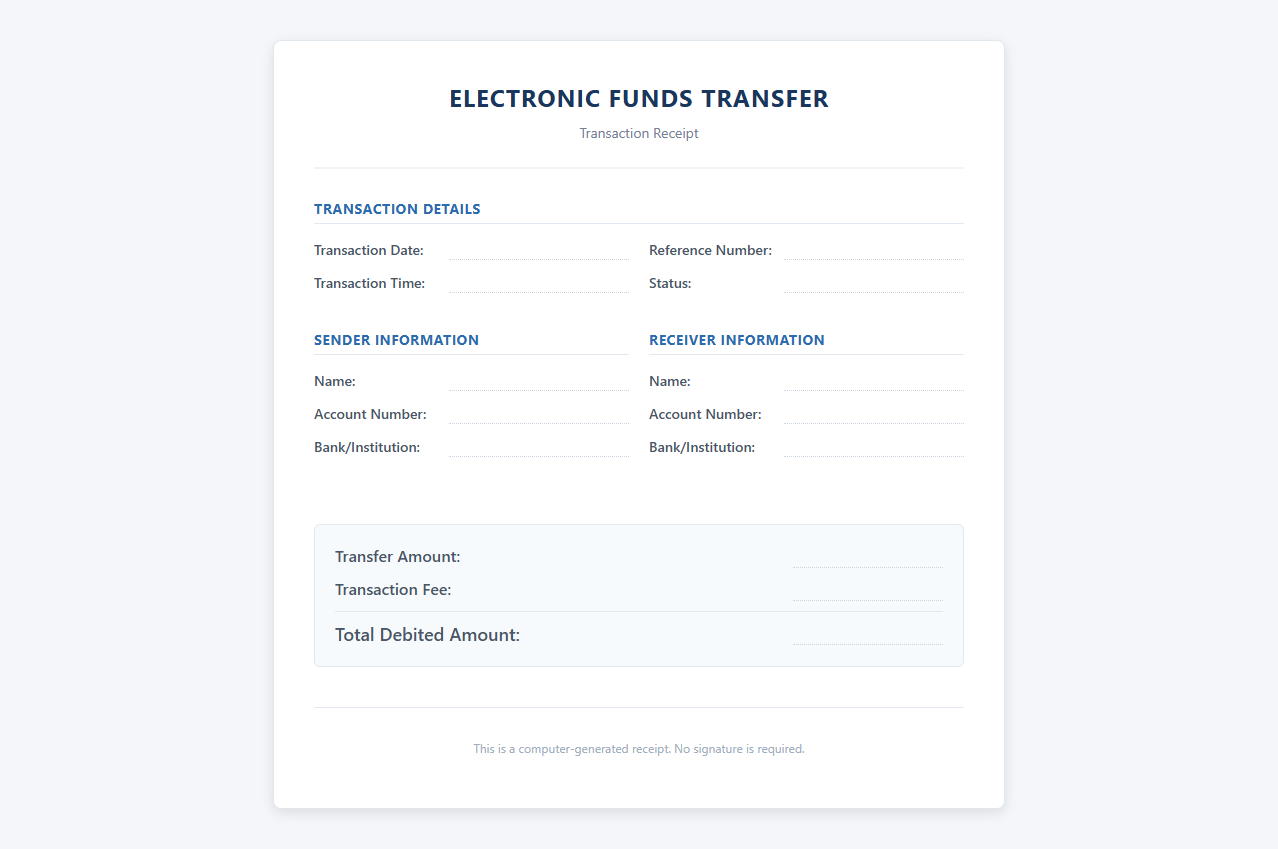 Download: .PDF
Wire Transfer Confirmation Receipt Template
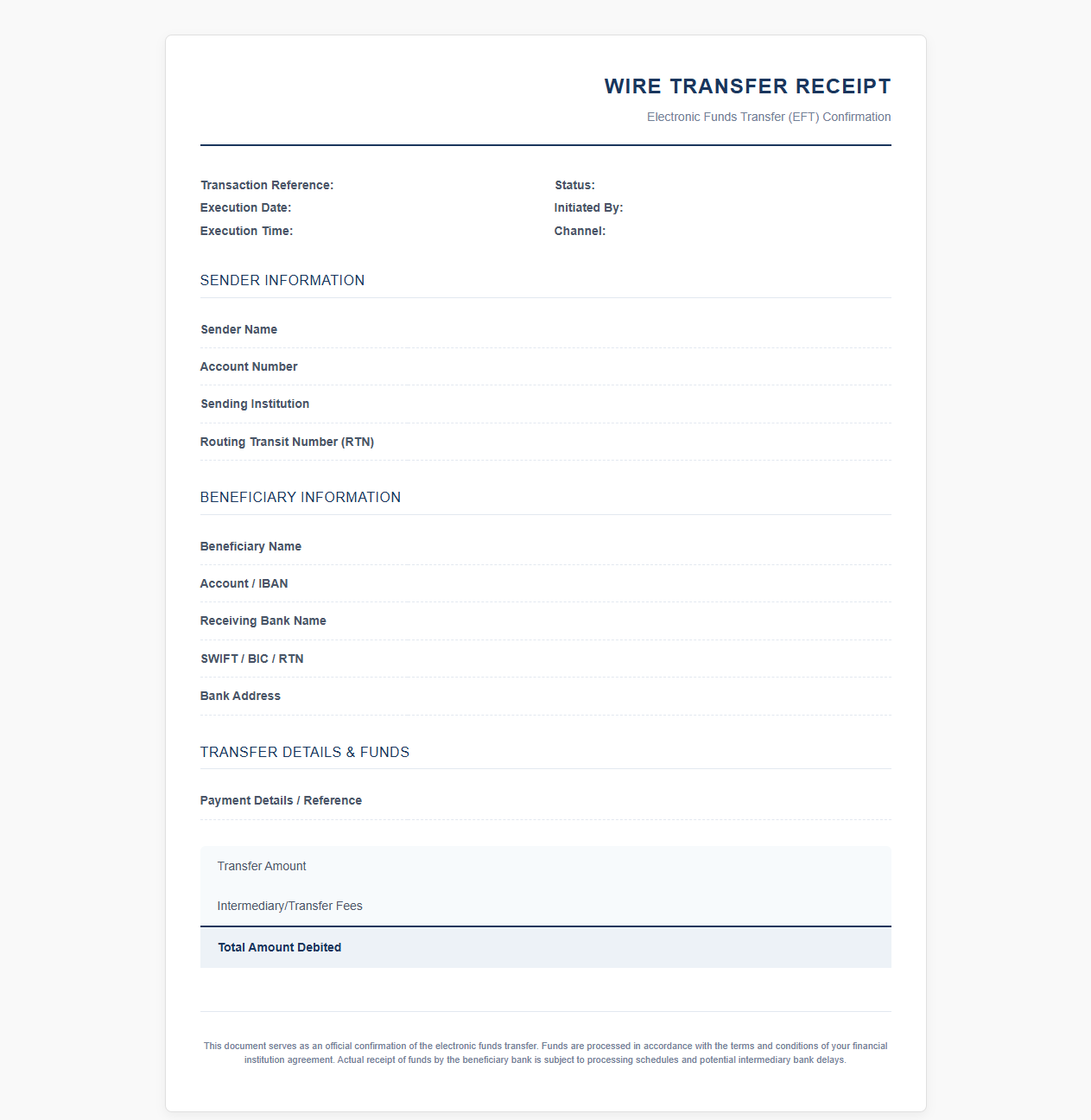 Download: .PDF
Digital Payment and EFT Receipt Template
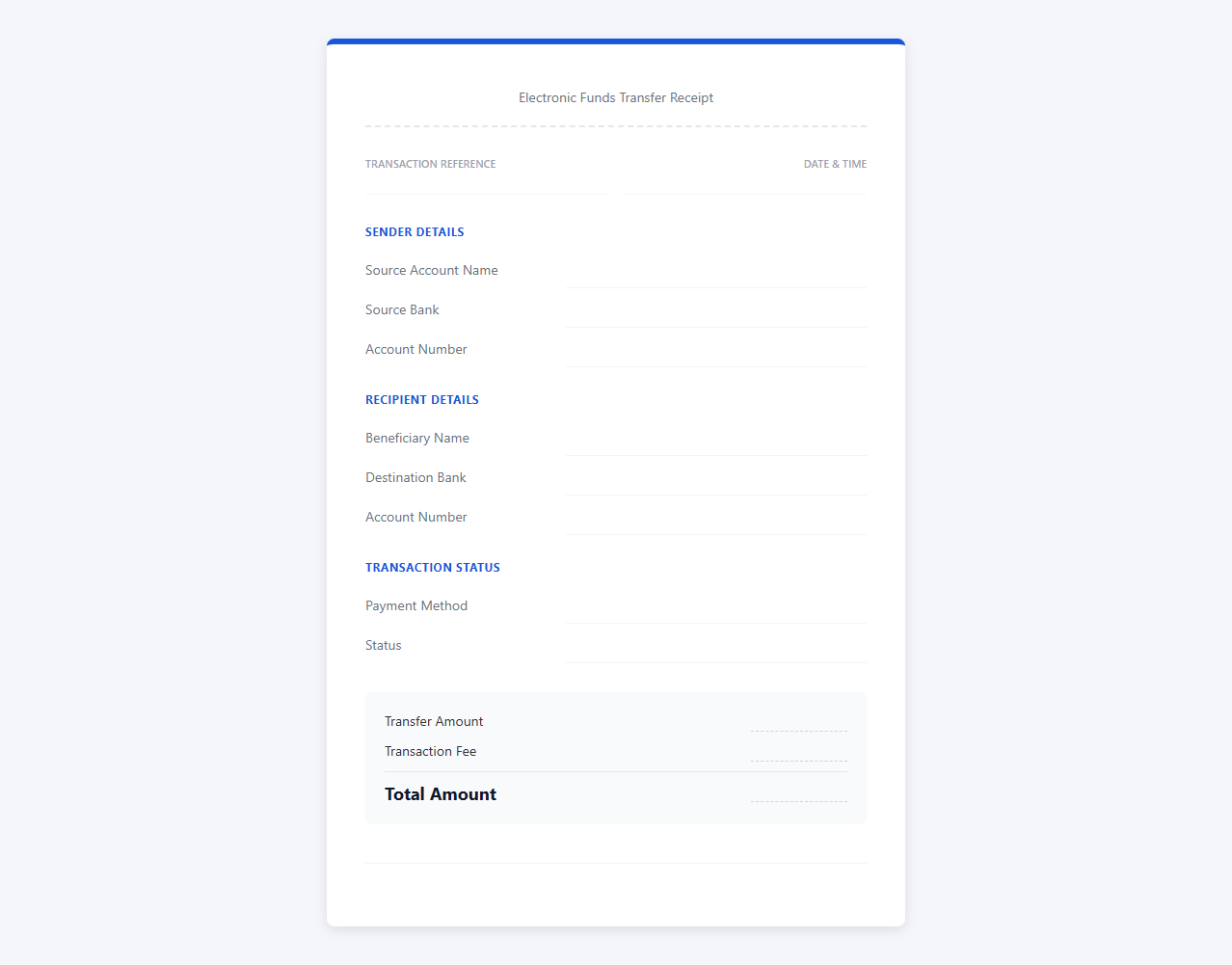 Download: .PDF
Electronic Funds Transfer Acknowledgment Document
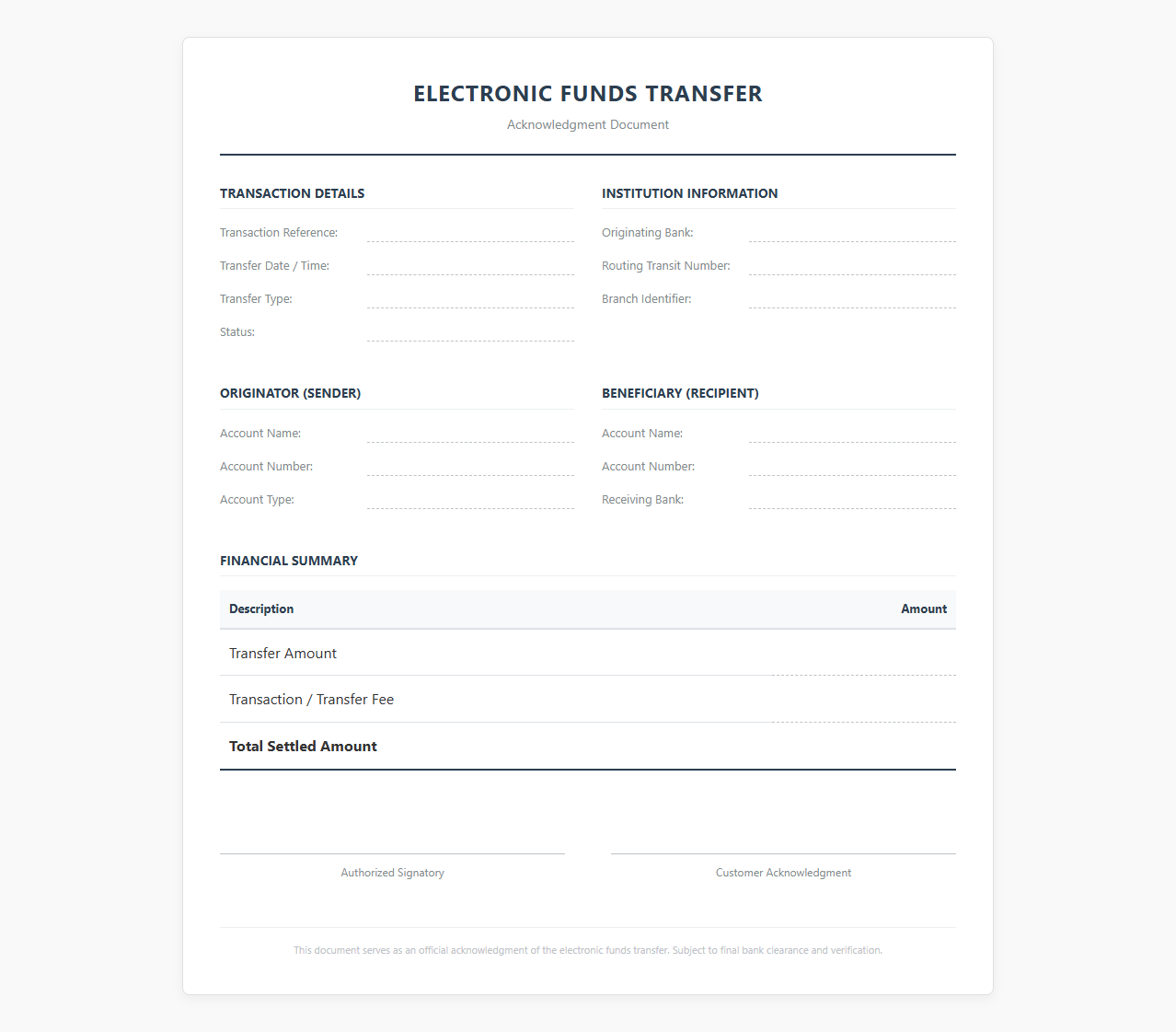 Download: .PDF
Direct Deposit EFT Receipt Template
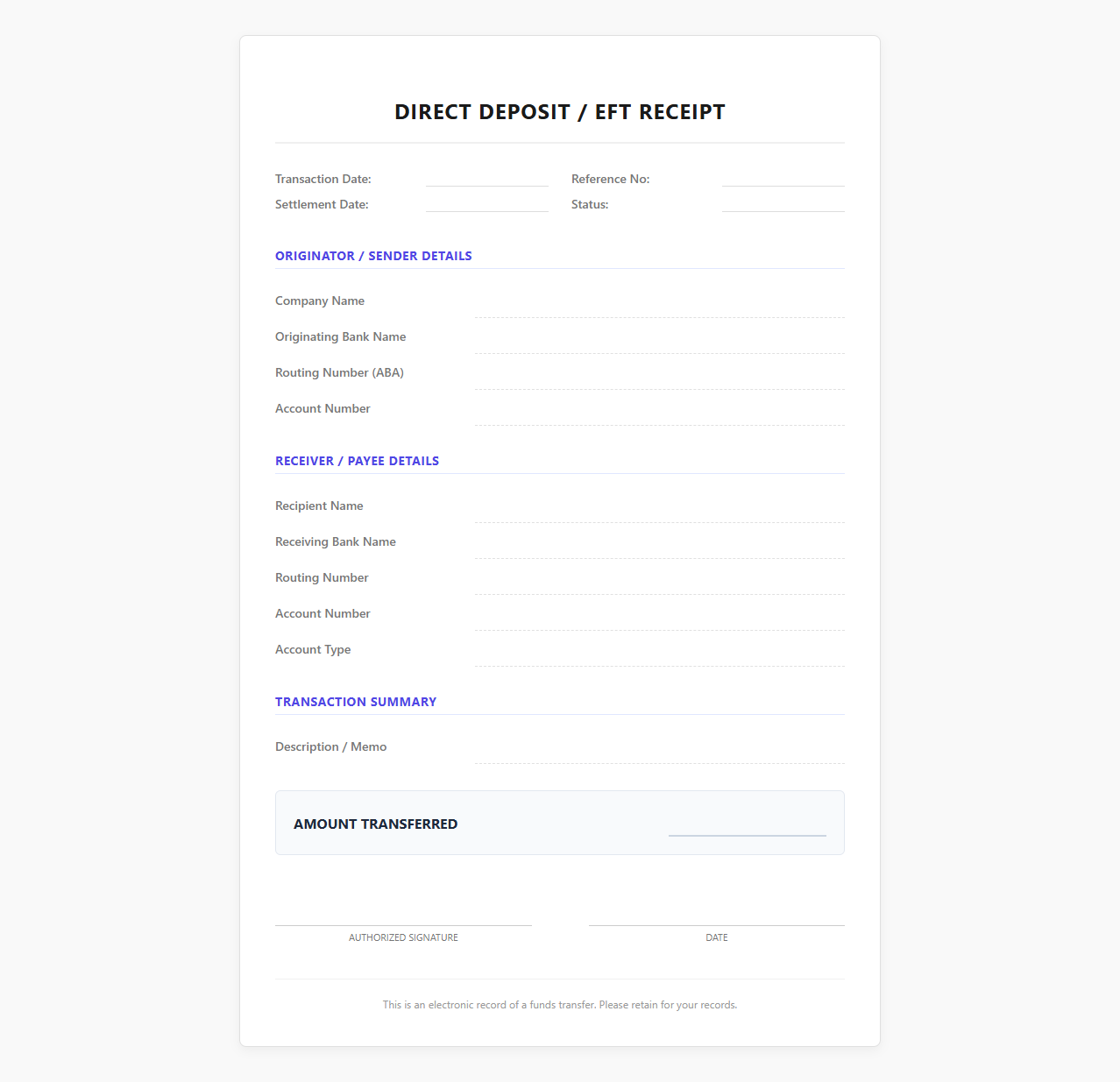 Download: .PDF
Online Bank Transfer Payment Receipt Template
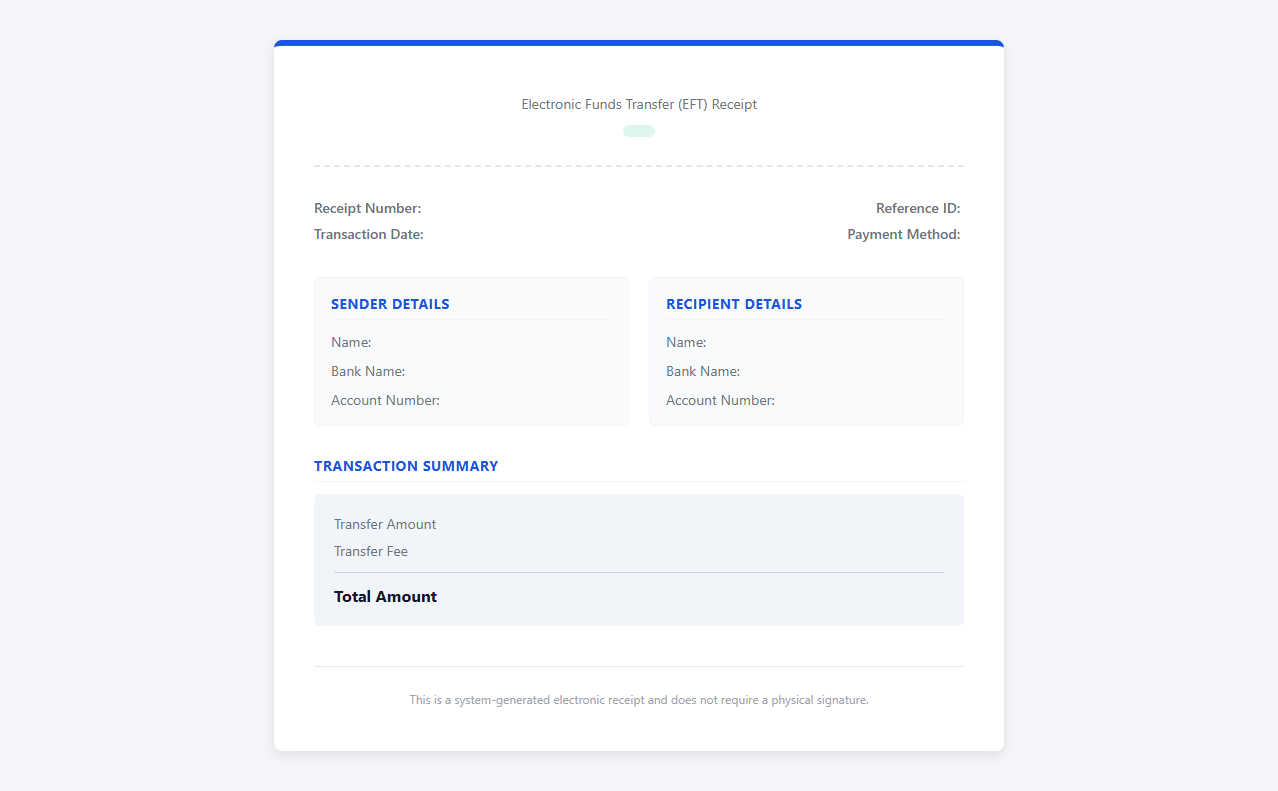 Download: .PDF
Automated Clearing House EFT Receipt Template
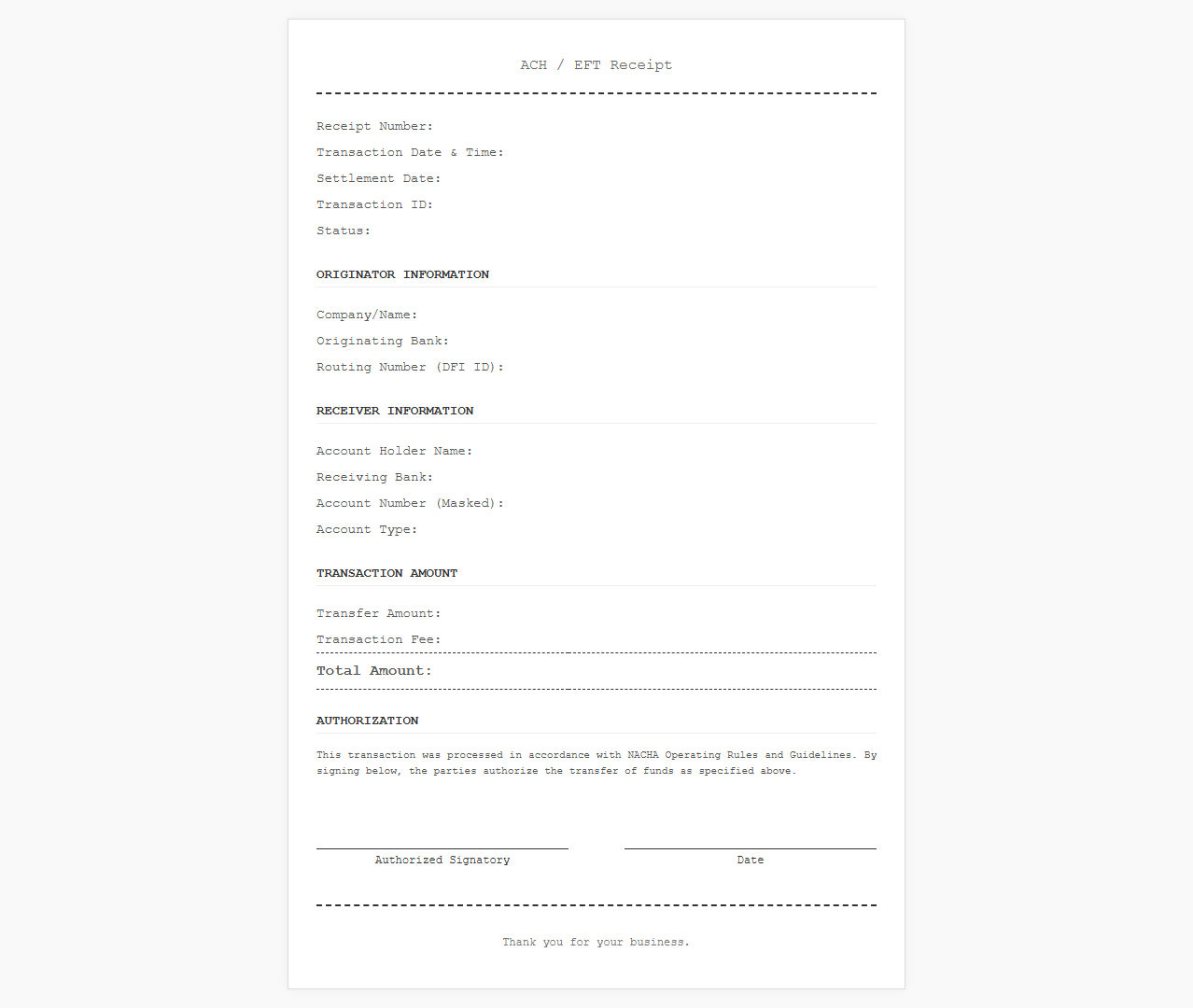 Download: .PDF
The Evolution of Electronic Funds Transfer Documentation
In the rapidly expanding global marketplace, the clarity of financial transactions forms the bedrock of enterprise commerce. As legacy paper-based workflows disappear, the necessity of standardizing digital transaction receipts has transitioned from a operational convenience to a regulatory and trust-building imperative. Modern organizations require instant, verifiable, and unambiguous records of every transaction to maintain accounting integrity and foster client confidence.
A standardized receipt does more than merely confirm a payment; it acts as an immutable point of reference that mitigates disputes, simplifies audits, and strengthens the relationship between service providers and end consumers. By prioritizing transparency, security, and uniform design, businesses ensure that digital documentation serves as a reliable extension of their financial operations.
Core Anatomy of a Standardized Digital Receipt
Essential Structural Metadata
Every electronic transaction record, regardless of its underlying network protocol, must contain a core set of metadata. This standardized architecture guarantees that internal accounting systems, automated reconciliation software, and human auditors can instantly parse and verify the information.
- Unique Transaction Identifier: A globally unique alphanumeric string generated at the time of clearing.
- Timestamp Correlation: The exact coordinated universal time (UTC) when the transaction was finalized.
- Entity Identification: Explicit legal names and contact vectors for both the payer and payee.
- Financial Breakdown: Itemized ledger lines detailing gross amount, applicable taxes, processing fees, and final net settlement.
ACH and Direct Deposit Receipt Framework
Automated Clearing House (ACH) Transaction Record
The layout below represents the technical structure required for documenting ACH batch payments and direct deposits, ensuring clear tracking through the clearing house network.
| Data Field | Field Value Reference |
|---|---|
| Originating Depository Financial Institution (ODFI) | Federal Reserve Bank Routing Number |
| Receiving Depository Financial Institution (RDFI) | Receiver Account Route Transit Number |
| SEC Class Code | CCD / PPD / WEB |
| Settlement Date | YYYY-MM-DD |
Wire Transfer Receipt Architecture
High-Security Fund Transfer Manifest
Due to the irreversible nature of wire transfers, the receipt must capture detailed routing and intermediary data to satisfy strict international treasury tracking standards.
| SWIFT / BIC Code: | AAAAUS33XXXX |
| Intermediary Bank Name: | Global Settlement Clearing Corp |
| Beneficiary IBAN/Account: | US12 CHIP 0000 1111 2222 33 |
| Federal Reserve Reference Number: | OMNIP240822A009182 |
Card Payments and Mobile Wallet Receipts
Point-of-Sale & Digital Wallet Ledger
Consumer-facing payment methods demand compact layouts that provide immediate assurance of payment authorization while keeping cardholder details secure.
| Payment Method: | Apple Pay (Visa 1234) |
| Device Account Number: | Tokenized ID: 9876 |
| Authorization Code: | Auth ID: AUTH88922 |
Security, Privacy, and Compliance Standards
Data Masking and Regulatory Frameworks
Modern digital receipts must comply with international privacy standards to ensure sensitive credentials are never stored or exposed needlessly.
- Payment Card Industry Data Security Standard (PCI-DSS) compliance mandates truncation of the primary account number (PAN).
- General Data Protection Regulation (GDPR) mandates the minimization of personally identifiable information (PII) on accessible records.
Implementing Dynamic Templates in Your Billing System
To programmatically generate standardized documentation, integrate dynamic template engines with your payment gateway webhooks. By injecting JSON transaction objects into pre-validated HTML schemas, you achieve reliable automation across your entire invoicing infrastructure.
<div class="receipt-container">
  <h4>Receipt for Transaction: <strong>{{transaction_id}}</strong></h4>
  <p>Amount Settled: <strong>{{currency}} {{amount}}</strong></p>
  <p>Timestamp: <strong>{{settled_at}}</strong></p>
</div>

Leave a comment