

Documenting non-cash charitable contributions remains a persistent, high-stakes challenge for both non-profit organizations and their donors, often resulting in costly compliance errors during tax season.
Before addressing any administrative solution, it is vital to recognize the intensifying regulatory scrutiny surrounding asset valuation. Establishing a rigorous internal framework is the necessary bridge to navigating this complexity. Adopting this structured approach grants organizations absolute administrative confidence while offering donors the peace of mind of legally defensible tax deductions.
As a crucial stipulation, however, stakeholders must understand that standardized receipt templates serve as substantiation of the gift, not as substitutes for qualified independent appraisals required for high-value assets. For example, while a template easily captures the details of publicly traded stocks, it must adapt to the distinct reporting fields required for complex donations like intellectual property or vehicles.
Below, we will examine the essential components of compliant receipt templates, outline key IRS valuation thresholds, and provide actionable strategies to safeguard your organization's tax compliance.
In-Kind Donation Receipt Template
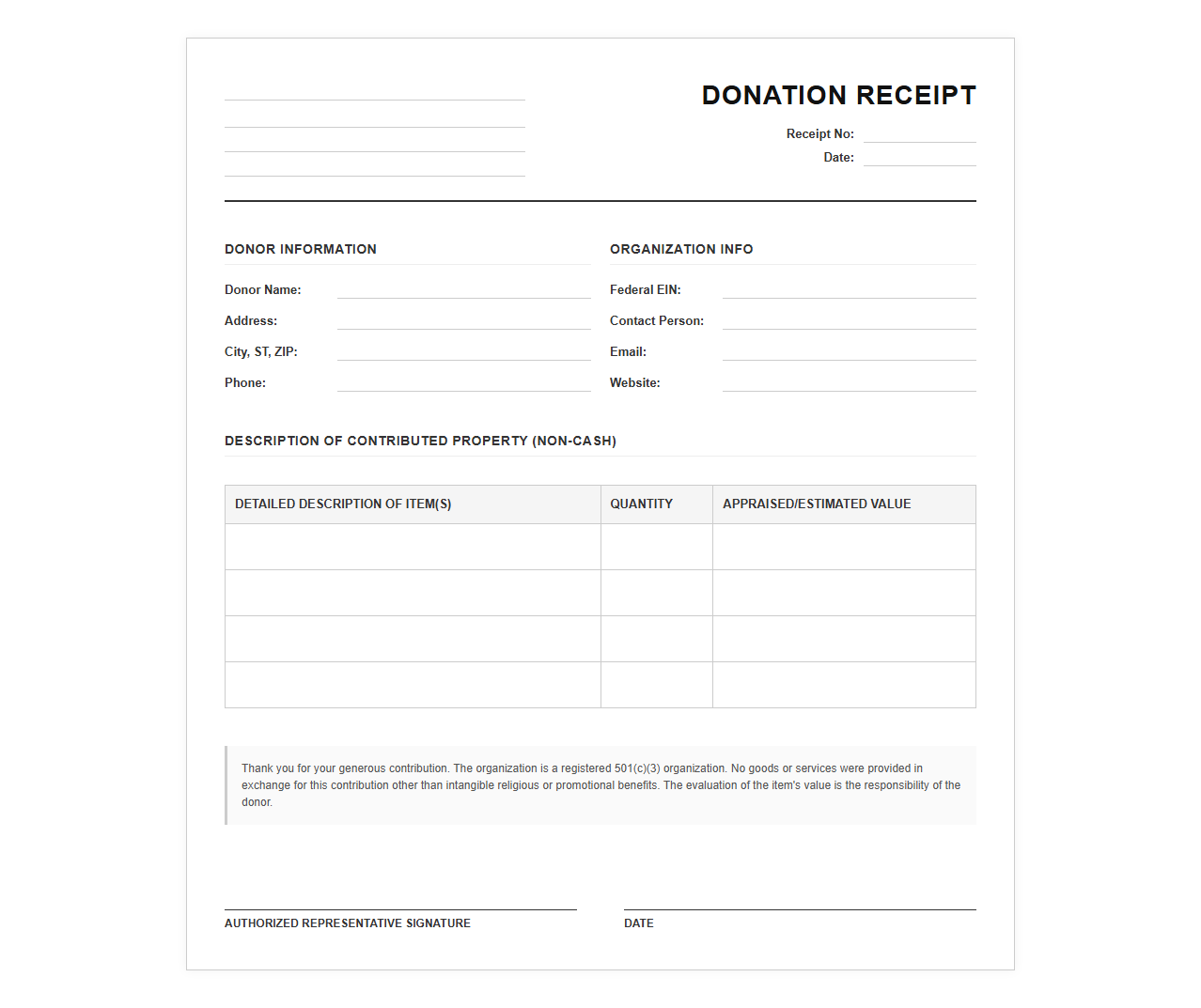 Download: .PDF
Non-Cash Gift Acknowledgement Letter
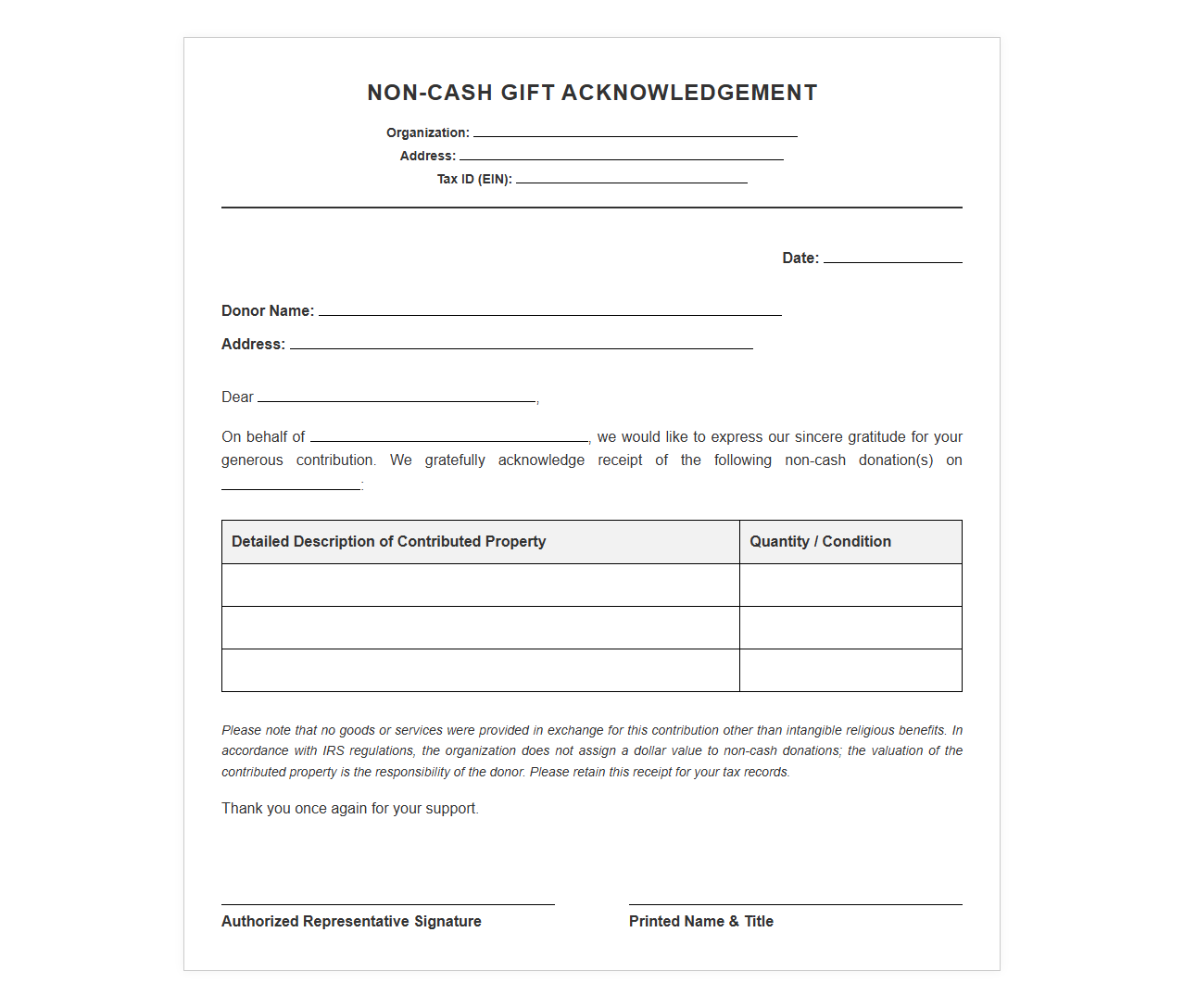 Download: .PDF
Charitable Contribution Receipt for Goods
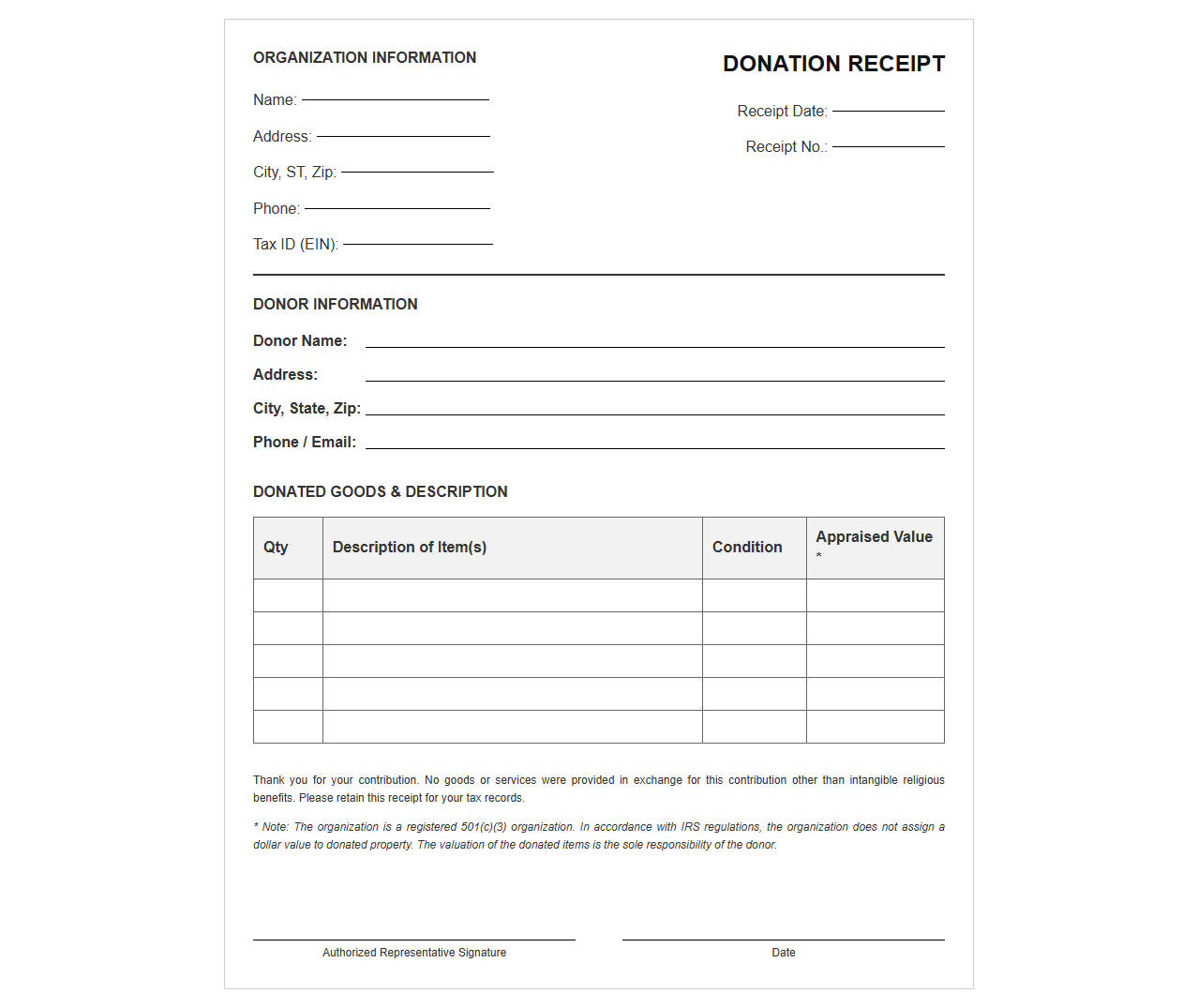 Download: .PDF
Non-Monetary Donation Tax Receipt Form
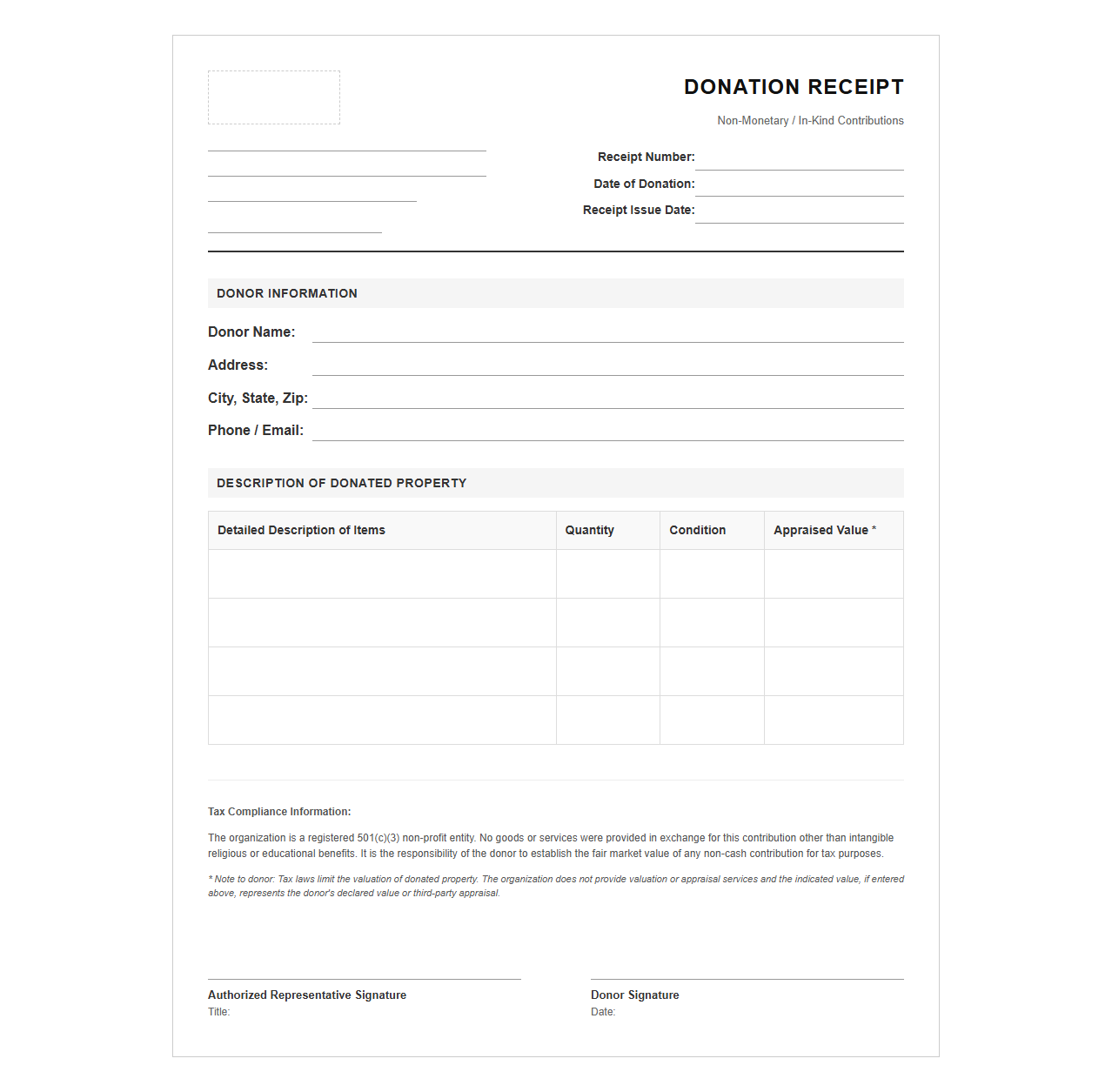 Download: .PDF
Material Gift Receipt Template for Nonprofits
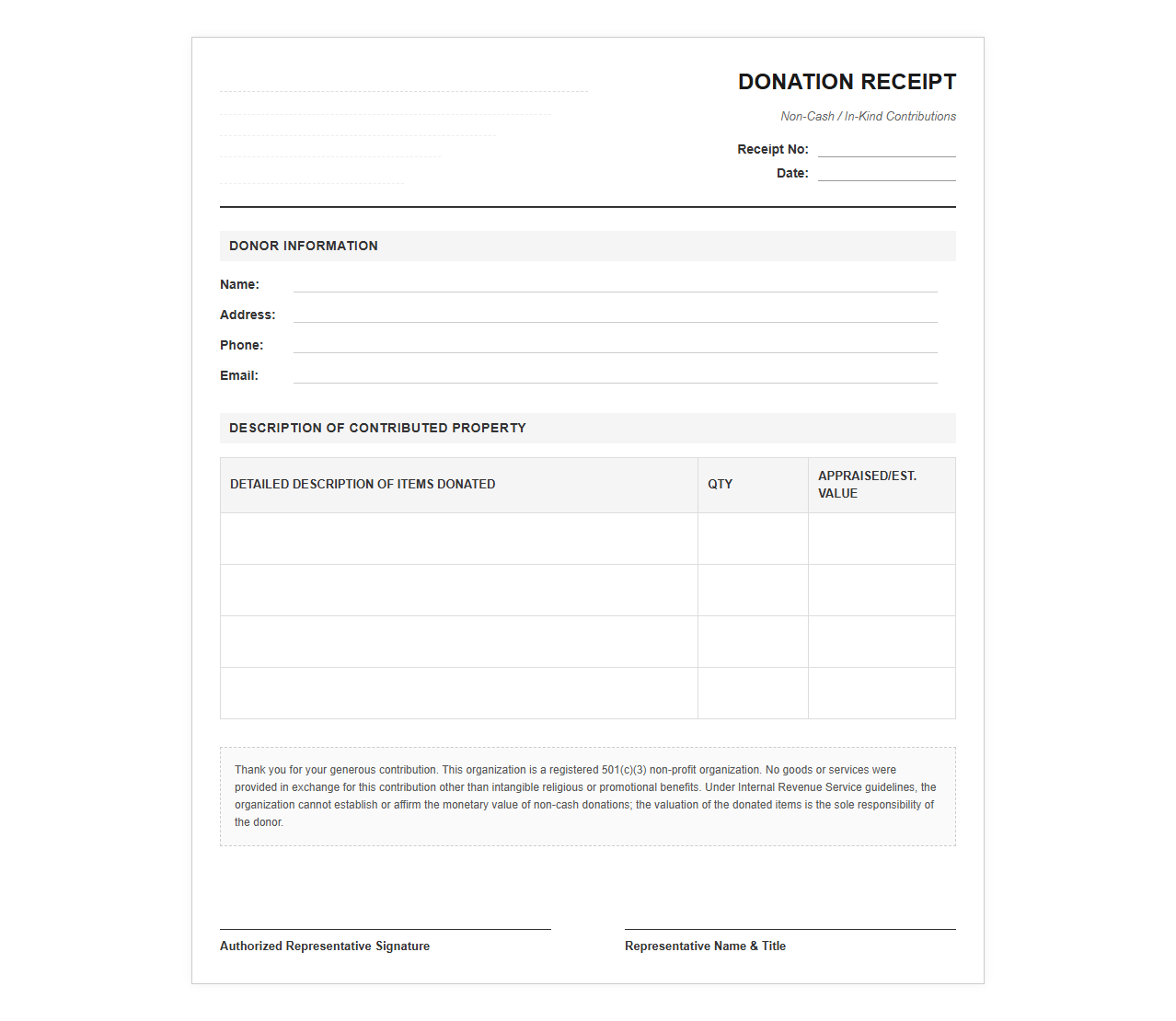 Download: .PDF
In-Kind Contribution Acknowledgement Template
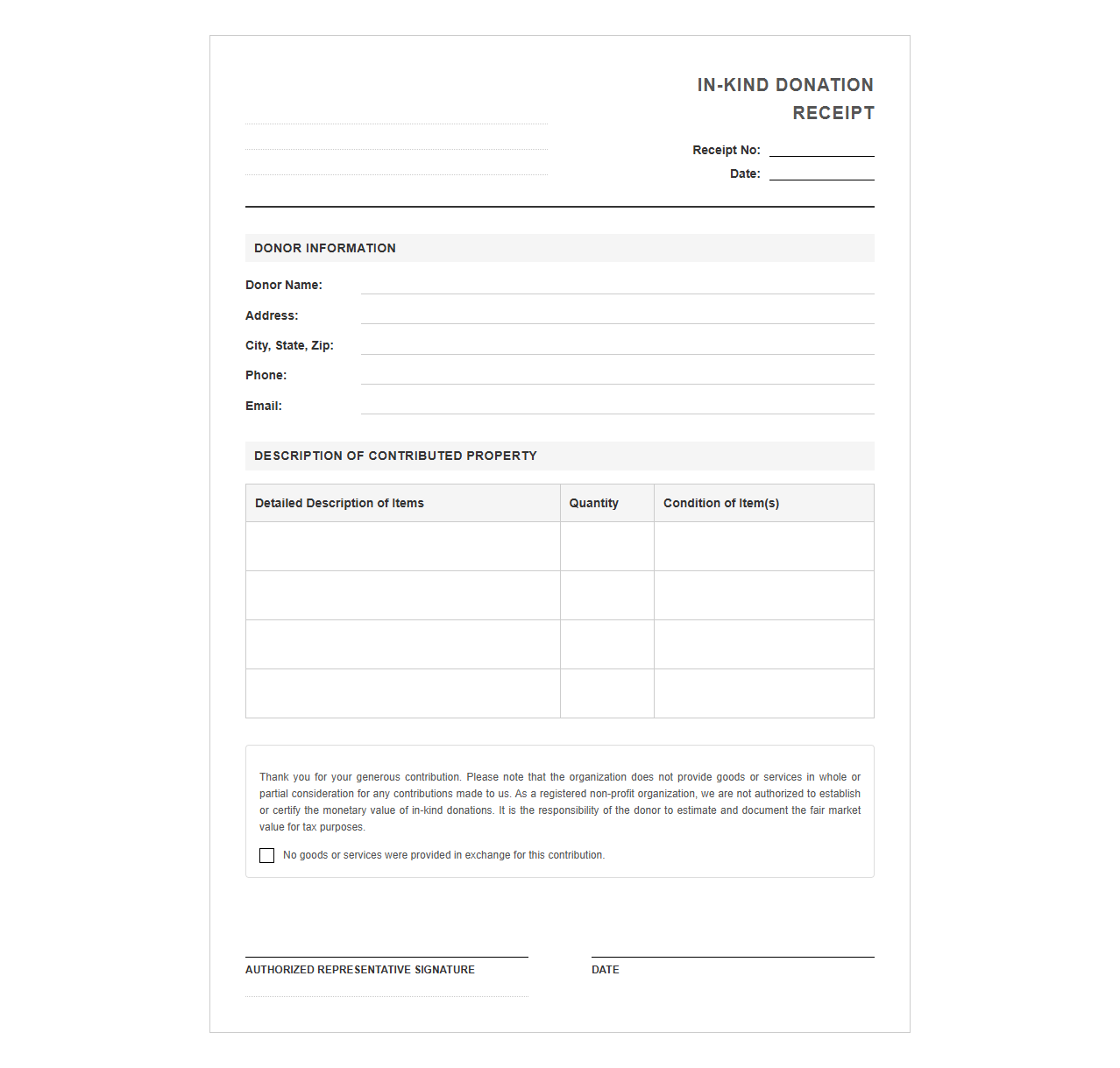 Download: .PDF
Tangible Property Donation Receipt Form
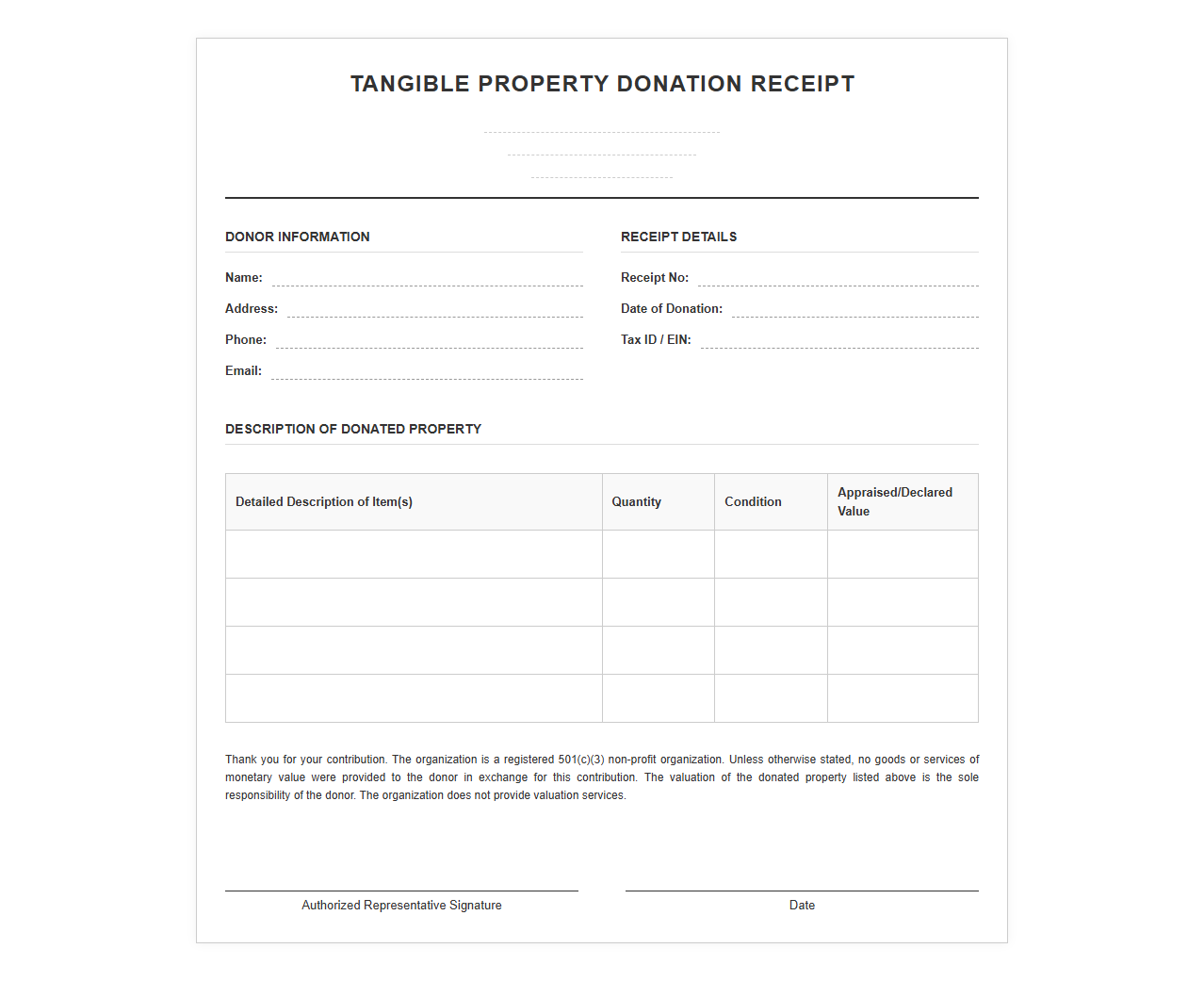 Download: .PDF
Non-Cash Charitable Contribution Receipt Template
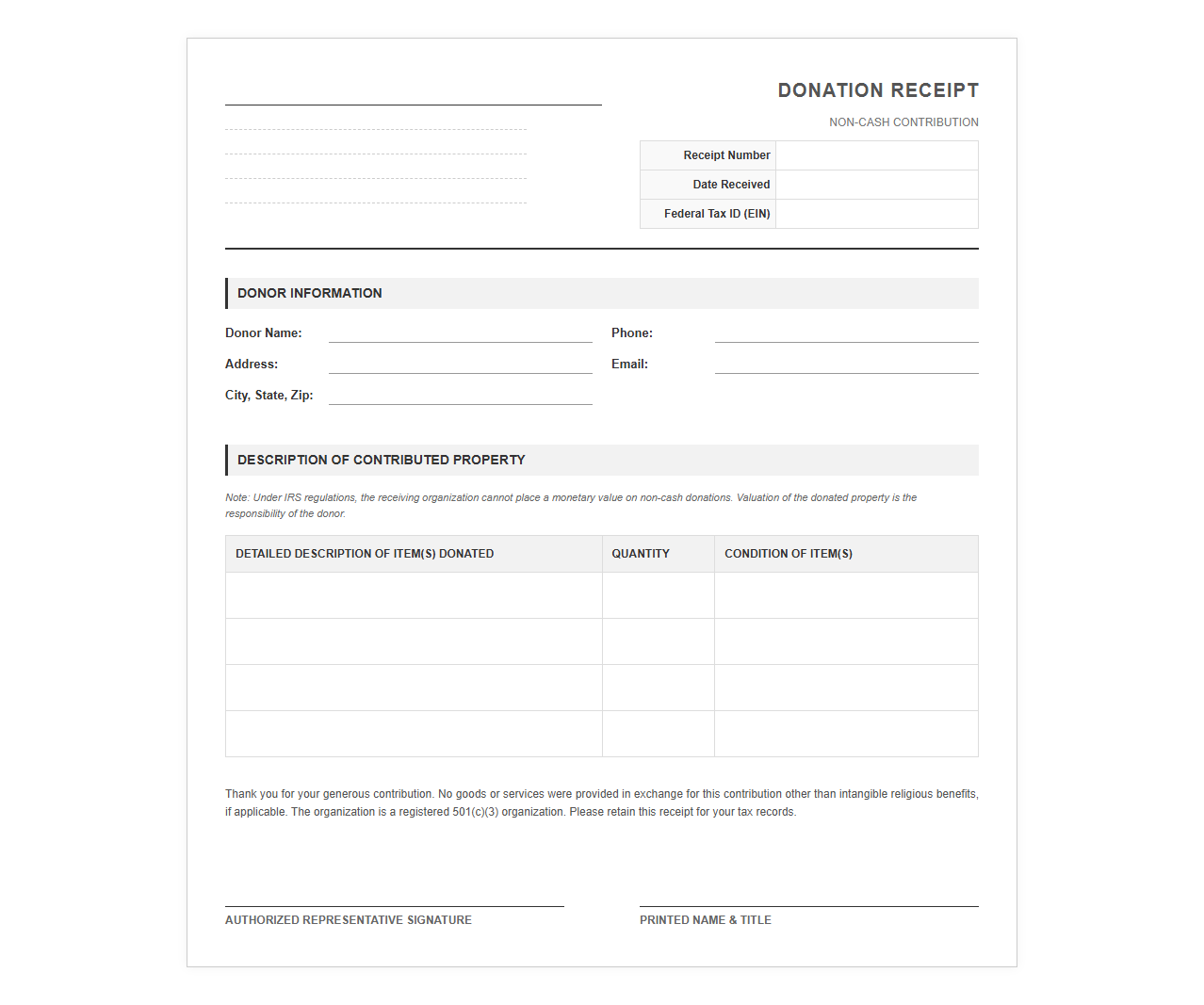 Download: .PDF
Demystifying Non-Cash Donations and Tax Compliance
In recent years, the landscape of philanthropy has shifted significantly. While monetary contributions remain vital, non-profit organizations are experiencing a massive rise in non-cash donations, also known as in-kind gifts. From vehicles and publicly traded securities to artwork, real estate, and office equipment, donors are increasingly leveraging their physical and financial assets to support charitable causes. However, this shift introduces complex administrative challenges. Strict tax compliance is essential for both donors wishing to claim legitimate deductions and non-profit organizations striving to maintain their tax-exempt status and donor trust.
IRS Regulations and Legal Requirements for In-Kind Gifts
The Internal Revenue Service (IRS) maintains strict legal frameworks governing non-cash contributions to ensure transparency and prevent tax evasion. Under these rules, the burden of valuation and proper documentation falls heavily on both the donor and the receiving charity. Organizations must navigate various threshold requirements. For instance, any single non-cash contribution valued over $250 requires a contemporaneous written acknowledgment. When a contribution exceeds $500, the donor must file IRS Form 8283. If the value of the donated property surpasses $5,000, the donor must secure a qualified appraisal and have the donee organization sign Section B of Form 8283, confirming receipt of the property.
Anatomy of a Compliant Non-Cash Receipt Template
To satisfy IRS requirements and protect your donors' tax deductions, a standardized non-cash donation receipt must contain specific legal language and information. A compliant receipt should never assign a monetary value to the received items; that responsibility lies solely with the donor.
- Donor Details: The full legal name and mailing address of the donor.
- Organization Information: The official name, address, and Employer Identification Number (EIN) of the non-profit.
- Date of Contribution: The exact calendar date on which the non-cash item was legally transferred.
- Detailed Description of Goods: A clear, objective description of the physical property (e.g., "Ten gently used desktop computers" rather than "technology equipment").
- No-Goods-Provided Statement: Explicit written confirmation stating whether the organization provided any goods or services in exchange for the contribution, or if the goods/services consisted entirely of intangible religious benefits.
Determining Fair Market Value and Appraisal Rules
Fair Market Value (FMV) is the price that an asset would sell for on the open market between a willing buyer and a willing seller. Donors must use accepted valuation methods, such as looking at comparable sales or replacement costs, to determine FMV. It is critical to remember that the receiving charity cannot determine or certify this value on the donor's behalf.
The Role of Digital Templates in Standardizing Compliance
Manually generating unique receipts for various in-kind donations is highly susceptible to administrative error and inconsistencies. Implementing digital, standardized templates streamlines this process, ensuring that every document produced automatically contains the legally required fields and disclaimer language. This systematic approach drastically reduces human error, fosters organization-wide consistency, and simplifies the record-keeping process during annual audits.
"Standardizing tax compliance through digital systems acts as a protective shield, protecting the donor's tax deduction while preserving the integrity of the non-profit's financial records."
Common Compliance Pitfalls and Audit Red Flags
Even well-intentioned organizations can make mistakes that trigger IRS audits or invalidate donor deductions. Understanding these frequent errors allows non-profits to establish proactive safeguards.
- Valuing the Gift on the Receipt: Writing a dollar amount on the non-cash receipt, which violates IRS guidelines and shifts legal liability to the non-profit.
- Vague Item Descriptions: Recording overly broad descriptions like "boxes of clothing" rather than detailing the contents and general condition.
- Missing "No-Goods" Language: Omitting the mandatory statement confirming that no goods or services were provided in exchange for the donation.
- Delayed Receipt Issuance: Failing to provide the written acknowledgment before the donor files their tax return or before the filing deadline.
Best Practices for Long-Term Donor and IRS Alignment
Maintaining a robust, compliant, and donor-friendly non-cash contribution system requires proactive planning. Organizations should implement clear internal policies that outline which types of in-kind gifts they can legally and practically accept. Training staff members to refuse to assign values on receipts ensures that the non-profit remains a neutral party. By utilizing pre-verified digital templates and establishing secure, organized digital archives of all issued receipts, non-profits can foster trust with their supporters, simplify their year-end reporting, and confidently navigate any future IRS inquiries.

Leave a comment