

Accounting practitioners frequently struggle with client misunderstandings and scope creep when initiating financial statement compilations. Without clear boundaries, a straightforward compilation can easily morph into uncompensated advisory work or, worse, costly disputes. Before drafting solutions, one must position these agreements within the strict regulatory framework of professional standards, such as SSARS, which govern practitioner reporting.
Utilizing standardized templates grants firms both immediate liability protection and streamlined client onboarding. However, as an educational stipulation, practitioners must explicitly define that a compilation is a non-assurance service, distinct from audits or reviews. Effective templates rely on concrete clauses-such as a "Management's Responsibility" provision and a "No Opinion Expressed" disclaimer-to establish these legal boundaries upfront.
This article outlines the essential components of professional compilation engagement letters, providing actionable templates and drafting strategies to secure your practice and elevate client trust.
Financial Statement Compilation Engagement Letter
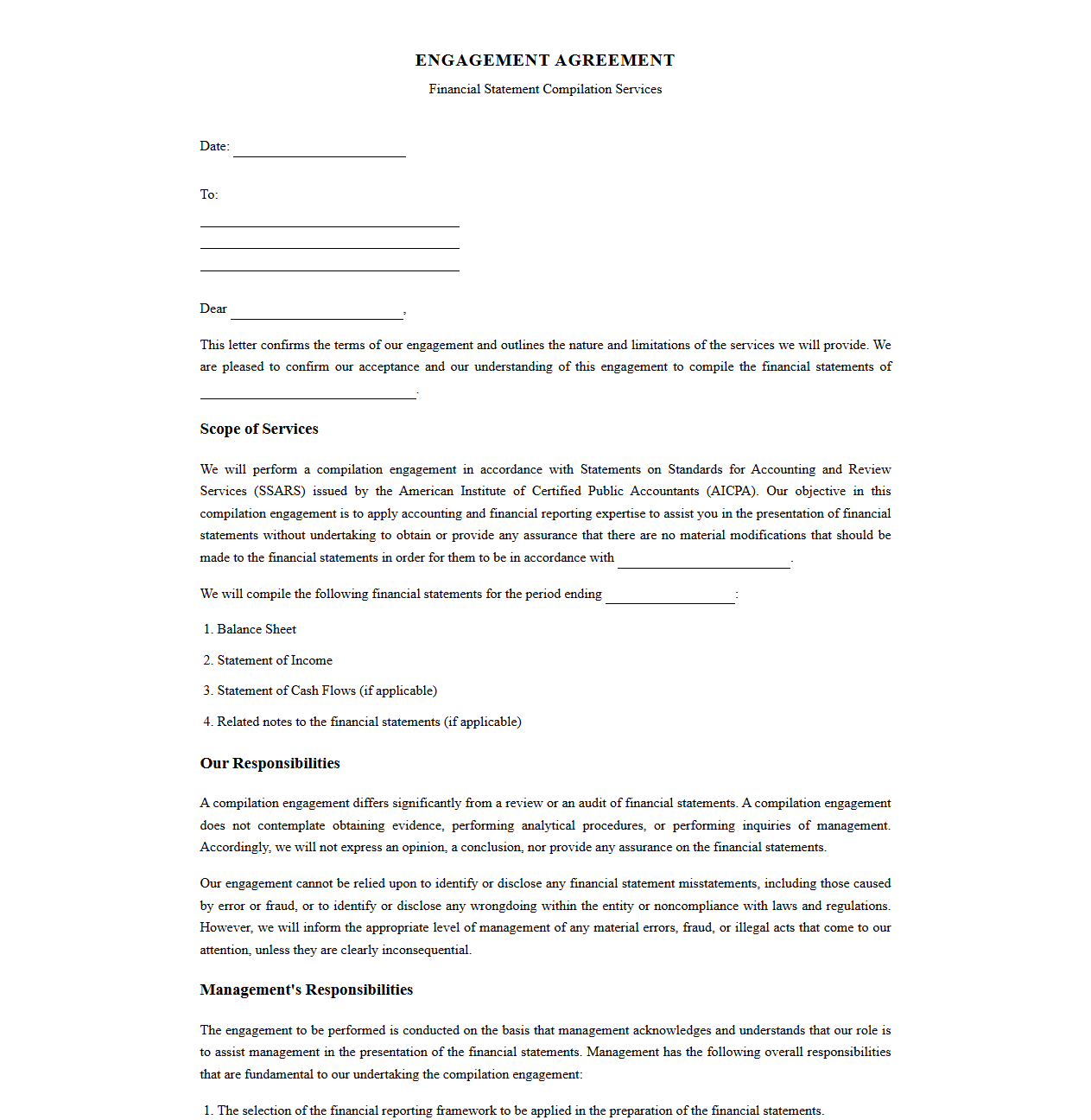 Download: .PDF
Standard Agreement for Financial Compilation Services
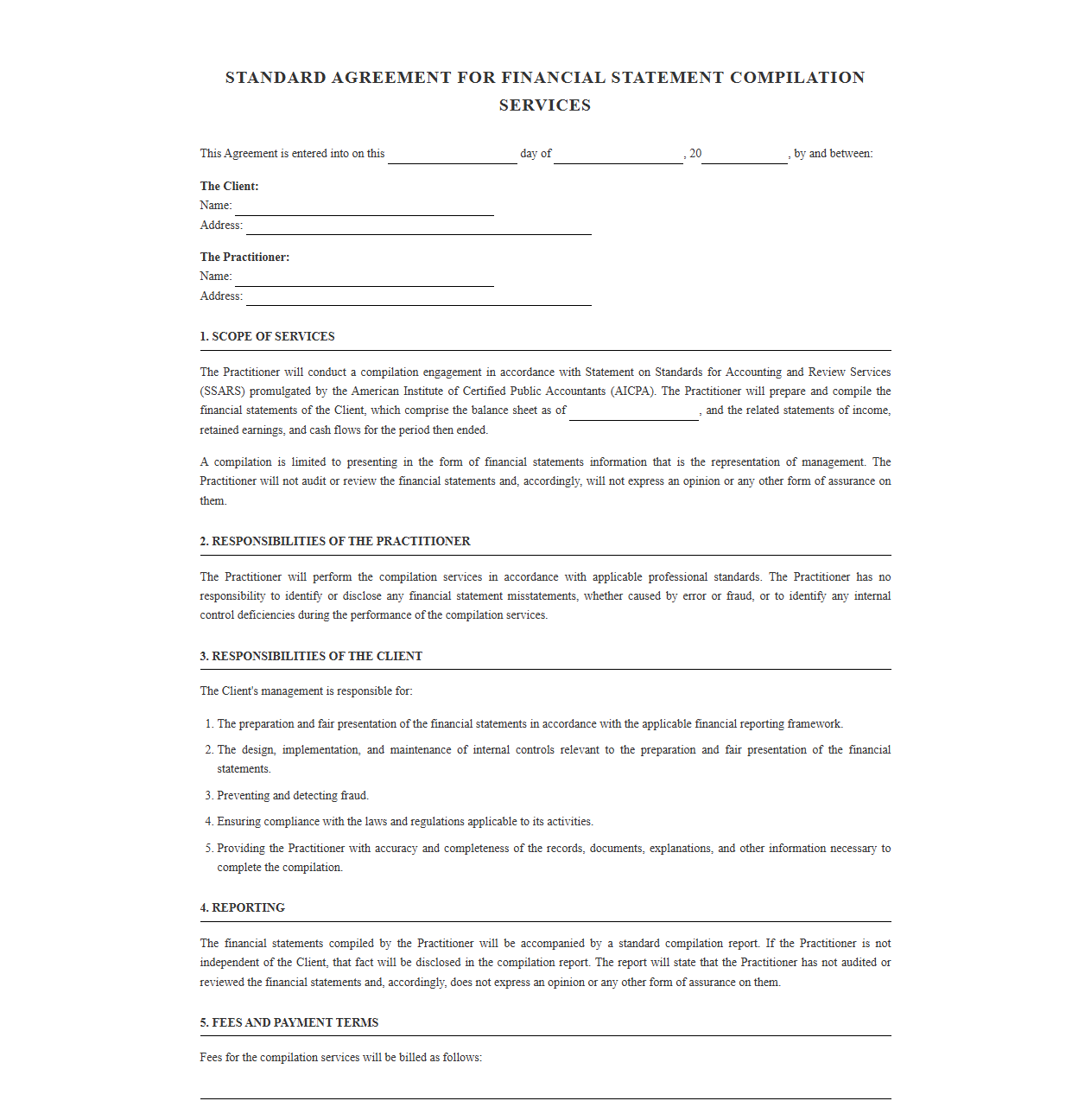 Download: .PDF
CPA Financial Statement Compilation Contract
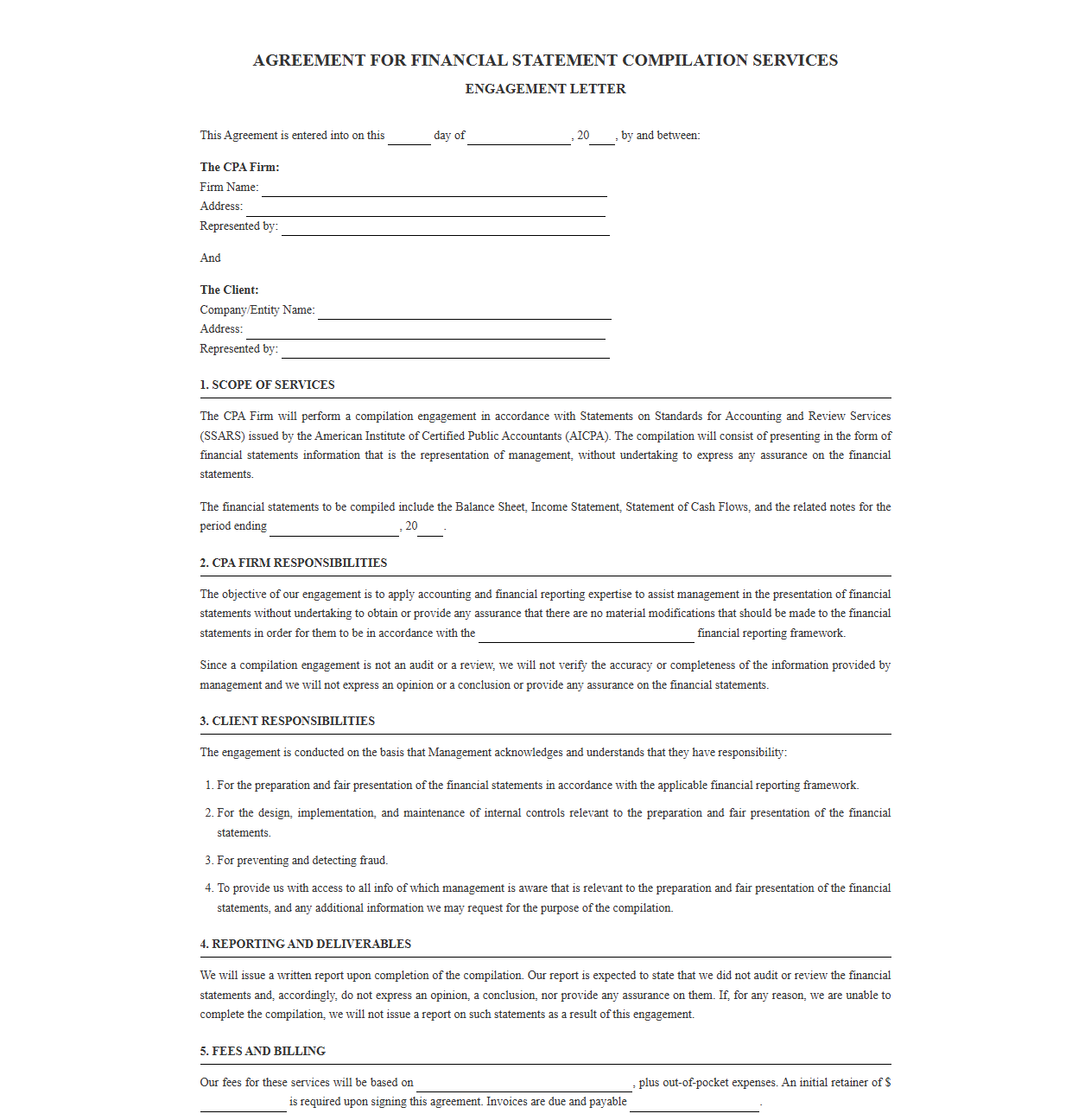 Download: .PDF
Financial Compilation Service Agreement Template
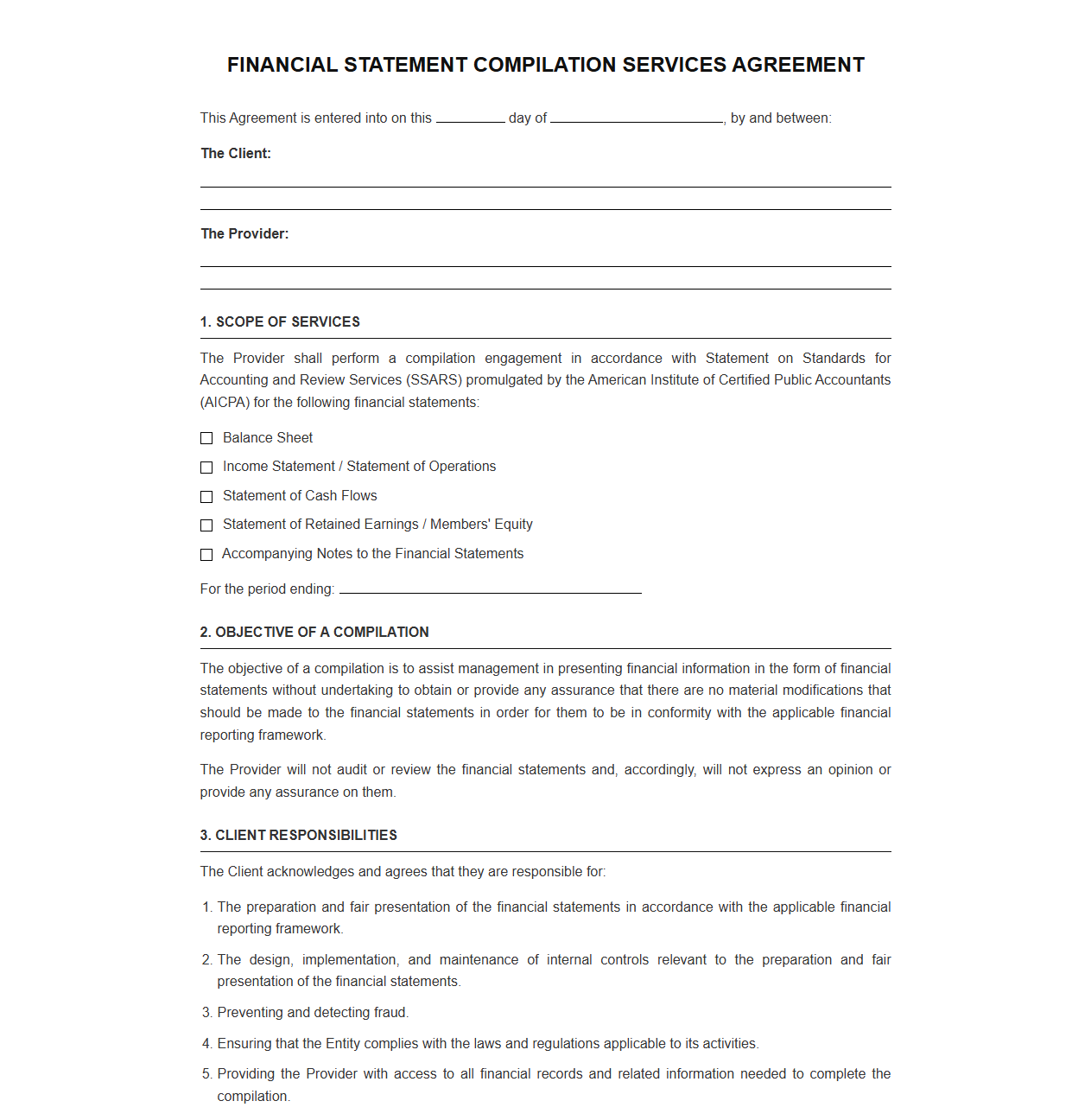 Download: .PDF
Corporate Financial Statement Compilation Agreement
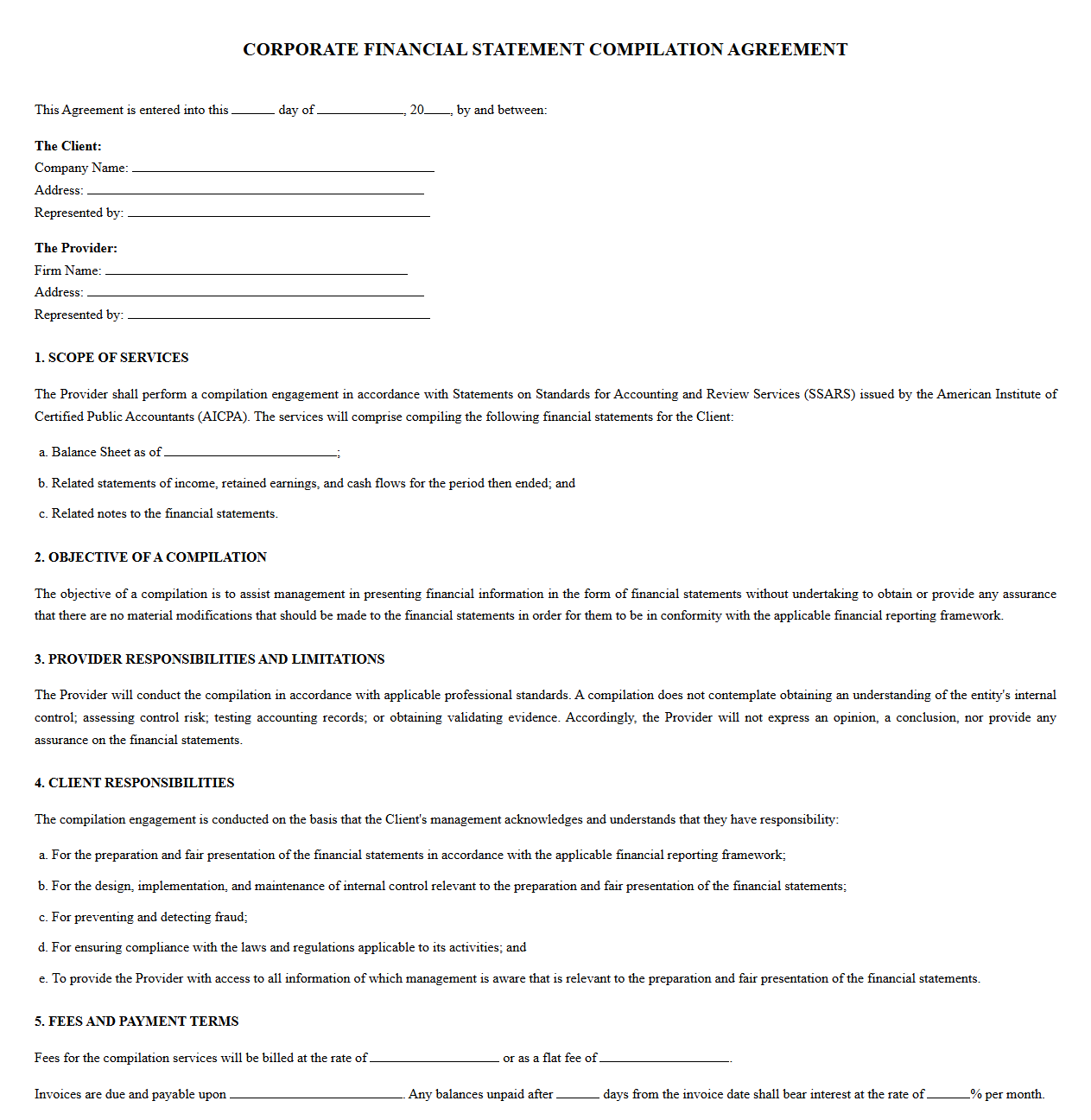 Download: .PDF
Client Agreement for Accounting Compilation Services
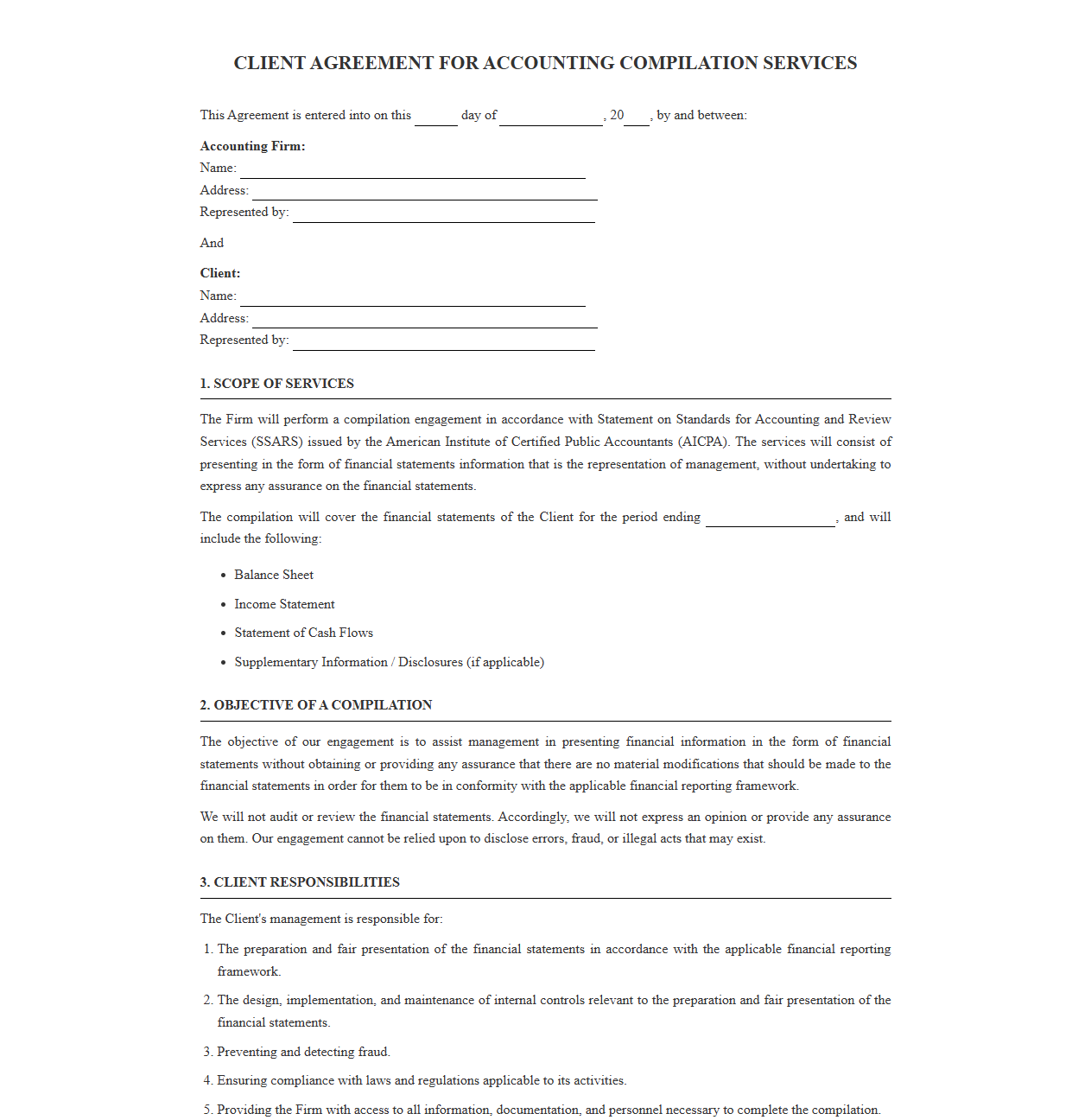 Download: .PDF
Annual Financial Statement Compilation Contract
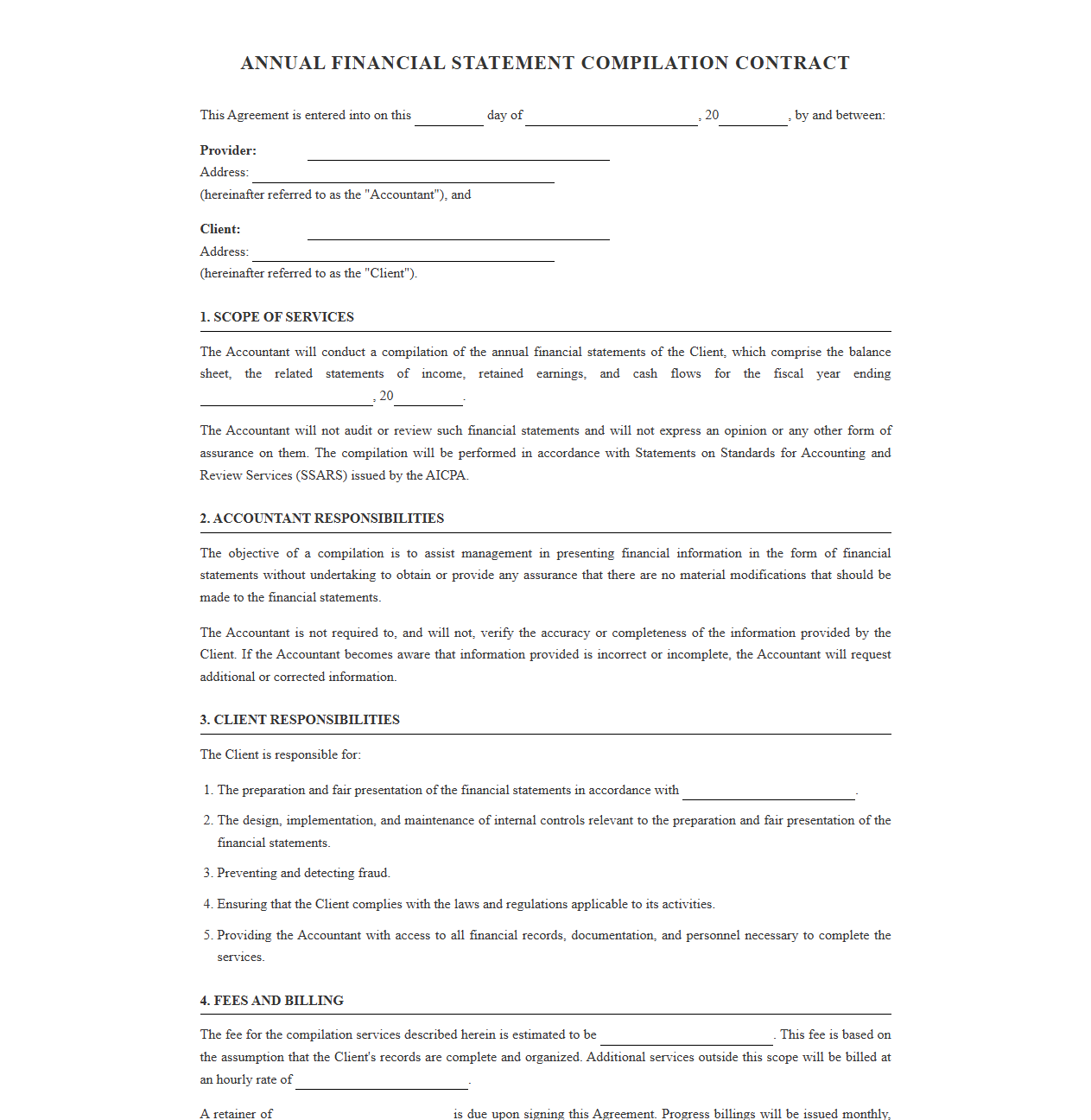 Download: .PDF
Professional Services Agreement for Financial Compilations
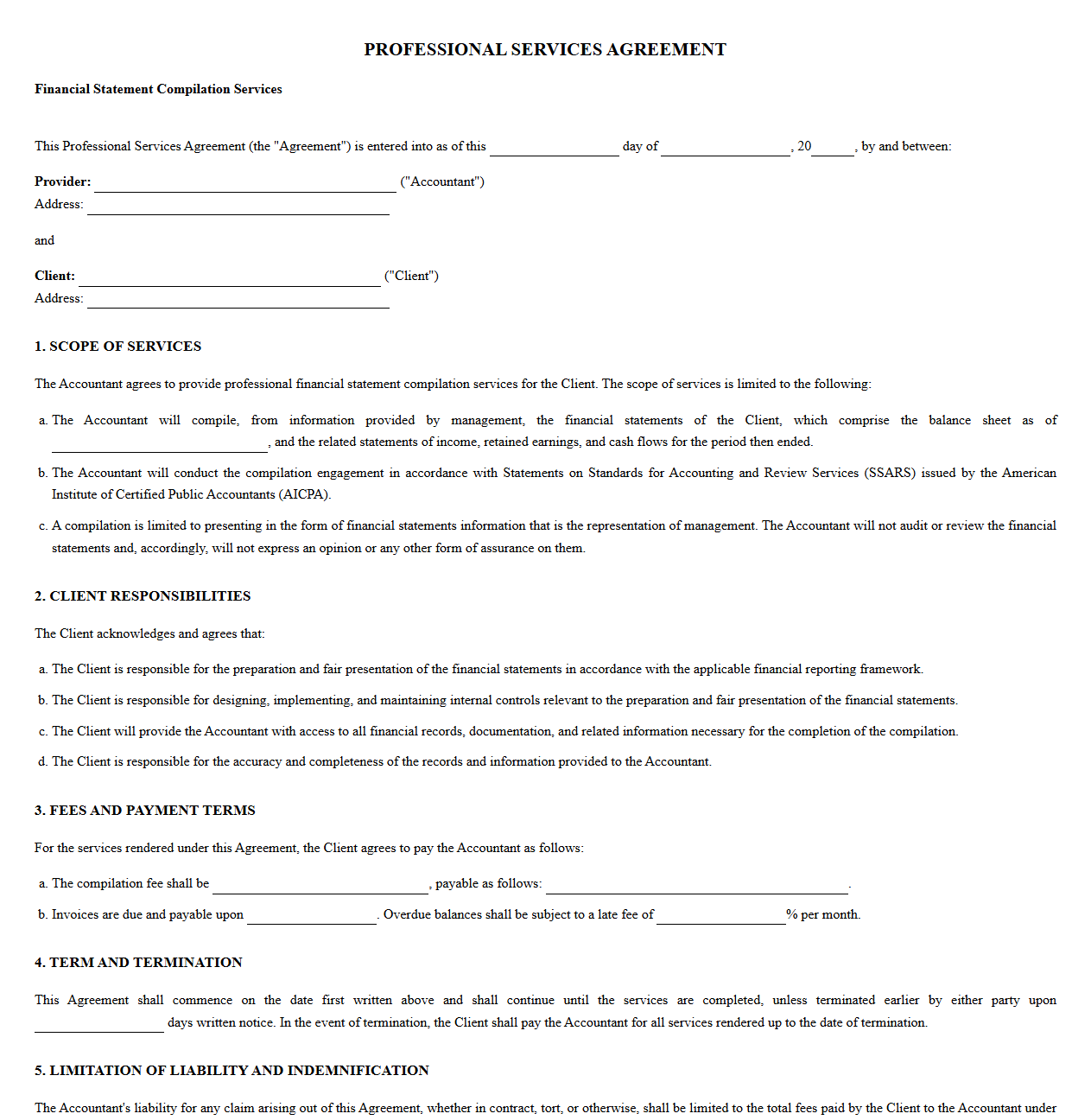 Download: .PDF
Introduction to Compilation Engagement Agreements
In the realm of professional accounting, establishing a clear understanding between the practitioner and the client is paramount. A compilation engagement agreement serves as the foundational contract that outlines the mutual expectations, roles, and boundaries of a financial statement compilation. Utilizing a well-structured engagement letter is crucial for securing accounting engagements, mitigating legal risks, and ensuring both parties are aligned before any financial analysis begins.
Securing a formal agreement helps protect the firm's liability while clarifying that a compilation is a non-assurance service. By setting these parameters early, practitioners can foster stronger client relationships built on transparency and professional trust.
Defining the Scope of Compilation Services
A compilation engagement involves presenting financial information in the form of financial statements without undertaking to express any assurance. It is essential to distinguish this service from more rigorous procedures such as audits and reviews.
- Included: Assisting management in presenting financial information in the form of financial statements in accordance with an applicable financial reporting framework.
- Excluded: Performing inquiry, analytical procedures, or physical inspections, which are reserved for review and audit engagements.
- Excluded: Testing internal controls or verifying the accuracy and completeness of the information provided by the client.
- Excluded: Expressing an opinion or providing any level of assurance on the financial statements.
Establishing Client Responsibilities and Representations
While the accountant compiles the reports, the primary responsibility for the underlying financial data rests entirely with the client. Management must ensure the accuracy of transactions and maintain robust internal controls to prevent errors or fraud.
"The client acknowledges and agrees that they are responsible for the preparation and fair presentation of the financial statements in accordance with the chosen financial reporting framework. This includes maintaining adequate internal controls, preventing fraud, and providing the practitioner with complete, accurate raw financial data."
Outlining the Practitioner's Responsibilities and Standards
The practitioner must perform the compilation with due professional care, adherence to ethical codes, and technical proficiency. This requires conducting the engagement in strict compliance with professional standards, specifically the Statements on Standards for Accounting and Review Services (SSARS). In addition, the agreement must clearly outline the limitations of the practitioner's liability, confirming that the accountant cannot be held responsible for detecting defalcations or irregularities that may exist within the client's records.
Structuring Fees, Billing, and Termination Clauses
To prevent billing disputes and maintain transparency, the engagement agreement must detail the fee structure, retainer requirements, and payment terms. It should also establish clear protocols for terminating the relationship should the need arise.
| Service / Charge Type | Rate / Fee Structure | Payment Terms |
|---|---|---|
| Standard Compilation Service | Flat fee of $2,000 per period | 50% deposit upfront, 50% upon delivery |
| Out-of-Scope Accounting Work | $220 per hour | Billed monthly as incurred |
| Administrative & Out-of-Pocket Expenses | At direct cost | Reimbursed upon final invoice |
Best Practices for Customizing Your Engagement Template
No two clients are identical, and standard templates must be adapted to address specific risk profiles, industry requirements, and local jurisdictions. Follow these steps to customize your agreement effectively:
- Identify and assess the client's industry-specific regulatory requirements.
- Adjust the limitation of liability clauses based on the client's risk profile and transaction volume.
- Define strict, clear deadlines for the delivery of raw financial data by the client.
- Review and update templates annually to reflect changes in professional standards and local tax laws.
Finalizing and Securing the Agreement
Once the document is customized, finalize the agreement by securing electronic signatures from all authorized parties. Modern digital signature platforms expedite this process while providing a secure audit trail. Store the completed contract in a centralized document management system to kickstart the client onboarding process efficiently.
To ensure your practice remains compliant, click here to download our customizable Compilation Engagement Agreement Template.
Leave a comment