

For accounting and bookkeeping professionals, the gradual, unbilled expansion of client demands-commonly known as scope creep-is a persistent hazard that quietly erodes profitability and exhausts staff. Before addressing how to bill for these extra hours, firms must first establish a rigorous foundation of mutual understanding through formal documentation.
Utilizing robust service agreement templates grants practitioners the contractual authority to protect their margins while elevating client trust. To do this effectively, agreements must employ educational framing; by including clear stipulations of what is not covered-such as explicitly excluding historical forensic cleanups or ad-hoc tax planning from standard monthly packages-you manage expectations from day one.
In this article, we will explore essential contract clauses designed to prevent boundary pushing, provide customizable templates you can implement immediately, and outline strategies to secure your firm's revenue.
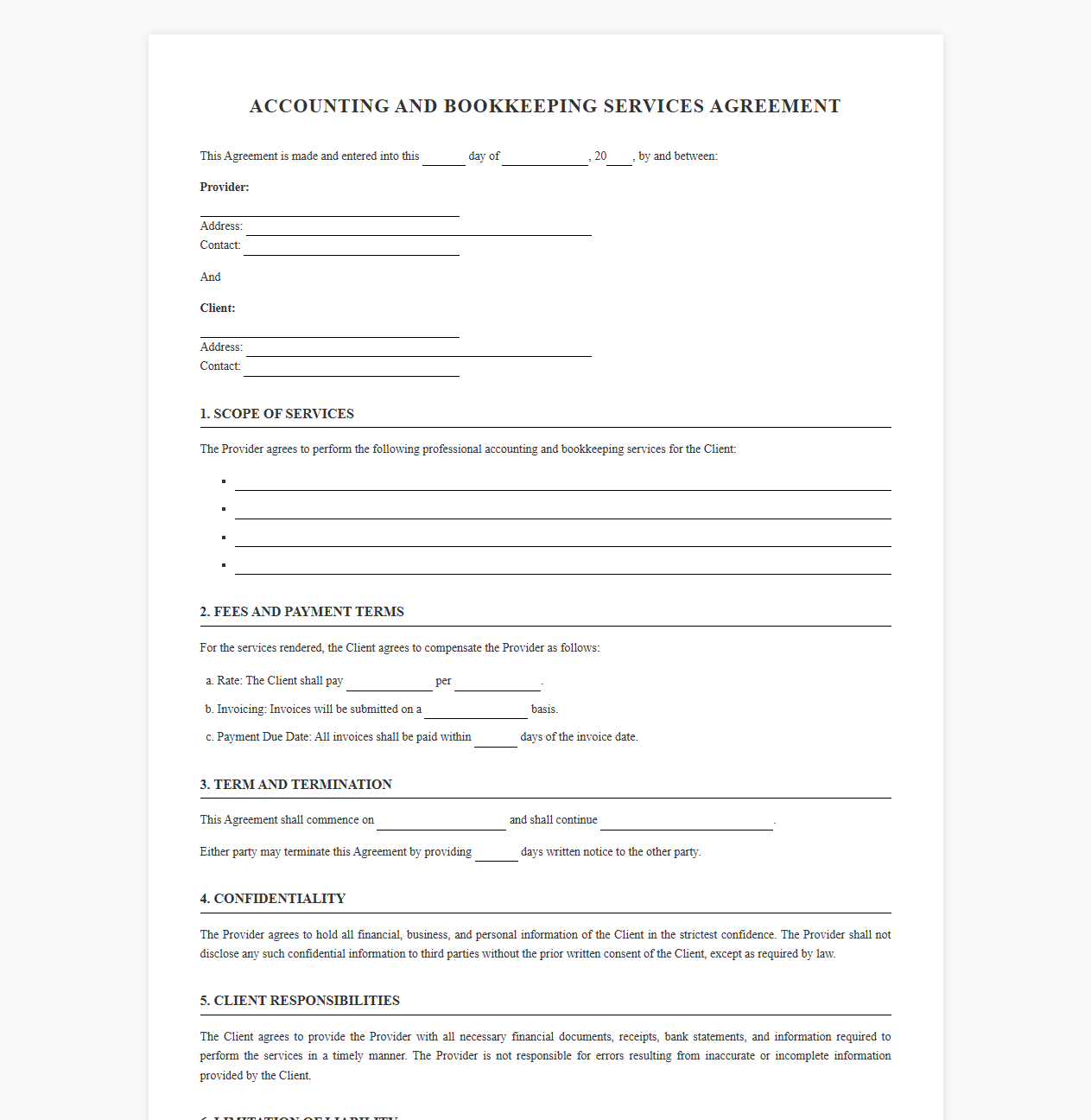
Bookkeeping and Accounting Services Contract Template
 Download: .PDF
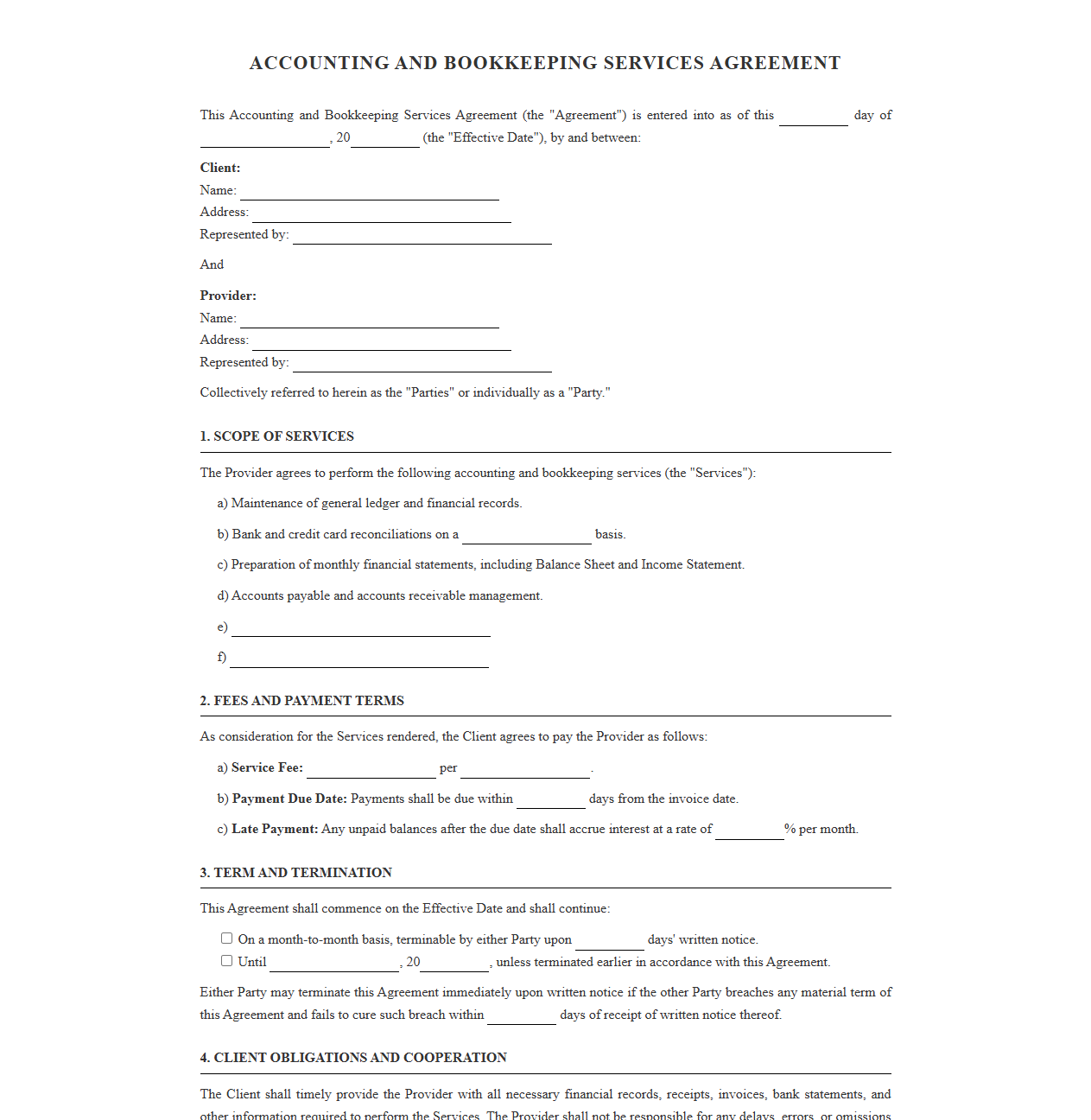
Standard Accounting Services Agreement
 Download: .PDF
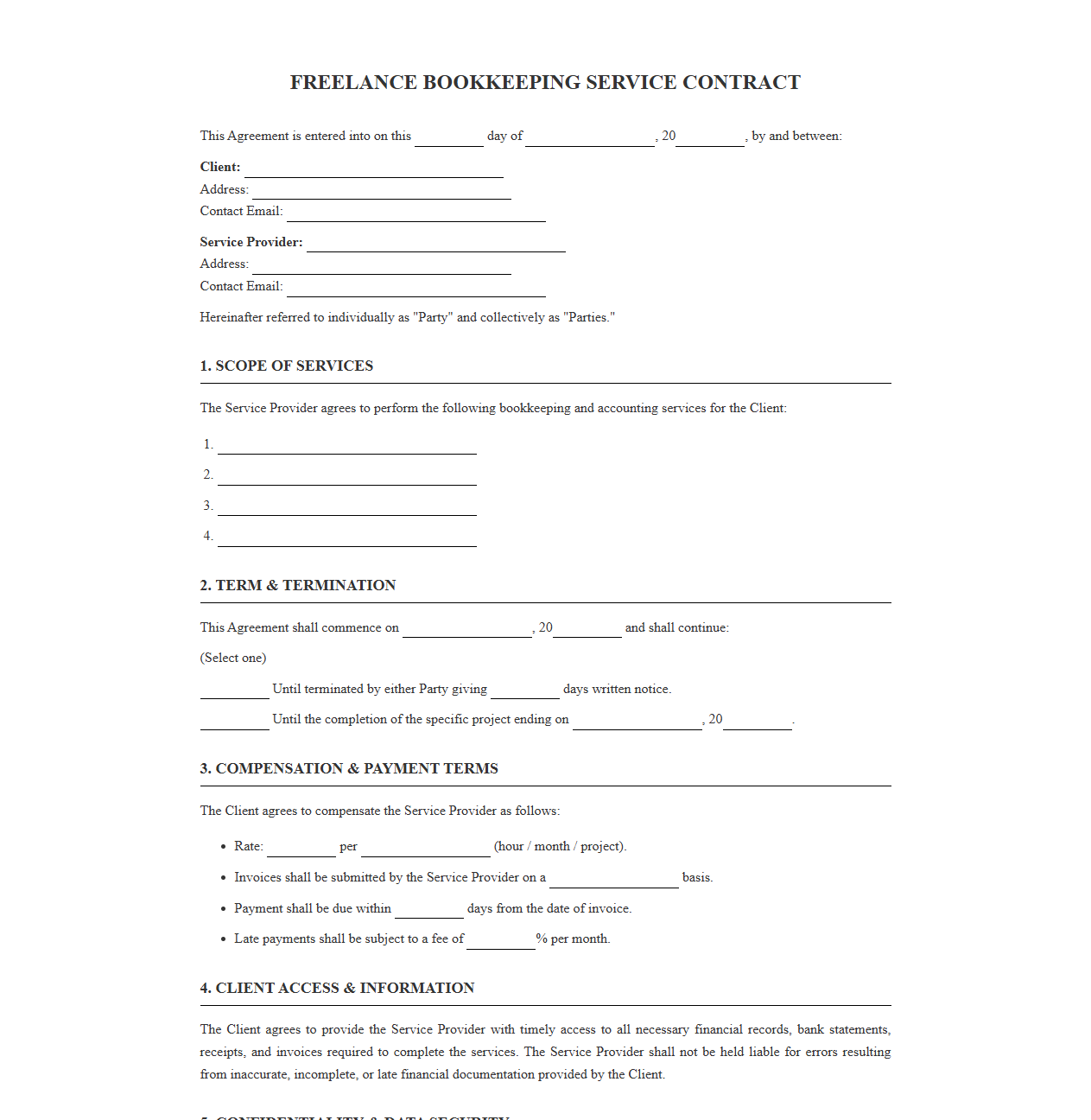
Freelance Bookkeeping Service Contract
 Download: .PDF
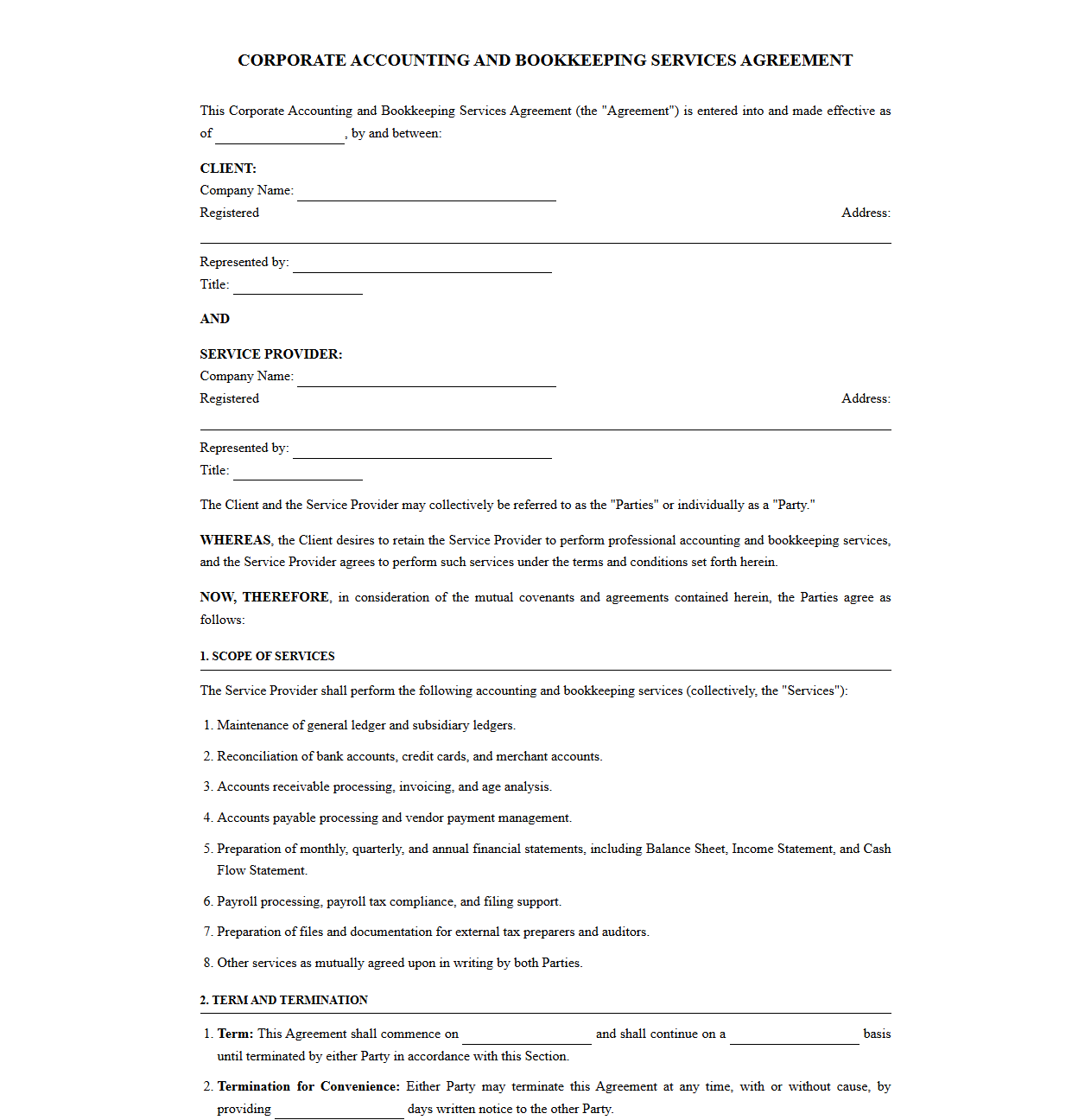
Corporate Accounting and Bookkeeping Services Agreement
 Download: .PDF
Monthly Bookkeeping Services Engagement Letter
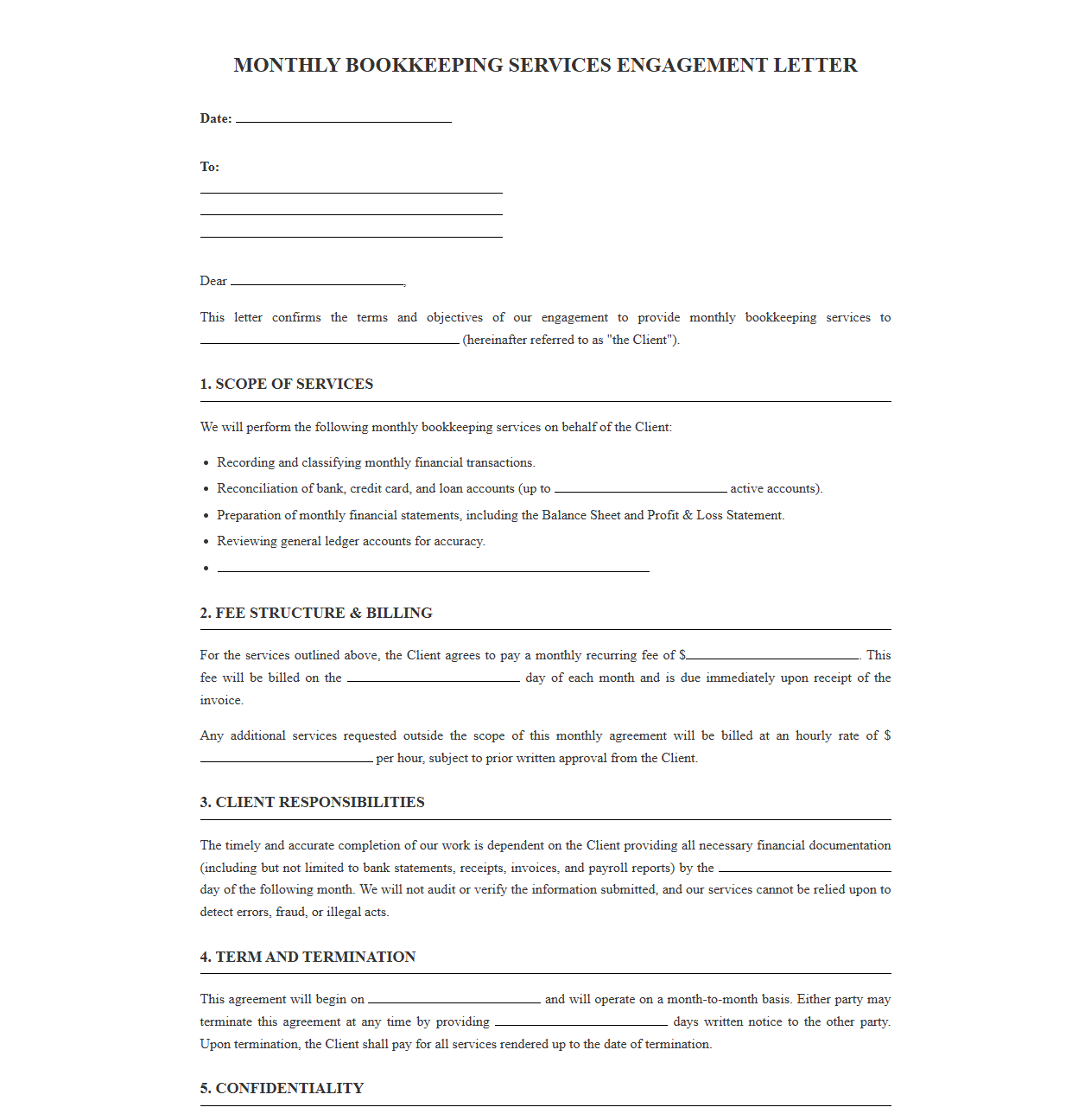 Download: .PDF
Financial Accounting and Bookkeeping Service Agreement
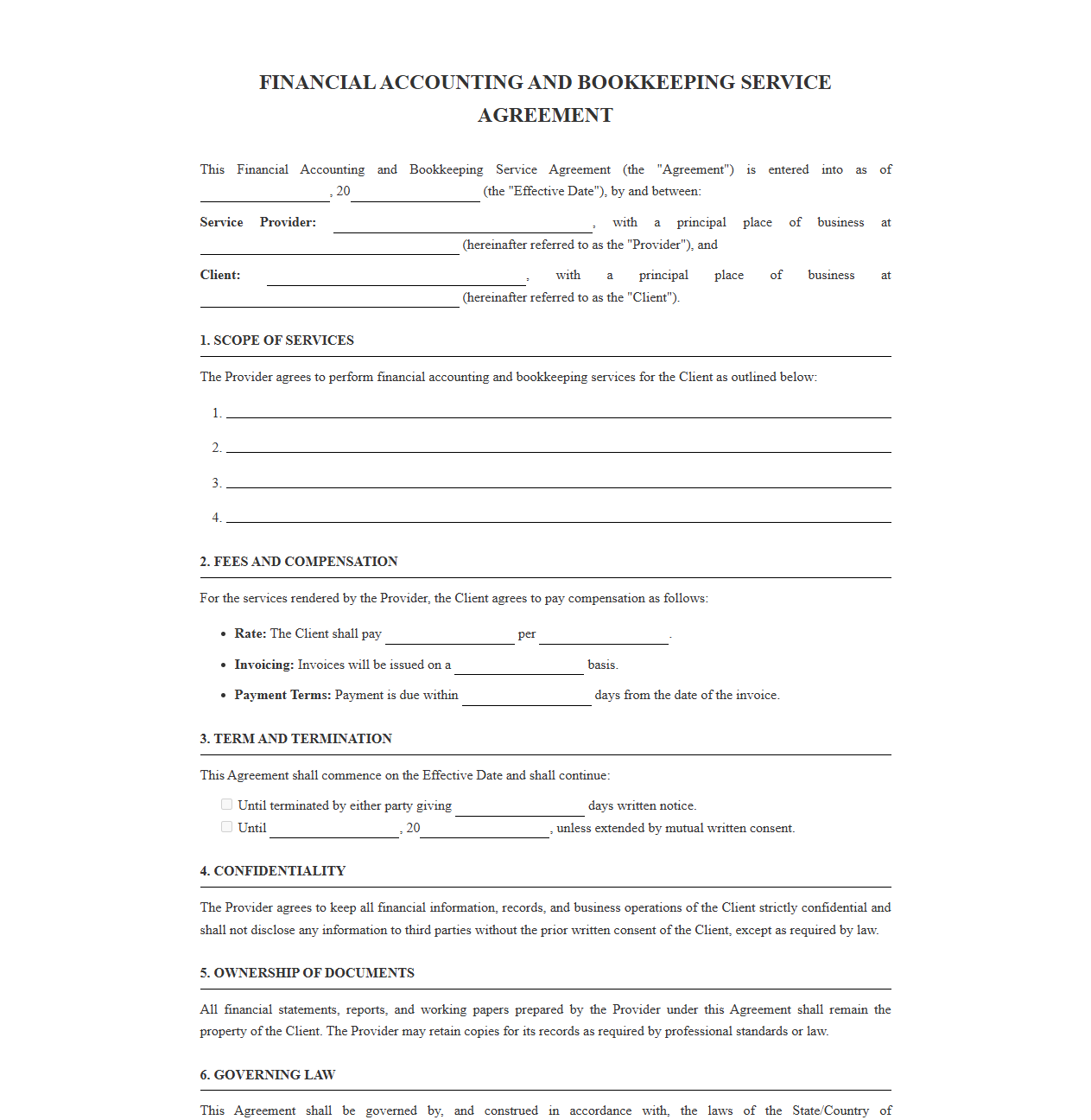 Download: .PDF
Small Business Bookkeeping Services Contract
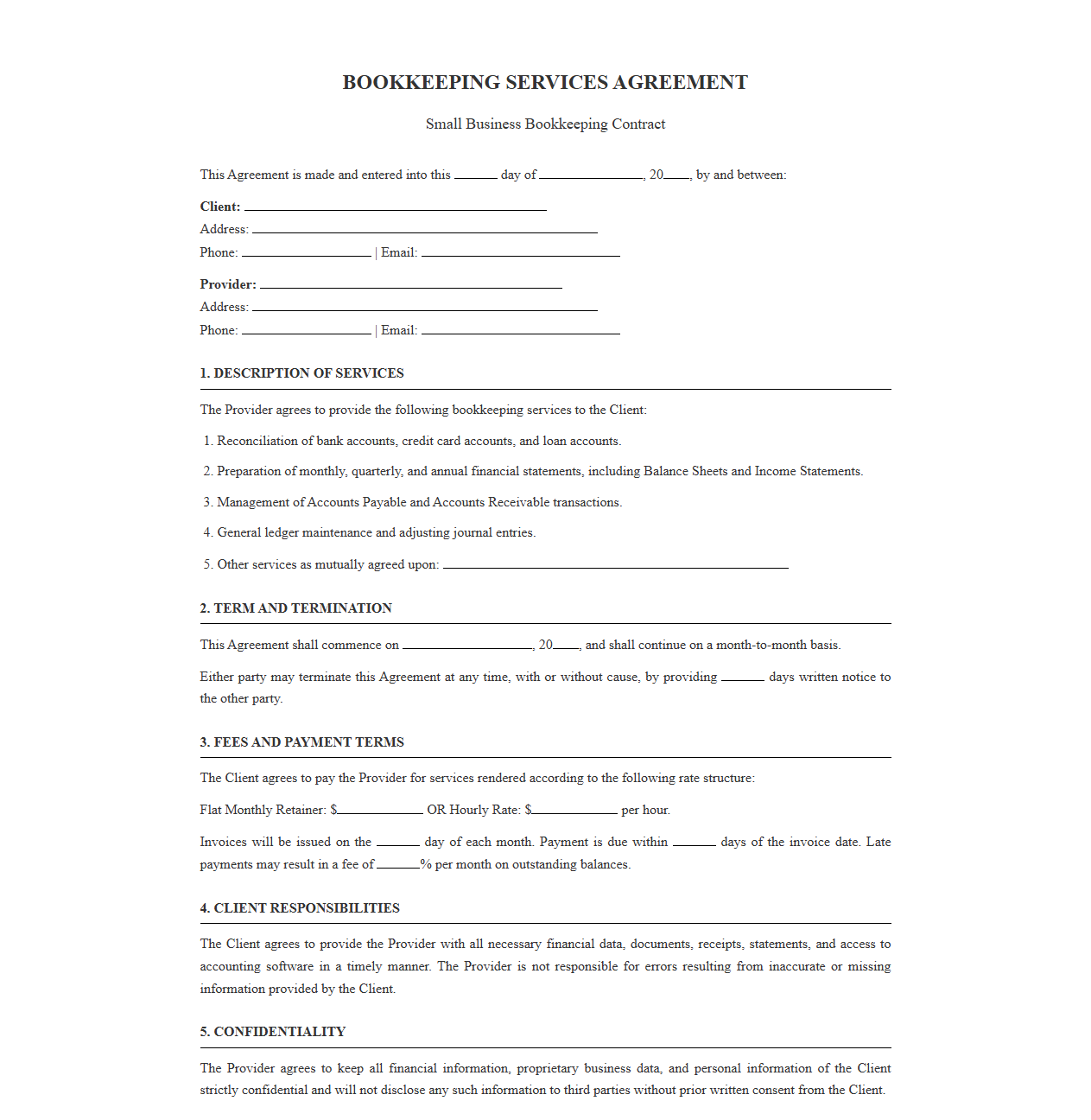 Download: .PDF
Virtual Accounting and Bookkeeping Service Agreement
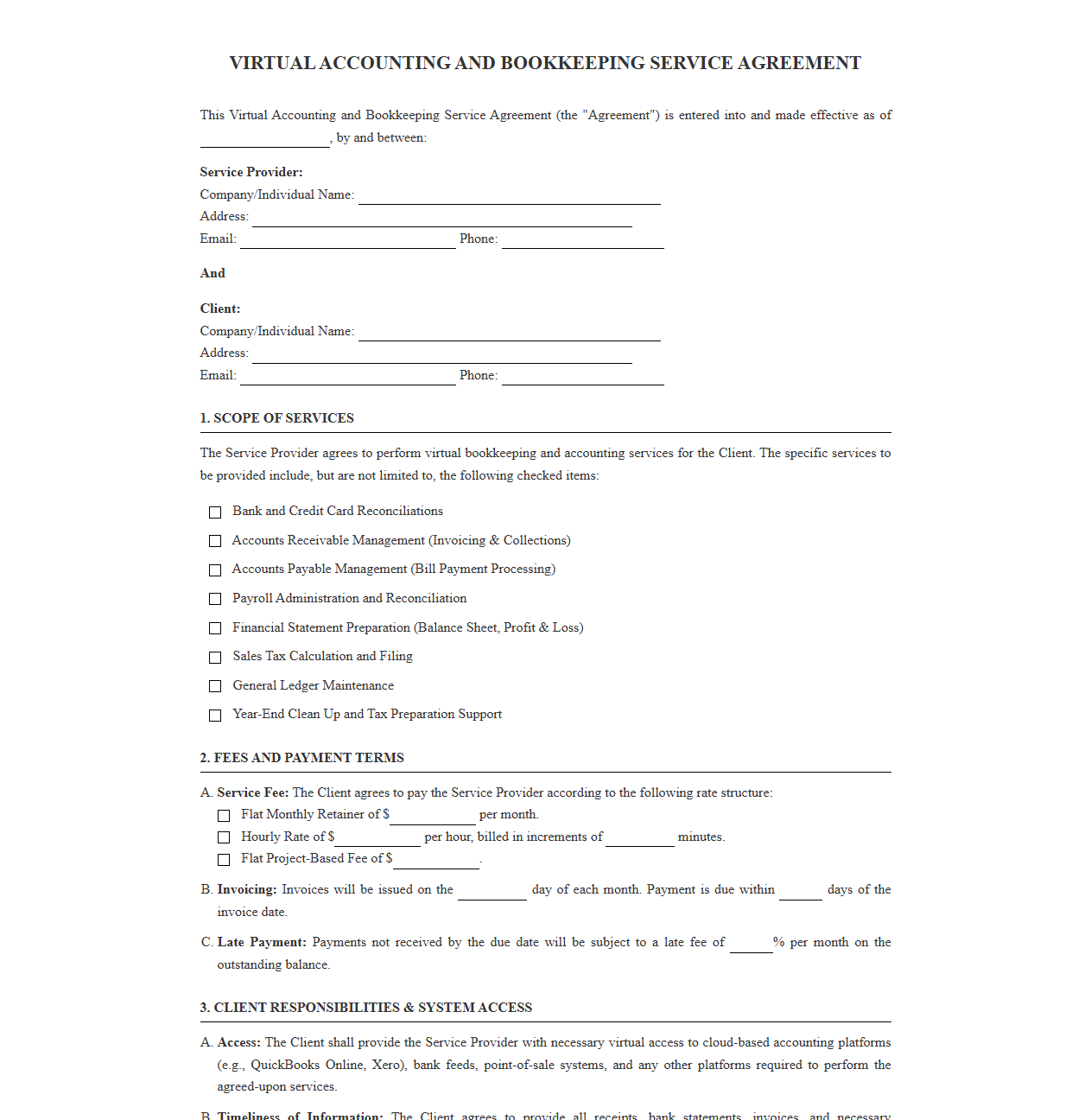 Download: .PDF
The Importance of a Solid Accounting Service Agreement
In the accounting and bookkeeping industry, a handshake agreement is never enough to secure your business interests. A robust bookkeeping service agreement serves as the foundational pillar of a successful client relationship, setting clear expectations right from day one. By clearly outlining the parameters of your engagement, this legal document safeguards your firm against misunderstandings and protects your business from costly liability claims, unresolved billing disputes, and unfair scope expectations.
Clearly Defining the Scope of Services
To maintain a profitable relationship, your contract must explicitly define what is included in your standard bookkeeping package. Ambiguity in this section often leads to misunderstandings, so listing specific, routine tasks helps the client understand exactly what they are paying for under their flat or recurring monthly fee.
- Monthly bank and credit card reconciliations.
- Preparation of standard financial statements, including Balance Sheets and Income Statements.
- Accounts payable management and weekly bill pay processing.
- Sales tax tracking and quarterly filing submissions.
Mechanisms to Prevent and Handle Scope Creep
Scope creep is one of the quickest ways to erode an accounting firm's profit margins. When clients ask for "quick favors" like extra custom reports or historical cleanups, these unbilled minutes quickly compound into hours of unpaid labor. Your agreement must include an explicit out-of-scope clause that mandates additional fees for any work falling outside the defined boundaries of the standard service plan.
"Any services requested by the Client that are not explicitly outlined in the Scope of Services section of this Agreement will be billed at our standard hourly rate of $150 per hour, subject to prior written approval from the Client before such work commences."
Establishing Payment Terms and Late Fee Policies
A healthy cash flow is essential for running a sustainable accounting practice, which is why your billing section must be explicit. Your agreement should detail exact payment schedules, supported payment methods, consequences for late payments, and the firm's legal right to stop working if invoices remain unpaid for too long.
- Invoices are generated on the 1st of each month and are due upon receipt via automated ACH or credit card authorization.
- Payments not received by the 5th business day of the month will automatically incur a 1.5% late fee compounded monthly.
- If payment is delayed by more than 15 calendar days, the firm reserves the right to suspend all bookkeeping work and withhold access to financial software until the account is settled.
Defining Client Obligations and Deadlines
A successful accounting partnership is a two-way street that relies heavily on the client's cooperation. Without timely and accurate data from the business owner, a bookkeeper cannot deliver clean financial records or meet tax deadlines. Both parties must recognize that the accuracy of the final financial output is directly dependent on the promptness and truthfulness of the input. Your agreement must establish clear timelines for clients to submit bank statements, receipts, and invoices, while outlining that delays in data delivery will excuse the firm from meeting subsequent reporting deadlines.
Limiting Liability and Indemnification Clauses
Accounting firms constantly handle highly sensitive financial data, making them vulnerable to legal claims if errors occur. To safeguard your business, your agreement must feature a robust limitation of liability clause that protects the firm from financial damages arising from inaccurate client records, internal client fraud, or unexpected third-party software outages. The contract should clearly state that the firm's maximum liability for any claims, losses, or damages shall not exceed the total fees paid by the client to the firm during the immediate three-month period preceding the claim.
Clear Termination and Offboarding Procedures
Even the best client relationships eventually come to an end, and having a structured offboarding process prevents awkward or hostile departures. Your termination clause should clearly outline the required notice period for both parties, how final outstanding balances will be collected, and how the transfer of financial credentials and historical data will be handled. To save time drafting these terms from scratch, you can access our comprehensive accounting service agreement template to establish a secure foundation for your client relationships today.

Leave a comment