

Managing subcontractor payments often leads to administrative friction, delayed timelines, and costly billing disputes that strain vital project relationships. As modern project scopes and compliance demands grow increasingly complex, relying on informal handshakes or vague purchase orders is no longer a viable business strategy. Implementing a standardized Subcontractor Payment Terms Agreement Template grants prime contractors the legal clarity and cash flow predictability needed to safeguard their margins.
While these templates serve as an invaluable operational baseline, users must stipulate that local prompt payment acts and regional jurisdictions will ultimately govern enforceable timelines. By incorporating concrete provisions such as "Pay-When-Paid" clauses, Net-30 milestone structures, and explicit retainage release terms, you establish objective, legally defensible triggers for compensation.
In this guide, we will examine the essential components of these agreement templates, analyze industry-standard payment structures, and provide customizable frameworks to streamline your next project.
Subcontractor Invoice and Payment Agreement Template
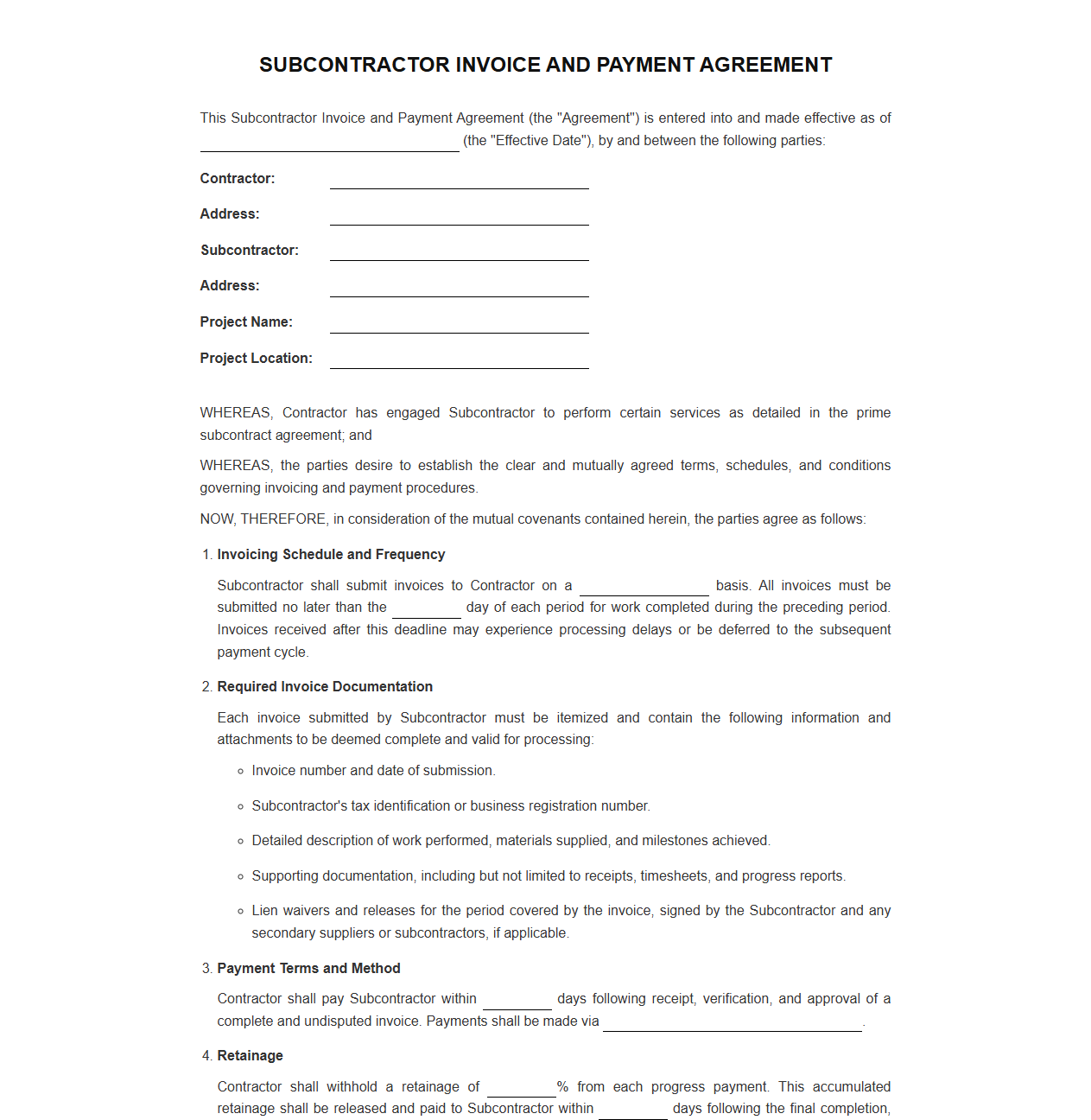 Download: .PDF
Subcontractor Payment Terms and Billing Agreement
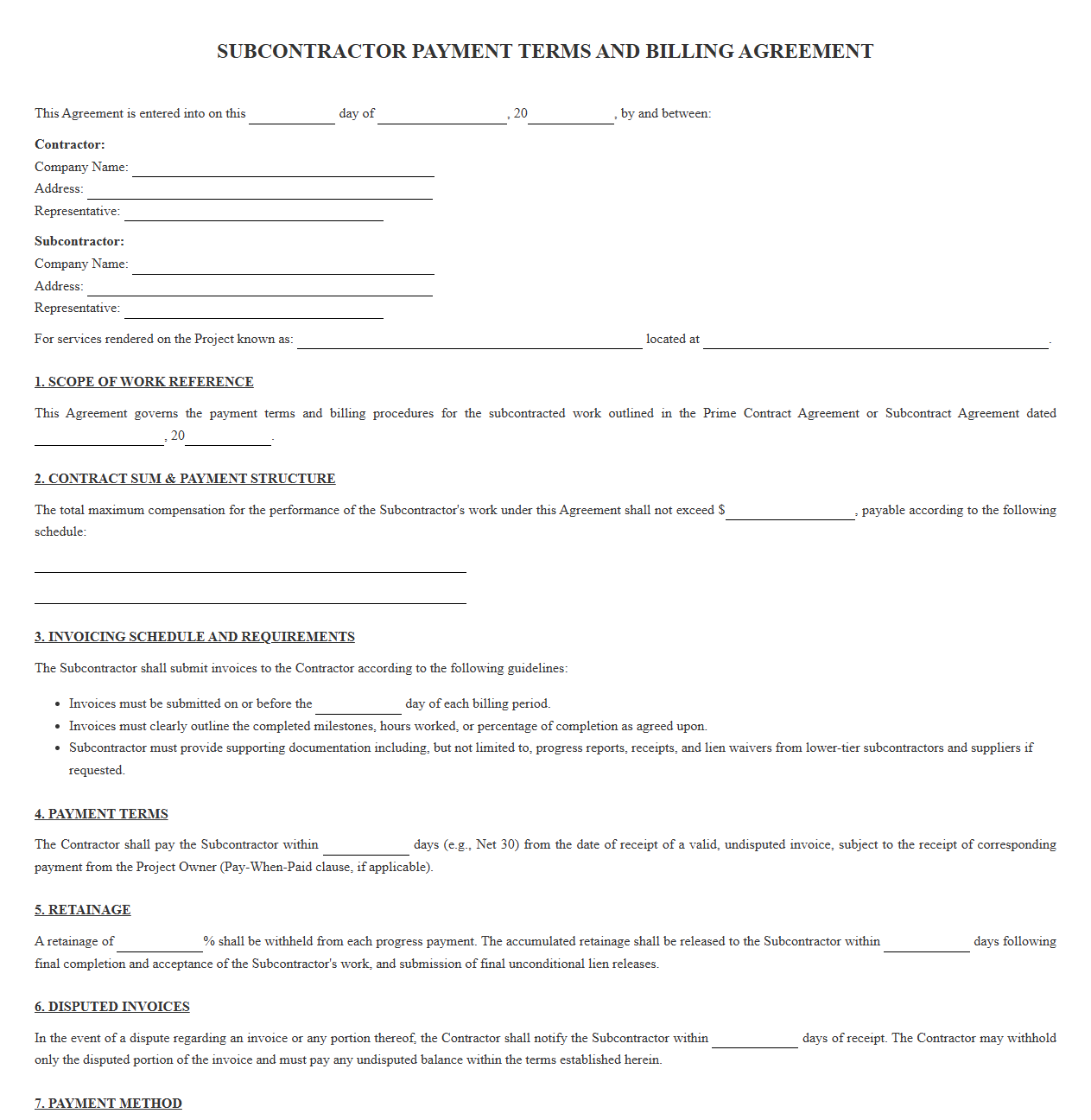 Download: .PDF
Subcontractor Invoicing Procedures and Payment Agreement
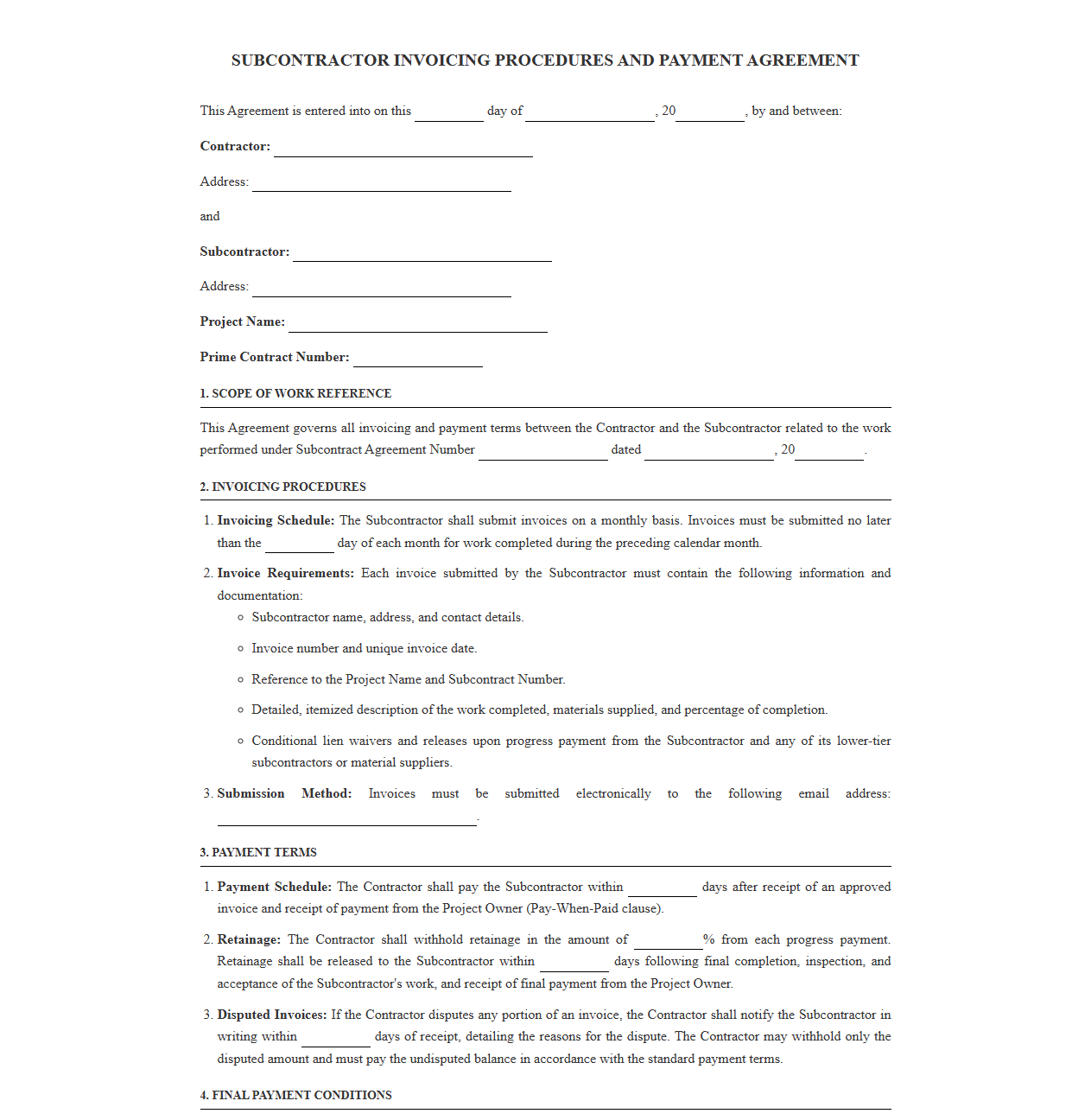 Download: .PDF
Subcontractor Billing and Payment Terms Contract
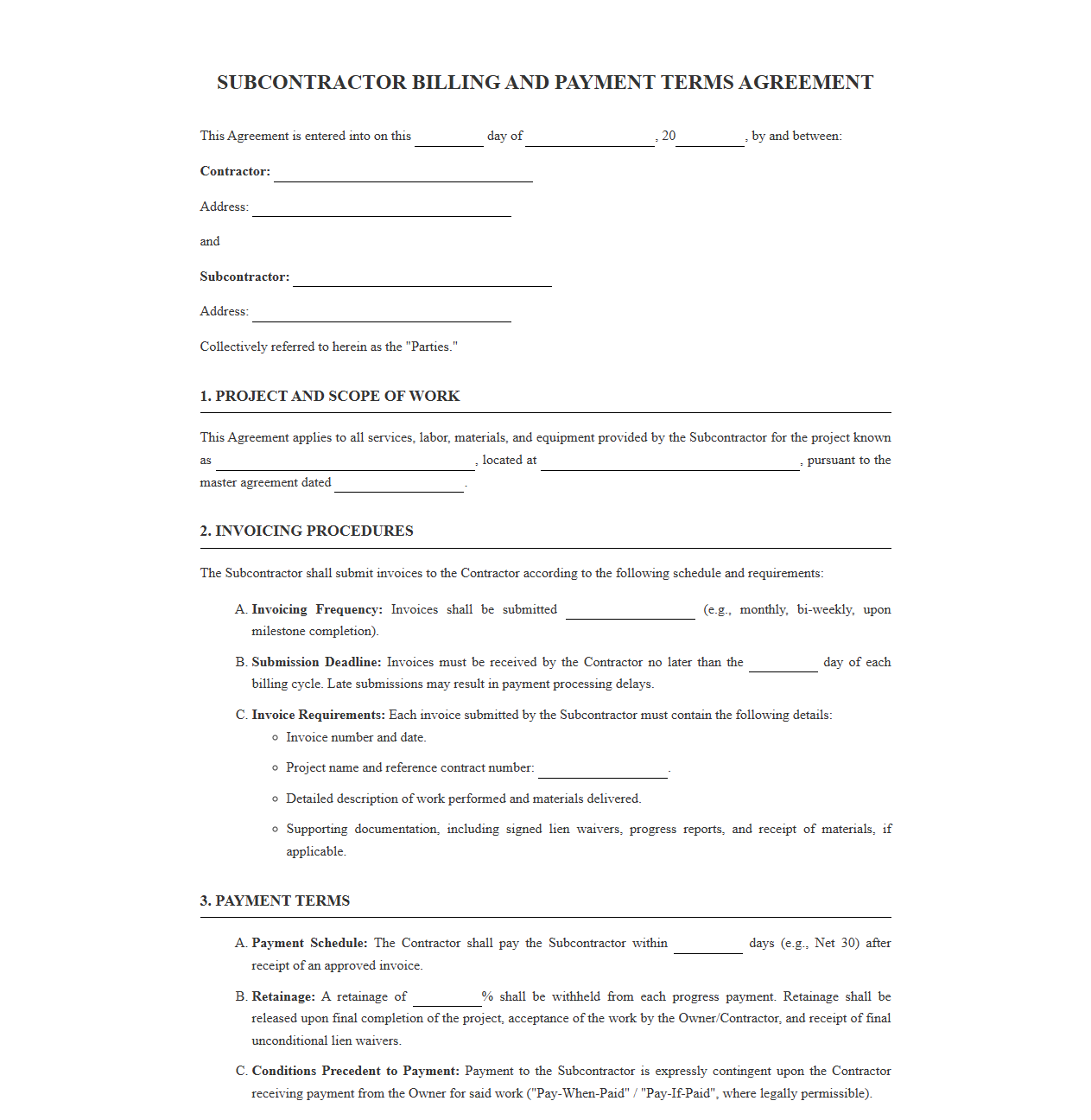 Download: .PDF
Standard Subcontractor Payment and Invoicing Policy
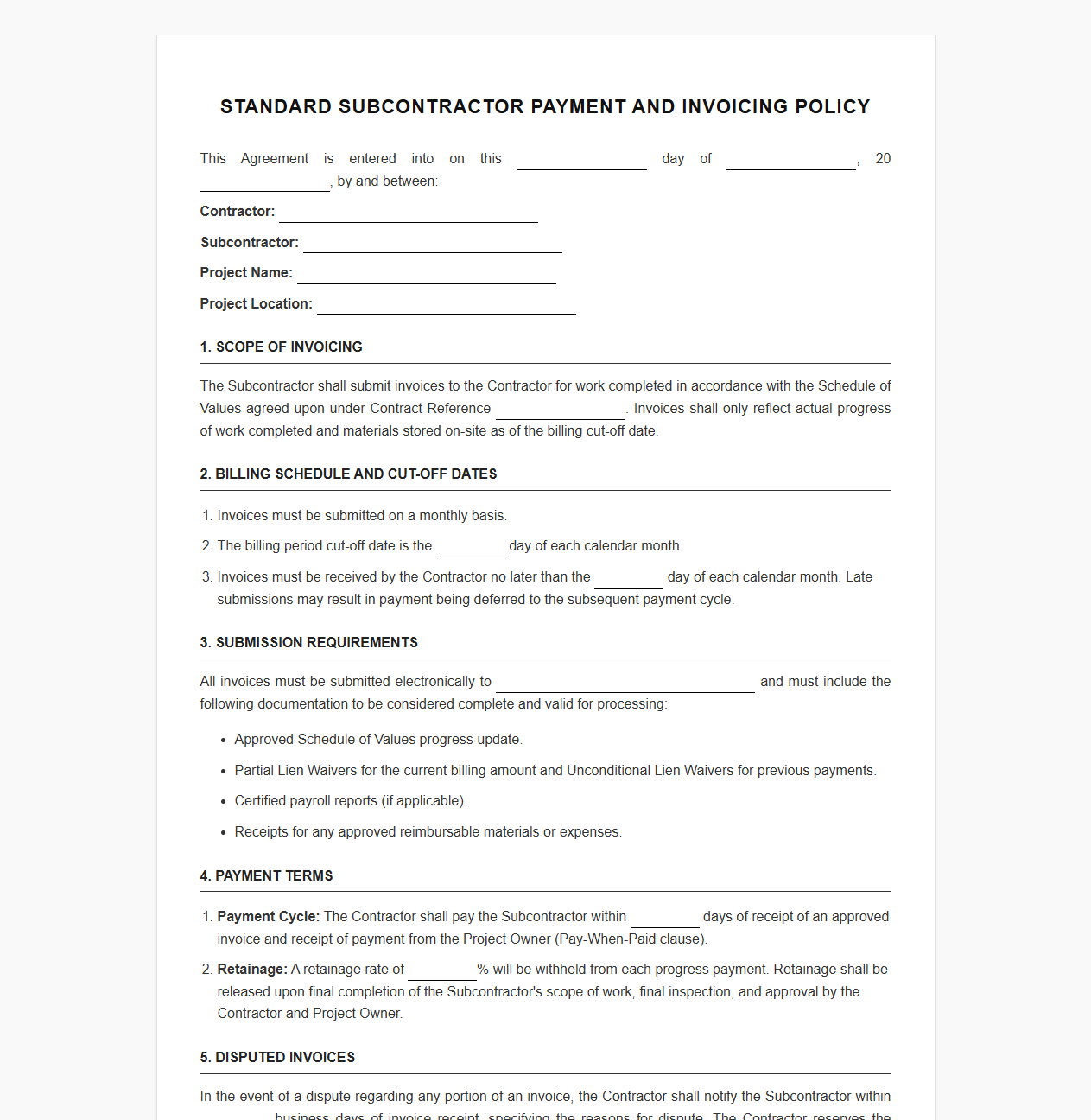 Download: .PDF
Subcontractor Compensation and Invoice Agreement
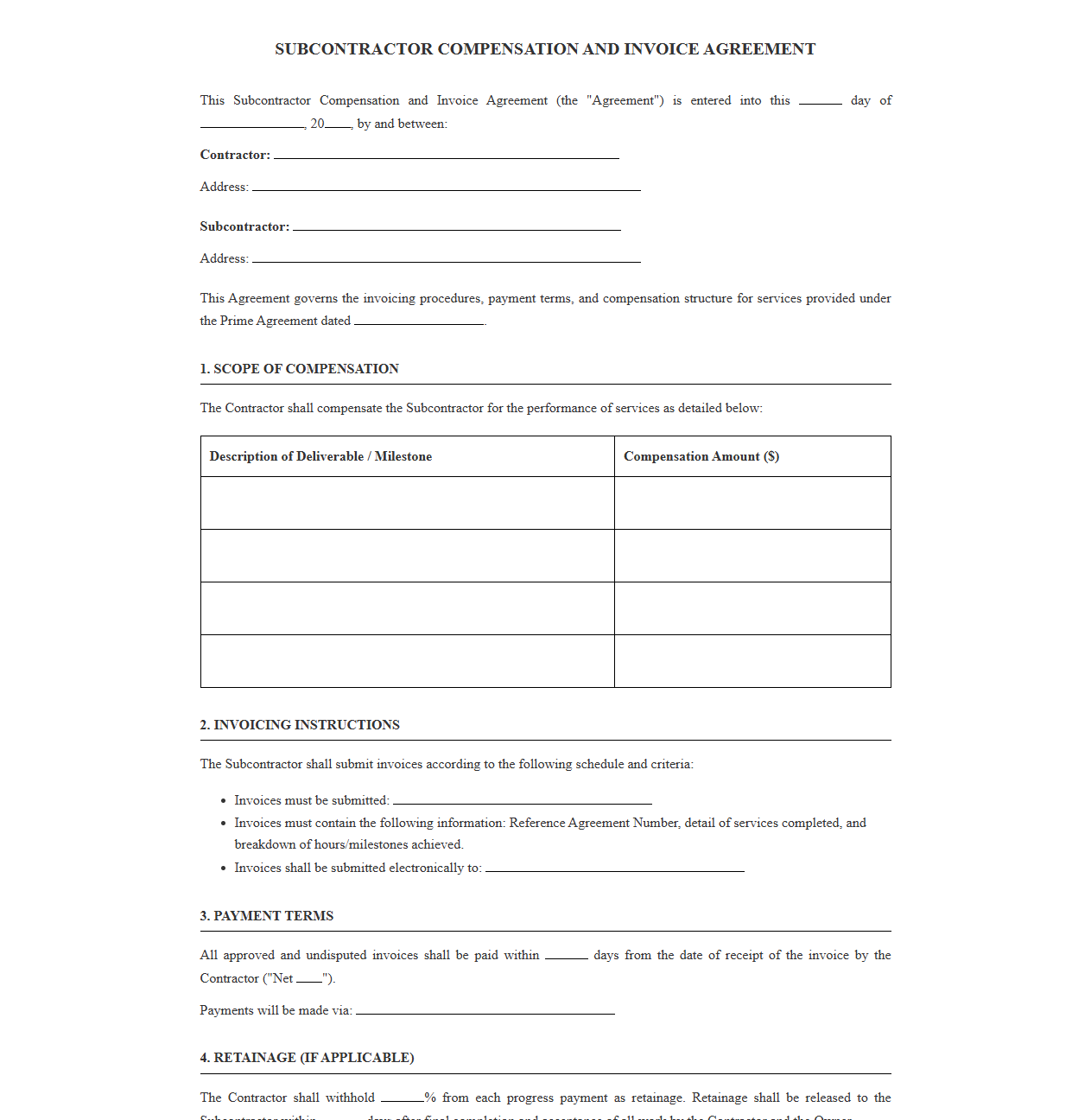 Download: .PDF
Master Agreement for Subcontractor Invoicing and Payment
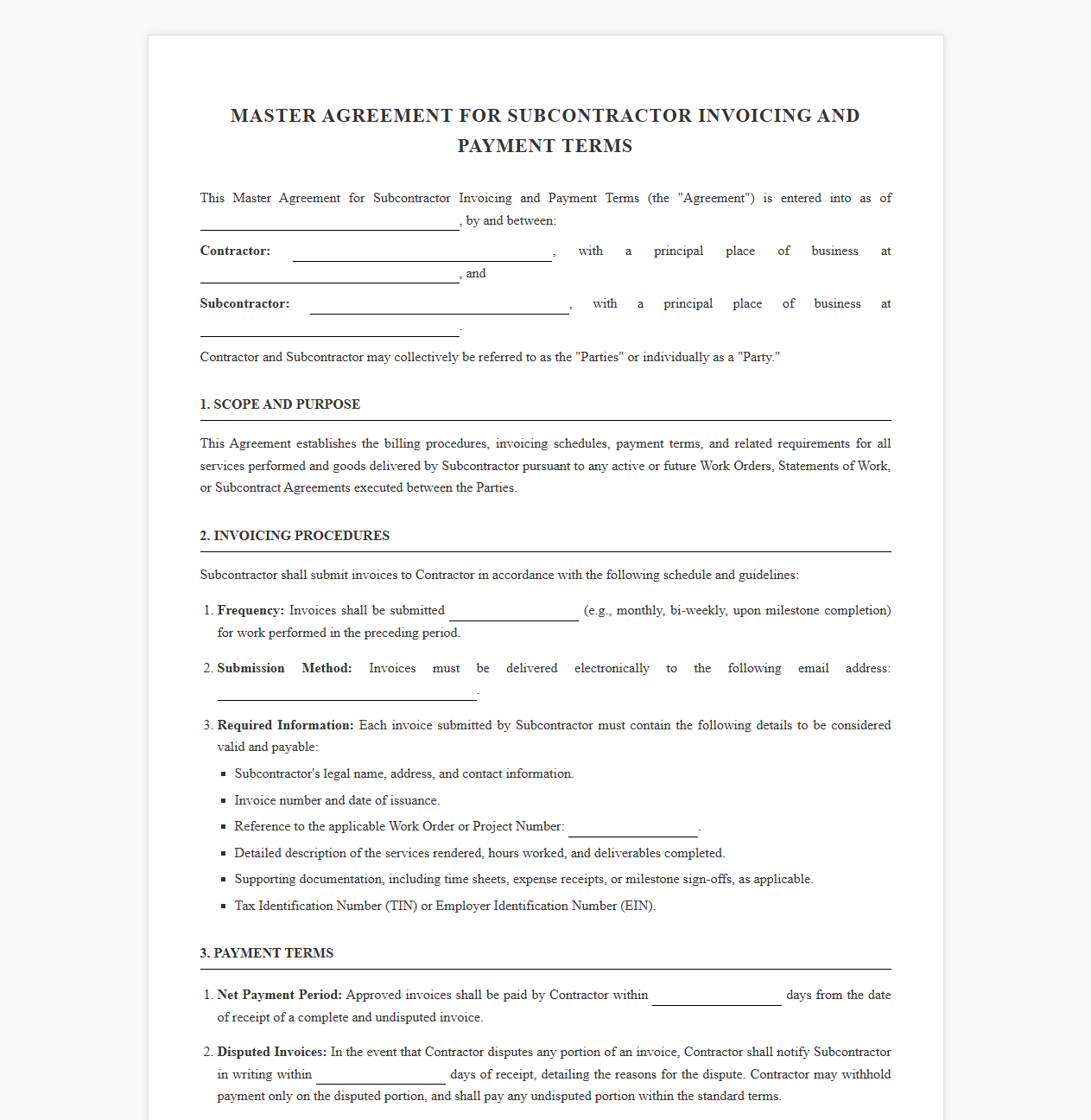 Download: .PDF
Subcontractor Invoice Submission and Payment Schedule Agreement
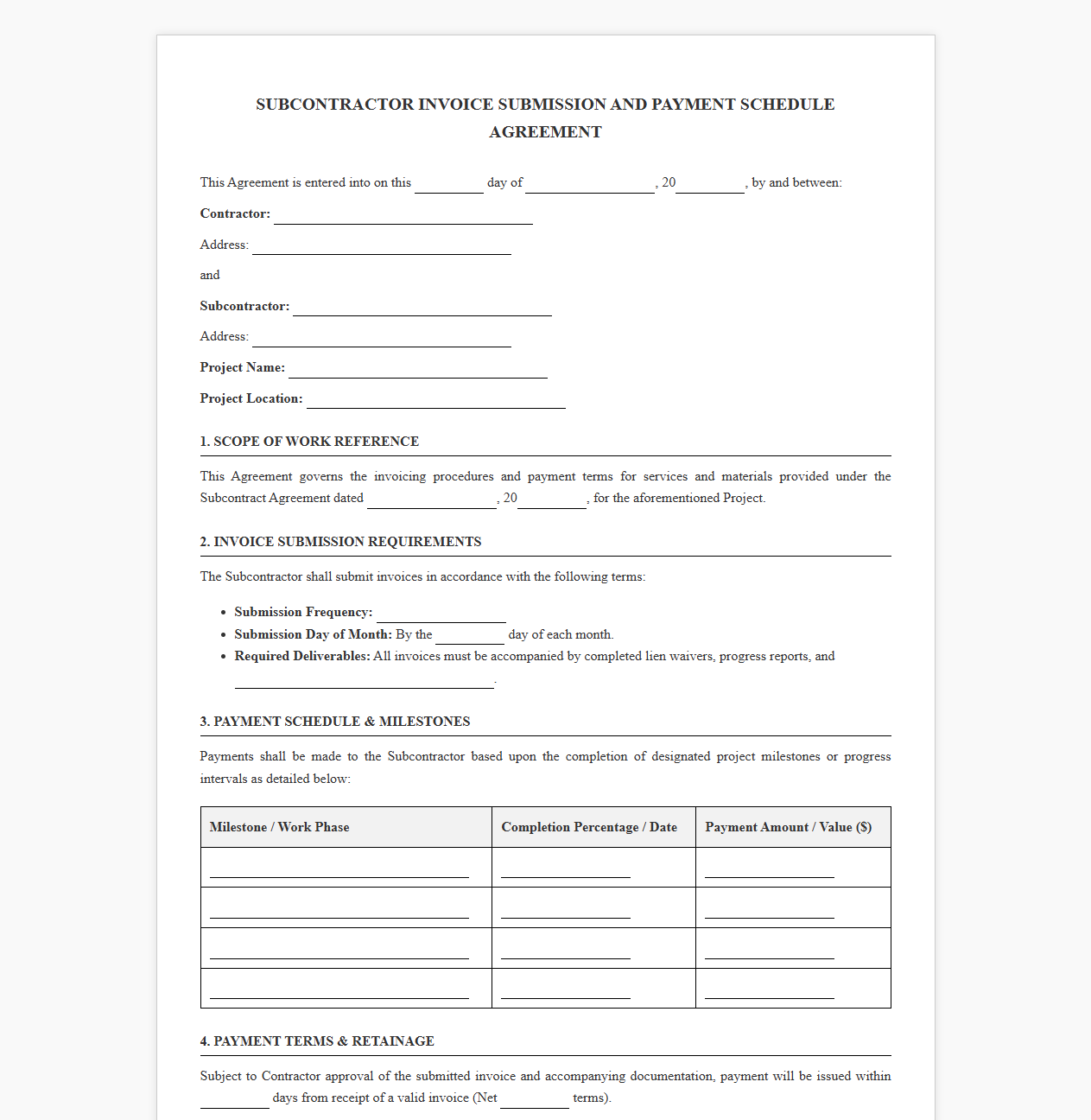 Download: .PDF
Establishing the Foundation: Why Subcontractor Payment Agreements Matter
In the construction industry, smooth financial operations are the bedrock of any successful build. A well-structured subcontractor payment terms agreement serves as a vital safeguard, ensuring that both general contractors and trade professionals remain aligned from day one. By clearly defining how, when, and under what conditions payments are made, this document actively prevents costly billing disputes that can stall progress on the jobsite.
Beyond conflict resolution, a transparent payment agreement significantly improves project cash flow for all parties involved. When subcontractors know exactly when to expect compensation, they can manage their labor and material costs more effectively. This predictability fosters deep trust, transforming transactional business relationships into strong, long-term partnerships built on mutual respect and financial transparency.
Key Elements of an Effective Payment Terms Template
To ensure maximum legal and operational protection, a standardized subcontractor payment template must be comprehensive yet easy to understand. Failing to define basic transactional boundaries can lead to misunderstandings and delayed handoffs.
- Scope of Work: A precise description of the exact tasks, deliverables, and materials the subcontractor is responsible for providing.
- Invoicing Procedures: Explicit instructions on how to submit invoices, including required templates, billing cycles, and submission deadlines.
- Payment Methods: Clear terms specifying the acceptable payment channels, such as direct deposit (ACH), physical checks, or electronic wire transfers.
- Verification Requirements: The documentation required to release funds, such as signed lien waivers, proof of insurance, and inspection approvals.
Defining Payment Milestones and Schedules
Establishing clear payment schedules is critical to maintaining a steady workflow. Rather than relying on vague timelines, agreements should link disbursements to specific calendar dates or verifiable construction milestones, such as the completion of framing or electrical rough-ins. Additionally, contractors must clearly define conditional clauses like "pay-when-paid" to manage risk distribution appropriately.
"Payment shall be disbursed to the Subcontractor within ten (10) business days of the General Contractor receiving corresponding payment from the Project Owner, subject to approval of the completed work milestone."
Managing Retainage, Backcharges, and Deductions
To guarantee the quality of work through to project completion, contracts often include financial safeguards. Retainage refers to a specific percentage of the contract value-typically 5% to 10%-withheld from progress payments until the overall project reaches substantial completion and final inspection.
Similarly, the contract must address backcharges, which are deductions applied to a subcontractor's payout to cover the cost of repairing defective work or cleaning up uncompleted tasks. Outlining these mechanisms clearly in the agreement ensures that final closeouts do not trigger sudden, unexpected financial disagreements.
Resolving Disputes: Clear Paths to Conflict Resolution
Even with a robust contract, financial disagreements can arise. Incorporating structured dispute resolution clauses prevents minor issues from escalating into disruptive, expensive litigation. The agreement should mandate a formal notice period, during which the aggrieved party must document and report the payment issue in writing to allow for an internal review.
If the issue remains unresolved, the contract should outline sequential steps starting with mediation, where a neutral third party helps negotiate a settlement. Should that fail, binding arbitration serves as a faster, private alternative to traditional court proceedings, ensuring a swift resolution that minimizes impact on the construction schedule.
Best Practices for Implementing and Customizing Your Templates
Deploying a standardized agreement requires a balance between consistency and project-specific flexibility. To seamlessly integrate these payment terms into your operations, consider the following structured steps:
- Customize for Project Specifics: Adjust the template clauses to match the unique risk profile, local regulations, and scale of each specific construction job.
- Maintain Open Communication: Walk through the payment terms with the subcontractor before work begins to ensure total alignment and answer any operational questions.
- Leverage Digital Signature Tools: Use secure e-signature platforms to speed up contract execution, automate reminders, and maintain a centralized digital paper trail.
Securing Your Project's Financial Health
Adopting standardized subcontractor payment agreements is a critical step in professionalizing your construction management workflow. By establishing transparent expectations and formalized conflict resolution pathways, you significantly reduce administrative friction and costly project delays.
Investing the time to draft and implement clear payment contracts is a strategic way to protect your profit margins, minimize administrative overhead, and build a loyal network of skilled subcontractors who trust your business and prioritize your builds.
Leave a comment