

General contractors and enterprise leaders constantly battle the looming threat of unexpected tax liabilities and audit penalties stemming from subcontractor non-compliance. As regulatory bodies intensify their scrutiny of independent contractor classifications, relying on informal agreements is no longer a viable operational strategy.
Implementing structured liability frameworks grants organizations a vital shield, ensuring robust financial protection against secondary tax assessments. However, it is important to stipulate that these legal instruments are not one-size-fits-all remedies; they must be meticulously customized to align with shifting state and federal tax codes to remain enforceable. For instance, incorporating specific "hold harmless" clauses regarding unpaid self-employment taxes or Form 1099 compliance can mean the difference between a seamless audit and devastating IRS penalties.
In this guide, we examine essential indemnification templates, dissect critical protective clauses, and outline the exact legal strategies needed to insulate your business from subcontractor-related tax exposure.
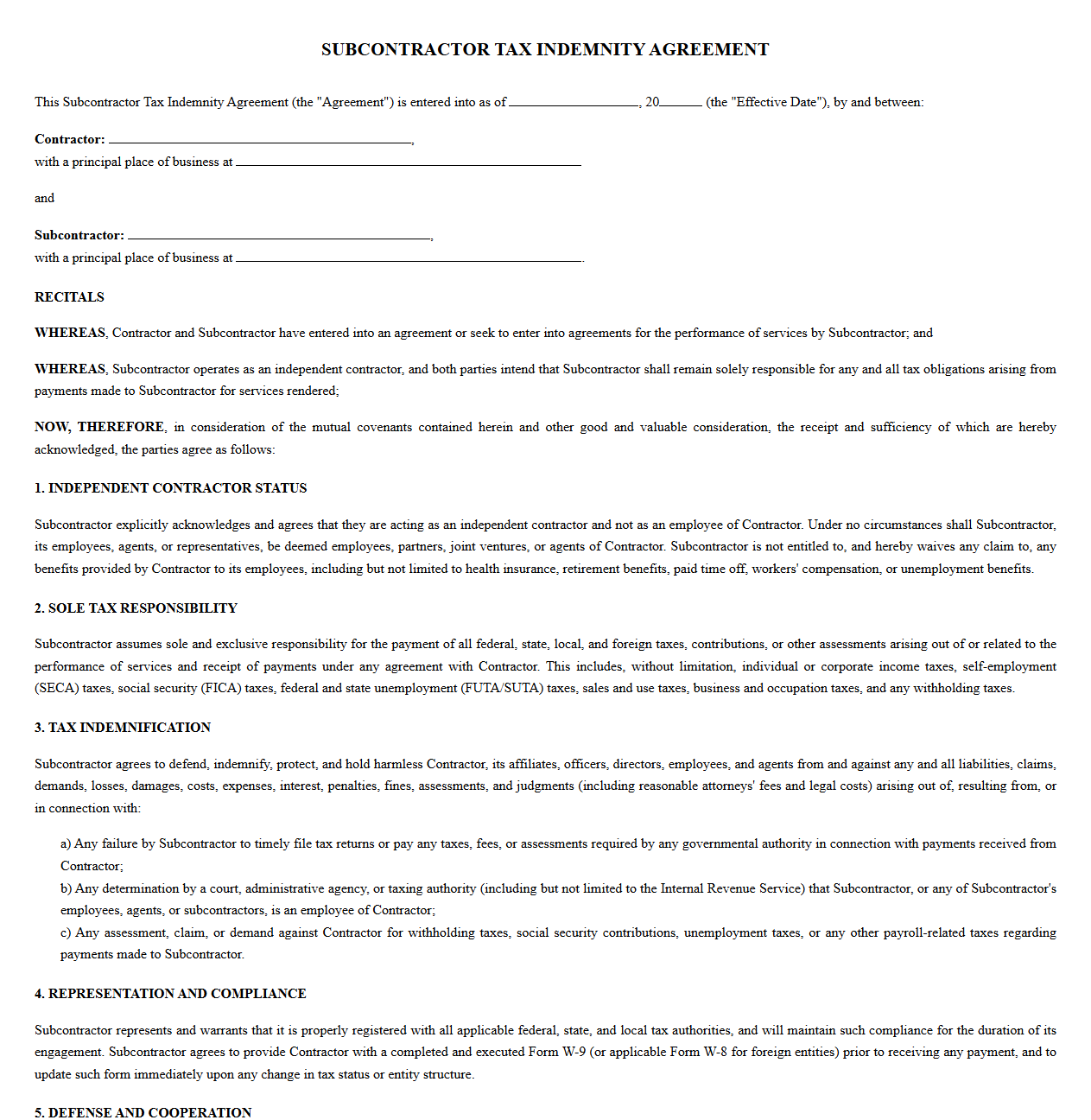
Subcontractor Tax Indemnity Agreement Template
 Download: .PDF
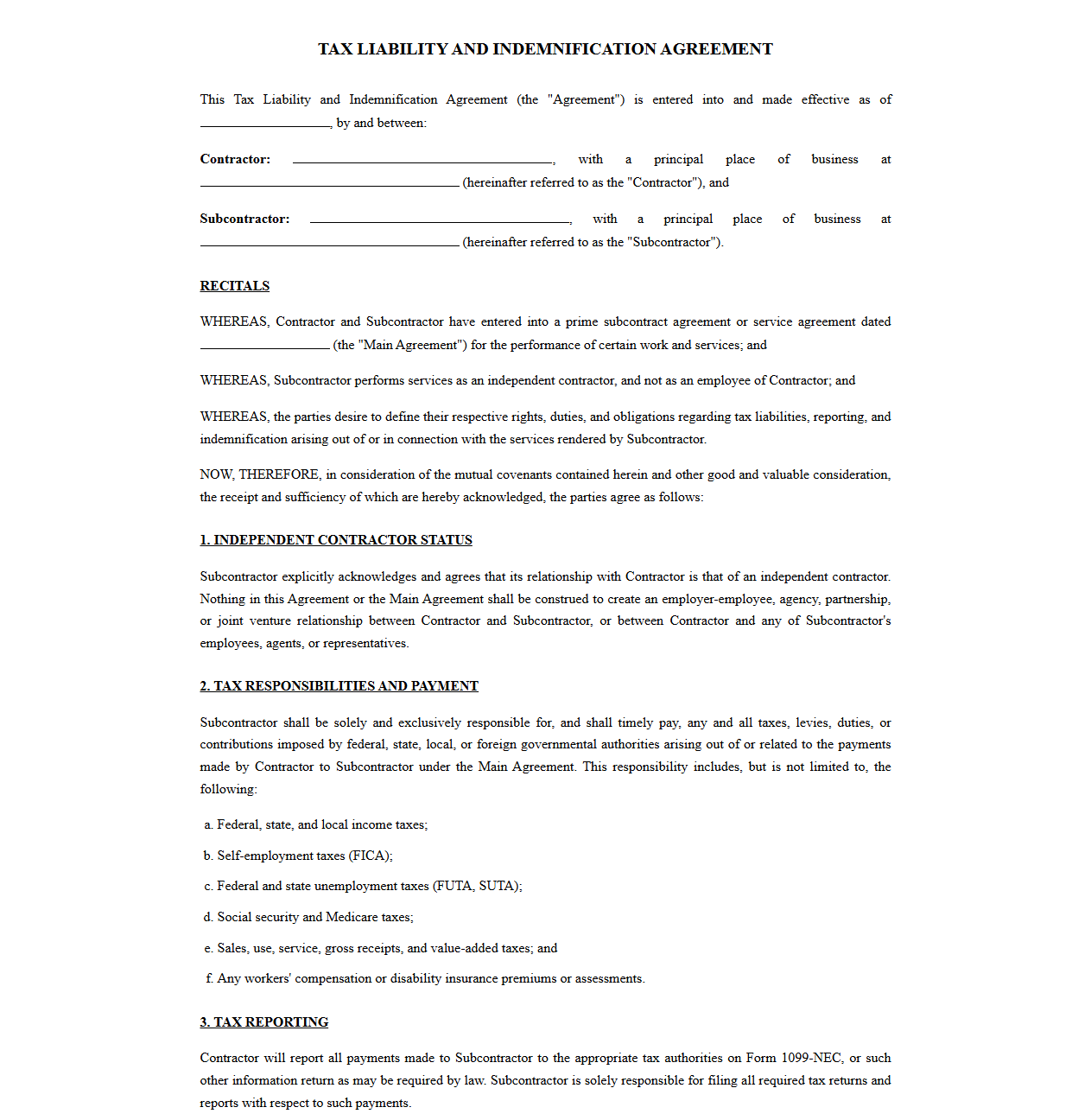
Tax Liability and Indemnification Agreement for Subcontractors
 Download: .PDF
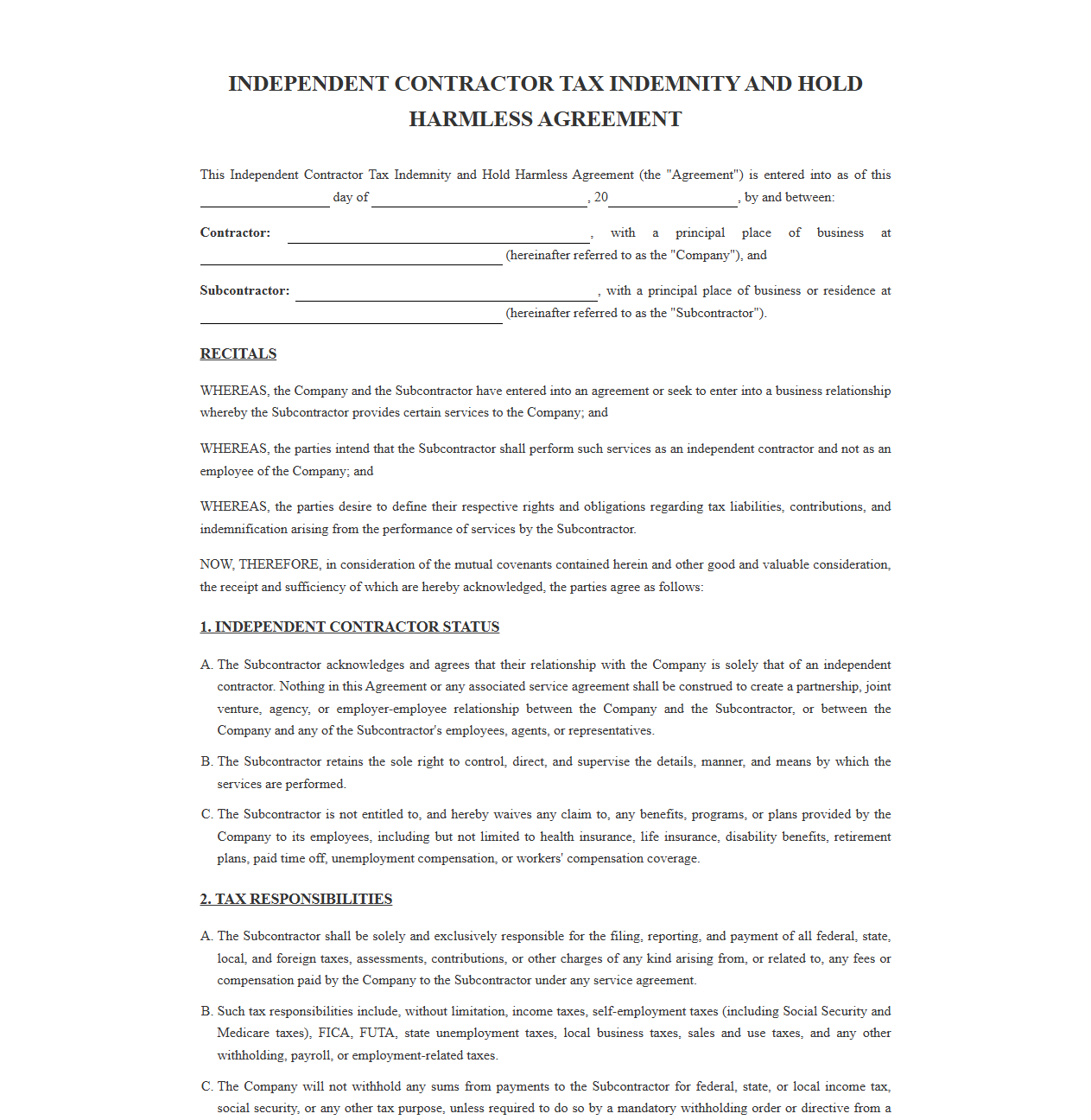
Independent Contractor Tax Indemnity and Hold Harmless Agreement
 Download: .PDF
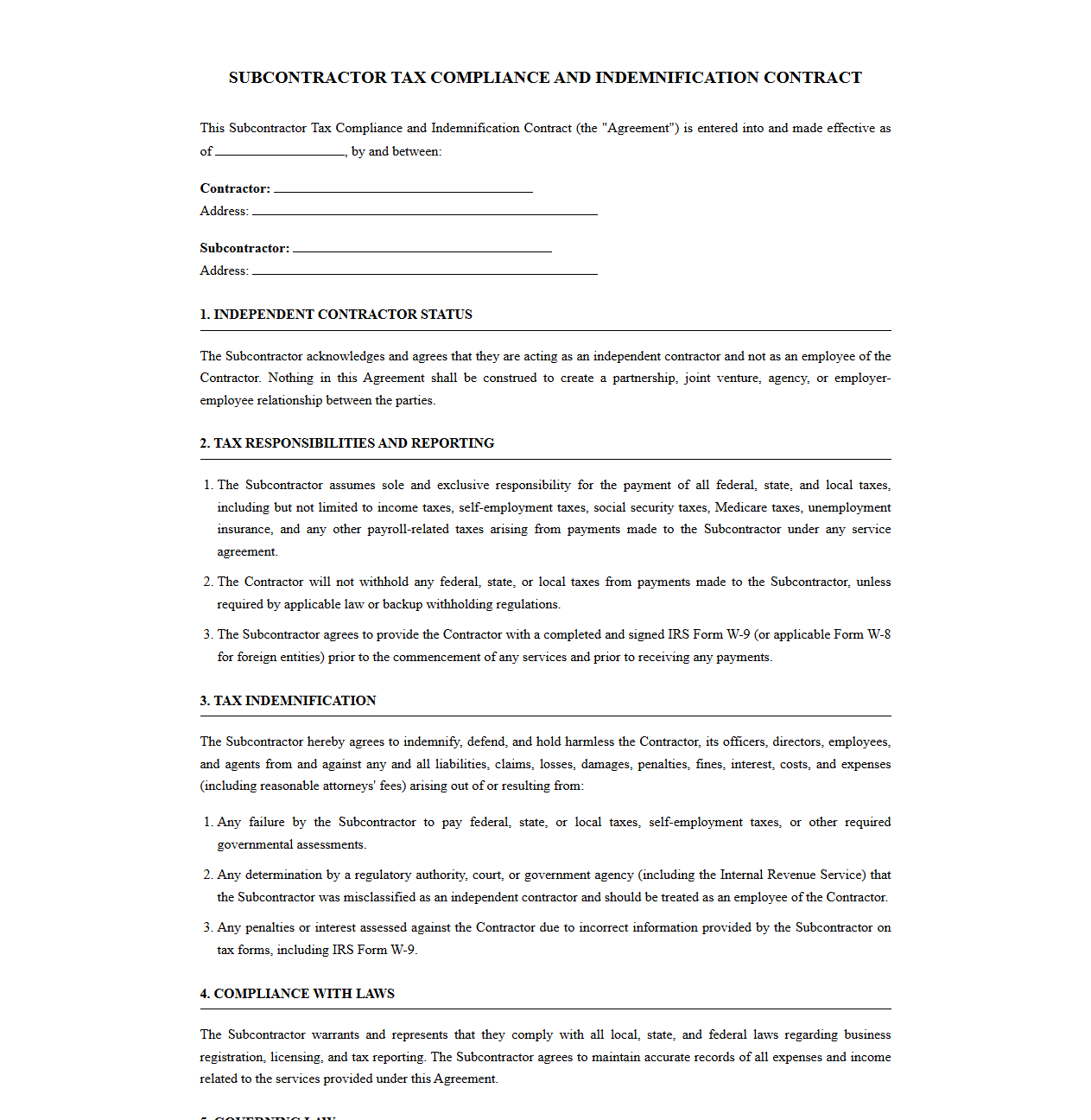
Subcontractor Tax Compliance and Indemnification Contract
 Download: .PDF
Tax Responsibility and Indemnity Agreement for Subcontracted Services
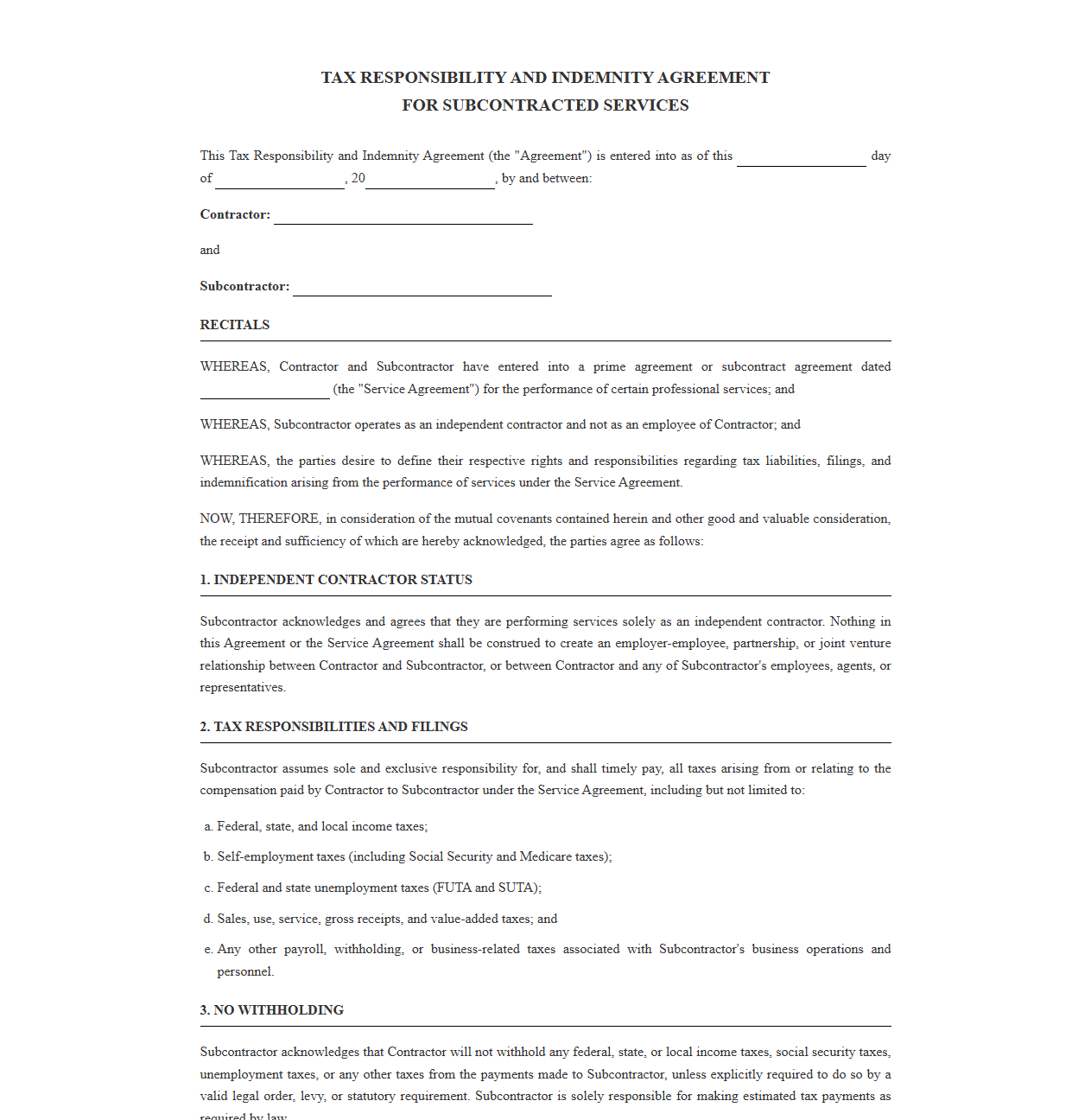 Download: .PDF
Subcontractor Agreement for Tax Liability Indemnification
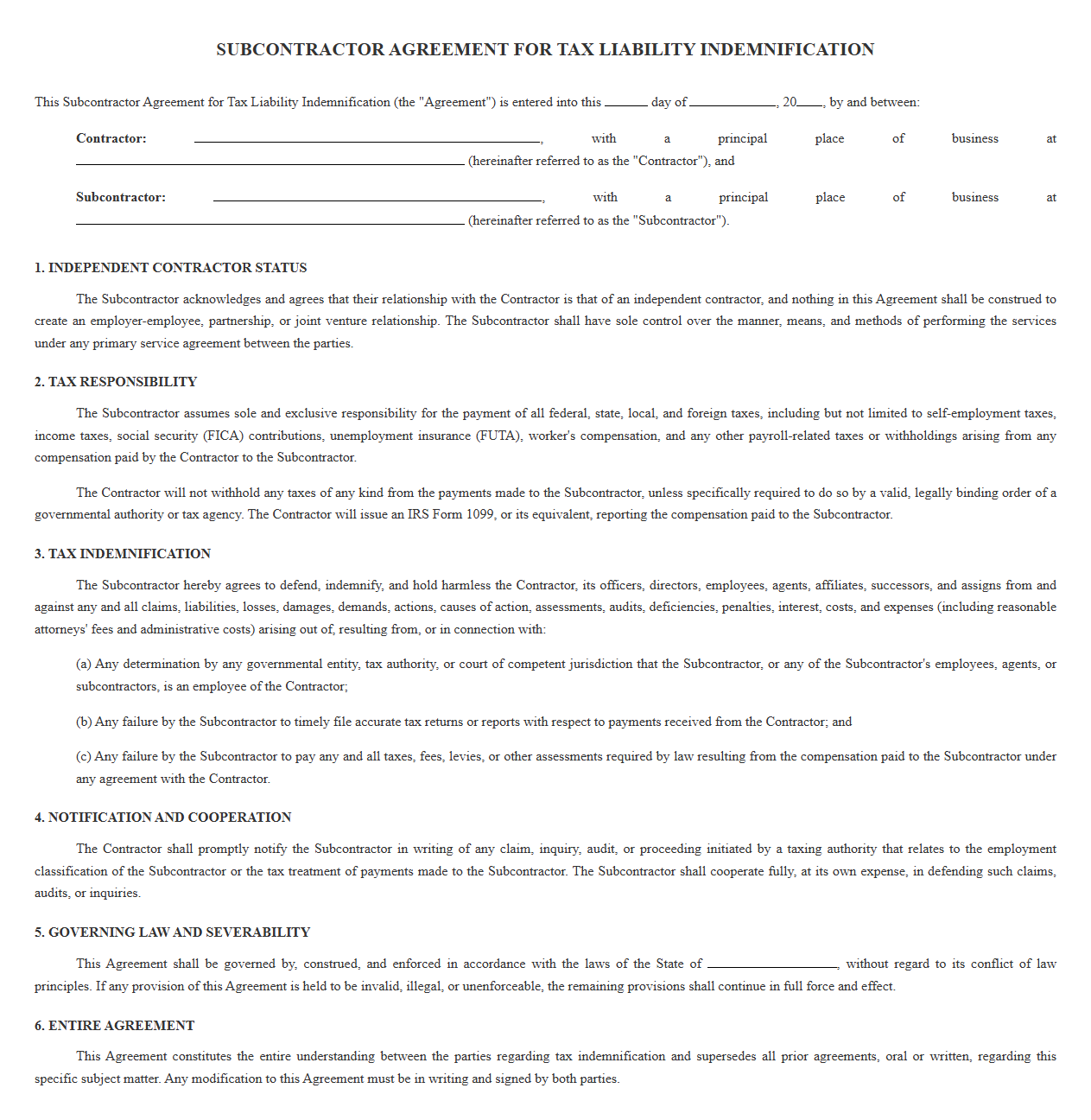 Download: .PDF
Master Subcontractor Tax Indemnity and Liability Release
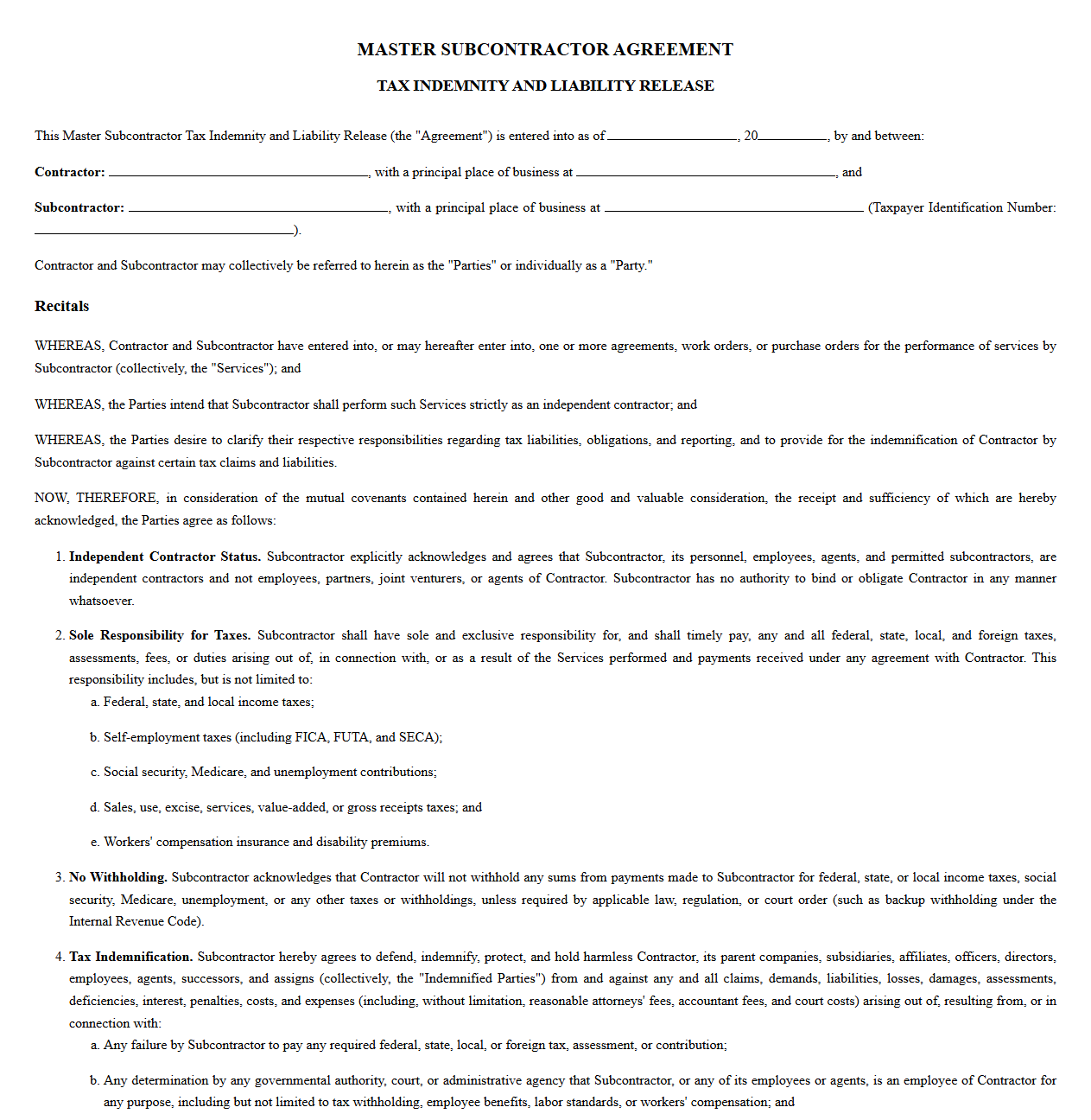 Download: .PDF
Tax Indemnification Clause and Agreement for Subcontractors
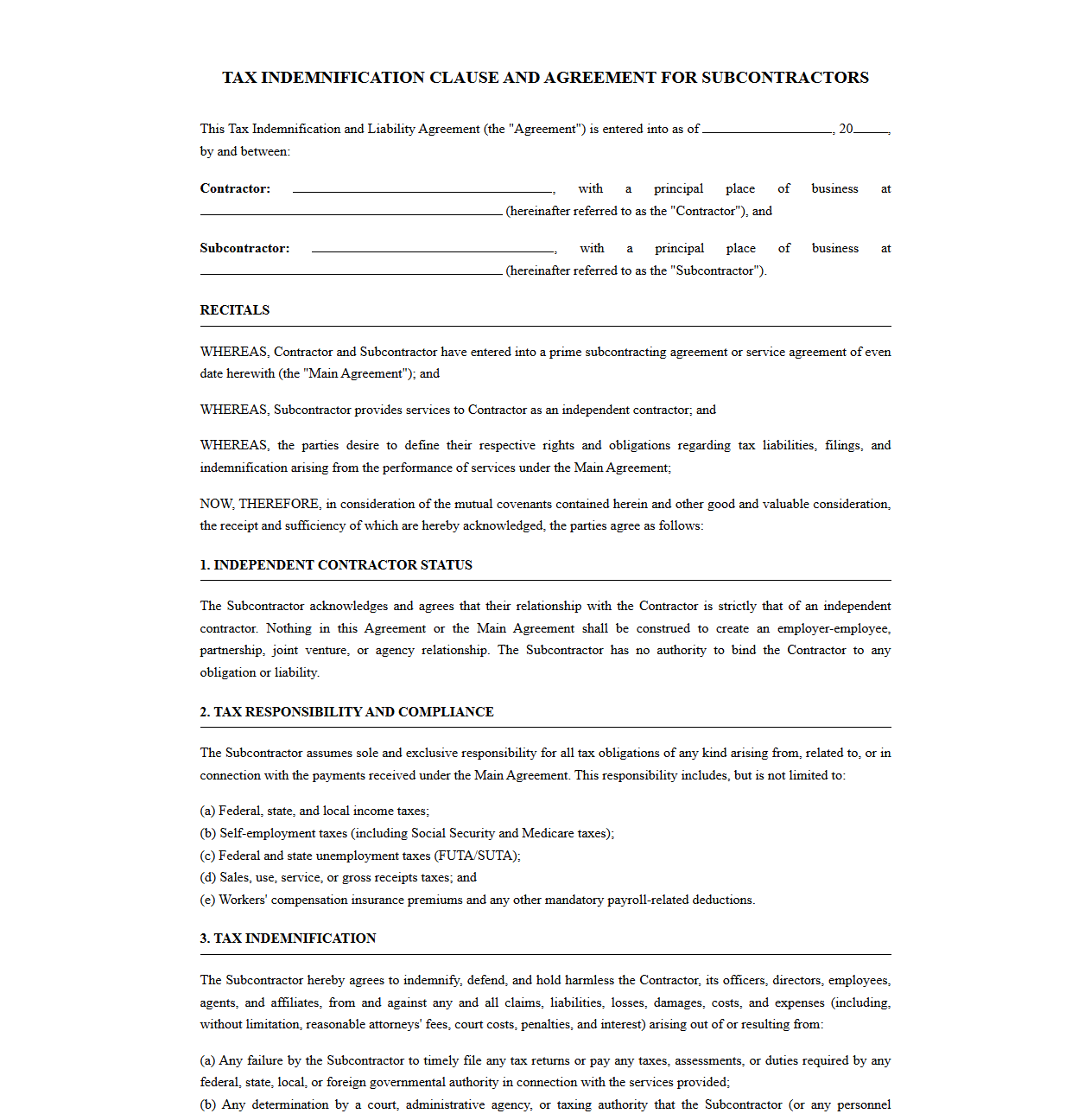 Download: .PDF
Construction Subcontractor Tax Indemnity and Liability Agreement
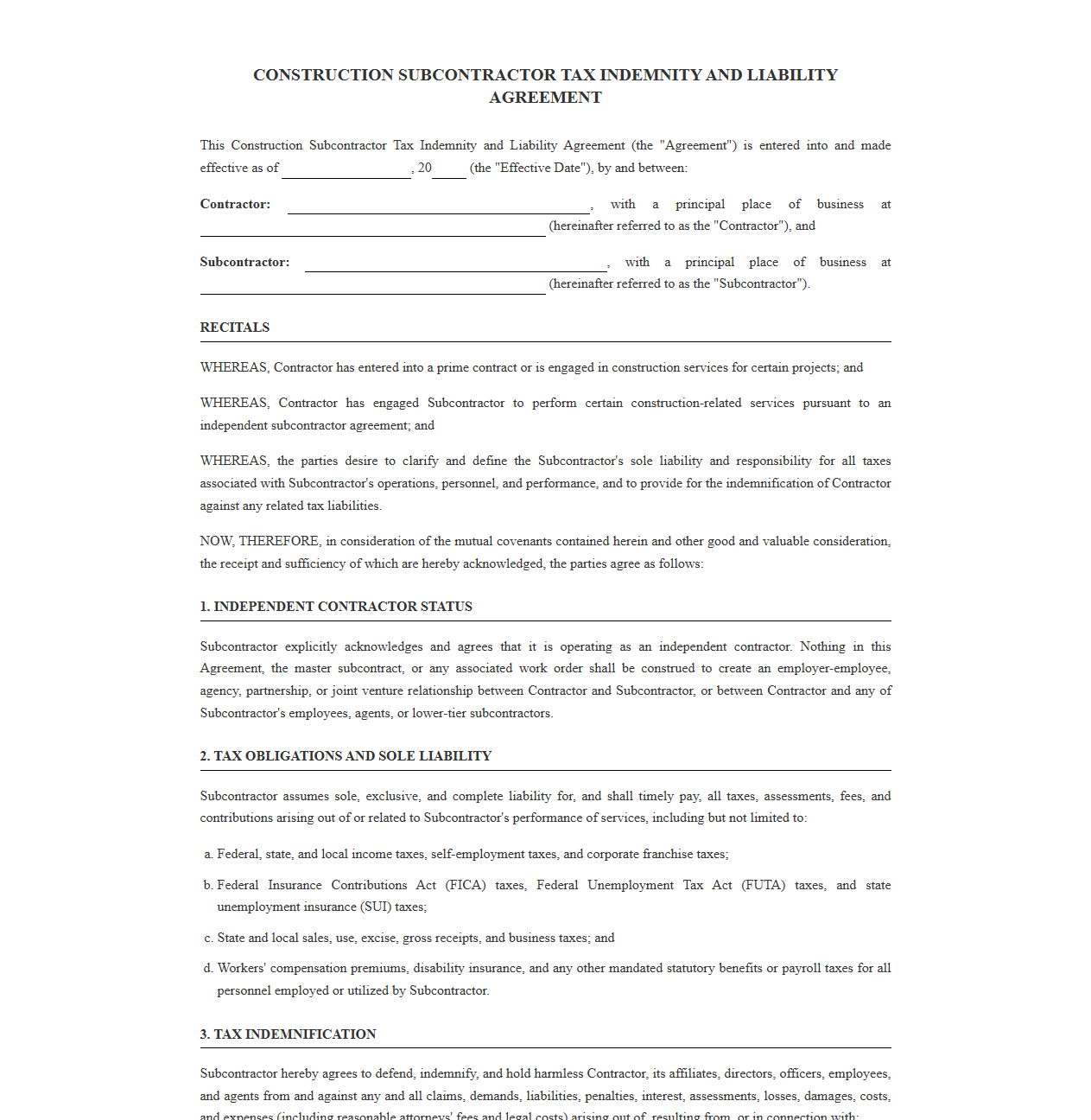 Download: .PDF
Understanding Subcontractor Tax Liabilities and Compliance Risks
General contractors operate in a high-stakes regulatory environment where the utilization of independent subcontractors is standard practice. However, this operational model carries substantial financial dangers. State taxing authorities and the IRS actively scrutinize worker classifications, exposing unsuspecting general contractors to devastating retroactive payroll tax assessments, unpaid Federal Insurance Contributions Act (FICA) taxes, and Federal Unemployment Tax Act (FUTA) obligations. When a hiring entity fails to establish clear boundaries, a single reclassification ruling can trigger catastrophic financial exposure.
To shield the primary business from these severe consequences, general contractors must implement robust contractual protections. Relying on verbal agreements or generic work orders is insufficient during aggressive IRS audits. To mitigate these tax liabilities, businesses must deploy specialized tax indemnification agreements that contractually shift the burden of tax compliance, reporting, and payment back to the subcontractor, ensuring the primary business remains insulated from costly regulatory interventions.
The Legal Distinction: Independent Contractor vs. Employee Status
Tax authorities evaluate the validity of a subcontractor relationship based on the economic reality of the arrangement rather than the label used in a contract. If an audit reveals that a general contractor exercises too much control over how, when, or where a subcontractor works, the relationship may be legally reclassified as an employer-employee relationship, triggering immediate penalties and back-tax demands.
To determine whether a worker is legally an independent subcontractor or a W-2 employee, regulatory agencies analyze three primary categories of control:
- Behavioral Control: Whether the hiring business has the right to direct and control how the worker does the task, including instructions on tools, sequence of work, and training.
- Financial Control: Whether the business has the right to control the business aspects of the worker's job, including how the worker is paid, whether expenses are reimbursed, and who provides the necessary tools and equipment.
- Relationship of the Parties: How the business and worker perceive their interaction, evaluated through written contracts, employee-type benefits (insurance, vacation pay), and the permanency of the relationship.
Drafting Essential Tax Indemnification Clauses
An effective subcontractor agreement must contain explicit, unambiguous language regarding tax responsibilities. A vague statement indicating that the subcontractor is "responsible for their own taxes" is rarely defensible in a formal audit. The contract must state that the subcontractor is an independent entity solely responsible for filing, reporting, and paying all federal, state, and local self-employment taxes, income taxes, and payroll-related withholding.
The following template illustrates a standard tax-specific indemnification clause designed to hold the subcontractor fully accountable for their tax obligations:
"Subcontractor covenants and agrees that it is an independent contractor and is solely responsible for the payment of all federal, state, and local income taxes, self-employment taxes, social security, Medicare, unemployment taxes, and any other payroll-related withholdings arising from the compensation paid under this Agreement. Subcontractor agrees to indemnify, defend, and hold harmless the Contractor from any and all claims, damages, liabilities, or assessments made by any taxing authority resulting from Subcontractor's failure to report and pay such taxes."
Defining Liability Limits and Financial Hold Harmless Provisions
Should a taxing authority challenge a worker's status, the hiring entity must have a contractually enforceable mechanism to recoup any financial losses. A general contractor must construct comprehensive liability limitation and protection provisions. These clauses must survive the termination of the contract to ensure long-term safety, as audits often occur years after a project is completed.
The core of this defense rests on a robust hold harmless provision that explicitly covers all back-taxes, statutory penalties, accrued interest, and reasonable legal fees. Furthermore, the contract must establish a clear duty to defend, forcing the subcontractor to finance the legal defense of the hiring business if a regulatory agency initiates an inquiry regarding the subcontractor's tax compliance or employment classification.
Audit Cooperation and Documentation Requirements
If a tax agency initiates an audit, the hiring entity must quickly produce verifiable documentation to prove the independent status of its subcontractors. Contractors cannot afford to search for missing paperwork mid-audit. Agreements should mandate that subcontractors cooperate fully with any state or federal tax inquiries and provide necessary documentation within a strict timeline, typically 5 to 10 business days from a written request.
Contracts must explicitly require the subcontractor to maintain and provide the following records upon request:
- A signed and fully executed, valid Form W-9 prior to any payments being disbursed.
- Proof of federal and state tax filings, such as redacted Schedule C forms or corporate tax returns showing business income.
- Proof of independent business operations, such as active marketing materials, active business entity registrations, or active local business licenses.
- Invoices submitted on professional business letterhead matching the subcontractor's registered business name.
Best Practices for Onboarding and Verification Templates
Enforceable contracts are only effective when paired with disciplined operational workflows. General contractors must implement a standardized onboarding process for every subcontractor before any physical work begins or compensation is issued. This proactive verification process serves as the first line of defense against future regulatory scrutiny, establishing a clear paper trail of compliance.
The onboarding workflow begins with verifying the legal and economic viability of the subcontractor's business entity. This includes confirming the subcontractor holds active general liability insurance and workers' compensation coverage. General contractors must run verification checks to ensure the business registration is active in the state of operation. This workflow prevents the accidental hiring of unregistered sole proprietors, which are frequently targeted for worker reclassification during audits.
Legal Remedies and Enforcement of Indemnity Breaches
When a subcontractor fails to meet their tax responsibilities or refuses to cooperate during an audit, the general contractor must have immediate access to contractually defined legal remedies. The contract must outline swift enforcement actions to mitigate financial exposure before a taxing authority issues a formal assessment. The primary business should retain the right to suspend performance or terminate the contract immediately upon discovery of a tax compliance breach.
To enforce these terms, the agreement should establish explicit withholding rights, allowing the contractor to escrow funds otherwise due to the subcontractor if there is a reasonable dispute regarding tax filings or classification status. Additionally, the contract should dictate that any unresolved disputes regarding tax indemnification or classification must be submitted to binding arbitration, keeping complex tax-legal disputes out of public courts while expediting resolution.

Leave a comment