

Nonprofit development teams frequently struggle with the administrative bottleneck of acknowledging planned gifts, where a single reporting error can jeopardize donor relations and tax compliance. As sophisticated estate planning vehicles become increasingly common in modern philanthropy, relying on ad-hoc documentation processes is no longer sustainable.
Establishing standardized receipt templates solves this operational drag, granting your team the efficiency to secure compliance while accelerating donor stewardship. However, while these templates serve as robust foundational frameworks, they must be adapted to meet specific state regulations and your organization's unique charter stipulations.
Whether you are processing a straightforward bequest, a charitable gift annuity, or a complex gift of real estate, having structured templates ensures absolute accuracy. In this article, we will break down the essential components of standardized receipts for every major gift type, providing you with a turnkey toolkit to streamline your administration.
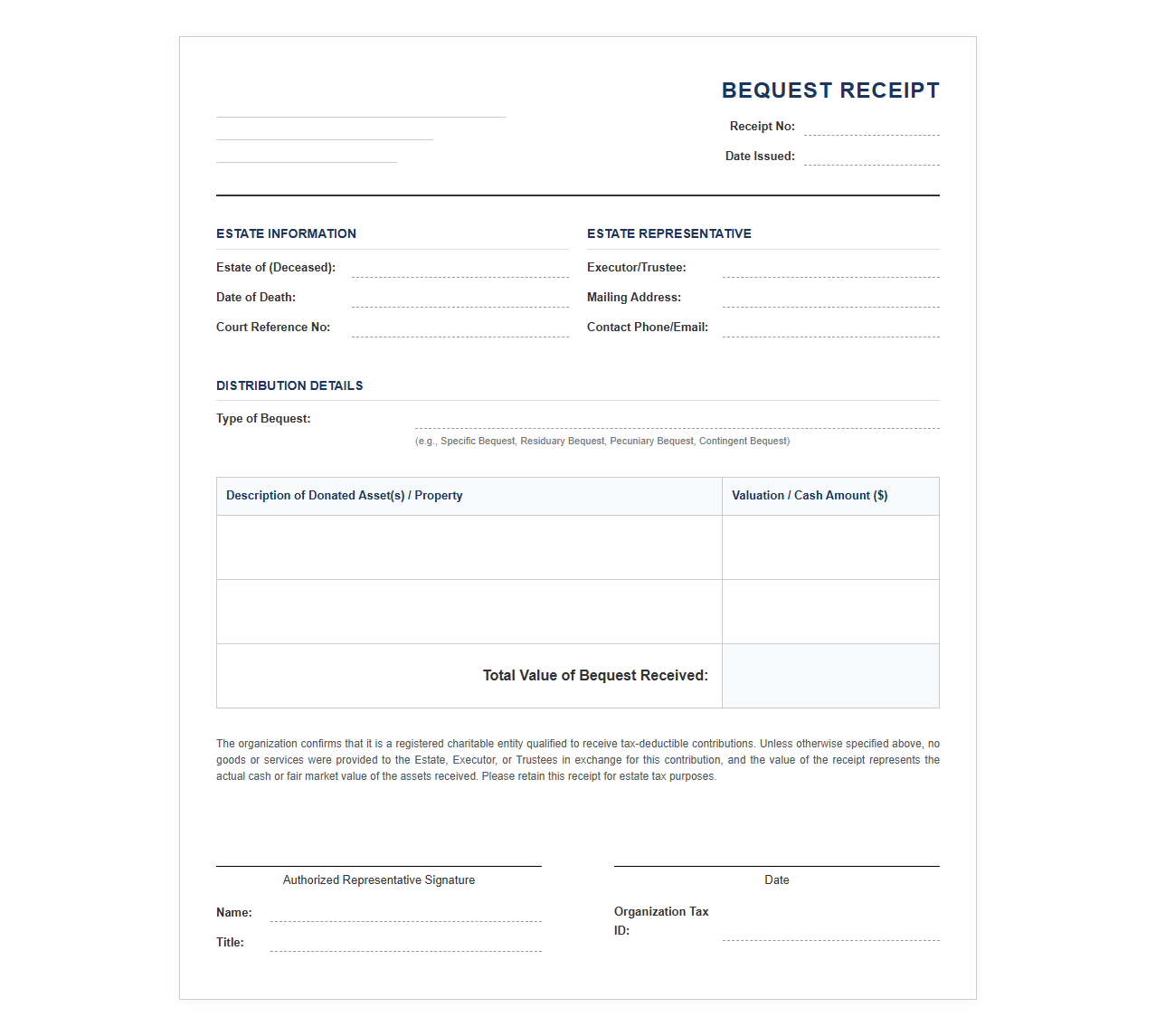
Bequest Donation Receipt Template
 Download: .PDF
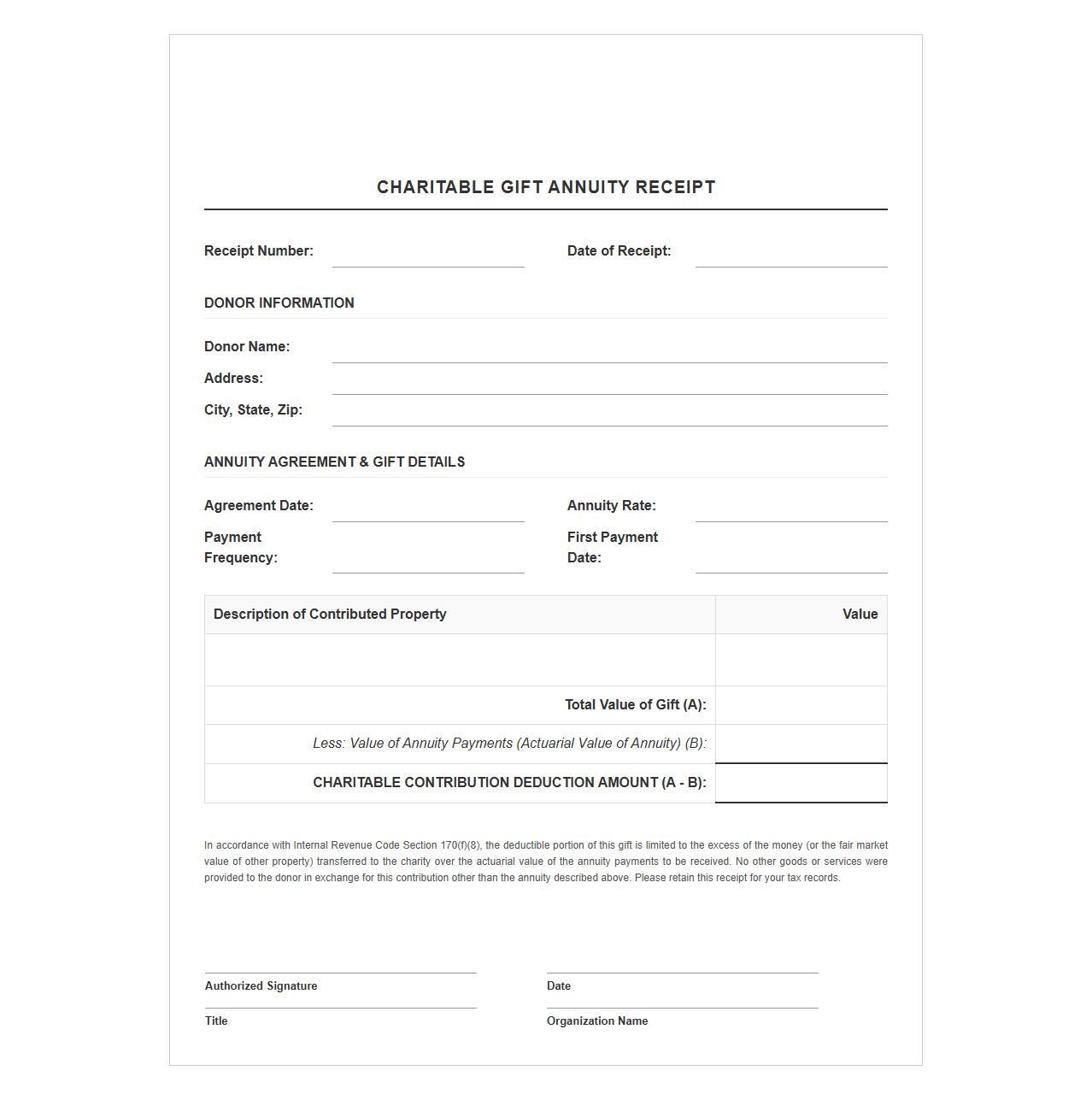
Charitable Gift Annuity Receipt Template
 Download: .PDF
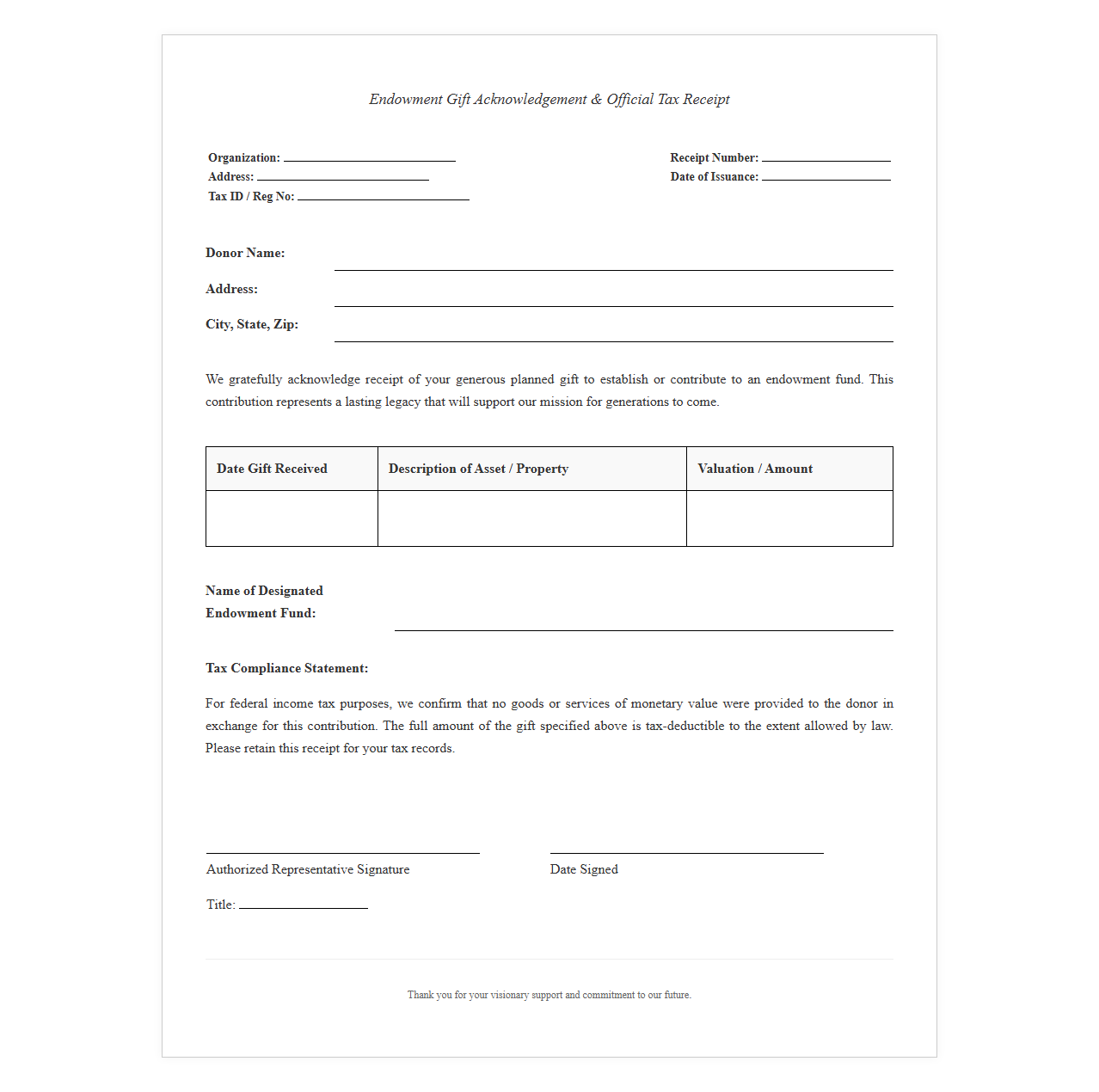
Endowment Gift Acknowledgement and Receipt Template
 Download: .PDF
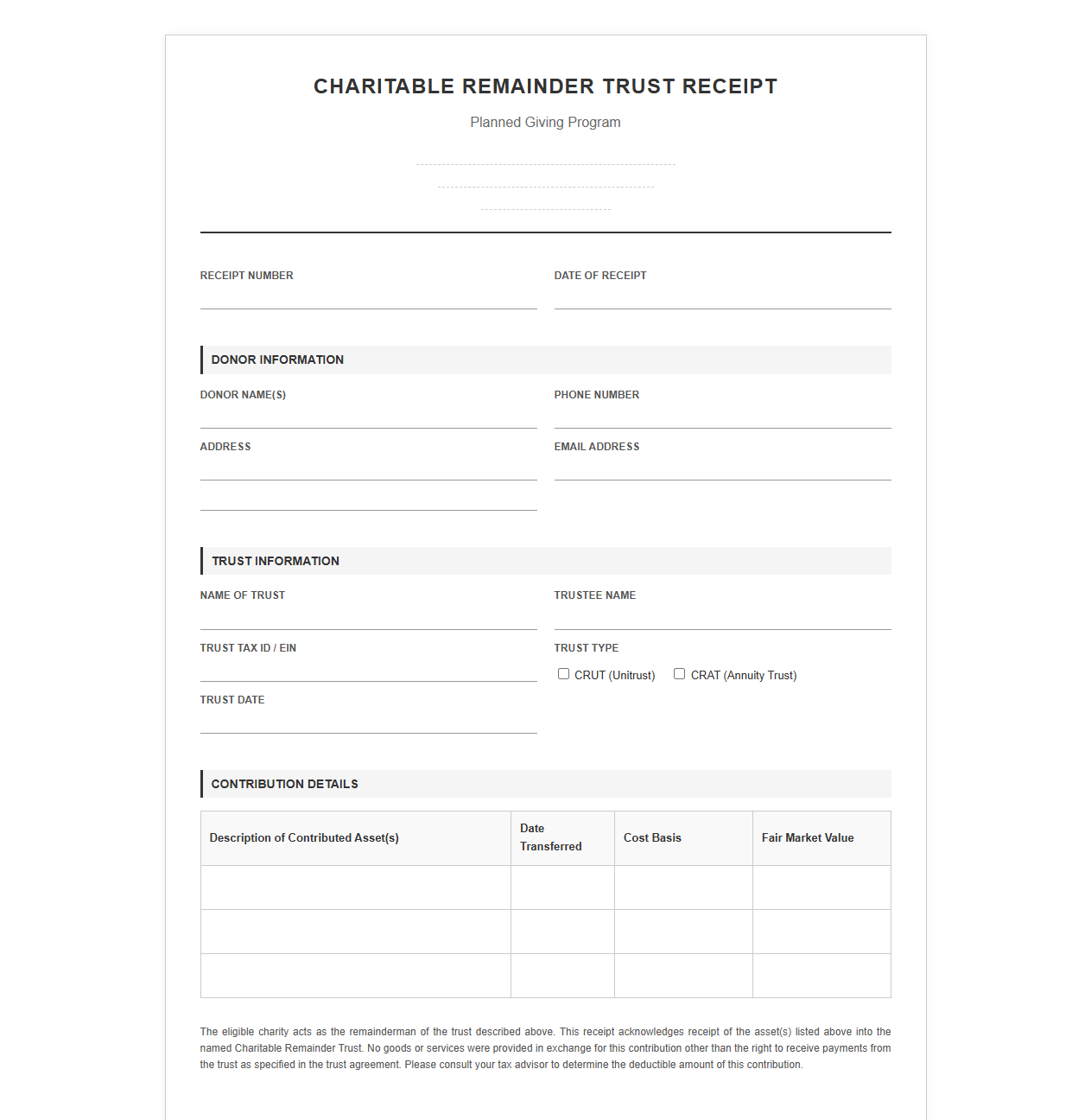
Charitable Remainder Trust Receipt Template
 Download: .PDF
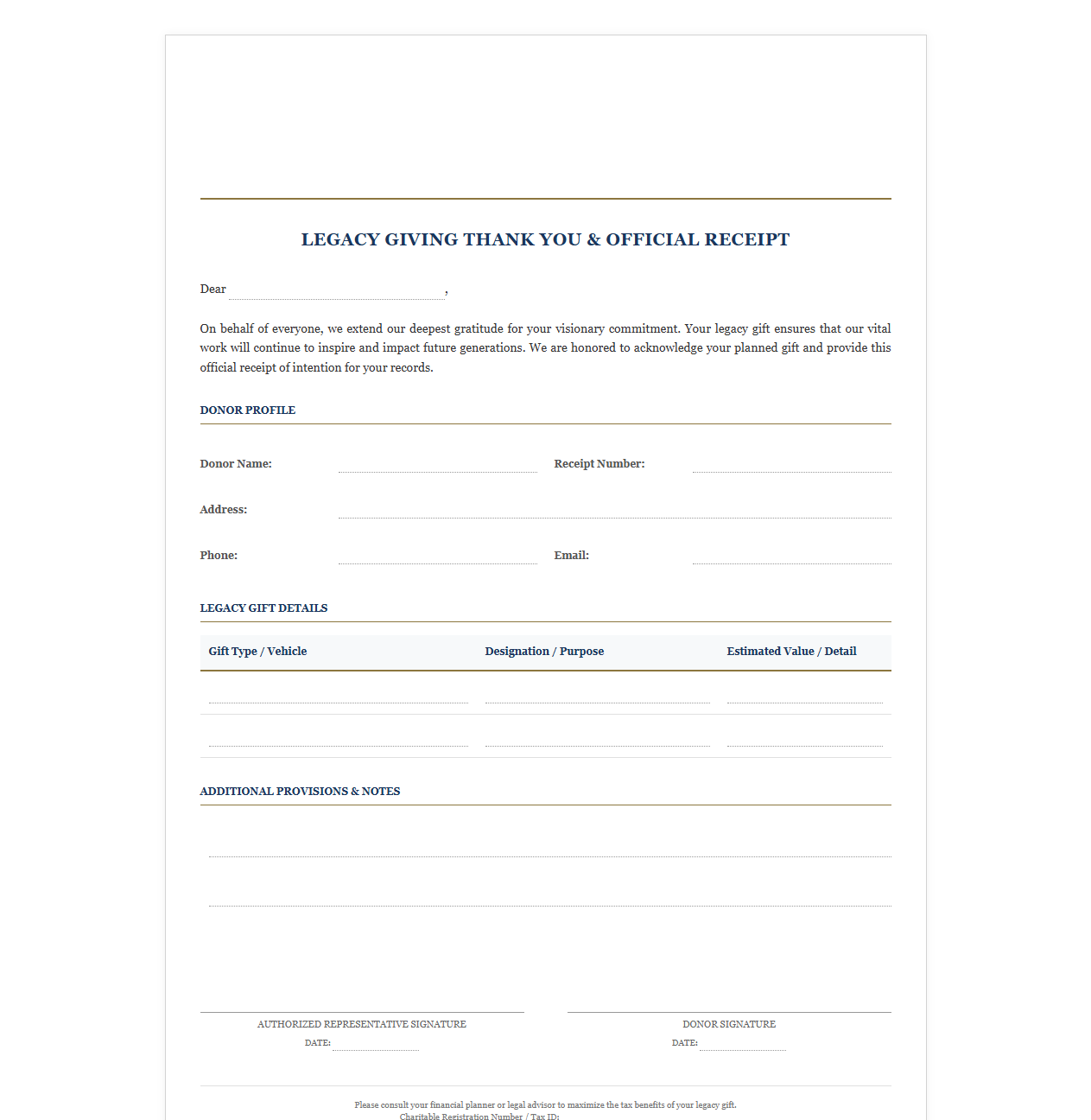
Legacy Giving Thank You and Receipt Form
 Download: .PDF
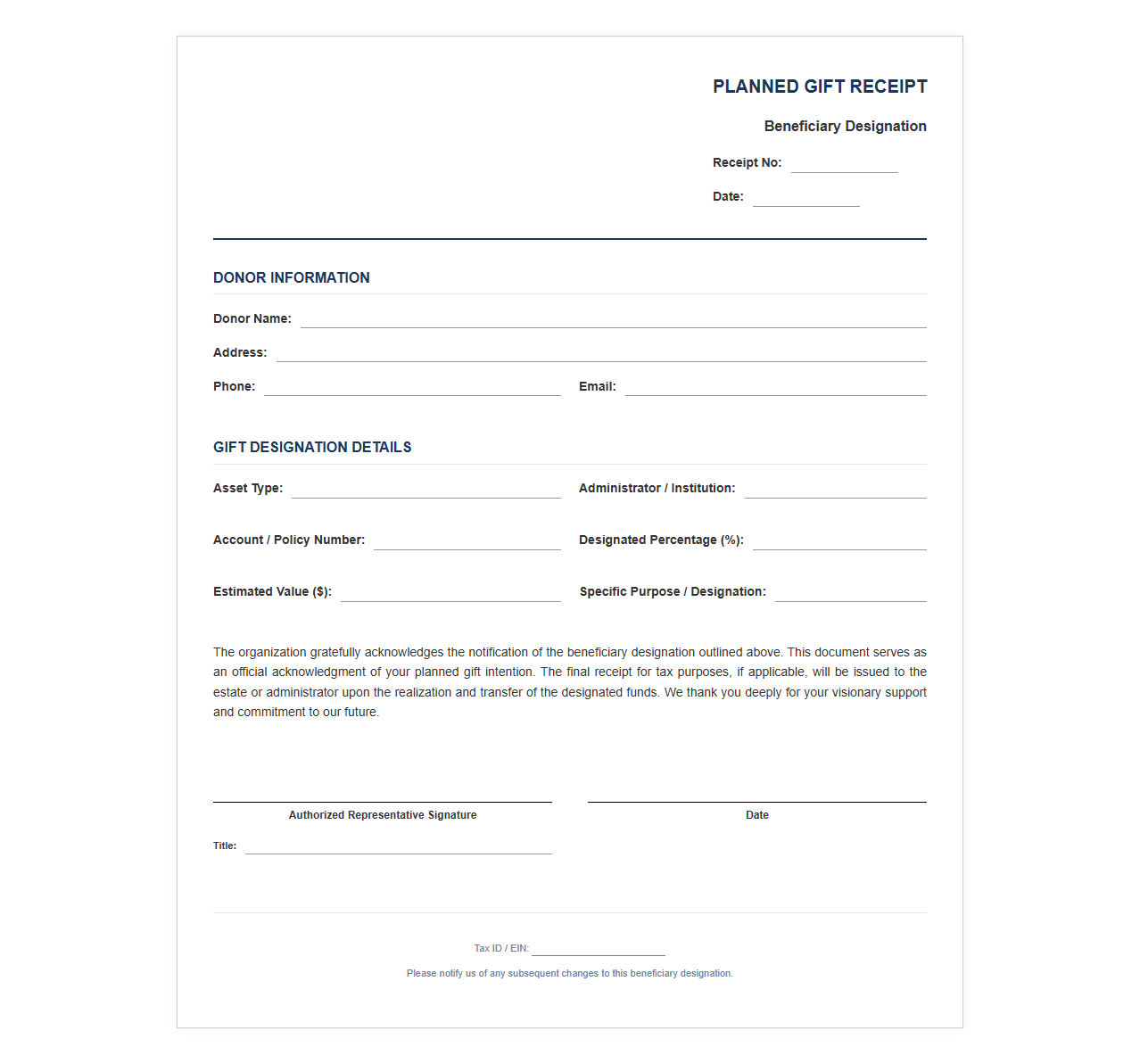
Beneficiary Designation Planned Gift Receipt
 Download: .PDF
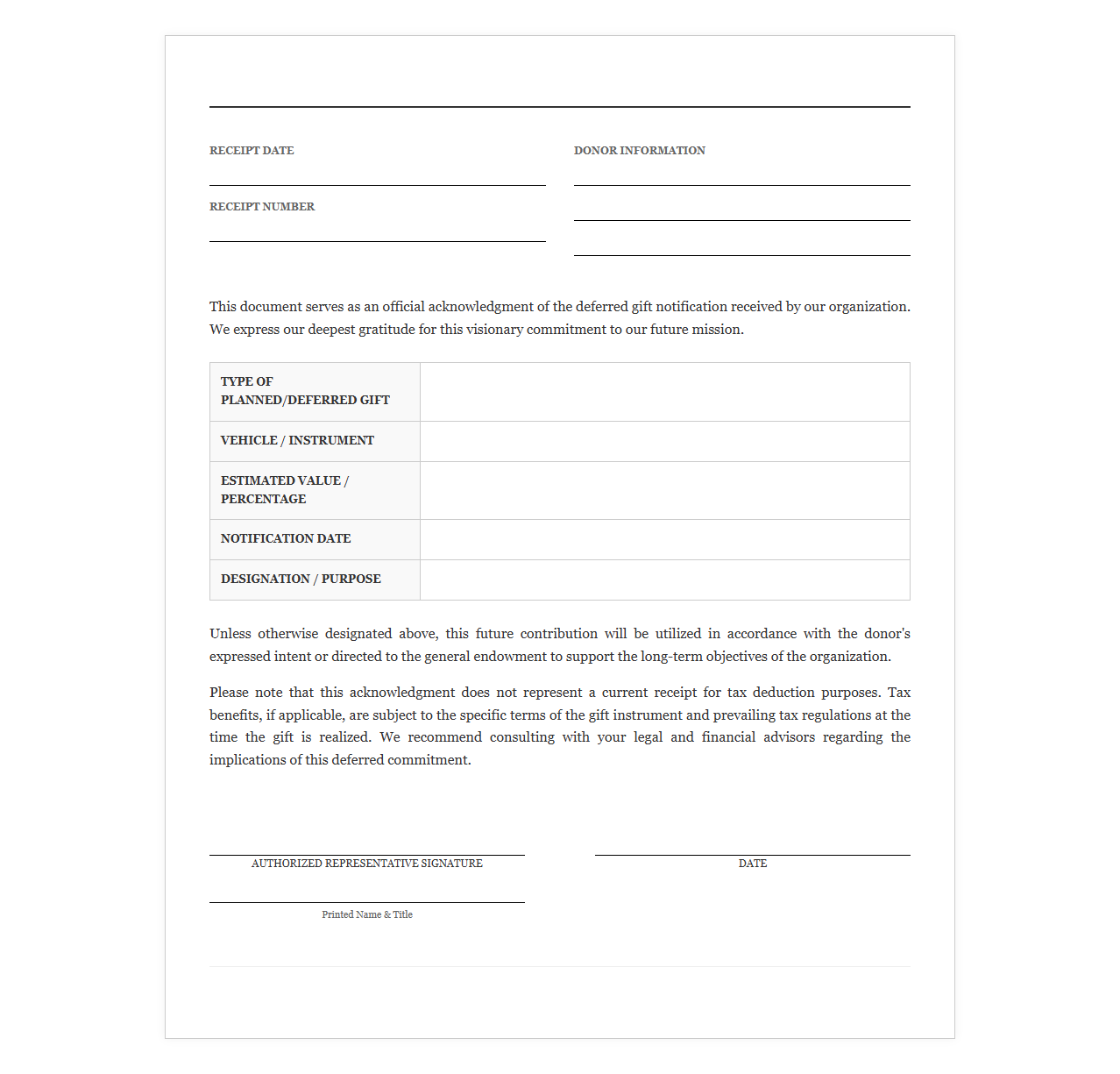
Deferred Giving Acknowledgment Receipt Template
 Download: .PDF
Life Insurance Planned Gift Receipt Template
 Download: .PDF
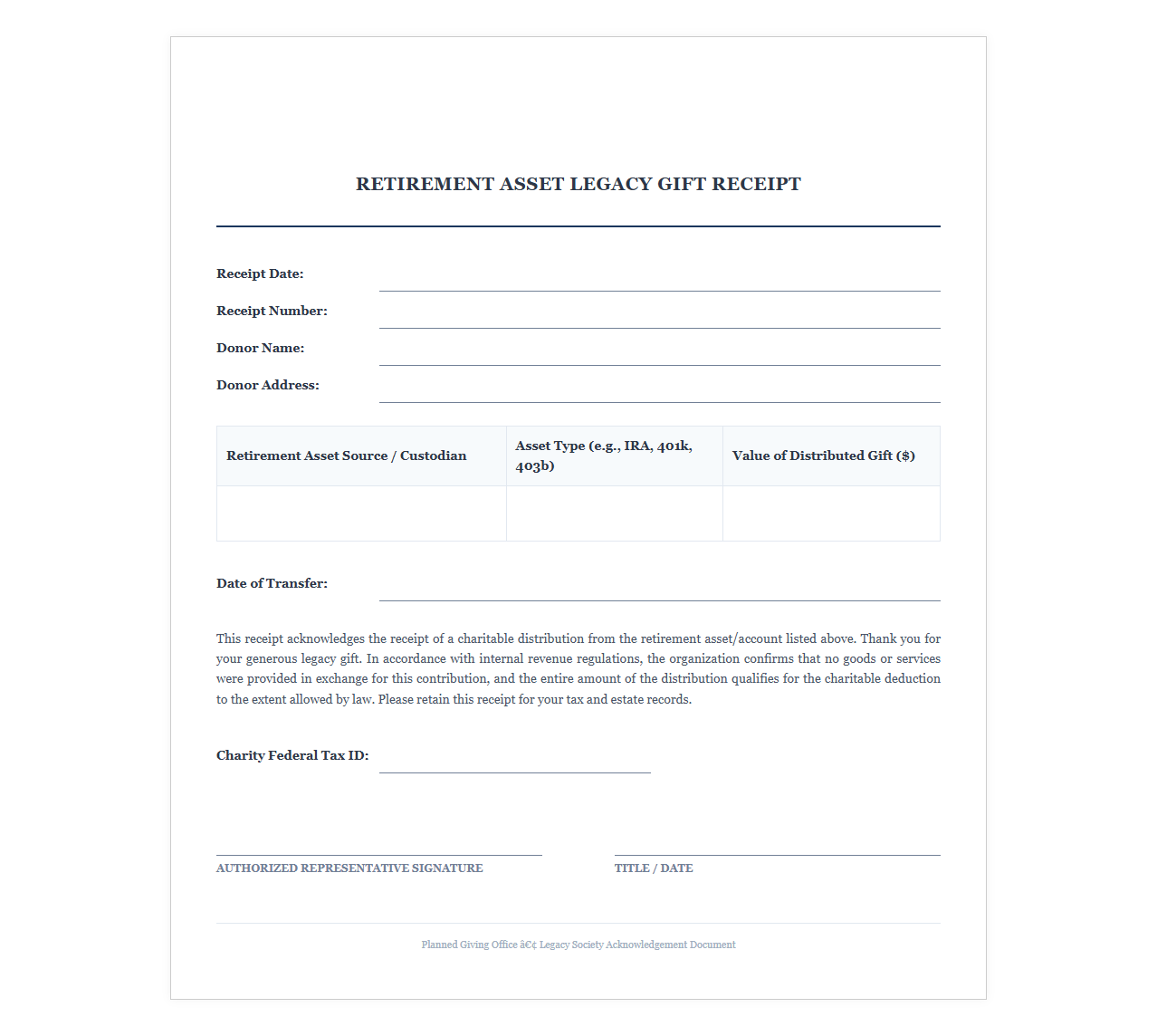
Retirement Asset Legacy Gift Receipt
 Download: .PDF
The Administrative Burden of Planned Giving
Managing legacy gifts presents a unique set of challenges for non-profit organizations. Unlike immediate cash contributions, planned giving involves complex legal agreements, deferred assets, and long-term commitments that may not materialize for decades. This temporal gap, combined with the intricate nature of estate planning, creates a heavy administrative load for development departments. Without a rigorous system in place, tracking these commitments leads to administrative bottlenecks and costly errors.
Establishing standardized receipt templates is crucial for maintaining operational efficiency and securing donor trust. When a donor decides to leave a portion of their estate to a cause, they require absolute certainty that their future contribution will be handled professionally. Standardized documentation ensures that every transaction is recorded accurately, reducing the time spent on manual audits and providing donors with the immediate, professional acknowledgment they expect and deserve.
Why Standardized Receipt Templates Matter
Adopting a uniform approach to documenting planned gifts provides immediate operational advantages. By replacing ad-hoc letters with structured templates, non-profits protect themselves and their supporters through consistent administrative habits.
- Legal and Tax Compliance: Standardized templates guarantee that every receipt contains the precise statutory language required by tax authorities, safeguarding the donor's tax deduction and protecting the organization's tax-exempt status.
- Reduction of Administrative Errors: Removing manual data entry errors prevents discrepancies between donor intent and the organization's financial records.
- Enhanced Donor Relations: Professional, timely, and clear receipts demonstrate organizational competence, reassuring legacy donors that their future gifts will be stewarded with integrity.
Categorizing Planned Gift Types for Documentation
Not all planned gifts are structured the same way, meaning a single, generic receipt cannot cover every scenario. Non-profits must categorize gifts based on their legal and financial structures to ensure accurate record-keeping.
Bequests
These are gifts made through a will or living trust. They are revocable during the donor's lifetime and only realize value upon the donor's passing, requiring a template that acknowledges the commitment without claiming immediate tax-deductible value.
Charitable Gift Annuities
A charitable gift annuity (CGA) is a contract where the donor transfers assets to a charity in exchange for a partial tax deduction and guaranteed lifetime income payments. The documentation must clearly split the gift value from the annuity schedule.
Charitable Remainder Trusts
These irrevocable trusts distribute income to the donor or beneficiaries for a set term, after which the remaining assets transfer to the charity. Receipts for these vehicles must reflect the present value calculations of the future interest.
Essential Elements of a Standardized Receipt
Regardless of the gift type, certain foundational components must exist on every receipt to satisfy legal regulations and accounting standards. Omitting these details can invalidate the document for tax purposes.
- The full, legal name of the organization and its Employer Identification Number (EIN).
- The legal name and mailing address of the donor.
- The date the gift commitment was officially accepted or the asset was transferred.
- A detailed description of the asset received, noting whether it is cash, securities, or real property.
- An explicit statement confirming whether the organization provided any goods or services in exchange for the contribution.
Designing the Bequest and Cash Gift Template
Bequests and direct cash commitments represent the most common forms of planned giving. The receipt template for these gifts must be clean, structured, and easy to read, ensuring that estate executors and donors can quickly verify the details of the future transfer.
Key Wording and Layout Fields
The layout should prioritize clarity, placing the organization's logo and contact information at the top, followed by the donor's details. The core text must include explicit language acknowledging the donor's intent to make a future gift through their estate plan. It must specify whether the bequest is a specific dollar amount, a percentage of the estate, or a residual allocation, alongside a clear field detailing how the donor wishes their funds to be designated.
Handling Complex Vehicles: Charitable Gift Annuities and Trusts
Complex deferred gifts require sophisticated receipt structures that can account for split-interest calculations. Because these vehicles involve both a charitable contribution and a financial return to the donor, the receipt must transparently break down these values.
Trust and Annuity Receipt Structures
Templates for gift annuities and trusts must present the calculation variables clearly. This ensures the donor's tax professionals can easily determine the allowable deduction based on government tables and interest rates.
| Data Field | Description / Purpose |
|---|---|
| Funding Asset Value | The fair market value of the cash or property transferred to establish the vehicle. |
| Annuity Rate / Payout Percentage | The agreed-upon percentage used to calculate the recurring payments to the donor. |
| Charitable Deduction Amount | The estimated present value of the future interest passing to the charity, calculated using applicable federal rates. |
Implementing Your New Template System
Developing standardized templates is only the first step; successful implementation requires integrating these forms into your organization's daily workflow. This integration ensures that no document is processed in isolation and that all staff members remain aligned.
"Operational excellence is achieved when your administrative tools match your philanthropic goals. Integrating standardized receipting directly into your donor database prevents information silos and secures the long-term viability of your planned giving program."
To begin, upload your completed templates into your donor management system or CRM, mapping database fields to the corresponding placeholders in the templates. Next, conduct comprehensive training sessions for your administrative and development staff, ensuring everyone understands when to deploy each specific template. Regular audits of sent receipts will help maintain quality control, keeping your records flawless and your donor relationships secure.

Leave a comment