

Nonprofit development officers often struggle to balance high-value donor stewardship with the grueling administrative demands of regulatory compliance. Managing complex endowment gifts requires absolute precision, yet manual, ad-hoc receipting processes frequently introduce costly formatting errors that jeopardize both donor trust and tax-exempt status.
Before addressing these operational bottlenecks, one must consider the shifting regulatory landscape. Heightened IRS scrutiny on long-term charitable assets means standard donation acknowledgments are no longer sufficient for sophisticated philanthropy.
Utilizing structured, compliant templates grants organizations immediate peace of mind and robust audit readiness. Please note: While these tools streamline administration, they serve as foundational frameworks rather than legal substitutes for professional counsel.
For instance, integrating specific elements such as UPMIFA-compliant disclosures and explicit donor-imposed restriction language provides verifiable proof of due diligence.
Below, we outline the vital components of compliant receipting, share essential templates for immediate use, and provide a roadmap to secure your organization's endowment workflows.
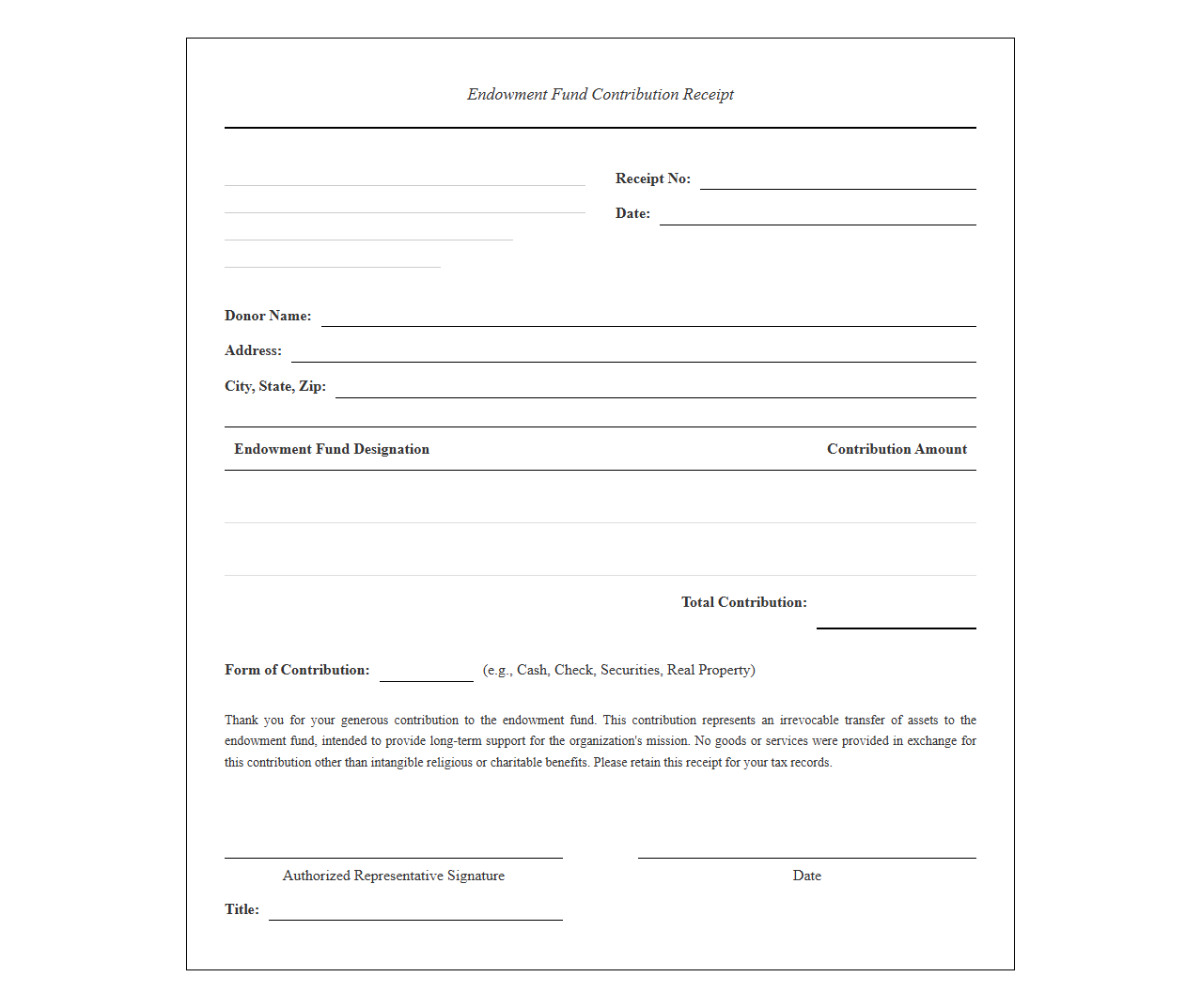
Endowment Fund Contribution Receipt Template
 Download: .PDF
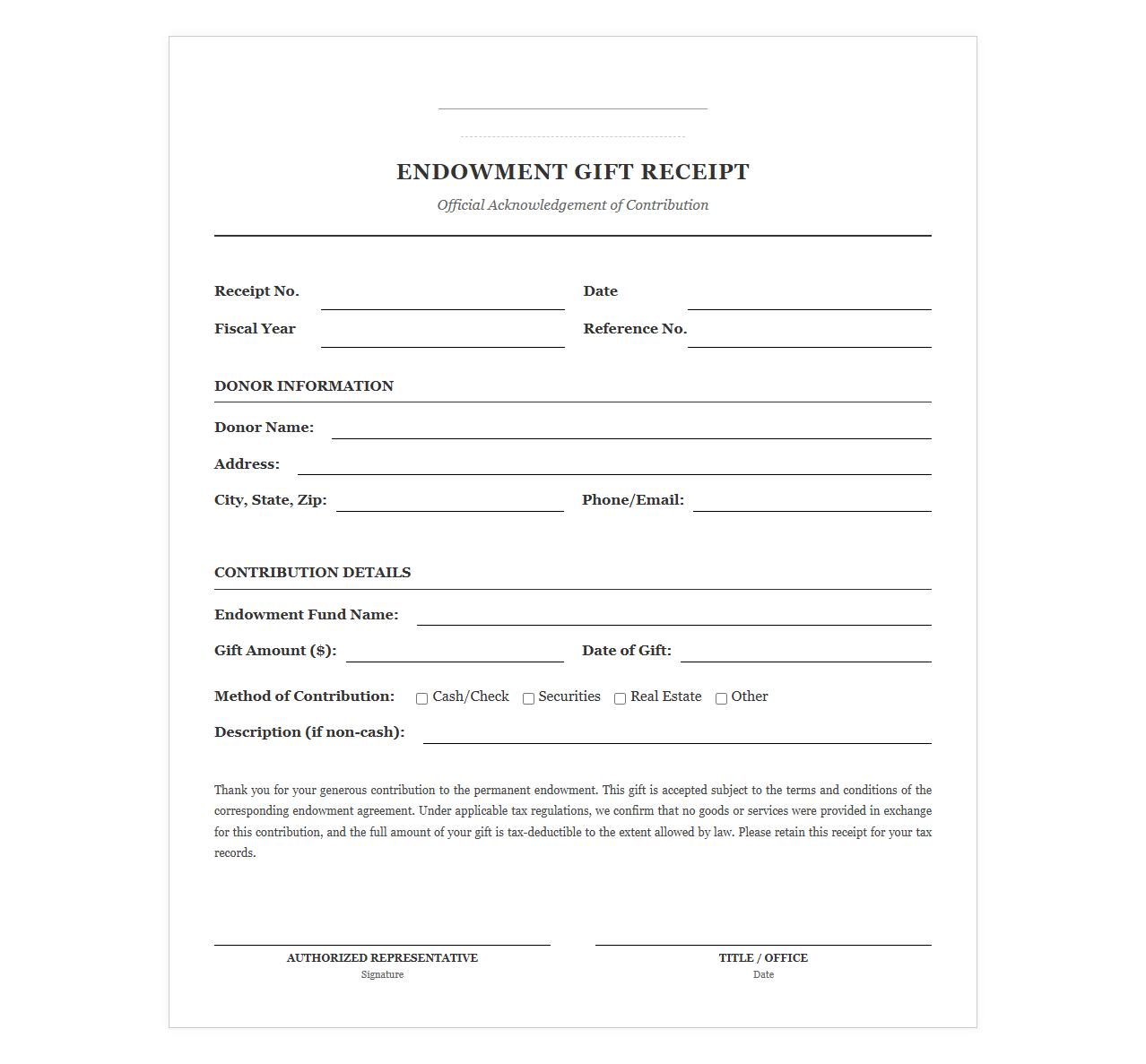
Endowment Gift Acknowledgement and Receipt Form
 Download: .PDF
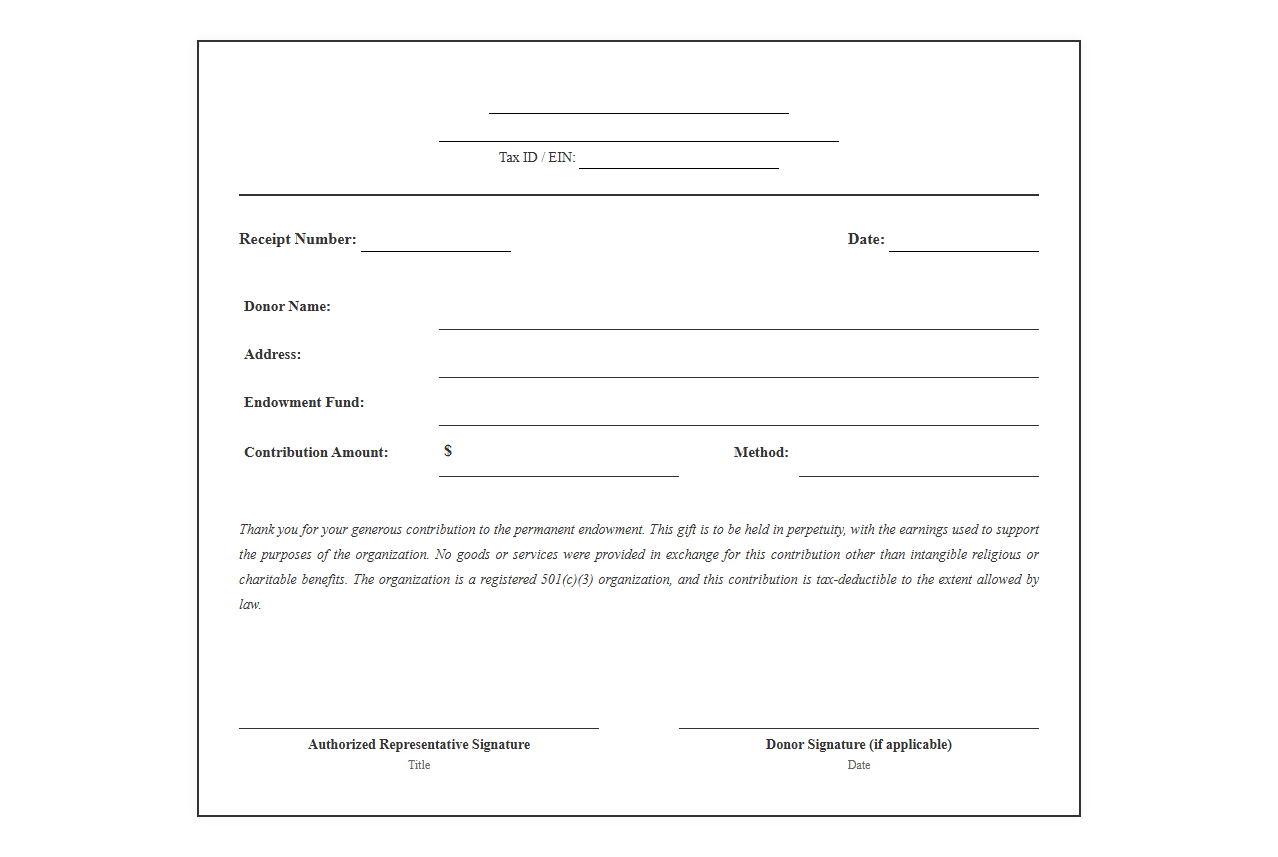
Charitable Endowment Donation Receipt Template
 Download: .PDF
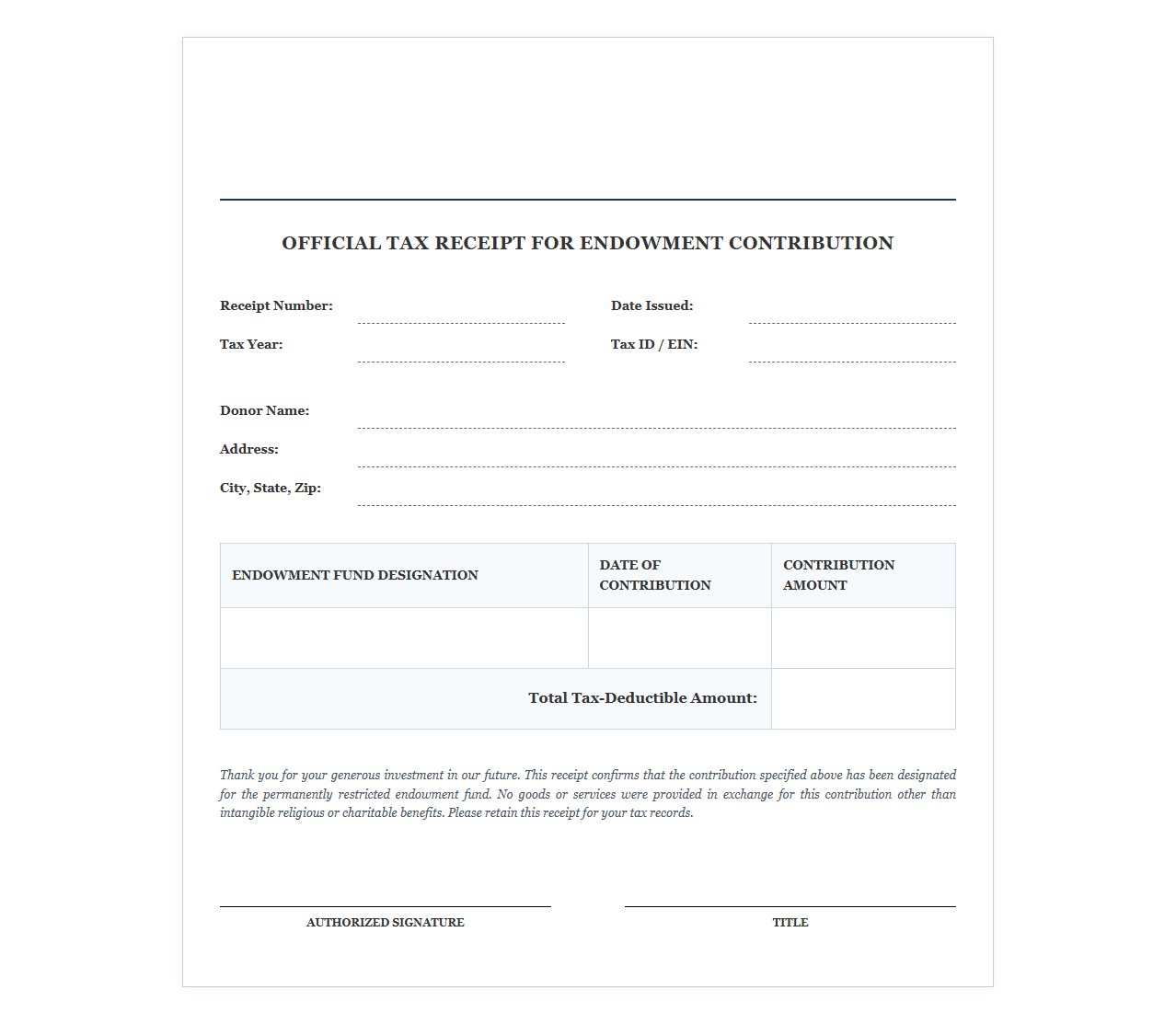
Endowment Giving Tax Receipt Template
 Download: .PDF
Legacy Endowment Contribution Receipt
 Download: .PDF
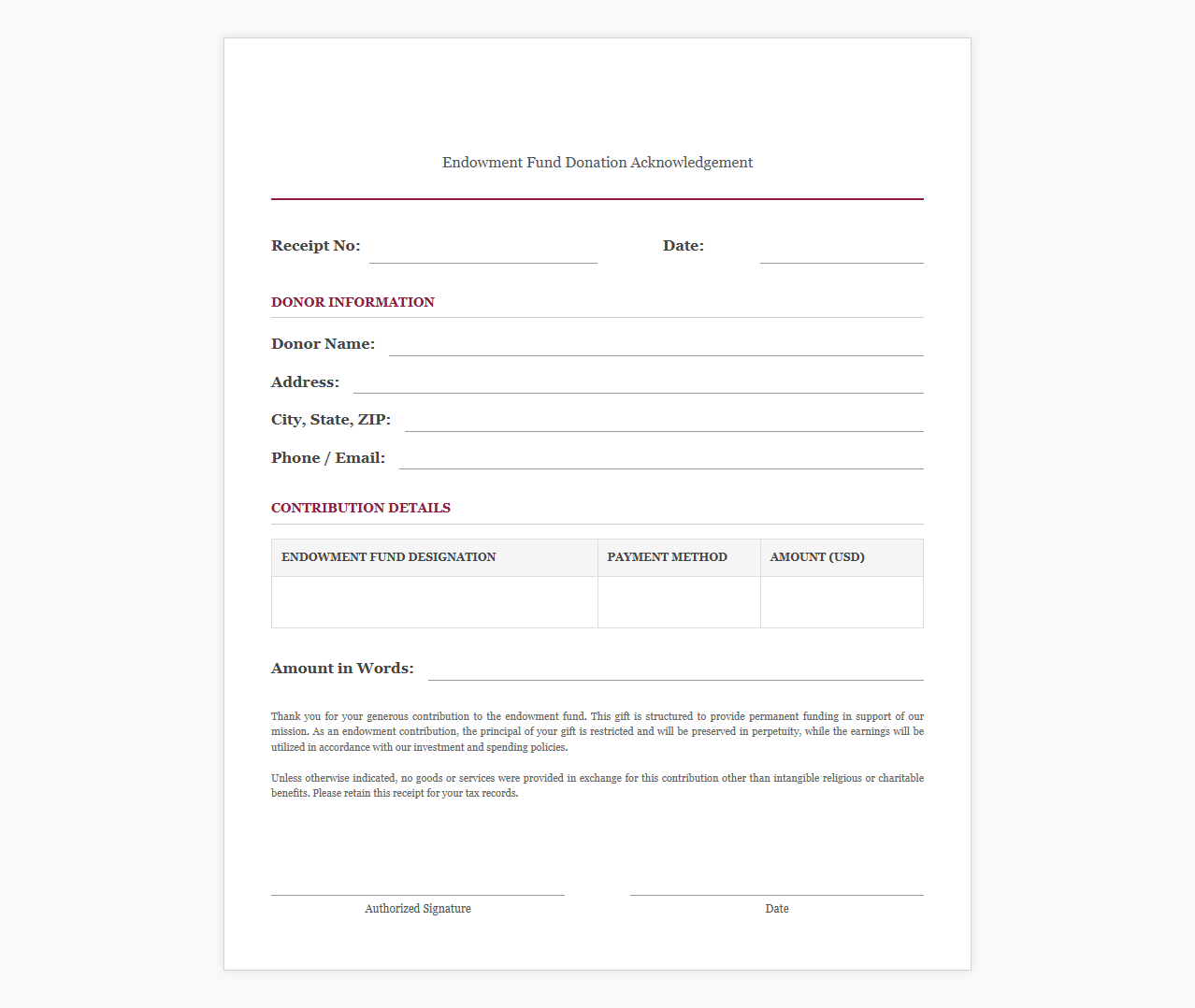
Endowment Fund Donation Acknowledgement Receipt
 Download: .PDF
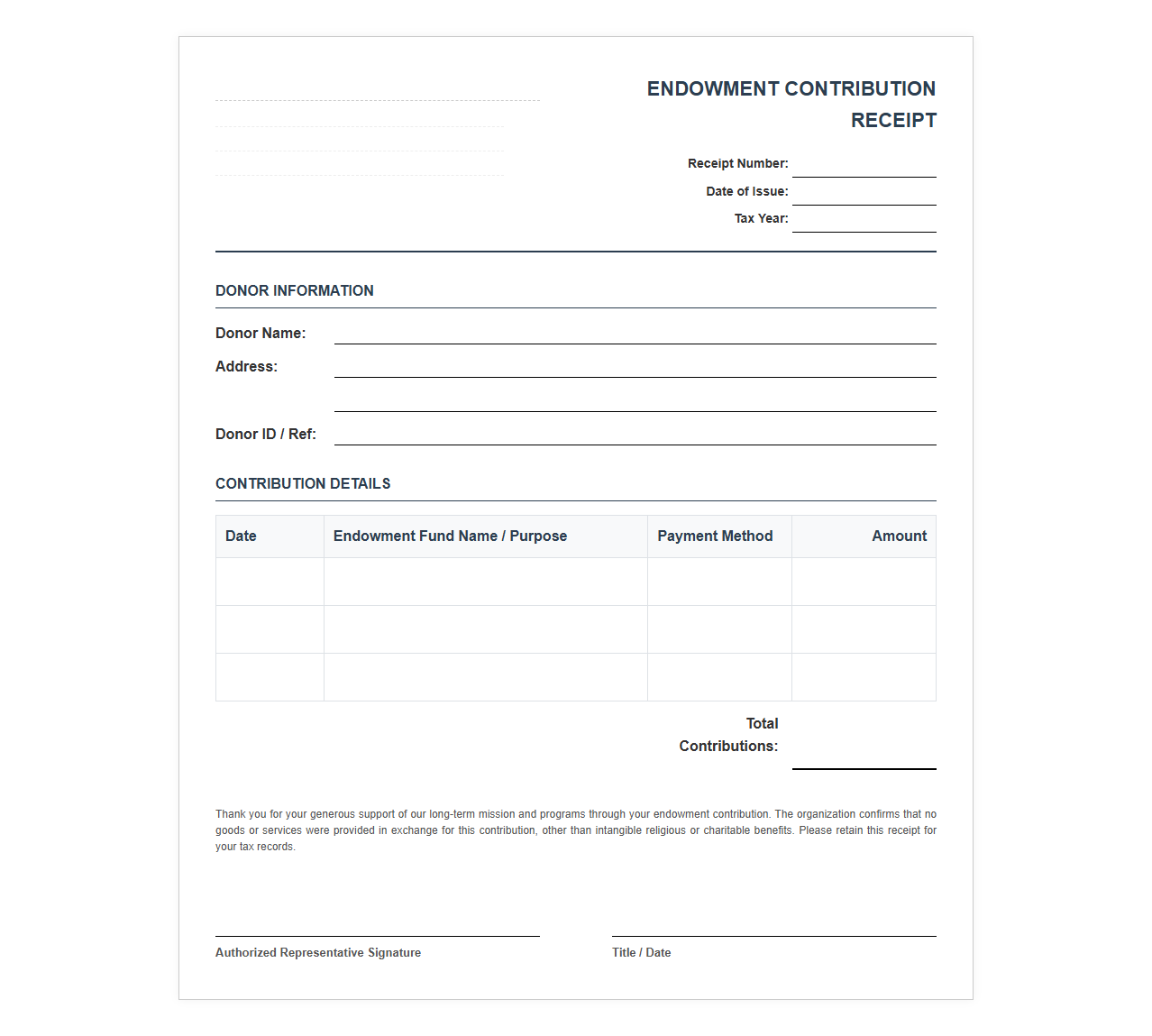
Annual Endowment Contribution Receipt Template
 Download: .PDF
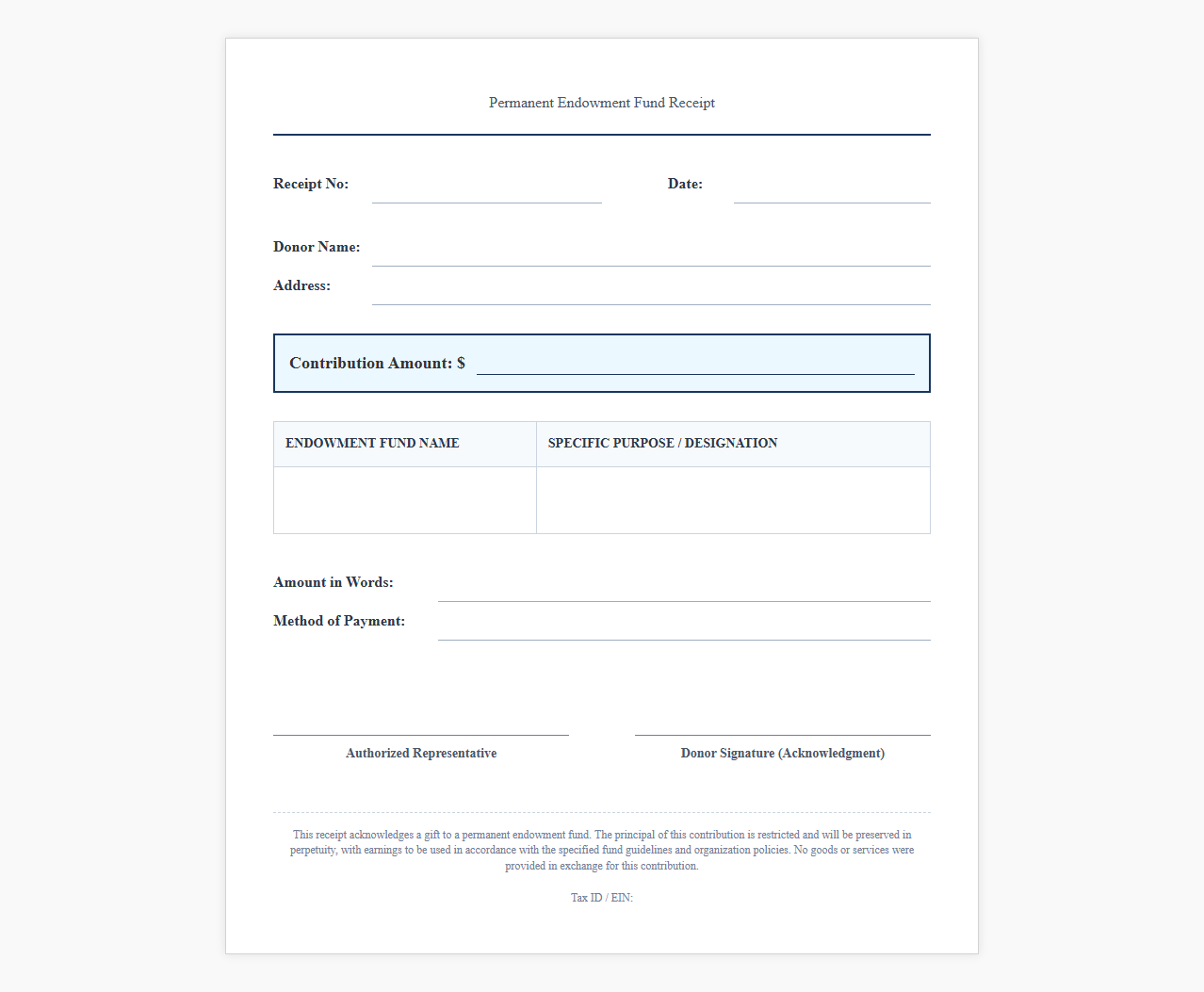
Permanent Endowment Fund Receipt Template
 Download: .PDF
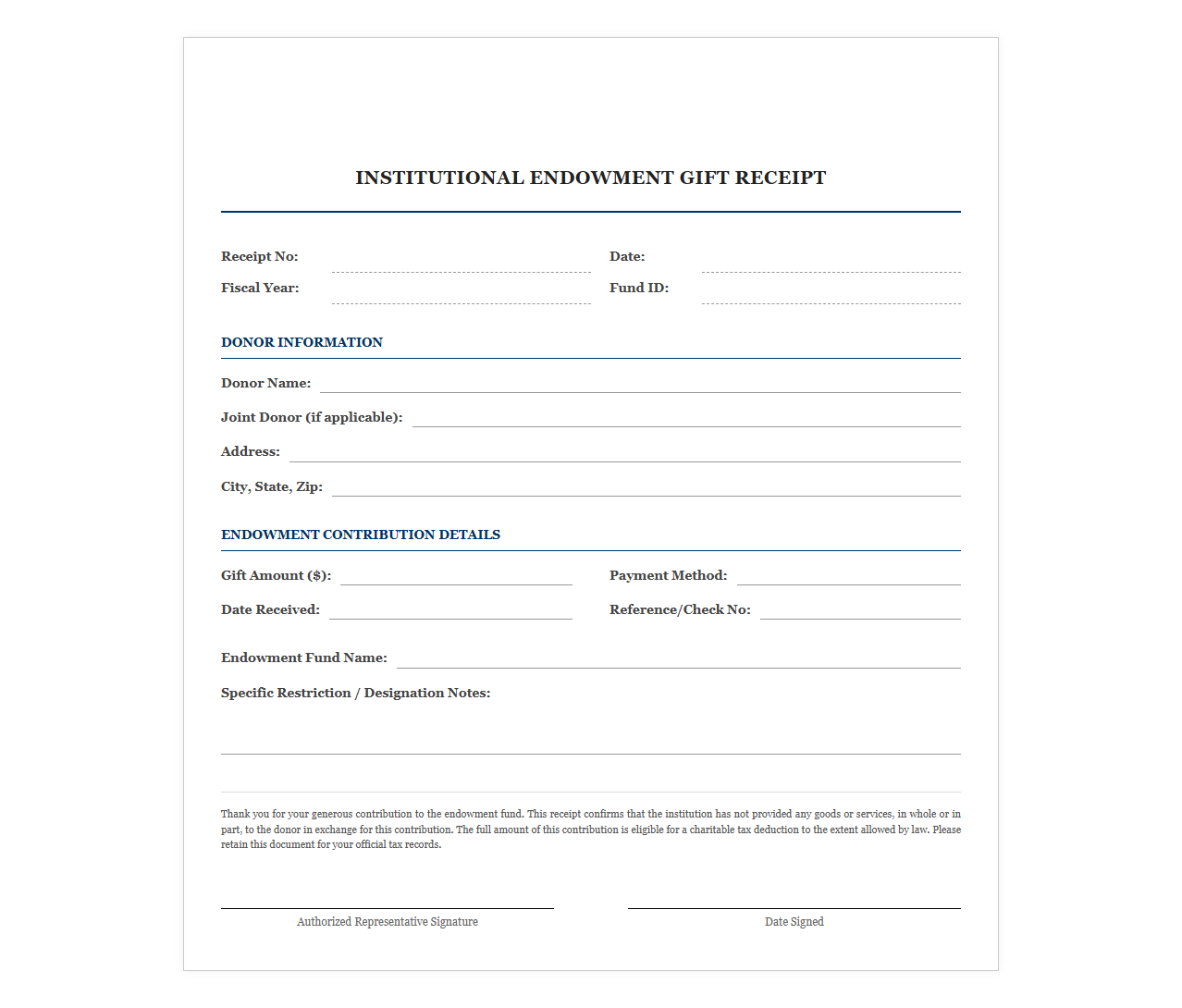
Institutional Endowment Gift Receipt Form
 Download: .PDF
Demystifying Donor Compliance in Endowment Management
Managing an endowment is a profound responsibility that bridges an organization's present operations with its long-term vision. At the heart of this relationship lies donor trust, which is established not just through impactful programs, but through rigorous administrative precision. Accurate endowment contribution receipts serve as the foundational cornerstone of this trust. When a donor earmarks funds for a permanent endowment, they are making a visionary commitment, and they expect the receiving organization to treat their gift with the utmost professional care.
Beyond building trust, these receipts are a critical tool for maintaining non-profit compliance. Because endowment gifts are legally restricted assets, improper documentation can lead to severe regulatory scrutiny, jeopardize your tax-exempt status, and damage your reputation. Providing timely, legally compliant receipts ensures that your supporters can confidently claim their eligible tax deductions while confirming that your organization is prepared to steward their legacy for generations to come.
Legal Safeguards: IRS Requirements for Gift Substantiation
To ensure donors can legally claim tax deductions for their contributions, non-profit organizations must strictly adhere to IRS substantiation rules. Failing to provide the correct disclosures can result in financial penalties for the charity and disallowed deductions for the supporter.
- Written Acknowledgment: Donors must receive a contemporaneous written acknowledgment for any single contribution of $250 or more.
- Quid Pro Quo Disclosures: If a donor receives goods or services in exchange for a contribution exceeding $75, the organization must provide a good faith estimate of the value of those goods or services.
- No Goods or Services Statement: The receipt must explicitly state whether the organization provided any goods or services in consideration, in whole or in part, for the contribution.
- Endowment Restriction Note: Under IRS guidelines, acknowledging that a gift is specifically designated for a permanent or term endowment helps substantiate the restricted nature of the asset from its inception.
Anatomical Blueprint of a Compliant Endowment Receipt
A legally sound endowment receipt must capture specific data points to satisfy both audit requirements and internal tracking needs. Missing even a single field can compromise the validity of the document.
- Organization Information: The full legal name, address, and Employer Identification Number (EIN) of the non-profit.
- Donor Identification: The complete name of the donor as it should appear on tax filings.
- Contribution Details: The exact date the contribution was received and the specific dollar amount or a detailed description of the non-cash asset.
- Endowment Fund Designation: Clear language identifying the specific named or general permanent endowment fund to which the gift is directed.
- Tax-Deductibility Statement: A formal declaration indicating that no goods or services were provided in exchange for the gift, or detailing the value of any benefits provided.
Standard Cash and Check Endowment Receipt Template
For standard monetary contributions, simplicity and clarity are paramount. The following template can be easily adapted to acknowledge cash, check, or electronic fund transfers specifically designated for permanent endowment funds.
[Organization Name]
[Mailing Address]
[City, State, ZIP]
[EIN: XX-XXXXXXX]
Date of Acknowledgment: [Date]
Donor Name: [Donor Full Name]
Donor Address: [Donor Address]
Thank you for your generous contribution of $[Amount], received on [Date of Receipt].
This gift has been successfully designated to the [Name of Endowment Fund] Permanent Endowment. As an endowment contribution, these funds will be preserved in perpetuity, with the earnings used to support our ongoing mission according to our board policies and donor agreements.
No goods or services were provided in exchange for this contribution. Therefore, the full amount of your contribution is deductible for federal income tax purposes to the extent allowed by law.
Please retain this receipt for your tax records.
Sincerely,
[Authorized Signature]
[Name and Title]
Specialized Template for Securities and Non-Cash Endowments
Acknowledging non-cash contributions, such as publicly traded stock, mutual funds, or closely held securities, requires a specialized approach. Organizations must never assign a dollar value to non-cash gifts on the receipt itself. Instead, the receipt must describe the asset in detail, leaving the valuation responsibility to the donor and their qualified appraiser.
Thank you for your generous contribution of securities, received by our brokerage account on [Date of Transfer]. This contribution consists of [Number of Shares] shares of [Name of Stock/Security, including Ticker Symbol]. These assets have been designated to support the [Name of Endowment Fund] Permanent Endowment, where they will help secure our long-term operational sustainability.
No goods or services were provided in exchange for this contribution. Please note that [Organization Name] does not provide valuation services; the value of this non-cash gift must be determined by the donor in consultation with their tax advisor or a qualified appraiser.
Digitizing the Workflow: Automation and Security Standards
In the digital age, manual receipt generation can lead to costly administrative bottlenecks and human error. Transitioning to automated receipting via modern donor management software helps ensure compliance while accelerating the delivery process. However, automation must be balanced with robust security standards to protect sensitive donor financial data.
- Encryption and Security: Ensure your donor database and email delivery systems use secure transport protocols (such as HTTPS and SSL/TLS) to prevent unauthorized interception. Learn more about data security standards from the Federal Trade Commission.
- System Integration: Connect your online giving forms directly to your Customer Relationship Management (CRM) system to eliminate manual data entry errors.
- Tamper-Proof PDFs: Automated receipts should be sent as read-only, password-protected, or digitally signed PDF attachments to prevent alteration.
- Consent and Preferences: Respect donor privacy laws by obtaining clear consent before sending electronic communication and allowing donors to choose their preferred receipt delivery method.
Sustaining Trust: Establishing an Annual Receipt Audit
Tax laws, state regulations, and organizational structures are constantly shifting. To ensure your receipting processes remain flawless, non-profit organizations should establish an annual audit of all receipt templates and workflows. This proactive measure guarantees that your documentation remains legally compliant and aligned with current standards.
During the audit, your finance team and legal counsel should review your templates against the latest IRS publications to ensure no disclosures are outdated. Reviewing internal workflows also ensures that restricted endowment funds are being correctly routed into the proper accounting channels immediately upon receipt. By formalizing this review process, you protect your organization from compliance risks and reinforce your commitment to donor transparency and institutional stewardship.

Leave a comment