

For many legal practitioners, managing billing disputes and tracking outstanding invoices remains a persistent administrative headache. Before implementing complex collections processes, it is essential to realize that secure payment management begins with absolute financial transparency. Establishing clear, documented transactions not only protects your firm's revenue but also fosters deep client trust and professional credibility.
However, a key stipulation is that these administrative tools must be carefully tailored to satisfy the strict trust accounting and ethical regulations of your specific jurisdiction. For example, utilizing distinct receipt templates for retainer deposits versus hourly billing earned fees ensures compliance while providing concrete proof of transaction for audit purposes.
In this article, we will examine the essential receipt templates every law firm should implement to streamline their billing cycle, secure client payments, and maintain flawless financial records.
Retainer Fee Receipt Template for Legal Counsel
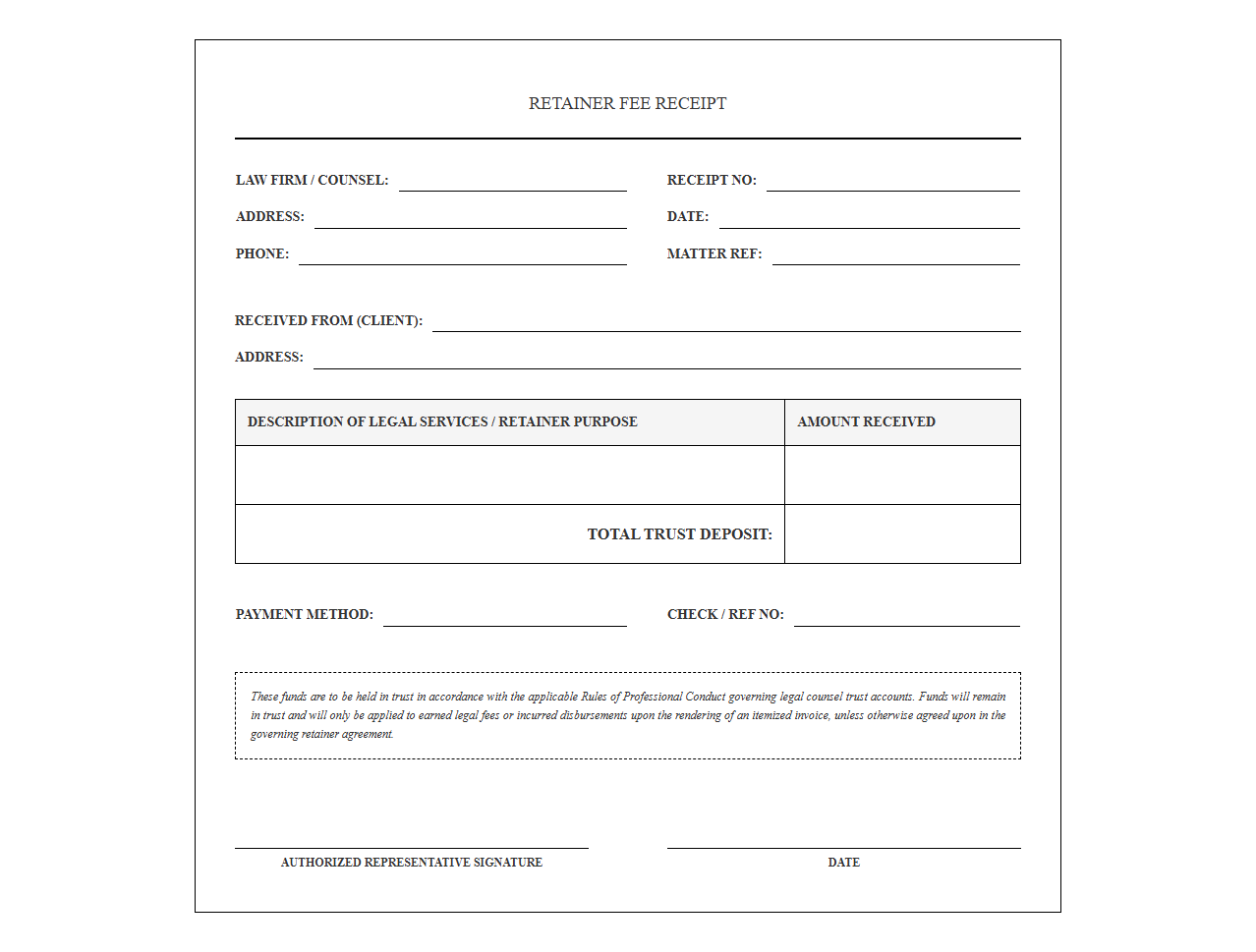 Download: .PDF
Itemized Legal Services Billing and Payment Receipt
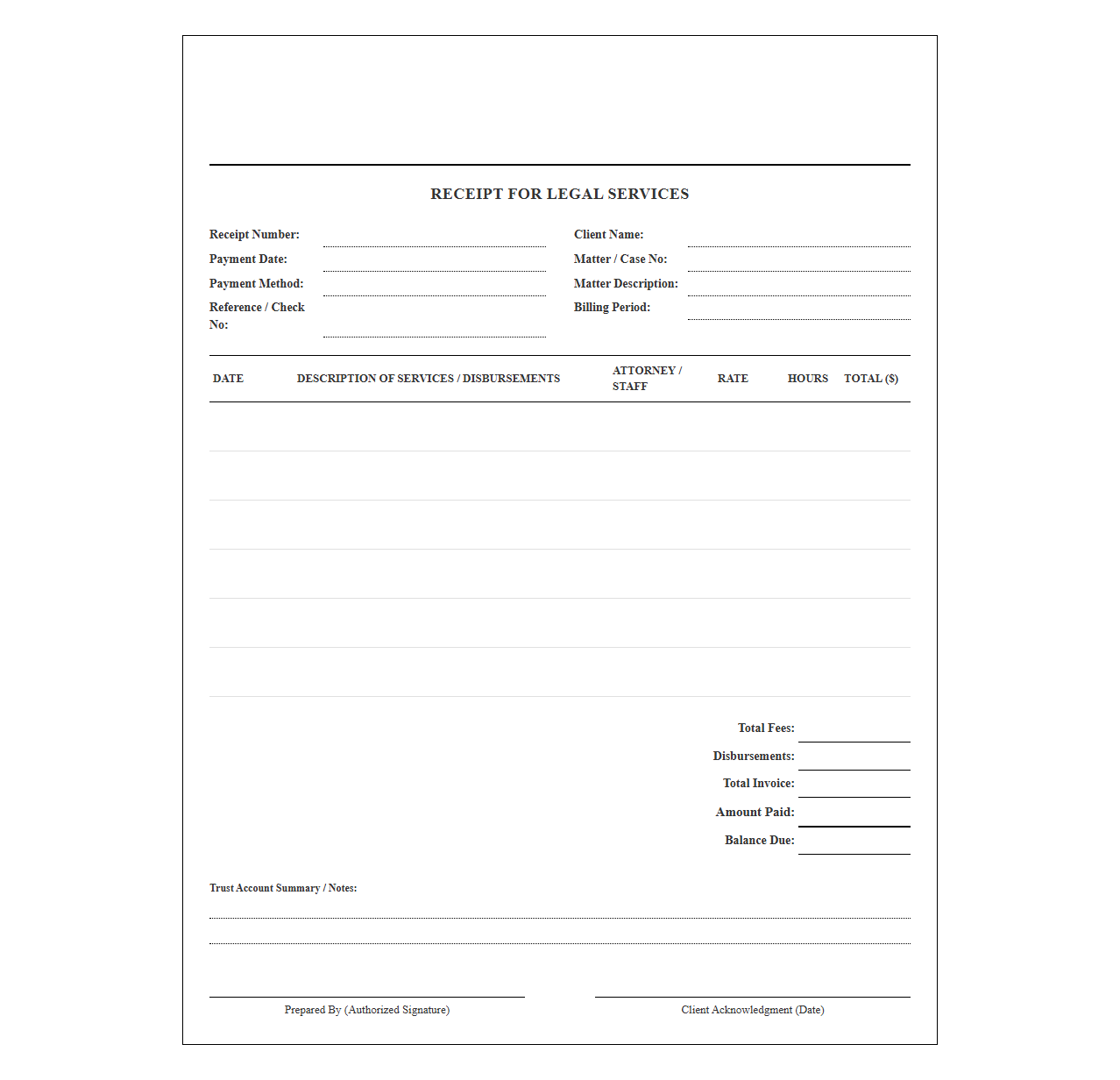 Download: .PDF
Attorney Consultation Fee Payment Receipt Template
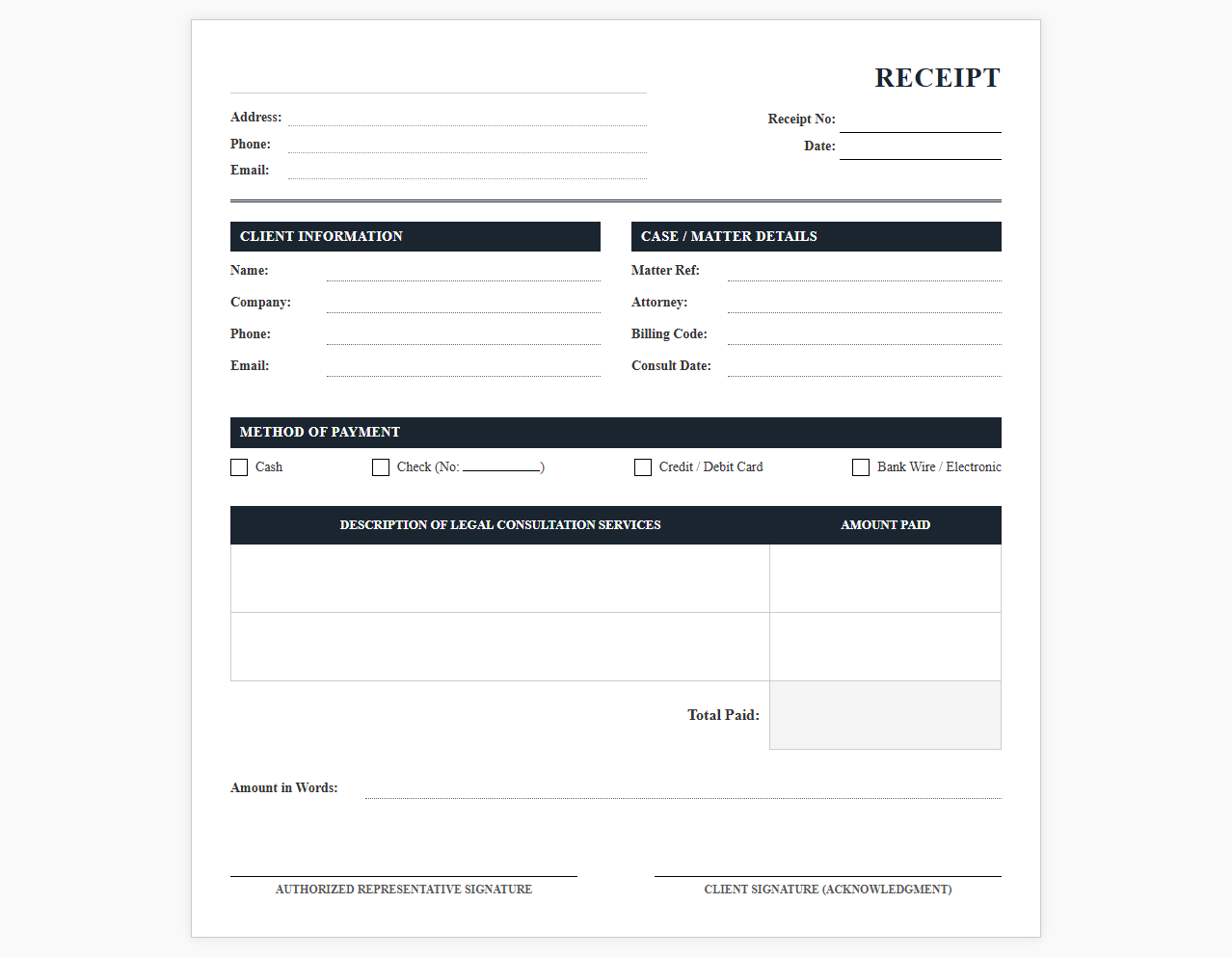 Download: .PDF
Law Firm Client Trust Account Deposit Receipt
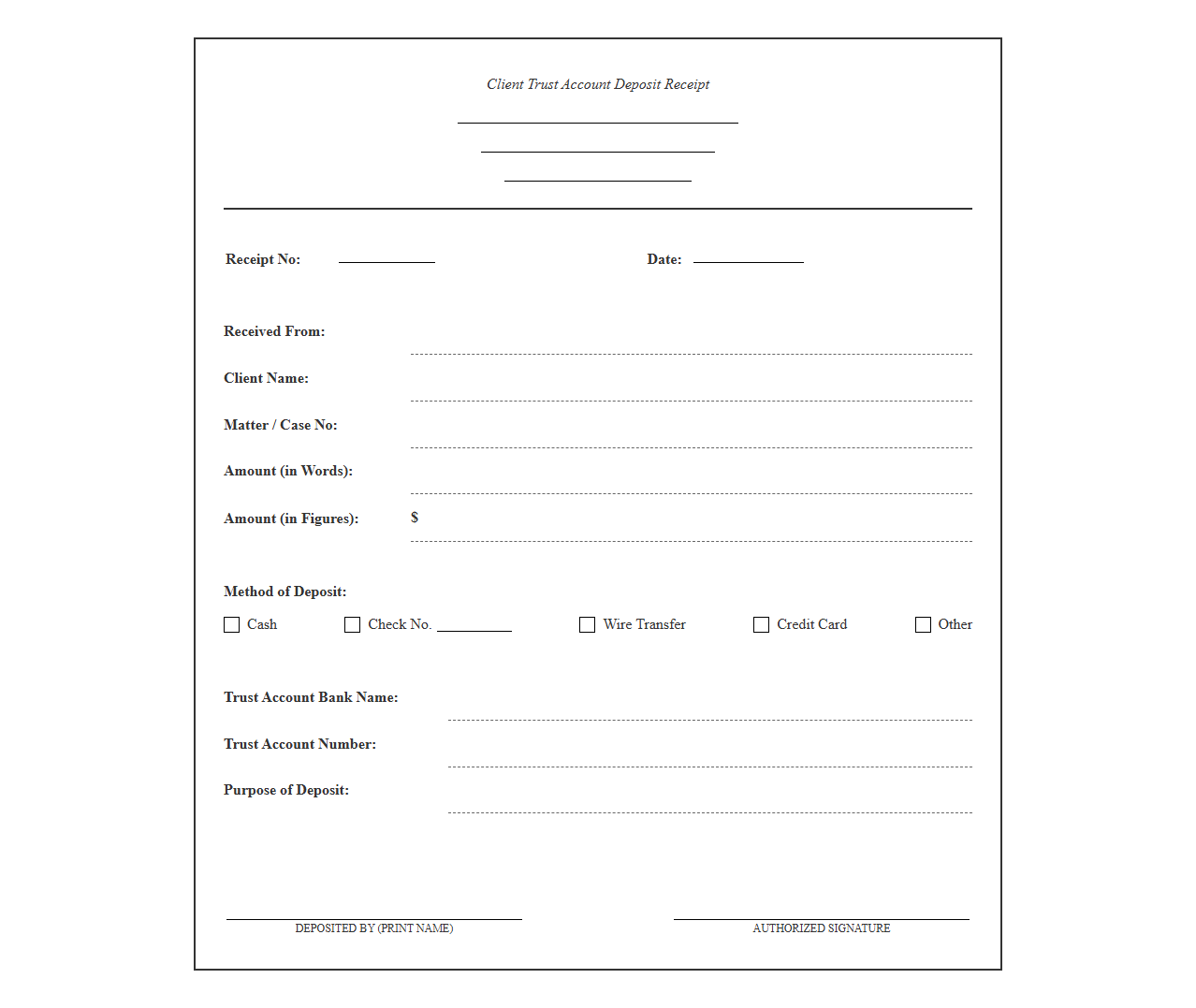 Download: .PDF
Pro Bono Legal Services Acknowledgment Receipt Form
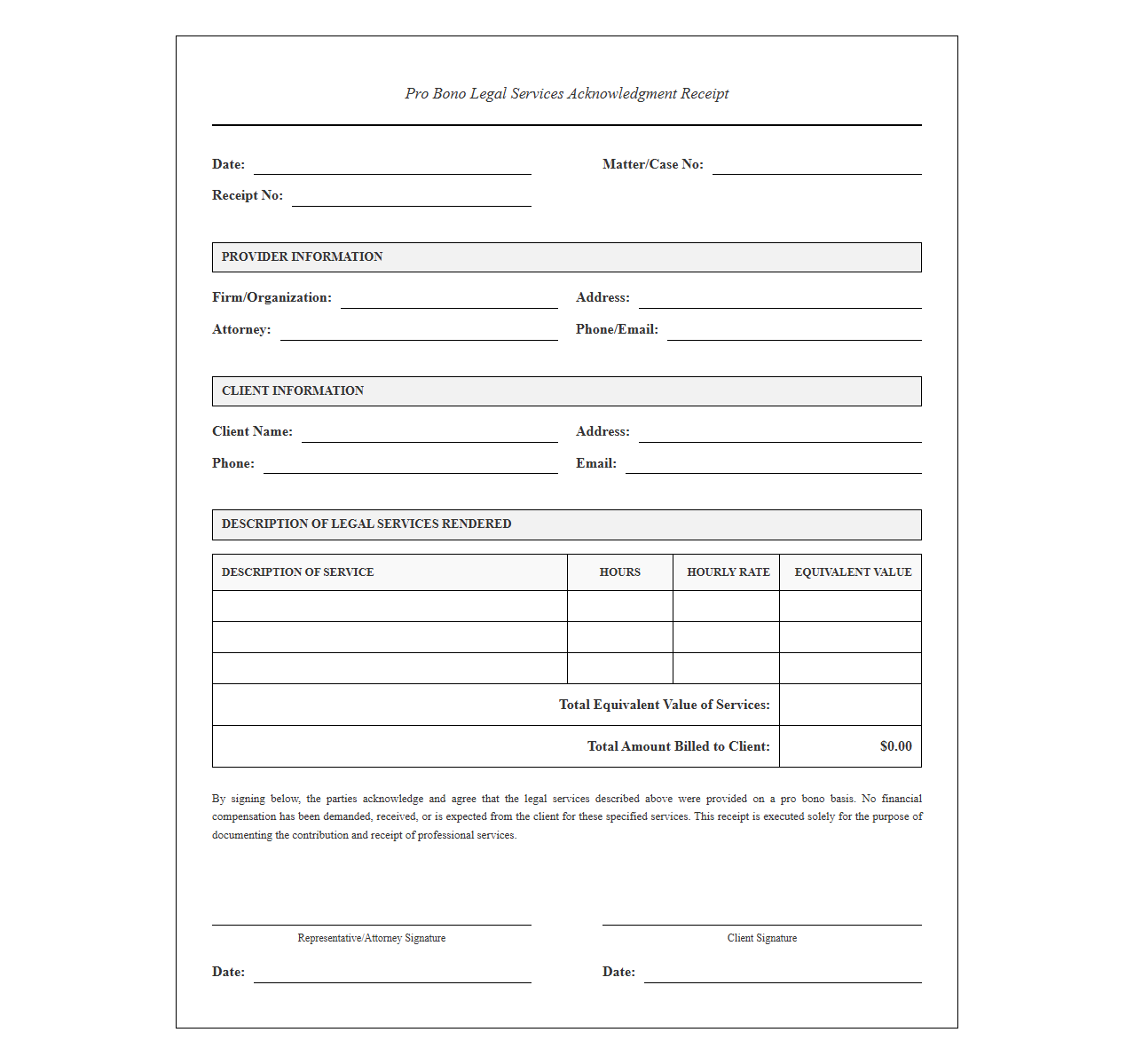 Download: .PDF
Flat Rate Legal Representation Payment Receipt
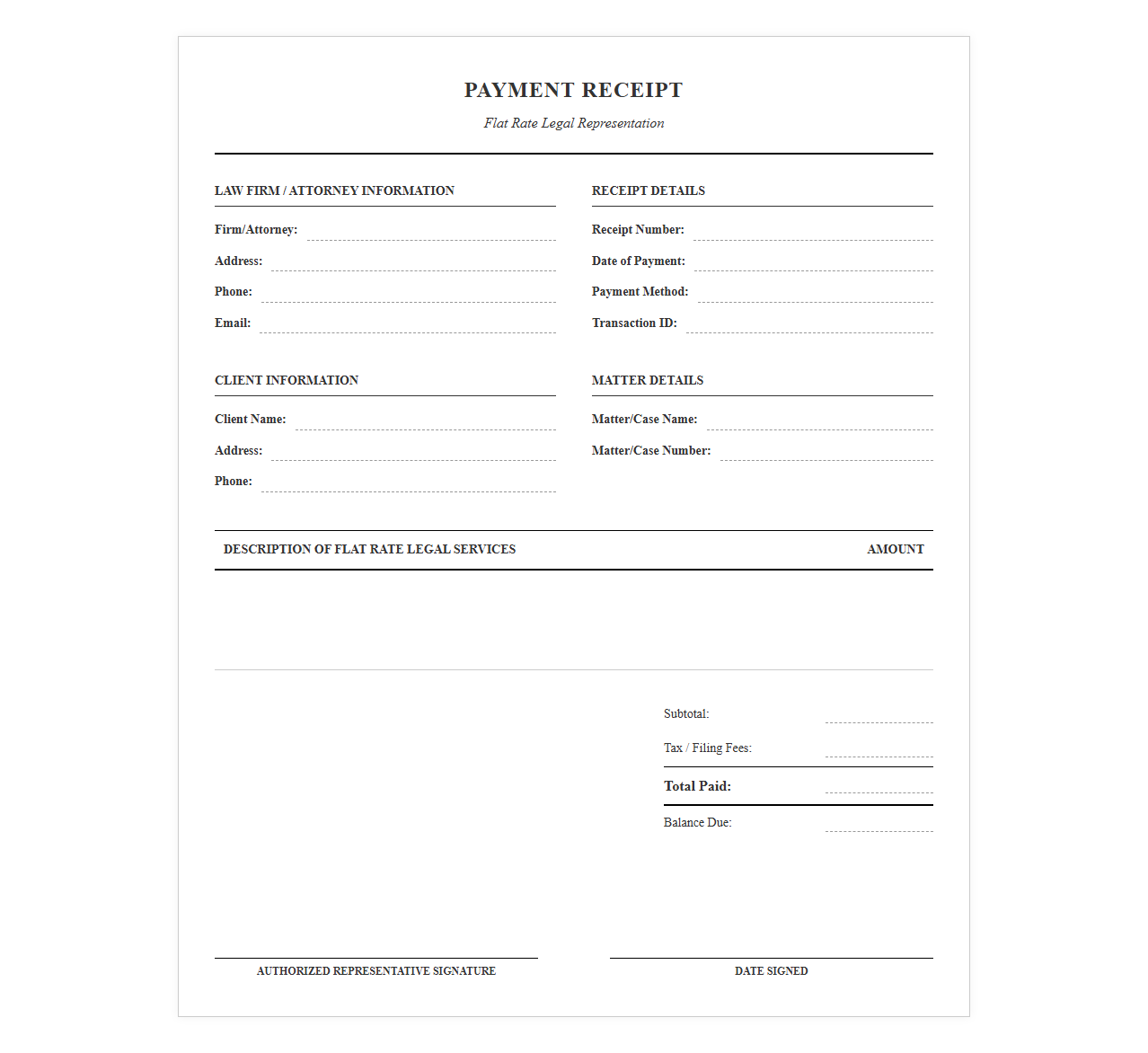 Download: .PDF
Legal Services Hourly Billing Statement and Receipt
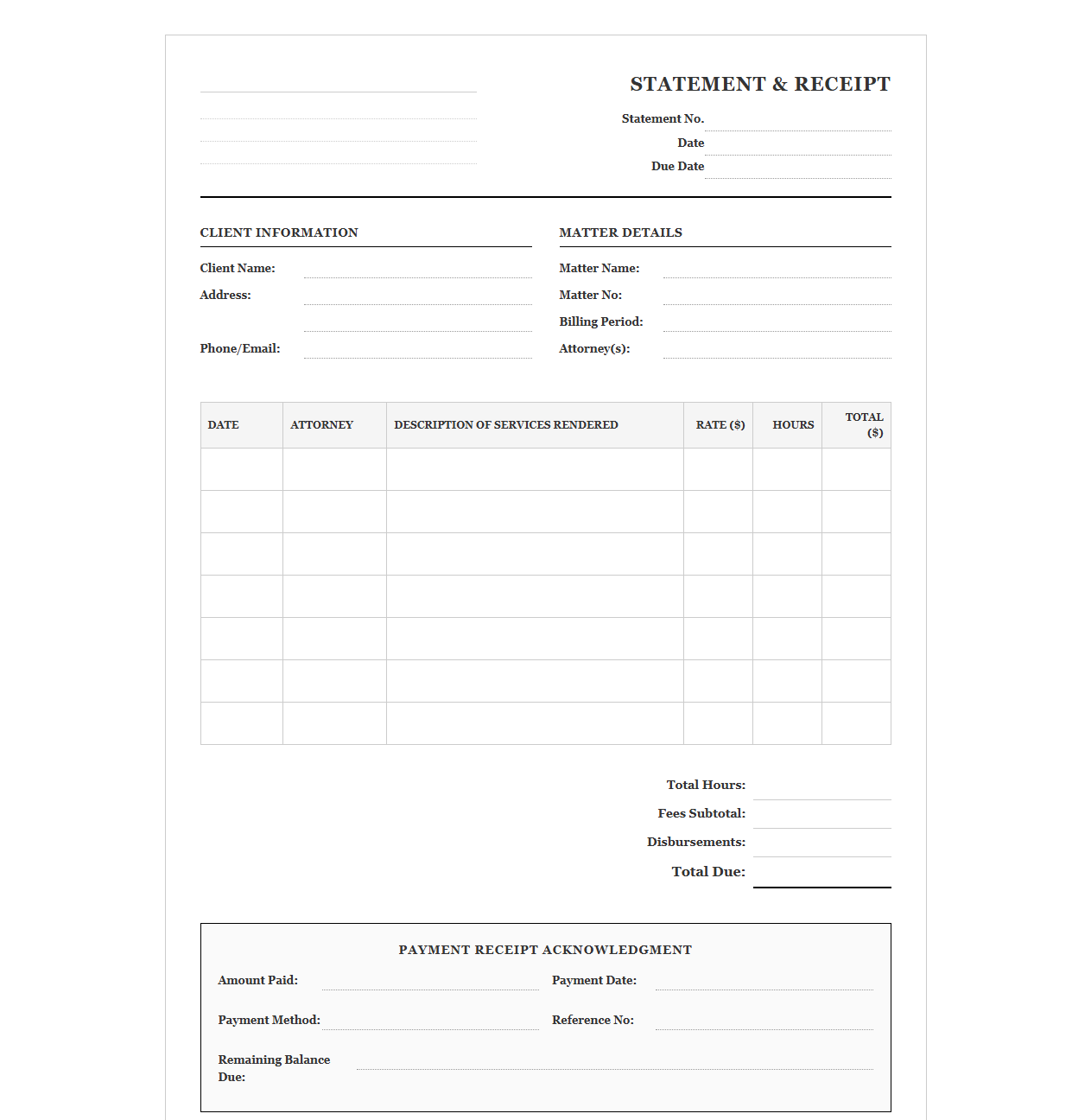 Download: .PDF
Court Filing Fees Reimbursement Legal Receipt
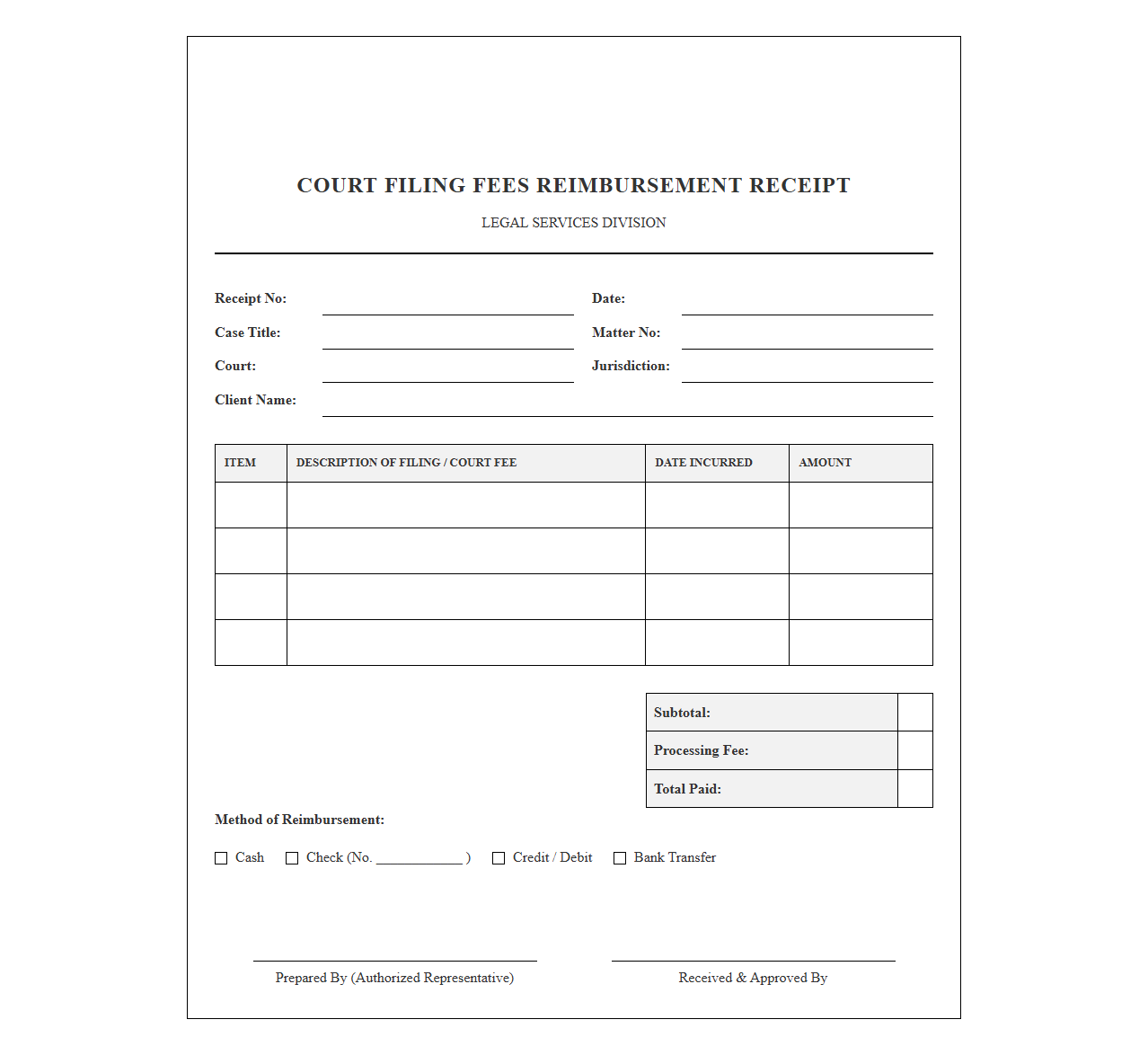 Download: .PDF
Introduction to Legal Payment Security and Documented Proof
In modern legal practices, the intersection of financial transactions and professional ethics demands an ironclad approach to billing. Securing client payments is not merely an administrative chore; it is a foundational pillar of client trust and professional integrity. When a law firm handles money, especially before services are fully rendered, the margin for error is zero.
Providing formal, well-documented proof of payment protects both the attorney and the client. Accurate legal receipts mitigate the risk of fee disputes, clarify the scope of representation, and ensure rigorous adherence to trust accounting regulations. By prioritizing payment security and transparent documentation, law firms can safeguard their reputation, maintain compliance with state bar rules, and foster long-term professional relationships.
Essential Information Every Legal Receipt Must Contain
A legally compliant billing receipt requires much more detail than a standard retail transaction slip. To satisfy auditing standards and maintain ethical transparency, specific details must be explicitly documented on every receipt generated by your firm.
Every legal payment receipt must include the following essential data points:
- Attorney and Firm Credentials: Complete law firm name, physical address, contact information, and the primary attorney's state bar identification number.
- Client Identification: The full legal name of the client, along with their unique client ID or case/matter number to prevent billing cross-contamination.
- Account Destination Details: Explicit labeling of whether funds are deposited into an IOLTA/Trust Account (for unearned retainers) or an Operating Account (for earned flat fees or hourly services).
- Itemized Financial Breakdown: The total amount paid, payment method, transaction date, and any applicable state-specific tax details or merchant processing parameters.
Template 1: The Standard Retainer Agreement Receipt
Retainer Trust Account Deposit Receipt
Below is a standardized template for confirming the receipt of upfront retainer fees. This document ensures clear communication that the funds are held in trust until earned.
============================================================
           RETAINER PAYMENT CONFIRMATION RECEIPT
============================================================
Date: [Date of Transaction]
Receipt Number: RET-[YYYY]-[Sequential Number]
Firm: [Law Firm Name] (Bar License #: [State Bar Number])
Address: [Firm Street Address, Suite, City, State, ZIP]
Client Name: [Client Full Name]
Matter/Case ID: [Matter Number]
The following funds have been received and deposited directly
into the firm's client trust account (IOLTA):
Transaction Details:
------------------------------------------------------------
Method of Payment: [e.g., Credit Card / Wire Transfer / Check]
Transaction Authorization Code: [Transaction ID]
Deposit Destination: Client Trust Account (IOLTA)
Initial Trust Deposit Amount: $ [Amount, e.g., 5,000.00]
Current Trust Account Balance for This Matter: $ [Amount]
Please Note: These funds will remain in the client trust account
until earned by the firm through documented hourly billings
or upon the completion of specified milestones, in accordance
with the executed Retainer Agreement.
============================================================
Template 2: Hourly Billing and Consultation Receipt
Hourly Consultation Ledger
The following itemized receipt details hours billed, the attorney's hourly rate, and the final processed payment for consultation services.
| Service Date | Description of Legal Services Rendered | Hours Billed | Hourly Rate | Line Total |
|---|---|---|---|---|
| [Date] | Initial case evaluation and document review | 2.0 hours | $350.00 | $700.00 |
| [Date] | Legal research regarding local municipal zoning codes | 1.5 hours | $350.00 | $525.00 |
| Total Paid | Payment Processed via [Payment Method] | 3.5 hours | - | $1,225.00 |
Template 3: Flat-Fee and Fixed-Rate Legal Services Receipt
Flat-Fee Transaction Receipt
Use this clean, streamlined template for transactional services where fees are fixed at the onset of representation.
============================================================
              FLAT-FEE LEGAL SERVICES RECEIPT
============================================================
Receipt Date: [Date of Transaction]
Invoice Number: FF-[Sequential Number]
Firm: [Law Firm Name] (Bar ID: [Bar Number])
Client: [Client Full Name]
Matter: [e.g., LLC Entity Formation / Simple Will Draft]
Payment Status: PAID IN FULL
Services Rendered:
- *Scope of Work:* Drafting and filing of Articles of Organization.
- *Filing Fees:* Covered under designated flat-rate agreement.
Total Payment Received: $ [Flat-Fee Amount, e.g., 1,500.00]
Payment Method: [e.g., ACH / Credit Card]
Operating Account Deposit Confirmation: [Operating Transaction ID]
Thank you for choosing [Law Firm Name]. Your transaction has been
successfully processed.
============================================================
Note: This receipt confirms that the specified flat fee has been earned upon receipt or deposited in accordance with the jurisdiction's rules regarding advance flat-fee agreements.
Best Practices for Storing and Dispatching Legal Receipts
Electronic receipts carry sensitive personally identifiable information (PII) and financial data. Handling these documents requires strict adherence to security and compliance protocols.
Ensure your firm implements these essential security and transmission safeguards:
- Enforce PCI-DSS Compliance: Never store full credit card numbers or sensitive CVV codes on local firm servers; utilize secure, tokenized payment gateways that conform to Payment Card Industry Data Security Standards.
- Secure Communication Channels: Use encrypted email services or secure client portals to send receipts, reducing the risk of interception and safeguarding attorney-client confidentiality.
- Ensure HIPAA and ALTA Alignment: When managing medical-legal cases or real estate closings, ensure that billing descriptions on public receipts do not compromise protected health information or private transaction data.
- Establish Immutable Archival Systems: Store financial records and receipts in secure, read-only cloud backups for the duration required by your state bar's record retention guidelines, typically between five and seven years.
Automating Your Legal Billing and Documentation Workflow
Standardizing your receipt generation processes eliminates manual data-entry errors and drastically cuts down on administrative overhead. By integrating secure payment templates directly into your firm's technical infrastructure, you ensure that every transaction triggers an automated, compliant, and professional confirmation for the client.
Adopting automated legal billing systems transforms financial administration from a vulnerable bottleneck into a seamless, secure system that enhances client confidence and guarantees compliance.

Leave a comment