

Managing appreciated stock contributions often introduces significant administrative bottlenecks for nonprofit development teams, who frequently struggle with the manual, error-prone process of tracking and acknowledging non-cash assets. As stock philanthropy grows to represent a larger share of major giving portfolios, organizations must establish structured, scalable workflows rather than relying on ad-hoc communication.
Utilizing standardized donation receipt templates grants your organization a repeatable, IRS-compliant framework that accelerates donor acknowledgment and reduces audit risks. However, while standardized tools drastically simplify operations, nonprofits must still ensure their final documents are reviewed by legal counsel to align with specific state regulations.
For example, a robust template ensures the seamless capture of critical data points, including the custodian broker's DTC number, the security's ticker symbol, and the average of the high and low trading prices on the date of transfer. In this article, we will examine the essential components of a compliant stock receipt, provide downloadable templates, and outline best practices for streamlining your donor stewardship pipeline.
Stock Gift Receipt Template
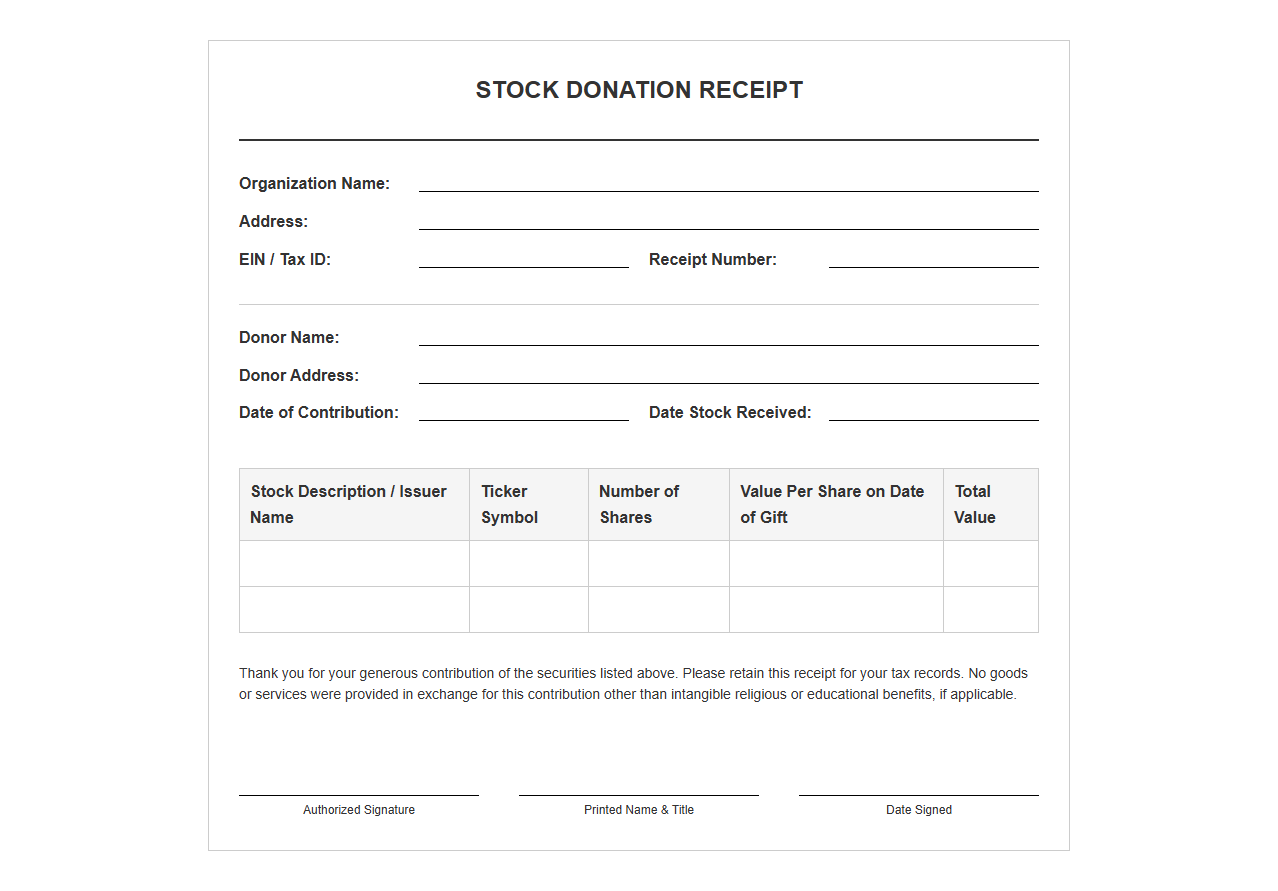 Download: .PDF
Securities Donation Acknowledgment Letter
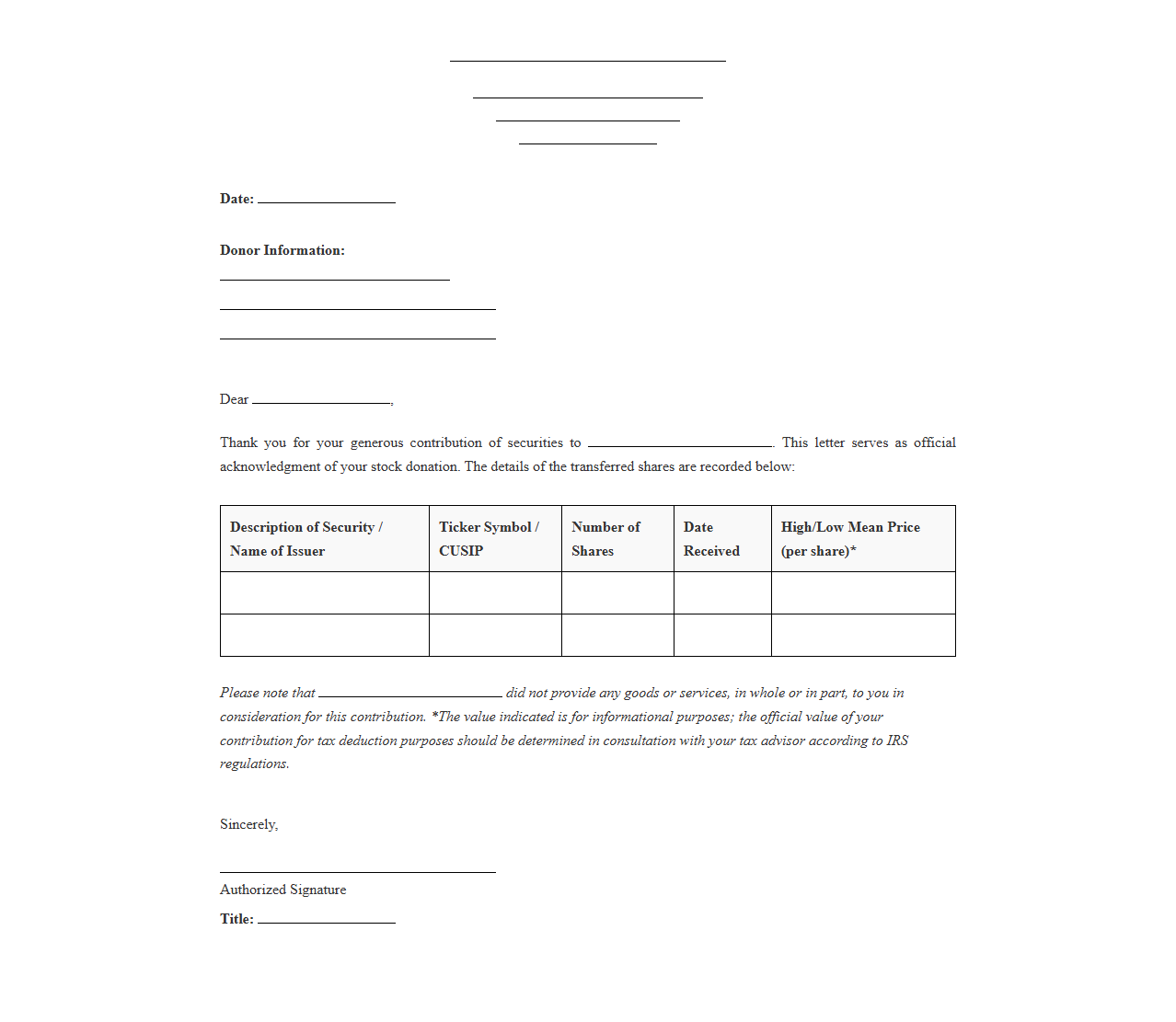 Download: .PDF
Charitable Stock Transfer Receipt
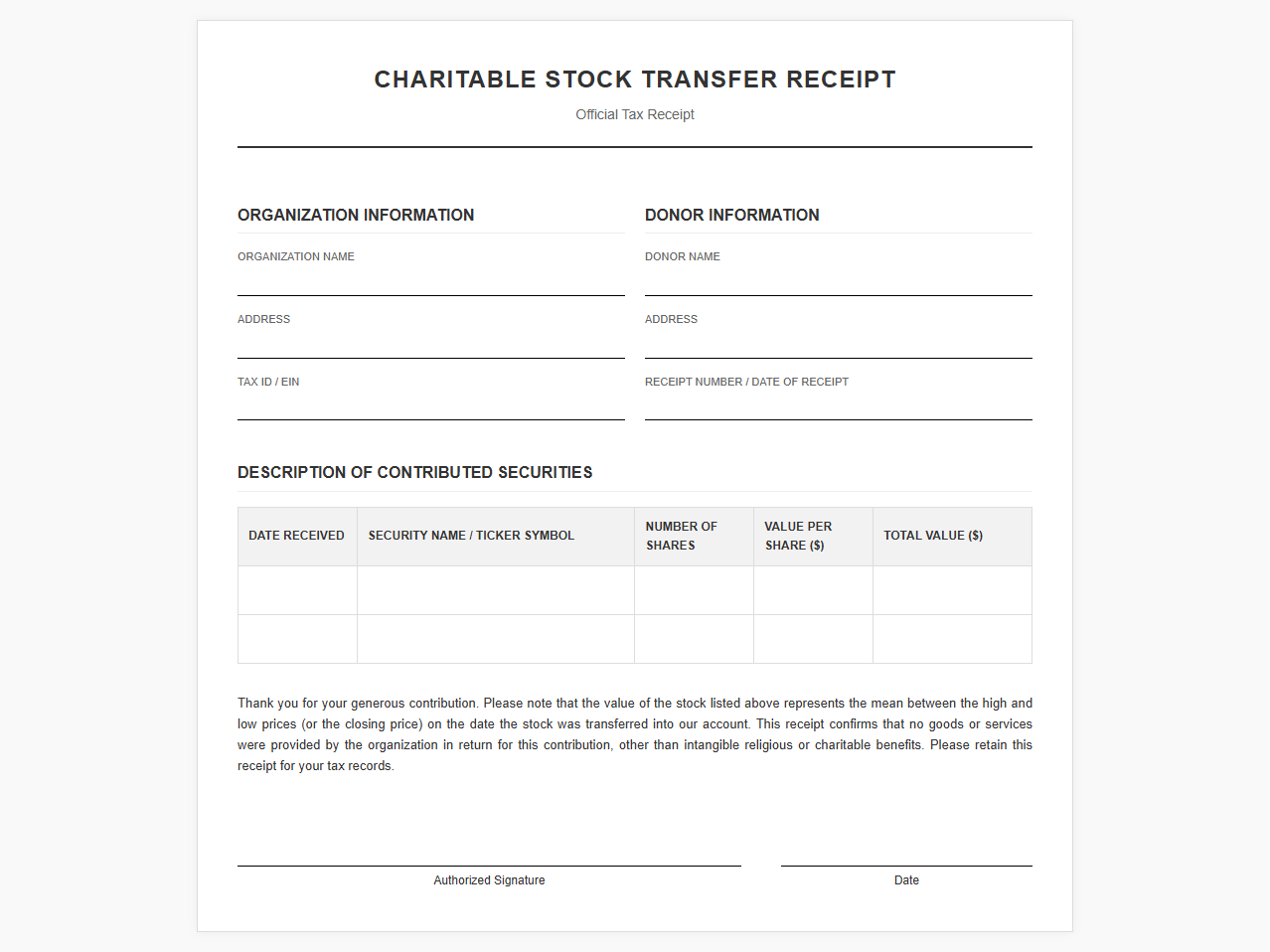 Download: .PDF
Equity Donation Tax Receipt
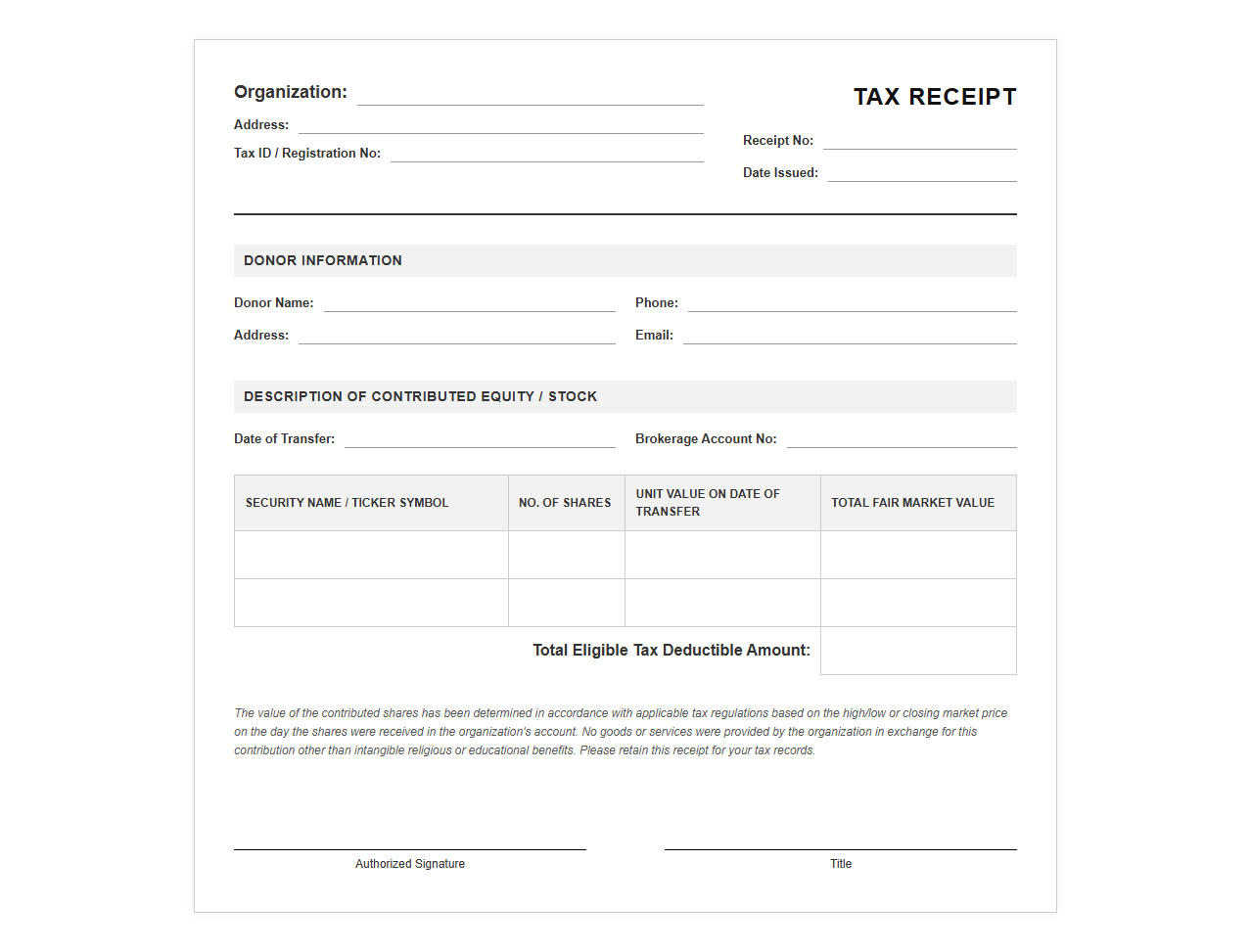 Download: .PDF
Mutual Fund Gift Receipt Template
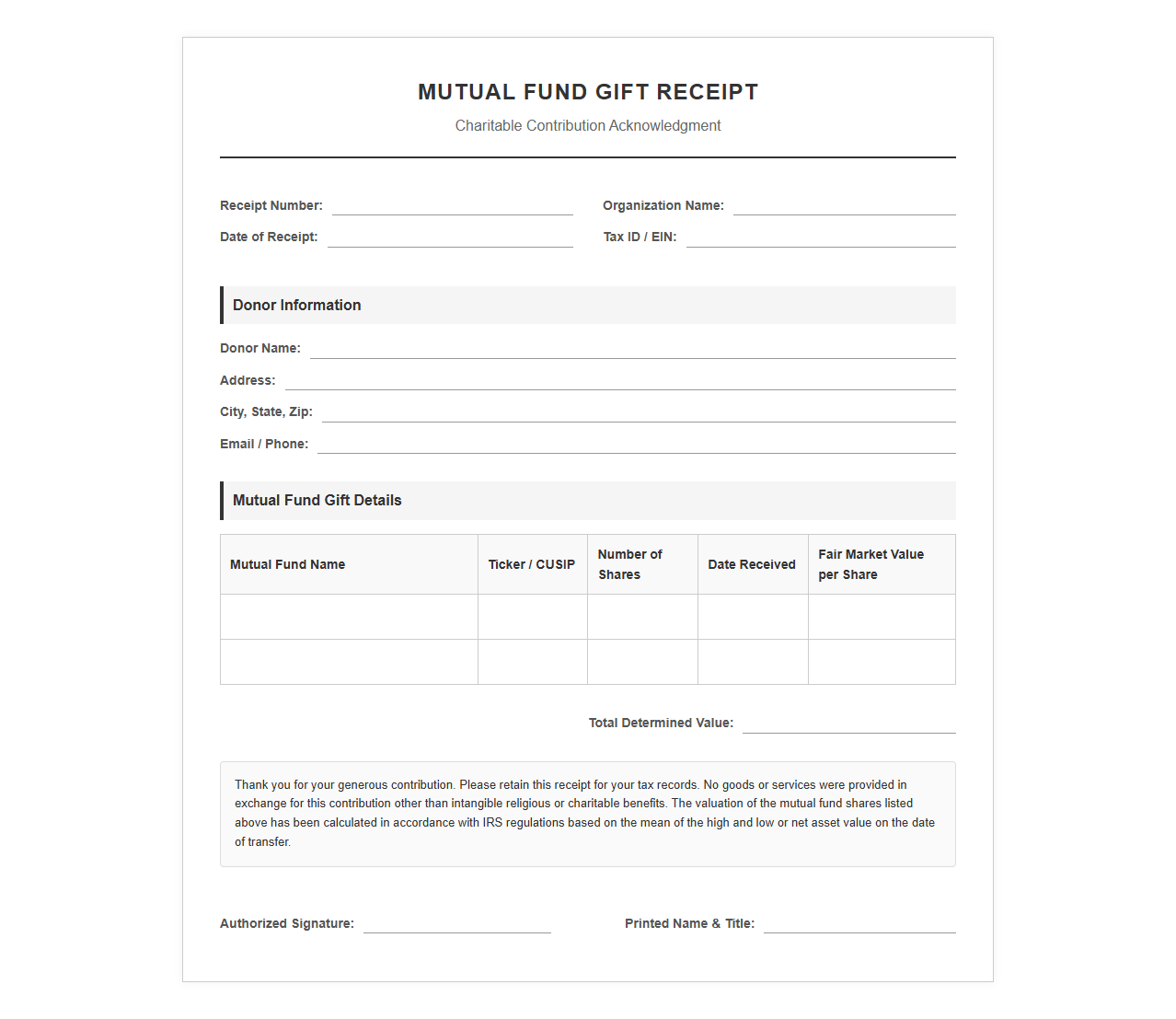 Download: .PDF
Non-Profit Stock Contribution Receipt
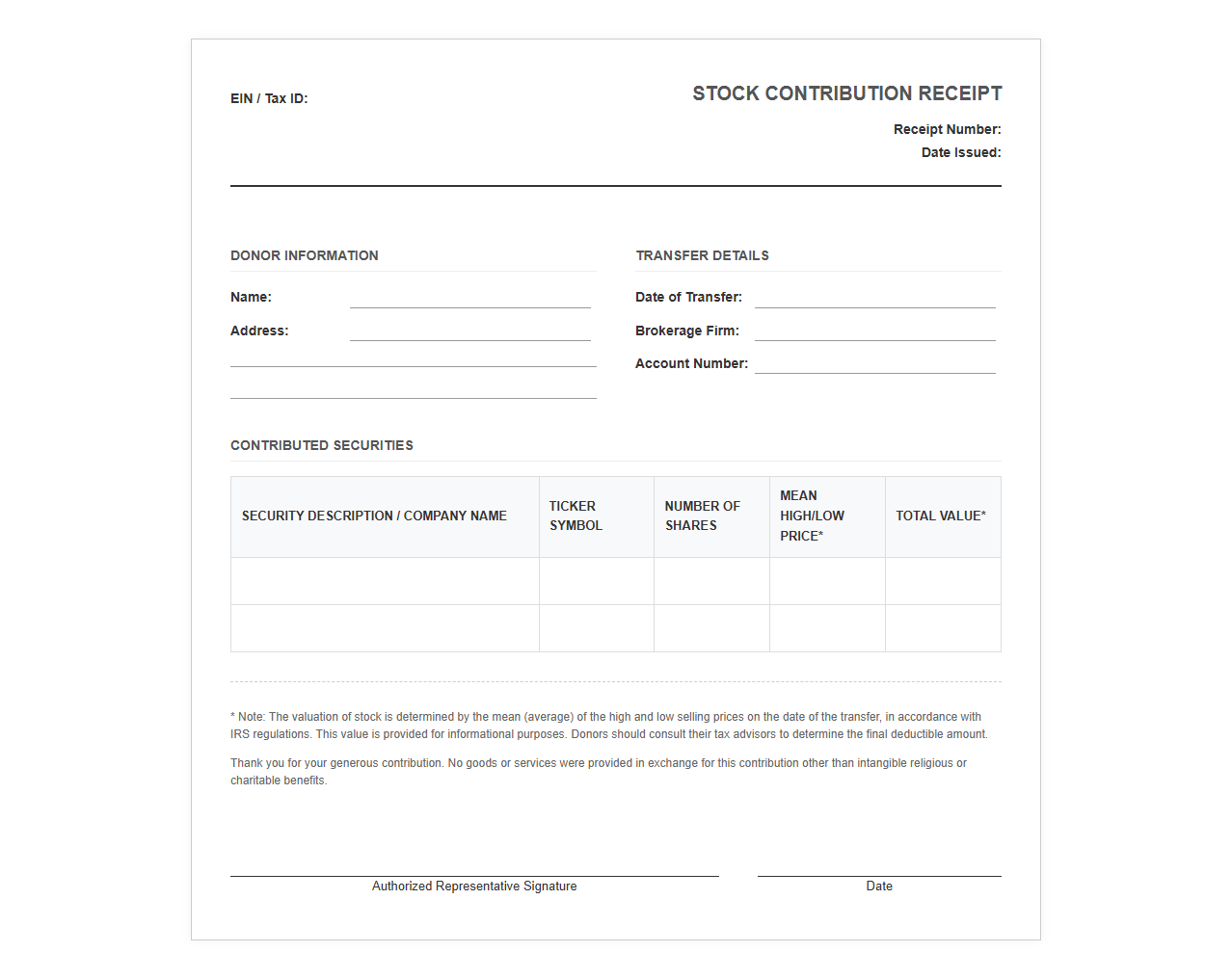 Download: .PDF
Share Donation Acknowledgment Form
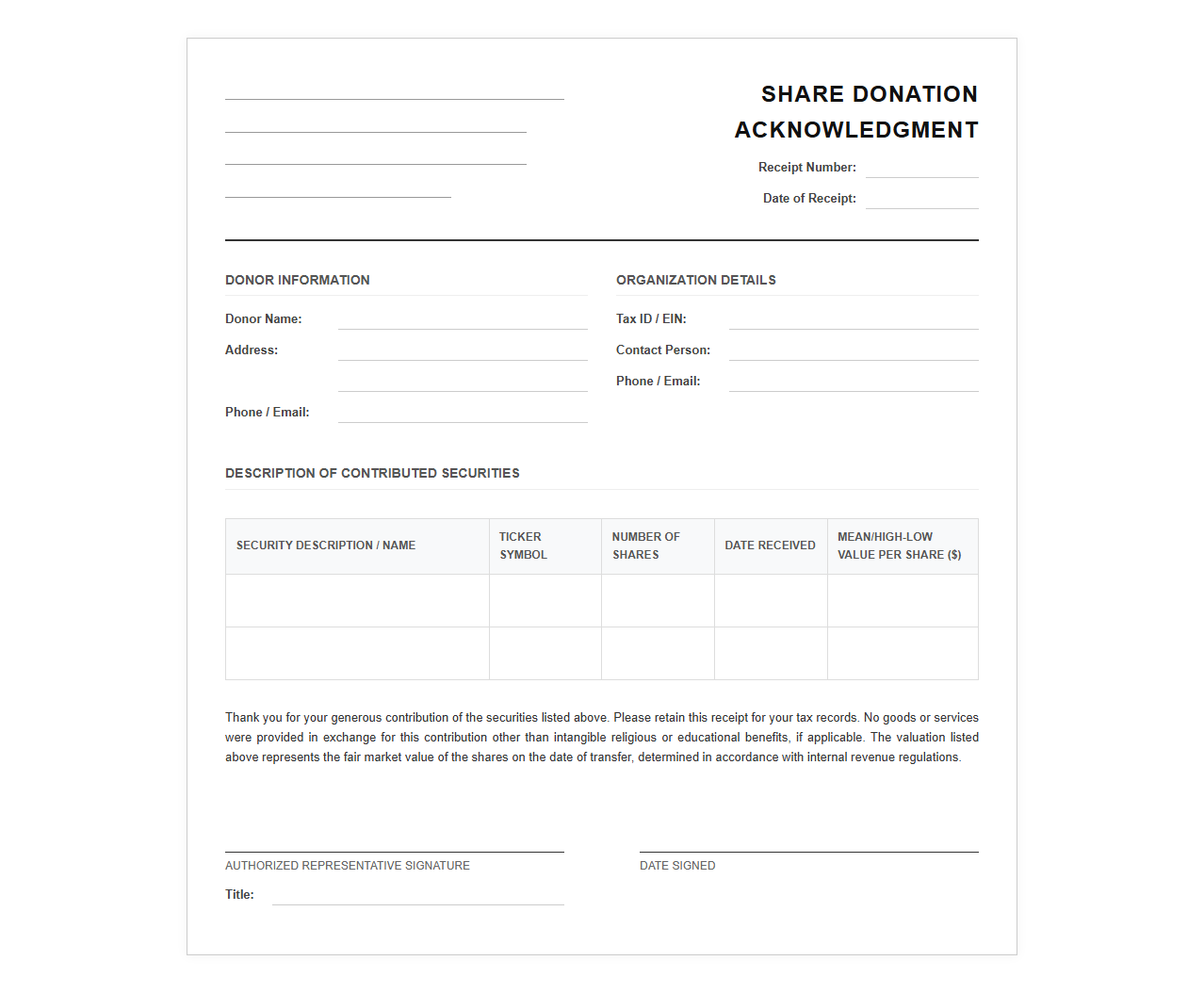 Download: .PDF
Stock Transfer Tax Confirmation Letter
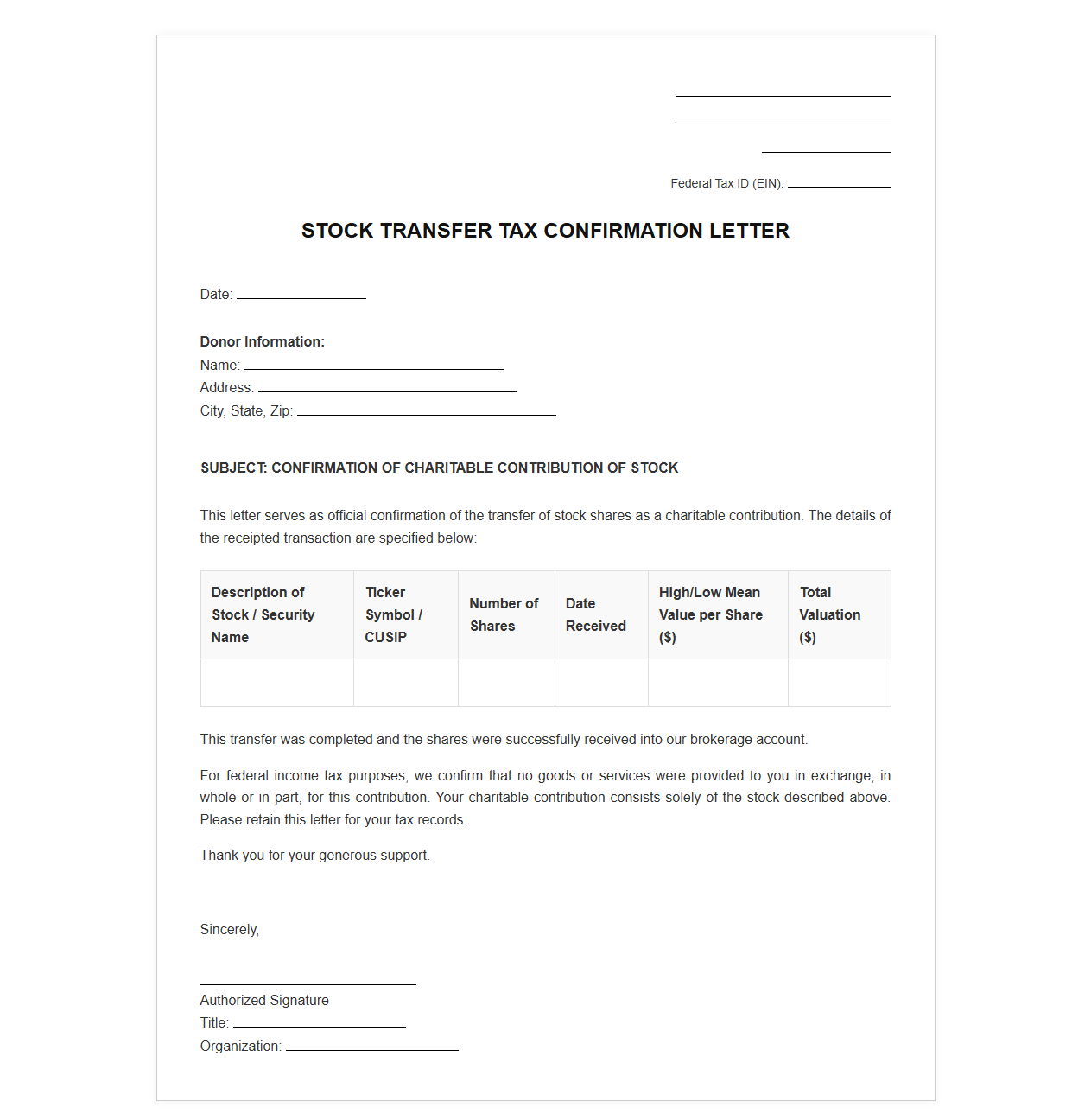 Download: .PDF
The Growing Trend of Charitable Stock Donations
In recent years, donating appreciated securities has emerged as one of the most tax-efficient strategies for philanthropic individuals. By transferring ownership of stocks, bonds, or mutual funds directly to a nonprofit, donors can avoid capital gains taxes while claiming a charitable deduction for the full fair market value of the asset. This win-win scenario has led to a significant surge in stock contributions across the nonprofit sector. However, this influx of non-cash gifts introduces severe administrative bottlenecks for organization staff, who must navigate complex transfer processes and meticulous recording requirements for every transaction.
The Challenge of Manual Receipting for Securities
Unlike simple cash or credit card transactions, processing stock donations manually introduces significant friction. Nonprofits must carefully track the exact date the transfer was completed, as this date determines the official gift date for tax purposes. Furthermore, valuation rules require calculation based on the average of the high and low trading prices on the day of transfer, rather than a simple end-of-day closing price. Without a streamlined process, these complexities lead to prolonged delays in donor communication, increasing the risk of clerical errors and administrative strain.
The Power of Standardized Templates
To overcome these challenges, forward-thinking organizations are turning to standardized donation receipt templates as a systematic solution. By establishing a uniform format, nonprofits can drastically reduce manual data entry and minimize the margin for error. These templates act as a reliable framework, ensuring that every issued receipt complies with strict legal standards while speeding up the administrative pipeline. Transitioning to a standardized model allows development departments to shift their focus from repetitive paperwork to building stronger donor relationships.
Essential Elements of a Compliant Stock Receipt
To meet IRS guidelines and provide donors with the necessary documentation for their tax returns, a stock donation receipt must contain specific, detailed information. A legally compliant receipt should include the following components:
- The legal name and EIN (Employer Identification Number) of the receiving nonprofit organization.
- The name of the delivering brokerage firm and the specific date the transfer was finalized.
- The exact number of shares transferred and the official stock ticker symbol.
- The standard IRS statement confirming that no goods or services were provided in exchange for the contribution.
Operational Benefits for Nonprofit Teams
Implementing standardized templates delivers immediate relief to both finance and development departments. By removing the guesswork from asset valuation and data recording, staff can process gifts in a fraction of the time.
A structured receipting system significantly lowers audit risks, ensures consistent record-keeping, and eliminates the chaotic backlog traditionally associated with the year-end tax season.
With an organized archive of standardized receipts, preparing annual financial statements becomes a seamless, stress-free endeavor.
Elevating the Donor Experience
High-net-worth individuals who contribute appreciated securities expect a level of professionalism that matches their sophisticated financial planning. Providing a prompt, clear, and highly detailed receipt reinforces the donor's confidence in the nonprofit's financial stewardship. When an organization acknowledges a complex transaction quickly and accurately, it builds deep-seated trust, laying the foundation for long-term loyalty and repeat major contributions.
Implementing Stock Templates in Your Workflow
Transitioning to an automated receipting pipeline requires a deliberate integration strategy. Nonprofits can achieve full optimization by following these practical steps:
- Design a comprehensive template that meets all legal compliance requirements and aligns with your organizational branding.
- Upload the standardized layout into your donor management software or customer relationship management (CRM) platform.
- Map the data fields within your CRM to automatically populate the stock details, transfer dates, and donor information directly into the template.
- Train your development and finance staff on the automated workflow to ensure seamless execution and tracking of every incoming stock gift.

Leave a comment