

Inheriting an estate is meant to bring closure, yet many beneficiaries find themselves facing the stressful reality of distribution discrepancies and accounting errors. Before attempting to resolve these financial imbalances, it is crucial to recognize that estate administration operates within a complex web of strict fiduciary duties and legal timelines.
Securing the correct documentation grants beneficiaries the legal leverage and clarity needed to formally dispute and rectify administrative mistakes. As a vital stipulation, however, please note that while standardized templates streamline this process, they serve as educational frameworks and are not a substitute for professional legal counsel.
Utilizing precise instruments, such as a formal Receipt, Release, and Refunding Agreement, ensures that corrected asset allocations are binding and secure. Below, we outline the essential return document templates designed to help you resolve distribution errors, protect your rightful inheritance, and facilitate a transparent estate closure.
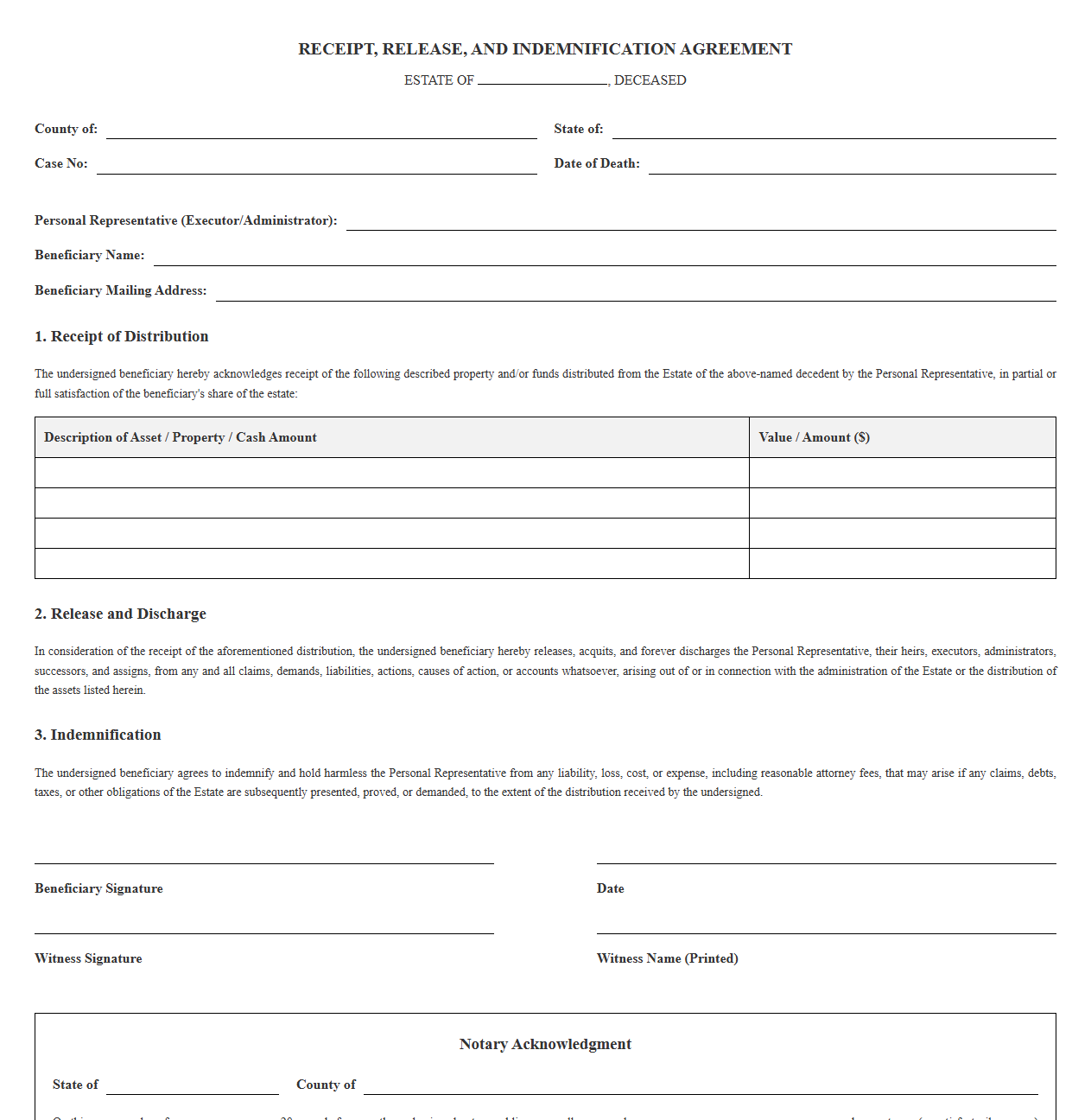
Estate Beneficiary Distribution Receipt and Release Form
 Download: .PDF
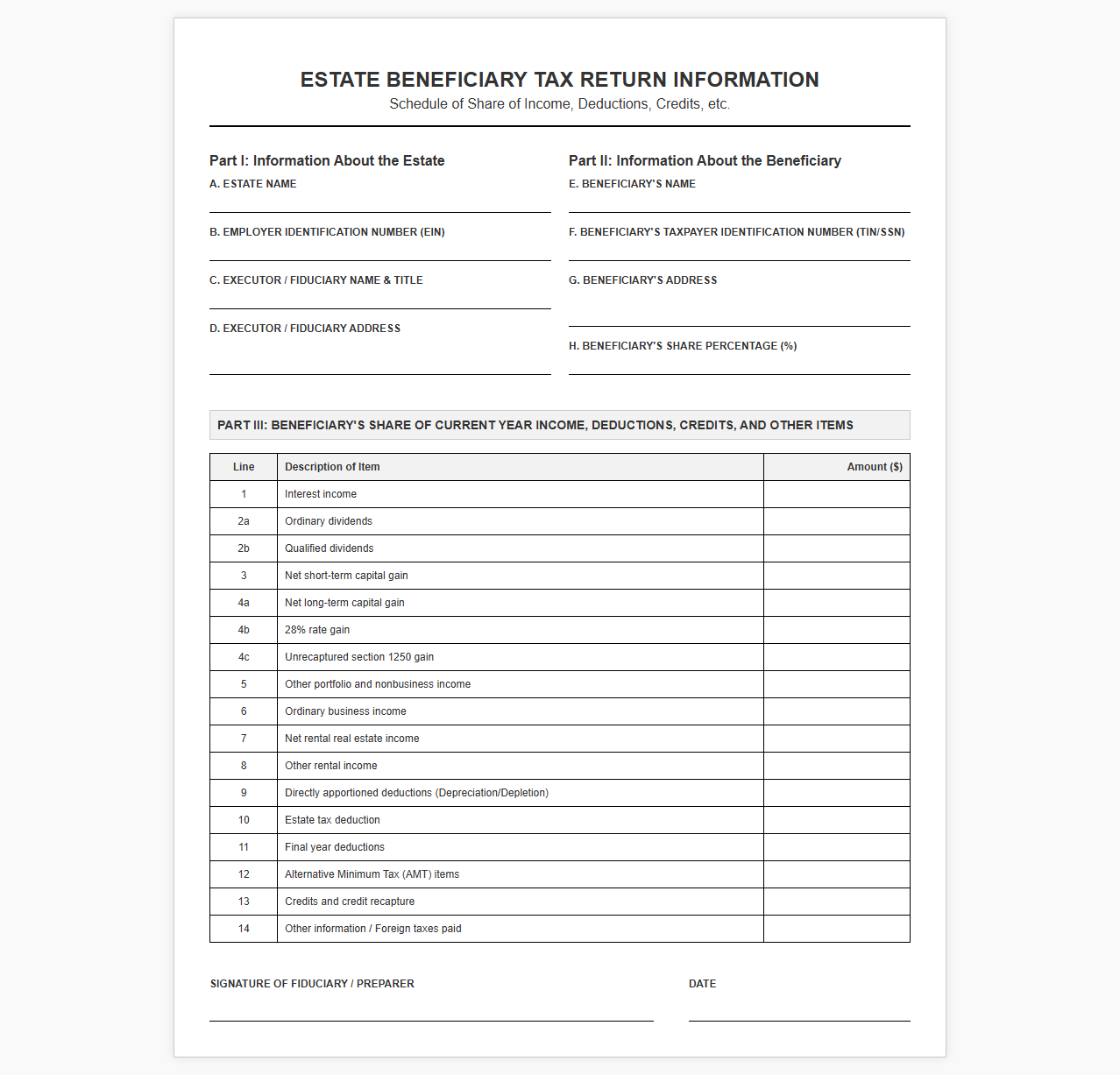
Estate Beneficiary Tax Return Information Template
 Download: .PDF
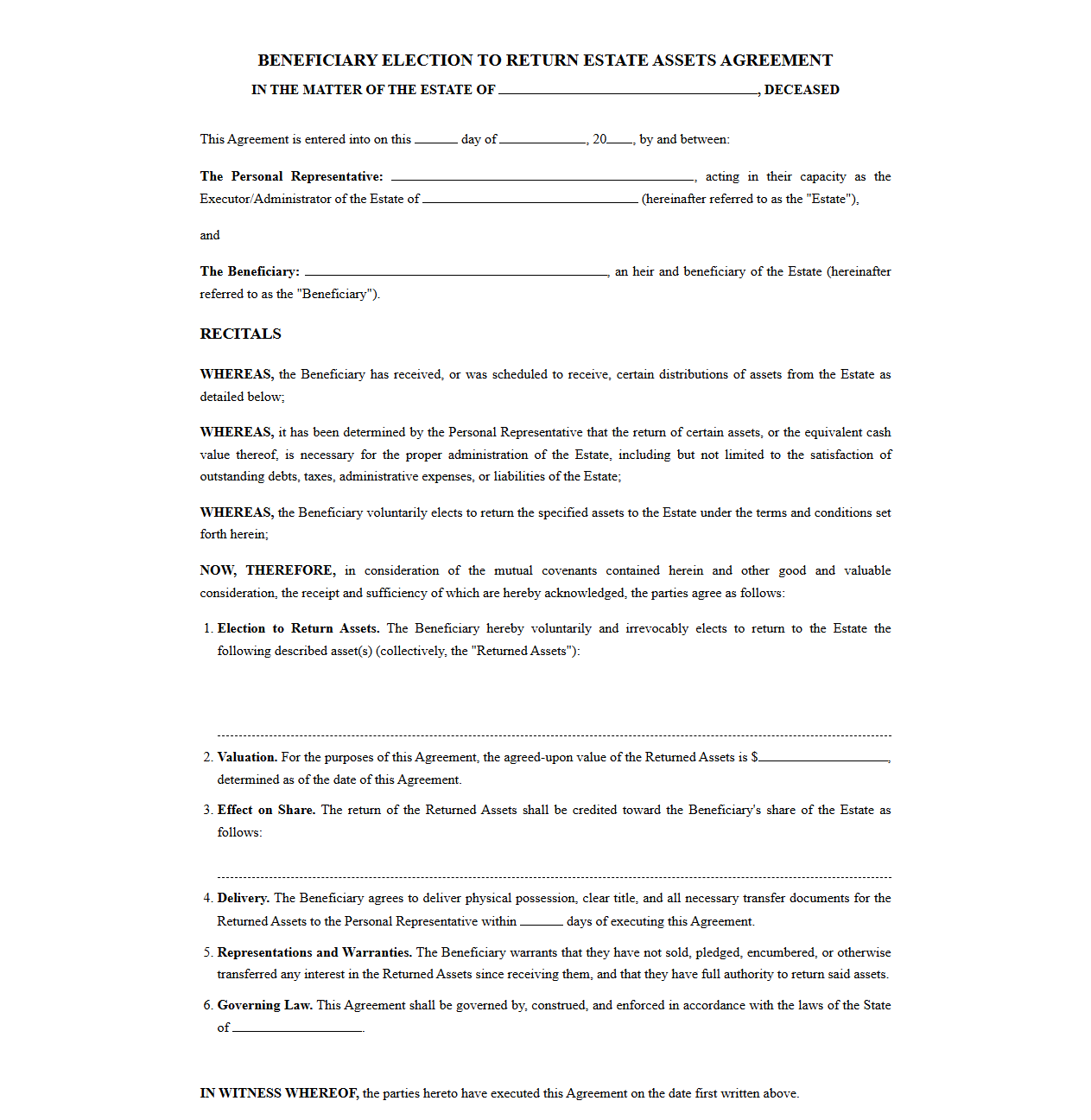
Beneficiary Election to Return Estate Assets Agreement
 Download: .PDF
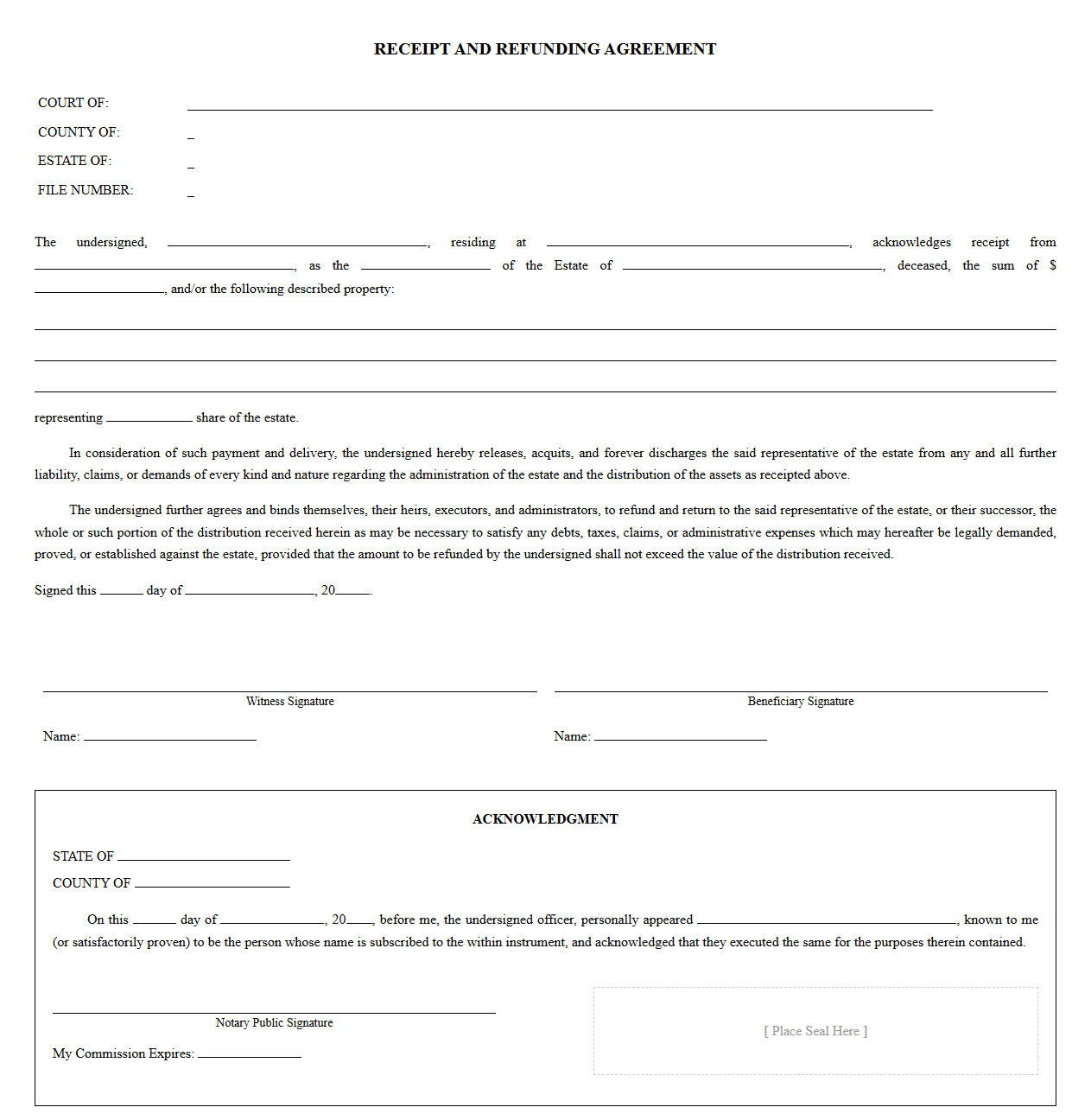
Estate Beneficiary Receipt and Refund Refunding Agreement
 Download: .PDF
Estate Distribution Return and Release Template
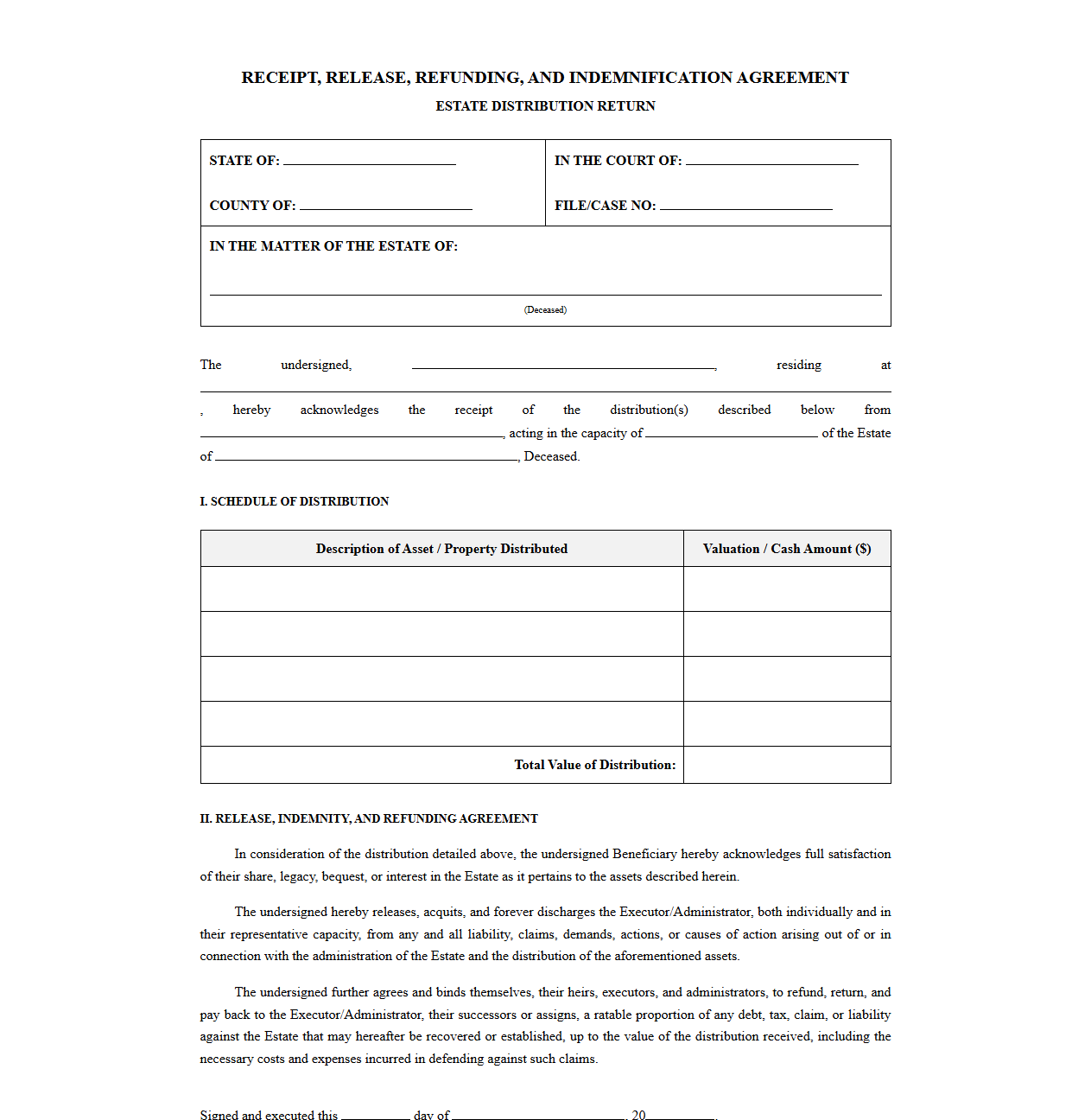 Download: .PDF
Beneficiary Acknowledgment and Return of Estate Property
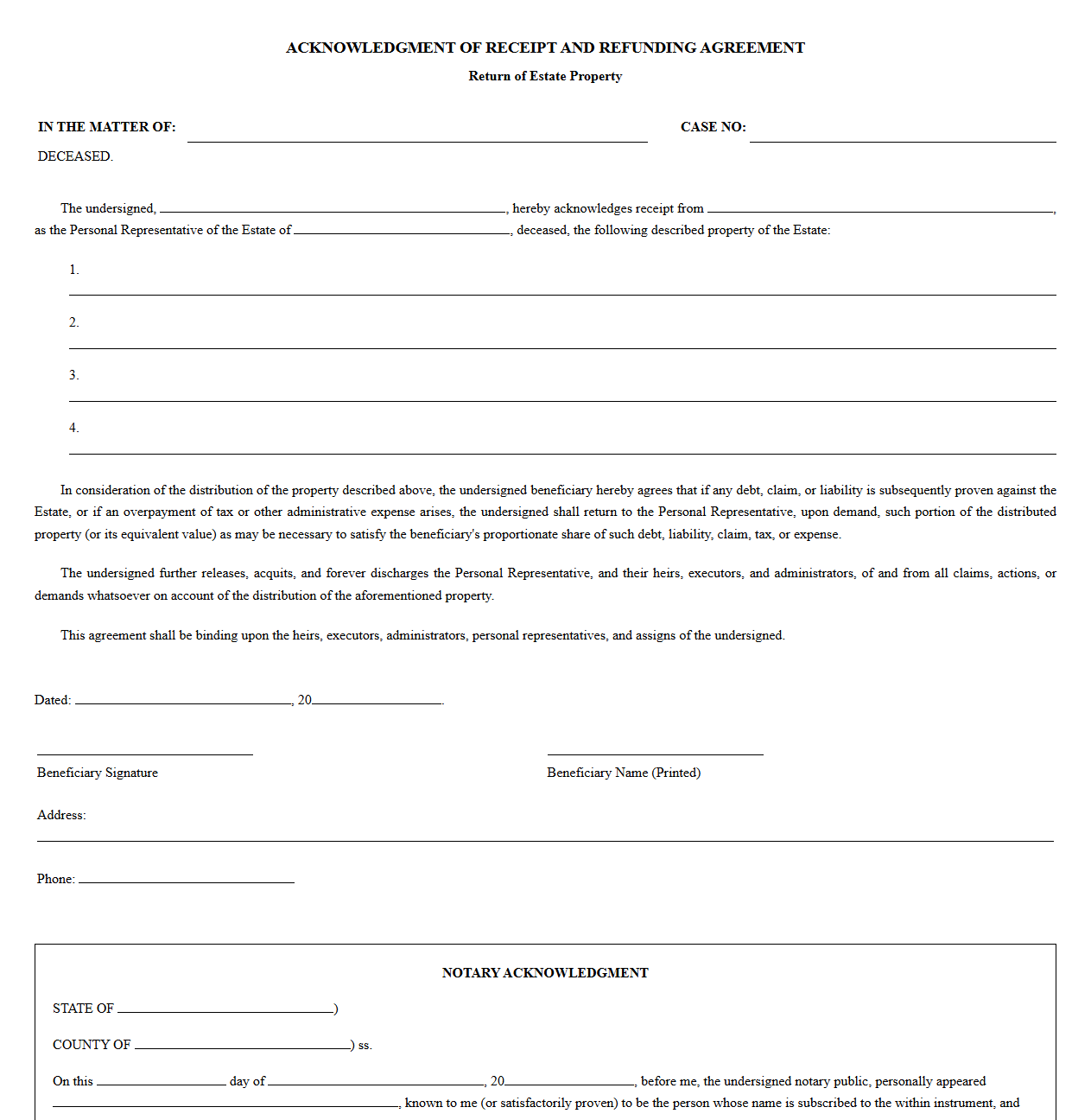 Download: .PDF
Estate Beneficiary Distribution Return Request Form
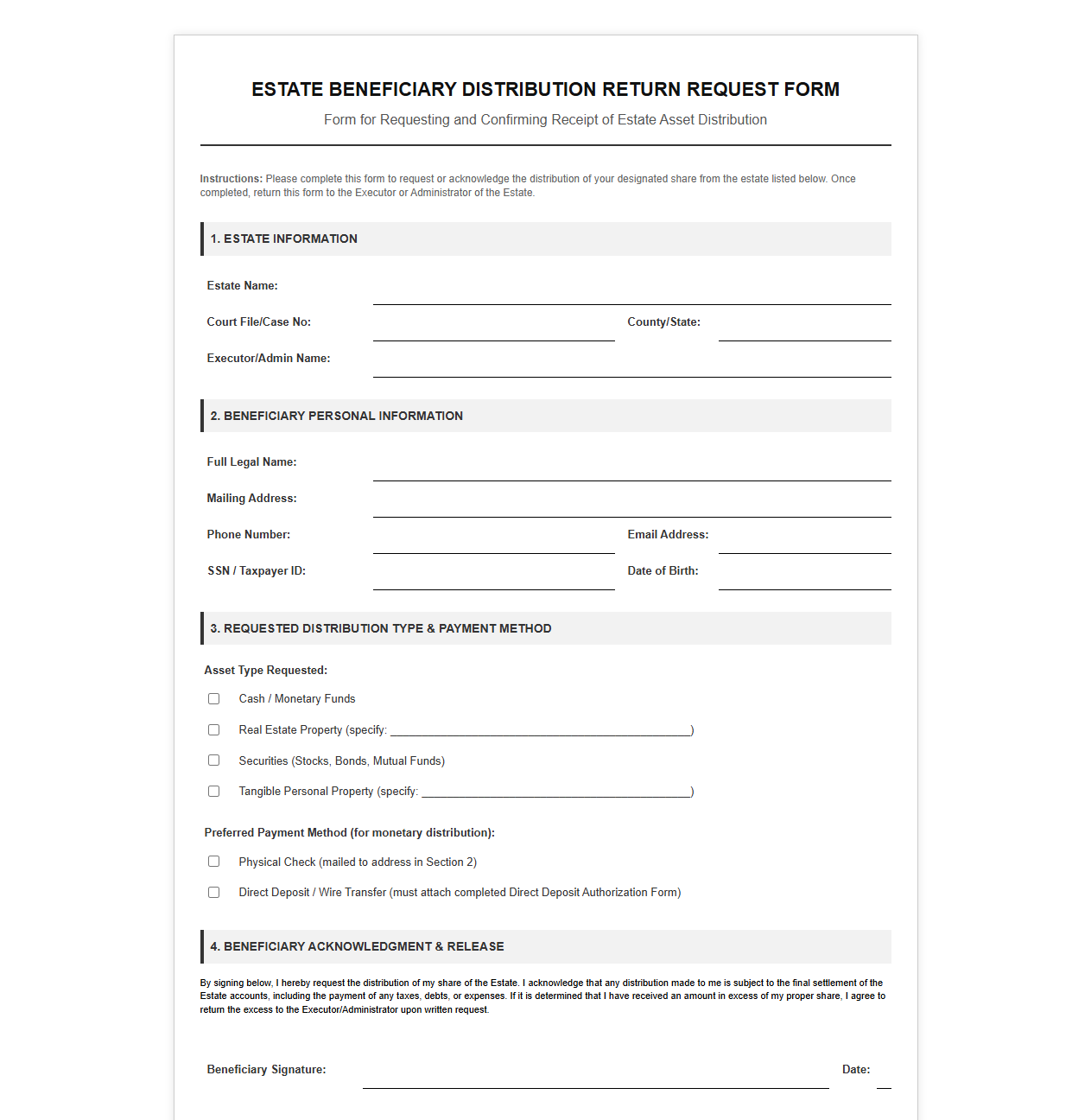 Download: .PDF
Inheritance Return Agreement Template for Estate Beneficiaries
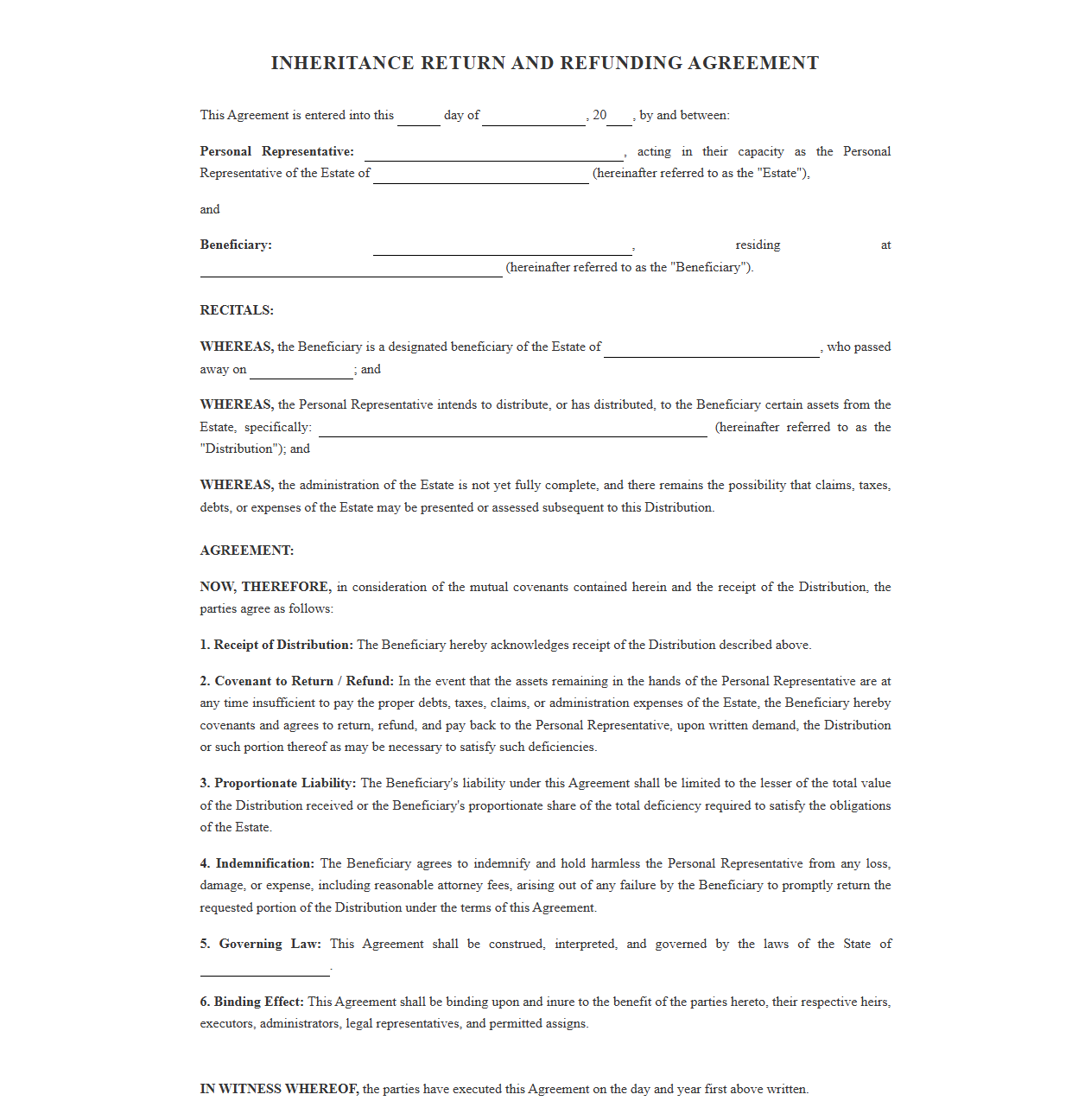 Download: .PDF
Estate Beneficiary Liability and Return Indemnity Agreement
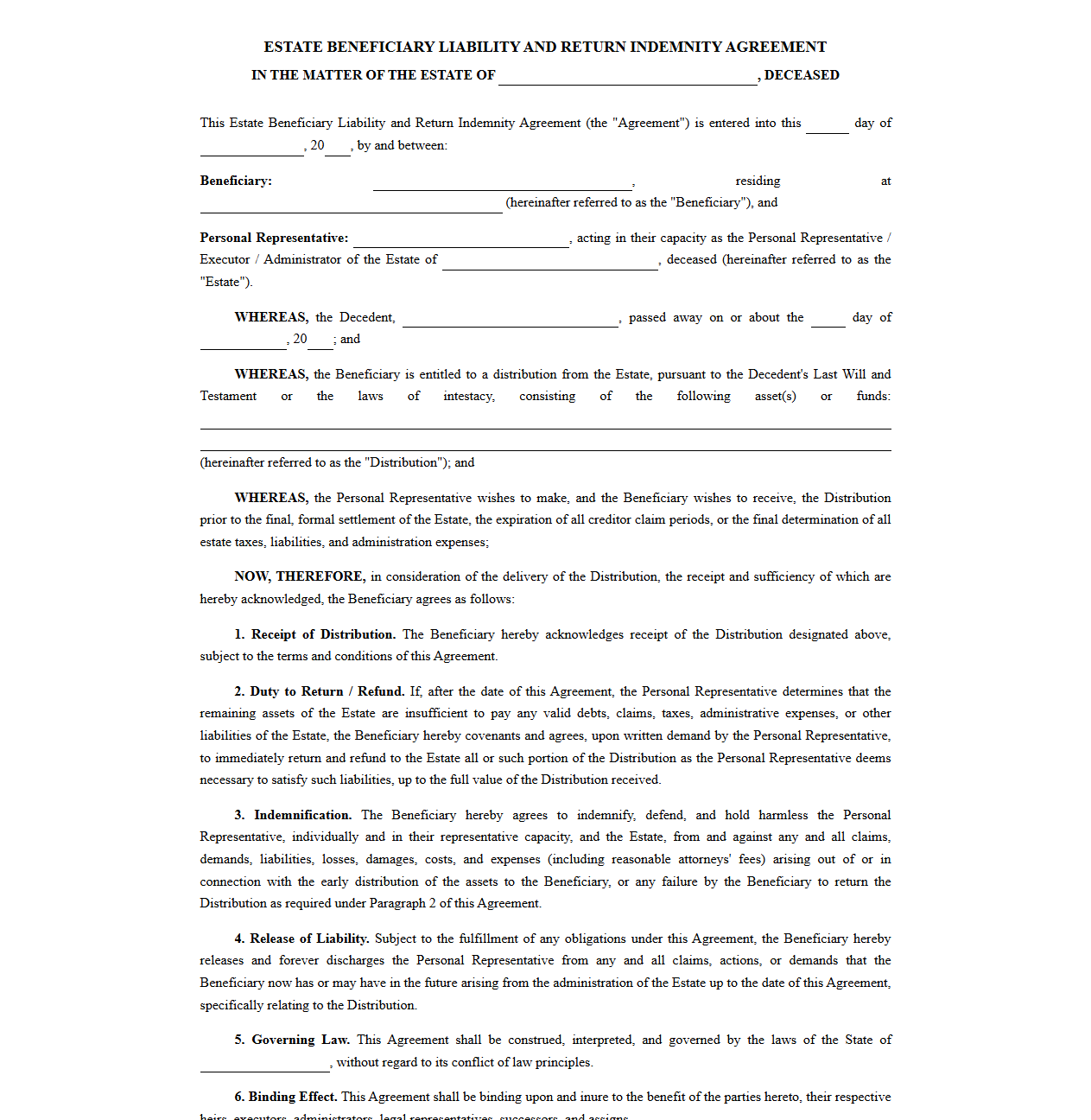 Download: .PDF
Understanding Estate Distribution Discrepancies
During the administration of an estate, distribution discrepancies can arise due to mathematical errors, overlooked creditor claims, or newly discovered tax obligations. When a beneficiary receives more than their designated share, resolving the issue legally is vital to protecting the estate's solvency. The executor or administrator has a strict fiduciary duty to ensure all assets are distributed in strict accordance with the will or state law. Utilizing standardized return templates ensures that these corrections are documented properly, legally binding, and fair to all parties involved.
What is an Estate Return Document?
An estate return document, commonly referred to as a refunding agreement or a restitution agreement, is a legal instrument used to correct overpayments. When an erroneous distribution occurs, this document legally obligates the beneficiary to return the excess assets to the estate pool. This ensures that the estate has sufficient funds to satisfy all legitimate debts, taxes, and equalizing distributions to other beneficiaries, shielding the executor from personal liability for the shortfall.
Template 1: The Partial Asset Return Agreement
This agreement is designed for situations where a beneficiary has received an overpayment and agrees to return the specific excess portion while retaining their legitimate share.
Agreement Structure and Clause Guide
Use the template below to draft a formal agreement outlining the terms of the partial return of estate assets.
PARTIAL ASSET RETURN AGREEMENT
This Agreement is entered into on [Date] by and between [Executor Name], as Executor of the Estate of [Decedent Name] (the "Estate"), and [Beneficiary Name] (the "Beneficiary").
1. RECITALS
Whereas, the Beneficiary received a distribution of [Description of Asset/Amount] on [Date of Distribution]; and
Whereas, it was subsequently determined that the distribution exceeded the Beneficiary's proper share by [Amount to be Returned];
2. AGREEMENT TO RETURN
The Beneficiary hereby agrees to return the sum of [Amount to be Returned] to the Estate within [Number] days of signing this Agreement.
3. NO WAIVER OF RIGHTS
Except as explicitly modified herein, all other rights of the Beneficiary regarding the remaining undistributed estate assets remain fully preserved.
Signature: ___________________________ (Executor)
Signature: ___________________________ (Beneficiary)
Template 2: Formal Demand for Return of Distributive Share
If a beneficiary is unresponsive or unwilling to return an overpayment voluntarily, the executor may need to issue a formal demand letter to initiate legal documentation of the recovery process.
[Date] To: [Beneficiary Name] [Beneficiary Address] RE: Formal Demand for Return of Excess Estate Distribution Dear [Beneficiary Name], This letter serves as formal notice and demand regarding the distribution of estate assets made to you on [Date]. Upon a reconciliation of the Estate of [Decendent Name], it has been determined that you received an overpayment of [Overpayment Amount] due to [briefly state reason, e.g., unpaid estate taxes discovered]. Pursuant to your statutory obligation and the terms of estate distribution, you are hereby requested to return the sum of [Overpayment Amount] to the estate account within fourteen (14) business days of the date of this letter. Failure to return these assets may require the Estate to pursue formal legal remedies. Sincerely, [Executor Signature] [Executor Name] Executor of the Estate of [Decendent Name]
Template 3: Mutual Release and Indemnity Agreement
A robust resolution involves securing a release to prevent future litigation. This agreement protects the executor from liability and indemnifies the beneficiary once the assets are successfully returned and verified.
The essential clauses that must be included in this document are:
- Recital of Correction: A clear statement identifying the original discrepancy and the exact corrective action taken.
- Mutual Release of Claims: Provisions where both the executor and the beneficiary agree to release each other from any further liability related to the specific discrepancy.
- Indemnification Clause: A clause protecting the executor against any future third-party claims arising from the initial overpayment.
- Governing Law: A provision specifying which state's laws will govern the validity and enforcement of the agreement.
How to Properly Execute Return Document Templates
Executing estate return documents requires meticulous adherence to legal formalities to ensure they hold up in a court of law should a dispute arise later.
- Review and Verify: Carefully review the financial calculations and ensure both parties agree on the precise amount to be returned before signing.
- Notarization: Sign the documents in the presence of a licensed Notary Public to verify the identity of the signees and prevent fraud claims.
- Secure Filing: File the executed agreement with the probate court handling the estate administration, if required by local state laws.
- Retain Copies: Distribute certified copies of the completed agreement to all signing parties and keep the original safe in the estate archives.
Safeguarding the Estate: Best Practices for Discrepancy Resolution
Preventing distribution errors is significantly less complex than recovering funds after they have been distributed. Adopting proactive measures protects both the executor and the beneficiaries.
- Conduct Professional Audits: Retain a certified public accountant (CPA) experienced in fiduciary accounting to review the estate books before making final distributions.
- Maintain Clear Communication: Keep beneficiaries informed about the estate's financial status, outstanding debts, and calculated shares to manage expectations early.
- Secure Experienced Legal Counsel: Consult with an estate planning or probate attorney to draft custom agreements and ensure compliance with state-specific probate codes.

Leave a comment